

Key Takeaways
- An AgriMove clone script helps startups build a smart agricultural logistics platform for farm-to-market transportation.
- Farmers, buyers, transporters, warehouses, fleet owners, wholesalers, and admins need connected supply-chain workflows.
- Shipment booking, transporter matching, route tracking, cold-chain visibility, payments, and analytics are core features.
- Pricing depends on logistics modules, mobile apps, fleet tools, warehouse workflows, integrations, and customization needs.
- A strong AgriMove-like platform can improve agricultural shipment visibility, reduce delays, and support better supply-chain control.
Feature Signals
- Farmers need shipment creation, pickup scheduling, price estimates, transporter access, tracking, and payment updates.
- Transporters need load availability, route details, vehicle management, delivery proof, wallet status, and trip history.
- Buyers and warehouses need inventory visibility, delivery timelines, quality checks, cold-chain updates, and receipt confirmation.
- Admins need control over users, shipments, vehicles, routes, warehouses, payments, disputes, reports, and platform settings.
- Notifications keep farmers, buyers, transporters, and admins updated on bookings, delays, delivery status, and payment activity.
Real Insights
- Agricultural logistics needs more than delivery tracking because produce quality, timing, storage, and handover accuracy matter.
- Weak route planning or missing shipment updates can create spoilage risk, payment disputes, and supply-chain delays.
- Cold-chain monitoring, warehouse coordination, verified transporters, and proof-of-delivery tools improve operational trust.
- Founders should focus on reliable farm-to-market workflows before adding advanced AI, automation, or large-scale analytics.
- Miracuves builds AgriMove Clone apps with shipment booking, fleet tracking, cold-chain workflows, warehouse tools, payments, and admin control.
Agricultural logistics is not the same as normal parcel delivery. A shipment may contain fresh produce, dairy, seafood, grains, seeds, fertilizers, equipment, or temperature-sensitive goods. A delay, wrong route, poor handover, missing tracking update, or payment dispute can directly affect quality, margin, and trust across the supply chain.
That is why founders are searching for an AgriMove clone script. They are not only looking for a delivery app. They want a smart agricultural logistics platform that connects farmers, buyers, transporters, warehouses, wholesalers, and platform operators inside one controlled digital ecosystem.
An AgriMove-style platform usually focuses on farm-to-market movement, real-time shipment tracking, transporter matching, cold-chain visibility, analytics, payment workflows, and supply-chain optimization. AgriMove’s own public positioning includes shipment registration, real-time tracking, analytics, route optimization, fleet management, cold-chain workflows, warehouse AI, and secure wallet-based payment release.
For founders, the real question is not simply, “Can I build an app like AgriMove?” The better question is, “What product foundation do I need to run agricultural logistics with enough visibility, control, and monetization flexibility?”
Miracuves helps founders build white-label, source-code-owned logistics and marketplace platforms that can be customized around agricultural workflows, delivery operations, transporter coordination, admin control, and business model clarity.
What Is an AgriMove Clone Script?
An AgriMove clone script is a ready-made or customizable software foundation that recreates the core business logic of an agricultural logistics platform. It does not mean copying AgriMove’s private code, brand identity, database, or proprietary assets. Instead, it means building a similar product model with your own branding, workflows, features, and monetization strategy.
The platform can be designed to support:
- Farmers listing produce or creating shipment requests
- Buyers placing orders or requesting transport
- Transporters accepting trips and updating delivery status
- Warehouses managing storage, quality checks, and dispatch
- Admins controlling users, shipments, payments, commissions, disputes, and analytics
For a founder, this type of clone script works best when the business model is already clear. If you know the region, commodity type, logistics problem, transporter supply, and buyer segment, a ready-made foundation can help you validate faster than starting from a blank technical scope.
Why Agricultural Logistics Needs More Than a Normal Delivery App
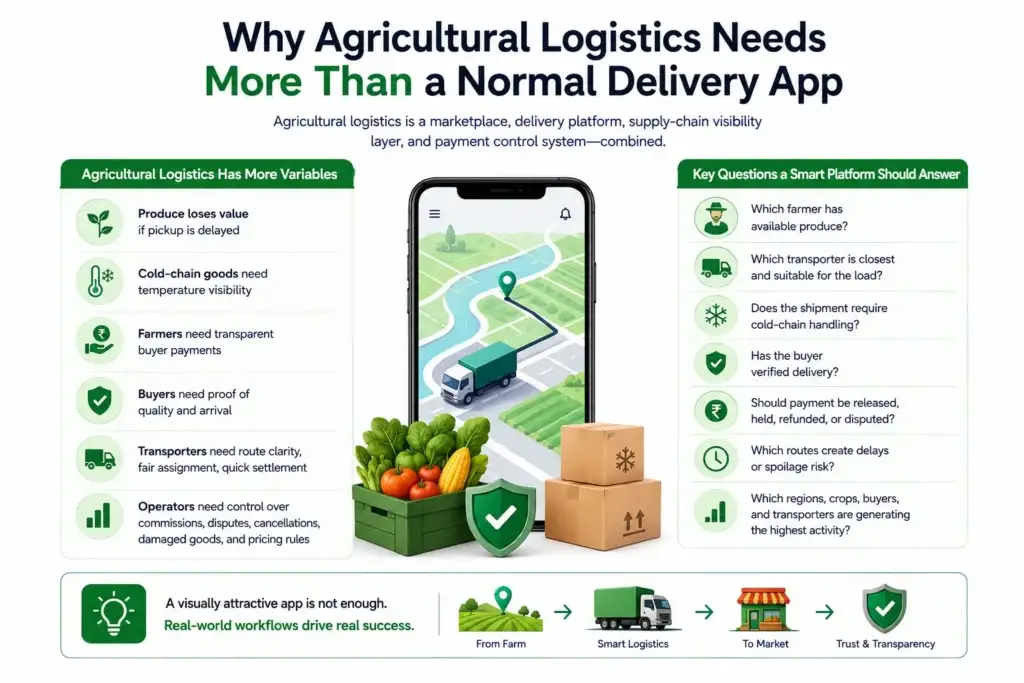
A standard courier app usually moves packages from point A to point B. Agricultural logistics has more variables.
Produce may lose value if pickup is delayed. Cold-chain goods need temperature visibility. Farmers may require transparent buyer payments. Buyers need proof of quality and arrival. Transporters need route clarity, fair assignment, and quick settlement. Platform operators need control over commissions, shipment disputes, cancellations, damaged goods, and regional pricing rules.
This makes agricultural logistics a marketplace, delivery platform, supply-chain visibility layer, and payment control system combined.
A smart agricultural logistics platform should answer questions such as:
- Which farmer has available produce?
- Which transporter is closest and suitable for the load?
- Does the shipment require cold-chain handling?
- Has the buyer verified delivery?
- Should payment be released, held, refunded, or disputed?
- Which routes create delays or spoilage risk?
- Which regions, crops, buyers, and transporters are generating the highest activity?
A founder who ignores these workflows may launch a visually attractive app but struggle with real-world operations.
Core Panels in an AgriMove Clone App
An AgriMove-style platform should not be built as one generic app. It needs role-specific panels because each stakeholder has a different job to complete.
Core Panels and Business Value
| Panel | Core Function | Founder Impact |
|---|---|---|
| Farmer App | Create shipment requests, list produce, track pickup, view payments, communicate with buyers or support. | Helps onboard supply directly and gives farmers visibility into logistics and payment status. |
| Buyer App | Browse produce, place orders, request delivery, track shipment, confirm receipt, raise disputes. | Creates demand-side trust by improving order visibility and delivery transparency. |
| Transporter App | Accept shipments, update pickup/delivery status, use navigation, upload proof of delivery, manage earnings. | Improves transporter participation by making assignments, routes, and payouts easier to manage. |
| Warehouse Panel | Manage storage, inventory movement, quality checks, cold-chain records, dispatch scheduling. | Supports aggregation points, storage hubs, and wholesale distribution workflows. |
| Admin Dashboard | Control users, shipments, routes, commissions, payments, disputes, analytics, and platform settings. | Gives the platform operator the control layer needed to scale beyond manual coordination. |
Must-Have Features of an AgriMove Clone Script
The first market version of an AgriMove clone app should focus on workflows that directly improve shipment movement, user trust, and admin control.
1. Farmer Registration and Produce Listing
Farmers should be able to create profiles, add produce details, mention quantity, pickup location, preferred delivery date, crop category, and special handling requirements. For high-trust marketplaces, document verification and farm profile approval can also be added.
2. Buyer Ordering and Shipment Requests
Buyers should be able to view available produce, place orders, request delivery, track shipment status, and confirm receipt. This is especially useful for wholesalers, retailers, restaurants, exporters, food processors, and institutional buyers.
3. Transporter Matching
The platform should match shipment requests with available transporters based on location, vehicle type, capacity, route, pricing, and shipment requirements. A transporter matching engine is one of the most important modules because poor assignment logic can create delays and failed deliveries.
4. Real-Time GPS Tracking
Live tracking helps farmers, buyers, transporters, and admins understand where goods are during transit. This reduces support calls and improves accountability across the supply chain.
5. Route Optimization
Route optimization helps transporters choose better routes and helps admins monitor delivery efficiency. For agricultural goods, routing should consider timing, distance, vehicle type, delivery priority, and cold-chain requirements where applicable.
6. Cold-Chain Support
Perishable goods such as fruits, vegetables, dairy, seafood, flowers, and meat may need temperature-controlled logistics. A strong AgriMove clone script can support temperature logs, cold-chain status, alerts, and sensor integrations based on the business scope.
7. Shipment Status Updates
The app should support clear shipment stages such as request created, transporter assigned, pickup confirmed, in transit, warehouse received, out for delivery, delivered, payment released, disputed, or cancelled.
8. Secure Wallet and Payment Flow
A wallet or escrow-style payment workflow can help hold buyer payments until delivery confirmation. This improves trust between farmers, buyers, and transporters. Payment release rules should be controlled from the admin dashboard.
9. Proof of Delivery
Transporters should be able to upload delivery proof using photos, OTP confirmation, QR scans, signatures, or invoice uploads. This is important when disputes arise around damaged goods, delayed delivery, or incomplete shipment.
10. Admin Analytics
Admins should be able to monitor shipment volume, active routes, transporter performance, delayed orders, commission revenue, rejected shipments, repeat buyers, and region-wise demand.
Advanced Features That Increase Product Value
Once the core platform is validated, founders can add advanced modules to improve operational depth.
IoT Sensor Integration
IoT sensors can track temperature, humidity, movement, and storage conditions. This is useful for cold-chain operators and exporters dealing with sensitive products.
AI-Based Demand and Yield Insights
If the platform collects enough historical data, AI modules can help forecast demand, identify route bottlenecks, estimate delivery risks, or recommend better pickup schedules.
Warehouse AI and Inventory Intelligence
Warehouse operators can use dashboards to manage stock movement, storage capacity, quality checkpoints, and dispatch timing. This helps when the platform expands beyond direct farm-to-buyer logistics.
Multi-Location Operations
A scalable agricultural logistics app should eventually support different regions, service zones, transport hubs, warehouse branches, and local pricing rules.
Transporter Performance Scoring
The platform can score transporters based on acceptance rate, on-time delivery, cancellation rate, dispute history, route performance, and customer feedback.
Dynamic Pricing and Commission Rules
Agricultural logistics pricing may change based on distance, route difficulty, vehicle type, demand, product sensitivity, cold-chain need, and delivery urgency. Admins should be able to adjust rules without depending on developers for every pricing change.
AgriMove Clone Script Pricing: What Actually Affects Cost?
There is no single fixed price for an AgriMove clone script because the cost depends on business scope, user roles, integrations, design, platform choice, and customization requirements. AgriMove’s public website does not show a visible pricing table in the crawled page content, so founders should treat pricing as a scope-based decision rather than expecting one universal package.
The biggest pricing factors include:
| Cost Factor | Why It Matters |
|---|---|
| Number of apps | Farmer, buyer, transporter, warehouse, and admin panels increase development scope. |
| Platform choice | Web-only, Android, iOS, or cross-platform builds affect effort and QA time. |
| Logistics complexity | Basic shipment tracking costs less than route optimization, transporter matching, and cold-chain alerts. |
| IoT integration | Temperature sensors, GPS devices, and vehicle telematics add API and hardware workflow complexity. |
| Payment workflows | Wallets, payment gateways, escrow release, refunds, and commission logic increase backend work. |
| Admin dashboard depth | More control over users, disputes, pricing, routes, warehouses, and reports increases build scope. |
| Custom branding | UI changes, custom flows, regional language support, and business-specific workflows affect pricing. |
| Scalability requirements | Multi-region, high-volume, cloud, analytics, and performance requirements add architecture planning. |
Miracuves’ recommendation is simple: do not price this as “just another delivery app.” Price it based on the operational control layer. The more real-world agricultural workflows you want to automate, the more important the backend, admin dashboard, and integration strategy become.
Read more: What Is an AgriMove-Like App and How Does an Agricultural Logistics Platform Work
Miracuves AgriMove-Like Platform Solution Cost and Tech Stack
Miracuves Pricing for an AgriMove-Like Agricultural Logistics Platform developed in JavaScript For $4,899 USD (One-Time Price) in just 6 days
Get a fully developed, deployment-ready agricultural logistics platform modeled around AgriMove-style farm-to-market transportation and supply chain operations. Built on a modern JavaScript foundation, this complete package includes everything you need to launch and scale:
Core Workflows: Farmer registration, shipment creation, transporter matching, pickup scheduling, route management, real-time shipment tracking, delivery confirmation, warehouse coordination, and customer notifications.
Built-in Revenue Logic: Shipment commissions, transporter service fees, subscription plans, delivery charges, warehouse service fees, premium logistics tools, featured transporter listings, and platform transaction charges.
Management Hub: Centralized admin dashboard, farmer management, transporter management, shipment monitoring, route controls, warehouse management, payment records, dispute handling, delivery reports, and logistics analytics.
Launch-Ready: Fully prepared for your custom branding, configuration, payment gateway setup, farmer and transporter onboarding, shipment workflow configuration, logistics category setup, and immediate market entry.
Why Is AgriMove-Like Platform Development More Affordable?
Most agricultural logistics platforms become expensive when businesses choose fully custom development from scratch. Building separate workflows for farmers, buyers, transporters, warehouses, shipments, route planning, tracking, payments, delivery verification, cold-chain operations, and admin controls can increase cost, timeline, and technical complexity.
We took a smarter, more practical approach:
You Aren’t Paying for Ground-Up Development: Our agricultural logistics engine is already developed, tested, and ready to deploy. You skip the inflated cost and long waiting period usually required to build a smart farm-to-market logistics platform from scratch.
The Power of JavaScript: We built this solution on a modern JavaScript architecture that supports real-time shipment updates, scalable transporter-matching workflows, interactive logistics dashboards, API-driven integrations, and smooth admin operations.
You get a launch-ready AgriMove-like agricultural logistics platform with practical shipment management, transporter coordination, tracking, payment, warehouse, and supply chain features, source code access, and faster deployment without the high custom development price tag.
Note: This cost is for the solution, re-branding, deployment, and source code only.
Ready-Made Agri Logistics Foundation vs Custom Development
A ready-made foundation is useful when your business model follows a proven pattern: farmers create supply, buyers create demand, transporters move goods, and admins control payments, commissions, disputes, and reporting.
Custom development is useful when your agricultural logistics model has highly unique rules, deep ERP integrations, enterprise warehousing, proprietary AI models, or hardware-heavy IoT systems.
| Build Option | Best For | Strength | Limitation |
| Ready-made clone foundation | Founders who want faster validation | Faster launch, lower starting risk, existing modules, source-code ownership | May need customization for agricultural workflows |
| Custom development | Enterprises or complex supply-chain operators | Fully tailored workflows, deep integrations, unique architecture | Higher cost, longer planning, more development effort |
| Hybrid approach | Founders with a clear core model and some custom needs | Start with existing logistics modules and customize agricultural layers | Requires careful scope planning |
For many founders, the strongest route is a hybrid model: use a ready-made logistics or marketplace foundation, then customize farmer onboarding, produce listing, cold-chain tracking, transporter matching, warehouse workflows, and settlement logic.
Founder Decision Signals Before Building
Founder Decision Signals
Speed
If you already understand the farming region, buyer segment, and logistics flow, a ready-made foundation can help you test demand faster than a full custom build.
Cost
Pricing should be based on the number of panels, integrations, admin depth, and cold-chain complexity rather than only screen count.
Scalability
If you plan to support multiple regions, warehouses, transporters, and produce categories, backend architecture matters from the beginning.
Market Fit
The platform should solve a real coordination problem: unreliable pickup, poor tracking, delayed payments, damaged goods, or weak buyer access.
Monetization Models for an AgriMove Clone App
A smart agricultural logistics platform can earn from several revenue streams. The right model depends on whether you are building for farmers, buyers, wholesalers, exporters, transporters, or warehouse operators.
Commission on Shipments
The platform can charge a commission on every completed shipment or order. This is the simplest model if the platform controls matchmaking and payment flow.
Transporter Subscription Plans
Transporters can pay monthly or yearly fees to access more shipment opportunities, advanced route tools, priority matching, or analytics.
Buyer Membership Plans
Large buyers, wholesalers, exporters, or retailers can subscribe for priority access, bulk order tools, preferred pricing, or advanced procurement dashboards.
Listing and Promotion Fees
Farmers, suppliers, or transporters can pay to promote listings, routes, produce categories, or verified service profiles.
Warehouse and Cold-Chain Fees
If the platform includes storage hubs or cold-chain partners, it can earn from storage, handling, quality checks, and temperature-controlled logistics services.
Data and Analytics Services
Aggregated insights around demand, route performance, produce movement, and regional supply can become a premium analytics layer for cooperatives, agribusinesses, and institutional buyers.
Security and Operational Controls
Agricultural logistics platforms handle user identities, payments, shipment data, location data, and business-sensitive supply-chain information. Security should be treated as a product foundation, not a final add-on.
Important controls include:
- Encrypted data transfer
- Role-based access control
- Secure payment gateway integration
- Wallet and payment release controls
- Transporter and business verification
- Admin activity logs
- Dispute management workflows
- Shipment audit trails
- Permission-based dashboards
- Fraud and abuse reporting
- Secure API integrations for maps, payments, IoT, and notifications
For regulated markets or export-heavy workflows, legal and compliance requirements should be reviewed based on the operating region, commodity type, payment structure, and logistics model.
Mistakes Founders Should Avoid
Mistakes Founders Should Avoid
Building Only a Delivery App
Agricultural logistics requires farmer workflows, buyer trust, transporter matching, quality checks, and payment settlement. A simple courier app may not handle these realities.
Ignoring Cold-Chain and Perishability
Perishable goods lose value when timing, temperature, or handover quality is not controlled. Cold-chain support should be planned early if your platform handles sensitive products.
Underbuilding the Admin Dashboard
The admin dashboard is where the platform operator controls pricing, commissions, users, disputes, refunds, transporters, warehouses, and analytics. Weak admin control creates operational dependency.
Choosing Price Before Scope
A low quote can become expensive if it excludes source code, mobile apps, payment logic, route optimization, analytics, or post-launch support.
Read more: Best Marketing Strategies to Grow an AgriMove Clone Agricultural Logistics Platform
How Miracuves Helps Build an AgriMove-Style Logistics Platform
Miracuves can help founders build an AgriMove-style platform using a white-label logistics, marketplace, or delivery foundation customized for agricultural operations.
A launch-ready approach can include:
- Farmer, buyer, transporter, and admin workflows
- Shipment booking and tracking
- Route and dispatch logic
- Payment gateway and wallet workflows
- Commission and pricing controls
- Warehouse or hub management where required
- Custom branding and white-label design
- Source-code ownership
- Scalable backend and API integrations
- Post-launch customization support based on scope
Founders exploring logistics-heavy platforms can also review Miracuves’ global logistics solutions, Uber Delivery Clone solution, and Dunzo Clone solution to understand adjacent delivery and logistics models.
Final Thoughts: Build the Logistics Control Layer, Not Just the App
The real value of an AgriMove clone script is not visual similarity. It is the ability to digitize agricultural logistics with better coordination, shipment visibility, payment control, transporter accountability, and supply-chain intelligence.
For founders, the strongest decision is to start with the workflows that matter most: farmer onboarding, buyer demand, transporter supply, shipment tracking, cold-chain requirements, wallet settlement, and admin control. Once the core flow works, advanced modules such as IoT sensors, warehouse AI, demand forecasting, and multi-region analytics can be added with more confidence.
Miracuves helps founders move faster by starting with a practical, white-label, source-code-owned product foundation that can be customized around real agricultural logistics operations.
FAQs
What is an AgriMove clone script?
An AgriMove clone script is a customizable software foundation for building an agricultural logistics platform inspired by AgriMove-style workflows. It can include farmer onboarding, buyer ordering, transporter matching, shipment tracking, cold-chain support, payment workflows, and admin control.
How much does an AgriMove clone script cost?
The cost depends on features, mobile apps, panels, integrations, route optimization, cold-chain tracking, payment logic, analytics, and customization scope. A basic logistics platform costs less than a multi-role agricultural supply-chain platform with IoT, wallet, warehouse, and AI modules.
Can I launch an AgriMove clone app with my own brand?
Yes. A white-label AgriMove clone app can be customized with your brand name, logo, colors, business workflows, user roles, pricing rules, and regional settings.
What features should an agricultural logistics app include?
A strong agricultural logistics app should include farmer profiles, produce listings, buyer ordering, transporter matching, real-time tracking, route optimization, proof of delivery, wallet payments, admin dashboards, dispute management, and analytics.
Is cold-chain tracking necessary for an AgriMove-style platform?
Cold-chain tracking is important if the platform handles perishable goods such as fruits, vegetables, dairy, seafood, meat, flowers, or temperature-sensitive agricultural products. It can be added through temperature logs, sensor integrations, alerts, and admin monitoring.
What panels are needed for an AgriMove clone app?
The platform usually needs a farmer app, buyer app, transporter app, warehouse panel, and admin dashboard. The final panel structure depends on whether your business handles direct deliveries, wholesale logistics, storage hubs, or multi-region operations.
Can Miracuves build an AgriMove-style logistics platform?
Yes. Miracuves can help founders build a white-label, source-code-owned agricultural logistics platform using ready-made logistics foundations and custom workflows for farmers, buyers, transporters, warehouses, payments, and admin control.
Is an AgriMove clone script better than custom development?
A clone script or ready-made foundation is better when you want faster validation using proven logistics workflows. Custom development is better when your agricultural supply-chain model needs highly unique integrations, enterprise workflows, or proprietary architecture.