Key Takeaways
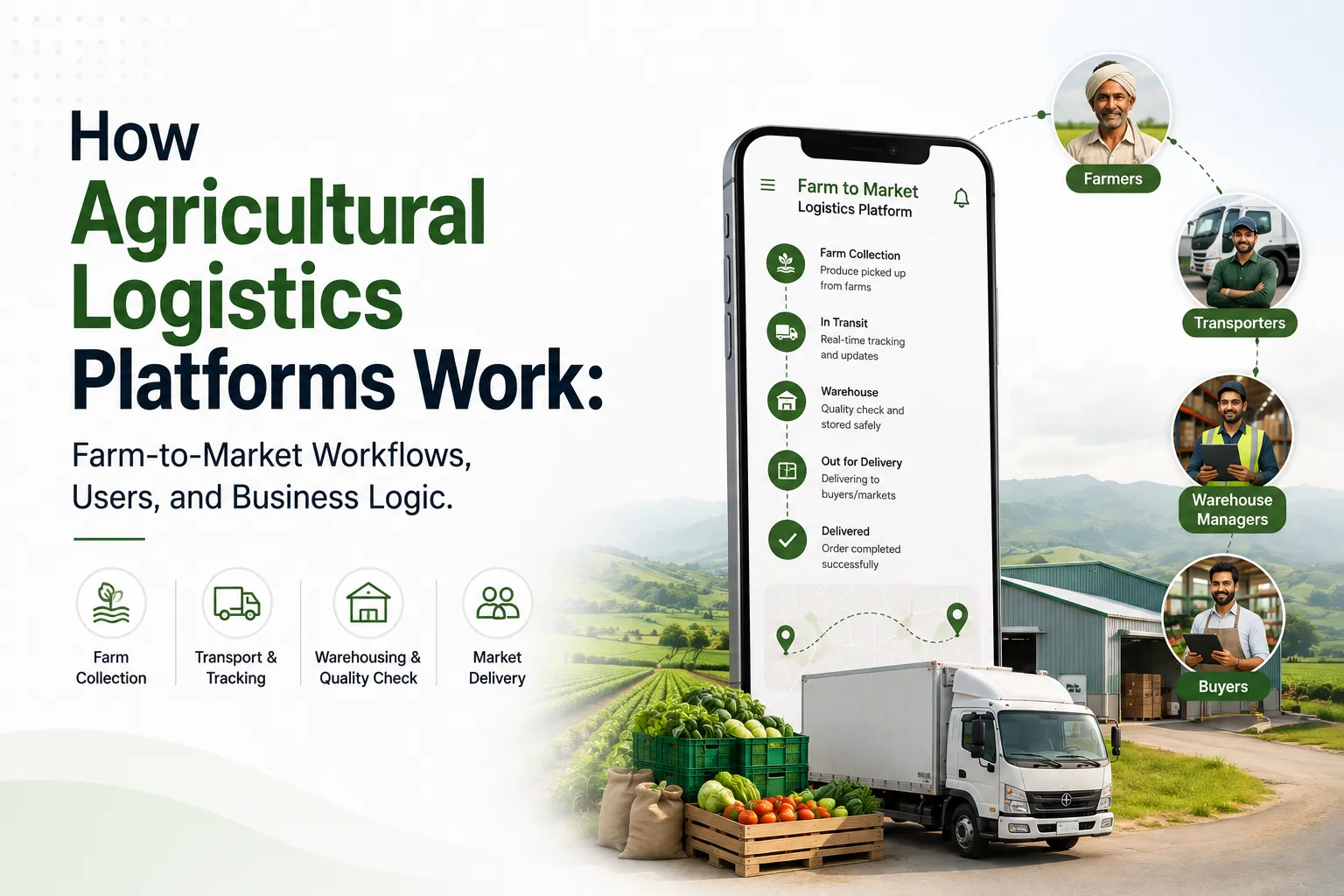
- Agricultural logistics platform connects farmers, FPOs, transporters, drivers, warehouses, quality inspectors, buyers, and admins through one coordinated farm-to-market workflow.
- The core workflow moves from load creation to transporter matching, pickup, shipment tracking, warehouse handover, quality inspection, delivery confirmation, and settlement.
- Farm logistics needs purpose-built workflows because produce can be seasonal, perishable, quality-sensitive, route-dependent, and dependent on storage or cold-chain handling.
- Business logic controls how loads are created, transporters are matched, prices are calculated, commissions are applied, disputes are resolved, and users receive permissions.
- A strong admin dashboard acts as the operating layer for managing users, shipments, routes, payments, commissions, disputes, quality records, and reports.
Workflow Signals
- Load creation should capture commodity type, quantity, packaging, pickup and delivery locations, vehicle requirements, timing, and special handling needs.
- Transporter matching can use manual assignment, bidding, nearby vehicle suggestions, contracted carriers, or fleet-based driver allocation.
- Shipment tracking can combine GPS visibility, route history, ETA updates, geofencing, milestones, cold-chain alerts, and manual field updates.
- Warehouse and quality workflows may record weight, batch details, storage location, grading, inspection images, temperature records, rejection reasons, and dispatch readiness.
- Delivery proof and settlement records help reduce disputes by documenting receipt, shortages, payments, transporter payouts, commissions, and other transaction outcomes.
Real Insights
- Agricultural logistics is not simply pickup and delivery; the platform must understand commodity, quality, storage, route, vehicle, buyer acceptance, and settlement requirements.
- Founders can begin with manual transporter assignment and introduce bidding, auto-matching, route filters, and capacity logic as shipment volume increases.
- Every user should have role-specific access so farmers, drivers, buyers, warehouse teams, inspectors, and admins only see the information and controls relevant to them.
- The operating model should shape the software from the beginning because transporter marketplaces, managed logistics networks, FPO-led systems, buyer-led logistics, and SaaS platforms require different workflows.
- The strongest workflow is: load creation → matching → dispatch → pickup → tracking → warehouse or quality checks → delivery proof → settlement → reporting.
Agricultural logistics is not just about moving crops from one location to another. It is a coordinated chain involving farmers, FPOs, collection centres, warehouses, transporters, drivers, buyers, quality inspectors, and platform operators.
When this process runs through phone calls, spreadsheets, and manual updates, the supply chain becomes difficult to control. Loads get delayed. Transporters miss route opportunities. Buyers wait for updates. Farmers do not always know when pickup will happen. Admin teams struggle to track payments, quality checks, and disputes.
An agricultural logistics platform solves this by creating one digital operating layer for farm-to-market movement. It helps different users post loads, assign transporters, track shipments, manage warehouse handovers, record quality checks, confirm delivery, and monitor settlement status.
This guide explains how agricultural logistics platforms work, which users are involved, what workflows matter, and how founders should think about the business logic before launching.
What Is an Agricultural Logistics Platform?
An agricultural logistics platform is software that helps manage the movement of farm produce, agricultural commodities, equipment, or supply-chain goods from origin points to buyers, processors, warehouses, exporters, mandis, or distribution centres.
It usually combines logistics, marketplace, tracking, warehouse, quality, and settlement workflows.
For example, a farmer may need to move vegetables from a village collection point to a buyer. An FPO may need to aggregate produce from multiple members and assign transport. A buyer may need shipment visibility before accepting delivery. A transporter may need verified loads on profitable routes. A warehouse team may need to record inbound stock, storage condition, and dispatch status.
A strong farm-to-market logistics platform gives each user the right interface and gives the platform operator the admin control needed to manage the complete transaction flow.
Founders planning this type of product should also understand how agriculture and agritech platform development supports field users, producer networks, digital crop movement, and rural business workflows.
Why Farm-to-Market Logistics Needs Purpose-Built Workflows
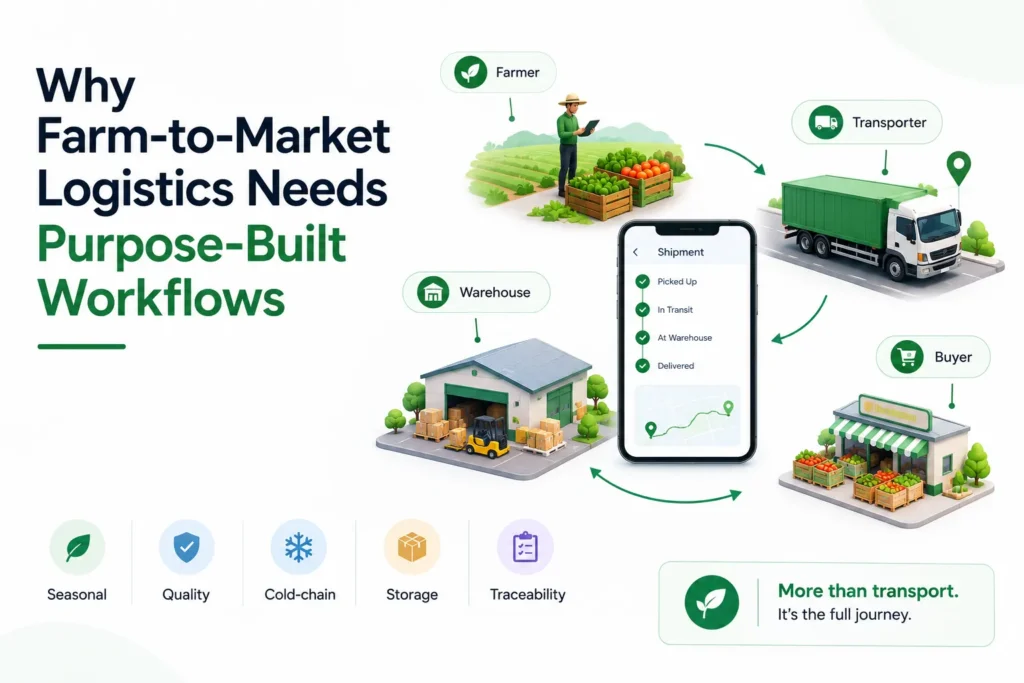
A generic delivery app usually focuses on pickup, delivery, driver assignment, payment, and tracking. Farm-to-market logistics needs more context.
Agricultural goods are often seasonal, quality-sensitive, route-dependent, and time-sensitive. Some shipments require cold-chain handling. Some require warehouse storage before buyer delivery. Some require grading, weighing, inspection, or rejection records. Some are handled through FPOs or cooperatives rather than individual farmers.
That means the platform must understand more than distance and delivery time. It must understand commodity type, quantity, packaging, vehicle requirement, route availability, pickup schedule, warehouse handover, quality approval, and settlement status.
This is where an agricultural logistics platform becomes different from a basic transport app. It helps the business manage the logic behind farm produce movement, not just the movement itself.
Core Users Inside a Farm-to-Market Logistics Platform
A farm logistics product usually has multiple user roles. Each role has different expectations, workflows, permissions, and business value.
Key Users and Their Platform Workflows
| User Type | What They Do | Why It Matters |
|---|---|---|
| Farmers | Create pickup requests, enter crop details, track shipment status, and view delivery confirmation. | Farmers get better visibility into produce movement instead of depending only on calls. |
| FPOs and Cooperatives | Aggregate produce, manage member loads, coordinate dispatch, and track group-level movement. | FPOs reduce manual coordination and manage multiple producers more efficiently. |
| Transporters | Find available loads, submit bids, accept assigned trips, and manage vehicle movement. | Transporters improve route utilization and access verified shipment demand. |
| Drivers | Receive pickup instructions, update trip status, upload proof, and follow assigned routes. | Drivers get clear field instructions and reduce missed handovers. |
| Warehouses | Record inbound stock, storage movement, dispatch readiness, and inventory status. | Warehouse visibility helps prevent loss, confusion, and manual reconciliation issues. |
| Buyers | Track shipment movement, review quality records, confirm delivery, and manage invoices. | Buyers gain confidence before accepting produce and releasing payment. |
| Quality Inspectors | Capture grades, images, inspection notes, rejection reasons, and approval status. | Inspection records reduce disputes between suppliers, buyers, and operators. |
| Platform Admins | Manage users, loads, routes, payments, commissions, disputes, dashboards, and reports. | Admin control helps the business operate and scale without relying on manual tracking. |
How the Farm-to-Market Workflow Usually Works
A farm-to-market logistics workflow is the journey from shipment request to final settlement. The exact process depends on the business model, but most platforms follow a similar structure.
1. Load Requirement Is Created
The workflow starts when a farmer, FPO, buyer, or admin creates a load requirement.
This may include:
- Crop or commodity type
- Quantity and unit
- Packaging type
- Pickup location
- Delivery location
- Preferred pickup date
- Vehicle type
- Handling requirement
- Cold-chain requirement
- Buyer or warehouse details
This step matters because poor load data creates downstream problems. If crop quantity, packaging, or destination details are unclear, transporters may reject the load or quote incorrectly.
2. Transporter Matching or Assignment Happens
Once the load is posted, the platform connects it with suitable transporters.
This can work in different ways:
- Admin manually assigns a transporter
- Transporters bid on available loads
- The platform suggests nearby vehicles
- Contracted carriers receive route-based assignments
- Drivers are assigned through a fleet dashboard
For early-stage founders, manual assignment may be enough. As shipment volume grows, bidding, auto-matching, route filters, and vehicle-capacity logic become more important.
Founders who want a deeper module view can review these agricultural logistics platform features before finalizing their product scope.
3. Dispatch and Pickup Are Confirmed
After the transporter accepts the load, the driver receives pickup instructions. The platform can track pickup arrival, loading status, documents, images, and confirmation records.
This stage is especially important for rural logistics because field conditions can be unpredictable. Poor network connectivity, delayed harvesting, wrong pickup location, or vehicle mismatch can affect the shipment.
A well-planned agricultural logistics platform should make field updates simple. Drivers and collection agents should not need complex screens to complete basic actions.
4. Shipment Movement Is Tracked
During transit, the platform tracks trip status and route progress. Depending on the scope, it may include GPS tracking, route history, milestone updates, ETA visibility, geofencing, cold-chain alerts, or manual status updates.
For perishable produce, live tracking is not only a convenience feature. It helps platform operators respond to delays, buyers plan receiving, and admins manage exceptions.
Founders building advanced dispatch and tracking flows can also explore Miracuves’ work in logistics and supply chain software development to understand how route visibility, fulfillment, and operational dashboards connect.
5. Warehouse or Collection Centre Handover Is Recorded
Not every shipment moves directly from farm to buyer. Many agricultural supply chains use collection centres, packhouses, warehouses, or cold rooms.
In those cases, the platform may need to record:
- Inbound quantity
- Weight
- Lot or batch details
- Storage location
- Quality status
- Repacking or grading notes
- Dispatch readiness
- Outbound movement
This workflow helps businesses manage produce that moves through multiple touchpoints before final delivery.
6. Quality Checks Are Completed
Quality inspection may happen at pickup, warehouse, buyer delivery, or all three. The platform can capture grade, images, rejection reasons, moisture level, packaging condition, temperature records, or checklist responses.
Quality records protect all sides of the transaction. Farmers and FPOs get transparency. Buyers get confidence. Admins get documentation for disputes. Transporters get clearer proof if damage did not happen during transit.
7. Delivery Is Confirmed
At the delivery stage, the buyer, warehouse, or receiver confirms that the shipment has arrived.
Proof of delivery can include:
- OTP confirmation
- Digital signature
- Photo proof
- Timestamped delivery status
- Receiver name
- Delivery notes
- Quantity received
- Shortage or rejection record
A strong delivery confirmation process reduces disputes and gives the platform operator a reliable record before settlement.
8. Settlement and Reporting Are Updated
After delivery, the platform updates payment and settlement records. Depending on the business model, this may involve farmer payment, transporter payout, buyer invoice, commission deduction, warehouse fee, cold-chain fee, or refund handling.
The admin dashboard should show settlement status clearly because payment confusion can damage trust faster than almost any other issue in agricultural logistics.
For a deeper cost-side planning view, founders can review this farm-to-market logistics app cost guide before requesting a final quote.
Read more – Ready-Made vs Custom Agricultural Logistics Platform Development: Which Route Fits AgriTech Startups?
The Business Logic Behind Agricultural Logistics Platforms
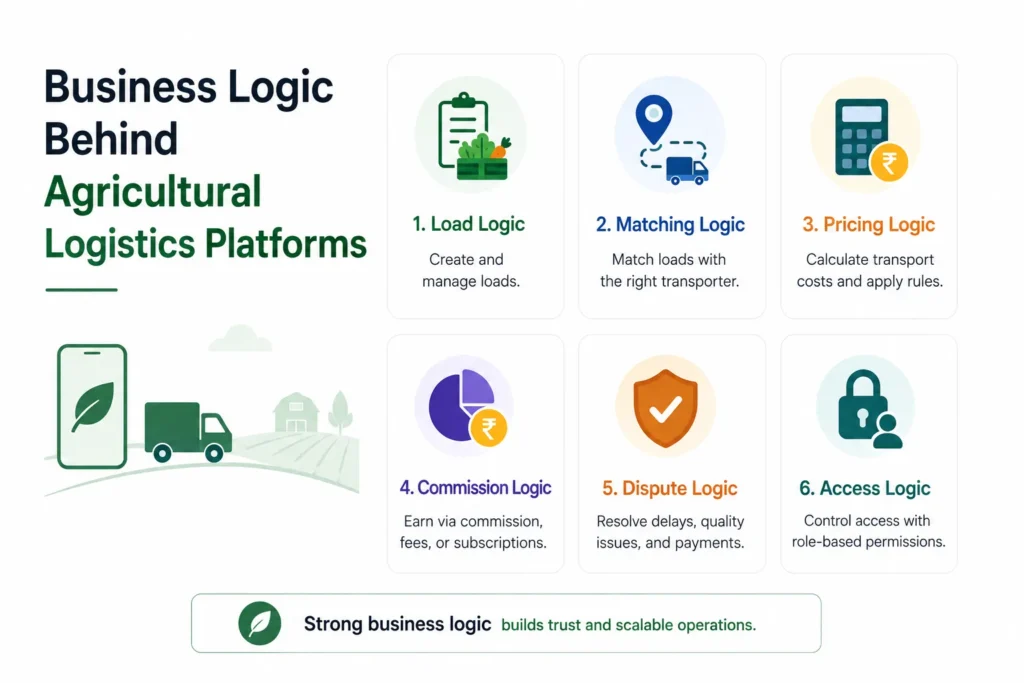
The strongest platforms are not built only around features. They are built around business logic.
Business logic defines how the platform makes decisions, applies rules, and controls operations. In agricultural logistics, that logic can include who can post loads, how transporters accept jobs, how rates are calculated, when payments are released, how disputes are handled, and how admins intervene.
Load Logic
Load logic defines how produce movement requests are created and managed. A simple platform may allow any farmer to post a load. A more controlled platform may require FPO approval, buyer confirmation, or admin verification before a load becomes visible to transporters.
Matching Logic
Matching logic decides how a load reaches the right transporter. This may depend on vehicle type, location, capacity, route, transporter rating, cold-chain capability, or pricing rules.
Pricing Logic
Pricing logic decides how transport costs are calculated. Some platforms use fixed rates. Some use bidding. Some use distance-based pricing. Some use route contracts or admin-defined price bands.
Commission Logic
Commission logic decides how the platform earns revenue. The operator may charge a percentage of shipment value, a fixed fee per load, a transporter subscription, buyer service fee, premium listing fee, or SaaS license.
To explore revenue paths in more detail, founders can review this farm logistics business model breakdown and align monetization with platform workflows.
Dispute Logic
Dispute logic defines what happens when there is a delay, shortage, quality issue, rejected delivery, payment conflict, or damaged produce claim. A good platform gives admins records, images, timestamps, and activity logs to resolve issues more fairly.
Access Logic
Access logic defines who can see and change what. Farmers should not see admin-only settlement controls. Drivers should only see assigned trips. Buyers should see relevant shipment and quality records. Admins should control permissions through role-based access.
Different Operating Models Founders Can Choose
Not every agricultural logistics platform works the same way. The business model should shape the product design from the beginning.
| Operating Model | How It Works | Best For | Product Priority |
|---|---|---|---|
| Transporter Marketplace | Farmers, FPOs, or buyers post loads and transporters accept or bid. | Markets with fragmented transport supply. | Load posting, bidding, ratings, route filters, settlement tracking. |
| Managed Logistics Network | The platform operator controls dispatch, transporter relationships, pricing, and fulfillment. | Businesses that want stronger operational control. | Admin dashboard, route planning, fleet assignment, exception handling. |
| FPO-Led Logistics System | FPOs aggregate produce and coordinate shipments for members. | Farmer groups, cooperatives, and regional agri networks. | Member management, group loads, pickup planning, buyer coordination. |
| Buyer-Led Procurement Logistics | Buyers create demand and coordinate pickup from farmers or collection points. | Processors, exporters, wholesalers, and institutional buyers. | Supplier onboarding, quality checks, delivery proof, invoice workflows. |
| SaaS for Agri Operators | The software is licensed to regional operators under their own brand. | Entrepreneurs, agencies, and logistics companies. | White-label branding, admin control, reports, configuration options. |
The right model depends on who owns demand, who controls fulfillment, and who pays for the platform.
Why Admin Control Is the Real Operating Layer
The admin dashboard is where the business becomes manageable.
A basic app may allow users to post and accept loads, but the admin panel decides whether the platform operator can actually run the business. Admin teams need to approve users, manage routes, monitor shipments, configure commissions, resolve disputes, review reports, control content, and manage payments.
A good admin system should help operators answer questions like:
- Which routes have the most demand?
- Which transporters are active?
- Which loads are delayed?
- Which buyers are creating repeat demand?
- Which disputes are unresolved?
- Which payments are pending?
- Which crop categories generate the most activity?
- Which regions need more supply or demand?
Without this visibility, the platform may look good on the front end but become difficult to operate after launch.
Security and Trust Workflows That Matter
Trust is central to farm-to-market logistics. Multiple parties are involved, and each transaction may carry financial, quality, and delivery risk.
Important trust layers include:
- User verification
- Transporter verification
- Role-based access control
- Secure payment gateway integration
- Admin approval controls
- Audit logs
- Proof of pickup
- Proof of delivery
- Quality inspection records
- Activity logs
- Dispute management
- Privacy-conscious data handling
Security should be treated as a foundation, not a marketing add-on. For agricultural logistics, this means every important action should leave a record that helps the operator understand what happened and respond responsibly.
Founder Decision Signals Before Building
Speed
If you need to validate one route, crop cluster, or buyer network quickly, start with the workflow needed for the first transaction loop instead of building every advanced module.
Cost
Cost increases when you add multiple user roles, live tracking, warehouse logic, cold-chain monitoring, payment automation, and custom reporting from day one.
Scalability
A scalable agricultural logistics platform needs clean permissions, flexible business rules, reliable APIs, admin controls, and reporting that can support more regions over time.
Market Fit
The first version should prove that farmers, FPOs, transporters, and buyers are willing to coordinate through the platform instead of relying only on calls and spreadsheets.
Ready-Made Foundation vs Custom Development
Founders usually compare two development paths: building from zero or starting with a ready-made foundation that can be customized for the target market.
Custom development can be useful when the operating model is highly unique, deeply integrated with existing systems, or built for very specific enterprise workflows. It gives flexibility, but it usually requires more discovery, design, development, testing, and launch planning.
A ready-made foundation can help when the founder wants to launch faster with proven user flows, admin control, tracking logic, and logistics modules already in place. The platform can then be adapted for branding, crop categories, language, region, route logic, pricing rules, payment workflows, and business model requirements.
For founders comparing build options, Miracuves’ ready-made app solutions can provide a faster starting point than building every workflow from zero.
If your operating model requires highly specific workflows, deeper integrations, or unique user journeys, custom mobile app development may be the better route for long-term flexibility.
For founders who want a launch-ready agricultural supply chain app foundation, Miracuves offers a white-label agricultural logistics solution that can support farm-to-market workflows, transporter coordination, shipment tracking, admin control, and business model customization.
Common Mistakes Founders Should Avoid
Building a Generic Delivery Flow for Agricultural Operations
Farm logistics may need grading, warehouse handovers, cold-chain handling, FPO coordination, quality records, and settlement visibility. A basic pickup-and-drop model may not solve the real operating problem.
Adding Too Many User Roles Before Validation
Every role adds permissions, screens, workflows, notifications, reports, and QA effort. Start with the users required for the first transaction loop.
Ignoring Admin Dashboard Depth
The admin panel is where the operator controls users, loads, routes, commissions, disputes, and reports. A weak admin layer can create long-term operational dependency.
Automating Payments Before the Rules Are Clear
Payment flows in agricultural logistics may involve farmers, FPOs, buyers, transporters, warehouses, and platform fees. Automate settlement only after the transaction rules are properly mapped.
How Miracuves Helps Founders Plan Agricultural Logistics Products
Miracuves helps founders, startups, agencies, and businesses launch ready-made and white-label app platforms with source-code ownership, branded design, admin dashboards, and faster deployment.
For agricultural logistics, the key is not simply launching an app. The key is mapping the right workflows: farmer onboarding, FPO aggregation, transporter matching, dispatch, warehouse movement, quality checks, delivery proof, settlements, and admin control.
Businesses that need expert support can work with Miracuves as an agricultural logistics app development company to plan, customize, and launch a platform aligned with their market.
Final Thoughts
A agrimove is not just a delivery product for farm goods. It is a business operating system for produce movement, transporter coordination, warehouse visibility, quality control, delivery proof, and settlement tracking.
The smartest founders begin by defining the workflow they need to validate first. A direct farm-to-buyer model, FPO-led aggregation model, transporter marketplace, managed logistics network, and SaaS licensing model all need different product decisions.
When the workflow is clear, technology becomes easier to plan. The platform can start with the essential transaction loop, then expand into route intelligence, warehouse control, cold-chain monitoring, advanced reporting, and automation as demand grows.
For founders planning to launch faster, Miracuves can help create a white-label, source-code-owned platform foundation aligned with agricultural logistics workflows, admin control, and long-term business model clarity.
FAQs
What is an agricultural logistics platform?
An agricultural logistics platform is software that helps manage farm-to-market movement across farmers, FPOs, transporters, warehouses, buyers, quality teams, and admins. It can support load posting, transporter assignment, shipment tracking, quality records, delivery proof, and settlement workflows.
How does a farm-to-market logistics platform work?
It usually starts with a load request, then moves through transporter matching, dispatch, pickup, route tracking, warehouse or collection centre handover, quality inspection, delivery confirmation, and settlement tracking.
Who uses agricultural logistics software?
Common users include farmers, FPOs, cooperatives, transporters, drivers, buyers, warehouses, collection centres, quality inspectors, processors, exporters, and platform administrators.
What features should an agricultural logistics platform include?
Core features may include user onboarding, load posting, transporter matching, route tracking, driver app, warehouse records, quality checks, proof of delivery, payment status, dispute management, notifications, and admin dashboards.
How is agricultural logistics software different from a normal delivery app?
A normal delivery app mainly focuses on pickup and drop-off. Agricultural logistics software often needs additional workflows for crop type, quantity, grading, cold-chain handling, FPO aggregation, warehouse movement, buyer acceptance, and multi-party settlement.
What business models can a farm logistics platform use?
Common models include shipment commission, transporter subscription, buyer service fee, premium load placement, SaaS licensing, managed logistics support, and regional operator licensing.
Why is admin control important in farm logistics apps?
Admin control helps the platform operator manage users, loads, transporters, routes, payments, commissions, disputes, quality records, and reports. Without a strong admin layer, daily operations become difficult to scale.
How can Miracuves help with agricultural logistics platform development?
Miracuves helps founders build ready-made and white-label app platforms with source-code ownership, branded design, admin dashboards, logistics workflows, tracking modules, and customization support. Final scope depends on the selected features, integrations, region, and operating model.
Miracuves is an independent software development company. We are not affiliated with, connected to, sponsored by, or endorsed by any company or product named in this article.
Terms such as “X Clone” are used descriptively. It is how the software industry refers to building a platform with functionality comparable to a known service, and how clients search for it.
The entire design and codebase of our products is built by our own team. Our products contain no code, design, graphics, or content originating from any third-party website or applications.
All third-party names and marks referenced in this article are the property of their respective owners, referenced solely to identify the services discussed.