Key Takeaways
- Load board and freight marketplace apps make money by connecting shippers, brokers, and carriers in one digital platform.
- Core revenue streams include subscriptions, load posting fees, promoted listings, commissions, premium tools, and data services.
- A freight marketplace needs load visibility, carrier matching, rate negotiation, tracking, document handling, and payment workflows.
- A strong business model helps logistics startups create repeat revenue while improving freight discovery and carrier utilization.
Revenue Signals
- Shippers need easy load posting, freight visibility, carrier access, shipment updates, pricing clarity, and booking support.
- Carriers need load search, route filters, truck posting, bid options, document uploads, and payment visibility.
- Brokers need carrier verification, rate management, dispatch tools, communication workflows, invoices, and shipment tracking.
- Admins need control over users, subscriptions, loads, bids, payments, documents, disputes, reports, and platform settings.
Real Insights
- A freight marketplace becomes valuable when it reduces empty miles, manual calls, pricing delays, and shipment uncertainty.
- Subscription revenue works best when users rely on the platform daily for load discovery and carrier matching.
- Trust features like verification, tracking, documents, reviews, and dispute workflows help support long-term marketplace growth.
- Miracuves builds load board and freight marketplace apps with load posting, carrier matching, bidding, subscriptions, tracking, payments, and admin control.
Load board and freight marketplace apps make money by helping shippers, freight brokers, carriers, dispatchers, and fleet operators find each other faster. At the surface level, the model looks simple: shippers and brokers post loads, carriers search for freight, and the platform earns from access, visibility, or transactions.
But the strongest freight marketplace businesses do not rely on only one revenue stream.
A profitable load board business model usually combines subscriptions, load posting fees, promoted listings, commission-based workflows, premium analytics, advertising partnerships, and embedded financial services. The marketplace creates the user activity, but the deeper revenue often comes from the tools built around that activity.
For founders, this matters because building a load board is not just about listing freight. The real business opportunity is to create a digital freight ecosystem where users return daily, trust the platform, and gradually adopt more paid tools.
Miracuves helps founders build ready-made and white-label load board marketplace apps with load posting, carrier matching, bidding, subscriptions, tracking, payments, document workflows, and admin control, giving logistics startups a faster foundation for launching a revenue-ready platform.
What Is a Load Board and Freight Marketplace App?
A load board app is a digital platform where shippers, brokers, and carriers connect to move freight. Brokers and shippers post available loads, while carriers search for loads based on lane, truck type, pickup date, destination, rate, and availability.
A freight marketplace platform takes this model further by supporting bidding, rate negotiation, carrier verification, shipment tracking, document uploads, payment workflows, reviews, analytics, and admin reporting. Instead of only showing load listings, it can support bidding, rate negotiation, carrier verification, shipment tracking, document uploads, payment workflows, reviews, analytics, and admin reporting.
In simple terms:
Shipper or broker posts freight → Carrier searches or gets matched → Parties negotiate → Load is booked → Shipment is tracked → Documents and payments are managed.This creates value for every side of the logistics ecosystem.
Shippers need faster carrier access, reliable delivery updates, and pricing clarity. Brokers need verified carriers, better load coverage, and dispatch control. Carriers need profitable loads, fewer empty miles, route filters, payment visibility, and tools that reduce manual calling.
The platform earns revenue by making these workflows easier, faster, and more reliable.
Read More: What Is a DAT Load Board-Like App and How Does a Digital Freight Marketplace Work?
Why the Freight Marketplace Business Model Is Bigger Than Load Matching
Many founders assume the load board business model is mainly about charging carriers to search for loads or charging brokers to post freight. Those revenue streams matter, but they are only the first layer.
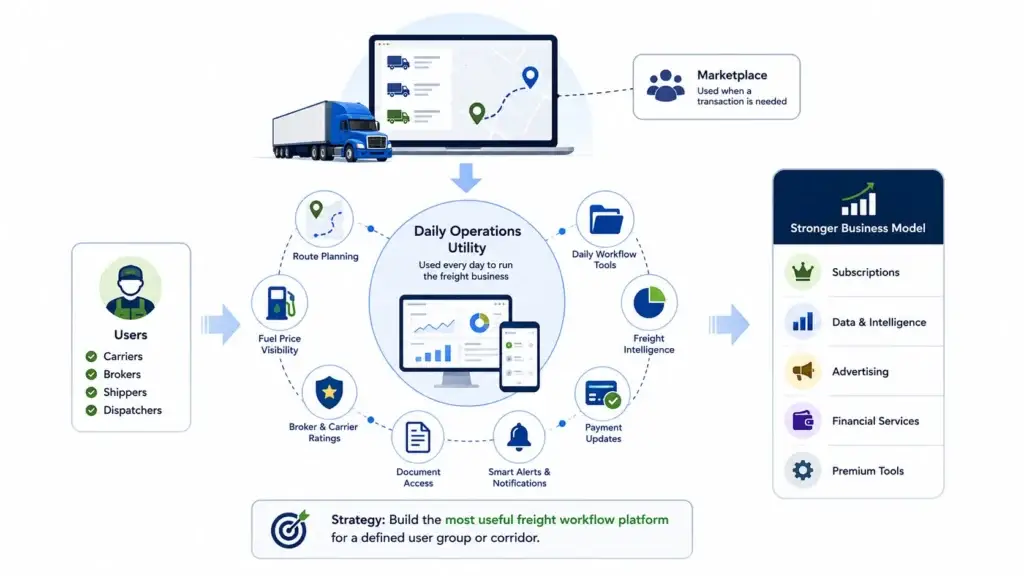
The stronger business model is built around daily freight operations.
A carrier may search for loads a few times a week, but they may need route planning, fuel price visibility, broker ratings, document access, alerts, payment updates, and freight intelligence much more often. A broker may post loads, but they also need carrier verification, rate management, dispatch visibility, invoice control, and performance reporting.
This is why successful freight marketplace apps often behave like a utility with a marketplace inside it.
A marketplace is used when someone needs a transaction. A utility is used repeatedly because it supports daily work. The more frequently users depend on the platform, the easier it becomes to monetize through subscriptions, data, advertising, financial services, and premium workflow tools.
For founders, this changes the product strategy. The goal should not be “build the biggest load list.” The goal should be “build the most useful freight workflow platform for a defined user group or corridor.”
Read More: Best Load Board Software 2026: Launch a Scalable Freight & Trucking Platform
The Core Users in a Load Board Marketplace
A freight marketplace becomes valuable only when it solves real problems for each participant. The monetization model should be designed around what each user is willing to pay for.
Shippers
Shippers need dependable access to transportation capacity. Their priorities include easy load posting, carrier discovery, shipment visibility, pricing clarity, and delivery reliability.
They may pay for:
- Load posting access
- Priority load visibility
- Carrier verification tools
- Shipment tracking
- Enterprise dashboards
- API integrations with internal logistics systems
Freight Brokers
Brokers need to cover loads quickly while protecting margins and maintaining service quality for customers. They care about verified carriers, lane pricing, fast communication, carrier availability, dispatch workflows, documents, invoices, and dispute records.
They may pay for:
- Unlimited or bulk load posting
- Premium carrier access
- Rate intelligence tools
- Carrier scorecards
- Team dashboards
- Workflow automation
Carriers and Owner-Operators
Carriers want profitable loads, reduced empty miles, trusted brokers, fast payment visibility, and better control over routes.
They may pay for:
- Advanced load search
- Lane alerts
- Truck posting
- Broker credit insights
- Rate benchmarks
- Factoring or quick-pay tools
- Fuel savings programs
Platform Admins
The business owner needs control over the entire marketplace, which is why working with a web app development company can be useful when the product requires admin dashboards, portals, analytics, and operational control panels. A strong admin panel should manage users, loads, bids, subscriptions, payments, commissions, documents, disputes, reports, content, notifications, and platform settings.
This control layer is critical because monetization depends on operational visibility. Without admin control, it becomes difficult to manage pricing plans, resolve disputes, approve users, detect abuse, or scale into new regions.
Freight Marketplace User Needs and Revenue Opportunities
| User Type | What They Need | How the Platform Can Monetize |
|---|---|---|
| Shippers | Fast carrier access, freight visibility, pricing clarity, delivery updates | Posting fees, enterprise plans, tracking tools, API access |
| Brokers | Carrier verification, load coverage, dispatch workflows, rate management | Subscription plans, bulk posting, premium tools, analytics |
| Carriers | Load discovery, route filters, broker trust, payment visibility | Search subscriptions, alerts, premium data, financial services |
| Admins | User control, payments, disputes, reporting, subscription management | Platform-wide monetization control and operational scaling |
The Main Revenue Streams of Load Board and Freight Marketplace Apps
A freight marketplace app can make money through several revenue streams. The right mix depends on whether the platform is designed as a simple listing board, a managed freight marketplace, a SaaS workflow tool, or a logistics intelligence platform.
1. Carrier Subscription Plans
Carrier subscriptions are one of the most common ways load board apps make money. Carriers pay a monthly or annual fee to access load search, saved searches, advanced filters, route-based matching, alerts, broker details, and premium tools.
This model works well when carriers use the platform regularly. If a carrier depends on the app to find loads, reduce empty miles, and compare opportunities, a subscription becomes easier to justify.
However, subscription revenue has a natural limit. Many small carriers are price-sensitive, and churn can increase when freight demand slows or when a carrier secures steady contract work outside the platform.
That is why subscription revenue should usually be treated as the foundation, not the entire business model.
A strong carrier subscription plan may include:
- Basic load search
- Advanced lane filters
- Truck posting
- Saved searches
- Real-time load alerts
- Broker profile access
- Document upload tools
- Premium rate insights
The key is to design pricing tiers carefully. Free access can help attract users, but the paid tier should unlock clear daily value.
2. Broker and Shipper Posting Fees
Brokers and shippers can be charged to post loads, boost visibility, access carriers, or use advanced dispatch tools. This revenue stream can be more stable than carrier subscriptions because brokers have a direct business reason to pay.
An uncovered load can create customer dissatisfaction, missed delivery deadlines, and lost revenue. Because of that, brokers are often willing to pay for faster load coverage, verified carrier access, and better visibility.
Posting fee models can include:
- Pay-per-load posting
- Monthly posting subscriptions
- Bulk posting packages
- Priority load visibility
- Featured broker accounts
- Team-based broker dashboards
For new freight marketplaces, broker monetization should be introduced carefully. If the platform does not yet have enough carrier density, brokers may not see enough value to pay. This is why many platforms first focus on building supply-side usage before aggressively monetizing demand-side users.
3. Promoted Listings and Featured Loads
Promoted listings allow brokers or shippers to make specific loads more visible to carriers. This can work well when the platform has enough traffic and search activity.
A promoted listing may appear higher in search results, be highlighted with a badge, or be sent through priority alerts to relevant carriers. This gives brokers a faster way to attract attention when a load is urgent or difficult to cover.
Common promoted listing options include:
- Featured load placement
- Urgent load badges
- Priority lane alerts
- Top-of-search visibility
- Sponsored broker profiles
This model is attractive because it can generate high-margin revenue without changing the core marketplace workflow. But it should not damage search quality. If paid placements make results less relevant, carriers may lose trust in the platform.
4. Transaction Commissions
A freight marketplace can also make money by taking a commission from completed bookings. This model works when the platform is involved in the transaction rather than only connecting users.
For example, the platform may support digital booking, rate confirmation, shipment status, proof of delivery, invoicing, and payment settlement. In return, it can charge a percentage of the freight value or a fixed transaction fee.
This model can generate higher revenue per booking, but it also creates more operational responsibility.
A commission-based freight marketplace may need to manage:
- Booking confirmation
- Payment collection
- Carrier settlement
- Dispute handling
- Cancellation rules
- Document verification
- Fraud monitoring
The strategic risk is that a commission model can make the platform feel like a broker competitor. If brokers believe the platform is competing with them, they may reduce their listings or move activity elsewhere.
For founders, commission revenue should be treated as a strategic decision, not just a pricing feature.
5. Premium Data and Freight Analytics
Data is one of the most valuable revenue streams in a mature load board marketplace.
Every search, post, bid, route, shipment, payment record, and interaction creates operational data. Over time, the platform can use this data to provide insights to carriers, brokers, shippers, and enterprise logistics teams.
Freight data products may include:
- Lane rate benchmarks
- Capacity density insights
- Broker payment behavior
- Days-to-pay information
- Seasonal demand patterns
- Carrier availability by corridor
- Dwell time and facility performance insights
- Market pricing dashboards
This revenue stream can be highly attractive because the data is generated through normal platform activity. Once the data infrastructure exists, the same insights can support multiple paid products.
For carriers, data helps with negotiation and route planning. For brokers, it supports pricing and coverage decisions. For enterprise shippers, it can improve planning, benchmarking, and procurement strategy.
This is why a founder should think about data capture from the first version of the product, even if data monetization comes later.
6. Advertising and Vendor Partnerships
A freight marketplace with daily carrier engagement can become a powerful distribution channel for businesses selling to trucking professionals.
Vendors may pay to advertise or partner with the platform because the audience is specific, active, and commercially relevant.
Potential advertising and partnership categories include:
- Fuel cards
- Insurance providers
- Factoring companies
- Truck maintenance services
- Tire and parts suppliers
- Truck stops
- ELD and compliance tools
- Route planning and telematics providers
This model works best when the platform is used frequently. If users only visit occasionally, advertising value stays limited. But if carriers open the app daily for loads, alerts, routes, fuel, or documents, the platform can sell highly targeted visibility.
The important rule is relevance. Advertising should support the user journey, not interrupt it.
7. Embedded Financial Services
Embedded financial services can become one of the strongest expansion paths for freight marketplace apps.
Carriers often pay fuel, driver, maintenance, and operating costs before they receive freight payments. This creates cash flow pressure. A platform that understands the load, broker, delivery status, and invoice history can support financial products more intelligently than a generic provider.
Common embedded financial services include:
- Invoice factoring
- Quick pay
- Fuel card programs
- Insurance distribution
- Equipment financing referrals
- Payment protection tools
These services can improve retention because they become part of the carrier’s operating workflow. A carrier that uses the platform for load discovery, payment visibility, and financing has more reasons to stay.
This is a major reason why the subscription should not be viewed as the final monetization layer. It can be the acquisition path for a customer who later adopts higher-value services.
How Pricing Tiers Should Be Designed
Pricing tiers should guide users from basic access to deeper operational value.
A common mistake is to create vague “basic, standard, premium” plans without tying each tier to a real job. Freight users do not pay for labels. They pay for outcomes: faster load discovery, better rates, trusted brokers, easier dispatch, and stronger visibility.
A smarter pricing structure may look like this:
| Tier | What It Includes | Business Purpose |
|---|---|---|
| Free | Basic search, limited listings, and profile access | Builds user habit and demonstrates marketplace activity before asking users to pay |
| Entry Paid | Saved searches, real-time alerts, full filters, and truck posting | Converts users who need daily load discovery and faster access to relevant freight |
| Professional | Rate benchmarks, broker insights, and lane analytics | Helps carriers and brokers make better pricing, negotiation, and route decisions |
| Fleet | Multi-user access, dispatch controls, truck assignment, and reporting | Supports fleet teams that need operational visibility across drivers, trucks, and loads |
| Enterprise | API access, bulk data, custom dashboards, and dedicated support | Serves brokers, shippers, and logistics companies that need scalable integrations and advanced data access |
The best upgrade triggers are tied to workflow pain. Alerts, saved searches, rate intelligence, broker trust data, and dispatch controls are strong paid features because they directly influence freight decisions.
Founder Decision Signals for a Freight Marketplace App
Speed
If your market already has active carriers and brokers, a ready-made load board foundation can help you launch faster instead of building every workflow from zero.
Monetization
If you plan to earn beyond subscriptions, your platform should support premium listings, analytics, commissions, financial integrations, and admin-controlled pricing plans.
Liquidity
If carriers cannot find relevant loads by corridor, they will leave. Focus on dense regional or vertical liquidity before trying to scale nationally.
Trust
Verification, documents, tracking, reviews, fraud controls, and dispute workflows are not optional. Trust decides whether users return and transact.
Key Metrics That Decide Load Board Profitability
These metrics help founders understand whether a load board marketplace is creating real liquidity, trusted matches, and repeat usage — not just collecting listings.
1. Corridor-Level Liquidity
What it measures:
Loads and active carriers by lane, route, region, or freight corridor.
Why it matters:
This shows whether the marketplace actually works where users operate. A platform may look strong at a national level, but if a specific corridor has too few active loads or carriers, users in that lane will still experience poor marketplace value.
2. Fill Rate
What it measures:
The percentage of posted loads that get successfully covered by carriers.
Why it matters:
Fill rate directly affects whether brokers and shippers keep using the platform. If posted loads do not get covered, demand-side users lose confidence and may return to phone calls, email networks, or competing load boards.
3. Time to Cover
What it measures:
How long it takes for a posted load to be matched, accepted, or booked by a carrier.
Why it matters:
Speed is one of the strongest value signals in a freight marketplace. The faster a platform helps brokers cover loads and carriers find freight, the more useful the marketplace becomes in daily operations.
4. Search-to-Contact Rate
What it measures:
How many load searches result in a real action, such as an inquiry, call, bid, message, or booking request.
Why it matters:
This separates real matching quality from simple listing volume. A marketplace with thousands of listings may still perform poorly if users do not contact each other after searching.
5. Listing Freshness
What it measures:
How many visible loads are still available, accurate, and relevant at the time users view them.
Why it matters:
Stale or duplicate listings damage trust quickly. Carriers need confidence that the loads they see are real, active, and worth pursuing.
6. DAU/MAU Ratio
What it measures:
The ratio of daily active users to monthly active users.
Why it matters:
This shows whether the platform has daily utility value. A high DAU/MAU ratio means users are returning frequently, which supports subscriptions, alerts, advertising, financial services, and premium tools.
7. Multi-Product Adoption
What it measures:
How many users adopt more than one paid feature or service, such as subscriptions, rate insights, promoted listings, factoring, fuel cards, or premium analytics.
Why it matters:
Multi-product adoption drives stronger unit economics and retention. A carrier who only uses load search may churn faster, but a carrier using search, alerts, payment tools, and fuel programs has more reasons to stay with the platform.
Corridor-level liquidity is especially important. A national average can hide the truth. A platform may look healthy overall but still fail for users in specific lanes. Freight marketplaces grow better when they dominate defined corridors or verticals before expanding too broadly.
What Features Support a Strong Revenue Model?
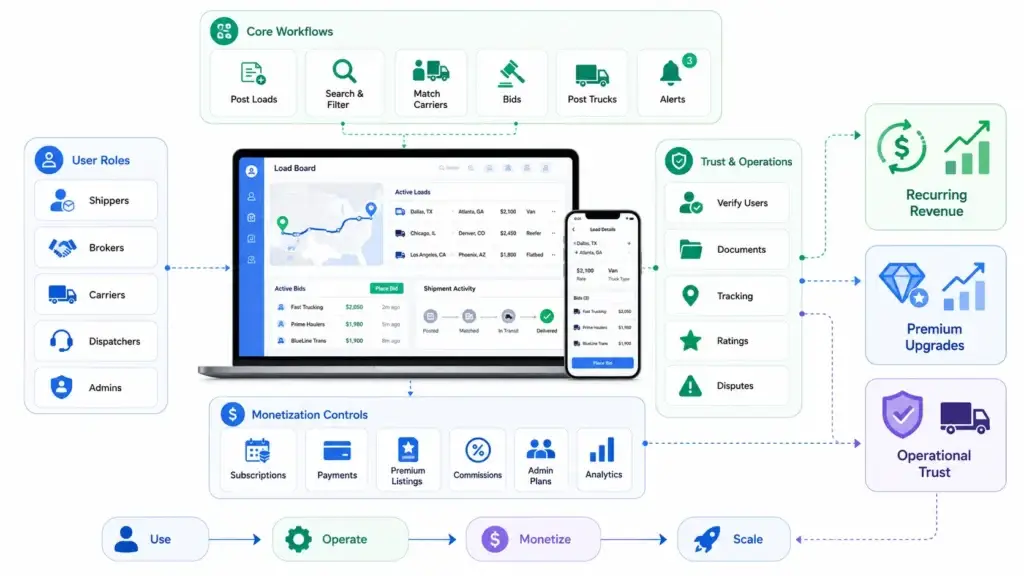
The right features make the monetization model easier to execute. A load board app does not need every advanced tool from day one, but it should be built with a clear path toward recurring revenue, premium upgrades, and operational trust.
Core features may include:
- User registration for shippers, brokers, carriers, dispatchers, and admins
- Load posting with pickup, drop, dates, equipment type, weight, and rate fields
- Advanced search and filtering by lane, location, equipment, date, and price
- Carrier matching based on availability, truck type, region, and preferences
- Bidding or negotiation workflows
- Truck posting for available carrier capacity
- Real-time alerts and notifications
- Broker and carrier verification
- Document upload for rate confirmation, invoice, proof of delivery, and insurance
- Shipment tracking and status updates
- Ratings, reviews, and dispute management
- Subscription and payment gateway integration
- Admin dashboard for users, loads, payments, plans, reports, and disputes
- Analytics for rates, lanes, activity, and platform performance
Miracuves’ load board marketplace development approach focuses on combining these operational workflows with monetization-ready controls, so founders can manage subscriptions, commissions, premium listings, and user activity from the backend.
Why Trust and Verification Matter in Freight Monetization
Trust is not just a safety feature in freight marketplace apps. It directly affects revenue.
If carriers do not trust brokers, they will hesitate to accept loads. If brokers do not trust carriers, they will avoid posting valuable freight. If listings are stale or documents are missing, both sides lose confidence.
A freight marketplace should include practical trust features such as:
- Carrier verification
- Broker verification
- Insurance and authority document uploads
- Role-based access control
- Activity logs
- Secure payment gateway integration
- Dispute management
- Fraud monitoring signals
- Admin approval workflows
- Ratings and reviews
For regulated or documentation-heavy logistics markets, the platform should be designed as a compliance-ready foundation. Final compliance depends on jurisdiction, legal review, integrations, and the operating model, but the product should support the workflows needed to manage verification and operational risk.
Common Mistakes Founders Should Avoid
Launching as a Pure Marketplace Without Standalone Value
Carriers will not stay if there are no useful loads, and brokers will not post if there are no active carriers. Utility features such as alerts, truck posting, route tools, broker insights, and payment visibility can help create value before full liquidity is achieved.
Expanding Too Broadly Before Winning a Corridor
A national launch with thin activity everywhere creates a weak experience for everyone. It is often better to win a specific region, lane, equipment category, or freight vertical before expanding.
Competing Only on Listing Volume
More listings do not always mean more value. Duplicate, outdated, or irrelevant loads can reduce trust and make search results worse. Freshness and match quality matter more than inflated volume.
Charging Before Users See Clear Value
Monetizing too early can reduce adoption and anchor the platform at a low perceived value. The better path is to prove marketplace usefulness, then introduce paid tools tied to real workflow benefits.
How a New Freight Marketplace Can Enter the Market
A new load board business does not need to compete with every large freight platform immediately, especially if the founder is studying models like an Uber Freight clone script to understand digital freight matching, carrier workflows, and platform monetization. In fact, trying to serve everyone from the start can weaken the product.
A stronger entry strategy may focus on one of these paths:
1. Win a Specific Freight Corridor
Instead of launching nationally, the platform can focus on a specific lane or region where brokers and carriers have repeated needs. Strong density in one corridor is more valuable than weak coverage everywhere.
2. Focus on a Specialized Freight Category
Some freight types need specialized workflows. Examples include refrigerated freight, flatbed, auto transport, hazmat, construction material, local delivery, or cross-border freight. A focused platform can serve these segments better than a generalist board.
3. Build Utility Features First
A platform can attract carriers through daily-use tools before full marketplace liquidity exists. Useful features may include alerts, route planning, document storage, broker notes, payment visibility, and truck availability posting.
4. Partner With Brokers or Fleets
Anchor users can help create initial activity. A few committed brokers or regional fleets can make the platform useful enough for early adoption.
5. Add Premium Tools Gradually
Once users are active, the platform can introduce paid layers such as rate intelligence, featured listings, subscriptions, API access, and financial services.
How Miracuves Helps Build Load Board and Freight Marketplace Apps
Building a freight marketplace from zero can take significant time because the product needs multiple workflows working together: load posting, carrier matching, bidding, search, tracking, documents, payments, analytics, subscriptions, admin control, and full stack app development support across frontend, backend, database, and deployment layers.
A ready-made solution from Miracuves can help founders start with a launch-ready foundation and customize it for their business model, region, user roles, branding, and monetization strategy.
Miracuves can support freight marketplace platforms with:
- White-label branding
- Source-code-owned setup
- Load posting and search workflows
- Carrier and broker panels
- Admin dashboard
- Subscription and payment modules
- Commission and premium listing options
- Tracking and notification workflows
- Document upload and management
- Scalable backend foundation
For founders planning to launch faster, Miracuves offers a practical path to test a load board business model without building every module from zero.
Final Thoughts: A Profitable Load Board Is More Than a Listing Platform
A load board or freight marketplace app becomes profitable when it does more than display available loads. The strongest platforms reduce empty miles, improve carrier discovery, speed up load coverage, support trusted transactions, and create daily operational value for users.
Subscriptions and posting fees can create predictable revenue, but long-term growth usually comes from premium data, workflow tools, promoted visibility, financial services, and deeper platform adoption.
For founders, the smarter goal is not simply to build the largest board. It is to build a trusted freight marketplace where carriers, brokers, and shippers return because the platform helps them make better decisions and complete work faster.
A ready-made load board solution from Miracuves can help founders move from concept to launch faster, while keeping control over branding, monetization, admin workflows, and future customization through a focused logistics app development approach.
FAQs
How do freight marketplace apps make money?
Through six streams: carrier subscriptions, broker posting fees, data and analytics, transaction commissions in managed models, advertising from vendors selling to carriers, and embedded financial services such as factoring and fuel cards. Data and financial services typically carry the highest margins — the marketplace function itself frequently does not.
Which revenue stream is most profitable?
Data and analytics. Rate, capacity, and payment-behavior data is generated as a by-product of normal platform operation, costs almost nothing incremental to produce, and can be sold repeatedly to carriers, brokers, and enterprises. Its value increases with scale while its cost stays flat.
How much is a carrier worth to a freight platform?
On subscription alone, roughly a few hundred dollars in lifetime gross profit over about fourteen months of retention. The same carrier using premium data, a fuel card, and factoring can generate four to five times the monthly contribution at identical acquisition cost — and typically retains far longer, because financial relationships create genuine switching costs.
Why do load board platforms give away free features?
Free utility features — parking, fuel prices, truck-legal routing — build a daily usage habit and acquire the carrier side before marketplace liquidity exists. That habit is what makes advertising and financial services viable, and it solves the cold-start problem from one side rather than trying to build both simultaneously.
What is the cold-start problem in freight marketplaces?
Carriers will not use a platform with no loads, and brokers will not post where there are no carriers. Freight makes this harder because liquidity must be local — density in a specific corridor matters far more than national coverage, so a thin national launch fails everywhere at once.
What metrics should a freight marketplace track?
Liquidity ratio measured per corridor, fill rate, time to cover, search-to-contact rate, listing freshness, daily-to-monthly active ratio, and multi-product adoption. Corridor-level liquidity is the most important and the most commonly misreported, because national averages conceal lanes where the product does not work.
Should a new platform charge commission on transactions?
It produces the highest revenue per transaction but adds payment risk, dispute handling, and settlement operations — and repositions the platform as a competitor to the brokers supplying its listings. Some have made it work, but it requires accepting that broker-supplied liquidity will eventually decline. It is a strategy decision, not a pricing one.
How should pricing tiers be structured?
Free search to build the habit, an entry paid tier adding alerts and saved searches, a professional tier adding rate benchmarking and broker credit data, a fleet tier adding seats and dispatch control, and enterprise for bulk data and integrations. Keeping alerts out of the free tier preserves the clearest upgrade trigger.