
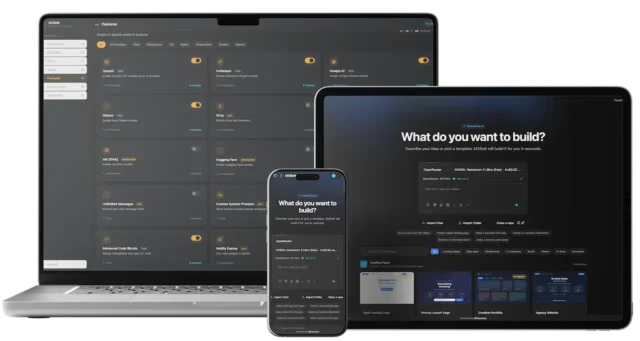
Pinduoduo Clone App - White-Label Group-Buying & Social Commerce Platform
Group Buying, Merchant Storefronts and Cross-Border From Day One
Launch a white-label Pinduoduo Clone: a marketplace where shoppers buy together, merchants run their own storefronts, and the retention loop is part of the product rather than a campaign.
Go Live in 6 Days with Group BuyingLive CommerceMulti-VendorGamifiedCross-BorderWhite-Label
⚡ Platform at a Glance
6
Revenue Levers
commission, merchant subscriptions, coupons, featured listings, sponsored live, licensing
7
Currencies, Live FX
cross-border pricing with live conversion from day one
3
Surfaces, One Codebase
shopper app, merchant portal and admin console
0
Revenue Share
you own the source outright, with no per-seat fee
Group Buying as a Real Domain
Not a discount flag: three dedicated group models with their own lifecycle, so team deals behave the way shoppers already expect.
Retention Built In, Not Bought
Daily check-in, an eight-segment spin wheel and streaks bring shoppers back without paying to re-acquire them.
🚀 Ready to launch your own group-buying marketplace?








Live in Action
Pinduoduo Clone Demo - Shopper App, Merchant Portal, Admin Console & Android App
Don’t just take our word for it – open the Miracuves Pinduoduo Clone yourself. Four live environments with real credentials for every role, no setup required. Explore each product layer before you commit.
SHOPPER WEB APP
The Buyer Surface
Sign in as a shopper and move through browsing, group buys, live streams, wallet and the rewards hub exactly as your audience will.
-
Open the web app in your browser
-
Login with the demo credentials below
-
Explore: Group buys, Flash sales, Live, Rewards
-
Try: user1@mxpdd.com | Demo@123
MERCHANT PORTAL
Where Sellers Run Campaigns
Sign in as a merchant to see the ten-section portal - the surfaces that decide whether sellers can operate without your engineering team.
-
Open the merchant portal in your browser
-
Login with the demo credentials below
-
Explore: Products, Group buys, Coupons, Orders
-
Try: merchant1@mxpdd.com | Demo@123
ADMIN CONSOLE
Run It Without a Dev Team
Sign in as an operator to work the twelve admin sections - users, merchants, catalogue, orders, campaigns, plans and analytics.
-
Open the admin panel in your browser
-
Login with the demo credentials below
-
Explore: Merchants, Orders, Coupons, Demand
-
Try: admin@mxpdd.com | Demo@123
ANDROID APP
Native on Mobile
Install the branded Android build - the same feature set as web, wrapped natively through Capacitor 8 with a mobile-first bottom navigation.
-
Download the app to your Android device
-
Login with the demo credentials below
-
Explore: Group buys, Cart, Wallet, Rewards
-
Try: user1@mxpdd.com | Demo@123
Watch It Work
Pinduoduo Clone Video Demo: Group Buying, Live Commerce & Admin Walkthrough
Want a guided tour? Book a 30-minute call with our team and map your marketplace launch – campaign mechanics, merchant onboarding, monetization model and go-live timeline.
Every Screen Mapped
Pinduoduo Clone App Flows - Shopper, Merchant, Admin & Mobile Screens
Thirty-nine routes across three role journeys – seventeen shopper pages, ten merchant sections and twelve admin sections. Every screen below is shipped, not a mockup.

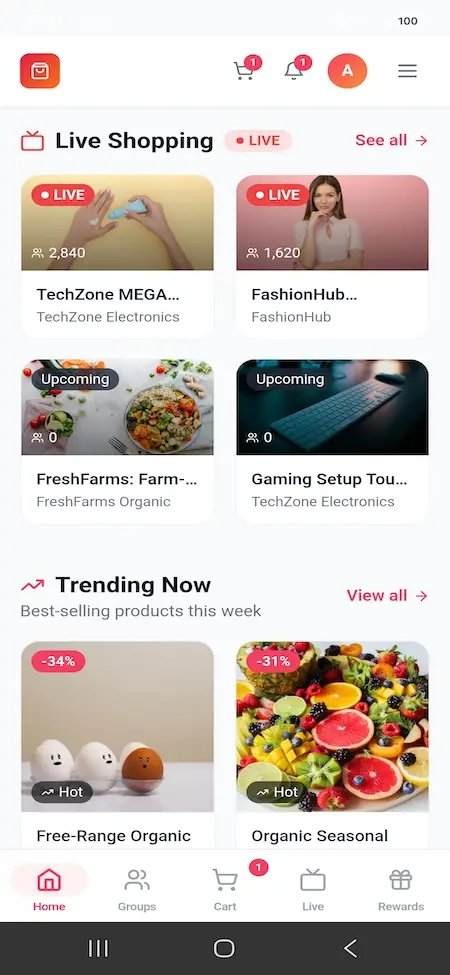
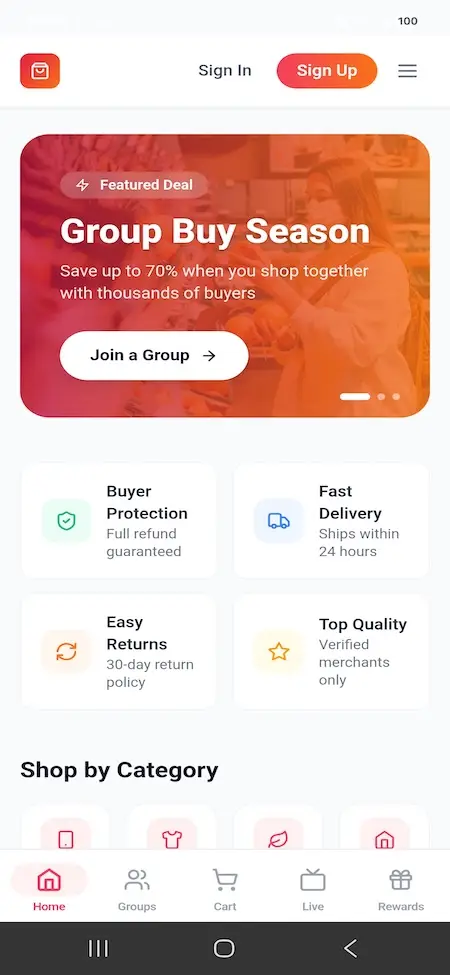
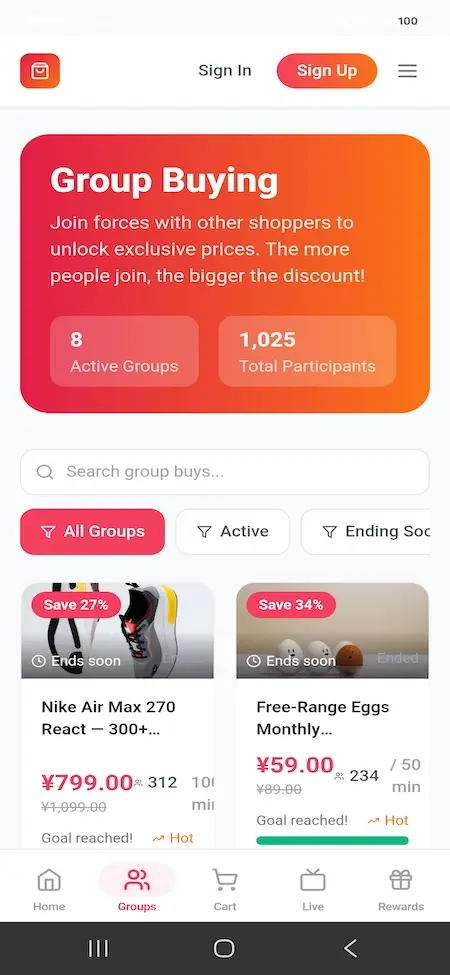
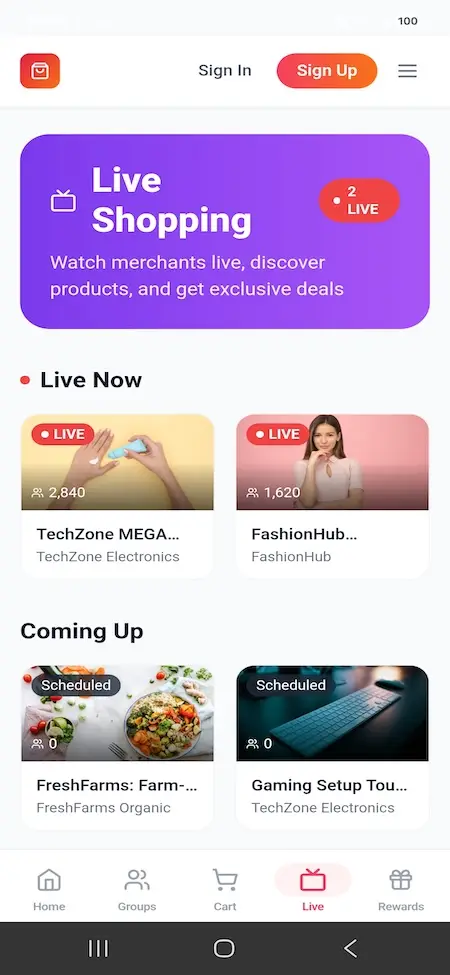
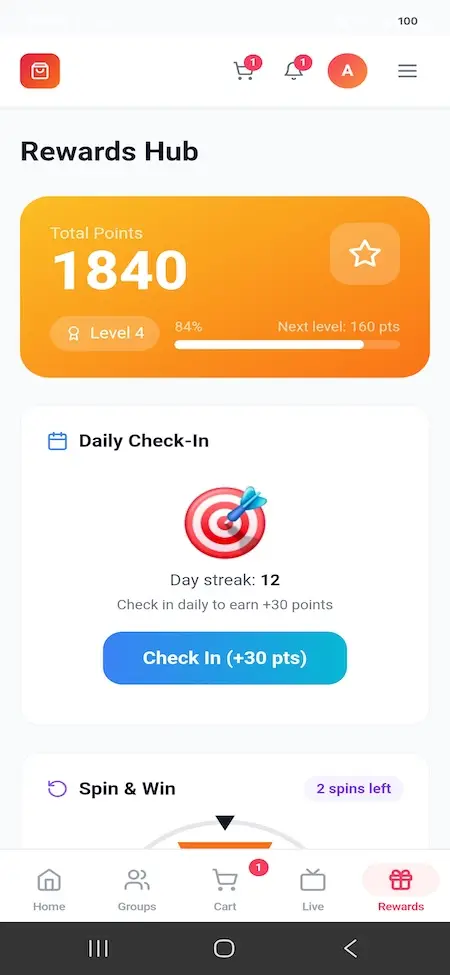
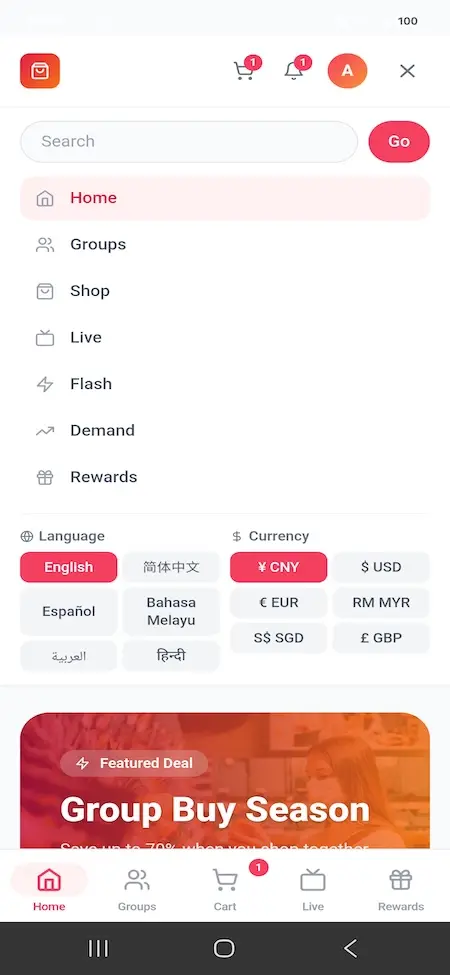
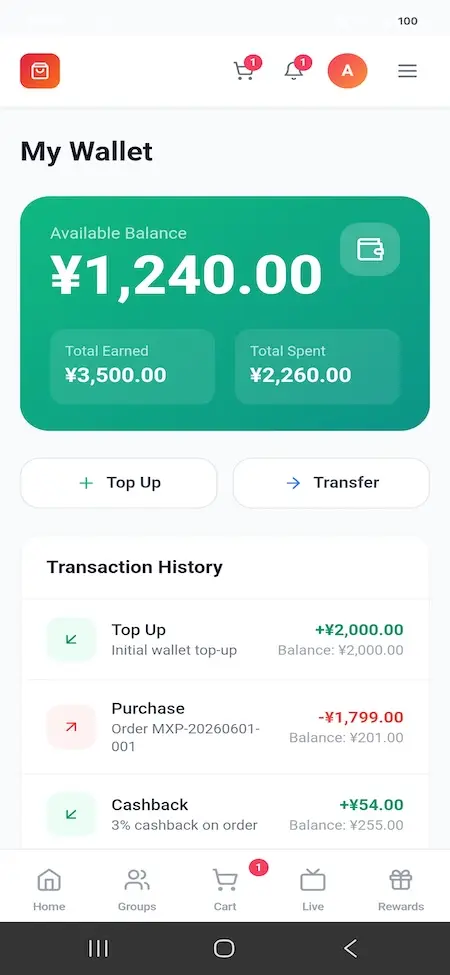
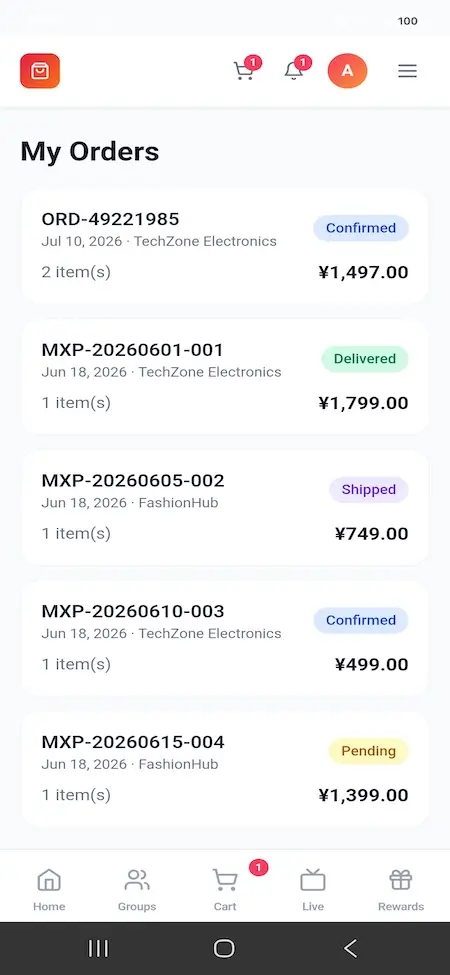
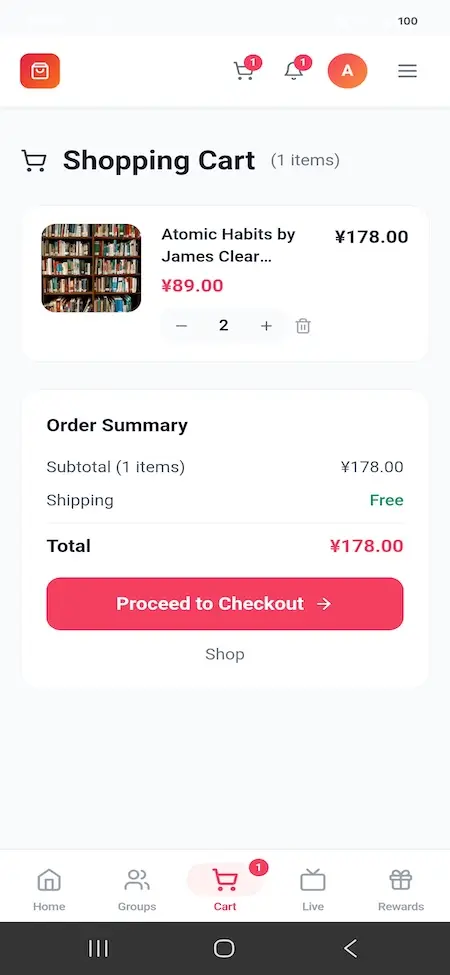
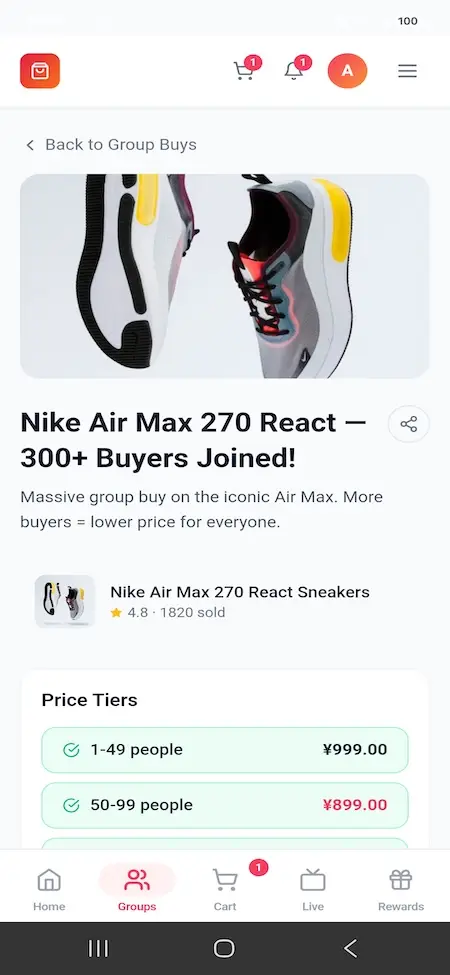
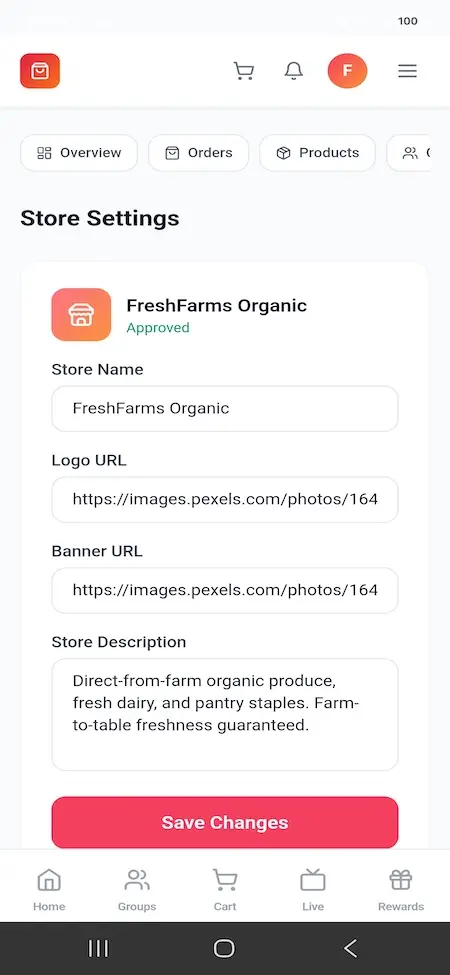
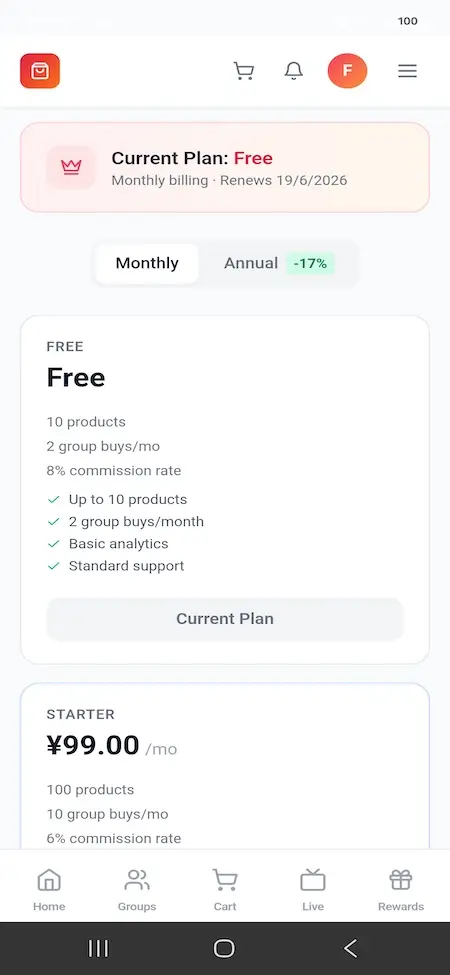
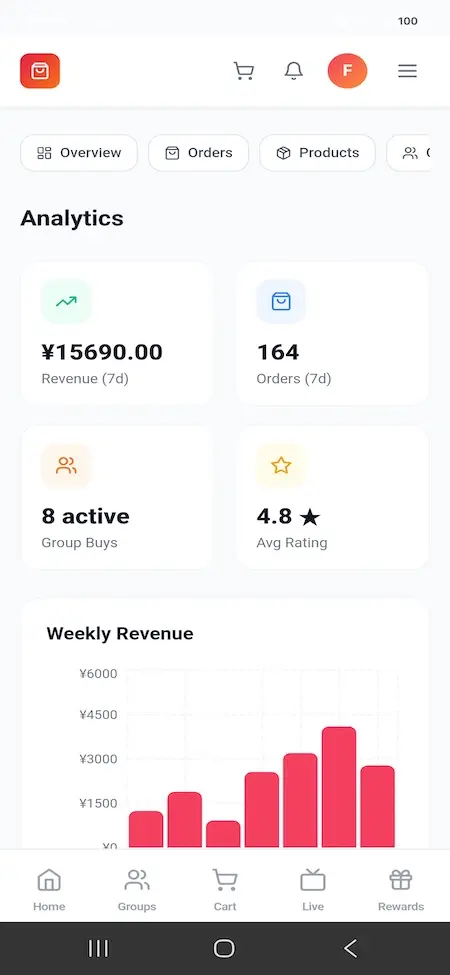
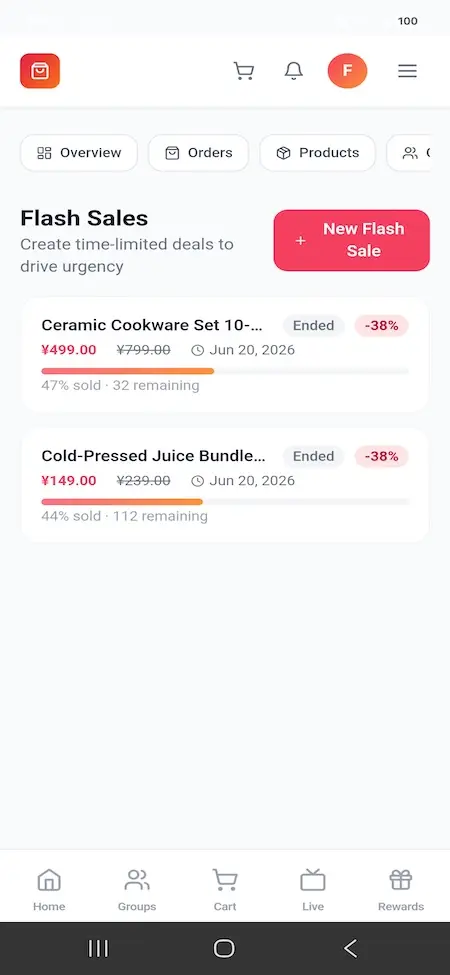
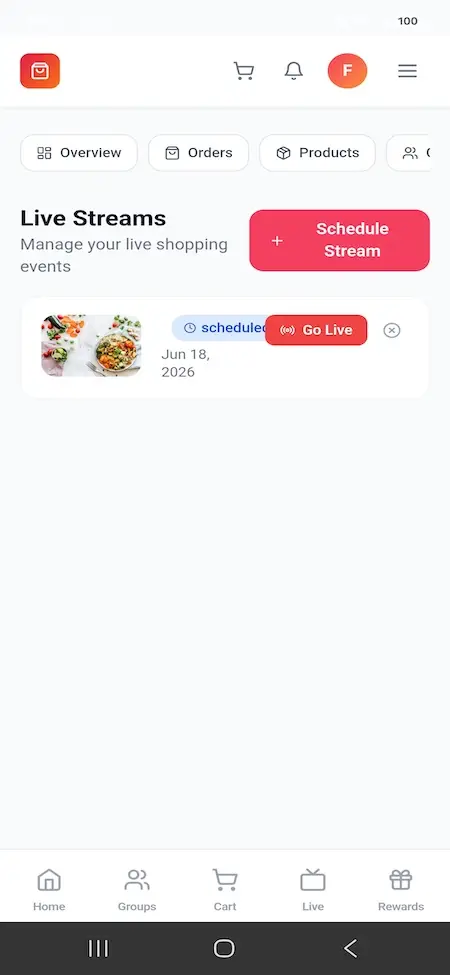
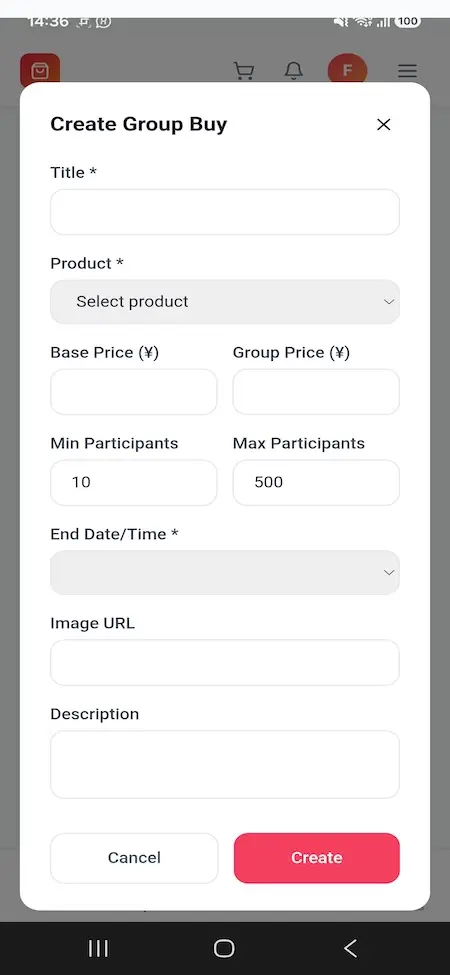
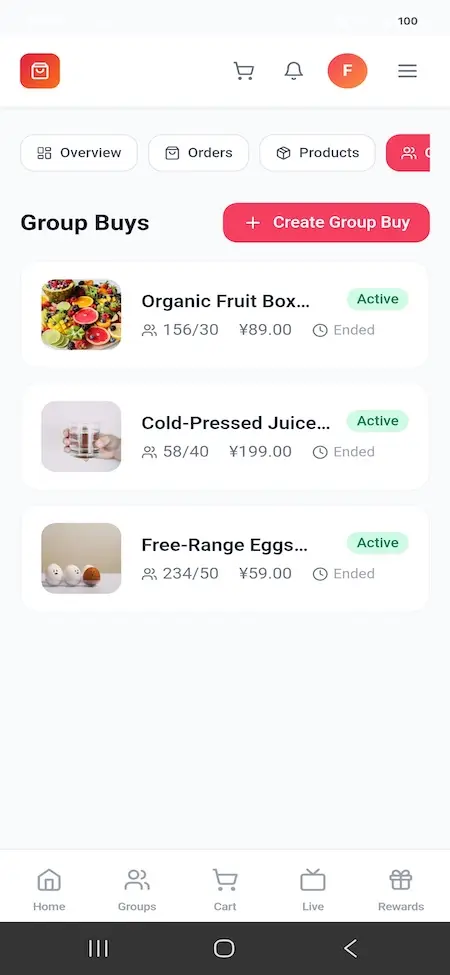
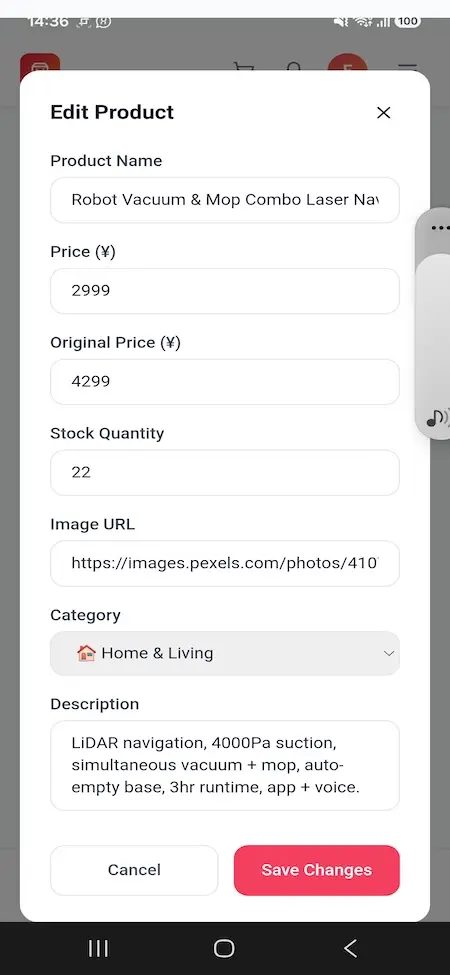
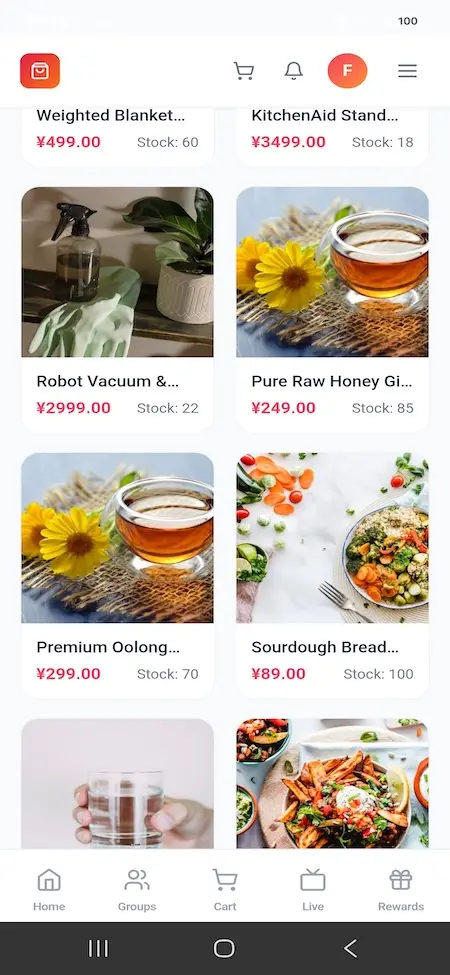
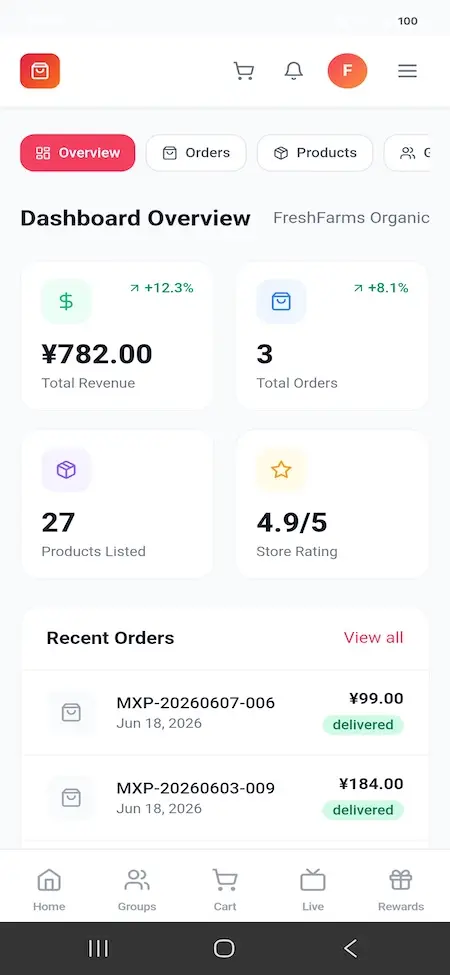
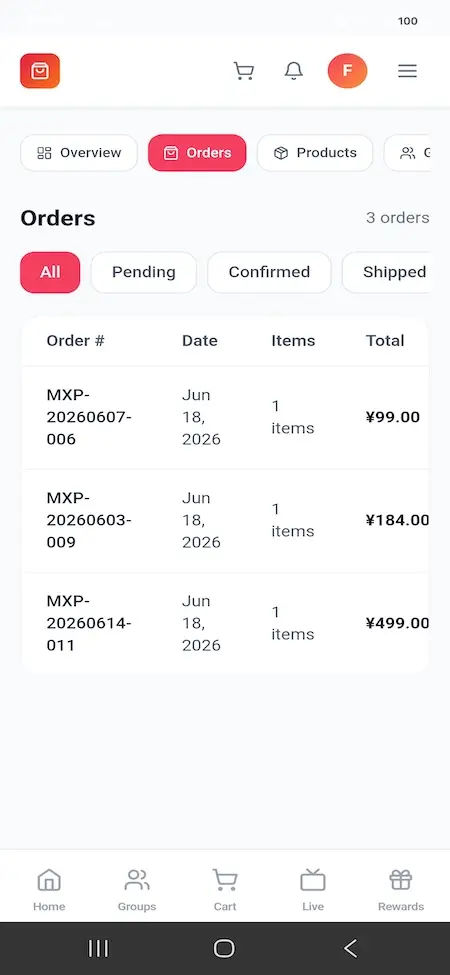
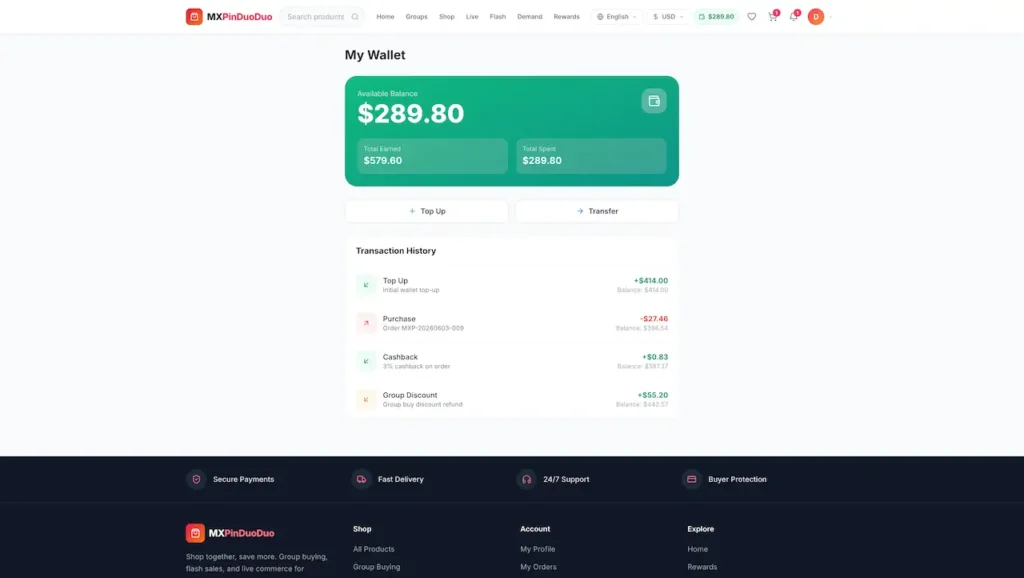
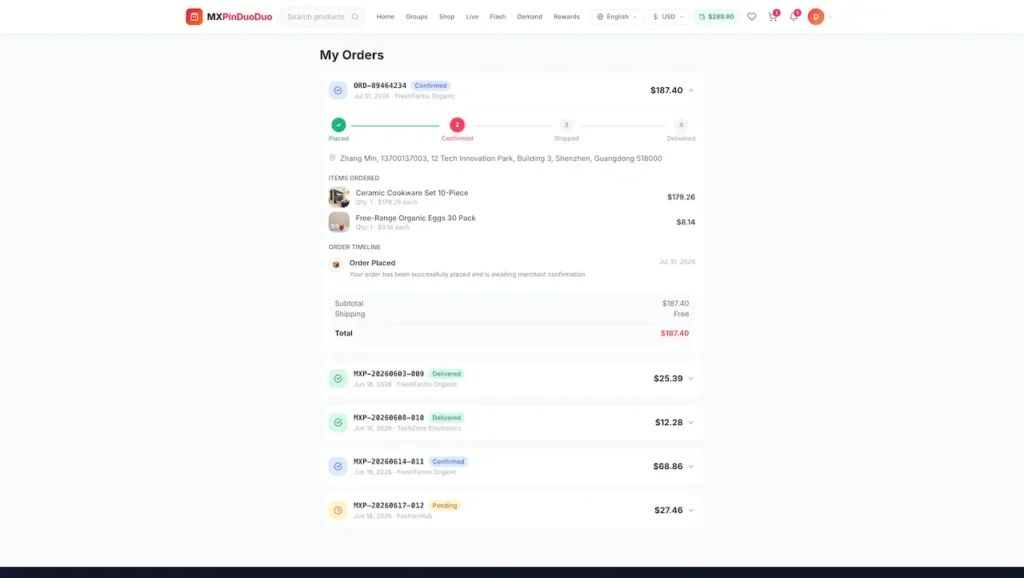
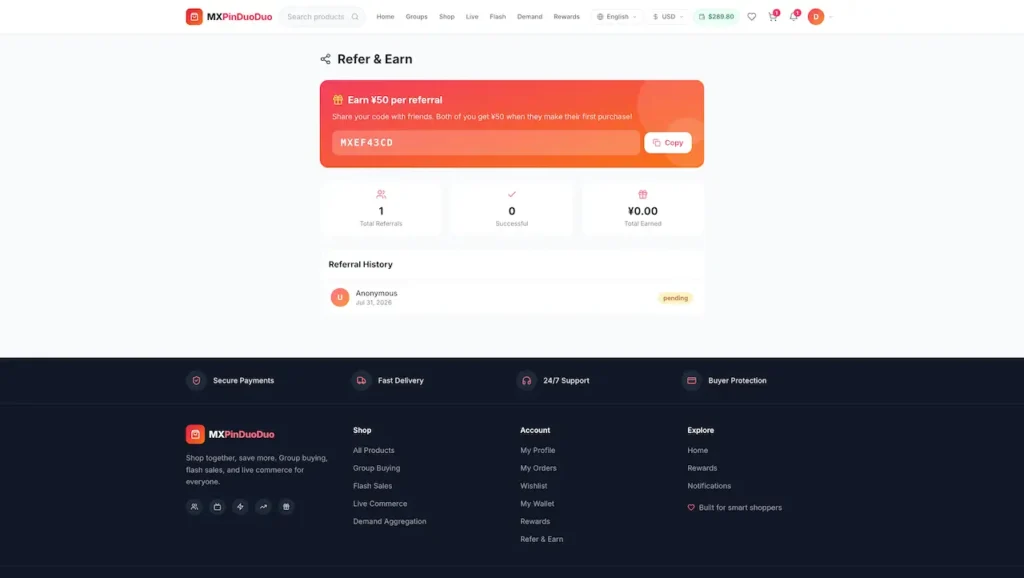
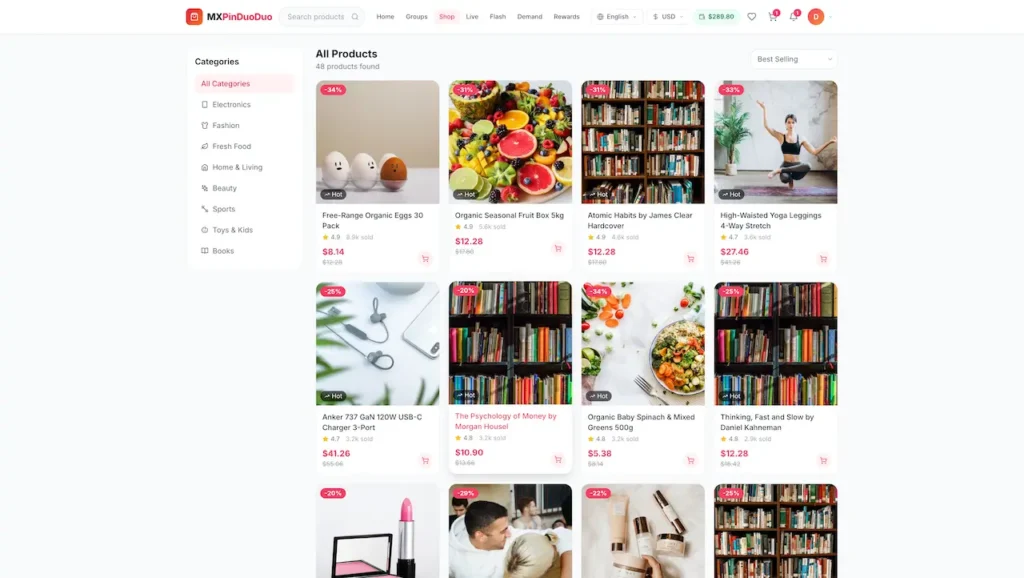
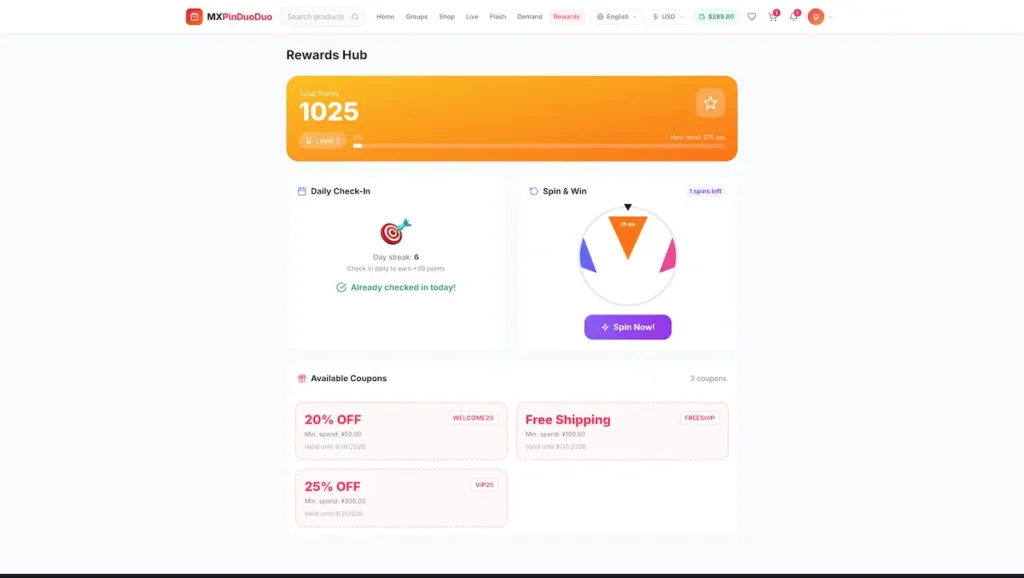
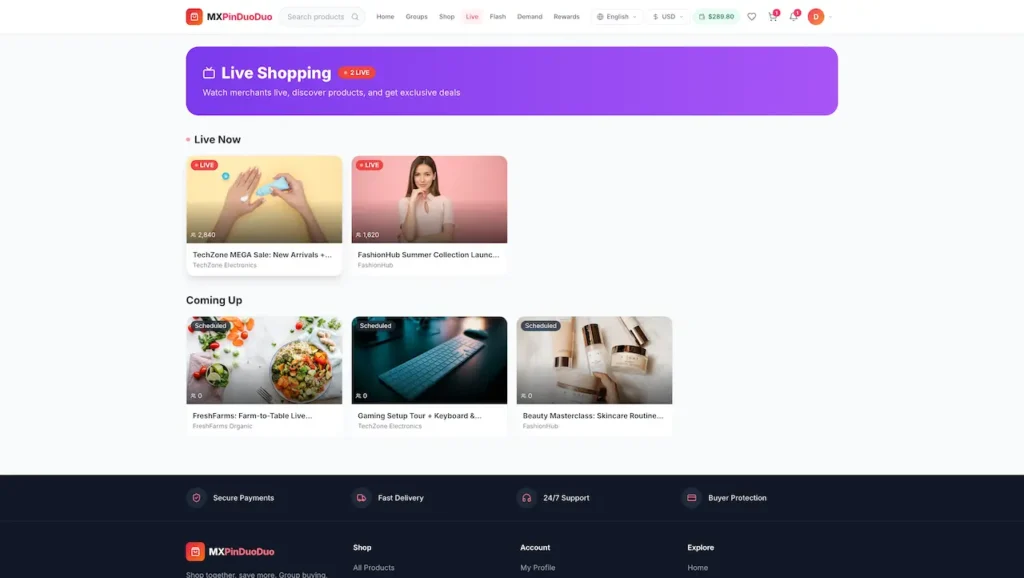
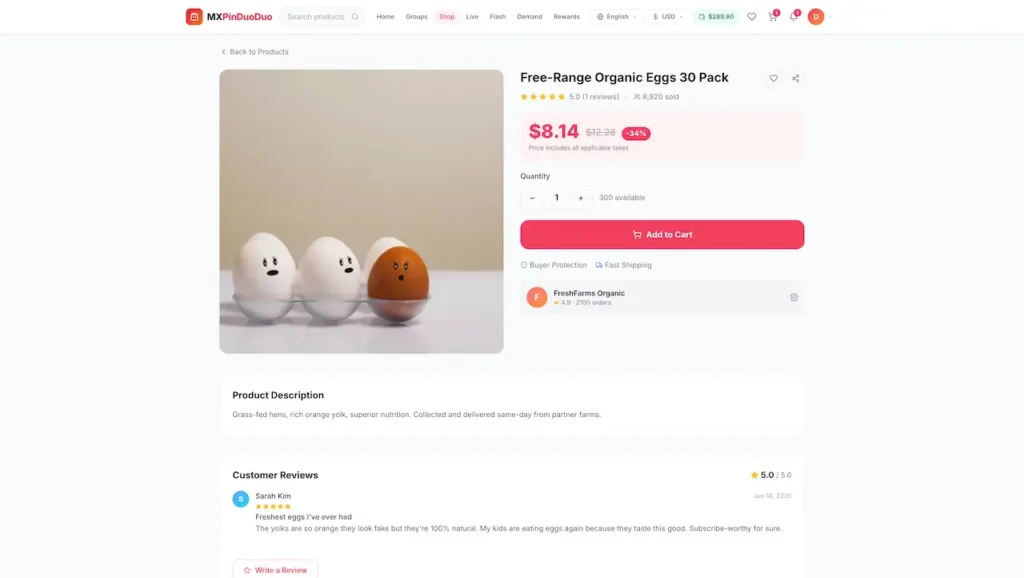
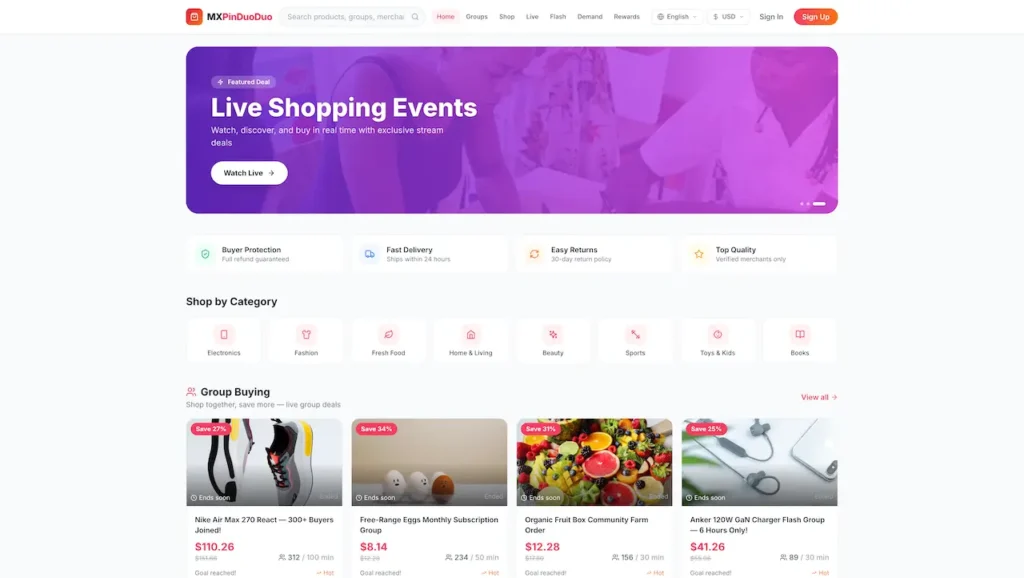
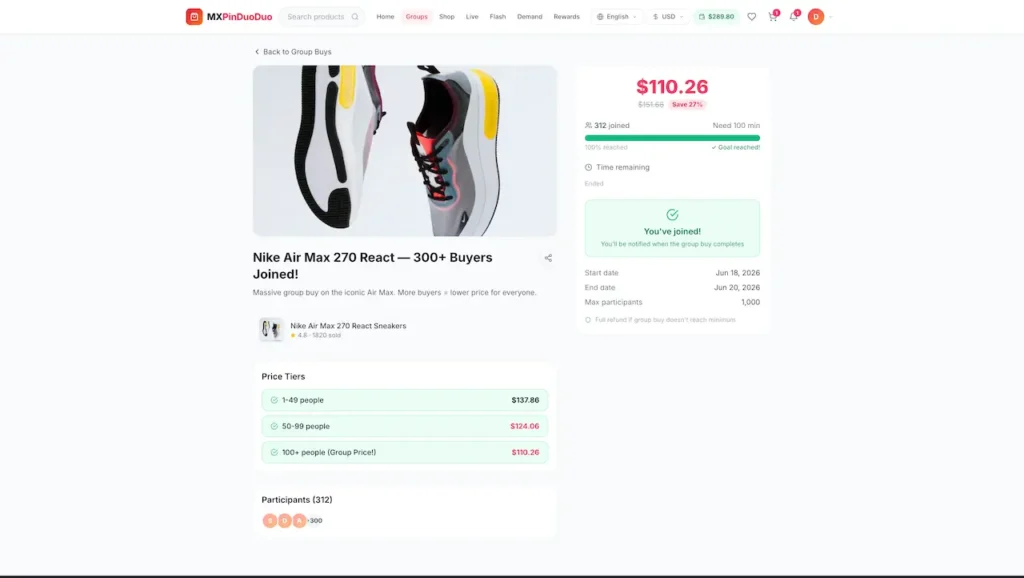
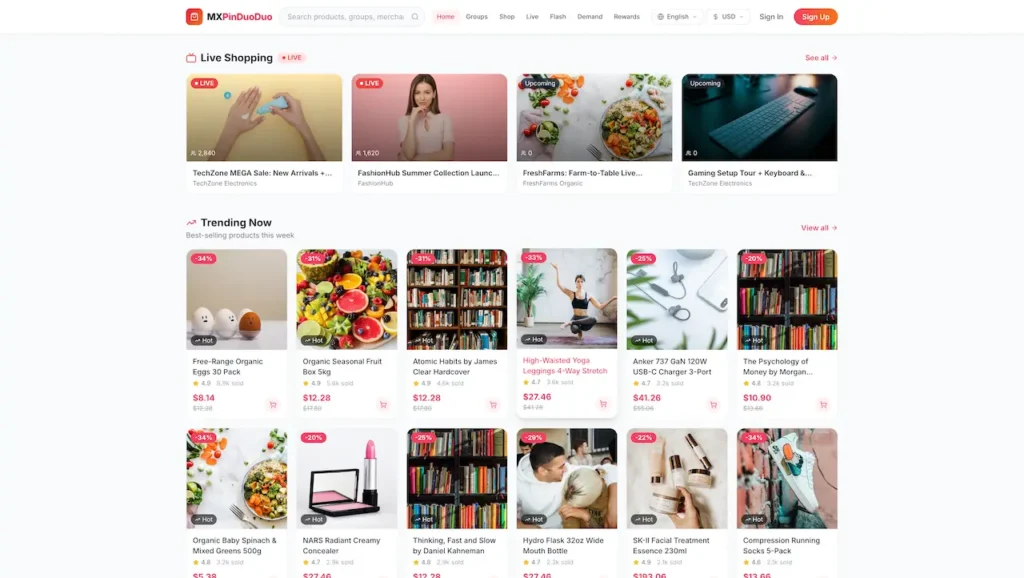
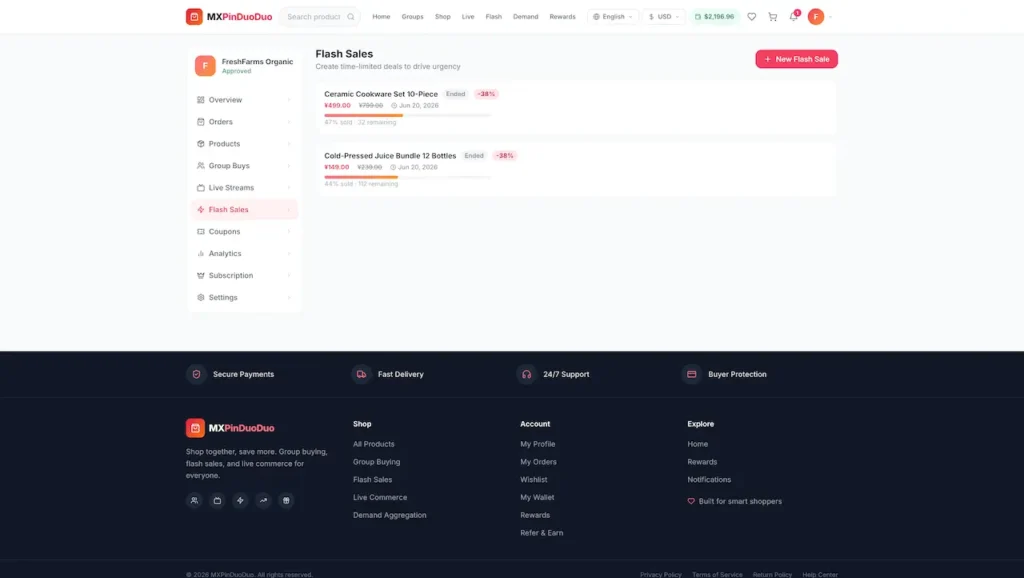
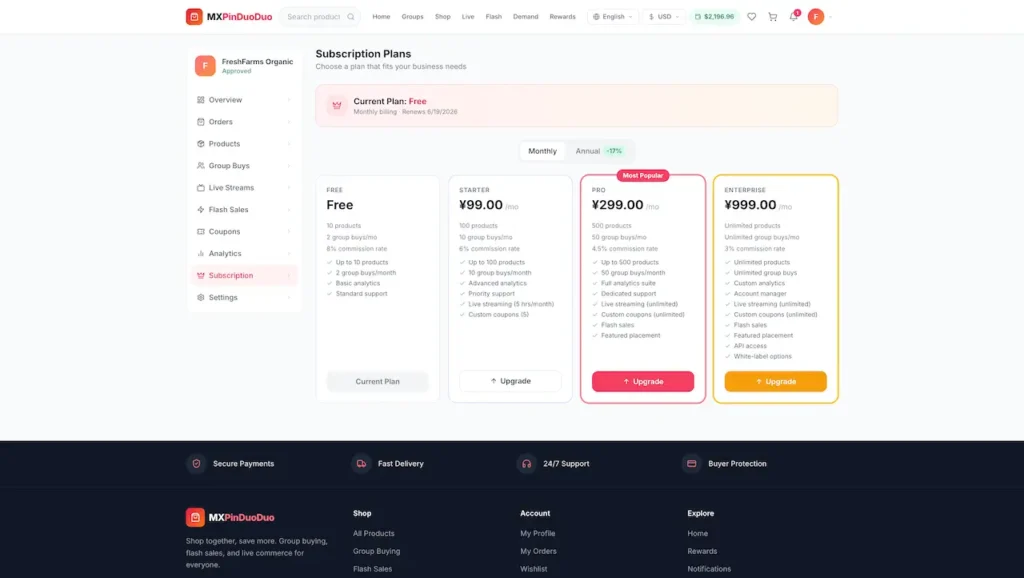
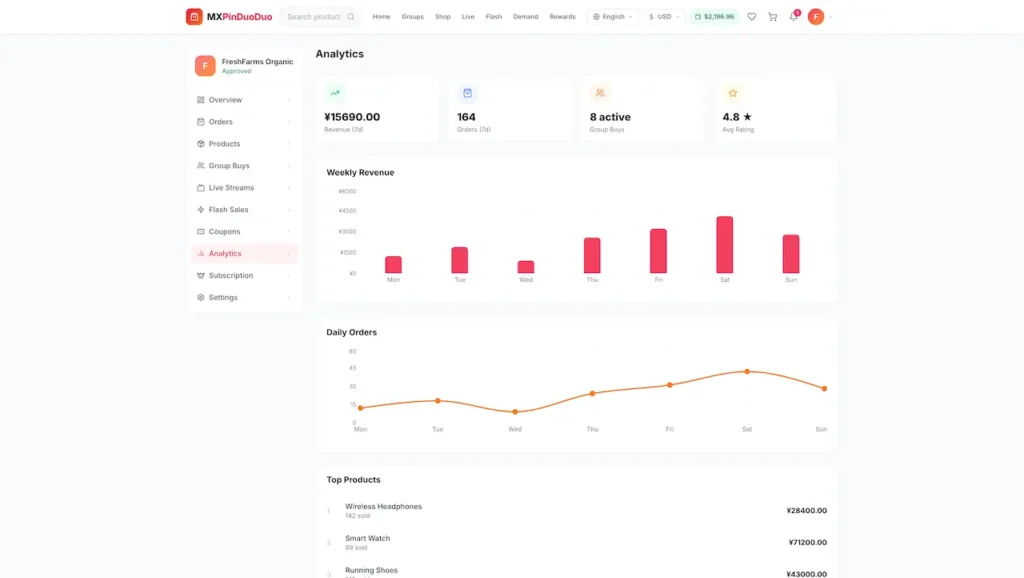
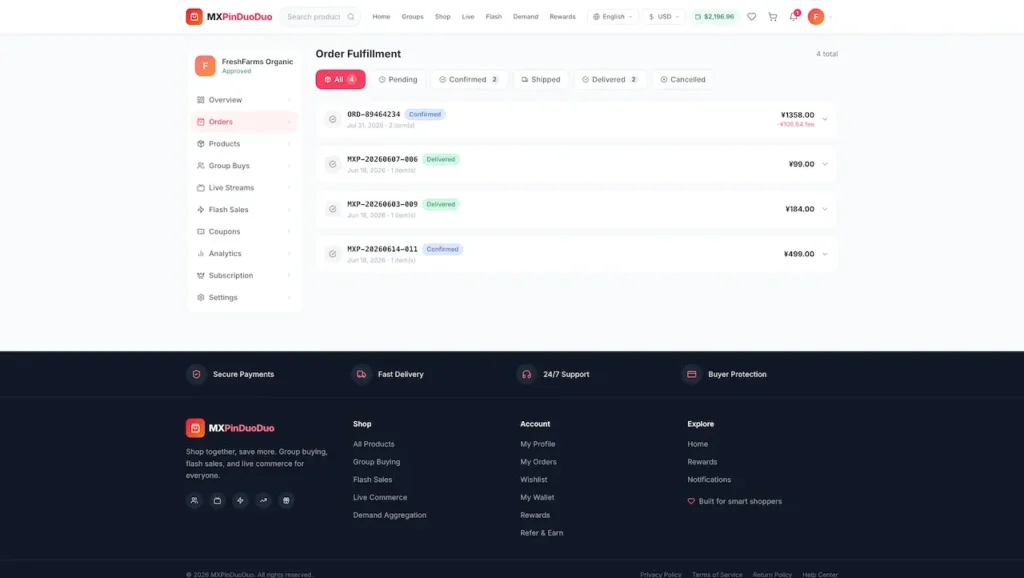
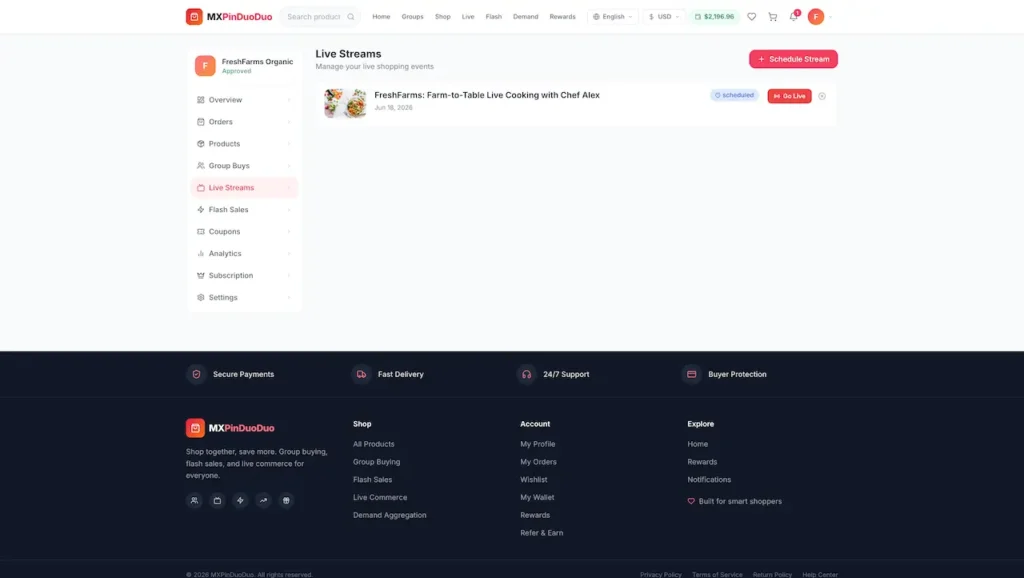
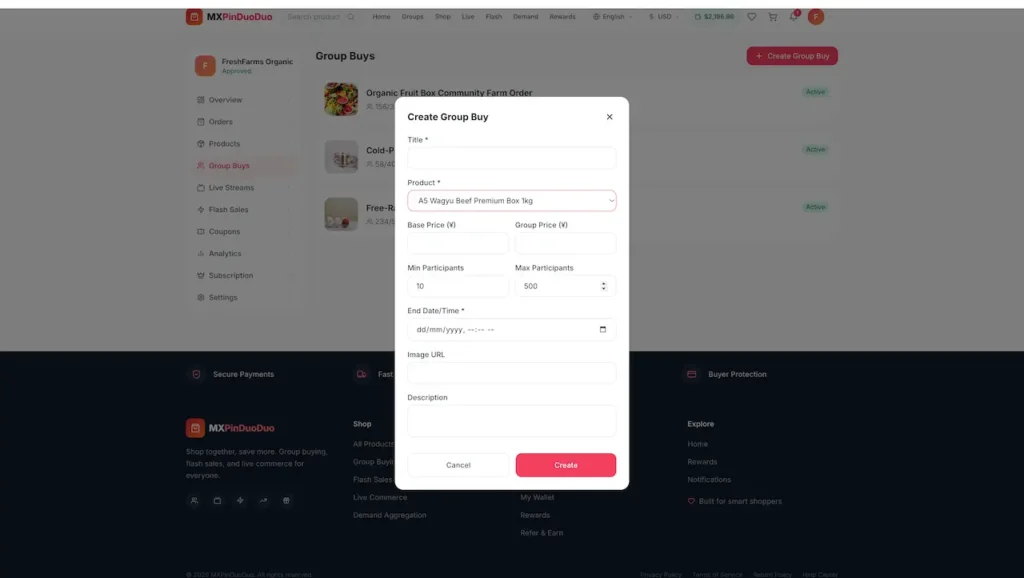
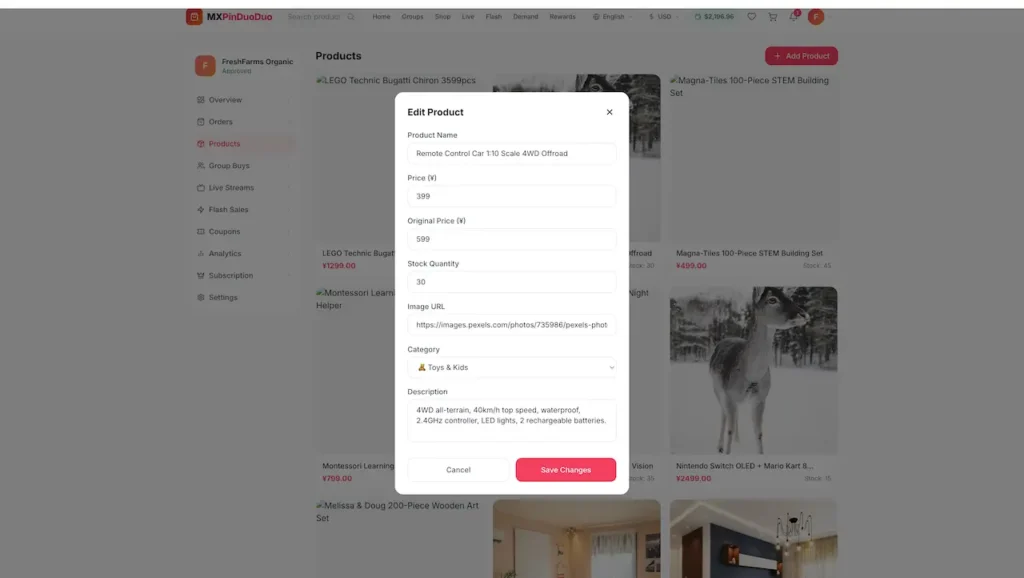
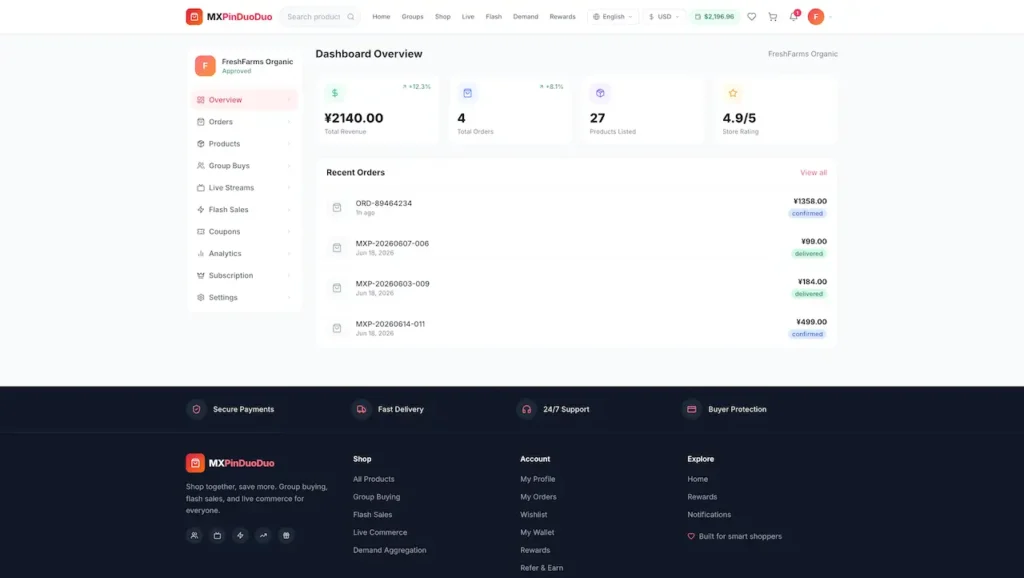
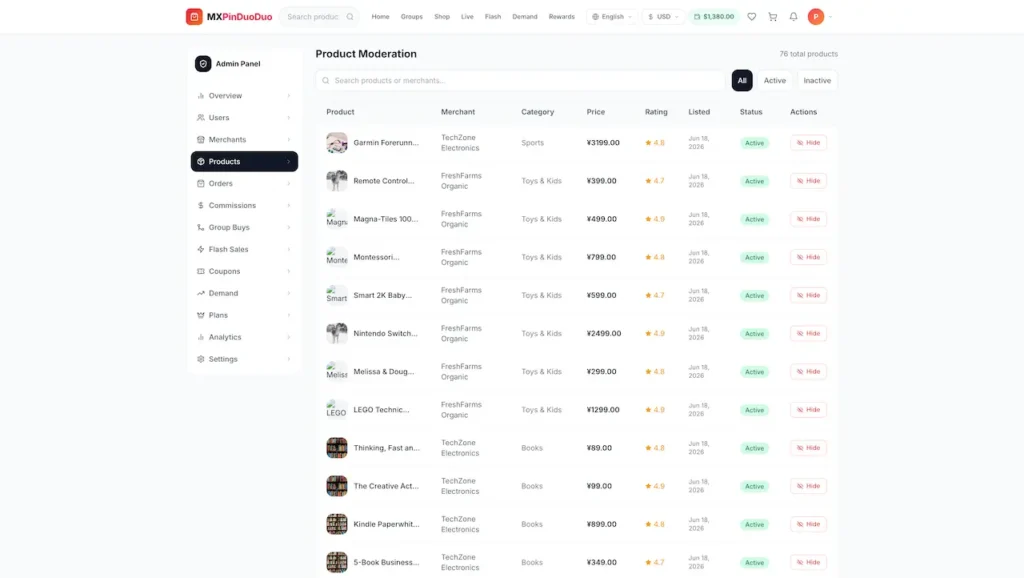
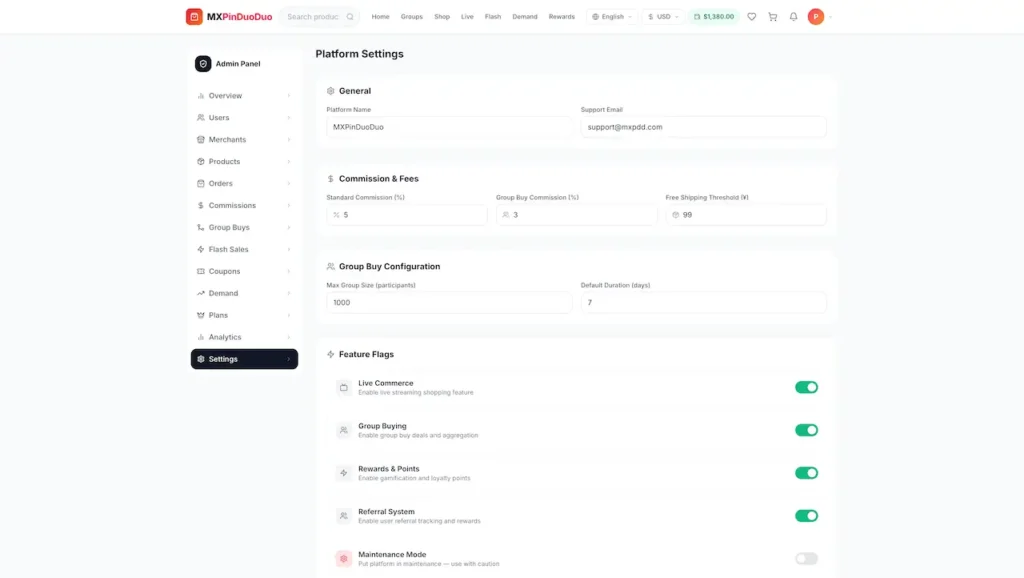
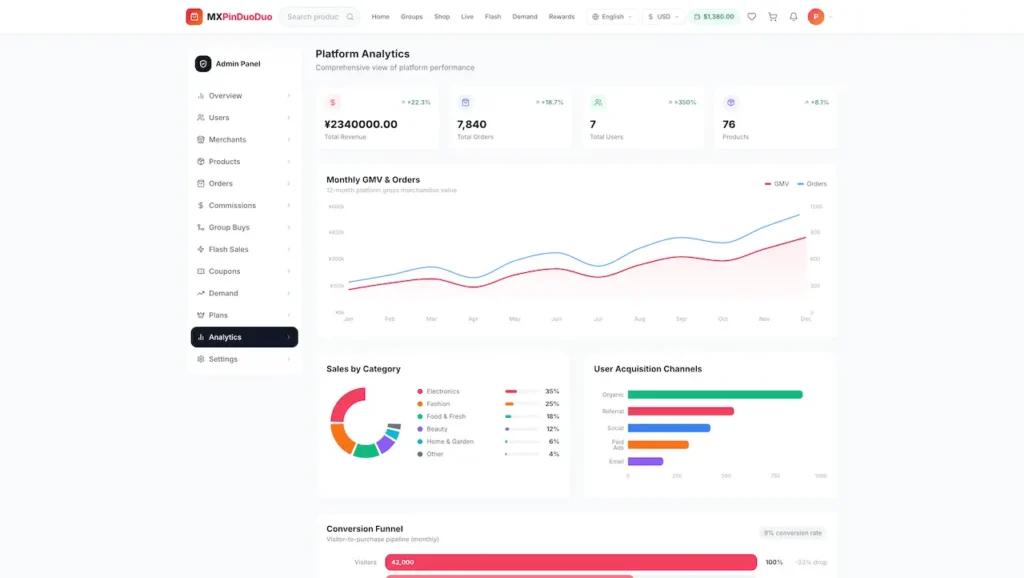
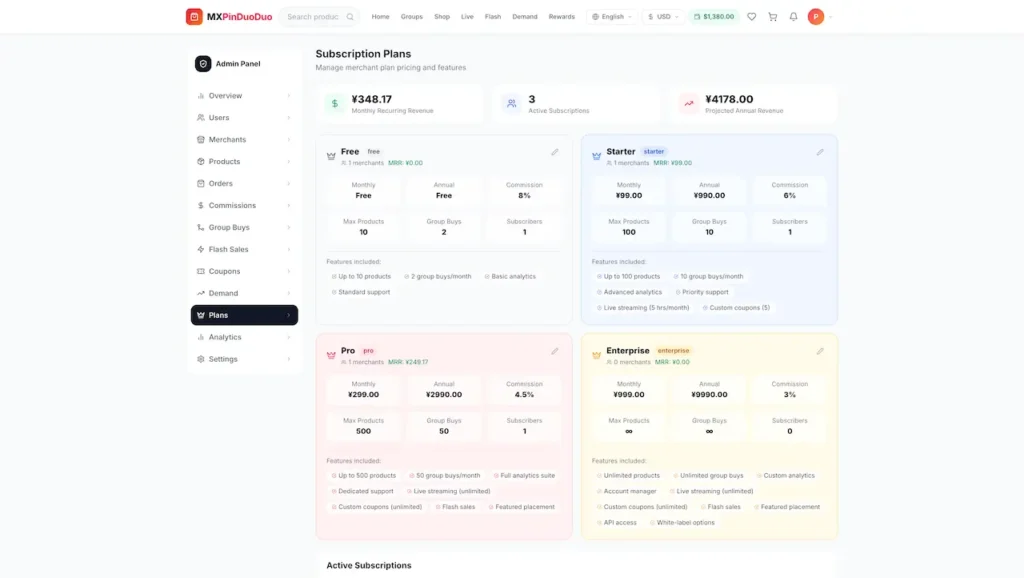
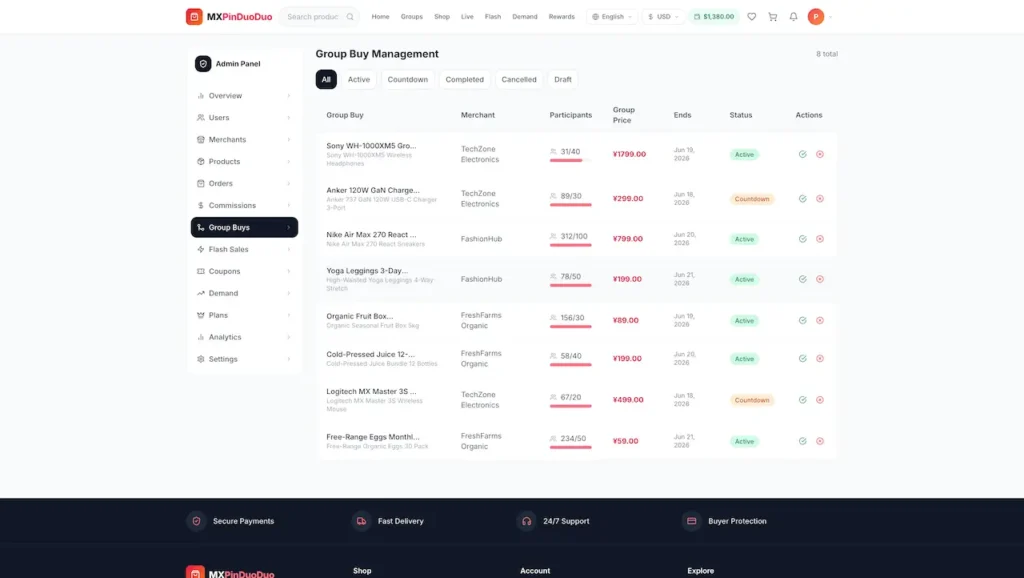
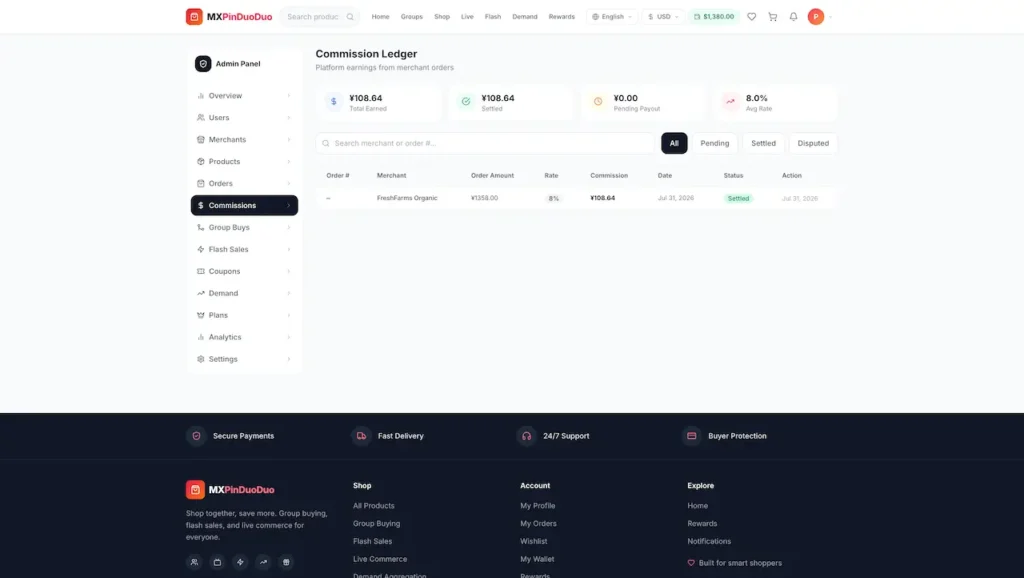
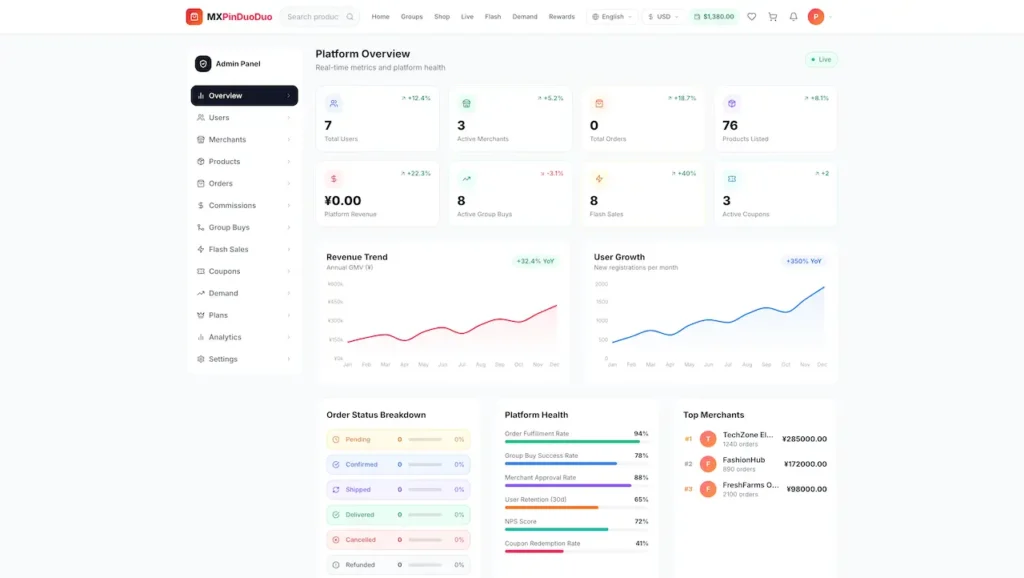
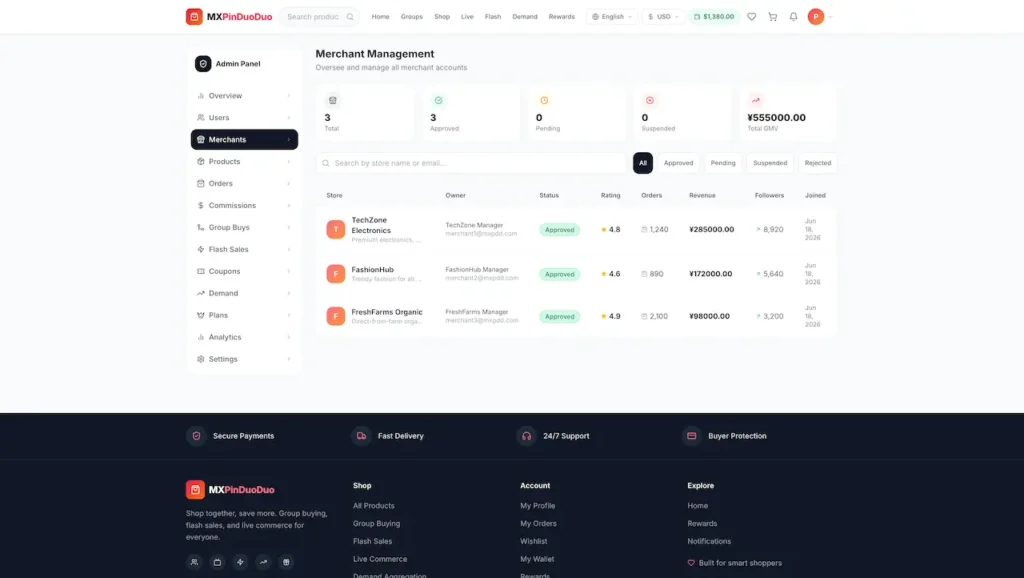
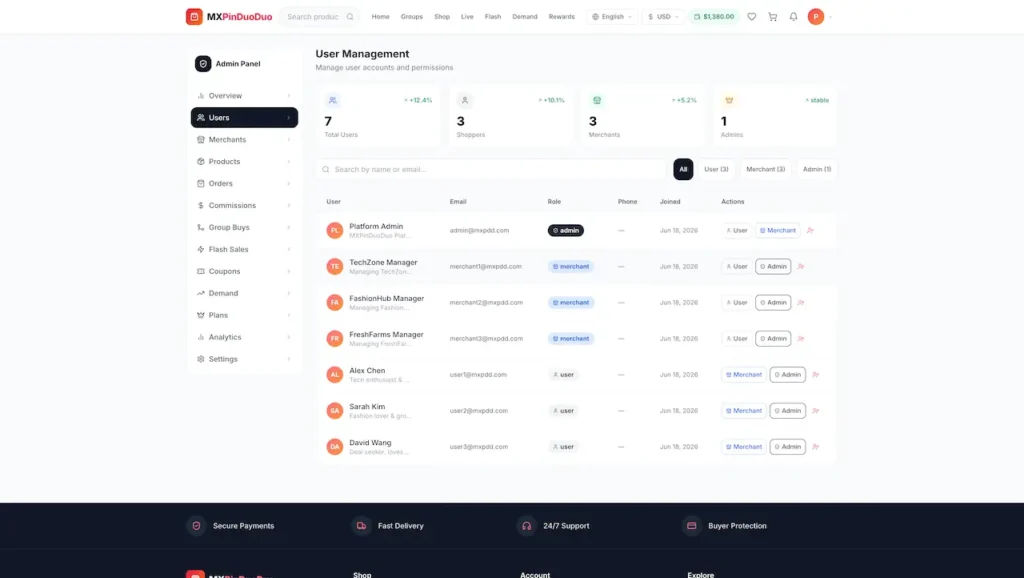
Follow a shopper from browsing through to joining a group buy, a merchant from store setup to their first campaign, and an operator from merchant approval through to platform analytics.
Client Voices
Pinduoduo Clone Client Reviews - Real Platforms, Real Results
Feedback from founders and operators who launched group-buying marketplaces with Miracuves. Client identities withheld under NDA.
Proof in Production
Pinduoduo Clone Case Study - Group-Buying Marketplace Deployment
How an operator launched a multi-vendor group-buying marketplace on the Miracuves Pinduoduo Clone. Client identity withheld under NDA.
Confidential Deployment
Group-Buying Marketplace
A multi-vendor group-buying marketplace launched on the Miracuves Pinduoduo Clone, with threshold pricing and live commerce from day one.
- Launching with group buying as a real domain rather than a discount flag
- Six languages and seven currencies configured before the first campaign
- A merchant portal the client's sellers could run without engineering support
- Launch a multi-vendor group-buying marketplace without building coordination mechanics from zero
- Give merchants campaign tooling and shoppers a reason to return daily
- Give merchants campaign tooling they can run without engineering
- Group buying with threshold pricing and a live participant ledger
- Flash sales, live commerce and demand aggregation
- Six languages and seven currencies with right-to-left support
- Gamified retention: daily check-in, spin wheel and points ladder
- Ten-section merchant portal sellers run themselves
"Group buying with a live participant ledger is the feature merchants ask about first. They run their own campaigns now without filing a ticket."
The Basics
What Is a Pinduoduo Clone App?
A Pinduoduo Clone is a ready-made multi-vendor marketplace built around coordinated buying rather than solo checkout. Shoppers cluster into group buys to unlock a threshold price, respond to time-boxed flash sales, buy from live streams, and vote on demand signals that tell merchants what to stock.
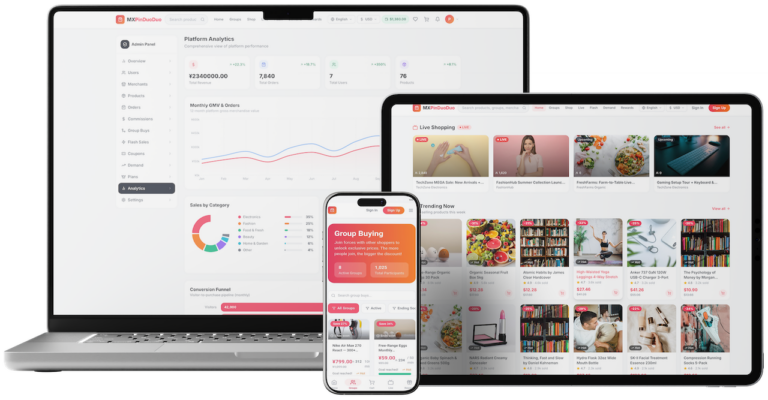
Not a Storefront Theme
The value is in the domain modelling - group buying alone occupies three tables covering thresholds, step tiers and a participant ledger, with orders retaining provenance back to the campaign that produced them.
Not a Rental Platform
You receive the source, the migrations and the data. No per-seat fee, no vendor roadmap dependency, and the schema is portable to any PostgreSQL 15 instance.
Honest About Readiness
Each capability is labelled shipped, configuration required or integration required - including which tables are provisioned at deployment - so scoping happens before purchase rather than after.
Built for Web, Android & API
What Is a Pinduoduo Clone Script?
The Miracuves build is a working product rather than a template. Fifteen database tables ship in the migration baseline with forty-two row-level security policies, seven lifecycle enums and a genuinely append-only wallet ledger.
-
Group buying with threshold and tier pricing
-
Live commerce with product pinning
-
Gamified retention that brings buyers back daily
-
Seven currencies and six languages with RTL
-
Shopper, merchant and admin from one codebase
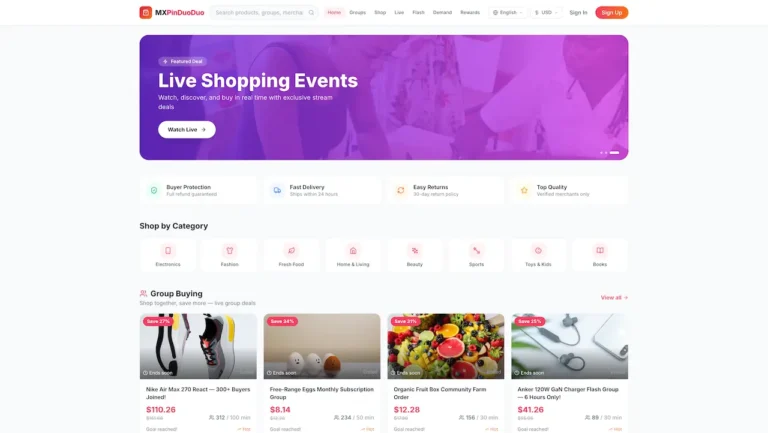
Where a capability is complete in the interface but its table is provisioned at deployment, the documentation says so plainly and supplies the recommended schema – no discovery after purchase.
Everything Included
Pinduoduo Clone Features - Group Buying, Live Commerce, Flash Sales & Rewards
Every capability below is built and demonstrable. Where a feature depends on provisioning a table at deployment or connecting a third-party account, that is stated against the feature rather than buried in a footnote.
Group Buying with Threshold Pricing
The flagship mechanic, modelled as its own domain - a base price, a group price and a minimum participant threshold, with optional step tiers that drop the unit price further as more buyers join.
- Threshold pricing that unlocks at minimum participants
- Optional step tiers – more buyers, lower unit price
- Live participant counter over a realtime channel
- Double-join blocked by a database constraint, not a check
Campaign Lifecycle & Provenance
Five campaign states from draft through to completed, a live countdown to close, an ordered participant list, and orders that retain a link back to the campaign that produced them.
- Campaign lifecycle across five states
- Countdown timer to close
- Participant list with joined-at ordering
- Orders retain a link back to their campaign
Live Commerce with Product Pinning
Scheduled and live stream states with products pinned in display order and viewer counts on listings. The schema models commerce state, so any video vendor plugs in unchanged.
- Scheduled and live stream states
- Products pinned to a stream in display order
- Viewer count surfaced on listings
- Video vendor plugs in without schema change
Flash Sales with Stock Caps
Time-boxed campaigns with a visible countdown, stock-remaining indicator and original-versus-flash pricing. Complete in the interface; table provisioned at deployment.
- Time-boxed campaigns with stock caps
- Countdown and stock-remaining indicators
- Original versus flash price display
- Table provisioned at deployment
Demand Aggregation & Voting
Buyers post what they want and at what price, others vote, and merchants respond to aggregate signal instead of guessing. Complete in the interface; table provisioned at deployment.
- Buyers post what they want and at what price
- Others vote to signal aggregate demand
- Merchants respond to real signals, not guesses
- Table provisioned at deployment
Multi-Vendor Catalogue
Products with multi-image galleries across many merchants, category browse with icon mapping, search across name and description, and sorting by newest, price or popularity.
- Multi-vendor catalogue with gallery images
- Category browse with icon mapping
- Search across name and short description
- Sort by newest, price or popularity
Cart & Multi-Merchant Checkout
A single cart spanning several sellers splits automatically into one order per merchant at checkout, with coupon validation and full subtotal, discount, shipping and final calculation.
- Cart grouped by merchant at checkout
- One cart splits into per-merchant orders
- Coupon validation against active and unexpired
- Subtotal, discount, shipping and final amounts
Orders with Historical Fidelity
A six-state lifecycle with merchant status updates and tracking numbers, where line items snapshot name, image and unit price so history survives catalogue edits.
- Six-state order lifecycle
- Line items snapshot name, image and price
- Merchant updates status and adds tracking
- History survives catalogue edits intact
Wallet & Append-Only Ledger
Balance with lifetime earned and spent, backed by a ledger across six transaction types that carries no update or delete policy - immutable by design rather than by convention.
- Wallet balance with lifetime earned and spent
- Append-only ledger across six transaction types
- Sign-up credit provisioned automatically
- Real top-up requires a payment provider
Gamified Rewards Hub
Daily check-in with consecutive-day tracking, an eight-segment spin wheel with mixed rewards, a points ladder driving level progression, and a redeemable coupon catalogue.
- Daily check-in awarding points
- Eight-segment spin wheel with mixed rewards
- Points totals driving level progression
- Coupon catalogue ready to redeem
Coupon Engine
Percentage, fixed-amount and free-shipping coupons with minimum purchase thresholds, maximum-use caps and usage counting - issued by either a merchant or the platform.
- Coupons in percentage, fixed and free-shipping forms
- Minimum purchase and maximum-use caps
- Merchant-issued or platform-issued
- Usage counted per coupon
Operator Admin Console
Twelve sections covering the four-state merchant moderation workflow, catalogue and campaign oversight, platform coupons, demand triage, plans and platform-wide analytics.
- Four-state merchant moderation workflow
- Approve, reject or suspend from the console
- Catalogue and campaign oversight
- Platform-wide analytics with charts
Note for buyers: Fifteen tables ship in the migration baseline covering identity, catalogue, commerce, group buying, live commerce, gamification and treasury. Cart, wishlist, addresses, notifications, referrals, flash sales, demand and merchant plans are complete in the interface and type layer, with recommended schemas documented, and are provisioned as a deployment step.
How Operators Earn
Pinduoduo Clone Revenue Models - Commissions, Subscriptions, Coupons & Operator Levers
The platform is structured for two complementary revenue streams – a take rate on transactions and a recurring fee from merchants – with promotional levers layered on top.
Transaction Commission
A per-merchant commission rate carried on the plan record, applied against gross merchandise value. The rate is defined per tier so operators can price aggressively for volume sellers.
Merchant Subscriptions
Monthly and annual plans with product and campaign quotas, a commission rate and a marketing feature list. Table provisioning and payment connection are deployment steps.
Platform-Issued Coupons
Coupons with no merchant attached are platform promotions, funded and controlled by the operator - useful for acquisition pushes and category launches.
Featured Listings & Boost
Paid placement for products, group buys and live streams. The catalogue and campaign models support it; the merchandising layer is a custom module.
Sponsored Live Streams
Operator-sold placement within the live commerce surface, priced per slot or per campaign, using the existing stream and pinning model.
White-Label Deployment
Deploy branded instances for vertical operators or clients. Branding, currencies, languages and catalogues are all operator-configurable per deployment.
The subscription model is deliberately shaped like Stripe’s, with billing cycle, period boundaries and a four-state status, so connecting a real payment provider is mechanical rather than a redesign.
Run It Without a Dev Team
Pinduoduo Clone Admin Console - Users, Merchants, Catalogue, Campaigns & Analytics
The admin console is a twelve-section surface gated by role at both the route and the database. Everything an operator does day to day – approving sellers, moderating catalogue, ending campaigns, issuing coupons – happens here rather than in a database client.
Admin Console Sections
Overview
Platform KPIs across users, merchants, products, orders and gross merchandise value, with recent activity and a pending-approvals queue.
Users
The full user list with search across email and display name, filtering by role, and a detail view covering profile and activity.
Merchants
The four-state moderation workflow - pending approval, approved, suspended, rejected - with store detail covering products and campaigns.
Products
Catalogue oversight across every merchant, with category and merchant filters, an active toggle, and deletion guarded against orphaning order history.
Orders
Every order platform-wide with status, merchant and buyer filters, detail view and status updates where policy permits.
Group Buys
All campaigns with status and merchant filters, plus force-end for campaigns that need to be stopped mid-flight.
Flash Sales
All flash campaigns with time-window and merchant filters, and force-end for the same reason.
Coupons
Both merchant and platform coupons in one view, with platform coupon creation, activation toggles and usage visibility.
Demand
The demand signal queue with status filtering, and transitions through in-progress, fulfilled and closed as merchants respond.
- Create and edit subscription plan tiers
- Set monthly and annual pricing
- Define product and campaign quotas
- Set the commission rate per tier
Plans & Settings
Subscription tier management alongside platform configuration for branding tokens, sign-up credit and feature toggles.
- Platform-wide charts across GMV and growth
- Group-buy success rate and coupon usage
- Merchant distribution across the catalogue
- Rendered with the same charting library as the merchant view
Need deeper governance? An application-level audit log of admin actions, merchant KYC, content moderation tooling and multi-admin role delegation are the modules operators most often add. Tell us the requirement and we will scope it.
Transparent Pricing
How Much Does It Cost to Build a Pinduoduo-Like Group-Buying App in 2026?
Building a Pinduoduo-style group-buying marketplace with Miracuves typically starts from around $3,999 for a launch-ready white-label Pinduoduo Clone and increases based on features, campaign mechanics, integrations, table provisioning and infrastructure complexity.
Not sure which option
is right for you?
Talk to us - we'll understand your goals, timeline, and budget, and point you to exactly what you need. No upselling, just honest advice.
The Full Package
What's Included - Pinduoduo Clone Source Code, Apps & Deployment
You receive a complete, deployable product – the application source, the database that gives it meaning, and the documentation a technical buyer will ask for. Everything transfers with full ownership: no runtime licence, no per-seat fee, no dependency on our roadmap.
Full Source Code
The complete React 18, TypeScript 5 and Vite 5 application - every page, component and context - yours to modify, extend and redeploy without restriction.
- Complete React 18, TypeScript 5 and Vite 5 application
- Every page, component and context included
- Yours to modify, extend and redeploy freely
- No obfuscation and no licence server
Database & Migrations
Fifteen tables, seven lifecycle enums, forty-two row-level security policies and twenty-three foreign keys, with ordered SQL migrations and recommended schemas for the deferred tables.
- Fifteen tables and seven lifecycle enums
- Forty-two row-level security policies
- Twenty-three foreign keys with deliberate cascade rules
- Ordered SQL migrations plus recommended schemas for deferred tables
Shopper Web App
Seventeen pages covering home, catalogue, product detail, group buys, flash sales, live commerce, demand, cart, checkout, orders, wallet, rewards, referrals and notifications.
- Seventeen shopper pages end to end
- Home, catalogue, product detail and search
- Group buys, flash sales, live commerce and demand
- Cart, checkout, orders, wallet, rewards and referrals
Merchant Portal
Ten sections giving sellers self-service control over catalogue, group buys, live streams, flash sales, coupons, order fulfilment, analytics, subscription and store settings.
- Ten-section merchant portal
- Products, group buys, live streams and flash sales
- Coupons, orders and fulfilment
- Analytics, subscription and store settings
Admin Console
Twelve sections covering users, merchants, catalogue, orders, campaigns, coupons, demand signals, subscription plans, platform analytics and configuration.
- Twelve-section admin console
- Users, merchants, products and orders
- Campaigns, coupons, demand and plans
- Platform analytics and settings
Android Application
A branded Capacitor 8 build from the same web bundle, with mobile bottom navigation, touch-sized targets and a signed APK pipeline. iOS is available as an add-on.
- Branded Capacitor 8 Android build
- Mobile bottom navigation and touch sizing
- Signed APK build pipeline
- iOS available as a future addition
Technical Documentation
Entity-relationship diagram, schema interpretation guide, complete API collection, developer and deployment handbook, and a VAPT and compliance posture document.
- Entity-relationship diagram and schema guide
- Complete API collection across every query pattern
- Developer, integration and deployment handbook
- VAPT and compliance posture document
Demo Data & Deployment
An idempotent seeder creating seven accounts and eighty rows for instant demos, plus six languages, seven currencies and deployment guidance for web, database and mobile.
- Demo seeder with seven accounts and eighty rows
- Six languages including right-to-left layout
- Seven currencies with conversion configured
- Deployment guidance for web, database and mobile
Want to see it running first? Open the live demo with the credentials above, or book a walkthrough and we will take you through the shopper app, the merchant portal and the admin console against your own category and market.
Explore Every Angle of the Pinduoduo Clone
Four focused guides - features, cost, how to choose a builder, and how the business model makes money - each going deeper than this overview can.
Features
Every feature by role - shopper, merchant, and admin - covering group buying, a 10-section merchant portal and a 12-section admin console.
See the full breakdown→Development Cost
Our fixed $3,999 price vs. freelancer, custom-agency, and enterprise ranges - plus the 6-day deployment timeline and what actually drives marketplace cost.
See exact pricing→Development Company
Agency vs. freelancer vs. Miracuves compared - plus marketplace-integrity checks and the red flags to run before you hire anyone.
Compare options→Business Model
Four revenue levers, the realistic path to first revenue, and the three operator models the platform supports.
See the playbook→Know Your Buyer
Who Is Our Pinduoduo Clone App Built For?
The platform suits operators whose commerce model depends on coordination rather than solo checkout – where buyers clustering together, responding to urgency, or signalling demand is what unlocks the price.
Regional Marketplace Operators
Cross-Border Aggregators
Niche Vertical Communities
Live-Commerce-First Brands
Social Commerce Startups
Agencies & White-Label Deployers
If your business depends on group buying, price-led demand aggregation, or volume moved through social sharing rather than paid acquisition, a Pinduoduo-style platform becomes a long-term owned asset rather than a listing you rent on somebody else’s marketplace.
Where It Fits
Pinduoduo Clone Use Cases - Group Buying, Live Drops & Cross-Border Marketplaces
The same codebase serves quite different marketplaces depending on which mechanic an operator leads with. A produce co-op leans on thresholds; a beauty brand leans on live commerce; a procurement platform leans on demand aggregation. Each configuration is theming, catalogue and emphasis rather than a fork.
Group-Buying Marketplaces
Coordinate buyers around a minimum quantity so the unit price drops for everyone – the mechanic that makes fresh produce co-ops, group procurement and bulk enrolment work where solo checkout cannot.
Flash Sale & Inventory Clearance
Run time-boxed drops with stock caps and a visible countdown, clearing inventory and creating the urgency that converts browsers who would otherwise defer the decision indefinitely.
Live Shopping & Drops
Sell live with products pinned to the stream and viewers converting mid-broadcast, using your own video vendor while the commerce state, pinning order and checkout are already modelled.
Demand-Led Procurement
Let buyers tell you what to stock by posting a product and a target price, then let others vote – turning passive wishlists into aggregate signals merchants can actually respond to.
Cross-Border Marketplaces
Operate across regions with seven currencies and six languages configured, including right-to-left layout, so a single deployment serves several markets rather than one per build.
White-Label Deployments
Deploy branded marketplace instances for vertical operators or agency clients, where the theme, currency set, language set and category tree are configuration rather than a separate codebase.
One product, many configurations. Every use case above runs on the same fifteen-table baseline and the same thirty-nine routes. What changes is which mechanic you lead with, the branding and the catalogue – not a fork you then maintain separately.
Market Timing
Why Launch a Group-Buying Marketplace in 2026?
Social commerce is where coordination, urgency and community overlap with buying intent, and the operators winning in it are the ones who own the mechanic rather than bolting a discount code onto a conventional storefront.
Coordination Converts
Group buying reframes a purchase as a shared event rather than a solo decision. The mechanic exists because it moves conversion in a way discount codes do not.
Retention Is the Hard Part
Acquisition is expensive and getting more so. A daily check-in, a spin wheel and a points ladder give buyers a reason to open the app when they have nothing specific to buy.
Cross-Border Is the Growth Edge
Single-currency, single-language platforms are geographically capped. Seven currencies and six languages with right-to-left support remove that ceiling on day one.
Live Commerce Keeps Growing
Broadcast selling continues to take share globally. Owning the commerce layer behind the stream matters more than owning the video pipe, which any vendor can supply.
Merchants Need Self-Service
A marketplace where every campaign needs operator intervention cannot scale. A ten-section merchant portal is what makes seller growth possible without headcount growth.
Buy-Versus-Build Is Settled
A from-scratch equivalent runs to six figures and most of a year before the first campaign. A white-label deployment reaches a working demo in days.
Platform by the Numbers
Building an equivalent marketplace from scratch is a six-to-twelve month effort across catalogue, campaigns, multi-role consoles and mobile. The economics of buying are not close.
Under the Hood
Pinduoduo Clone Tech Stack - React 18, TypeScript, Vite & PostgreSQL
Under the hood, a group-buying marketplace needs coordination mechanics that hold under contention, multi-vendor isolation, and a merchant portal sellers can actually operate. Here is the stack behind it.
Shopper, Merchant & Admin Surfaces
React 18.3 · TypeScript 5.5 · Vite 5.4
- Tailwind CSS 3.4 with operator-configurable theming
- React Router 7 across thirty-nine routes
- Lucide icon set and Recharts for analytics
- Roughly 200KB of gzipped JavaScript
Auto-Generated REST & Realtime
PostgREST · Realtime Channels
- REST surface generated directly from the schema
- Around eighty distinct query patterns in the app
- Realtime channel driving the group-buy counter
- No ORM and no second source of truth
Domains, Policies & Ledgers
PostgreSQL 15 · Row-Level Security
- Fifteen tables across seven business domains
- Forty-two policies with deny-by-default posture
- Seven lifecycle enums rejecting invalid states
- Append-only wallet ledger enforced by policy
Roles, Sessions & Access Control
Supabase Auth · Role-Based Access
- Email and password with bcrypt hashing
- Three roles – shopper, merchant and administrator
- Session restoration and auth-state subscription
- Two-factor and social sign-in available as customization
Mobile Packaging & Edge Functions
Capacitor 8 · Deno Edge Functions
- Android packaged from the same web bundle
- Signed APK pipeline with a single build command
- Edge function for idempotent demo seeding
- Deploys to Vercel, Netlify or Cloudflare Pages
Currencies, Languages & Preferences
React Context · 211 Translation Keys
- Auth, language and currency held in context
- Six languages with automatic right-to-left for Arabic
- Seven currencies with conversion and locale formatting
- Preferences persisted between sessions
Note for Tech Buyers: payment capture, production video, image storage with resizing, full-text search, transactional email and error monitoring connect through documented integration points using your own provider credentials. Every layer above is mainstream and widely hired for, with no proprietary framework and a schema portable to any PostgreSQL instance.
End to End
How the Pinduoduo Clone Works - Signup, Campaigns, Coordination & Fulfilment
A group-buying marketplace looks simple on the surface and runs on a structured identity, catalogue, coordination and settlement pipeline underneath. Here is the path from signup to a fulfilled, monetized order.
Shopper Journey - From Signup to Group Purchase
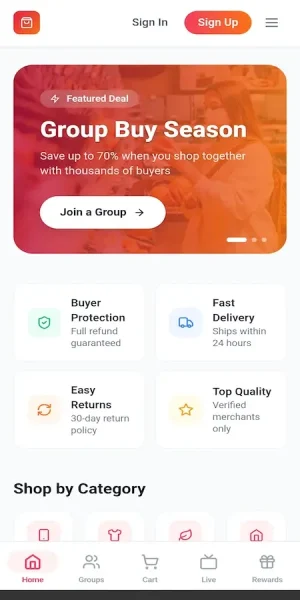
Onboarding & Provisioning
A signup creates the authentication user, then provisions the profile, the wallet with its sign-up credit and the gamification row - each gated by row-level security so no client can provision for another user.
- Email and password through managed authentication
- Profile created with the default shopper role
- Wallet opened with the sign-up credit applied
- Rewards row created ready for the first check-in
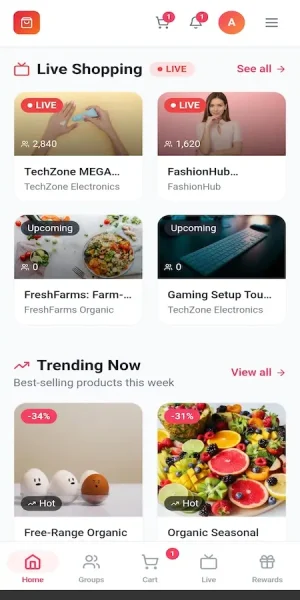
Discovery & Catalogue
Shoppers arrive on a home surface built for time-to-engagement, with categories, trending products, active campaigns and live streams loaded in parallel rather than in sequence.
- Category grid with icon mapping
- Trending products ordered by units sold
- Active group buys ranked by participation
- Live and scheduled streams with viewer counts
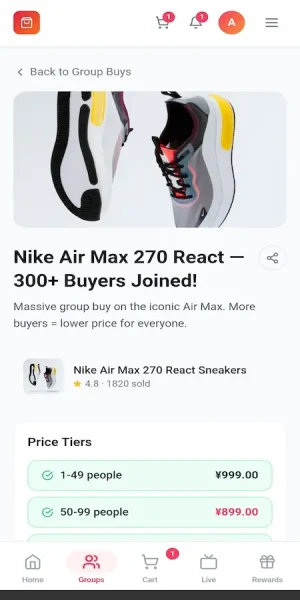
Coordination & Threshold
Joining a group buy writes a participant row that the database itself guards against duplication, and the counter climbs live for everyone watching the same campaign.
- Composite constraint blocks a second join
- Price snapshotted at the moment of joining
- Realtime channel updates the participant list
- Step tiers drop the unit price as numbers grow
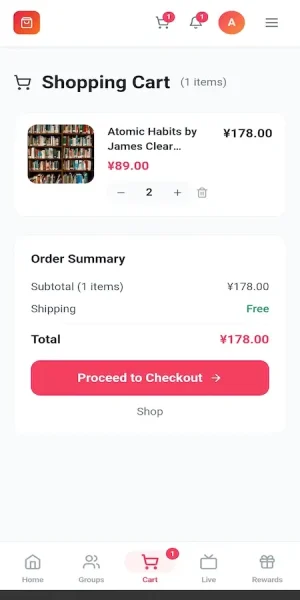
Cart & Checkout
A cart holding items from several merchants splits into one order per merchant at checkout, so fulfilment stays clean even when a basket spans the marketplace.
- Cart grouped by merchant automatically
- Coupon validated against active and unexpired
- Subtotal, discount, shipping and final calculated
- Line items snapshot name, image and unit price
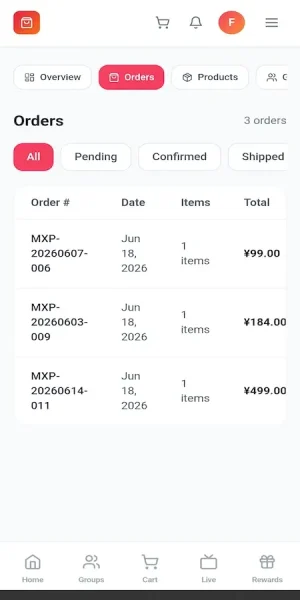
Fulfilment & Provenance
Merchants move orders through a six-state lifecycle and attach tracking, while the order keeps its link back to the campaign that produced it.
- Six-state lifecycle from pending to delivered
- Cancellation and refund as terminal branches
- Tracking number surfaced to the buyer
- Campaign provenance preserved on the order
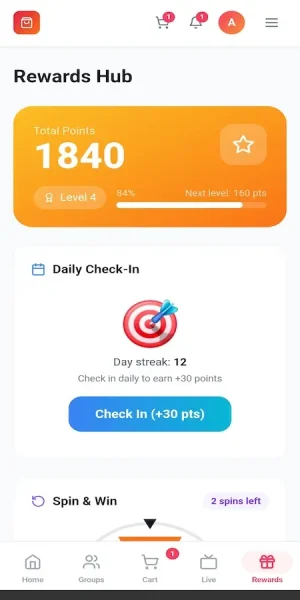
Retention & Monetization
The rewards hub brings buyers back between purchases, while the operator earns through commission, merchant subscriptions and platform-issued promotions.
- Daily check-in and spin wheel with mixed rewards
- Points ladder driving level progression
- Append-only ledger across six transaction types
- Commission and subscription levers on the operator side
Visual Flow Diagram
Sign Up → Browse → Join Group → Threshold → Checkout → Fulfil
How It's Built
Pinduoduo Clone Platform Architecture & Backend Flow
No Application Server
The React client talks directly to a policy-gated REST surface generated from the schema. There is no middle tier to deploy, scale or keep in sync with the database.
Authorization at the Database
Forty-two row-level security policies enforce access by role, ownership and state. A client cannot query another user's wallet or orders even with a valid token.
Deny by Default
Any operation without an explicit policy is refused. Append-only behaviour on the wallet ledger comes from deliberately withholding update and delete policies rather than from application discipline.
Business Logic in Code
No triggers and no stored procedures. Every state transition lives in the application, which means every transition is readable, debuggable and auditable in the codebase.
Invariants in the Schema
Where only the database can guarantee correctness it does - a composite constraint blocks double-joins atomically, and restrict rules stop deletions orphaning order history.
Realtime Without a Server
The live group-buy counter runs on a scoped realtime channel over database change events, with no separate WebSocket service to operate.
Performance Targets
Built to Scale - Indexed Reads, Bounded Writes & Growth Headroom
The platform is designed to run comfortably at the ten-thousand to hundred-thousand monthly active user band without modification, with a documented and incremental path well beyond that. Scaling levers are conventional – additional indexes, table partitioning, read replicas and a CDN – rather than a re-architecture.
Coordination Mechanics at the Database
Group buying is the platform’s highest-traffic write path, so the correctness guarantees sit in the schema rather than in application checks that races can defeat.
What the database enforces directly:
- One join per shopper per campaign, atomically
- Price snapshotted at join so later edits cannot change it
- Campaign status constrained to five valid values
- Order provenance preserved even if a campaign is removed
Multi-Vendor Isolation Without Complexity
Tenancy is flat by merchant – every commercial row carries a merchant reference, and the store record shares its identifier with the owner profile.
That decision keeps the security predicates and the indexes simple:
- One foreign key to index rather than a tenant column
- Ownership predicates reduce to a single comparison
- Merchants see only their own catalogue and orders
- A tenant column can be added later without breaking joins
Gamified Retention & Digital Economy
Retention is the hardest problem in commerce, and the rewards layer exists to give shoppers a reason to return between purchases.
The retention engine covers:
- Daily check-in with consecutive-day tracking
- Spin wheel with mixed point and coupon rewards
- Points ladder driving visible level progression
- Wallet credit as a second reason to come back
Operational Load Without an Engineering Rota
A marketplace where sellers cannot self-serve does not scale, so the merchant portal is deliberately complete across all ten sections.
Merchants handle their own work directly:
- Catalogue, pricing and stock management
- Group buys, flash sales and live streams
- Coupon issuance and order fulfilment
- Analytics without an operator request
Indexed Hot Paths
Eight explicit indexes target the queries that actually run hot - merchant catalogue, category browse, campaign status and windows, order history and wallet ledger.
Reconcilable Ledger
Wallet history is append-only by policy, so the balance can always be checked against the sum of its entries rather than trusted on faith.
Historical Fidelity
Order line items snapshot product name, image and unit price, so a buyer's history stays accurate even after the merchant edits or removes the listing.
Deliberate Cascade Rules
Each relationship chooses its own delete behaviour - cascade for personal data, restrict where history must survive, set-null where losing a reference beats losing a row.
Lifecycle in the Type System
Seven enums constrain order, campaign, stream and merchant states, so an invalid status is rejected by the database rather than discovered in production.
Documented Scaling Path
From the current architecture through added indexes, partitioning, read replicas and dedicated search - each stage written down rather than left to be improvised.
Built for Customization & Long-Term Growth
Every business ends up needing something the base product does not do. The architecture is deliberately conventional so extending it is ordinary work rather than archaeology.
Adding a capability is a migration, a type and a page. The stack is React, TypeScript and PostgreSQL throughout, all widely hired for, with no proprietary framework in the way.
Note for founders and CTOs: You can start lean and still be ready to scale. The documented path runs from the current architecture, through additional indexes, to partitioning the ledger and orders, to read replicas and search infrastructure – each step incremental rather than a rebuild.
Built to Be Audited
Pinduoduo Clone Security - RLS-Enforced, Append-Only & Procurement-Friendly
Security posture is documented against the OWASP Top 10 with mappings to GDPR, CCPA, PCI-DSS and SOC 2 supplied for procurement review. The distinguishing claim is that access control is enforced in the database and is independently testable rather than asserted in the interface.
OWASP Top 10 Mapping
Documented Threat Model
PII Inventory
Pre-Launch Hardening Checklist
Compliance Mapping
Deployment Hardening
Deny-by-Default Access Control
Row-level security is enabled on every public table with forty-two policies. An operation without an explicit policy is refused, so nothing is public by accident.
Append-Only Financial Ledger
The wallet transaction table has no update or delete policy. Even a fully compromised client cannot silently rewrite a user's financial history.
No Card Data on Platform
The platform never handles raw card numbers. Payment processing is delegated to a compliant gateway, which keeps the deployment out of the hardest part of PCI scope.
Injection and XSS Closed Off
All database access goes through parameterized queries with no raw SQL in the client, and the interface escapes interpolated content by default.
Cascade-Based Erasure
Deleting the authentication record cascades through profile, wallet, ledger, rewards, participation, orders and merchant data - the right-to-be-forgotten mechanism, enforced by foreign keys.
Invariants the Client Cannot Bypass
Composite uniqueness blocks double-joins, restrict rules protect order history, and check constraints bound review ratings - all at the database rather than in the interface.
Where hardening is deployment-governed rather than shipped – project hardening, email confirmation, two-factor on operator accounts, backup retention, error tracking – the documentation lists it as a pre-launch checklist rather than implying coverage.
Go Further
Pinduoduo Clone Add-Ons - Payments, Video, Search & Enterprise Controls
Out of the box the platform is complete and demonstrable. The modules below are the ones operators most often add on the way to production – either because they need a third-party account, or because they differentiate against competitors running similar infrastructure.
Payment Gateway
The wallet, ledger and order models are complete. Connecting Stripe, Alipay, WeChat Pay, Razorpay or PayPal for real money movement is an integration with your own merchant credentials.
Production Video Infrastructure
The live commerce schema models commerce state rather than video delivery. Mux, Agora, AWS IVS or a self-hosted cluster plugs in at the front end with no schema change.
Production Search
Search runs on pattern matching today, which is right for a launch catalogue. Full-text indexing or a dedicated engine like Algolia, Meilisearch or Typesense is the step at scale.
Image Storage & Resizing
The catalogue accepts image URLs today. A storage bucket with owner-scoped write policies and a resize pipeline is the module for merchant-uploaded media.
Deferred Table Provisioning
Cart, wishlist, addresses, notifications, referrals, flash sales, demand and merchant plans ship with recommended schemas documented. Provisioning them is a scoped, well-specified task.
Logistics & Fulfilment
Order tracking is a field today. Connecting a rate, label and tracking provider turns fulfilment into an automated flow rather than a manual status update.
iOS Application
Android ships with the base product. The same web bundle packages for iOS through the same native bridge, making an iOS build an additive step rather than a second codebase.
Enterprise Controls
Merchant KYC, an application-level audit log, content moderation tooling, multi-admin delegation, single sign-on and data residency for deployments where procurement sets the requirements.
Building in eCommerce? We Have the Whole Market Covered.
The Pinduoduo Clone is one platform in a complete marketplace and eCommerce suite. If your roadmap extends beyond group buying, these connect naturally.
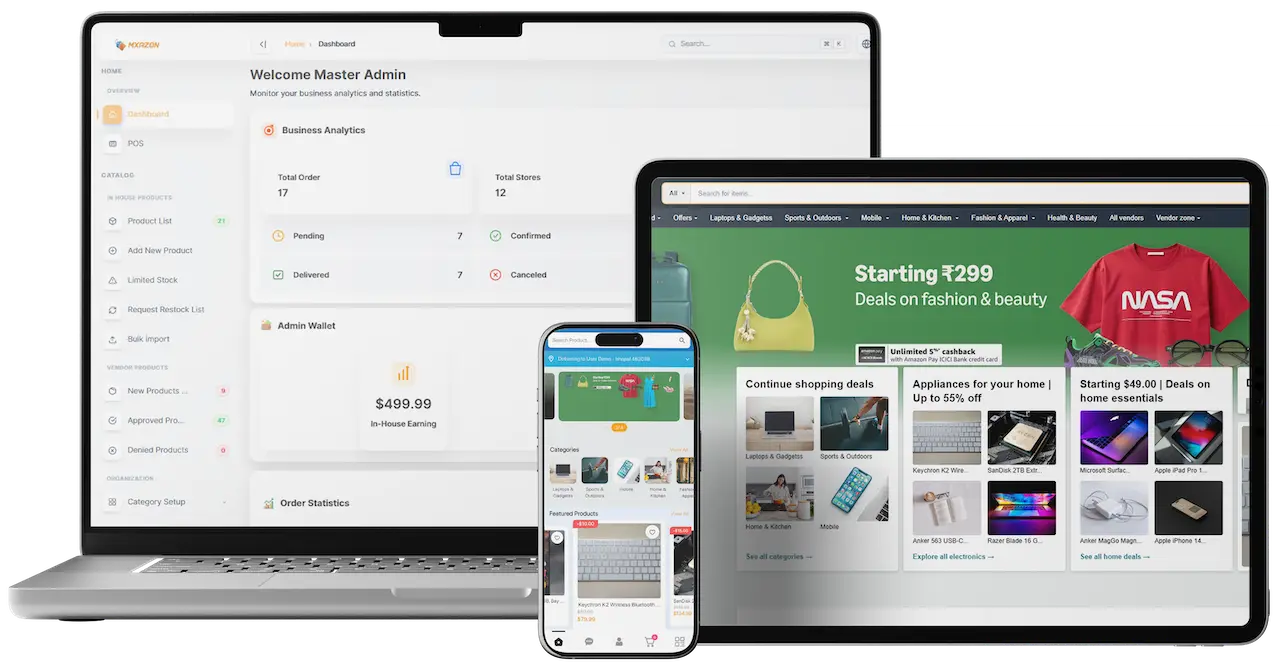
Amazon Clone
Full-scale multi-vendor marketplace with catalogue depth, fulfilment workflows and buyer trust mechanics.

Alibaba Clone
B2B wholesale marketplace with bulk pricing, supplier verification and trade enquiry workflows.

Noon Clone
Regional eCommerce marketplace built for Middle East logistics, payments and Arabic-first shopping.
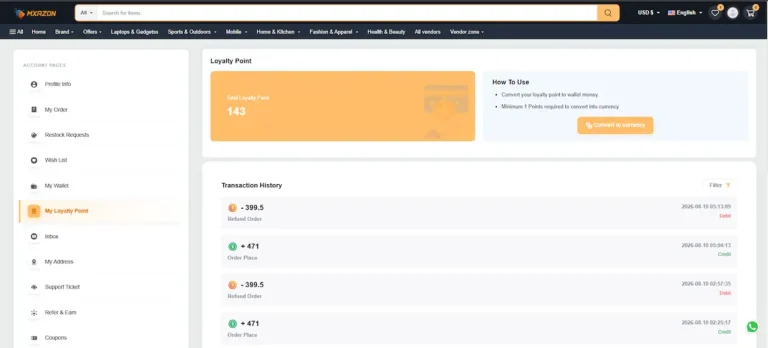
Flipkart Clone
Large-scale value marketplace with flash-sale events, seller onboarding and mobile-first buying.
The Commercial Case
Marketability, Revenue Potential & Business Prospects
Social commerce sits where coordination, urgency and community intersect with buying intent, and that overlap is why the model keeps producing durable marketplaces rather than single-cycle apps. Group buying in particular converts because the price is unlocked collectively – the buyer is not deciding alone.
Two Revenue Streams
Commission on transactions and recurring merchant subscriptions are complementary - one scales with volume, the other gives predictable baseline revenue.
Merchant Self-Service
A complete merchant portal is what lets seller count grow without operator headcount growing alongside it. That ratio is the whole economics of a marketplace.
Low Operating Headcount
A team of two to three engineers can run the entire stack - one codebase, one backend, one deployment pipeline, no separate mobile team.
Exit Optionality
The codebase and the data are yours, and the schema is portable to any PostgreSQL instance. There is no proprietary format to unwind at exit.
Platform-issued coupons and commission on delivered orders are the fastest levers because both are operational in the shipped baseline. Merchant subscriptions follow once the plan tables are provisioned and a payment provider is connected. Most operators seed a small group of founding merchants, run the first group-buy campaigns themselves to prove the mechanic, then open self-service onboarding.
Defensibility comes from liquidity rather than from code. Once merchants and buyers both establish themselves, the switching cost is high on both sides and compounds. The platform contribution is making sure the marketplace is operator-owned from day one, so accumulated liquidity stays with the operator rather than with a storefront vendor.
Example Revenue Scenarios
The commercial argument for owning the platform rather than renting a storefront is straightforward: an operator on someone else’s marketplace captures a transaction but not the merchant relationship, the buyer data or the take rate. The build-versus-buy maths reinforces it, since an equivalent from scratch is most of a year and a six-figure budget before the first campaign runs.
Niche Vertical Marketplace
Monthly Active Users
Commission carries early revenue while merchant count is still small.
A focused category – produce, beauty or collectibles – where group buying does the conversion work and the operator take rate stays modest by design.
Regional Multi-Vendor Platform
Monthly Active Users
Merchant subscriptions become the steady line, commission the variable one.
A regional marketplace where seller self-service is what allows merchant count to grow faster than operator headcount.
Cross-Border Aggregator
Monthly Active Users
All levers contribute, with featured placement and sponsorship scaling fastest.
A multi-market operator using the currency and language layer to serve several regions from one deployment rather than one build per market.
Why Miracuves
Miracuves vs Other Pinduoduo Clone Developers
There are many ways to build a marketplace: generic scripts, freelancers, agencies, or white-label infrastructure.
Why Founders Choose Miracuves
Group Buying Modelled Properly
Three dedicated tables with threshold logic, step tiers, a participant ledger and order provenance - the part generic scripts implement as a discount field and cannot extend afterwards.
Access Control in the Database
Forty-two row-level security policies with a deny-by-default posture, so a client bug cannot leak another user's orders or wallet. That is the claim a security review actually tests.
A Merchant Portal That Works
Ten complete sections covering catalogue, campaigns, coupons, fulfilment and analytics. Sellers operate independently instead of queueing behind your team.
Full Source Code Ownership
The complete React, TypeScript and PostgreSQL codebase is yours to modify and deploy. No vendor lock-in, no runtime licence, no roadmap dependency.
Documented to Enterprise Standard
ERD, schema guide, API collection, developer handbook and VAPT posture - enough to pass a procurement review rather than just a demo.
Honest Readiness Language
Shipped, configuration required or integration required is stated per capability, including which tables are provisioned at deployment. Nothing surprises you after purchase.
Compare & Discover Why Clients Choose Us as
#1 Ready-Made Clone Solution Partner
| Criteria | Miracuves Pinduoduo Clone | Generic Clone Script | Custom Dev Agency |
|---|---|---|---|
| Time to Launch | 6 days (Production) | Unknown / DIY | 6-9+ months |
| Source-Code Ownership | ✔ Full | Often limited / encrypted | Usually yes |
| Feature Depth (Pinduoduo-like) | High (group buying, live commerce & gamified retention) | Basic (listing & feed only) | Depends on budget |
| Security & Compliance | Strong (ISO mindset, GDPR-ready) | Minimal | Varies widely |
| Scalability & Performance | Cloud & CDN-optimized | Rarely considered | Depends on architecture |
| Monetization Options | Multiple (ads, gifts, subs) | Limited / needs custom work | Custom (more time & cost) |
| Admin & Analytics | Full-fledged dashboard | Very basic or missing | Custom build (extra cost) |
| Cost vs Speed vs Quality | Balanced | Cheap but risky | High cost, slow |
| Ongoing Support & Updates | Available with clear plans | Usually none | Depends on contract |
Not every route to a group-buying marketplace ends in something you can actually operate at scale. Here is where we differ.
Industries
Industries We Serve
The Pinduoduo Clone suits any operator whose commerce model rewards coordination. Fresh produce and farm-to-table networks use thresholds to make co-operative buying work at farm scale. Beauty and cosmetics brands run live commerce alongside group campaigns, the dominant pattern in the category. Electronics sellers coordinate early adopters and clear inventory through flash sales. Fashion operators combine demand aggregation with live drops. Group procurement platforms unlock volume pricing for small businesses. Education providers use bulk enrolment to discount tuition. Collectibles marketplaces run limited-edition drops. Cross-border aggregators lean on the currency and language layer. Agencies deploy branded marketplace instances per client.
- 🛒 Group Buying
- 🥬 Fresh & Grocery
- 💄 Beauty & Cosmetics
- 📱 Electronics
- 👗 Fashion & Apparel
- 🎁 Collectibles & Drops
- 🏢 Group Procurement
- 🎓 Education & Courses
- 🌍 Cross-Border Retail
- 📺 Live Commerce
- 🏪 Multi-Vendor Retail
- 🚀 Agencies & Builders
Miracuves’ Pinduoduo Clone is built as a coordination-first marketplace adaptable to any category – multi-vendor and open by default, curated and invite-only where your model requires it, and white-labelled entirely under your brand.
Changelog
Pinduoduo Clone Release Log - Version History & Updates
| Version | Date | What's New |
|---|---|---|
| v2026.1 | Jul 2026 | Initial release - group-buying marketplace with threshold pricing, live commerce, flash sales, wallet ledger and a merchant portal. |
Blog & Resources
Pinduoduo Clone App - Latest Insights & Guides
Stay updated with the latest trends, guides and case studies on group-buying mechanics, marketplace development and social commerce growth.
Last Updated on October 5, 2026 by samruddhi kadam Key Takeaways Live shopping helps beauty…

How Group Buying Apps Make Money: Marketplace Revenue Streams Founders Should Know
Last Updated on August 21, 2026 by sakshi Key Takeaways Group-buying apps can earn through…
How Group Buying Marketplaces Turn Social Sharing Into Ecommerce Growth
Last Updated on September 1, 2026 by sakshi Key Takeaways Group buying turns social sharing…
Pinduoduo Clone vs Custom Development
Last Updated on August 31, 2026 by sakshi Key Takeaways Ready-made social commerce platforms help…
How to Reduce Fraud in Group-Buying Marketplaces: Seller, Payment, and Coupon Abuse Controls
Last Updated on August 19, 2026 by sakshi Key Takeaways Group-buying fraud can involve sellers,…

FAQ
Pinduoduo Clone FAQ - Pricing, Group Buying, Merchants & Deployment
Everything you need to know about the Miracuves Pinduoduo Clone.
A ready-made, white-label multi-vendor marketplace built around coordinated buying – group buys with threshold and tier pricing, flash sales, live commerce, demand aggregation, a gamified rewards engine, and separate shopper, merchant and admin surfaces, all rebrandable under your own identity.
Yes. You launch under your own branding, catalogue and policies. The product replicates common marketplace and group-buying patterns rather than any protected asset, and you set your own terms of service and seller rules.
The Miracuves Pinduoduo Clone starts from $3,999 for a launch-ready white-label deployment. Final scope varies with table provisioning, integrations, campaign mechanics, infrastructure and any custom modules.
A merchant sets a base price, a group price and a minimum participant threshold, with optional step tiers that drop the unit price further as numbers grow. Shoppers join, the counter updates live, and the database blocks anyone joining twice. Each participant’s price is snapshotted at the moment they join.
Fifteen tables ship in the migration baseline covering identity, catalogue, commerce, group buying, live commerce, gamification and treasury. Cart, wishlist, addresses, notifications, referrals, flash sales, demand and merchant plans are complete in the interface and type layer, with recommended schemas documented, and are provisioned during deployment.
The wallet, append-only ledger, coupon and order models are complete and operational. Real money movement requires connecting a payment provider – Stripe, Alipay, WeChat Pay, Razorpay or PayPal – with your own merchant credentials. The platform never handles raw card data.
The platform ships the commerce layer behind the stream – scheduling, product pinning with display order, viewer counting and checkout. Video delivery is deliberately vendor-agnostic, so Mux, Agora, AWS IVS or a self-hosted cluster plugs in without any schema change.
A branded Android app is included, built from the same React bundle through Capacitor 8 at full feature parity with web, including the merchant and admin panels. iOS is available as an add-on and uses the identical build artefact rather than a second codebase.
Seven currencies with live conversion and locale-aware formatting, and six languages – English, Simplified Chinese, Spanish, Malay, Arabic and Hindi – with automatic right-to-left layout for Arabic. Both sets are operator-configurable.
Yes, that is the point of the ten-section merchant portal. Sellers manage their own catalogue, launch group buys with tier pricing, schedule live streams, create flash sales, issue coupons, fulfil orders with tracking, and view their own analytics.
Yes. You receive the complete React 18, TypeScript and Vite application, the PostgreSQL schema with its migrations and row-level security policies, the edge function and the Android build configuration, with full ownership to modify and extend.
It ships with OWASP Top 10 mapping, forty-two deny-by-default access policies, an append-only financial ledger, cascade-based data erasure, a documented threat model and a PII inventory – all in a dedicated VAPT and compliance document. Production hardening items are listed as a pre-launch checklist rather than implied.
Let's turn your idea into
a live platform.
Get a free consultation, a clear timeline, and honest answers. We'd rather earn your trust than rush a sale.
Go deeper on this platform
The detail pages, the guides behind it, and where it fits.
E-commerce app development
See the service→ ProductDevelopment Company
Agency vs. freelancer vs. Miracuves compared - plus marketplace-integrity checks and the red flags to run before you hire anyone.
Compare options→Business model
How this kind of platform is structured and where its revenue comes from.
Read the guide→ ProductFeatures
Every feature by role - shopper, merchant, and admin - covering group buying, a 10-section merchant portal and a 12-section admin console.
See the full breakdown→ ProductBusiness Model
Four revenue levers, the realistic path to first revenue, and the three operator models the platform supports.
See the playbook→Retail and e-commerce
See the industry→ GuideHow it works
The user journey, the core mechanics and what sits behind them.
Read the guide→ GuideFeatures and pricing
What a ready-made script includes and what it costs.
Read the guide→Development Cost
Our fixed $3,999 price vs. freelancer, custom-agency, and enterprise ranges - plus the 6-day deployment timeline and what actually drives marketplace cost.
See exact pricing→ GuideRevenue model
The income streams and fee structure, broken down.
Read the guide→ Talk to an expert →Miracuves is an independent software development company. We are not affiliated with, connected to, sponsored by, or endorsed by Pinduoduo.
“Pinduoduo Clone” is used descriptively. It is how the software industry refers to building a platform with functionality similar to Pinduoduo, and how clients search for it.
The entire design and codebase is built by our own team. The product contains no code, design, graphics, or content originating from the Pinduoduo website or applications.
Pinduoduo and all other third-party names and marks are the property of their respective owners, referenced here solely to describe the category of software offered.