


Key Takeaways
- Group buying turns social sharing into part of the ecommerce transaction.
- Buyers invite others because group participation unlocks a direct financial benefit.
- Merchants gain concentrated demand, higher order volume, and clearer product signals.
- The marketplace can reduce reliance on paid acquisition through embedded referral loops.
- Sustainable growth requires discounts, merchant margins, product quality, and fulfillment to work together.
Business Model Signals
- Select products where higher order volume can justify a group discount.
- Define group sizes, price levels, campaign periods, and completion conditions.
- Give merchants control over inventory, campaigns, pricing, orders, and reports.
- Track invitation conversion, completed groups, repeat purchases, and merchant participation.
- Monetize through commissions, promoted visibility, campaign tools, and merchant services.
Real Insights
- Sharing works when users receive value, not when the platform simply asks for promotion.
- Group buying concentrates demand but does not automatically create profitable margins.
- Merchant quality and reliable fulfillment determine whether acquired buyers return.
- Referral activity should be measured against completed orders, not link clicks alone.
- Miracuves develops group-buying marketplaces with social sharing, merchant tools, and campaign controls.
Group buying marketplaces are changing how ecommerce platforms acquire users, move inventory, and create repeat engagement. Instead of depending only on paid ads, search traffic, or one-to-one transactions, this model turns shoppers into active participants in the growth loop.
A traditional ecommerce platform waits for users to search, compare, and buy. A group buying marketplace encourages users to invite friends, unlock better prices together, share deals socially, and return for new offers. That shift may look simple on the surface, but strategically, it changes the economics of online shopping.
For founders, the real lesson is not just “offer discounts.” The stronger lesson is this: when social sharing, group deals, merchant campaigns, referral incentives, and gamified discovery work together, ecommerce growth can become more community-driven and less dependent on expensive acquisition channels.
This is why the group buying marketplace model has become a serious strategy for startups, regional ecommerce brands, local marketplaces, and founders exploring social commerce. Miracuves helps founders understand this model not as a copy of one platform, but as a launch-ready commerce framework that can be adapted for local markets, niche categories, and price-sensitive audiences.
What Is a Group Buying Marketplace?
A group buying marketplace is an ecommerce platform where shoppers can unlock better prices or special deals by purchasing together. Instead of every customer buying individually, the platform encourages users to form purchase groups, invite friends, share product links, and complete orders collectively.
The model is built around a simple behavioral idea: people are more likely to act when a deal feels social, time-sensitive, and shared.
In a normal ecommerce journey, one person discovers a product, compares the price, and decides whether to buy. In a group buying journey, one person discovers a deal and becomes the starting point for additional demand. The buyer may invite friends, family, community members, or social contacts to join the purchase and unlock the offer.
That is what makes the model powerful. The platform is not just selling products. It is using each product offer as a social distribution mechanism.
A group buying marketplace usually includes:
- Product listings with individual and group pricing
- Deal-sharing options
- Referral or invite flows
- Time-limited campaigns
- Merchant dashboards
- Group order tracking
- Discount unlock rules
- Admin approval and moderation controls
- Payment and refund workflows
- Campaign analytics
For founders, the value of this model is not only lower pricing. It is the ability to create demand aggregation, where many small buyers combine into a larger buying signal that merchants can respond to.
Why Social Sharing Changes Ecommerce Growth
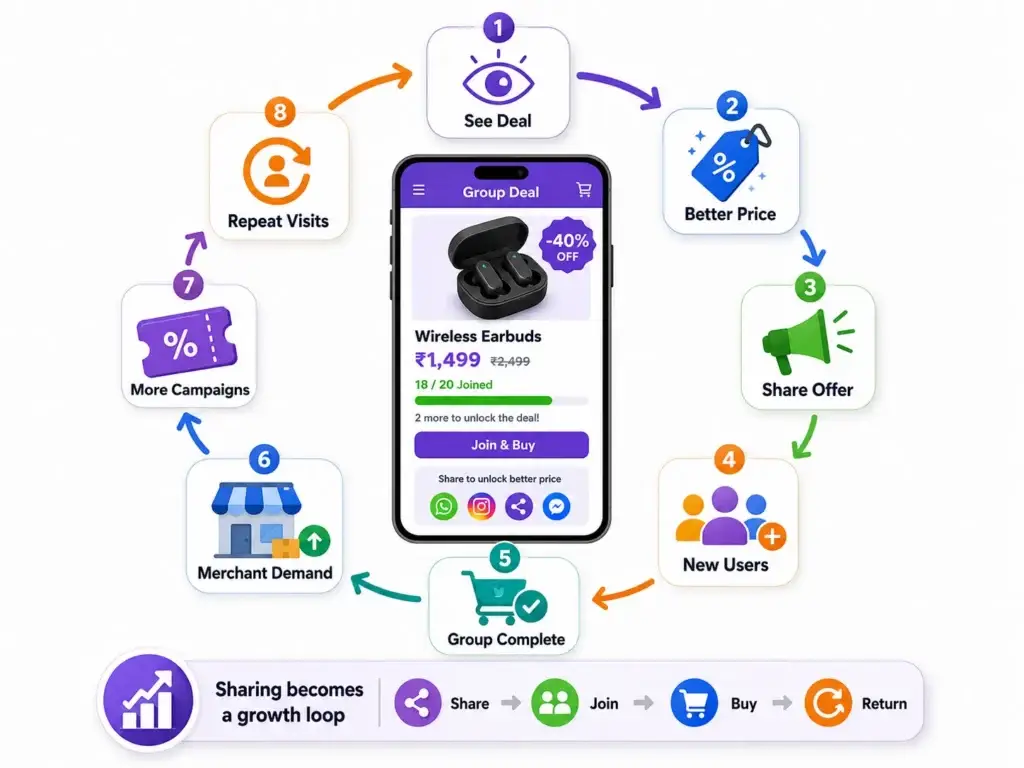
Image Source: AI-generated visual by Miracuves
Social sharing changes ecommerce because it turns customer acquisition into a product behavior.
In most ecommerce businesses, growth depends heavily on paid ads, influencer campaigns, SEO, marketplace visibility, or discounts. Those channels can work, but they often become expensive as competition increases. A group buying marketplace adds another layer: users help distribute offers because the product experience gives them a reason to share.
This creates a growth loop:
- A user sees a deal.
- The deal becomes more attractive when others join.
- The user shares the offer.
- More users enter the platform.
- The group completes the purchase.
- Merchants see demand concentration.
- The platform creates more campaigns.
- Users return for future deals.
The key difference is that sharing is not separate from buying. Sharing is part of the transaction.
This is why group buying can reduce dependence on paid acquisition when designed correctly. The platform is not asking users to promote the business out of goodwill. It gives them a direct benefit: a better price, a reward, a completed deal, or access to a limited offer.
The Business Logic Behind Group Buying Ecommerce
The group buying ecommerce model works because it aligns three sides of the marketplace: shoppers, merchants, and the platform operator.
Shoppers want better prices and a more engaging purchase experience. Merchants want order volume, product visibility, and predictable demand. The platform wants engagement, transaction activity, merchant participation, and monetization opportunities.
When the model is designed properly, each side benefits from the same behavior: more people joining the deal.
How Group Buying Creates Value Across the Marketplace
| Participant | What They Want | How Group Buying Helps |
|---|---|---|
| Customers | Lower prices, discovery, rewards, and trust | They unlock better deals by inviting others and buying together. |
| Merchants | More orders, visibility, and demand predictability | They can sell larger volumes through social deal campaigns. |
| Platform Operator | Growth, engagement, monetization, and data | The platform turns sharing, referrals, and campaigns into repeat activity. |
| Suppliers | Demand signals and inventory movement | Aggregated demand helps suppliers understand what customers want in volume. |
The strongest group buying marketplaces do not simply discount products. They create a structured system where pricing, urgency, social proof, and merchant incentives all support the same growth loop.
How Group Buying Marketplaces Turn Users Into Acquisition Channels
A user becomes an acquisition channel when the platform gives them a reason to bring another user into the buying journey.
This can happen through:
- Invite-to-unlock pricing
- Referral rewards
- Group deal countdowns
- Shareable product links
- Team purchase campaigns
- Wallet credits
- First-order incentives
- Gamified coupons
- Community-based deals
The important point is that social sharing should not feel like a marketing task. It should feel like the natural next step in the purchase journey.
For example, a customer may see a product at one price for individual purchase and a better price if two or more people join. That simple difference changes the user’s behavior. Instead of deciding alone, the shopper now has a reason to share the deal with someone else.
This is where group buying becomes a growth engine. Every product can become a mini-campaign. Every buyer can become a referrer. Every completed group can create data for future campaigns.
Why Demand Aggregation Is the Real Power Behind the Model
Demand aggregation means combining scattered individual demand into a stronger collective signal.
In ecommerce, this matters because merchants often struggle with uncertainty. They do not always know which products will move, how much inventory to prepare, or where demand will come from. A group buying marketplace gives merchants clearer signals by concentrating demand around specific deals, time windows, categories, or regions.
For founders, demand aggregation can support:
- Better merchant negotiations
- Higher campaign participation
- Faster inventory movement
- More predictable order volumes
- Better pricing power
- Stronger category-level insights
This is especially useful in markets where customers are price-sensitive and merchants are willing to trade margin for volume.
A group buying marketplace does not need to own inventory to create value. Its role is to organize demand, route attention, enable transactions, and give merchants tools to compete for customers.
Core Features Every Group Buying Marketplace Needs
A group buying marketplace needs more than product listings and discounts. The business model only works when the platform has the right feature layers for shoppers, merchants, and administrators.
Customer App Features
The customer side should make discovery, sharing, group participation, and checkout simple.
Important customer features include:
- Social login and user profiles
- Personalized product feed
- Individual and group pricing display
- Invite friends or share deal option
- Group progress indicator
- Deal countdown timer
- Cart and checkout
- Wallet or reward credits
- Order tracking
- Ratings and reviews
- Push notifications
- Referral history
- Customer support access
The customer experience should clearly answer three questions: What is the deal? How do I unlock it? What happens after I join?
Merchant Panel Features
Merchants need tools to create, manage, and measure campaigns.
Important merchant features include:
- Merchant onboarding
- Product listing management
- Inventory updates
- Group deal creation
- Discount rules
- Campaign scheduling
- Order management
- Refund and return handling
- Sales analytics
- Product performance reports
- Promotion tools
- Payout tracking
Without a strong merchant panel, the platform operator becomes too dependent on manual operations. That slows growth and creates operational risk.
Admin Dashboard Features
The admin dashboard is the control layer of the marketplace.
Important admin features include:
- User management
- Merchant approval
- Product moderation
- Category management
- Commission settings
- Campaign approval
- Payment monitoring
- Refund and dispute management
- Coupon and referral control
- Fraud monitoring
- Analytics and reporting
- Notification management
- Content and banner control
For a group buying marketplace, admin control is not optional. It decides whether the business can manage quality, trust, campaigns, payments, and growth without depending on developers for every operational change.
Monetization Models for Group Buying Marketplaces
Group buying marketplaces can monetize in multiple ways, but the strongest approach is usually layered monetization. The platform should avoid over-monetizing too early before it has user trust, merchant participation, and transaction density.
Common monetization models include:
| Revenue Stream | How It Works | Founder Consideration |
|---|---|---|
| Merchant Commission | The platform earns a percentage from each completed sale. | Works well when transaction volume is consistent. |
| Featured Listings | Merchants pay for better product visibility. | Requires strong traffic and fair placement rules. |
| Sponsored Campaigns | Merchants promote special deals or seasonal offers. | Works best when campaign analytics are available. |
| Subscription Plans | Merchants pay monthly for advanced tools or visibility. | Better for mature platforms with active sellers. |
| Delivery or Service Fees | Customers pay additional fees for fulfilment or convenience. | Must be transparent to avoid checkout friction. |
| Wallet Credits and Loyalty | Rewards encourage repeat purchases and referrals. | Needs careful control to protect margins. |
The goal is to monetize participation without weakening the deal experience. If customers feel the platform is no longer value-driven, group buying loses its strongest emotional trigger.
Founder Decision Signals
Speed
If your target market is already familiar with social shopping, a ready-made platform foundation can help you test group deals faster instead of spending months building every module from zero.
Cost
The main cost drivers are customer app flows, merchant tools, admin control, payment integration, campaign logic, referral systems, and custom branding.
Scalability
Scalability depends on backend stability, campaign rules, order volume handling, notification systems, merchant onboarding, and analytics.
Market Fit
The model works best when customers are deal-sensitive, socially connected, and comfortable sharing offers with friends, groups, or communities.
Why Gamification Makes Social Commerce More Engaging
Gamification works in group buying because it gives users small reasons to return, share, and complete actions.
This can include:
- Deal countdowns
- Spin rewards
- Daily check-ins
- Invite bonuses
- Progress bars
- Limited-time coupons
- Group completion badges
- Wallet rewards
- Flash deal unlocks
However, gamification should support buying behavior, not distract from it.
A common mistake is adding games without connecting them to business outcomes. A reward wheel may look engaging, but if it does not increase order completion, referrals, retention, or repeat visits, it becomes decoration rather than strategy.
The best gamified shopping experiences are simple, measurable, and tied to clear actions. They help users discover deals, invite others, complete purchases, and return for future offers.
Trust and Quality Control Matter More Than Discounts
Group buying marketplaces often attract price-sensitive users, but low prices alone cannot build long-term trust. If product quality is poor, delivery is unreliable, merchants are unverified, or refunds are difficult, users may try the platform once and never return.
Trust systems should include:
- Merchant verification
- Product approval workflows
- Review moderation
- Refund and return rules
- Delivery status visibility
- Customer support
- Abuse reporting
- Dispute management
- Admin audit logs
- Fraud monitoring
For marketplace founders, trust is not a legal checkbox or a support function. It is part of the product foundation.
Customers are more likely to share deals when they trust the platform. Merchants are more likely to participate when rules are clear. The platform can scale more safely when admin teams have visibility into disputes, refunds, campaign abuse, and seller performance.
Group Buying Marketplace vs Traditional Ecommerce Marketplace
| Factor | Traditional Ecommerce Marketplace | Group Buying Marketplace |
| Discovery Style | Search, filters, categories, ads | Social sharing, feeds, referrals, deals |
| Purchase Behavior | Individual decision-making | Collective participation |
| Growth Driver | SEO, paid ads, marketplace traffic | Social invites, deal sharing, referral loops |
| Pricing Logic | Fixed or seller-defined pricing | Group-based or campaign-based pricing |
| Engagement Layer | Reviews, offers, recommendations | Gamification, countdowns, group progress |
| Merchant Value | Access to marketplace buyers | Access to concentrated demand |
| Platform Challenge | Competing for attention | Managing trust, incentives, and campaign quality |
Traditional ecommerce is still powerful, especially for search-led categories. But group buying marketplaces create a different kind of advantage: they turn social behavior into transaction behavior.
That is why this model is especially relevant for categories such as daily essentials, groceries, fashion accessories, home goods, beauty products, local deals, agricultural products, and budget-friendly consumer goods.
Where Group Buying Marketplaces Work Best
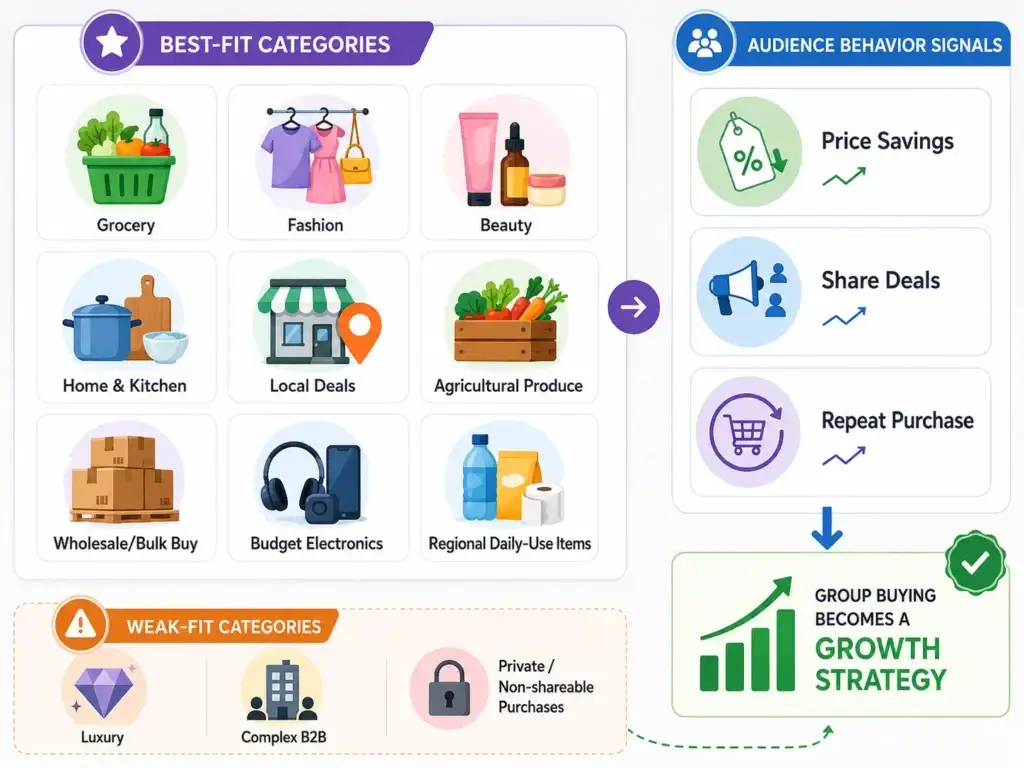
Image Source: AI-generated visual by Miracuves
The group buying model is not right for every category. It works best when the product has broad appeal, price sensitivity, repeat demand, and shareability.
Strong categories include:
- Grocery and household essentials
- Fashion and accessories
- Beauty and personal care
- Home and kitchen products
- Local community deals
- Agricultural produce
- Wholesale and bulk-buy products
- Budget electronics accessories
- Regional products and daily-use items
Weak-fit categories may include highly personalized luxury purchases, complex B2B procurement with long approval cycles, or products where buyers do not want to share purchase intent socially.
Founders should validate whether their audience has three behaviors:
- They care about price savings.
- They are comfortable sharing deals.
- They buy the category frequently enough to return.
If these signals are present, group buying can become more than a feature. It can become the platform’s growth strategy.
Mistakes Founders Should Avoid
Copying Features Without Designing Incentives
Group buying does not work because a button says “invite friends.” It works when the reward, urgency, price difference, and checkout flow make sharing feel valuable.
Launching Without Merchant Controls
If merchants cannot manage campaigns, inventory, pricing, and orders properly, the platform operator will face operational bottlenecks very quickly.
Ignoring Trust and Product Quality
Discount-driven marketplaces can lose credibility if refunds, reviews, seller verification, and delivery tracking are weak.
Over-Monetizing Too Early
Charging merchants heavily before the platform has demand can reduce seller participation. Growth and liquidity should come before aggressive monetization.
How Founders Can Adapt the Group Buying Model for Local Markets
A group buying marketplace should not blindly copy another platform’s playbook. The smarter approach is to adapt the model to the local audience, supply chain, payment habits, and social behavior.
Founders should think through:
- Which products are already shared or discussed socially?
- Which customer segments are most price-sensitive?
- Which merchants can handle volume-based selling?
- Which social channels are strongest in the target market?
- What discount rules are sustainable?
- What fulfilment model will protect customer trust?
- What admin controls are needed from day one?
For example, a local grocery group buying platform may need delivery radius controls, merchant inventory updates, and WhatsApp-based sharing. A fashion deals platform may need flash campaigns, influencer-led deal sharing, and strong return rules. A wholesale community marketplace may need bulk order rules, seller verification, and business buyer accounts.
The model stays the same at the strategic level, but the execution should fit the market.
Miracuves Perspective: Build the Growth Loop Before Scaling the Catalog
Many ecommerce founders make the mistake of starting with a large catalog. But in social commerce, catalog size is not the first growth driver. The first growth driver is the loop that makes users discover, share, join, buy, and return.
Before scaling product categories, founders should build:
- A clear group deal flow
- A simple sharing experience
- Merchant campaign tools
- Reliable order and payment flows
- Admin control over sellers and discounts
- Referral and reward logic
- Trust and dispute workflows
- Analytics for campaign performance
Miracuves helps founders build ready-made and white-label ecommerce marketplace foundations that can be customized for social shopping, group deals, merchant campaigns, and admin-led marketplace control.
For founders evaluating implementation, the next step is not to chase every feature. The next step is to define the business model, user journey, merchant workflow, and launch scope clearly.
A soft next step is to explore a ready-made group-buying ecommerce platform that can be adapted for your market.
Final Thoughts: Social Sharing Becomes Powerful When It Is Built Into the Transaction
A group buying marketplace is not just an ecommerce site with discounts. It is a commerce system where social sharing, pricing incentives, merchant participation, and user behavior work together.
The strongest platforms in this category do not depend only on traffic. They create participation. They give users a reason to invite others. They give merchants a reason to offer better deals. They give the platform operator a way to grow through product-led sharing instead of relying only on paid marketing.
For founders, the opportunity is clear: group buying can be a strong model when the audience is price-sensitive, the products are shareable, merchants can support volume, and the platform has the right control layer.
The smarter move is not to copy a famous app feature by feature. It is to understand the growth mechanism, adapt it to your market, and launch with a platform foundation that supports customers, merchants, campaigns, payments, referrals, and admin control from the beginning.
FAQs
What is a group buying marketplace?
A group buying marketplace is an ecommerce platform where shoppers can unlock better prices or special offers by purchasing together. Users usually invite friends or share deals to complete a group purchase and access the discounted price.
How does social sharing help ecommerce growth?
Social sharing helps ecommerce growth by turning customers into acquisition channels. When users share deals to unlock rewards or group discounts, the platform gains new visitors through product behavior rather than depending only on paid advertising.
What features are needed for a group buying ecommerce platform?
A group buying ecommerce platform usually needs product listings, group pricing, invite links, referral rewards, merchant dashboards, campaign tools, payment integration, order tracking, admin controls, dispute management, and analytics.
Is group buying suitable for every ecommerce category?
No. Group buying works best for products with broad appeal, repeat demand, price sensitivity, and social shareability. It is less suitable for highly private, luxury, or complex purchases where users are unlikely to invite others.
How do group buying marketplaces make money?
They can make money through merchant commissions, featured listings, sponsored campaigns, subscription plans, delivery or service fees, and promotional tools. The right monetization model depends on traffic, merchant demand, and transaction volume.
Why do founders choose social commerce marketplace models?
Founders choose social commerce marketplace models because they can combine ecommerce transactions with referrals, group deals, social discovery, and repeat engagement. This can help reduce acquisition pressure when the growth loop is designed properly.
What is the biggest risk in a group buying marketplace?
The biggest risks are weak trust controls, poor merchant quality, unsustainable discounts, refund issues, and copying features without designing the right user incentives. A strong admin dashboard and clear operating rules are essential.
Can Miracuves help launch a group buying marketplace?
Yes. Miracuves helps founders build ready-made and white-label marketplace platforms with source code, branded design, merchant workflows, admin control, and faster deployment options based on the selected launch scope.
Miracuves is an independent software development company. We are not affiliated with, connected to, sponsored by, or endorsed by any company or product named in this article.
Terms such as “X Clone” are used descriptively. It is how the software industry refers to building a platform with functionality comparable to a known service, and how clients search for it.
The entire design and codebase of our products is built by our own team. Our products contain no code, design, graphics, or content originating from any third-party website or applications.
All third-party names and marks referenced in this article are the property of their respective owners, referenced solely to identify the services discussed.