

Key Takeaways
- The best GTM strategy for a new ticketing and event discovery platform is to start with one focused event niche and build strong local market density.
- Organizer acquisition should come before large-scale attendee marketing because organizers create the event supply that makes discovery valuable.
- A city-by-city launch works better than broad national expansion because event discovery is highly location-sensitive.
- The platform should position itself around event discovery and organizer growth, not only ticket transactions.
- Expansion should begin only after the first niche demonstrates repeat organizer listings, attendee browsing, ticket conversions, and sustainable marketplace traction.
GTM Signals
- A strong city launch can begin with 30–100 quality events and 20–50 organizer relationships before the platform is promoted widely.
- Organizer acquisition works best through direct outreach, venue partnerships, campus communities, local promoters, creators, referrals, and hands-on onboarding.
- Attendee growth can come from local SEO, category pages, short-form content, WhatsApp sharing, referrals, community partnerships, and geo-targeted campaigns.
- Retention features such as saved events, organizer follows, reminders, recommendations, weekly digests, and loyalty programs help create repeat discovery habits.
- Important GTM metrics include active organizers, repeat listings, event-to-checkout conversion, ticket sales, repeat purchases, check-in success, and platform revenue per event.
Real Insights
- Paid traffic cannot solve an empty marketplace, so founders should build enough quality event supply before investing heavily in attendee acquisition.
- The strongest early signal is whether organizers return after their first event because repeat listings show that the platform is creating real business value.
- Ticketing captures transactions, but discovery drives repeat usage by helping attendees continuously find relevant things to do.
- Founders should prioritize event creation, payments, QR validation, organizer dashboards, admin controls, and analytics before adding advanced features.
- The strongest launch path follows a focused sequence: niche → city → supply → discovery → ticket conversion → retention → expansion.
Launching a ticketing and event discovery platform is not the same as launching a normal app.
A food delivery app needs restaurants and customers. A ride-hailing app needs drivers and riders. But a ticketing and event discovery platform has an additional challenge: the platform must feel alive every day. Users will only return if they consistently find relevant concerts, workshops, club nights, festivals, meetups, sports events, cultural experiences, or local activities worth attending.
That means the best go-to-market strategy for ticketing platforms is not “run ads and list events.” The best strategy is to build liquidity in one focused market, win event organizers first, turn events into discovery loops, and use ticketing data to prove that your platform helps organizers sell more tickets.
For founders, this is where the business decision becomes important. Should you start with a broad Eventbrite-style platform? Should you focus on nightlife, college events, music gigs, professional workshops, sports, local experiences, or creator-led events? Should your platform lead with ticketing, discovery, community, or organizer tools?
The right answer depends on your target market, but the launch principle is clear: start narrow, build event supply density, create repeat attendee habits, and expand only after your first niche shows real traction.
Miracuves helps founders build marketplace and booking platforms with white-label app foundations, admin control, source-code ownership, and scalable product workflows. For a ticketing and event discovery startup, that foundation matters because your launch speed, organizer onboarding, ticketing reliability, and analytics layer directly affect your ability to grow.
Why Ticketing and Event Discovery Platforms Are Harder to Launch Than They Look
A ticketing platform looks simple from the outside. Users browse events, select tickets, pay online, receive a QR code, and attend. Organizers create event pages, sell tickets, and check attendees in at the venue. For founders planning to launch this model faster, Miracuves’ events ticketing solution can support event discovery, ticket booking, organizer workflows, and admin control.
But the marketplace layer is where the real complexity begins.
An event discovery platform needs enough supply to make browsing useful. It also needs enough demand to convince organizers that listing events is worth their time. This creates the classic marketplace cold-start problem.
If the platform launches with too few events, users leave. If it launches with too few users, organizers do not care. If the event quality is weak, discovery becomes cluttered. If checkout fails during a high-demand event, trust drops quickly. If organizers cannot see sales data, they may return to older platforms.
That is why a new platform should not start by trying to serve every event category. A focused go-to-market strategy helps founders control supply, build relationships, measure conversion, and create a clear reason for both organizers and attendees to switch.
Read more- Why Startups Choose a BookMyShow Clone Over Building a Ticket Booking Platform From Scratch
The Best GTM Strategy: Start With a Narrow Event Category and Own It Deeply
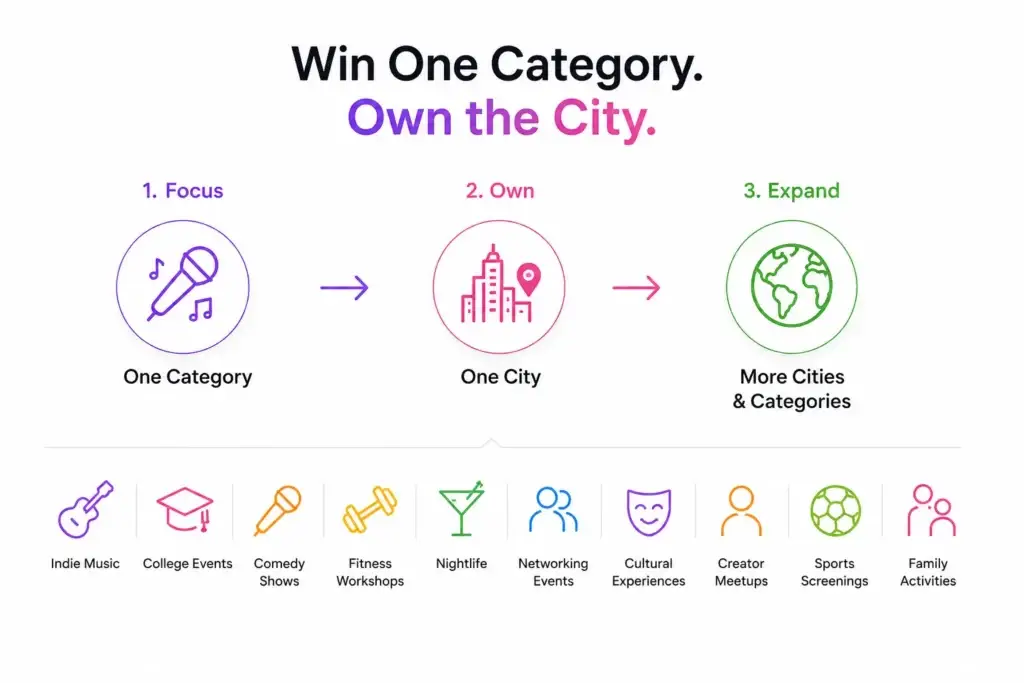
The best go-to-market strategy for a new ticketing and event discovery platform is a focused wedge strategy.
Instead of launching as “a platform for all events,” start as the strongest platform for one specific event segment.
Examples include:
- Indie music gigs in one city
- College events and student festivals
- Comedy shows and open mics
- Fitness workshops and wellness events
- Nightlife and club events
- Professional networking events
- Local cultural experiences
- Creator-led meetups
- Sports screenings and fan events
- Family-friendly weekend activities
This matters because event discovery is local, emotional, and intent-driven. People are not simply buying tickets. They are deciding how to spend their evening, who to go with, how much to pay, and whether the experience feels worth leaving home for.
A narrow category gives your platform sharper positioning. It also makes your first acquisition campaigns easier. A founder can personally onboard 50 nightlife organizers in one city more effectively than trying to attract thousands of unrelated event hosts across multiple categories.
Build Supply Before Demand: Why Organizer Acquisition Comes First
For a new ticketing and event discovery platform, organizer acquisition should usually come before large-scale attendee marketing.
Organizers create the inventory. Without them, your platform has nothing meaningful to discover. But organizers are busy, skeptical, and often already using social media, WhatsApp groups, Eventbrite, Ticketmaster, venue websites, or spreadsheets.
To win them, your pitch must be practical:
“We will help you sell more tickets, reduce manual work, and understand your audience better.”
That pitch is stronger than saying:
“List your event on our new platform.”
Your organizer acquisition strategy should include:
- Free early listing support
- Done-for-you event page creation
- Fast QR ticket setup
- Simple payout process
- Clear attendee data access
- Promo code tools
- Sales dashboard access
- Social sharing assets
- Featured placement for early partners
- On-ground support for first events
In the early stage, manual work is not a weakness. It is how you learn. The founder or launch team should personally help organizers create listing events, improve event descriptions, upload visuals, set ticket tiers, and plan promotion.
This gives you two advantages. First, you build supply faster. Second, you learn what organizers actually need before investing in unnecessary features.
Choose the Right Beachhead Market Before Spending on Paid Ads
A beachhead market is the first narrow audience your platform is designed to win.
For ticketing and event discovery, the best beachhead market should have three qualities:
- Frequent events
A niche with one event per month is hard to build around. A niche with events every week creates repeat discovery. - Fragmented promotion
If organizers rely on scattered Instagram posts, WhatsApp forwards, venue pages, and manual ticketing, your platform can create value. - Clear attendee identity
Students, music fans, startup founders, runners, comedy lovers, parents, or nightlife audiences are easier to target than “everyone who likes events.”
A strong beachhead could be “student nightlife events in Mumbai,” “indie comedy shows in Bangalore,” or “startup networking events in Dubai.” The category should be specific enough to dominate, but large enough to support expansion.
Once the platform proves traction in one segment, the founder can expand into adjacent categories.
For example:
Indie music gigs → nightlife → festivals → creator-led events → city experiences
This staged approach avoids the mistake of building a broad marketplace with no clear reason to exist.
Position the Platform Around Discovery, Not Just Ticketing
Many ticketing platforms compete on transaction features: ticket creation, payment, QR code, check-in, and reporting. These features are important, but they are not enough to build a strong consumer habit.
Event discovery is the retention engine.
A user may buy tickets only occasionally, but they can browse events weekly if the experience feels useful. That means your platform should help users answer questions like:
- What is happening near me this weekend?
- What events match my interests?
- Where are my friends going?
- Which events are trending?
- What is affordable tonight?
- Which organizers do I follow?
- What should I not miss this month?
This is why platforms such as Fever emphasize curated local experiences and city-based discovery. Ticketmaster’s move into AI-powered discovery also shows how event search is expanding into conversational and recommendation-based journeys.
For a new founder, the opportunity is not to become a bigger generic ticketing tool. The opportunity is to become the most useful discovery layer for a specific audience.
Core Product Modules Needed Before GTM Scale
A go-to-market strategy only works if the product can support the promise. If your campaign drives users to a weak event page, slow checkout, or unreliable ticket validation flow, your early growth budget gets wasted.
A launch-ready ticketing and event discovery platform should include the following modules.
Core Platform Modules and Business Value
| Module | Business Value | Founder Impact |
|---|---|---|
| Attendee App or Web Experience | Allows users to browse, search, filter, save, and buy tickets. | Creates the consumer discovery layer needed for repeat usage. |
| Organizer Dashboard | Lets organizers create events, manage tickets, track sales, and view attendees. | Improves organizer retention and reduces manual support. |
| Admin Panel | Controls users, organizers, events, commissions, payments, refunds, and reports. | Gives the platform operator control over operations and monetization. |
| Ticketing and QR Validation | Supports ticket purchase, digital tickets, QR codes, and check-in workflows. | Protects event-day trust and reduces entry chaos. |
| Payment and Payout Flow | Handles ticket payments, organizer payouts, refunds, and platform fees. | Directly affects revenue, trust, and organizer confidence. |
| Discovery and Recommendation Layer | Surfaces relevant events by location, category, popularity, and user behavior. | Improves browsing, retention, and ticket conversion. |
| Marketing and Analytics Tools | Tracks page views, sales, promo codes, conversions, and audience behavior. | Helps organizers see the platform as a growth channel, not only a listing tool. |
| Trust and Safety Workflows | Supports organizer verification, moderation, abuse reports, refund rules, and dispute handling. | Protects platform credibility as listings and payments grow. |
Use a City-by-City Launch Model Instead of a Broad National Launch
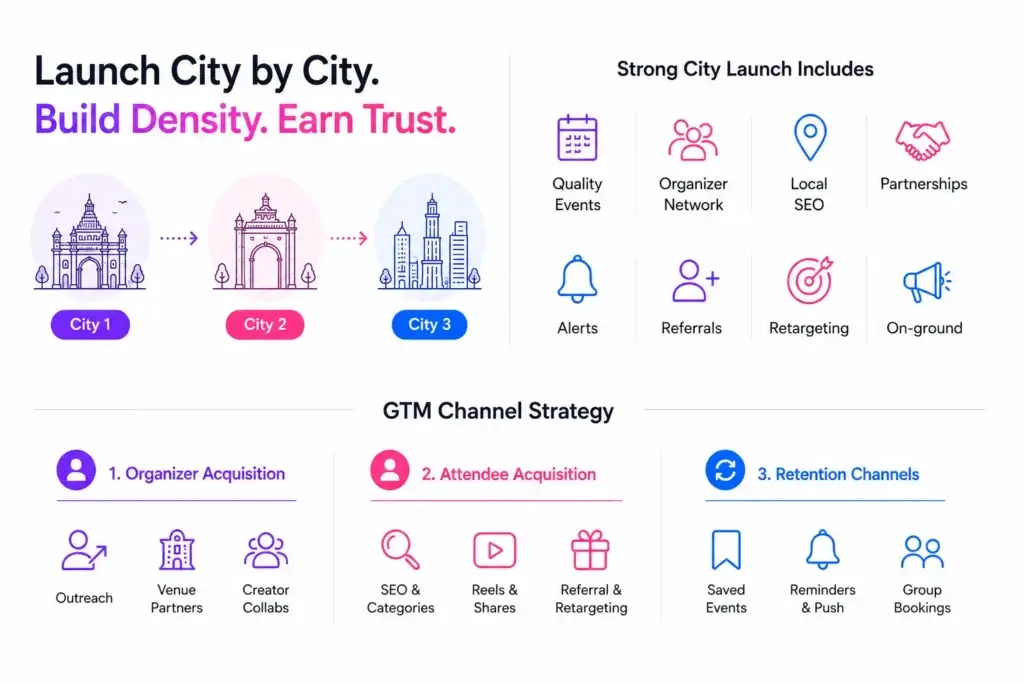
Event discovery is highly location-sensitive. A user in Pune does not care that your platform has many events in Delhi. A user in London does not care about concerts in Manchester unless they are planning a trip.
This is why the city-by-city launch model works better than broad national marketing.
A strong city launch includes:
- 30–100 quality events listed before public launch
- 20–50 organizer relationships
- Category pages for major event types
- Local SEO pages for “events near me” style searches
- Partnerships with venues, campuses, communities, and creators
- Social content around weekend plans
- Push and email alerts by interest category
- Early user referral loops
- Retargeting for event page visitors
- On-ground event activation
The goal is to make the platform feel dense in one city before expanding. Density creates trust. A sparse platform feels abandoned, even if the technology is strong.
GTM Channel Strategy for a New Event Discovery Platform
A new ticketing and event discovery platform should not depend on one acquisition channel. It needs different channels for organizers and attendees.
1. Organizer Acquisition Channels
Organizer acquisition should be relationship-led in the beginning. The best channels include:
- Direct outreach to event organizers
- Venue partnerships
- College societies and campus communities
- Creator and influencer partnerships
- Local promoter networks
- Event agencies
- WhatsApp and Instagram outreach
- Referral incentives for organizers
- Free onboarding support
- Event-page creation assistance
The first organizer acquisition goal is not automation. It is trust. Once early organizers see ticket sales, smooth check-in, and useful reporting, they become repeat suppliers.
2. Attendee Acquisition Channels
Attendee acquisition should be discovery-led. The best channels include:
- Local SEO pages
- Category landing pages
- Instagram Reels and short-form event previews
- WhatsApp share links
- Creator collaborations
- Referral rewards
- Paid social retargeting
- Event reminder emails
- Push notifications
- Community partnerships
- “Weekend guide” content
- Geo-targeted ads for specific events
Paid ads should be used carefully. Sending cold traffic to a generic homepage is usually weak. Sending users to a specific event, category, weekend guide, or personalized discovery page is much stronger.
3. Retention Channels
Retention is where event platforms become valuable. A user may not buy every week, but they can keep browsing if the platform understands their interests.
Retention channels include:
- Follow organizer feature
- Saved events
- Event reminders
- “Similar events” recommendations
- Personalized weekly digest
- Friend invite and group booking flows
- Post-event ratings
- Calendar sync
- Loyalty points
- Early access for repeat users
The goal is to make the platform part of the user’s planning behavior.
Founder Decision Signals Before Launch
Speed
If your target niche already has active organizers and fragmented promotion, speed matters. A launch-ready platform helps you test supply, ticketing, and discovery before competitors build stronger local relationships.
Cost
Do not spend heavily on advanced features before proving event liquidity. Start with the core workflows: event creation, ticket purchase, payment, QR validation, admin control, and analytics.
Scalability
Ticketing platforms can face sudden traffic spikes when a popular event goes live. Your backend, payment flow, and ticket availability logic should be planned before high-demand campaigns.
Market Fit
If organizers repeatedly list events and users return to browse without being pushed every time, your platform is moving beyond one-time ticketing into real discovery behavior.
Monetization Models for a Ticketing and Event Discovery Platform
The revenue model should align with the value the platform creates. If the platform only processes tickets, commission may be the main revenue stream. If it drives discovery and sales, it can monetize through promotion, data insights, and organizer tools.
| Monetization Model | How It Works | Best For |
|---|---|---|
| Ticket Commission | Platform earns a percentage or fixed fee per ticket sold. | Most event ticketing marketplaces |
| Organizer Subscription | Organizers pay monthly for premium tools, analytics, or listing benefits. | Repeat organizers, venues, agencies |
| Featured Listings | Organizers pay to appear higher in search or category pages. | Dense event marketplaces |
| Sponsored Collections | Brands or organizers sponsor curated event categories. | Lifestyle, city, entertainment platforms |
| Ads and Promotions | Platform sells promotional placements to organizers or brands. | Platforms with strong attendee traffic |
| Convenience Fee | A fee is added to attendee checkout. | High-demand ticketing categories |
| SaaS Tools for Organizers | Advanced dashboards, CRM, promo codes, and attendee analytics. | Professional event organizers |
| Affiliate Partnerships | Platform earns through partner venues, food, travel, merchandise, or local experiences. | City discovery ecosystems |
The strongest long-term model usually combines ticket commission with organizer growth tools. This positions the platform as a revenue partner, not just a checkout provider.
White-Label vs Custom Development for Event Ticketing Platforms
Founders usually face two development paths: build everything from zero or start with a white-label foundation and customize it.
| Build Path | Advantages | Limitations | Best For |
| Fully Custom Development | Maximum flexibility, unique architecture, custom workflows. | Longer timeline, higher cost, more product risk before validation. | Funded teams with validated requirements and complex workflows. |
| White-Label Foundation | Faster launch, lower execution risk, ready-made core flows, admin control. | Requires careful customization to avoid generic positioning. | Founders who want faster market validation and ownership. |
| No-Code Prototype | Quick testing for simple flows. | Limited scalability, checkout logic, custom integrations, and performance control. | Very early experiments or internal demos. |
For most new founders, the practical route is to launch a focused first version with core ticketing, discovery, payments, organizer dashboards, and admin control. Once demand is proven, the product can evolve with deeper personalization, AI recommendations, loyalty, organizer CRM, or venue integrations.
Miracuves supports both ready-made and custom app development paths. For founders planning an event marketplace, a white-label solution or source-code-owned product foundation can reduce avoidable build time while still allowing custom branding, monetization logic, and platform control.
Launch Roadmap: A Practical 90-Day GTM Plan
A strong ticketing and event discovery platform launch can be planned in stages.
Days 1–30: Supply Building and Niche Validation
The first month should focus on organizer relationships and event inventory.
Key actions:
- Select one city and one event category
- Identify 100–200 potential organizers
- Personally onboard early organizers
- Create event listing templates
- Build landing pages for the niche
- Set up payment, QR tickets, and check-in workflows
- Offer early partners free or discounted listing support
- Build WhatsApp and Instagram sharing flows
- Collect organizer objections and feature requests
The founder’s goal is to understand why organizers would switch.
Days 31–60: Attendee Acquisition and Discovery Testing
The second month should focus on bringing relevant attendees to live event pages.
Key actions:
- Launch category pages
- Publish weekly local event guides
- Run small paid campaigns for specific events
- Partner with creators and local communities
- Launch referral rewards
- Create social proof around sold or trending events
- Track event page views, checkout starts, purchases, and drop-offs
- Test push notifications and email reminders
- Improve event images, titles, descriptions, and FAQs
The goal is not vanity traffic. The goal is ticket conversion and repeat browsing.
Days 61–90: Retention, Organizer Success, and Expansion Readiness
The third month should turn early usage into repeat behavior.
Key actions:
- Launch organizer analytics reports
- Add follow-organizer and saved-event features
- Create personalized weekly event digests
- Offer premium placements to high-performing organizers
- Build case-based learning from top events
- Improve refund, dispute, and support workflows
- Start waitlists for adjacent categories
- Build a city expansion checklist
The platform should only expand after it proves repeat organizer listings and repeat attendee browsing.
Metrics That Matter for Event Platform GTM
A ticketing and event discovery platform should track marketplace quality, not only downloads.
Important metrics include:
- Number of active organizers
- Repeat organizer listing rate
- Number of live events per category
- Event page views
- Event page to checkout conversion
- Checkout completion rate
- Ticket sales by source
- Average tickets sold per event
- Attendee repeat purchase rate
- Saved events per user
- Push/email open rates
- Refund and dispute rate
- Check-in success rate
- Organizer payout completion time
- Gross ticket value
- Platform revenue per event
The most important early signal is whether organizers come back after their first event. If they do, your platform is creating real business value.
Trust, Safety, and Compliance Workflows Founders Should Not Ignore
Ticketing platforms handle payments, attendee data, refunds, organizer verification, event claims, and sometimes age-restricted or high-risk event categories. Trust and safety should be part of the product foundation from the start.
Important workflows include:
- Organizer verification
- Secure payment gateway integration
- Refund and cancellation rules
- QR ticket fraud prevention
- Duplicate ticket validation
- Role-based admin access
- Event moderation
- Abuse reporting
- Dispute management
- Activity logs
- Secure API integration
- Privacy-conscious data handling
A new platform does not need enterprise complexity on day one, but it does need operational controls. If something goes wrong during event entry, payment settlement, or refund handling, users and organizers will blame the platform.
Mistakes Founders Should Avoid
Launching Too Broadly
A generic event marketplace is hard to position, hard to market, and hard to populate. Start with one niche or city where the platform can feel useful quickly.
Spending on Ads Before Supply Is Strong
Paid traffic cannot fix an empty platform. Build enough quality event inventory before running major attendee acquisition campaigns.
Treating Organizers as Listings Instead of Partners
Organizers need sales, data, promotion, and operational support. If the platform only offers a listing page, it becomes easy to replace.
Ignoring Event-Day Operations
QR scanning, ticket validation, refunds, check-in support, and attendee communication can decide whether organizers trust the platform again.
Building Advanced Features Before Validation
AI recommendations, loyalty points, resale, and dynamic pricing can be valuable later. First, prove that organizers list and attendees buy.
How Miracuves Helps Founders Launch Ticketing and Event Discovery Platforms Faster
A ticketing and event discovery platform needs more than attractive screens. It needs booking logic, organizer workflows, event listing management, payment integration, QR ticket validation, admin control, user engagement, analytics, and scalable backend planning.
Miracuves helps founders create white-label and custom marketplace platforms with source-code ownership, branded design, admin dashboards, and scalable app architecture. For a founder entering the ticketing space, this can reduce the risk of spending months on core infrastructure before testing the actual market.
The smarter path is not to copy Eventbrite, Ticketmaster, or Fever blindly. The smarter path is to identify a focused market, build the right product foundation, and launch with a GTM strategy that creates real organizer and attendee value.
Final Thoughts: The Best GTM Strategy Is Focused, Local, and Organizer-Led
The best go-to-market strategy for a new ticketing and event discovery platform is not a broad launch with generic ads. It is a focused marketplace strategy that starts with one niche, builds event supply density, supports organizers, and creates discovery habits for attendees.
Founders should think in this order:
Niche → city → supply → discovery → ticket conversion → retention → expansion
If the platform can help organizers sell more tickets and help attendees discover better events with less effort, it has a real reason to exist. The strongest platforms are not only ticket processors. They are discovery engines, marketing channels, and operational tools for the live experience economy.
For founders planning to launch faster, Miracuves offers ready-made and custom app development support for marketplace, booking, listing, and event-style platforms with source-code ownership and admin control.
FAQs
What is the best go-to-market strategy for a ticketing and event discovery platform?
The best strategy is to start with one focused niche or city, onboard event organizers first, create enough quality event supply, and then drive targeted attendee demand through local discovery, social sharing, SEO, partnerships, and referral loops.
Should a new ticketing platform focus on organizers or attendees first?
Most new platforms should focus on organizers first because organizers create the event inventory. Once the platform has enough relevant events, attendee marketing becomes more effective.
How do event discovery platforms make money?
Event discovery platforms can earn through ticket commissions, convenience fees, organizer subscriptions, featured listings, sponsored collections, advertising, SaaS tools for organizers, and affiliate partnerships.
What features are essential for launching an event ticketing app?
Essential features include event listings, search and filters, event detail pages, ticket purchase, secure payment integration, QR tickets, check-in tools, organizer dashboard, admin panel, refunds, notifications, and analytics.
How can a new event platform compete with Eventbrite or Ticketmaster?
A new platform should not compete broadly at first. It should focus on a specific underserved niche, provide better local discovery, offer stronger organizer support, and build community-led acquisition loops.
Why is event discovery important for a ticketing platform?
Ticketing captures the transaction, but discovery creates repeat usage. Users return when the platform helps them find relevant events, follow organizers, receive recommendations, and plan what to do next.
Is a white-label solution suitable for launching a ticketing platform?
A white-label solution can be useful when founders want to launch faster with core workflows such as event listings, ticketing, payments, admin control, and user management already in place. Customization is still important for branding, niche positioning, and unique growth features.
How does Miracuves help with event ticketing platform development?
Miracuves helps founders build ready-made and custom app solutions with white-label branding, source-code ownership, admin dashboards, marketplace workflows, and scalable product architecture suited for booking, listings, and event discovery platforms.
Miracuves is an independent software development company. We are not affiliated with, connected to, sponsored by, or endorsed by any company or product named in this article.
Terms such as “X Clone” are used descriptively. It is how the software industry refers to building a platform with functionality comparable to a known service, and how clients search for it.
The entire design and codebase of our products is built by our own team. Our products contain no code, design, graphics, or content originating from any third-party website or applications.
All third-party names and marks referenced in this article are the property of their respective owners, referenced solely to identify the services discussed.