

Key Takeaways
- Group-buying fraud can involve sellers, buyers, payments, coupons, referrals, refunds, and payouts.
- Seller verification should continue after onboarding through activity and complaint monitoring.
- Coupon and referral rewards need account, device, order, and campaign-level restrictions.
- Suspicious payments, refunds, and payout changes should support manual review.
- Strong admin visibility helps teams identify connected patterns instead of isolated incidents.
Fraud-Control Signals
- Verify seller identity, business details, bank accounts, and product information.
- Monitor repeated devices, unusual orders, rapid refunds, and connected accounts.
- Delay referral rewards until valid payments and purchase behaviour are confirmed.
- Require additional verification when sellers change payout or account details.
- Give admins controls to pause campaigns, restrict accounts, review disputes, and export logs.
Real Insights
- Fraud usually appears through connected behaviour across multiple marketplace workflows.
- Strict controls everywhere can block legitimate buyers and reduce campaign conversion.
- Automated risk rules work best when teams can review and override decisions.
- Fraud prevention should evolve as new sellers, campaigns, and payment methods are introduced.
- Miracuves develops group-buying marketplaces with seller governance, admin controls, and fraud-review workflows.
Group-buying marketplaces are built around urgency, discounts, seller participation, shared deals, referrals, wallet flows, and campaign-based purchasing. That is exactly what makes them powerful for growth. It is also what makes them attractive to fraudsters.
A normal ecommerce store mostly deals with product, payment, and delivery risk. A group-buying marketplace has additional layers: sellers can manipulate listings, buyers can create multiple accounts to exploit deals, coupon campaigns can be abused, fake group orders can distort demand, and refund disputes can quickly damage trust.
For founders, fraud prevention should not be treated as a post-launch support problem. It should be designed into the marketplace foundation from the beginning.
This guide explains how to reduce fraud in group-buying marketplaces through seller verification, payment controls, coupon abuse prevention, admin monitoring, and operational trust workflows.
Why Group-Buying Marketplaces Face Different Fraud Risks
Group-buying platforms are not simple product catalogues. They are demand aggregation engines.
A shopper may join a deal, invite friends, use a coupon, unlock threshold pricing, claim wallet rewards, participate in flash sales, and trigger seller-side fulfilment. Every one of these actions creates a possible abuse point.
Fraud can happen across four layers:
| Fraud Layer | What Can Go Wrong | Business Impact |
|---|---|---|
| Seller onboarding | Fake merchants, duplicate seller accounts, false business details | Low-quality catalogue, payout risk, counterfeit listings |
| Buyer activity | Multiple accounts, referral abuse, fake group formation | Inflated acquisition cost, distorted demand signals |
| Campaign and coupon rules | Coupon farming, first-order discount abuse, fake redemptions | Lost margin, damaged promo budget |
| Payments and refunds | Chargebacks, refund manipulation, payout redirection | Revenue leakage, disputes, operational workload |
This is why fraud prevention should be part of the marketplace’s operating system, not a last-minute plugin.
Stripe’s fraud guidance explains that account and promotion abuse often targets platform incentives such as sign-up credits, referral bonuses, and discounts, and that this abuse can occur before any payment takes place. That means platforms need identity, behaviour, and account-level signals, not only payment fraud checks.
The Main Types of Fraud in Group-Buying Marketplaces
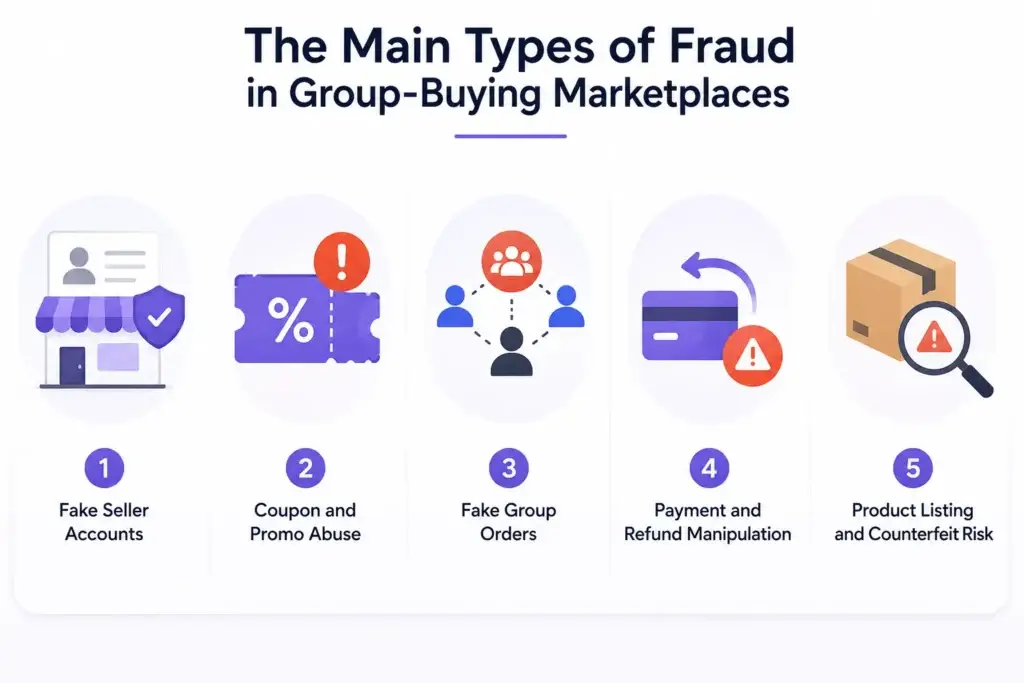
Image Source: AI-generated visual by Miracuves
Fraud in a social commerce marketplace usually appears as a pattern, not a single event. A single suspicious order may not prove abuse. But repeated patterns across sellers, accounts, devices, coupons, refunds, and payouts can reveal a larger risk.
1. Fake Seller Accounts
Fraudulent sellers may create storefronts using false identity details, misleading business information, or duplicate accounts. Their goal may be to list counterfeit products, collect payments, manipulate campaigns, or redirect payouts.
A safer marketplace should verify who controls the seller account before giving access to sensitive actions such as listing products, launching campaigns, changing payout details, or receiving settlements.
Marketplace seller verification usually includes checks such as email and phone verification, identity verification, business registration checks, address confirmation, beneficial owner checks, and re-verification after sensitive account changes.
2. Coupon and Promo Abuse
Group-buying platforms often depend on coupons, referral rewards, joining incentives, limited-time discounts, and first-order offers. These can drive strong early traction, but they can also be abused.
Common promo abuse patterns include:
- Multiple accounts created by the same person
- Repeated use of first-order discounts
- Self-referral between duplicate accounts
- Coupon sharing outside intended rules
- Reward farming through fake engagement
- Group-deal manipulation using coordinated accounts
Stripe highlights multi-accounting, bonus abuse, and referral exploitation as common promotion-abuse patterns, especially when users create multiple accounts to bypass restrictions or claim incentives beyond the intended policy.
3. Fake Group Orders
In group-buying marketplaces, demand signals matter. Sellers and operators may use group participation data to decide pricing, inventory, campaign priority, and fulfilment.
Fraudsters can manipulate this by creating fake buying groups, joining campaigns through duplicate accounts, or triggering deal thresholds without genuine purchase intent. This creates operational problems because the platform may misread artificial demand as real demand.
The result can be poor inventory planning, seller frustration, refund pressure, and weaker buyer trust.
4. Payment and Refund Manipulation
Payment fraud does not only mean stolen cards. In marketplaces, payment risk can also include suspicious refund requests, chargebacks, wallet misuse, payout manipulation, and disputes between buyers and sellers.
A group-buying platform should have clear rules for:
- Payment authorization
- Refund eligibility
- Order cancellation
- Wallet credit usage
- Seller settlement timing
- Dispute review
- Suspicious transaction flags
Without these controls, fraud losses can appear slowly across refunds, coupon leakage, support tickets, and seller payout issues.
5. Product Listing and Counterfeit Risk
A group-buying marketplace may attract many sellers because campaign-based selling can move products quickly. But fast seller growth also creates listing risk.
Fraudulent or careless sellers may upload inaccurate product descriptions, duplicate listings, counterfeit goods, misleading images, or false inventory claims.
Marketplace governance matters here. Flipkart’s marketplace governance framework, for example, describes risk-based seller onboarding, monitoring, audit trails, escalation protocols, listing screening, and controls against fake listings, multi-account misuse, return manipulation, and promotional fraud.
Read More: Group-Buying Marketplace Features and Pricing: What Founders Should Evaluate Before Launch
Seller Verification: The First Fraud-Control Layer
Seller verification is the first serious line of defence for a group-buying marketplace.
The goal is not to create unnecessary friction for every seller. The goal is to apply the right level of verification based on seller risk.
A small seller listing low-risk products may need basic checks. A high-volume seller, cross-border seller, or merchant requesting payout changes may need stronger verification.
What a Seller Verification Workflow Should Include
| Control | Business Value | Founder Impact |
|---|---|---|
| Email and phone verification | Reduces low-effort fake registrations | Creates a basic trust layer before seller access |
| Identity or business verification | Confirms who controls the seller account | Reduces fake storefront and payout risk |
| Address and business detail checks | Improves seller accountability | Supports safer onboarding and dispute handling |
| Risk scoring | Prioritizes high-risk sellers for manual review | Prevents the admin team from reviewing every seller equally |
| Re-verification after sensitive changes | Protects payout details and account ownership | Reduces settlement fraud and account takeover risk |
Seller verification should continue beyond onboarding. A seller who was low risk at registration may become high risk after unusual sales spikes, excessive refund requests, sudden payout changes, duplicate listings, or repeated buyer complaints.
That is why seller trust should be managed as a lifecycle, not a one-time form.
Coupon Abuse Controls: Protecting Growth Without Killing Conversion
Coupons and referral campaigns are useful because they reduce friction for new buyers. But if the marketplace gives away discounts too easily, fraudsters can turn the promotion engine into a leakage engine.
The key is to design coupon logic around eligibility, limits, behaviour, and review triggers.
Strong Coupon Rules Founders Should Consider
A group-buying marketplace should be able to configure rules such as:
- One coupon per verified buyer
- Coupon eligibility only after phone or payment verification
- Time delay before referral reward release
- Referral reward only after the referred buyer completes more than one valid purchase
- Coupon limits by device, payment method, user account, or household signals
- Campaign-level redemption caps
- Category-specific coupon restrictions
- Manual review for unusual coupon clustering
This does not mean every marketplace needs heavy friction from day one. It means the platform should allow the operator to adjust coupon rules as abuse patterns appear.
Why Behavioural Monitoring Matters
A user who signs up, claims a discount, makes one suspicious purchase, and disappears may look normal in isolation. But if hundreds of accounts follow the same pattern, the platform has a problem.
Behavioural monitoring can help detect:
- Accounts created within similar time windows
- Repeated device or IP patterns
- Similar checkout behaviour
- Identical referral loops
- Coupon redemptions from related accounts
- Orders that repeatedly cancel after coupon use
Stripe’s guidance recommends prevention strategies such as identity verification at account creation, promo eligibility logic, rate limits, and ongoing behavioural monitoring for platforms and marketplaces dealing with account and promotion abuse.
Payment Controls: Reducing Transaction, Refund, and Payout Risk
Payment safety is one of the most important trust layers in any marketplace. But for group-buying models, the logic can be more complex because payments may connect to deal thresholds, seller fulfilment, wallet credits, coupons, refunds, and settlement timing.
A safer marketplace should not treat payment as a single checkout event. It should treat payment as a full transaction lifecycle.
Payment Risk Areas to Control
| Risk Area | What to Monitor | Useful Control |
| Checkout | Failed payments, repeated attempts, suspicious payment methods | Gateway risk checks, rate limits, payment method validation |
| Wallet usage | Unusual credit usage, bonus abuse, refund credit recycling | Wallet ledger logs, usage limits, admin alerts |
| Refunds | Repeat refund requests, seller-specific refund spikes | Refund rules, manual review, dispute workflow |
| Seller payouts | Payout detail changes, sudden high-volume settlements | Step-up verification, payout delay rules, admin approval |
| Chargebacks | Buyer disputes and payment reversals | Transaction history, order evidence, dispute records |
The founder’s goal is not to block every unusual action automatically. The goal is to build enough visibility so the admin team can decide what deserves approval, delay, rejection, or escalation.
Read More: How Social Group Buying Works: A Complete Guide for Ecommerce Businesses
Admin Controls: The Difference Between Detection and Action
Fraud detection is only useful if the operator can act on it.
A group-buying marketplace should give admins practical control over users, sellers, products, campaigns, coupons, orders, refunds, wallet activity, and reports. Without this, the founder becomes dependent on developers or manual database checks every time something goes wrong.
Miracuves’ group-buying social commerce solution includes merchant and admin workflows, including areas for merchants to manage products, group buys, coupons, and orders, while admins manage merchants, orders, coupons, and demand through the admin console.
Admin Actions That Help Reduce Fraud
Admins should be able to:
- Approve, reject, or suspend sellers
- Review flagged sellers before payout
- Pause suspicious campaigns
- Limit coupon usage by campaign
- Track refund patterns
- Monitor wallet activity
- Review order histories
- View buyer and seller disputes
- Restrict risky product listings
- Export logs for review
- Assign role-based access to team members
For founders, this matters because fraud prevention is not only technical. It is operational. Your team needs controls that match real marketplace workflows.
Founder Decision Signals
Speed
If you want to launch quickly, choose a marketplace foundation where seller, coupon, order, and admin controls already exist instead of building every workflow from zero.
Cost
Fraud prevention can reduce hidden costs from refunds, promo leakage, manual support, low-quality sellers, and avoidable dispute handling.
Scalability
As sellers and campaigns grow, manual review alone becomes slow. Admin dashboards, rules, logs, and monitoring workflows help the platform scale with control.
Market Fit
Trust affects repeat usage. Buyers are more likely to return when deals feel fair, sellers are verified, payments are secure, and disputes are handled clearly.
Trust and Safety Workflows Every Founder Should Plan Before Launch
A group-buying marketplace should not depend only on “block” or “allow” decisions. Real fraud prevention needs workflows.
1. Seller Onboarding Workflow
Before a seller can publish campaigns, the platform should collect the right seller details, verify required information, and apply risk-based review.
A low-risk seller may move through quickly. A high-risk seller may require more documentation, address review, category checks, or manual approval.
2. Product Listing Review Workflow
Products should be reviewed based on category, pricing, brand sensitivity, seller history, and complaint patterns. High-risk categories may require stricter review before going live.
3. Coupon and Campaign Approval Workflow
Not every seller should be allowed to create unlimited coupons or launch high-discount campaigns without oversight. Admins should be able to approve campaigns, set discount limits, and monitor redemption behaviour.
4. Refund and Dispute Workflow
Refunds should follow defined rules. The platform should track who requested the refund, why it was requested, whether the product was shipped, whether the seller has a high dispute rate, and whether the buyer shows repeat refund behaviour.
5. Payout Review Workflow
Seller payouts should not be completely detached from risk. If a seller suddenly changes payout details, receives a spike in orders, or has unresolved disputes, the admin team should be able to delay or review the payout.
Security Layers That Support Fraud Prevention
Fraud prevention and security are connected, but they are not identical.
Security protects systems, accounts, payments, and data. Fraud prevention protects marketplace rules, incentives, sellers, buyers, and transactions from abuse.
A strong group-buying marketplace should consider:
- Encrypted data transfer
- Encrypted data storage
- Secure payment gateway integration
- Role-based access control
- Admin activity logs
- Seller verification workflows
- Buyer account risk signals
- Coupon usage limits
- Fraud monitoring
- Transaction monitoring
- Dispute management
- Abuse reporting
- Secure API integration
- Permission-based dashboards
Final compliance depends on the target market, legal review, payment providers, operating model, privacy requirements, and implementation choices. A platform can support compliance-ready workflows, but no software alone should be described as automatically compliant everywhere.
Ready-Made Foundation vs Building Fraud Controls From Zero
Founders often underestimate how much marketplace control logic is needed beyond the visible app screens.
A product catalogue, cart, and checkout are not enough. A group-buying marketplace also needs seller onboarding, campaign management, coupon rules, order visibility, refund workflows, wallet logic, admin review, and risk monitoring.
| Decision Area | Building From Zero | Ready-Made Marketplace Foundation |
| Seller onboarding | Must be designed and developed from scratch | Starts with existing merchant workflows that can be customized |
| Coupon controls | Requires custom rule logic | Can begin with configurable campaign and coupon flows |
| Admin visibility | Often added late after issues appear | Admin control is part of the operating layer |
| Launch speed | Slower because every module must be planned and built | Faster because core marketplace flows already exist |
| Risk management | Depends on how much budget is assigned upfront | Can start with practical workflows and improve over time |
| Source-code flexibility | Depends on vendor contract | Miracuves provides source-code ownership for ready-made solutions |
Miracuves’ ready-made approach is useful for founders who want to validate a group-buying social commerce model faster while still keeping control over branding, admin workflows, customization, and source code.
Mistakes Founders Should Avoid
Launching coupons without abuse limits
Unlimited or poorly scoped coupons can attract fake accounts, self-referrals, and repeated discount farming. Founders should define usage rules before campaigns go live.
Approving every seller too quickly
Fast onboarding is useful, but sellers should still pass the right level of verification based on category, payout access, business details, and risk signals.
Ignoring payout changes
A seller changing bank or payout details should trigger extra review, especially if the account has high sales, recent disputes, or unusual login activity.
Depending only on payment fraud tools
Many marketplace abuse patterns happen before payment, especially coupon abuse, referral abuse, fake accounts, and campaign manipulation.
Practical Fraud-Prevention Checklist for Founders
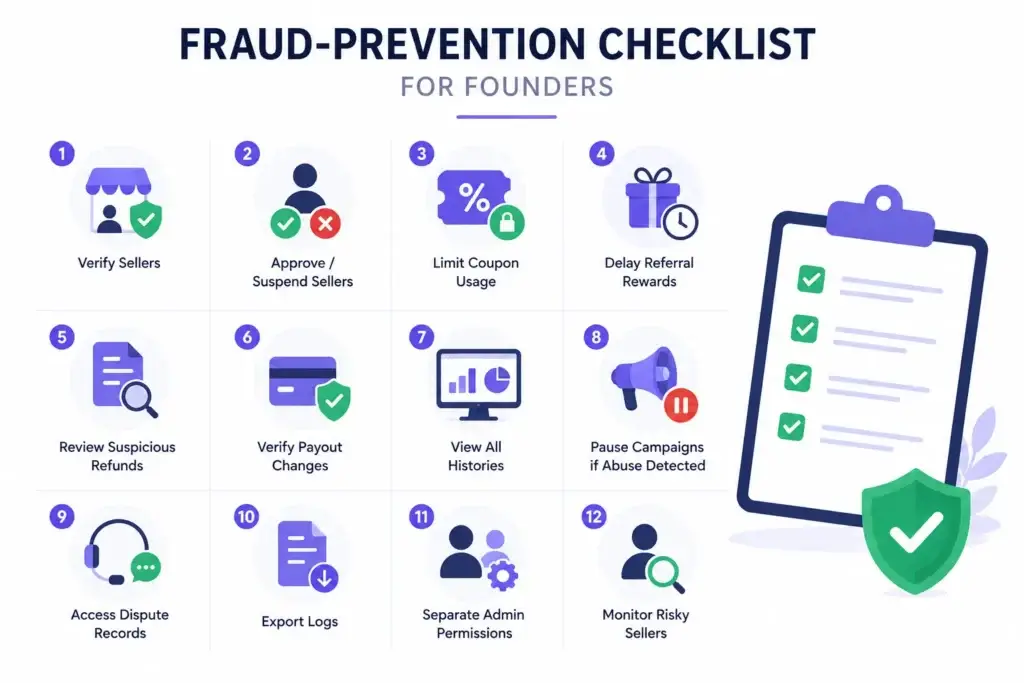
Image Source: AI-generated visual by Miracuves
Before launching a group-buying marketplace, review these areas:
- Can sellers be verified before listing products?
- Can admins approve or suspend sellers?
- Can coupon usage be limited by account, device, order, or campaign?
- Can referral rewards be delayed until valid purchase behaviour is confirmed?
- Can suspicious refunds be reviewed manually?
- Can payout detail changes trigger step-up verification?
- Can admins view buyer, seller, coupon, wallet, and order histories?
- Can campaigns be paused if abuse is detected?
- Can support teams access dispute records?
- Can the platform export logs for review?
- Can permissions be separated between admin roles?
- Can risky sellers be monitored after onboarding?
If the answer is “no” to most of these, the platform may look launch-ready on the surface but still be operationally weak.
Read More: Pre-Launch and Post-Launch Marketing Plan for Social Shopping Marketplace
How Miracuves Helps Founders Build Safer Group-Buying Marketplaces
Launching a group-buying marketplace is not only about adding products, discounts, and checkout flows. Founders also need a strong control layer that helps them manage sellers, coupons, orders, refunds, payments, and campaign activity as the platform grows.
Miracuves helps founders build ready-made and white-label marketplace solutions with source-code ownership, branded design, admin control, and faster deployment. For a group-buying or social commerce business, this gives founders a stronger starting point instead of building every workflow from zero.
The key advantage is operational control. With the right marketplace foundation, founders can:
- Manage seller onboarding and approval workflows
- Configure coupon rules and campaign limits
- Monitor group-buying orders and buyer activity
- Review refund, cancellation, and dispute requests
- Track seller performance and suspicious activity
- Control admin permissions for different team members
- Customize workflows based on the business model
- Scale marketplace operations with better visibility
For founders, this matters because fraud prevention is not only a security feature. It directly affects buyer trust, seller quality, campaign profitability, and long-term marketplace growth.
Miracuves’ marketplace approach helps businesses launch faster while keeping seller governance, coupon abuse prevention, payment safety, and admin monitoring in focus. This makes it easier to validate a group-buying commerce idea without losing control over the trust and safety layer.
Final Thoughts: Fraud Prevention Is a Marketplace Growth Decision
Fraud prevention is not only about stopping bad actors. It is about protecting the trust loop that makes a group-buying marketplace work.
Buyers need to trust deals. Sellers need to trust payouts. Operators need visibility into coupons, campaigns, refunds, orders, and disputes. Without that control layer, growth can become expensive very quickly.
The stronger decision is to plan seller verification, coupon rules, payment controls, refund workflows, and admin monitoring before launch. A marketplace that grows with trust has a better chance of keeping buyers, attracting better sellers, and scaling without avoidable operational risk.
FAQs
What is group-buying marketplace fraud prevention?
Group-buying marketplace fraud prevention is the process of detecting and reducing abuse across sellers, buyers, coupons, referrals, payments, refunds, campaigns, and payouts. It helps founders protect trust, reduce revenue leakage, and manage marketplace risk.
Why are group-buying marketplaces vulnerable to coupon abuse?
Group-buying platforms often use discounts, referrals, wallet credits, and joining incentives to drive engagement. Fraudsters may create multiple accounts, self-refer, or repeatedly claim first-order offers unless coupon eligibility and redemption rules are controlled.
How can seller verification reduce marketplace fraud?
Seller verification helps confirm who controls a seller account before that seller can list products, receive payouts, or launch campaigns. It can reduce fake storefronts, payout fraud, duplicate seller accounts, and repeat abuse.
What payment controls should a social commerce marketplace include?
A social commerce marketplace should include secure payment gateway integration, transaction logs, refund rules, wallet tracking, seller payout review, dispute records, and admin visibility into suspicious payment behaviour.
Should every seller go through the same verification process?
No. A risk-based approach is better. Low-risk sellers may need basic checks, while high-volume sellers, cross-border sellers, sellers in sensitive categories, or sellers changing payout details may need stronger verification.
How can founders reduce referral fraud?
Founders can reduce referral fraud by delaying referral rewards, requiring verified payment methods, limiting referrals by account or device signals, reviewing unusual referral clusters, and releasing rewards only after valid repeat purchase behaviour.
What admin features help reduce marketplace fraud?
Useful admin features include seller approval, campaign moderation, coupon controls, order monitoring, refund review, wallet activity logs, dispute management, payout approval, role-based access, and fraud alert workflows.
Can a ready-made marketplace solution support fraud prevention?
Yes, if it includes practical marketplace workflows such as seller management, coupon controls, order visibility, admin dashboards, payment integration, and customization options. Final fraud-prevention strength depends on configuration, policies, integrations, and operating model.
Miracuves is an independent software development company. We are not affiliated with, connected to, sponsored by, or endorsed by any company or product named in this article.
Terms such as “X Clone” are used descriptively. It is how the software industry refers to building a platform with functionality comparable to a known service, and how clients search for it.
The entire design and codebase of our products is built by our own team. Our products contain no code, design, graphics, or content originating from any third-party website or applications.
All third-party names and marks referenced in this article are the property of their respective owners, referenced solely to identify the services discussed.