




Key Takeaways
- Smart routing helps recover failed subscription payments.
- Multi-gateway setups reduce payment dependency risks.
- Failed renewals directly impact creator revenue.
- Payment recovery improves subscriber retention.
- Routing logic strengthens platform revenue stability.
Payment Routing Signals
- Route payments by region, card type, and risk level.
- Use gateway health scoring for better approval rates.
- Retry failed renewals through approved alternate routes.
- Separate creator wallets from payment collection systems.
- Give admins control over routing and gateway rules.
Real Insights
- Payment failures create retention problems, not just billing issues.
- Single-gateway dependence increases operational risk.
- Subscription recovery can significantly improve revenue retention.
- Payment infrastructure should be planned before launch.
- Miracuves builds creator platforms with smart routing and payout controls.
Creator platforms do not fail only because creators stop posting or fans stop subscribing. Many fail because payments quietly break in the background.
A renewal declines. A gateway flags the platform. A processor delays settlement. A creator cannot withdraw earnings. A fan tries to subscribe but sees a failed checkout. None of these issues look dramatic at first, but together they create one of the most dangerous revenue leaks in the premium creator economy: payment infrastructure fragility.
For technical founders and operations managers, the question is no longer, “Which payment gateway should we integrate?” The stronger question is, “Can our payment architecture survive declines, gateway restrictions, processor reviews, chargebacks, renewals, refunds, and creator payouts without interrupting revenue?”
That is where smart payment routing for creator platforms becomes a serious business advantage, especially for subscription-led products such as an OnlyFans Clone, fan monetization platform, or premium creator community where recurring billing directly affects creator earnings.
Stripe, for example, supports many creator economy use cases and offers tools for billing, payouts, and global payments, but it also maintains prohibited and restricted business rules, including restrictions around adult content and related services. For premium creator platforms, especially those handling subscriptions, PPV content, tips, live interactions, or high-risk creator categories, relying on one standard API can expose the entire business to avoidable failure.
Miracuves helps founders build creator economy platforms, including OnlyFans Clone solutions, with monetization workflows, payment gateway logic, creator dashboards, admin control, payout management, and white-label app foundations designed for faster launch and scalable operations. For payment-heavy creator businesses, that foundation should not stop at “gateway connected.” It should include routing logic, recovery workflows, and operational controls that protect recurring revenue.
The Deplatforming Threat in the Creator Economy
Creator platforms sit in a sensitive payment category because they combine recurring subscriptions, digital content, direct creator earnings, fan payments, refunds, disputes, and sometimes mature or restricted content categories.
That mix makes payment operations more complex than a normal ecommerce checkout.
A standard ecommerce store may lose one order when a card fails. A creator platform can lose the entire creator-fan relationship if the subscription renewal fails at the wrong time. A marketplace may survive a payout delay for a vendor. A creator platform can lose creator trust quickly if earnings are unclear, delayed, frozen, or reversed.
The real threat is not only a formal “ban.” It is a chain reaction:
- A processor flags transaction patterns.
- Some payments start failing.
- Renewals are not recovered quickly.
- Creators see unstable earnings.
- Fans lose access after failed renewals.
- Support tickets increase.
- The platform loses both revenue and trust.
This is why payment infrastructure must be treated as a core product layer. It affects retention, creator loyalty, subscriber experience, cash flow, and operations.
Payment processors publish restrictions because they must manage legal, brand, card-network, fraud, and chargeback risk. Stripe’s restricted business materials, for instance, explicitly describe categories that require careful review or are prohibited under its rules. The founder lesson is not to bypass processor policies. The lesson is to design a compliant, transparent, multi-provider payment stack that avoids putting the entire business behind one fragile gate.
Read more: How Safe is a White-Label OnlyFans App? Security Guide 2026
Why Standard Payment APIs Break Under Premium Creator Platform Risk
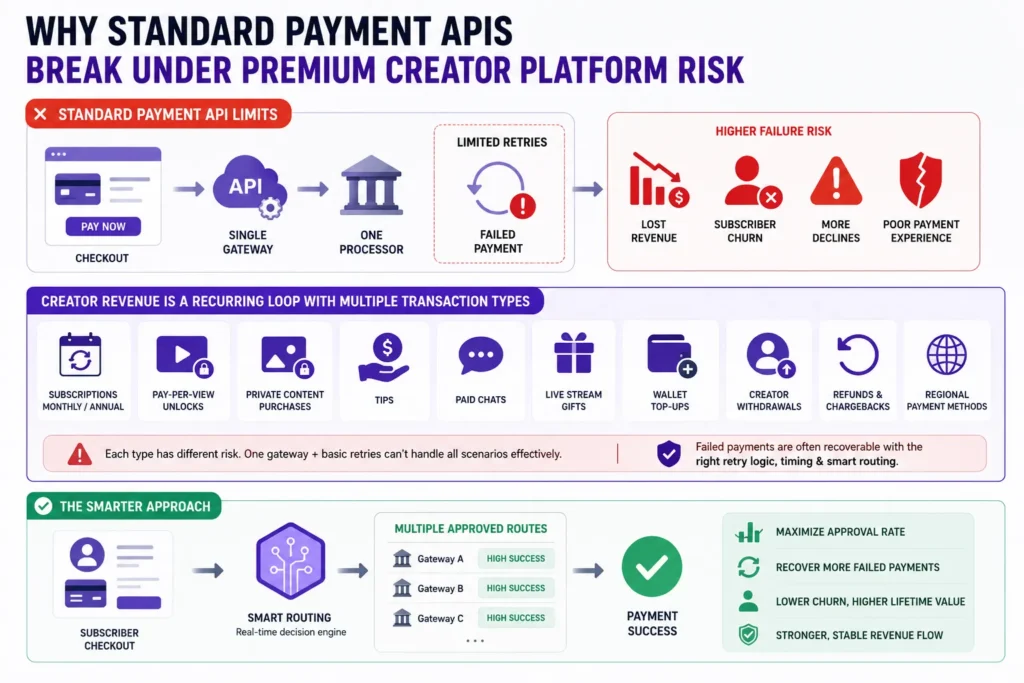
A standard payment API integration is usually built around one main processor. It may include checkout, cards, recurring billing, refunds, and webhooks. For many SaaS or ecommerce platforms, that can be enough.
For creator platforms, it often is not.
The reason is simple: creator revenue is not a one-time transaction. It is a recurring loop.
A creator platform may process:
- monthly subscriptions
- annual plans
- pay-per-view unlocks
- private content purchases
- tips
- paid chats
- live stream gifts
- wallet top-ups
- creator withdrawals
- refunds
- chargebacks
- regional payment methods
Each transaction type carries different risk. A first-time subscription is not the same as a renewal. A $5 tip is not the same as a $300 bundle purchase. A fan wallet top-up is not the same as a creator payout.
Stripe itself recommends automated retries for failed subscription payments and notes that many failed payments are recoverable. That point matters because failed renewals are not always final losses. They are often recoverable if the platform has the right retry timing, routing logic, and subscriber communication.
But a single-gateway retry system still has limits. If the gateway itself is underperforming for a card type, region, bank, risk category, or account status, retrying the same path may not solve the problem. Smart routing adds another layer: it sends or retries the transaction through the best available approved route.
Read more: Top Monetization Strategies for Adult Platforms like OnlyFans in 2026
Standard APIs vs. High-Risk Multi-Gateway Routing
The difference between a standard API and a smart routing engine is not cosmetic. It changes how the platform handles failure.
Standard Payment API vs. Smart Multi-Gateway Routing
| Payment Layer | Standard Single-Gateway API | Smart Multi-Gateway Routing | Founder Impact |
|---|---|---|---|
| Gateway dependency | One primary payment processor handles most transactions. | Multiple approved gateways are connected and used based on routing rules. | Reduces dependency on one processor account. |
| Failed renewals | Retries usually happen within the same gateway environment. | Failed renewals can be retried through alternate approved routes when eligible. | Improves subscription recovery potential. |
| Risk segmentation | All transactions may flow through the same processor logic. | Transactions can be routed by region, card type, content category, risk score, amount, or billing type. | Improves operational control and reduces blanket exposure. |
| Gateway downtime | Checkout or renewals may fail when the gateway is unavailable. | Traffic can fail over to another route when configured and approved. | Protects revenue continuity. |
| Admin control | Limited visibility into why payments fail beyond gateway reports. | Admin dashboards can show gateway performance, decline reasons, recovery rate, and route health. | Gives operations teams better decisions. |
Smart routing is already recognized in the broader payment infrastructure market because it can improve authorization rates, reduce false declines, and recover transactions by routing them through better-performing paths. Stripe’s own guide to intelligent payment routing explains that routing can improve approvals by matching transactions to processors with stronger historical success for specific factors, and that alternate paths can help recover false declines.
For creator platforms, the same principle becomes more urgent because recurring billing is directly tied to creator income.
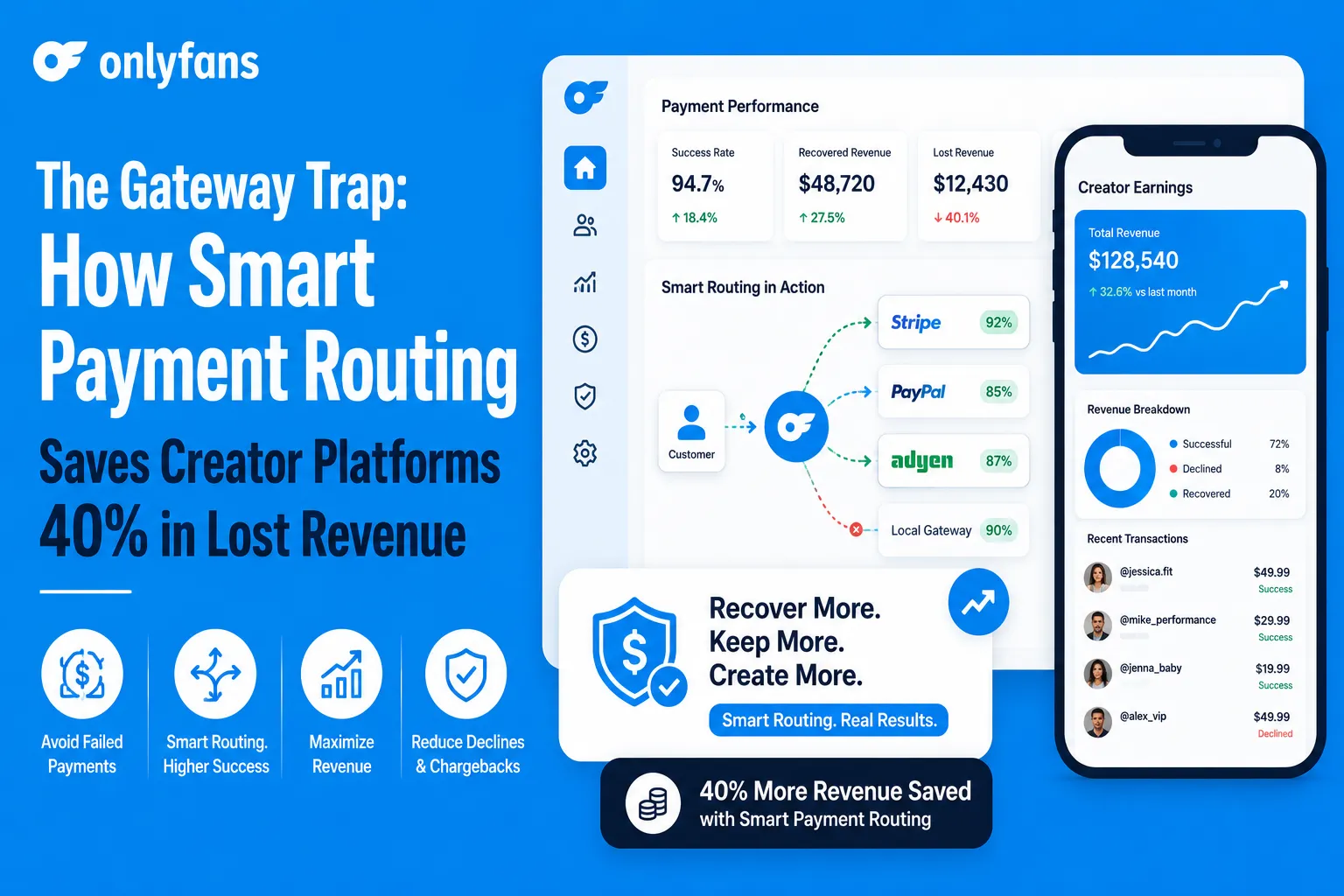
Hard Data: Recovering 40% of Failed Subscription Renewals
In Miracuves’ supplied internal benchmark scenario, a generic Stripe-only integration was compared against a multi-gateway, risk-mitigating routing engine for creator platform subscription renewals.
The result: the smart routing architecture retained 40% more subscription revenue that would otherwise have been lost through failed renewals, gateway-level friction, or unrecovered billing attempts.
This does not mean every creator platform will automatically see the same result. Recovery depends on gateway approvals, card mix, region, risk category, billing model, retry timing, customer communication, and processor rules. But the pattern is important: a single checkout API leaves too much revenue exposed when recurring payments fail.
Here is the simplified revenue logic.
| Scenario | Stripe-Only Generic Setup | Multi-Gateway Smart Routing Setup |
|---|---|---|
| Initial renewal attempt | Processed through one gateway | Routed through preferred gateway based on rule set |
| Failed payment handling | Retry inside same gateway logic | Retry through eligible alternate approved gateway |
| Risk segmentation | Limited or manual | Rules based on content type, geography, billing type, user history, and amount |
| Operational visibility | Gateway dashboard dependent | Platform-level view of route performance and recovery |
| Revenue outcome | Higher unrecovered renewal loss | 40% increase in retained subscription revenue in supplied benchmark |
This is where founders often misread the payment problem. They think payment failure is a checkout issue. In reality, it is a retention issue.
A failed renewal does not only reduce platform revenue. It interrupts creator income. It may cancel access for a subscriber who intended to stay. It creates a support burden. It increases churn that was not caused by product dissatisfaction.
External subscription billing research also supports the seriousness of failed payments. Baremetrics reports that subscription businesses can lose meaningful monthly recurring revenue to failed payments and that dunning/recovery workflows can recover significant revenue when handled properly.
For a creator platform, payment recovery should be designed before launch, not patched after the first frozen account or failed renewal spike.
Read more: 10,000 Unlocks in 5 Minutes: Surviving a Viral Traffic Spike on a Creator Platform.
How Smart Routing Actually Works Inside a Creator Platform
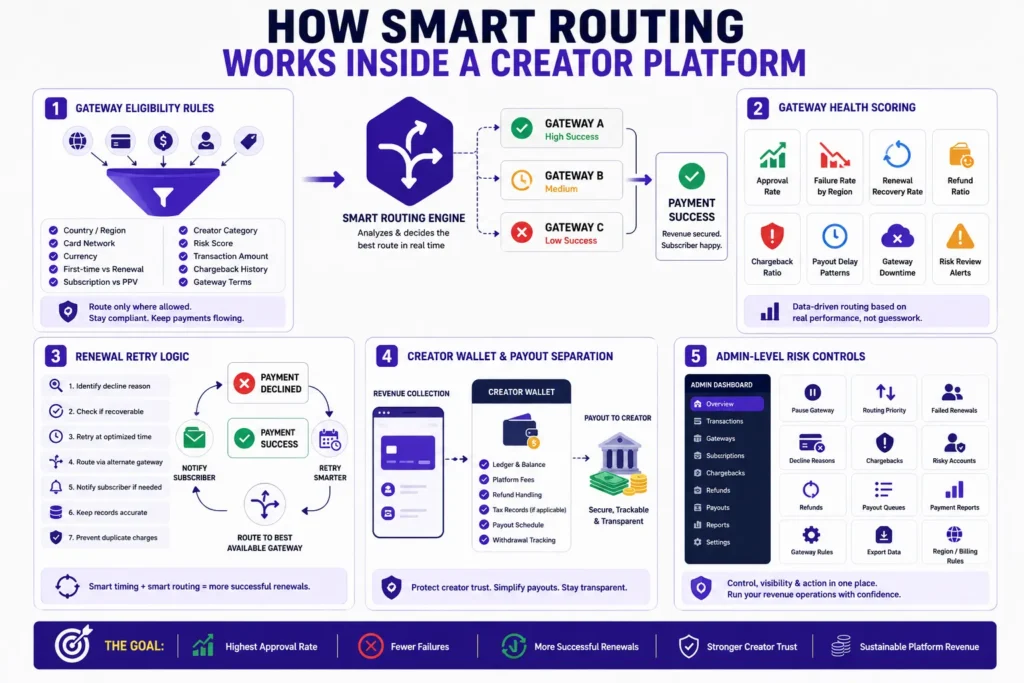
Smart routing is not just “connect three gateways and hope one works.” It is a controlled payment decision layer.
A strong creator platform routing engine usually includes five parts.
1. Gateway Eligibility Rules
Not every transaction should be sent to every processor. Some processors may support certain content categories, currencies, regions, card types, or subscription models better than others.
Eligibility rules define which gateway is allowed to process which transaction.
Example routing criteria:
- country or region
- card network
- currency
- first-time payment vs renewal
- subscription vs PPV
- creator category
- risk score
- transaction amount
- chargeback history
- gateway approval terms
This protects the platform from careless routing that violates processor rules. The goal is compliant continuity, not policy evasion.
2. Gateway Health Scoring
A smart routing engine should track live and historical performance.
Operations teams should be able to see:
- approval rate by gateway
- failure rate by region
- renewal recovery rate
- refund ratio
- chargeback ratio
- payout delay patterns
- gateway downtime
- risk review alerts
Payment routing research and industry guidance commonly emphasize routing based on processor performance, transaction attributes, and adaptive decisioning. For creator platforms, that performance layer should be visible inside the admin dashboard.
3. Renewal Retry Logic
Recurring billing is where smart routing becomes revenue-critical.
A failed subscription renewal should trigger a structured recovery workflow:
- Identify decline reason.
- Check whether the failure is recoverable.
- Retry at an optimized time.
- Route through an alternate eligible gateway when needed.
- Notify the subscriber if payment action is required.
- Keep creator and platform records accurate.
- Prevent duplicate charges.
Stripe’s Smart Retries feature also reflects the broader payment principle that retry timing matters in subscription recovery. A creator platform can extend this principle by combining retry timing with multi-gateway routing.
4. Creator Wallet and Payout Separation
Subscription collection and creator payout should not be treated as the same flow.
A platform may collect from subscribers through gateways, but creator earnings need a wallet ledger, payout schedule, fee deductions, refund handling, tax-related records where applicable, and withdrawal status tracking.
That is why a creator wallet system for video platforms is a natural supporting layer for smart routing. Payment collection protects revenue. Wallet logic protects creator trust.
5. Admin-Level Risk Controls
Operations managers need control, not blind automation.
The admin dashboard should allow the platform operator to:
- pause a gateway
- change routing priority
- review failed renewal cohorts
- inspect gateway decline reasons
- monitor chargebacks
- flag risky accounts
- manage refunds
- review payout queues
- export payment reports
- configure gateway rules by region or billing type
This is where Miracuves’ white-label creator platform approach becomes valuable. A founder does not only need frontend creator features. They need the backend control layer that keeps revenue operations stable.
Founder Decision Signals: When You Need Smart Routing Before Launch
Founder Decision Signals
Speed
If your platform plans to launch with subscriptions, tips, PPV, or wallet top-ups, payment routing should be part of the first release rather than a later rescue project.
Cost
A basic gateway setup may look cost-efficient at launch, but unrecovered renewals, frozen funds, support tickets, and creator churn can become more expensive than building the right payment layer early.
Scalability
As creators, countries, currencies, and billing patterns increase, one processor path becomes harder to manage. Routing gives the platform a scalable control layer.
Market Fit
If creator earnings depend on recurring fans, failed renewals can make creators believe the platform lacks monetization reliability even when demand is strong.
You should consider smart payment routing before launch if your platform has any of these conditions:
- You depend on monthly or annual creator subscriptions.
- You support PPV unlocks, tips, live gifts, or paid chats.
- You operate across multiple countries or currencies.
- You expect high chargeback sensitivity.
- You serve premium, niche, or high-risk creator categories.
- You need creator payouts and wallet transparency.
- You cannot afford subscription downtime during gateway review.
- You want operations teams to control payment rules without developer involvement for every change.
For founders building an OnlyFans-style creator monetization platform, this is not a secondary feature. It is part of the revenue foundation.
Mistakes Founders Make With Creator Payment Infrastructure
Mistakes Founders Should Avoid
Relying on one gateway for every payment flow
A single-gateway setup may be faster to launch, but it creates dependency risk. If that gateway underperforms, restricts the account, delays settlement, or fails in a region, the entire platform feels the impact.
Treating payment retries as a simple cron job
Retrying failed renewals at random intervals can increase decline rates or frustrate users. Recovery should consider decline reason, gateway eligibility, timing, and customer communication.
Ignoring payout transparency
Creators care about what they earned, what was deducted, what is pending, and when they can withdraw. Poor payout visibility weakens creator trust even when fan engagement is strong.
Using routing to bypass processor policies
Smart routing should support compliant payment continuity. It should not be used to hide business activity, misclassify transactions, or bypass gateway restrictions.
Security and Compliance Layers Smart Routing Should Include
Payment routing for creator platforms should include security and compliance-ready workflows from the start.
Important layers include:
- encrypted data transfer
- tokenized payments
- secure API integration
- role-based admin access
- payment activity logs
- creator verification
- subscriber risk signals
- chargeback monitoring
- refund workflows
- payout review queues
- audit logs
- permission-based dashboards
For high-risk or regulated categories, final compliance depends on jurisdiction, legal review, processor approval, integrations, content policy, and operating model. A platform should never assume that adding multiple gateways automatically solves compliance risk.
The safer approach is to build a transparent payment architecture that supports processor review, internal auditability, and clear operational control.
How Miracuves Builds Payment-Resilient Creator Platforms
Miracuves helps founders build white-label creator platforms with monetization workflows, admin dashboards, source-code ownership, and faster launch paths. For creator platforms where subscriptions and payments are central to the business model, the payment layer can include more than a basic gateway integration.
A Miracuves-style creator platform foundation can support:
- subscription billing
- PPV content unlocks
- tips and creator monetization
- wallet and payout workflows
- gateway integration logic
- multi-gateway routing architecture
- payment failure tracking
- admin-level payment controls
- creator earning dashboards
- refund and dispute management
- secure transaction records
- source-code-owned customization
Founders planning to launch a creator business can also explore Miracuves’ creator economy app development payout guide and creator monetization platform guide for supporting context.
For fintech-heavy payment architecture, Miracuves’ fintech industry expertise is also relevant because creator payments increasingly overlap with wallets, payouts, subscriptions, transaction logs, and compliance-ready financial workflows.
Final Thoughts: Creator Revenue Depends on Payment Continuity
The creator economy rewards platforms that help creators earn reliably. That reliability does not come only from better profiles, beautiful feeds, or premium content tools. It comes from the infrastructure that keeps subscriptions active, payments accepted, wallets accurate, and payouts transparent.
The gateway trap is believing that one standard API is enough because checkout works on day one.
For technical founders and operations managers, the stronger decision is to build payment continuity into the product foundation. Smart routing, gateway redundancy, retry logic, payout visibility, and admin risk controls can protect the revenue layer before payment failures turn into creator churn.
Miracuves helps founders launch creator platforms with white-label flexibility, source-code ownership, admin control, and monetization-ready architecture. For premium creator businesses, that architecture should include the payment resilience needed to keep recurring revenue moving.
Planning to build a creator platform with secure payment routing and recurring billing workflows? Contact Miracuves to discuss your launch-ready creator platform architecture.
FAQs
What is smart payment routing for creator platforms?
Smart payment routing is a payment architecture that sends transactions through the most suitable approved gateway based on rules such as region, card type, transaction risk, billing type, gateway performance, and failure history. For creator platforms, it helps protect subscriptions, PPV purchases, tips, and wallet top-ups from unnecessary payment failure.
Why should creator platforms avoid relying on one payment gateway?
A single gateway creates dependency risk. If that processor declines more renewals, delays settlement, restricts the account, or does not support a specific risk category, the platform can lose revenue and creator trust. Multi-gateway routing reduces that single point of failure.
Can smart routing prevent payment gateway bans?
Smart routing should not be positioned as a way to bypass processor rules. It helps platforms route transactions through approved, compliant payment paths and reduce operational dependency. Final gateway approval depends on the processor, business model, content policy, jurisdiction, and risk review.
How does smart routing recover failed subscription renewals?
When a renewal fails, the system checks the decline reason, gateway eligibility, retry timing, and user payment status. If eligible, it may retry the payment through another approved route or trigger a subscriber update workflow. This can reduce involuntary churn.
What does the 40% retained subscription revenue improvement mean?
It refers to Miracuves-supplied benchmark data comparing a generic Stripe-only setup with a multi-gateway, risk-mitigating routing architecture. In that scenario, smart routing retained 40% more subscription revenue that would otherwise have been lost through failed renewals or unrecovered payment attempts.
Is Stripe bad for creator platforms?
No. Stripe supports many creator economy use cases and offers strong payment products. The risk is relying on any single processor as the only payment path, especially for premium creator platforms with subscriptions, PPV, tips, payouts, or sensitive content categories.
What features should a creator platform payment system include?
A strong payment system should include recurring billing, gateway routing, smart retries, wallet ledger logic, payout workflows, refund management, chargeback monitoring, audit logs, admin controls, secure API integrations, and transaction reporting.