
Google Flights operates within Alphabet, which generates $330B+ annual revenue (2026 estimate), making it one of the most powerful monetization machines in the world. Unlike traditional travel platforms, Google Flights is not designed to directly sell flights—it is designed to own the discovery layer of travel.
For founders, Google Flights is a masterclass in how to monetize user intent at scale. It doesn’t rely on commissions as its primary driver—instead, it leverages its dominance in search and advertising.
What makes this model powerful is simple: Google controls where travel decisions begin, and that position is more valuable than owning the transaction itself.
Google Flights Revenue Overview – The Big Picture
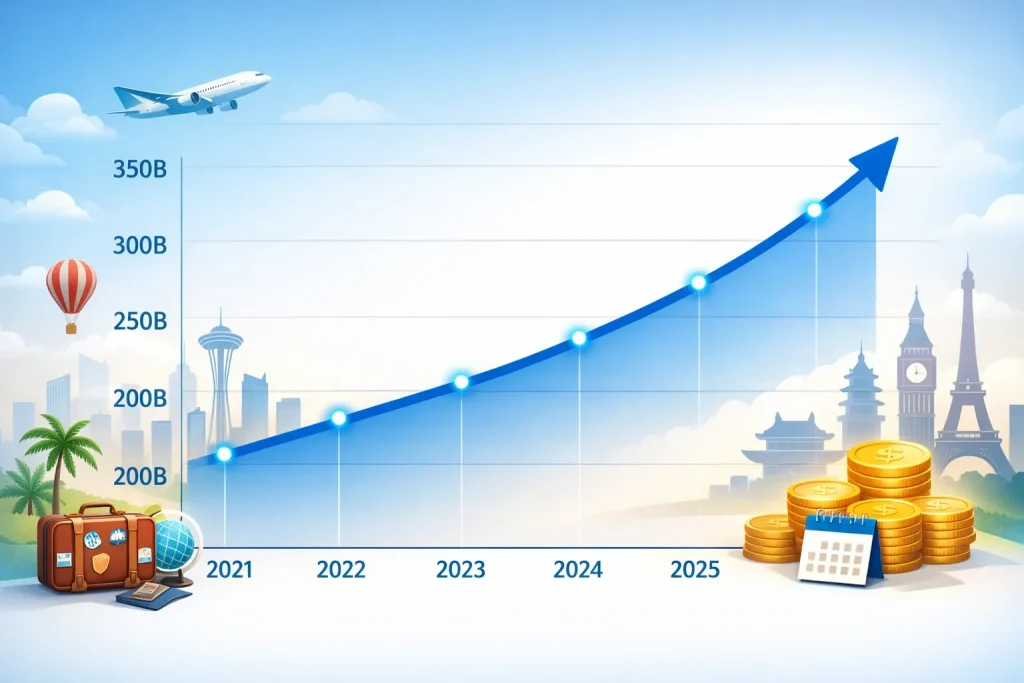
Google Flights is not a standalone revenue-reporting unit, but its contribution is embedded within Google’s advertising business, which accounts for the majority of Alphabet’s $330B+ revenue.
Key snapshot (2026 estimates):
• Alphabet total revenue: $330B+
• Core revenue driver: Advertising (~75–80%)
• Google Flights role: Travel intent capture layer
• Growth rate: High single-digit to low double-digit YoY
• Profitability: Extremely high margins due to ad model
• Valuation context: Alphabet ~$2T+ market cap
Revenue distribution (Alphabet proxy):
• North America: Largest share
• Europe: Strong secondary market
• Asia-Pacific: Fastest-growing
Benchmark comparison:
• Competes with Kayak, Skyscanner, Expedia
• Advantage: Direct integration with Google Search
Read More: What Is Google Flights? A Simple Guide to Finding Better Flight Deals
Primary Revenue Streams Deep Dive
Revenue Stream #1: Travel Search Ads (CPC Model)
This is the dominant revenue engine.
• Airlines and OTAs pay to appear in flight results
• Ads blend seamlessly into search results
• High-intent queries = premium CPC
Estimated contribution: 60–70% (within travel vertical)
Pricing model:
• Auction-based CPC
• Highly dynamic pricing
Performance insight:
Travel keywords are among the most expensive in Google Ads due to high conversion value.
Revenue Stream #2: Google Hotel Ads Integration
Google Flights connects with Google Hotels to monetize full trip planning.
• Cross-platform monetization
• Increases revenue per user
Estimated contribution: 10–20%
Pricing model:
• CPC + commission hybrid
Revenue Stream #3: Partner Referral Traffic
Google directs users to airline and OTA websites.
• Traffic monetization through paid placements
• Prioritized listings for advertisers
Estimated contribution: 10–15%
Pricing model:
• Cost-per-click or referral agreements
Revenue Stream #4: Data & Demand Intelligence
Google leverages aggregated travel data.
• Demand forecasting
• Pricing trends
Estimated contribution: <5% (strategic)
Pricing model:
• Enterprise-level data solutions
Revenue Stream #5: Ecosystem Monetization (Indirect)
Google Flights increases engagement across Google products.
• Search → Maps → YouTube → Ads
• Drives broader ad revenue
Estimated contribution: Indirect but significant
Pricing model:
• Cross-product monetization
Revenue Streams Breakdown (Latest Available Data)
| Revenue Stream | Description | Estimated Revenue Share | Pricing Model |
|---|---|---|---|
| Travel Ads | Paid search placements | 60–70% | CPC auction |
| Hotel Ads | Cross-sell monetization | 10–20% | CPC / Commission |
| Referral Traffic | Partner traffic monetization | 10–15% | CPC / Referral |
| Data Monetization | Travel insights & analytics | <5% | Enterprise contracts |
| Ecosystem Revenue | Indirect monetization | — | Ad ecosystem |
The Fee Structure Explained
Google Flights is free for users but monetizes suppliers aggressively.
Platform Fee Structure (Latest Available Data)
| User Type | Fee Type | Typical Fee Range | Notes |
|---|---|---|---|
| Travelers | Free usage | $0 | Core strategy |
| Airlines | CPC fees | $1 – $10+ per click | High competition routes |
| OTAs | Ad spend | Variable | Auction-driven |
| Hotels | Listing fees | Variable | Via Google Hotels |
| Enterprise Clients | Data access | Contract-based | Insights & analytics |
Hidden revenue layers:
• Retargeting ads
• Cross-device tracking
• Behavioral data monetization
Regional pricing:
• Higher CPC in US/EU
• Lower but growing in Asia
How Google Flights Maximizes Revenue Per User
Google doesn’t monetize transactions—it monetizes decisions.
Customer segmentation:
• Budget vs premium travelers
• Business vs leisure
Upselling mechanics:
• Flights → hotels → experiences
• Entire trip funnel monetization
Cross-selling systems:
• Integrated search results
• Google ecosystem linking
Dynamic pricing:
• Real-time bidding
• Query-based pricing
Retention monetization:
• Price tracking alerts
• Gmail integration
LTV optimization:
A single user generates multiple monetizable queries across their journey.
Psychological tactics:
• Price insights (“prices likely to rise”)
• Urgency messaging
• Comparison framing
Cost Structure & Profit Margins
Google Flights benefits from massive scale economics.
Infrastructure:
• Data centers
• AI systems
Customer acquisition:
• Nearly zero (organic search dominance)
Marketing spend:
• Minimal compared to competitors
Operations:
• Engineering-heavy
• Minimal human operations
R&D:
• AI pricing models
• Search optimization
Unit economics:
• Extremely high margins
• Low marginal cost per user
Margin strategy:
• Increase ad yield
• Improve targeting
• Expand ecosystem integration

Future Revenue Opportunities (2026–2028 Outlook)
AI-powered travel planning:
• Conversational search
• Predictive booking
Full-stack booking:
• Potential direct booking expansion
Market expansion:
• Emerging travel markets
New monetization layers:
• Subscription travel tools
• Premium insights
Risks:
• Regulatory pressure
• Antitrust scrutiny
• Competition from AI startups
Startup opportunities:
• Niche travel discovery
• AI travel agents
• Personalized itinerary platforms
Lessons for Entrepreneurs
What works:
• Owning the discovery layer
• Monetizing intent
• Platform dominance
What to replicate:
• CPC-based monetization
• Ecosystem integration
• Data-driven optimization
Market gaps:
• Humanized travel planning
• Experience-based platforms
What to improve:
• Transparency in pricing
• Better personalization
Final Thought
Google Flights proves that the most powerful businesses don’t always own the product—they own the decision-making moment. That’s where margins are highest and defensibility is strongest.
For founders, the key lesson is simple: if you can position yourself at the top of the funnel, you control everything that follows.
In a world shifting toward AI-driven discovery, platforms that own intent—like Google—will continue to dominate entire industries without ever owning inventory.
FAQs
1. How much does Google Flights make per transaction?
It doesn’t earn per transaction directly; it earns per click via advertising.
2. What is the most profitable revenue stream for Google Flights?
CPC-based travel search advertising.
3. How does Google Flights’ pricing compare to competitors?
Users see free results, but suppliers pay higher CPC due to competition.
4. What percentage does Google take from providers?
Indirectly varies via CPC economics rather than fixed commission.
5. How has Google Flights’ revenue model evolved?
From simple search tool to full travel discovery ecosystem.
6. Can small startups use a similar model?
Yes, in niche verticals with high-intent traffic.
7. What scale is needed for profitability?
Massive traffic scale is required.
8. How can founders implement a similar model?
Focus on capturing intent and monetizing via ads.
9. What alternatives exist to this revenue model today?
Subscription-based travel apps, direct booking platforms, AI travel assistants.
Miracuves is an independent software development company. We are not affiliated with, connected to, sponsored by, or endorsed by any company or product named in this article.
Terms such as “X Clone” are used descriptively. It is how the software industry refers to building a platform with functionality comparable to a known service, and how clients search for it.
The entire design and codebase of our products is built by our own team. Our products contain no code, design, graphics, or content originating from any third-party website or applications.
All third-party names and marks referenced in this article are the property of their respective owners, referenced solely to identify the services discussed.