

Key Takeaways
What You’ll Learn
- Fiverr is a freelance marketplace that connects buyers with service providers across multiple categories.
- Users purchase services through predefined gigs with transparent pricing and delivery timelines.
- Freelancers build profiles and offer services with packages and add-ons.
- Platform commissions are the primary revenue driver in Fiverr-like models.
- Trust and reviews play a major role in driving conversions and repeat usage.
Stats That Matter
- Freelance economy is expected to grow beyond $450 billion globally in coming years.
- Millions of active buyers and sellers operate on freelance marketplaces.
- Commission-based revenue models dominate platforms like Fiverr.
- Digital services demand continues to rise across design, development, and marketing.
- Gig-based platforms are becoming a core part of the global workforce.
Real Insights
- Simple pricing models help users make faster purchase decisions.
- Successful platforms balance buyer demand and freelancer supply.
- Ratings and reviews build credibility and long-term trust.
- Niche specialization can outperform generic marketplaces.
- Growth depends on user experience, trust, and consistent service quality.
Fiverr-like freelance marketplaces generated over $370M+ in quarterly revenue last year, fueled by the explosive global expansion of remote work, digital outsourcing, and the rising demand for micro-services across industries. With businesses of all sizes—from startups to global enterprises—now relying on freelance talent for design, development, marketing, content, and automation tasks, online gig marketplaces have become one of the fastest-growing digital business models of the decade.
This shift isn’t temporary—it’s a structural evolution in how work gets done. Companies want flexible talent. Freelancers want global reach. Entrepreneurs want scalable digital income. A Fiverr-style platform sits right at the center of this transformation, enabling smooth transactions, standardized pricing, fast delivery, and secure payments.
For founders and platform builders, understanding this revenue model is essential. Fiverr’s success proves that you don’t need to offer services yourself to build a high-earning business—you just need to connect the right buyers and sellers. With multiple revenue layers like commissions, subscriptions, promoted gigs, payment fees, and premium tools, a Fiverr clone can quickly evolve into a highly profitable marketplace with recurring revenue and strong margins.
And with ready-to-launch solutions from Miracuves, entrepreneurs can tap into this proven business model of fiverr without spending years in development, allowing them to enter the booming freelance economy faster and more efficiently than ever.
Fiverr Clone Revenue Overview – The Big Picture
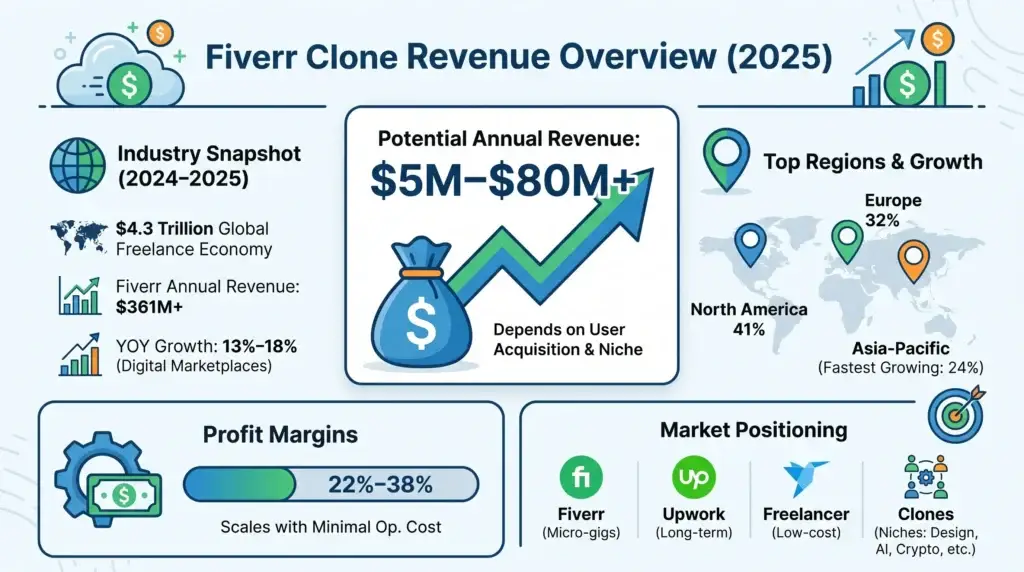
A Fiverr-style freelance marketplace operating in 2026 can generate $5M–$80M+ annually, depending on user acquisition and niche specialization.
Industry revenue snapshot (2024–2026):
• Global freelance economy: $4.3 trillion
• Fiverr annual revenue: $361M+
• YOY growth: 13%–18% in digital service marketplaces
• Top regions: North America 41%, Europe 32%, Asia-Pacific growing fastest at 24%
Profit margins: 22%–38% because marketplace models scale with minimal operational cost.
Market position vs competitors:
• Fiverr focuses on micro-gigs
• Upwork focuses on long-term projects
• Freelancer.com targets global low-cost hiring
• Fiverr clones can enter niches (design-only, AI tasks, crypto gigs, etc.) to dominate faster
Read More: Fiverr App Explained – Features, Benefits & How It Works
Primary Revenue Streams Deep Dive
Revenue Stream #1: Commissions on Transactions
The core monetization engine.
How it works:
Platform takes a percentage from seller earnings and/or buyer payments.
Percentage of total revenue:
55%–70%
Typical rates:
• Seller commission: 10%–20%
• Buyer fee: 5%–10%
• Service fee on high-value orders: 3%–5%
Example:
If your platform processes $10M GMV yearly and charges 15% → $1.5M revenue.
Revenue Stream #2: Seller Subscription Plans (Pro Accounts)
Paid plans offering more visibility and tools.
Percentage of total revenue:
10%–18%
Pricing structure:
Basic: $9/month
Pro: $29/month
Elite: $59/month
Features include analytics, lower commission, premium listing badges.
Example:
2,000 sellers on $29/month → $58,000/month.
Revenue Stream #3: Promoted Gigs / Sponsored Listings
How it works:
Sellers pay to rank higher in search or category pages.
Percentage contribution:
7%–15%
Pricing:
CPC model ($0.20–$1/click)
Daily budgets ($5–$50/day)
Real example:
Top freelancers spend $80–$200/month on ads.
Revenue Stream #4: Payment Processing Fees
How it works:
Charging a fee for secure payouts, conversions, PayPal, Stripe, etc.
Percentage:
4%–7%
Fees include:
• Withdrawal fee ($1–$3)
• Currency conversion (1%–3%)
• Instant payout charge ($2–$5)
Revenue Stream #5: Course Marketplace / Learning Hub
How it works:
Selling digital courses for freelancers.
Contribution:
2%–5%
Examples:
Skill-building, client management, AI work tutorials.
Read More: Business Model of Fiverr : Strategy Breakdown 2025
Revenue Streams Percentage Breakdown Table
| Revenue Stream | Percentage of Total Revenue |
|---|---|
| Commissions | 55%–70% |
| Seller Subscriptions | 10%–18% |
| Promoted Gigs | 7%–15% |
| Payment Fees | 4%–7% |
| Courses/Other Add-ons | 2%–5% |
The Fee Structure Explained
User-Side Fees (Buyers)
• Platform fee: 5%–10% per order
• Small-order fee: $2–$3
• Currency conversion: 1%–3%
Provider-Side Fees (Sellers)
• Commission on each sale: 10%–20%
• Withdrawal fee: $1–$3
• Subscription fee (optional): $9–$59/month
• Boosting gigs (ads): $10–$100/month
Hidden Revenue Tactics
• Priority ranking for premium users
• Instant payout charges
• Placement in trending categories
• Handling fees on dispute resolution
Regional Pricing Differences
• Developing markets: lower buyer fees
• US/EU: highest commission tolerance
• Middle East demand growing for niche freelance platforms
How a Fiverr Clone Maximizes Revenue Per User
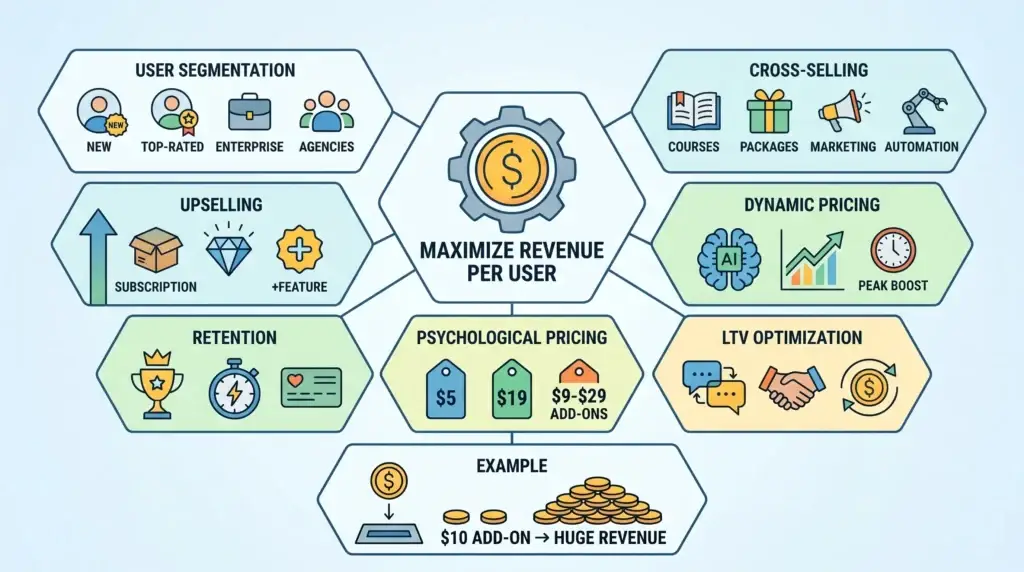
User segmentation:
New sellers, top-rated sellers, enterprise buyers, agencies.
Upselling:
• Encourage subscriptions
• Promote high-margin categories
• Sell feature upgrades
Cross-selling:
• Courses
• Business packages
• Marketing add-ons
• Gig automation packages
Dynamic pricing:
AI-driven pricing suggestions
Peak-hour visibility boosts
Retention monetization:
• Seller ranking systems
• Faster payouts for premium plans
• Repeat buyer incentives
Lifetime value optimization:
• Platform-level messaging tools
• Client-seller relationship continuity
• Buyer credits for reorders
Psychological pricing:
• $5 starter gigs
• $19 middle-tier gigs
• Premium add-ons at $9–$29
Example:
If each seller buys just one $10 add-on per month → huge additional revenue.
Global Cost of Development for a Fiverr Clone App
Fiverr-Like Freelance Marketplace Development — Market Price by Tech Stack
The tech stack affects gig listing speed, freelancer management, order flow, messaging, payments, and dispute handling in a Fiverr-like platform. PHP/Laravel works well for cost-effective freelance marketplace launches, Node.js/React.js supports real-time chat, order updates, and faster dashboard performance, while Go microservices suit large freelance platforms with high traffic, multiple service categories, and complex transaction workflows.
PHP/Laravel is often the most practical choice for launching a Fiverr clone quickly and affordably. Node.js/Python fits better when real-time marketplace workflows and heavier platform activity become more important, while Go microservices are better suited for enterprise-scale freelance marketplaces with higher concurrency and more complex infrastructure needs.
These values reflect global development cost estimates. Final pricing varies based on freelancer and buyer dashboards, gig listings, search filters, order management, chat, reviews, commissions, escrow payments, dispute resolution, admin controls, and platform complexity.
Miracuves Fiverr-Like Platform Solution Cost and Tech Stack
Miracuves Pricing for a Fiverr-Like Freelance Marketplace Platform developed in PHP/Laravel with Flutter Apps for $2,499 USD (One-Time Price) in just 6 days
Miracuves Pricing for a Fiverr-Like Freelance Marketplace Platform developed in PHP for $2,499 USD One-Time Price in just 6 days
Get a fully developed, deployment-ready freelance service marketplace modeled after Fiverr. Built on a stable PHP foundation, this complete package includes everything you need to launch and scale a gig-based marketplace business:
- Core Workflows: Freelancer registration, buyer registration, gig listing, service category browsing, order placement, custom offer requests, order delivery, revision flow, chat, reviews, and customer notifications.
- Built-in Revenue Logic: Marketplace commissions, gig service fees, featured gig placements, freelancer subscriptions, buyer service charges, promoted listings, cancellation charges, and payout setup.
- Management Hub: Centralized admin dashboard, freelancer management, buyer management, gig approval, order tracking, payment records, dispute handling, refund management, review moderation, and marketplace analytics.
- Launch-Ready: Fully prepared for your custom branding, configuration, payment gateway setup, category setup, freelancer onboarding, and immediate market entry.
Why Is Fiverr-Like Marketplace Development More Affordable?
Most freelance marketplace platforms become expensive when businesses choose fully custom development from scratch. A Fiverr-style platform usually needs buyer workflows, freelancer dashboards, gig management, order tracking, payments, messaging, dispute handling, reviews, commissions, and admin controls. Building all of this separately can increase both development cost and launch time.
We took a smarter, more practical approach:
You Aren’t Paying for Ground-Up Development: Our freelance marketplace engine is already developed, tested, and ready to deploy. You skip the inflated cost and long waiting period usually required for building a Fiverr-style platform from scratch.
The Power of PHP: We built this solution on a reliable and cost-effective PHP architecture. This keeps the upfront price affordable while supporting essential gig listings, freelancer management, buyer orders, payments, reviews, dispute workflows, and admin operations.
You get a launch-ready Fiverr-like freelance marketplace with practical monetization features, source code access, and faster deployment without the high custom development price tag.
Note: This cost is for the solution, re-branding, deployment, and source code only.
Cost Structure & Profit Margins
Major cost drivers:
• Hosting & server scaling
• AI-based search/recommendation engine
• Payment gateway integrations
• Support and moderation teams
• Marketing/CAC
• Security & compliance (fraud prevention, KYC)
Unit economics:
CAC: $8–$25
Average revenue per order: $4–$12
Payback period: 1–2 months
Path to profitability:
Commission + recurring subscriptions = strongest profit formula.
Margin enhancement strategies:
• Reduce fraud costs with automation
• Promote self-service features
• Introduce ad-based monetization
Future Revenue Opportunities & Innovations
New revenue streams emerging in 2026:
• AI-generated gigs
• AI-assisted seller tools
• Automated gig fulfillment
• B2B freelancer subscription packages
• Marketplace for pre-built digital assets
AI/ML potential:
• Personalized gig recommendations
• Dynamic commission pricing
• Risk scoring for fraud prevention
Expansion markets:
• Africa (fastest-growing freelancer adoption)
• Middle East (high demand for skilled gig work)
• South Asia (mass freelancer supply)
Emerging monetizable features:
• Pay-per-lead system
• Subscription-only job categories
• Virtual workspace collaboration
Threats:
• High competition
• Price wars
• AI replacing low-cost gigs
Why this opens opportunity:
Niche Fiverr clones outperform general marketplaces because specialized demand is skyrocketing.
Lessons for Entrepreneurs & Your Opportunity
Key takeaways:
• Commission marketplaces have unbeatable scalability
• Subscriptions add predictable recurring revenue
• Ad monetization increases seller competitiveness
• Payment fees boost margin without extra work
• Diversification through courses and add-ons increases LTV
Market gaps to exploit:
• Niche categories (AI gigs, crypto gigs, design-only, coding-only)
• Region-specific freelancer marketplaces
• Verified-pro sellers marketplace
• AI-assisted buyer–seller matchmaking
Revenue innovations possible:
• Tiered commissions
• Membership bundles
• Hybrid SaaS + marketplace model
Final Thought
A Fiverr clone can become a highly scalable marketplace business with strong recurring revenue, global reach, and minimal operating overhead—if monetized strategically through commissions, subscriptions, promoted listings, and AI-powered seller tools. The freelance economy continues to expand, and platforms that solve real problems for both buyers and sellers—speed, trust, affordability, and skill matching—are well-positioned for long-term growth.
With the right pricing structure, growth strategy, and value-added features such as AI-assisted gig creation, analytics dashboards, workflow automation, and instant payouts, your marketplace can achieve higher retention, stronger engagement, and sustainable profitability. As more businesses embrace freelance outsourcing, the opportunity to build a niche or regional freelance marketplace has never been greater.
With Miracuves’ ready-to-launch Fiverr Clone solution, entrepreneurs can launch faster, reduce development risk, and focus on scaling their business from day one. The next successful freelance marketplace could be yours. Let’s build together and create a platform that connects talent with opportunity while driving lasting business growth.
FAQs
How much does a Fiverr clone make per transaction?
Usually 10%–20% commission + buyer fee 5%–10%.
What’s the most profitable revenue stream?
Commissions + seller subscriptions.
How much does it cost to build a Fiverr-like platform?
With Miracuves, you can launch a Fiverr-like platform starting at just $2,499 with a ready-made solution.
How has the revenue model evolved?
Shift to subscriptions, ads, AI tools, and instant payout fees.
Can small platforms use similar models?
Yes—niche markets perform even better.
How to implement similar revenue models?
Use commission layers, subscriptions, ads, and payment fees.
What are alternatives to this model?
Lead-based fees, SaaS tools, or hybrid gig-subscription models.
Miracuves is an independent software development company. We are not affiliated with, connected to, sponsored by, or endorsed by any company or product named in this article.
Terms such as “X Clone” are used descriptively. It is how the software industry refers to building a platform with functionality comparable to a known service, and how clients search for it.
The entire design and codebase of our products is built by our own team. Our products contain no code, design, graphics, or content originating from any third-party website or applications.
All third-party names and marks referenced in this article are the property of their respective owners, referenced solely to identify the services discussed.