



Key Takeaways
- AgriMove-style platforms connect farmers, buyers, transporters, and drivers.
- Core workflows include load matching, tracking, delivery proof, and payments.
- Cold-chain visibility matters for perishable and high-value produce.
- Admin dashboards control users, pricing, disputes, payouts, and shipments.
- The platform should solve agriculture logistics, not just basic delivery.
Logistics Platform Signals
- Match loads by crop, vehicle, capacity, route, price, and urgency.
- Track GPS, ETA, delays, pickup proof, and delivery confirmation.
- Support temperature alerts, quality checks, and cold-chain handovers.
- Build wallet settlement, transporter payouts, commissions, and disputes.
- Plan offline sync for farms and routes with weak connectivity.
Real Insights
- Load matching is the core engine, not just a search filter.
- Transporter economics matter as much as farmer and buyer demand.
- Live tracking must protect freshness, trust, and accountability.
- Admin visibility prevents payment and delivery issues from becoming manual chaos.
- Miracuves builds AgriMove-style platforms with logistics, tracking, and payout workflows.
Agriculture logistics is no longer just about moving produce from farms to buyers. It is about speed, freshness, transparency, fair pricing, route efficiency, transporter availability, and payment trust.
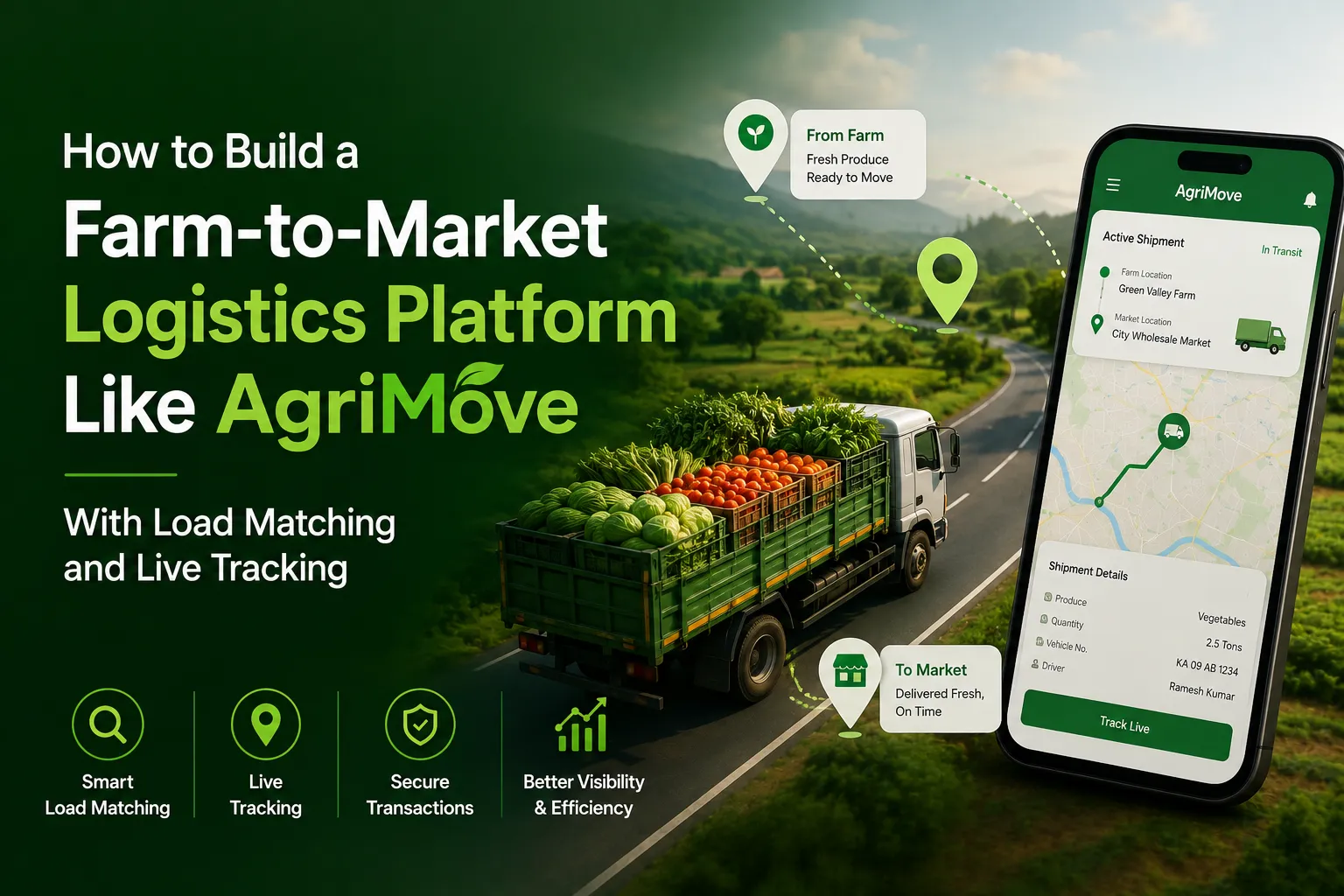
A farm-to-market logistics platform like AgriMove clone app connects farmers, transporters, buyers, wholesalers, and logistics operators in one digital ecosystem. Instead of depending on phone calls, informal truck availability, delayed updates, and manual payment follow-ups, the platform helps users list produce, match available loads with suitable transporters, track shipments live, monitor cold-chain conditions, verify delivery, and release payments through a secure workflow.
AgriMove’s public platform describes a model where buyers place orders or farmers list produce, the system matches them with transporters, generates tracking IDs, supports pickup and handover, enables real-time location and temperature tracking, and releases payment after delivery verification.
For founders, this creates a strong product opportunity. Food and agriculture supply chains still face information gaps, transportation inefficiencies, post-harvest losses, and weak market access. FAO notes that transportation is a critical point in fresh fruit and vegetable supply chains and contributes to global food losses between harvest and retail, while the World Bank highlights the role of digital platforms in reducing information asymmetry, transaction costs, and market access barriers in agriculture.
A well-built farm-to-market logistics platform can help farmers move produce faster, buyers source more reliably, transporters reduce empty trips, and platform operators build a monetization-ready agriculture logistics business.
What Is a Farm-to-Market Logistics Platform?
A Farm-to-Market Logistics Platform Like AgriMove is a digital system that manages the movement of agricultural produce from farms, collection centers, warehouses, packhouses, mandis, cooperatives, or aggregation hubs to buyers, wholesalers, retailers, exporters, processors, and final distribution points.
Unlike a normal courier app, a farm logistics platform must handle agriculture-specific complexity:
- Produce type and grade
- Harvest window
- Pickup urgency
- Perishability
- Vehicle capacity
- Cold-chain requirement
- Route distance
- Buyer delivery slot
- Weight and quantity verification
- Farmer payment settlement
- Transporter proof of delivery
- Market linkage
- Quality and rejection workflows
This is why founders should not treat the product as a simple “delivery app.” It is closer to a logistics marketplace, procurement system, and supply-chain visibility platform combined.
Read more-What Is an AgriMove-Like App and How Does an Agricultural Logistics Platform Work?
Why Farm-to-Market Logistics Platforms Are Becoming Important
Digital agriculture is growing because farmers, buyers, and logistics providers need better coordination. The World Bank has highlighted that digital technologies can reduce the cost of linking sellers and buyers, improve access to markets, increase supply-chain transparency, and help small-scale producers become more competitive.
For perishable produce, logistics quality directly affects revenue. FAO’s food loss data estimates that 13.3% of food was lost globally in 2023 after harvest across farm, transport, storage, wholesale, and processing stages.
A farm-to-market logistics platform can reduce these gaps by improving:
- Transporter discovery
- Load availability
- Vehicle utilization
- Pickup scheduling
- Route optimization
- Cold-chain visibility
- Delivery accountability
- Payment trust
- Farmer market access
- Buyer procurement reliability
For founders, the business opportunity is not only “moving goods.” It is creating trust and visibility in a supply chain that has historically depended on fragmented communication.
How a Platform Like AgriMove Works
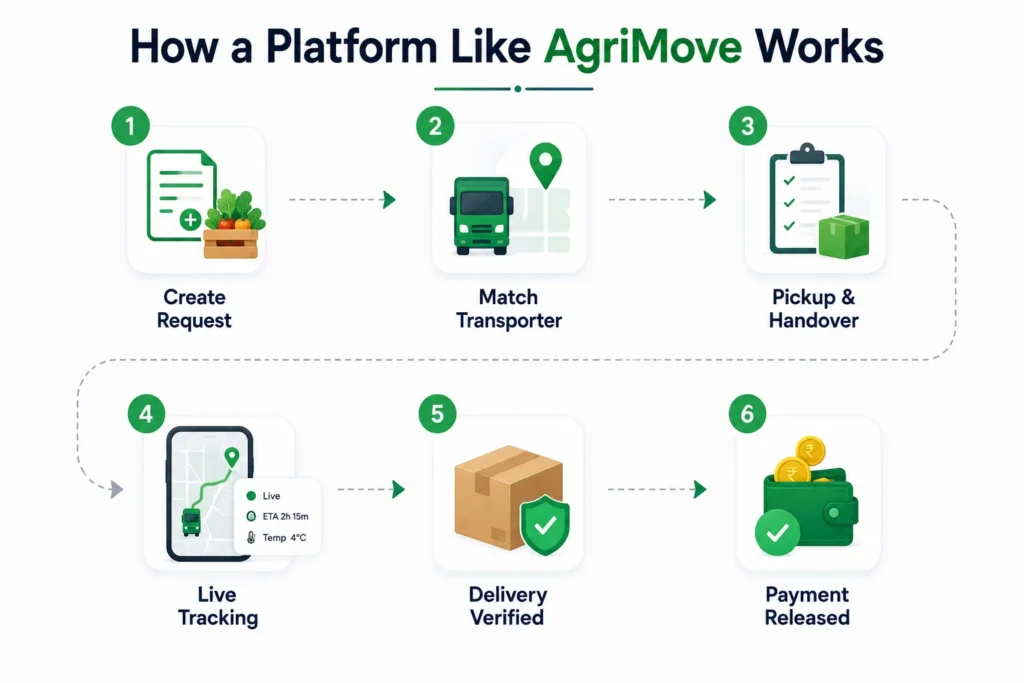
A practical AgriMove-like platform should follow a structured shipment journey.
Step 1: Farmer or Buyer Creates a Shipment Request
A farmer can list available produce with quantity, pickup location, harvest date, packaging type, expected price, and preferred delivery window. A buyer can also place a procurement order for a crop type, grade, volume, and delivery destination.
Step 2: System Matches the Load With a Transporter
The load matching engine checks vehicle type, location, route, capacity, cold-chain availability, transporter rating, pricing, and delivery time.
Step 3: Pickup and Handover Are Verified
The driver or transporter reaches the pickup location, verifies the load, captures pickup proof, activates temperature sensors where required, and updates the shipment status.
Step 4: Live Tracking Begins
The platform tracks the vehicle location, ETA, shipment milestones, driver status, delay alerts, and temperature conditions for perishable goods.
Step 5: Delivery Is Verified
The buyer or receiving manager confirms weight, quality, delivery proof, and issue status.
Step 6: Payment Is Released
Once delivery is verified, the platform can trigger wallet settlement, transporter payout, farmer payment, commission deduction, or dispute workflow.
This type of flow reflects the public AgriMove process where order placement, transporter matching, tracking ID generation, pickup, real-time location and temperature tracking, delivery verification, and wallet payment release are part of the platform journey.
Read more- Best Marketing Strategies to Grow an AgriMove Clone Agricultural Logistics Platform
Core User Panels Needed in a Farm Logistics Platform
A scalable agriculture logistics marketplace should include multiple panels. Each participant needs a different workflow.
Farm-to-Market Logistics Platform Panels
| Panel | Core Features | Business Value |
|---|---|---|
| Farmer App | Produce listing, pickup request, price visibility, shipment tracking, payment status, support tickets. | Helps farmers access transporters and buyers without relying only on informal networks. |
| Buyer Panel | Order placement, crop requirements, delivery slots, shipment tracking, quality confirmation, payment records. | Improves procurement planning and reduces uncertainty in fresh produce sourcing. |
| Transporter Panel | Available loads, bid or accept flow, vehicle management, route details, earnings, delivery records. | Helps transporters reduce empty runs and find agriculture-specific freight opportunities. |
| Driver App | Pickup navigation, load verification, GPS tracking, proof of pickup, proof of delivery, route alerts. | Keeps shipment execution transparent from farm gate to destination. |
| Admin Dashboard | User verification, shipment control, pricing rules, commissions, disputes, analytics, payout control. | Gives the platform operator control over operations, trust, monetization, and growth. |
Load Matching: The Engine Behind the Platform
Load matching is the most important feature in a farm-to-market logistics platform. It decides which transporter should carry which produce, at what price, on which route, and within which delivery window.
A basic matching system may simply match pickup location with nearby vehicles. A stronger system considers more variables.
Load Matching Factors
| Matching Factor | Why It Matters |
|---|---|
| Produce type | Different crops need different handling, packaging, and urgency. |
| Vehicle capacity | The truck must support the weight and volume of the produce. |
| Cold-chain requirement | Perishables may need refrigerated vehicles or insulated containers. |
| Pickup distance | Nearby transporters reduce waiting time and pickup cost. |
| Route compatibility | A vehicle already moving toward the buyer destination can reduce empty miles. |
| Delivery deadline | Harvested produce may lose value if delayed. |
| Transporter rating | Trust matters when moving high-value or perishable goods. |
| Pricing rules | The platform must support fair but profitable trip pricing. |
| Return load potential | Better matching can help transporters reduce empty return trips. |
| Market demand | Buyer demand can influence which loads should move first. |
Load matching can start rule-based and become smarter over time. Early versions can use location, vehicle type, capacity, and price. Later versions can add AI-based recommendations, route clustering, seasonal demand patterns, and transporter reliability scoring.
Research on dynamic delivery matching shows that assigning orders to vehicles involves decisions such as order assignment, batching, and adapting to dynamic vehicle positions, which reinforces why matching is a serious backend problem rather than a simple filter.
Live Tracking Features That Actually Matter
Live tracking should do more than show a moving dot on a map. In agriculture logistics, tracking must protect trust, freshness, and accountability.
A strong live tracking module should include:
- GPS-based vehicle location
- Pickup timestamp
- Route progress
- ETA calculation
- Delay alerts
- Driver contact masking
- Temperature monitoring for cold-chain loads
- Multi-stop shipment tracking
- Buyer and farmer tracking views
- Admin live map
- Proof of pickup
- Proof of delivery
- Exception alerts
- Offline sync for poor-network routes
Load Market’s tracking product highlights practical freight tracking features such as live GPS location, ETAs, automated updates, customer tracking links, chat, and shipment visibility.
For agriculture, the same tracking logic needs produce-specific upgrades such as temperature, freshness windows, pickup proof, and quality confirmation.
Cold Chain and Produce Quality Workflows
Cold-chain visibility is especially important for fruits, vegetables, dairy, seafood, meat, flowers, and export-quality produce.
A platform can support cold-chain logistics through:
- Refrigerated vehicle tagging
- Temperature sensor integration
- Temperature threshold alerts
- Cold-chain handover checklist
- Packaging condition photos
- Loading and unloading timestamps
- Quality inspection notes
- Rejection and dispute workflow
- Digital delivery proof
- Batch or lot traceability
FAO specifically identifies handling practices, packaging, temperature management, and airflow as important areas for reducing food loss during transportation.
This means a founder should not treat cold-chain as a premium feature only. If the platform targets perishables, cold-chain workflows should be part of the product foundation.
Admin Dashboard: Where the Business Is Controlled
The admin dashboard is where the platform operator manages trust, revenue, operations, and growth.
Important admin modules include:
- Farmer verification
- Buyer verification
- Transporter verification
- Vehicle approval
- Driver document management
- Crop category management
- Load posting control
- Commission settings
- Route pricing rules
- Dispute management
- Payment release control
- Live shipment map
- Fraud monitoring
- Cancellation management
- Analytics dashboard
- Support tickets
- Cold-chain exception reports
For founders, the dashboard decides whether the business can scale without manual chaos. Without strong admin control, every delay, dispute, failed delivery, or payment issue becomes an operational bottleneck.
Revenue Model for a Farm-to-Market Logistics Platform
A farm logistics platform can generate revenue through several channels.
| Revenue Stream | How It Works | Best For |
| Commission per completed shipment | Platform takes a percentage from transporter fee or buyer order value. | Marketplace-style model |
| Transporter subscription | Verified transporters pay monthly to access premium load opportunities. | Large transporter network |
| Buyer procurement subscription | Buyers pay for verified farmer access, recurring supply, and analytics. | B2B procurement |
| Featured load posting | Farmers or buyers pay to boost urgent loads. | Competitive supply regions |
| Route optimization fee | Platform charges for advanced route planning and analytics. | Larger logistics operators |
| Cold-chain monitoring fee | Extra fee for temperature tracking and sensor visibility. | Perishable produce |
| Wallet transaction fee | Small fee on escrow, payouts, or payment processing. | High transaction volume |
| White-label licensing | Cooperatives, exporters, or logistics businesses use a branded version. | Enterprise or regional operators |
The strongest monetization model depends on the target market. A farmer-first platform may need low entry friction, while a B2B procurement network can support subscription and analytics pricing.
Technology Stack for a Farm Logistics Platform
The tech stack should support real-time updates, mobile workflows, route data, offline conditions, secure payments, and scalable logistics activity.
A practical stack can include:
| Layer | Recommended Options |
| Mobile apps | Flutter or React Native |
| Web dashboard | React, Next.js, or Angular |
| Backend | Node.js, Laravel, Java Spring Boot, or Python |
| Database | PostgreSQL or MySQL |
| Real-time updates | WebSockets, Firebase, or MQTT |
| Maps and routing | Google Maps, Mapbox, OpenStreetMap |
| Notifications | Firebase Cloud Messaging, SMS, WhatsApp, email |
| Payments | Payment gateway, wallet ledger, escrow workflow |
| Analytics | BI dashboard, event tracking, logistics reports |
| Cloud | AWS, Google Cloud, Azure, or scalable VPS setup |
| IoT integration | Temperature sensors, GPS devices, RFID, QR codes |
For early launch, founders can start with mobile GPS tracking and add IoT sensors later. For cold-chain-heavy businesses, sensor integration should be planned from the beginning.
Security and Trust Features
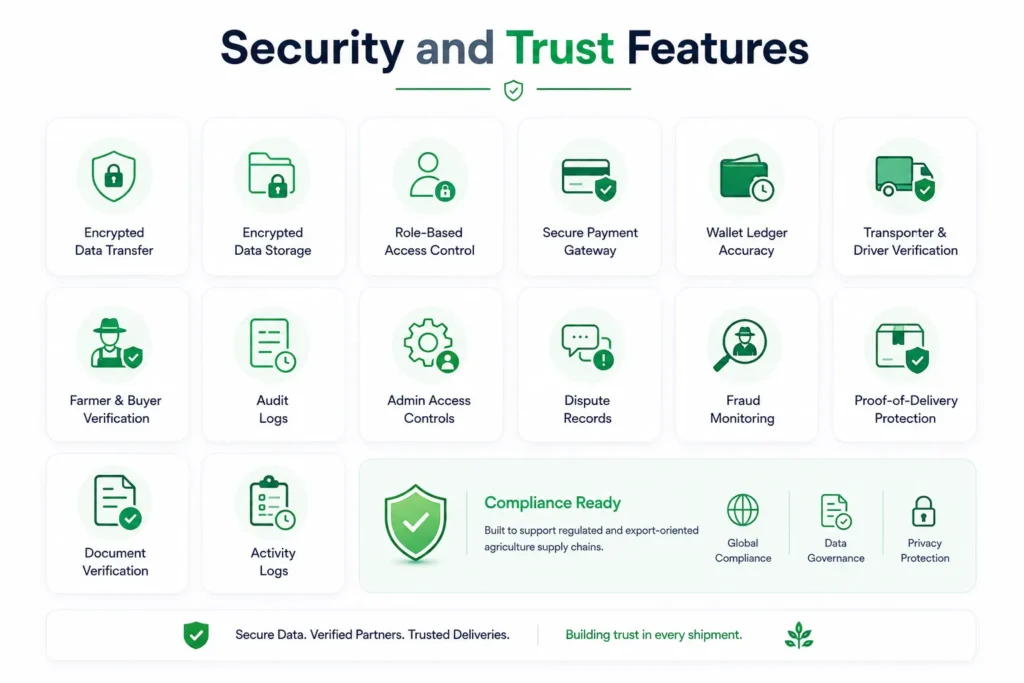
Agriculture logistics involves payments, identity, location data, vehicle information, delivery proof, and trade records. Security should be treated as a foundation, not an add-on.
Important security layers include:
- Encrypted data transfer
- Encrypted data storage
- Role-based access control
- Secure payment gateway integration
- Wallet ledger accuracy
- Transporter and driver verification
- Farmer and buyer verification
- Audit logs
- Admin access controls
- Dispute records
- Fraud monitoring
- Proof-of-delivery protection
- Document verification
- Activity logs
For regulated or export-oriented agriculture supply chains, compliance requirements may depend on the country, product type, buyer rules, documentation standards, and legal review.
Custom Build vs Ready-Made Logistics Foundation
Founders usually have two build paths: custom development or a ready-made logistics foundation.
| Build Option | Best For | Advantage | Limitation |
| Custom development | Unique agricultural workflows, enterprise procurement, complex integrations | Full flexibility | Higher cost and longer timeline |
| Ready-made logistics foundation | Faster launch, market validation, standard marketplace workflows | Faster deployment and lower build risk | Requires customization for agriculture-specific logic |
| Hybrid approach | Founders who need speed plus custom modules | Launch faster while adding differentiators | Needs clear scope control |
Miracuves helps founders build source-code-owned logistics platforms using ready-made and customisable foundations. For farm-to-market logistics, this can include load matching, driver apps, buyer dashboards, shipment tracking, admin control, wallet workflows, and agriculture-specific custom modules.
Read more- Why AgriTech Startups Choose an AgriMove Clone Over Custom Platform Development
Founder Decision Signals
Speed
If the market opportunity is time-sensitive, start with core load matching, tracking, and admin workflows before adding advanced AI or IoT modules.
Cost
Pricing depends on features, integrations, tech stack, customization, and launch scope. Confirm the final quote based on selected modules.
Scalability
If you expect multiple crop categories, regions, transporter types, and buyer segments, build flexible route, pricing, and admin rules early.
Market Fit
The product should solve a real logistics bottleneck first: truck availability, buyer access, tracking trust, cold-chain visibility, or payment settlement.
Mistakes Founders Should Avoid
Building only a delivery app
Farm logistics needs produce listing, load matching, buyer coordination, cold-chain visibility, quality checks, and payment workflows. A basic courier app will not solve the full market problem.
Ignoring transporter economics
Transporters need better route utilization, fair pricing, faster payouts, and reliable load availability. If the platform benefits only buyers or farmers, transporter adoption will suffer.
Skipping offline-first design
Farm pickup locations and rural routes may have weak connectivity. Driver apps should support offline capture and sync when the network returns.
Adding cold-chain tracking too late
If the platform handles perishables, temperature visibility and handover checks should be planned early. Retrofitting cold-chain workflows later can create operational gaps.
How Miracuves Can Help Build a Farm-to-Market Logistics Platform
Miracuves helps founders, logistics companies, cooperatives, agriculture marketplaces, and procurement businesses build digital platforms with source-code ownership, custom branding, admin dashboards, scalable backend workflows, and monetization-ready architecture.
For a farm-to-market logistics platform, Miracuves can help build:
- Farmer app
- Buyer dashboard
- Transporter app
- Driver app
- Admin dashboard
- Load matching engine
- Live GPS tracking
- Route optimization
- Shipment milestone tracking
- Wallet and payout workflows
- Cold-chain tracking logic
- Proof of pickup and delivery
- Dispute management
- Commission and subscription models
- Analytics and reporting
Founders exploring this model can also review Miracuves’ logistics and freight ecosystem, including the Loadboard & Freight Platforms, loadboard platform, Global Logistics, Lalamove clone logistics platform, and custom mobile app development services.
Final Thoughts: Build for Agriculture Logistics Reality, Not Just App Screens
A farm-to-market logistics platform succeeds when it solves real supply-chain friction. Farmers need transport access, buyers need dependable procurement, transporters need profitable loads, and platform operators need visibility, control, and monetization.
The real product is not just a map, a truck icon, or a shipment page. It is the operating layer that connects produce demand, vehicle availability, route efficiency, live tracking, cold-chain confidence, and payment settlement.
For founders, the stronger decision is to build a logistics foundation that can grow from first-region validation to multi-region marketplace scale. With the right architecture, a platform like AgriMove can become more than a farm delivery app. It can become a trusted digital bridge between farms, markets, and logistics networks.
FAQs
1. What is a farm-to-market logistics platform?
A farm-to-market logistics platform is a digital system that connects farmers, buyers, transporters, drivers, and platform operators to manage produce movement from farms to markets, warehouses, wholesalers, processors, or retailers.
2. How does a platform like AgriMove work?
A platform like AgriMove allows farmers or buyers to create shipment requests, matches them with transporters, tracks the shipment in real time, verifies delivery, and supports secure payment release after completion.
3. What is load matching in agriculture logistics?
Load matching is the process of matching available produce shipments with suitable transporters based on pickup location, destination, vehicle capacity, cold-chain requirement, delivery window, price, and transporter reliability.
4. Why is live tracking important in farm logistics?
Live tracking improves transparency by showing shipment location, ETA, pickup status, delivery progress, driver updates, and delay alerts. For perishables, it can also support temperature and cold-chain visibility.
5. What features should a farm logistics app include?
A farm logistics app should include farmer listings, buyer orders, transporter matching, driver app, GPS tracking, route optimization, shipment milestones, proof of pickup, proof of delivery, wallet payments, admin dashboard, and dispute management.
6. Can a farm logistics platform support cold-chain delivery?
Yes. A farm logistics platform can support cold-chain delivery through refrigerated vehicle tagging, temperature sensor integration, temperature alerts, packaging checks, and delivery condition verification.
7. How does a farm logistics platform make money?
Common revenue streams include shipment commissions, transporter subscriptions, buyer subscriptions, featured load postings, cold-chain monitoring fees, route optimization fees, wallet transaction fees, and white-label licensing.
8. How can Miracuves help build an AgriMove-like platform?
Miracuves can help build a farm-to-market logistics platform with load matching, live tracking, farmer and buyer panels, transporter and driver apps, wallet workflows, admin dashboards, route optimization, and source-code-owned architecture.