
Key Takeaways
- Ready-made vs custom agricultural logistics platform development should be decided based on launch speed, validation stage, workflow complexity, integrations, budget, and long-term product control.
- A ready-made agricultural logistics software gives startups an existing foundation for common workflows such as load posting, transporter matching, tracking, payments, reporting, and admin management.
- Custom development makes more sense when the business depends on proprietary logistics logic, deep enterprise integrations, IoT automation, or highly specialized workflows.
- Source-code ownership, customization rights, API access, documentation, and future maintainability should be checked regardless of the development route.
- Early-stage AgriTech founders should prioritize market validation and the core farm-to-market transaction loop before investing heavily in advanced technology.
Decision Signals
- Choose a ready-made foundation when the priority is faster launch, lower early build exposure, route validation, user onboarding, and testing standard farm logistics workflows.
- Choose custom development when the operating model is already validated and requires unique pricing, dispatch, procurement, compliance, analytics, or multi-region business logic.
- Deep ERP, telematics, accounting, warehouse, IoT, and enterprise data integrations can make custom architecture more appropriate.
- Ready-made platforms can still support long-term growth when they provide source-code access, customization flexibility, scalable architecture, and integration options.
- The decision should account for user roles, matching logic, live tracking, warehouse operations, cold-chain requirements, payments, admin depth, and reporting needs.
Real Insights
- The development choice is a business timing decision, not simply a comparison between cheaper and more expensive technology.
- Building every feature from zero before validating farmer, transporter, and buyer behavior can increase product risk and delay real market learning.
- Choosing ready-made without checking customization and ownership can also create limitations as the agricultural logistics business grows.
- Advanced capabilities such as predictive routing, IoT cold-chain automation, ERP integration, and proprietary analytics become more valuable after the core logistics workflow is proven.
- The strongest decision path is: validate market needs → define essential workflows → compare ownership and customization → choose the development route → launch → learn → scale.
Choosing how to build an agricultural logistics platform is one of the first serious product decisions an AgriTech founder has to make.
The idea may look clear from the outside: connect farmers, FPOs, buyers, transporters, warehouses, drivers, and admins through one farm-to-market logistics system. But once development starts, the real complexity appears. The platform may need load posting, transporter matching, live shipment tracking, warehouse handovers, quality checks, cold-chain visibility, proof of delivery, settlement tracking, and role-based admin control.
This is where founders usually compare two routes: a ready-made platform foundation or fully custom development.
A agricultural logistics software helps founders launch faster with proven workflows that can be customized around their market. Custom development gives deeper flexibility when the product needs unique logic, proprietary workflows, or heavy integrations.
Neither route is automatically right for every startup. The better question is: which development path fits your current stage, budget, timeline, operational model, and validation risk?
Why AgriTech Startups Compare Ready-Made and Custom Development
AgriTech startups often operate under pressure. They need to prove demand, onboard field users, build trust with transporters, secure buyer participation, and show investors or stakeholders that the product can move real shipments.
At the same time, agricultural logistics software is not a simple app category. A farm-to-market product may involve:
- Farmer onboarding
- FPO and cooperative workflows
- Buyer management
- Transporter discovery
- Driver tracking
- Load posting
- Route allocation
- Cold-chain handling
- Warehouse inventory
- Quality inspections
- Payments and settlements
- Admin dashboards
- Reports and dispute handling
Building all of this from zero can take significant planning and budget. But launching with an underdeveloped product can also create trust issues if users cannot complete the core shipment workflow.
That is why the build decision matters. The development route affects how fast the founder can enter the market, how much customization is possible, how much capital is spent early, and how quickly real usage data can guide the next version.
Founders planning this space should first understand how agriculture and agritech platform development supports field users, rural workflows, farm produce movement, and digital supply-chain coordination.
What Is a Ready-Made Agricultural Logistics Platform?
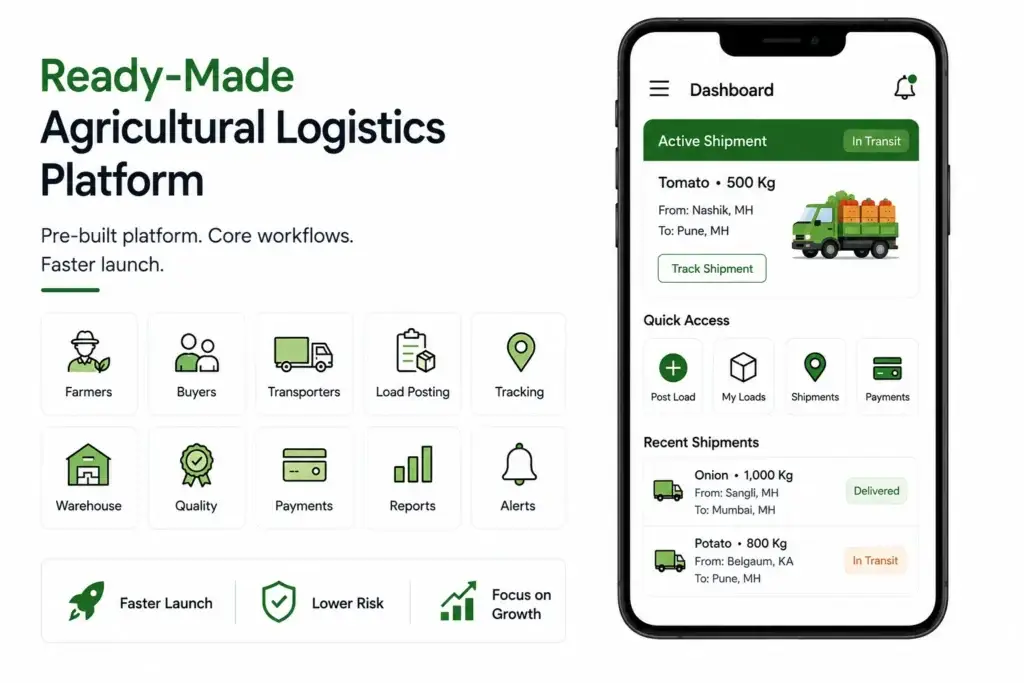
A ready-made agricultural logistics platform is a pre-built app foundation that already includes core workflows for managing agricultural transport, shipment visibility, user roles, admin control, and business operations.
It is not meant to be used blindly without customization. The purpose is to give founders a faster starting point so they can adapt the platform around their brand, market, crop category, user roles, route logic, payment workflows, and operating model.
A ready-made foundation may already include modules such as:
- Farmer or supplier onboarding
- Buyer management
- Transporter panel
- Driver workflow
- Load posting
- Shipment tracking
- Route visibility
- Warehouse handover
- Quality record management
- Payment status
- Admin dashboard
- Notifications
- Reports and analytics
For founders, the value is speed and reduced early uncertainty. Instead of spending months rebuilding standard logistics workflows, the startup can focus on market validation, partner onboarding, route liquidity, buyer trust, and operational refinement.
What Is Custom Agricultural Logistics Software Development?
Custom agricultural logistics software development means building the product from the ground up based on a founder’s exact requirements.
This route usually begins with discovery, workflow mapping, UX planning, technical architecture, database design, API development, mobile app development, admin dashboard creation, QA, deployment, and post-launch iteration.
Custom development can be the right choice when the business model is highly differentiated. For example, a startup may need advanced predictive pricing, proprietary route optimization, ERP integration, IoT-based cold-chain automation, complex procurement workflows, or multi-region enterprise controls.
The tradeoff is that custom development usually requires more time, more planning, more testing, and more budget discipline. It also requires founders to make many product decisions before they have enough real user data.
Ready-Made vs Custom Agricultural Logistics Platform Development: Core Comparison
Ready-Made vs Custom Development for AgriTech Startups
| Decision Area | Ready-Made Platform Foundation | Custom Development |
|---|---|---|
| Launch Speed | Faster because core app flows, admin modules, and standard logistics workflows already exist. | Slower because discovery, UX, backend, integrations, testing, and deployment start from zero. |
| Early Cost Exposure | More cost-efficient for founders validating demand before expanding scope. | Higher upfront investment because every workflow must be designed and built separately. |
| Customization | Can be customized around branding, user roles, workflows, language, routes, payments, and modules. | Offers maximum flexibility for highly unique operating models. |
| Market Validation | Useful when the priority is testing farmer, transporter, buyer, and route adoption quickly. | Useful when the market is already validated and the product needs proprietary differentiation. |
| Technical Control | Strong if source code is included and the vendor allows customization. | Strong if contracts clearly define source-code ownership, documentation, and handover. |
| Integration Depth | Suitable for common integrations such as maps, notifications, payment gateways, and basic analytics. | Better for deep ERP, IoT, telematics, accounting, procurement, or enterprise data integrations. |
| Best Fit | Early-stage founders, regional operators, agencies, and startups that need faster launch and validation. | Funded teams, enterprises, or operators with unusual workflows and long-term technical requirements. |
When a Ready-Made Platform Foundation Makes More Sense
A ready-made approach is usually stronger when the founder needs to launch, learn, and improve quickly.
This is especially true when the business model follows a known agricultural logistics pattern, such as farm-to-market transport, transporter matching, FPO-led aggregation, buyer delivery, warehouse movement, or regional produce logistics.
1. You Need to Validate Demand Before Overbuilding
Many AgriTech ideas fail not because the app could not be built, but because the market workflow was not validated.
A founder may assume farmers will post loads digitally, buyers will accept platform-based sourcing, and transporters will use an app to find routes. But those assumptions need real-world testing.
A ready-made agricultural logistics platform helps founders test:
- Whether farmers or FPOs will create shipment requests
- Whether transporters will accept or bid on loads
- Whether buyers trust digital delivery records
- Whether route tracking reduces support calls
- Whether payment visibility improves trust
- Whether admins can manage disputes and exceptions
- Whether the business can monetize through commissions, subscriptions, service fees, or managed logistics
The faster this learning happens, the faster the founder can improve the product.
2. You Have a Standard Farm-to-Market Workflow
If the platform needs common workflows like user onboarding, load posting, transporter matching, shipment tracking, proof of delivery, payment status, and admin reporting, a ready-made foundation can reduce unnecessary development time.
Founders who want to compare module-level requirements can review these agricultural logistics platform features before finalizing what should be included in the first launch version.
3. You Want to Reduce Early Product Risk
A startup’s first version should not become a heavy product experiment where every screen, workflow, and backend rule is built from scratch before real users test the model.
Ready-made development reduces early product risk because the foundation already supports familiar digital logistics patterns. The founder can then invest more energy into onboarding farmers, building transporter supply, securing buyer demand, and improving route liquidity.
4. You Need Admin Control From Day One
In agricultural logistics, the admin dashboard is not optional. It is the control centre for the business.
The operator needs to manage users, loads, transporters, vehicles, shipment status, routes, payments, commissions, disputes, reports, and support requests. If the admin layer is weak, the business becomes difficult to manage even if the mobile app looks polished.
A good ready-made foundation should give the founder a practical admin layer from the beginning.
5. You Want a Faster Route to Revenue Testing
A platform does not become a business until it can test monetization. A ready-made system can help founders experiment with revenue models earlier, such as shipment commission, transporter subscription, buyer service fee, premium load placement, or managed logistics support.
To explore revenue paths in more detail, founders can review this farm logistics business model breakdown before deciding how the platform should make money.
When Custom Agricultural Logistics Development Makes More Sense
Custom development is not wrong. It can be the better decision when the startup has validated the market and needs a product that cannot be supported by standard workflows.
1. Your Operating Model Is Highly Unique
If your platform depends on unusual pricing logic, proprietary dispatch algorithms, unique buyer contracts, advanced procurement rules, multi-country operations, or specialized compliance workflows, custom development may be required.
The more unique the business rules, the more likely a fully custom architecture becomes valuable.
2. You Need Deep Enterprise Integrations
Some agricultural logistics businesses need to connect with ERP systems, procurement tools, IoT devices, telematics systems, accounting platforms, warehouse management systems, or third-party data providers.
A ready-made system may support common integrations, but deep enterprise integration often needs custom planning, custom APIs, custom data mapping, and dedicated QA.
3. You Have Strong Internal Product Clarity
Custom development works better when the founder already understands the market, user roles, operational rules, and monetization model. If the team has already tested the workflow manually or through a smaller product version, custom development becomes less risky.
Without this clarity, founders may spend heavily on features that users later ignore.
4. You Are Building a Proprietary Technology Advantage
If the main competitive advantage is the technology itself, custom development may be necessary. For example, a startup building predictive demand routing, AI-led fleet assignment, automated crop quality scoring, or deeply specialized cold-chain intelligence may need a custom product roadmap.
Cost Factors Founders Should Compare Before Choosing
The cost of agricultural logistics platform development depends on scope. Founders should not compare only the headline development route. They should compare what each route includes and what each route will require after launch.
| Cost Factor | Why It Matters | Ready-Made Impact | Custom Impact |
|---|---|---|---|
| User Roles | Farmer, FPO, transporter, driver, buyer, warehouse, inspector, and admin workflows all add complexity. | Core roles may already exist and need configuration. | Each role must be designed, developed, and tested from scratch. |
| Load Matching | Manual assignment, bidding, route-based matching, and auto-allocation require different logic. | Standard matching can be adapted faster. | Custom matching can support unique business rules. |
| Live Tracking | GPS, route history, ETA, and geofencing add technical depth. | Common tracking flows may already be included. | Advanced tracking logic may require custom architecture. |
| Warehouse Logic | Receiving, inventory, bin-level stock, and dispatch status increase backend complexity. | Basic warehouse workflows can be customized. | Detailed WMS-style logic may need full custom development. |
| Cold-Chain Support | Perishable goods may need temperature logs, alerts, and exception handling. | Suitable for standard cold-chain visibility. | Better for IoT-heavy or sensor-led automation. |
| Payments | Commissions, transporter payouts, buyer invoices, refunds, and settlement records need careful rules. | Standard payment status and commission flows can reduce setup time. | Complex settlement logic may need custom development. |
| Integrations | Maps, SMS, WhatsApp, payment gateways, ERP, telematics, and accounting tools affect cost. | Common integrations are easier to add. | Deep integrations increase discovery and testing effort. |
For a deeper pricing breakdown, founders can review this farm-to-market logistics app cost guide before requesting a final quote.
Timeline Differences: What Founders Should Expect
A ready-made route is usually faster because the product foundation already exists. The founder mainly needs branding, configuration, workflow adjustments, content setup, deployment, and selected customization.
A custom route usually takes longer because the team must define the product from zero. Even before coding begins, the founder needs requirement discovery, user journey mapping, technical architecture, database planning, integration planning, UX design, and acceptance criteria.
For early-stage startups, this time difference matters because market learning is often more valuable than theoretical planning. A founder can spend months perfecting a product that has not yet been tested with real farmers, transporters, or buyers.
A practical decision is to ask:
Do we need full uniqueness now, or do we need real market feedback faster?
Product Ownership and Source Code Control
Product ownership should be part of the decision from the beginning.
Some ready-made platforms are only rented as SaaS tools. Others are white-label and source-code-owned. Some custom builds include clean handover and documentation. Others create vendor dependency if the contract is unclear.
Founders should confirm:
- Who owns the source code?
- Can the platform be customized after launch?
- Is the backend documented?
- Are APIs accessible?
- Can another team maintain the product later?
- Are third-party integrations controlled by the founder’s accounts?
- Is there a clear handover process?
- Are admin permissions configurable?
Source-code ownership matters because AgriTech startups often evolve after launch. A platform may start with farm produce movement, then add cold-chain logistics, warehouse inventory, B2B procurement, transporter subscriptions, buyer analytics, or regional licensing. The founder needs enough technical control to keep improving the product as the market changes.
Read more – Load Matching and Live Tracking in Farm-to-Market Logistics Platforms: How the Workflow Works.
Scalability: Ready-Made Does Not Mean Static
A common misunderstanding is that ready-made platforms cannot scale. That depends on how the solution is built and whether the founder receives customization rights, source-code access, and technical support.
A scalable agricultural logistics platform should be able to support:
- More users
- More regions
- More crop categories
- More transporters
- More warehouses
- More admin roles
- More transaction volume
- More integrations
- More reporting depth
The question is not whether the first version has every advanced feature. The question is whether the foundation can grow without forcing a full rebuild too early.
Founders building stronger dispatch, tracking, and fulfillment workflows can also explore Miracuves’ experience in logistics and supply chain software development to understand how route visibility, shipment coordination, and operational dashboards connect.
Founder Decision Signals
Speed
Choose ready-made if your immediate goal is to launch, validate routes, onboard early users, and test farm-to-market workflows faster.
Cost
Choose ready-made when you want to reduce early build exposure. Choose custom when the business already has enough clarity and budget for deeper product investment.
Scalability
Choose the route that supports long-term expansion across users, regions, warehouses, routes, payment flows, and integrations.
Market Fit
Choose ready-made when market adoption is still untested. Choose custom when user behavior, revenue model, and operating rules are already validated.
Practical Scenarios for AgriTech Startups
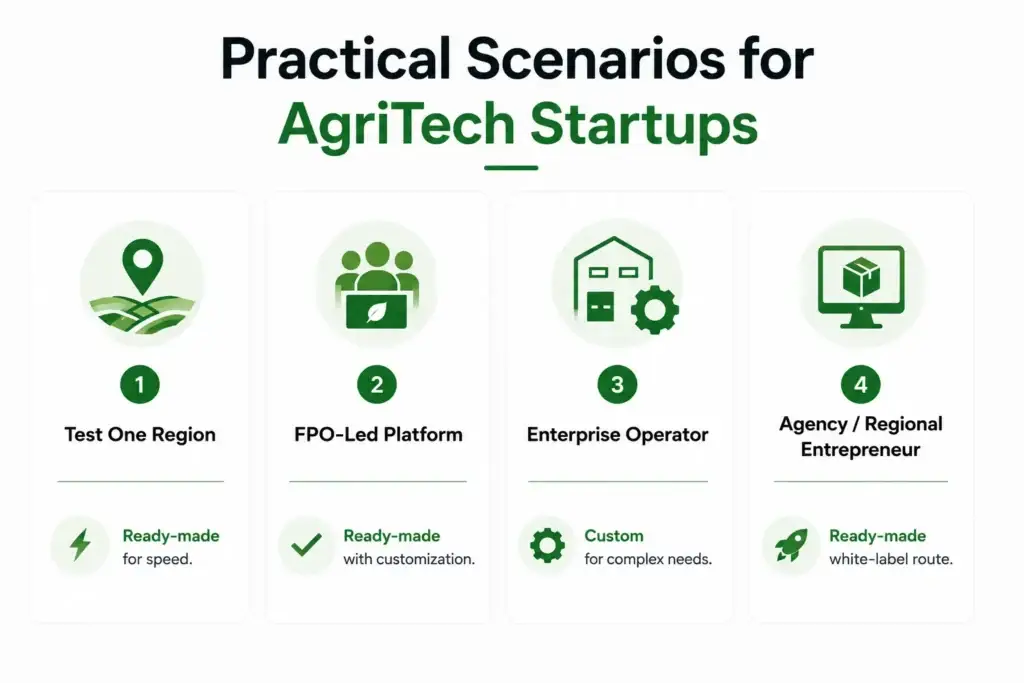
Scenario 1: Early Founder Testing One Region
A founder wants to test produce transport between one growing region and one buyer cluster. The main need is farmer onboarding, load posting, transporter matching, shipment tracking, and admin visibility.
A ready-made foundation is usually the stronger route because the founder needs speed and learning.
Scenario 2: FPO-Led Logistics Platform
An FPO wants to coordinate produce movement for members, manage group loads, track transporter activity, and provide buyers with delivery visibility.
A ready-made platform can work if member workflows, group load management, and admin reporting can be customized.
Scenario 3: Enterprise Agri Supply Chain Operator
A large operator needs ERP integration, cold-chain IoT devices, warehouse automation, multi-region procurement workflows, accounting integration, and proprietary analytics.
Custom development may be stronger because the business logic is complex and integration-heavy.
Scenario 4: Agency or Regional Entrepreneur
An agency or entrepreneur wants to launch a branded agricultural logistics app for a regional market. They need a white-label foundation, admin control, source-code ownership, and faster deployment.
A ready-made white-label route is usually more practical because the business can launch quickly and refine after market feedback.
How to Avoid Building the Wrong Version
Mistakes Founders Should Avoid
Choosing Custom Development Before Validating Demand
A fully custom product can become expensive if farmers, buyers, or transporters do not adopt the workflow. Validate the transaction loop before overbuilding.
Choosing Ready-Made Without Checking Customization Rights
A ready-made platform is useful only if it can be adapted to your brand, workflows, user roles, payment rules, and growth plan.
Ignoring Admin Control
The admin dashboard decides whether the platform operator can manage users, routes, loads, disputes, payments, commissions, and reports without constant developer dependency.
Building Too Many Advanced Features Too Early
IoT, ERP integration, predictive routing, and advanced analytics are useful when the core logistics workflow is already active. Add complexity after the market proves demand.
Where Miracuves Fits Into the Decision
Miracuves helps founders, startups, agencies, and businesses launch ready-made and white-label app platforms with source-code ownership, branded design, admin dashboards, and faster deployment.
For an agricultural logistics platform, the goal is not just launching a mobile app. The goal is building a practical product foundation that supports farm-to-market movement, transporter coordination, route visibility, warehouse operations, quality records, payment status, and admin control.
For founders comparing build options, Miracuves’ ready-made app solutions can provide a faster starting point than building every workflow from zero.
If your operating model requires highly specific workflows, deeper integrations, or unique product architecture, custom mobile app development may be the better route for long-term flexibility.
For founders who want a launch-ready agricultural supply chain app foundation, Miracuves offers a white-label agricultural logistics solution that can support farm-to-market workflows, transporter coordination, shipment tracking, admin control, and business model customization.
Businesses that need deeper planning support can also work with Miracuves as an agricultural logistics app development company to map the right route before launch.
Final Thoughts
The decision between ready-made and custom agricultural logistics platform development is not only a technical choice. It is a business timing decision.
If your startup still needs to validate farmer adoption, transporter participation, buyer trust, route demand, and monetization logic, a agrimove can help you move faster and learn from the market sooner.
If your workflows are already validated and your competitive advantage depends on proprietary technology, deep integrations, or highly specialized logic, custom development may be the stronger long-term route.
The smartest founders do not choose the longest build by default. They choose the route that gets the right product into the market at the right stage, with enough control to improve as the business grows.
FAQs
What is an agricultural logistics platform?
An agricultural logistics platform is software that helps manage farm-to-market movement across farmers, FPOs, buyers, transporters, drivers, warehouses, quality inspectors, and admins. It can support load posting, transporter matching, shipment tracking, proof of delivery, settlement visibility, and admin control.
What is the difference between ready-made and custom agricultural logistics platform development?
Ready-made development starts with an existing platform foundation that can be customized for branding, workflows, user roles, and launch needs. Custom development starts from zero and is built around highly specific requirements, integrations, and proprietary product logic.
When should an AgriTech startup choose a ready-made platform?
A ready-made platform is a strong choice when the startup wants faster launch, market validation, lower early build risk, standard logistics workflows, admin control, and a customizable foundation before investing heavily in advanced features.
When should a startup choose custom agricultural logistics software?
Custom development is better when the startup has a highly unique operating model, validated demand, complex enterprise integrations, proprietary dispatch logic, advanced IoT requirements, or deep workflow requirements that cannot be handled by a ready-made foundation.
Is a ready-made agricultural logistics platform customizable?
Yes, a strong ready-made platform can usually be customized around branding, user roles, crop categories, route logic, transporter workflows, payment rules, notifications, integrations, reports, and admin permissions. The exact scope depends on the vendor and source-code access.
What affects the cost of agricultural logistics platform development?
Cost depends on user roles, shipment workflows, transporter matching logic, live tracking, warehouse modules, cold-chain requirements, payment integrations, admin dashboard depth, third-party APIs, and customization scope. Final pricing should be confirmed based on selected modules and launch requirements.
Why is source-code ownership important for AgriTech startups?
Source-code ownership gives founders more long-term flexibility. As the platform grows, the business may need new workflows, integrations, monetization models, regional rules, and reporting layers. Source-code access reduces dependency and supports future customization.
How can Miracuves help with agricultural logistics platform development?
Miracuves helps founders build ready-made and white-label app platforms with source-code ownership, branded design, admin dashboards, shipment workflows, tracking modules, and customization support. Final scope depends on user roles, integrations, region, and business model.
Miracuves is an independent software development company. We are not affiliated with, connected to, sponsored by, or endorsed by any company or product named in this article.
Terms such as “X Clone” are used descriptively. It is how the software industry refers to building a platform with functionality comparable to a known service, and how clients search for it.
The entire design and codebase of our products is built by our own team. Our products contain no code, design, graphics, or content originating from any third-party website or applications.
All third-party names and marks referenced in this article are the property of their respective owners, referenced solely to identify the services discussed.