Discover how the business model of Marqeta powers modern fintech with its card issuing platform, flexible Marqeta revenue model, and scalable infrastructure strategy in 2026. Marqeta didn’t become a household name like Uber or PayPal — but it powers them.
From a niche fintech startup to a $5+ billion market player, Marqeta has quietly become the infrastructure backbone for companies like Square (Block), DoorDash, Klarna, and Instacart, enabling them to issue and control payment cards with precision. This clearly explains how Marqeta works behind the scenes of today’s biggest digital platforms.
What makes the Marqeta business model fascinating is this: It doesn’t serve end consumers directly — it builds the rails that power other billion-dollar apps.In 2026, as embedded finance and digital payments dominate global markets, the Marqeta revenue model is more relevant than ever. Businesses no longer want generic banking solutions — they want programmable, flexible financial infrastructure — exactly what Marqeta delivers.
How the Marqeta Business Model Works
Marqeta operates as a modern card issuing platform — essentially providing the infrastructure that allows businesses to create, manage, and scale their own payment card programs without becoming banks.
Instead of building financial products from scratch, companies plug into Marqeta’s APIs to launch customized payment experiences — from virtual cards to real-time spend controls.
Core Business Model Overview
Marqeta follows a B2B fintech infrastructure model (Platform-as-a-Service) with elements of:
- API-driven platform
- Usage-based monetization
- Embedded finance enablement
Key Components of the Model
1. Type of Model
- Primary Model: Fintech Infrastructure Platform (API-first)
- Secondary Layer: Transaction-based revenue model
- Hybrid Nature: Combines SaaS + Payments + Banking-as-a-Service
2. Value Proposition
Marqeta creates value for multiple stakeholders:
For Businesses (Clients like DoorDash, Klarna):
- Launch card programs quickly without regulatory complexity
- Real-time control over transactions (approve/decline instantly)
- Customizable payment flows (BNPL, gig economy payouts, expense cards)
- Scalable infrastructure without heavy upfront investment
For End Users (Indirect beneficiaries):
- Faster payments
- More secure and controlled transactions
- Seamless digital financial experiences
For Banks & Networks (Visa, Mastercard):
- Increased transaction volume
- Access to innovative fintech use cases
3. Stakeholders in the Ecosystem
Marqeta sits at the center of a multi-sided ecosystem:
- Businesses (Program Managers) → Use Marqeta to issue cards
- Issuing Banks → Provide regulatory backing
- Card Networks (Visa/Mastercard) → Enable global transactions
- End Users → Use cards indirectly
Marqeta’s role: Orchestrator of this entire ecosystem.
4. Evolution of the Model
Marqeta didn’t start as a giant:
- 2010–2015: Focused on prepaid and early fintech use cases
- 2016–2020: Growth via partnerships (Square/Block became dominant client)
- 2021 IPO Era: Positioned as a leader in card issuing infrastructure
- 2023–2026: Shift toward diversification beyond Block, expansion into:
- BNPL infrastructure
- Expense management platforms
- Embedded finance ecosystems
- BNPL infrastructure
Read more : What Is Marqeta and How Does It Work?
Target Market & Customer Segmentation Strategy
Marqeta’s strength lies in who it serves — and how precisely it aligns its product to their needs.
Unlike consumer apps, Marqeta targets businesses building financial products, making its segmentation more strategic, high-value, and long-term.
Primary & Secondary Customer Segments
Primary Segment: Fintech & Digital-First Platforms
These are Marqeta’s core revenue drivers:
- Fintech companies (Klarna, Affirm, Chime-like platforms)
- Digital banks / neobanks
- Buy Now, Pay Later (BNPL) providers
- Expense management platforms (Brex, Ramp)
Behavior:
- High transaction volume
- Rapid scaling needs
- Demand for customization and control
Secondary Segment: Platform-Based Businesses
- Gig economy platforms (DoorDash, Uber-like ecosystems)
- Marketplaces & e-commerce platforms (Instacart, Shopify ecosystems)
- Travel & mobility apps
Use case:
- Instant payouts to workers
- Controlled spending (e.g., delivery driver cards)
Customer Journey: From Discovery → Retention
Marqeta’s journey is not emotional — it’s technical and strategic.
1. Discovery
- Developer communities
- API documentation & sandbox environments
- Partnerships with banks and fintech accelerators
2. Evaluation
- Technical testing (API performance, flexibility)
- Compliance and regulatory compatibility
- Cost vs scalability comparison
3. Conversion
- Integration into product stack
- Launch of card programs
4. Retention & Expansion
- Increased transaction volume
- Expansion into new geographies
- Adoption of additional features (fraud controls, tokenization, etc.)
Customer Segment Analysis
| Segment Type | Needs | Marqeta Solution | Value Delivered |
| Fintech Startups | Fast launch, flexibility | API-first issuing platform | Speed + scalability |
| Enterprises | Embedded finance capabilities | Custom card programs | New revenue streams |
| Gig Platforms | Instant payouts, control | Real-time card issuing | Efficiency + cost control |
| BNPL Providers | Payment flexibility | Dynamic card authorization | Better user experience |
Revenue Streams and Monetization Design
Now that we understand who Marqeta serves, the next question is:
How does Marqeta actually make money?
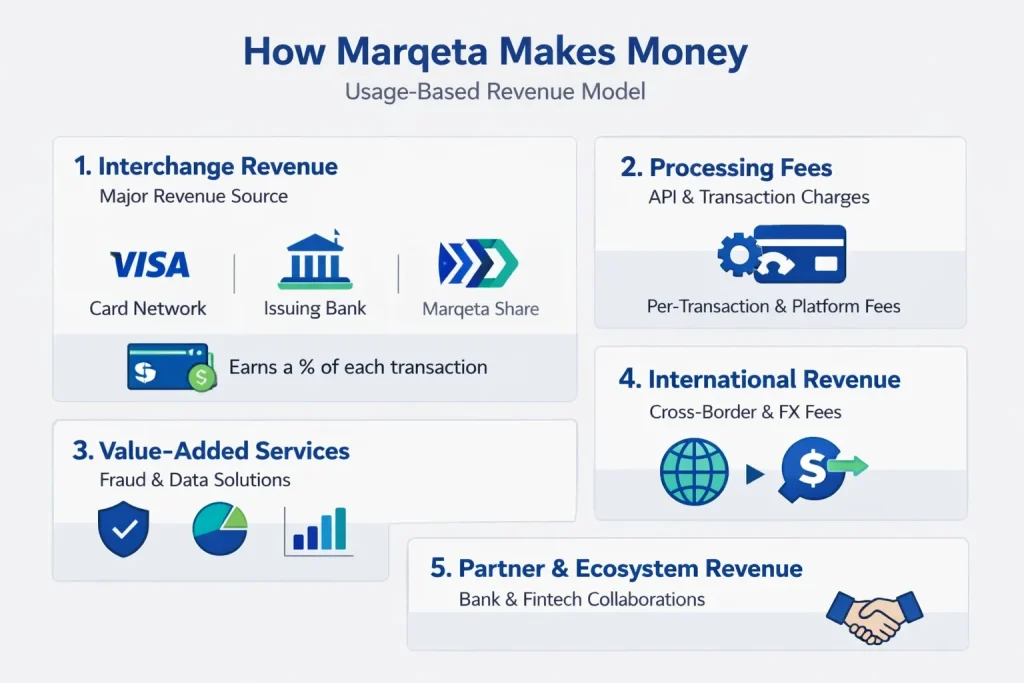
Unlike traditional SaaS platforms with fixed subscriptions, Marqeta’s monetization is deeply tied to transaction volume and ecosystem activity — meaning its revenue grows as its clients grow.
Core Revenue Model Overview
Marqeta operates on a usage-based fintech revenue model, combining:
- Interchange revenue sharing
- Processing & platform fees
- Value-added service monetization
This creates a scalable, compounding revenue engine.
Primary Revenue Stream
1. Interchange Revenue (Largest Contributor)
This is Marqeta’s biggest income source.
How it works:
- Every time a card issued via Marqeta is used, a small fee (interchange) is charged to the merchant.
- This fee is shared between:
- Card network (Visa/Mastercard)
- Issuing bank
- Marqeta (platform share)
- Card network (Visa/Mastercard)
Key Insights (2025–2026):
- Contributes majority of total revenue (often 70%+)
- Highly dependent on client transaction volume (e.g., Block historically drove a large share)
- Scales automatically as customers grow
Example:
More DoorDash orders → more card swipes → more revenue for Marqeta.
Secondary Revenue Streams
2. Processing & Platform Fees
- Charges for API usage, card issuance, and transaction processing
- Often structured as:
- Per-transaction fees
- Program management fees
- Per-transaction fees
Predictable revenue layer complementing interchange.
3. Value-Added Services
Marqeta monetizes advanced capabilities such as:
- Fraud detection & risk controls
- Tokenization & security features
- Data analytics & reporting tools
- Just-in-time (JIT) funding infrastructure
These features increase ARPU (Average Revenue Per User/client).
4. International Expansion Revenue
- Fees from cross-border transactions
- Currency conversion margins
- Regional program setups
Read more : Marqeta Clone Revenue Model: How Marqeta Makes Money in 2026
Operational Model & Key Activities
Behind Marqeta’s elegant API platform lies a highly sophisticated operational engine — one that balances technology, compliance, partnerships, and scale in real time.
This isn’t just a software company. It’s a financial infrastructure operator managing millions of transactions daily with near-zero tolerance for failure.
Core Operations
1. Platform & Infrastructure Management
- API uptime, scalability, and latency optimization
- Cloud-native infrastructure (multi-region deployment)
- Real-time transaction processing systems
In fintech, milliseconds matter — reliability is non-negotiable.
2. Compliance & Regulatory Management
- Coordination with issuing banks for regulatory coverage
- KYC, AML, and fraud monitoring systems
- Adapting to global financial regulations (US, EU, APAC)
This is one of the biggest value-adds Marqeta provides — removing regulatory burden from clients.
3. Risk & Fraud Control Systems
- Real-time transaction decisioning (approve/decline logic)
- AI-driven fraud detection models
- Spend controls and tokenization security
4. Client Support & Program Management
- Dedicated enterprise support teams
- Onboarding assistance for fintech clients
- Continuous optimization of card programs
High-touch support = stronger retention.
5. Sales & Developer-Led Growth
- Enterprise sales teams targeting large fintechs
- Developer-first onboarding (APIs, sandbox testing)
Industry events, fintech partnerships, and thought leadership
Strategic Partnerships & Ecosystem Development
Marqeta’s true strength isn’t just its technology — it’s the ecosystem it has built around that technology.
In fintech, no company operates alone. Success depends on how well you integrate with banks, networks, regulators, and platforms. Marqeta has mastered this by positioning itself as the connective layer between all players.
Collaboration Philosophy
Marqeta follows a clear principle:
“Enable others to build, and grow as they grow.”
Instead of competing with banks or fintech apps, Marqeta empowers both, creating a win-win ecosystem where:
- Banks provide compliance
- Networks provide reach
- Businesses provide innovation
- Marqeta provides the infrastructure tying it all together
Key Partnership Types
1. Technology & API Partners
- Integration with fintech stacks, SaaS platforms, and developer tools
- Cloud providers and infrastructure partners
Enables seamless embedding of payments into apps.
2. Issuing Banks (Critical Backbone)
- Partners like Sutton Bank, MetaBank (Pathward), etc.
- Provide regulatory licenses and compliance frameworks
Without banks, card issuing isn’t possible — this is a core dependency turned into a strategic alliance.
3. Card Networks (Visa & Mastercard)
- Enable global payment acceptance
- Provide transaction rails and interchange systems
Marqeta acts as a bridge between modern fintech and traditional networks.
4. Payment & Wallet Integrations
- Apple Pay, Google Pay integrations
- Tokenization partnerships
Expands usability and enhances user experience.
Ecosystem Strategy: The Real Competitive Moat
Marqeta’s ecosystem creates powerful advantages:
Network Effects
- More clients → more transactions → stronger partner relationships
- More partners → easier onboarding → more clients
A self-reinforcing growth loop.
Partner Value Creation
- Banks gain transaction volume
- Networks gain innovation use cases
- Clients gain speed and flexibility
Everyone benefits — which strengthens loyalty.
Monetization Within the Ecosystem
- Revenue sharing with banks and networks
- Upselling services across partner integrations
- Cross-border transaction monetization
Growth Strategy & Scaling Mechanisms
Marqeta’s growth story is not driven by viral consumer adoption — it’s powered by strategic client acquisition, ecosystem expansion, and transaction volume scaling.
Growth Engines
1. Organic Growth via Client Scaling
- As clients like Block, Klarna, or DoorDash grow → Marqeta’s transaction volume increases automatically
- No additional customer acquisition cost required
This creates compounding growth without proportional spending.
2. Developer-Led Virality
- Strong API documentation and sandbox environments
- Easy onboarding for developers and fintech startups
Developers become internal advocates, accelerating adoption within companies.
3. Enterprise Sales Strategy
- Focus on high-value, high-volume clients
- Long sales cycles but large contract sizes
Fewer clients, but significantly higher revenue per client.
4. Product Expansion Strategy
Marqeta continuously expands its offering:
- Tokenization and digital wallet support
- BNPL infrastructure
- Expense management solutions
- Advanced fraud and risk tools
This enables upselling and deeper client integration.
Scaling Challenges & How Marqeta Solved Them
Challenge 1: Client Concentration Risk
- Historically, a large portion of revenue came from Block (Square)
Solution:
- Diversified client base (BNPL, SaaS, enterprise fintech)
- Expanded into new industries
Challenge 2: Regulatory Complexity
- Different countries = different compliance requirements
Solution:
- Partnered with local issuing banks
- Built flexible compliance infrastructure
Challenge 3: Infrastructure Scalability
- Handling millions of real-time transactions globally
Solution:
- Invested heavily in cloud-native architecture
- Built highly reliable, low-latency systems
Challenge 4: Increasing Competition (BaaS players)
- New fintech infrastructure providers entering the market
Solution:
- Focus on deep customization and control
- Strengthened partnerships with Visa and Mastercard
Positioned as premium infrastructure, not commodity service
Competitive Strategy & Market Defense
As the fintech infrastructure space becomes increasingly crowded in 2026, Marqeta’s ability to defend its position is just as important as its ability to grow.
Core Competitive Advantages
1. Strong Network Effects
- More clients → more transaction data → better optimization
- More volume → stronger partnerships with banks & networks
This creates a reinforcing loop that new entrants struggle to match.
2. High Switching Barriers
- Deep API integrations within client systems
- Embedded into core financial workflows
Switching providers would require:
- Rebuilding infrastructure
- Re-certifying compliance
- Risking operational disruption
Result: extremely sticky customers
3. Advanced Technology & Real-Time Decisioning
- Just-in-Time (JIT) funding capabilities
- Real-time transaction authorization controls
- Highly customizable card logic
This level of control differentiates Marqeta from generic BaaS providers.
4. Data-Driven Personalization & Intelligence
- Insights from transaction patterns
- Fraud detection improvements over time
- Optimization for client-specific use cases
Data becomes a strategic asset, not just an operational byproduct.
Market Defense Tactics
1. Handling Pricing Pressure
- Instead of competing on lowest cost, Marqeta emphasizes:
- Reliability
- Scalability
- Customization
Competes as a premium infrastructure provider, not a commodity.
- Reliability
2. Strategic Feature Rollouts
- Continuous innovation in:
- Tokenization
- Embedded finance tools
- Risk & fraud systems
Keeps clients from exploring alternatives.
- Tokenization
3. Partnership-Led Defense
- Deep ties with Visa, Mastercard, and issuing banks
- Hard for competitors to replicate quickly
Partnerships act as barriers to entry.
4. Client Diversification Strategy
- Reduced dependency on a single large client (like Block)
- Expansion into:
- BNPL
- SaaS platforms
- Enterprise fintech
- BNPL
Lessons for Entrepreneurs & Implementation
Marqeta’s journey offers more than just inspiration — it provides a playbook for building scalable, future-ready platforms. If you’re an entrepreneur in 2026, the real question isn’t “Can I build the next Marqeta?”
Key Factors Behind Marqeta’s Success
1. Infrastructure Over Interface
- Marqeta didn’t chase end-users
- It built the backend powering other apps
Lesson: The biggest opportunities today lie in enabling others, not competing with them.
2. Revenue That Scales Automatically
- Transaction-based monetization
- Growth tied to customer success
Lesson: Design business models where revenue grows with usage, not just acquisition.
3. Deep Integration = Strong Retention
- Embedded APIs create high switching costs
- Clients become long-term partners
Lesson: Build products that become essential, not optional.
4. Ecosystem Thinking
- Partnerships with banks, networks, and fintechs
- Multi-sided value creation
Lesson: Don’t build in isolation — build within an ecosystem of value exchange.
Implementation Roadmap for Founders
Phase 1: Foundation
- Identify high-value ecosystem gap
- Define core API-driven product
- Validate with pilot clients
Phase 2: Build
- Develop scalable backend infrastructure
- Establish key partnerships (banks/APIs)
- Launch MVP with core functionality
Phase 3: Scale
- Expand client base
- Introduce monetization layers
- Optimize infrastructure and compliance
Phase 4: Expansion
- Add advanced features
- Enter new markets
Strengthen ecosystem partnerships
Ready to implement Marqeta’s proven business model for your market?
Miracuves builds scalable platforms with tested business models and growth mechanisms.
We’ve served 6,000+ clients. Get your free business model consultation today.
Card issuing platforms are custom work at Miracuves, handled by our fintech app development team. FinTech builds start at $12,999 and typically take 15-30 days, extending to 45-60 days for larger scope. Issuing bank partnerships and card scheme membership are arranged by you.
Conclusion
Marqeta’s business model is a powerful reminder that the most valuable companies in today’s economy aren’t always the most visible — they’re the ones enabling everything behind the scenes.
By focusing on infrastructure instead of interface, Marqeta transformed itself into a critical layer of the global fintech ecosystem. Its success didn’t come from chasing millions of users, but from empowering companies that already had them — and scaling alongside their growth.
The real takeaway? Innovation alone isn’t enough — it’s the combination of strategic positioning, scalable monetization, and ecosystem execution that creates lasting success.
As we move deeper into 2026 and beyond, platform economies will continue to evolve toward modular, API-driven, and embedded systems, where businesses plug into each other rather than operate independently.
FAQs
1. What type of business model does Marqeta use?
Marqeta uses a B2B fintech infrastructure model, combining API-driven platform services with transaction-based revenue. It enables businesses to issue and manage payment cards.
2. How does Marqeta’s model create value?
It simplifies complex banking infrastructure through APIs, allowing companies to launch customized financial products quickly. This reduces cost, time, and regulatory burden.
3. What are its key success factors?
Strong API technology, deep partnerships with banks and networks, and a scalable transaction-based revenue model. Its ability to embed deeply into client systems also drives retention.
4. How scalable is it?
Highly scalable, as revenue grows with client transaction volume rather than user acquisition. The more clients grow, the more Marqeta earns.
5. What are the biggest challenges?
Client concentration risk, regulatory complexity across regions, and increasing competition from other fintech infrastructure providers. Maintaining reliability at scale is also critical.
6. How can entrepreneurs adapt it to their region?
By focusing on local financial gaps like SME payments, lending, or expense management. Building API-first platforms and partnering with local banks is key
7. What are alternatives to this model?
Traditional SaaS subscription models, full-stack neobanks, or payment processors like Stripe and Adyen. However, these often lack Marqeta’s level of customization.
8. How has it evolved over time?
Marqeta evolved from prepaid card solutions to a full-scale card issuing platform. It expanded into embedded finance, BNPL, and global markets to stay competitive in 2026.
Related Articles
Miracuves is an independent software development company. We are not affiliated with, connected to, sponsored by, or endorsed by any company or product named in this article.
Terms such as “X Clone” are used descriptively. It is how the software industry refers to building a platform with functionality comparable to a known service, and how clients search for it.
The entire design and codebase of our products is built by our own team. Our products contain no code, design, graphics, or content originating from any third-party website or applications.
All third-party names and marks referenced in this article are the property of their respective owners, referenced solely to identify the services discussed.