

Key Takeaways
- OTT bandwidth costs can exceed app development costs.
- Video delivery efficiency directly impacts profitability.
- Adaptive streaming reduces unnecessary data usage.
- CDN routing helps optimize streaming performance.
- Bandwidth planning should start before launch.
Cost Optimization Signals
- Use HLS or DASH adaptive bitrate streaming.
- Serve different qualities based on network conditions.
- Reduce high-bitrate delivery on weak connections.
- Use intelligent CDN selection and caching.
- Monitor egress costs and viewer consumption patterns.
Real Insights
- Many OTT startups underestimate AWS bandwidth bills.
- Fixed MP4 delivery often wastes streaming resources.
- Adaptive streaming improves both cost and playback quality.
- Scaling viewers without optimization can hurt margins.
- Miracuves builds OTT platforms with bandwidth-efficient streaming architecture.
For most video startups, the first fear is development cost. The second fear arrives later, when users actually start watching.
That fear is bandwidth.Every minute watched becomes data transferred. Every HD stream becomes CDN traffic. Every viral show, sports clip, live session, or binge-watched episode can turn into a recurring infrastructure bill. For bootstrapped media founders, this is where growth can become dangerous. A streaming app that scales without delivery optimization does not simply gain users. It multiplies egress cost.
That is why Miracuves treats OTT infrastructure as a margin problem, not only a playback problem. Our white-label OTT and Netflix clone engine is designed around adaptive bitrate streaming, HLS/DASH packaging, CDN-aware routing, and backend controls that reduce avoidable bandwidth waste before it becomes a cloud-billing crisis.
This article breaks down how optimized adaptive streaming can reduce bandwidth consumption by up to 45% in benchmark scenarios compared with unoptimized MP4-style delivery scripts. The exact result depends on content length, bitrate ladder, viewer devices, geography, CDN strategy, and playback behavior, but the principle is consistent: do not serve more video data than the user’s screen, connection, and session actually need.
Apple describes HLS as a web-compatible streaming technology that works with ordinary web servers and CDNs while dynamically adapting playback to network conditions. MPEG-DASH follows the same adaptive principle by allowing stream quality to switch based on network performance.
The Problem With Standard MP4 Delivery
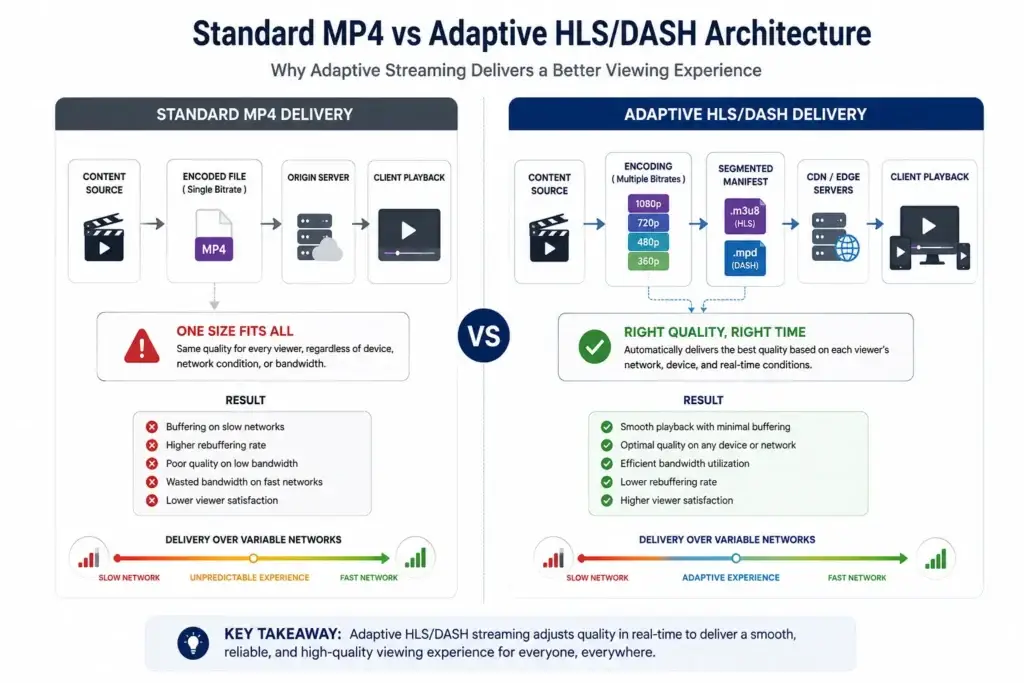
Many low-cost streaming scripts use simple MP4 delivery. The system uploads a video, stores it, and plays the file directly or through a basic CDN URL.
That looks simple. It is also expensive at scale.
A standard MP4 delivery model usually works like this:
- The platform stores a single high-resolution video file.
- The player loads that file directly.
- Every user receives the same video quality unless manually changed.
- A mobile user on a small screen may still receive a large file.
- A user on weak internet may buffer, retry, and consume wasted transfer.
- CDN delivery remains volume-heavy because the system has no bitrate intelligence.
This is fine for a small private video library. It is risky for a public OTT product.
The core issue is that MP4 delivery optimizes for implementation simplicity, not bandwidth efficiency. It does not ask whether the viewer needs 1080p. It does not adjust segment-by-segment. It does not react intelligently to network degradation. It often turns every playback session into a high-cost session.
Benchmarking Standard MP4 vs. Adaptive Bitrate Streaming
Adaptive bitrate streaming changes the delivery model.
Instead of serving one large file, the platform encodes each video into multiple bitrate and resolution variants. These variants are split into small segments. The video player then chooses the most appropriate segment quality based on device, screen size, bandwidth, and playback conditions.
HLS supports adaptive delivery over ordinary web infrastructure and CDNs. MPEG-DASH also delivers media through segmented HTTP-based streaming and allows bitrate switching based on network performance. Cloudflare explains adaptive bitrate streaming as the ability to adjust video quality during playback as network conditions change.
Benchmark Scenario
For this Miracuves benchmark model, assume a 60-minute video session with mixed device usage:
| Viewer Type | Share of Sessions | Actual Needed Quality | Waste Risk With Fixed MP4 |
|---|---|---|---|
| Mobile users on 4G/5G | 55% | 480p–720p | High |
| Tablet users | 20% | 720p | Medium |
| Desktop users | 20% | 720p–1080p | Medium |
| Smart TV users | 5% | 1080p+ | Low |
In an unoptimized MP4 setup, many users receive the same high-bitrate file even when their screen, network, or session behavior does not require it.
In an optimized HLS/DASH setup, the player can move between bitrate levels such as:
| Rendition | Typical Use Case | Example Bitrate |
|---|---|---|
| 360p | Weak mobile networks, previews | 0.7 Mbps |
| 480p | Mobile playback | 1.2 Mbps |
| 720p | Standard HD viewing | 2.5 Mbps |
| 1080p | Desktop / TV playback | 5 Mbps |
| 4K | Premium large-screen playback | 12–18 Mbps |
The winning architecture does not block HD playback. It avoids forcing HD delivery when HD is unnecessary.
Read more : 3 Weeks to Smart TVs: How We Deployed a Netflix Clone Across 5 Platforms Simultaneously
How Adaptive Bitrate Creates a 45% Margin Win Under Heavy Load
The 45% reduction comes from reducing average delivered bitrate per session, not from lowering video quality for everyone.
Here is a simplified benchmark:
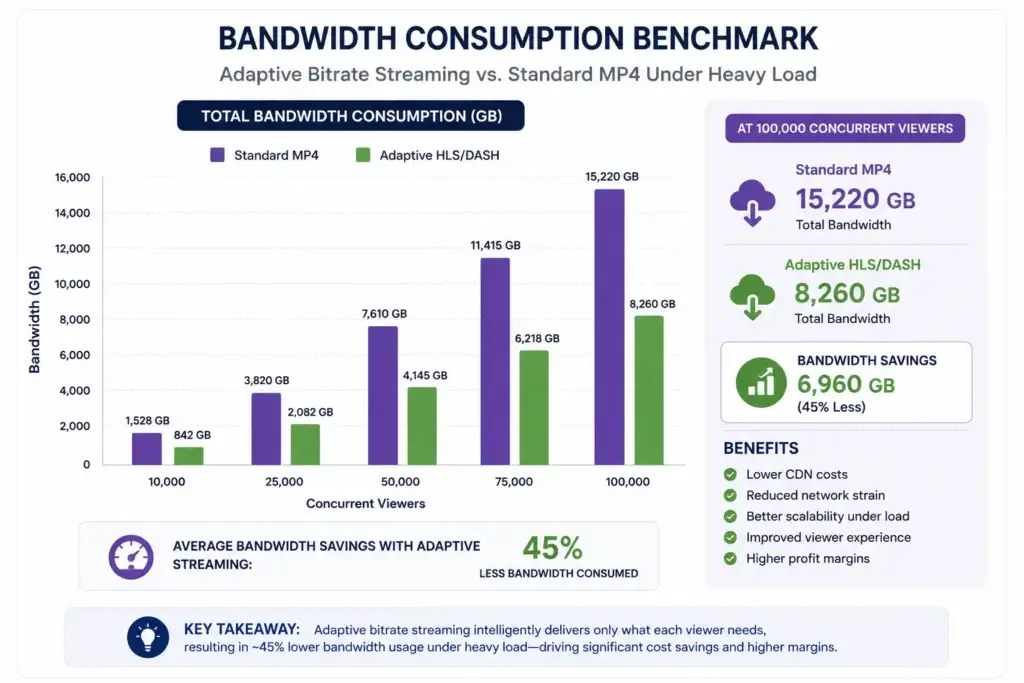
| Delivery Model | Average Delivered Bitrate | 60-Minute Data Transfer Per Viewer | 100,000 Monthly Viewing Hours |
|---|---|---|---|
| Fixed MP4 Delivery | 5 Mbps | ~2.25 GB | ~225 TB |
| Adaptive HLS/DASH Delivery | 2.75 Mbps | ~1.24 GB | ~124 TB |
| Estimated Reduction | — | ~45% | ~101 TB saved |
This model assumes that fixed MP4 delivery serves a high-bitrate stream too often, while adaptive delivery distributes sessions across mobile, tablet, desktop, and TV-appropriate renditions.
The result is not magic. It is math.
When the average delivered bitrate drops from 5 Mbps to 2.75 Mbps, bandwidth usage falls by roughly 45%. For a video platform, that reduction directly affects CDN egress, origin load, cache pressure, and infrastructure margin.
Formula:
Bandwidth per viewer = bitrate × watch time ÷ 8
For 5 Mbps over 60 minutes:
5 Mbps × 3,600 seconds ÷ 8 = 2,250 MB ≈ 2.25 GB
For 2.75 Mbps over 60 minutes:
2.75 Mbps × 3,600 seconds ÷ 8 = 1,237 MB ≈ 1.24 GB
That is the difference between growth that strains the business and growth that can be planned.
What Miracuves Optimizes Inside the OTT Engine
A bandwidth-conscious OTT platform is not just a video player. It is a delivery system.
Miracuves’ OTT and Netflix clone architecture focuses on the layers that affect recurring infrastructure cost:
| Optimization Layer | What It Does | Founder Impact |
|---|---|---|
| HLS/DASH packaging | Converts video into adaptive streaming segments | Prevents one-size-fits-all delivery |
| Bitrate ladder design | Creates multiple quality levels for different devices | Reduces over-delivery |
| CDN-aware routing | Sends users to efficient edge locations | Improves latency and reduces origin pressure |
| Cache strategy | Keeps popular segments closer to users | Reduces repeated origin fetches |
| Device-aware playback | Serves appropriate quality for mobile, desktop, and TV | Protects user experience and cost |
| Admin monitoring | Tracks usage, viewing, and delivery behavior | Gives operators cost visibility |
| Content workflow control | Manages uploads, encoding, publishing, and access | Reduces operational dependency |
For founders exploring a streaming platform, Miracuves can support a white-label OTT app, Netflix clone app, or broader video streaming app development workflow using a launch-ready foundation. Exact features, integrations, and infrastructure design should be finalized based on the target audience, content type, geography, and monetization model.
Founder Decision Signals: When Bandwidth Optimization Becomes Non-Negotiable
Read More: How to Integrate TMDB and IMDb APIs for Automatic Movie Metadata Import in a VOD Script
Founder Decision Signals Speed
If your platform needs to launch quickly, starting with a streaming-ready architecture is safer than adding HLS/DASH after bandwidth bills become painful.
Cost
If video delivery is your largest recurring cloud cost, adaptive bitrate optimization can protect margins by reducing unnecessary GB transfer.
Scalability
If you expect regional growth, creator uploads, live events, or binge-watch behavior, CDN routing and bitrate ladders should be designed early.
Market Fit
If your users are mobile-first or bandwidth-sensitive, adaptive streaming improves playback stability while avoiding over-delivery.
Speed
If your platform needs to launch quickly, starting with a streaming-ready architecture is safer than adding HLS/DASH after bandwidth bills become painful.
Cost
If video delivery is your largest recurring cloud cost, adaptive bitrate optimization can protect margins by reducing unnecessary GB transfer.
Scalability
If you expect regional growth, creator uploads, live events, or binge-watch behavior, CDN routing and bitrate ladders should be designed early.
Market Fit
If your users are mobile-first or bandwidth-sensitive, adaptive streaming improves playback stability while avoiding over-delivery.
A CTO should treat bandwidth optimization as a product requirement when:
- Watch time is central to revenue.
- Users are spread across multiple regions.
- The platform uses subscription, ads, pay-per-view, or creator monetization.
- Mobile-first users form a large share of traffic.
- The platform expects spikes from new releases, campaigns, or live events.
- Cloud cost predictability matters more than raw feature count.
This is why a ready-made OTT foundation should not be evaluated only by screens and modules. The real question is: what happens when people actually watch?
Intelligent CDN Routing: The Layer Most Founders Ignore
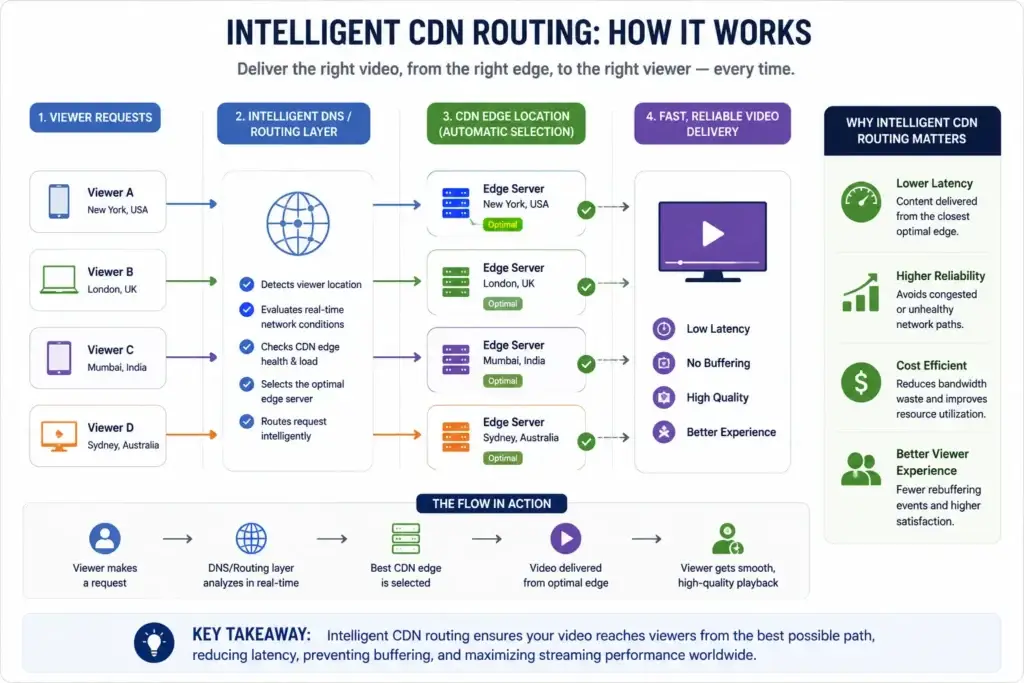
Adaptive bitrate reduces file-size waste, while CDN routing minimizes delivery inefficiency. A CDN stores content closer to viewers through edge locations, but the way your app leverages the CDN is critical. Poor routing, weak cache headers, unnecessary origin fetches, and unoptimized segment requests can still inflate costs.
A stronger OTT backend should support:
- Segment-level CDN caching
- Region-aware edge delivery
- Tokenized playback URLs
- Cache-control rules for popular content
- Origin shielding where appropriate
- Retry logic that avoids multiplying wasted requests
- Analytics for cost per stream and bitrate distribution
Streaming at scale demands operational visibility into CDN performance, bitrate adaptation, and cost per stream. Bootstrapped media founders need more than a basic video script—they need an OTT engine that reveals how infrastructure decisions directly impact unit economics.
Standard Script vs. Miracuves OTT Engine
| Layer | Unoptimized Streaming Script | Miracuves OTT Engine Approach |
|---|---|---|
| Video delivery | Direct MP4 or basic CDN file serving | HLS/DASH adaptive segment delivery |
| Bitrate control | Often fixed or manual | Multiple renditions with adaptive switching |
| Mobile efficiency | May over-serve HD files | Device-aware playback quality |
| CDN usage | Basic asset delivery | CDN-aware routing and caching logic |
| Cost visibility | Limited infrastructure insight | Admin and analytics-ready usage monitoring |
| Scaling risk | Costs rise sharply with watch time | Bandwidth consumption is actively optimized |
| Founder outcome | Faster initial setup but higher scaling risk | Stronger foundation for sustainable video growth |
The point is not that every platform needs enterprise-grade complexity on day one. The point is that video delivery should not be treated as an afterthought.
For a founder, the danger is not launching a simple app. The danger is launching a simple app with a cost model that breaks when users arrive.
Why This Matters for Monetization
Bandwidth optimization is not only an infrastructure win. It affects every OTT monetization model.
| Monetization Model | Why Bandwidth Cost Matters |
|---|---|
| Subscription | High watch time is good only if delivery cost stays controlled |
| AVOD / ads | Free users can become expensive if every session is over-served |
| Pay-per-view | Margins depend on keeping delivery cost below transaction value |
| Creator revenue share | Platform costs must be controlled before payouts |
| Freemium previews | Autoplay and trailers can leak bandwidth without conversion |
| Regional OTT | Mobile-first audiences need quality without waste |
A founder may spend months improving payment flows, pricing plans, and content acquisition. But if the platform delivers every stream inefficiently, monetization gains can disappear into infrastructure bills.
Read more : Top 14 Features for a Competitive Netflix Clone in the Modern Market
Miracuves Perspective: Build the Streaming Margin Layer Early
The strongest OTT platforms are not built only for beautiful playback. They are built for sustainable delivery economics.
Miracuves helps founders build white-label, source-code-owned OTT and Netflix clone platforms with admin control, branded user experiences, monetization workflows, and streaming infrastructure planning. For ready-made solutions, Miracuves can support faster launch paths while still allowing customization around content workflows, CDN setup, user roles, payment models, and analytics.
The right approach is not to copy Netflix blindly. It is to understand the infrastructure principles that make video delivery scalable, then adapt them to your market, budget, and audience behavior.
If your audience is mobile-first, bitrate design matters.
If your content is long-form, watch time economics matter.
If your growth depends on ads or subscriptions, cost per stream matters.
If you are bootstrapped, every unnecessary GB matters.
Final Thoughts: The Real OTT Cost Is Not the App, It Is the Stream
The biggest mistake in OTT planning is treating bandwidth as a later-stage engineering issue.
It is not. Bandwidth is part of the business model. Every subscription, ad impression, free preview, binge session, and live event depends on the economics of video delivery. A platform that streams inefficiently can become expensive before it becomes profitable.
Adaptive bitrate streaming through HLS/DASH gives founders a practical way to reduce waste, improve playback stability, and protect margins. In Miracuves benchmark modeling, the difference between fixed MP4 delivery and optimized adaptive streaming can reach up to 45% lower bandwidth consumption under mixed-device heavy-load scenarios.
For bootstrapped media founders and CTOs, that is not just a technical improvement. It is runway protection.
Want to build an OTT platform with bandwidth-conscious streaming architecture? Contact Miracuves to discuss a white-label OTT solution with adaptive delivery, admin control, and scalable video infrastructure.
FAQs
What are OTT bandwidth costs?
OTT bandwidth costs are the recurring charges created when video data is transferred from storage, origin servers, or CDNs to viewers. These costs increase with watch time, video quality, number of viewers, and delivery geography.
How does adaptive bitrate streaming reduce bandwidth cost?
Adaptive bitrate streaming reduces bandwidth cost by serving the most appropriate video quality for each viewer’s device, screen size, and network condition. Instead of forcing every viewer to load a large high-resolution file, HLS/DASH delivery switches between smaller and larger segments as needed.
What is the difference between HLS and DASH?
HLS and DASH are both adaptive streaming protocols. HLS was developed by Apple and is widely used across Apple devices and many other playback environments. DASH is an adaptive HTTP streaming standard that also supports segmented playback and bitrate switching. The right choice depends on device support, player strategy, DRM needs, and platform architecture.
Why do bootstrapped OTT startups struggle with AWS egress costs?
Bootstrapped OTT startups struggle because video delivery scales directly with user viewing time. If a platform gains traction but sends oversized streams, cloud and CDN bills can rise faster than subscription or ad revenue.
How can Miracuves help with OTT app development?
Miracuves helps founders launch white-label OTT and Netflix clone platforms with source-code ownership, admin dashboards, monetization workflows, branded design, and streaming architecture planning. Final scope depends on features, integrations, content workflows, and infrastructure requirements.
Is HLS better than MP4 for OTT platforms?
For scalable OTT platforms, HLS is usually better than direct MP4 delivery because it supports segmented adaptive streaming, CDN-friendly delivery, and smoother playback under changing network conditions. MP4 can work for simple use cases, but it often becomes inefficient at scale.
Can adaptive bitrate streaming really cut costs by 45%?
It can in benchmark scenarios where the unoptimized baseline over-serves high-bitrate video to users who do not need it. The exact saving depends on bitrate ladder design, content type, user devices, watch time, CDN pricing, and geography. The 45% figure should be treated as a realistic benchmark model, not a universal guarantee.
What should CTOs monitor in an OTT backend?
CTOs should monitor average bitrate per session, bandwidth per user, CDN cache-hit ratio, origin requests, cost per stream, device distribution, buffering rate, playback errors, and region-level delivery cost.
Miracuves is an independent software development company. We are not affiliated with, connected to, sponsored by, or endorsed by any company or product named in this article.
Terms such as “X Clone” are used descriptively. It is how the software industry refers to building a platform with functionality comparable to a known service, and how clients search for it.
The entire design and codebase of our products is built by our own team. Our products contain no code, design, graphics, or content originating from any third-party website or applications.
All third-party names and marks referenced in this article are the property of their respective owners, referenced solely to identify the services discussed.