Key Takeaways
What You’ll Learn
- JustEat-style apps can be safe for business use when they combine strong platform security, payment protection, and compliance-ready delivery operations.
- Security in a food delivery platform goes beyond login protection, because it also includes customer data safety, payment security, restaurant access control, rider workflows, and fraud prevention.
- Core protection layers include encrypted transactions, secure APIs, role-based access control, audit readiness, payment gateway security, and continuous monitoring.
- Compliance matters as much as app security, especially when the platform handles user data, card payments, and region-specific legal obligations.
- A secure and compliant delivery platform supports long-term growth by building trust with customers, restaurants, delivery partners, and regulators.
Stats That Matter
- Trust and compliance are major launch factors in food delivery apps where users expect safe payments, protected personal data, and reliable order handling.
- Standards like PCI DSS, GDPR, SSL/TLS, and secure infrastructure practices are critical for reducing legal and operational exposure.
- Weak providers usually show clear red flags such as missing security documentation, outdated technology, no compliance proof, and no update policy.
- Pre-launch audits and post-launch monitoring both matter, because security gaps can appear during development as well as after real users and live payments enter the system.
- A strong delivery platform performs better when security controls, compliance checks, payment protection, and incident response planning are built into the full product lifecycle.
Real Insights
- A JustEat-like platform is only as safe as its weakest operational layer, because insecure payments, poor admin controls, or weak vendor oversight can damage trust quickly.
- Technology alone is not enough, since businesses also need legal readiness, security audits, staff training, and a clear breach response process.
- Compliance should be treated as part of product design, not as a final checklist item added just before launch.
- Regular updates, penetration testing, and continuous monitoring are what keep a delivery platform secure after launch, not just one-time development effort.
- For most businesses, the safest food delivery app model is one that combines secure infrastructure, verified payment protection, documented compliance, and disciplined post-launch monitoring into one dependable system.
You’ve heard the horror stories about data breaches, leaked customer information, and hacked food delivery platforms bringing entire businesses to a halt overnight. In 2026, when a single security failure can destroy brand trust in minutes, the biggest question every food delivery entrepreneur asks is simple but critical:
Is a white-label JustEat app actually safe to launch and scale?
With millions of users sharing personal details, live locations, and payment information daily, food delivery apps have become prime targets for cybercriminals. From stolen card data and manipulated orders to privacy violations and unauthorized account access, the risks are real—and growing fast.
For founders planning to launch a JustEat-like app, security cannot be treated as an optional feature added after development. The platform must protect customers, restaurant partners, delivery professionals, administrators, and every transaction flowing through the system from the moment it goes live.
Safety matters more than ever because today’s customers don’t judge your app only by its speed and convenience. They also judge it by how effectively it protects their identity, money, location, and privacy. Regulators across Europe, the UK, and other global markets are tightening data protection requirements, while non-compliance penalties can severely damage—or even shut down—a growing startup.
In this guide, you’ll get an honest, no-fluff security assessment of a white-label JustEat app. We’ll examine the real risks, the security standards your platform should meet in 2026, and the practical steps required to launch a safe, compliant, and trust-ready JustEat-like food delivery app.
You’ll also see how Miracuves approaches security differently by building protection into the platform’s foundation rather than treating it as an afterthought.
This is not a sales article. It is a practical survival guide for founders who want to launch quickly without gambling on security..
Understanding White-Label JustEat App Security Landscape
What White-Label App Security Actually Means
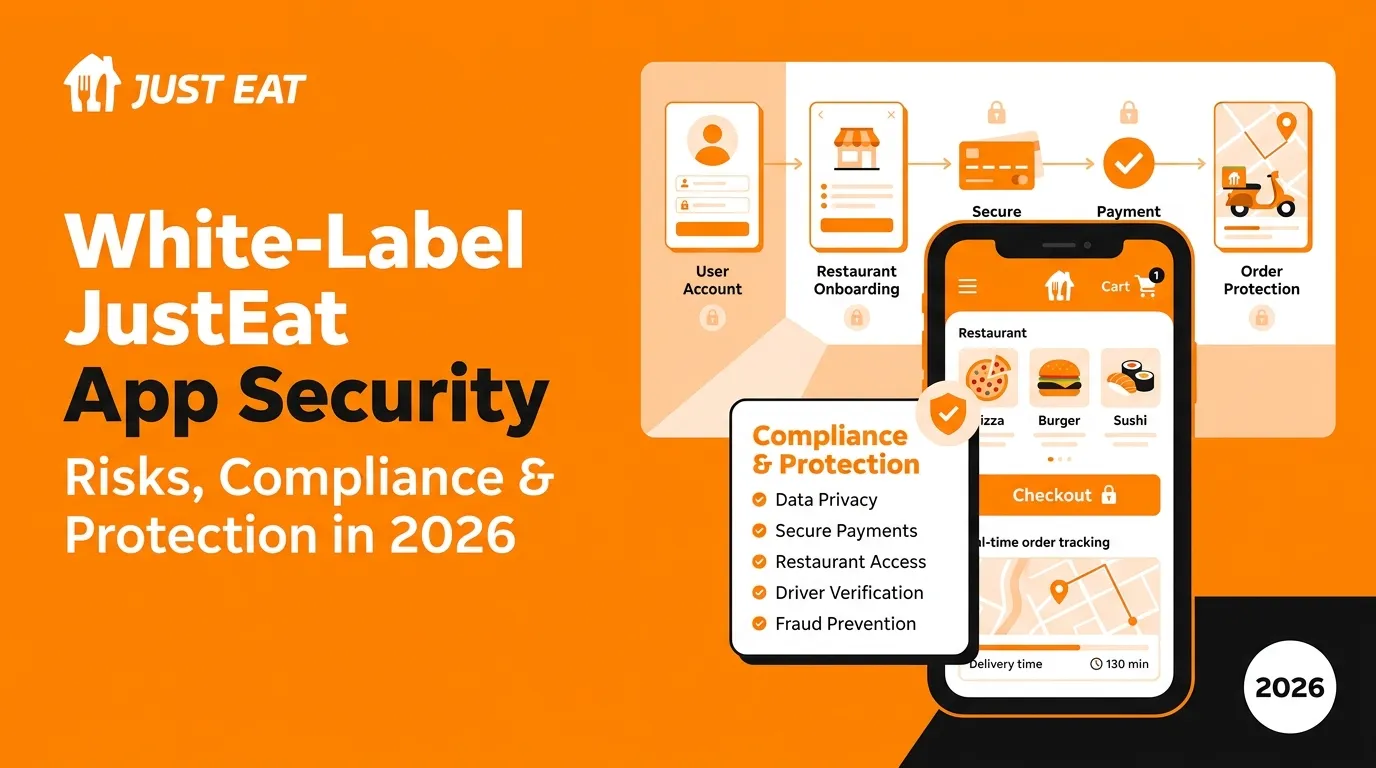
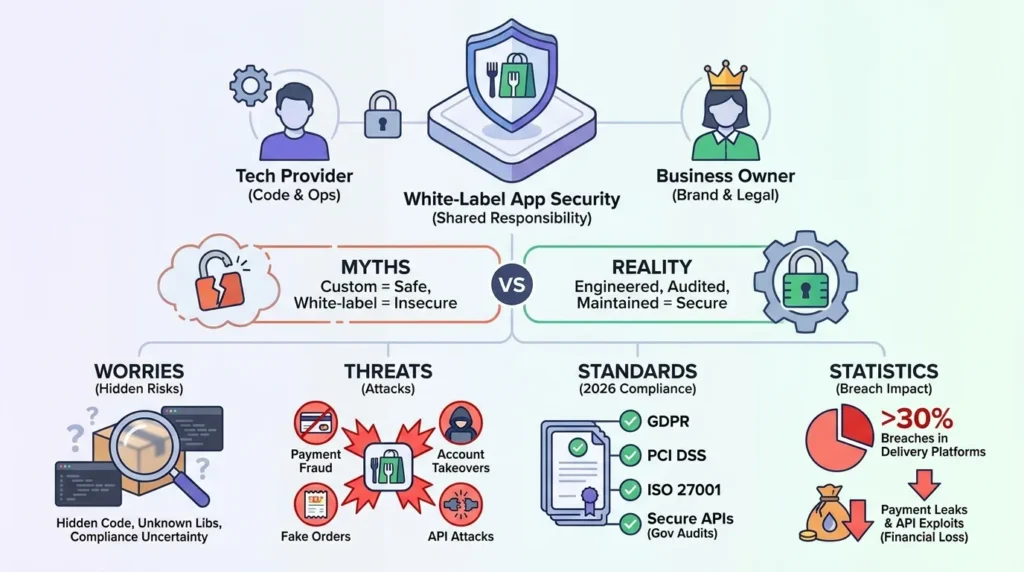
White-label JustEat app security refers to how safely the ready-made platform protects user data, payments, restaurants, and delivery operations when it is rebranded and launched under your business name. The responsibility of security is shared between the technology provider and the business owner, but legal accountability always falls on the brand that launches the app.
Common Security Myths vs Reality
Many founders believe that white-label apps are automatically insecure or that only custom-built apps can be safe. In reality, security depends on how the app is engineered, audited, and maintained. A poorly built custom app can be far riskier than a professionally secured white-label app.
Why People Worry About White-Label Apps
The fear comes from hidden code quality issues, unknown third-party libraries, lack of transparency, and uncertainty about compliance. Since entrepreneurs don’t personally build the code, they worry about what they cannot see or verify.
Current Threat Landscape for JustEat-Type Platforms
Food delivery platforms face constant risks such as payment fraud, fake order injections, account takeovers, location tracking abuse, and API attacks. Hackers target these apps because they combine financial data, real-time logistics, and personal user information.
Security Standards in 2026
In 2026, food delivery apps are expected to follow strict global standards like GDPR, PCI DSS, ISO 27001, and secure API frameworks. Governments now actively audit platforms handling digital payments and location-based services.
Real-World App Security Incident Statistics
Recent global cybersecurity reports show that over 30 percent of consumer app breaches now occur in marketplace and delivery platforms. Payment data leaks and API exploits remain the most common causes of legal action and financial loss in this sector.
Read More: What is JustEat App and How Does It Work?
Key Security Risks & How to Identify Them
Data Protection & Privacy Risks
User trust in a white-label JustEat app is built on how securely personal and transactional data is handled. Any weakness here directly exposes the business to legal and financial fallout.
User Personal Information
Names, phone numbers, addresses, and order history are high-value data for attackers. Weak database security or improper access controls often lead to mass data leaks.
Payment Data Security
Card details, UPI tokens, and wallet credentials must follow PCI DSS standards. Unencrypted storage or poorly integrated payment gateways are leading causes of financial fraud.
Location Tracking Concerns
Real-time GPS tracking of users and delivery partners creates serious privacy exposure if APIs are not properly secured. Location leaks can result in stalking, fraud, and regulatory violations.
GDPR and Data Privacy Compliance
Failure to obtain lawful consent, improper data retention, or cross-border data transfers without safeguards can result in heavy penalties under GDPR and similar laws.
Technical Vulnerabilities
Code Quality Issues
Hard-coded credentials, outdated libraries, and insecure logic increase the attack surface of the app. Poorly written code is one of the most exploited weaknesses in white-label platforms.
Server Security Gaps
Improper firewall configurations, unsecured cloud storage, and weak admin access controls allow attackers to compromise entire systems.
API Vulnerabilities
Insecure APIs enable data scraping, fake order creation, and unauthorized account access. API abuse is one of the fastest-growing threats in food delivery apps.
Third-Party Integrations
SMS gateways, maps, analytics, and payment tools introduce risks if their security practices are weak or outdated.
Business-Level Risks
Legal Liability
Any breach makes the business owner legally responsible, not the technology provider. Lawsuit exposure increases rapidly after large-scale incidents.
Reputation Damage
Loss of customer trust after a security incident significantly impacts user retention and partner onboarding.
Financial Losses
Chargebacks, refunds, penalties, and downtime costs often exceed the original app investment.
Regulatory Penalties
Non-compliance with data protection and payment regulations can lead to fines running into millions.
Risk Assessment Checklist
- Is user data encrypted at rest and in transit
- Are payment systems PCI DSS compliant
- Are APIs protected with authentication and rate limiting
- Is regular penetration testing conducted
- Are third-party tools security audited
- Is there a formal incident response plan
- Is data access role-based and logged
Read More: Key JustEat Features for Food Delivery Apps
Security Standards Your White-Label JustEat App Must Meet
Essential Security Certifications
ISO 27001 Compliance
This standard ensures that the app follows a structured information security management system to protect business, user, and operational data.
SOC 2 Type II
SOC 2 Type II verifies how securely the platform handles data over time, covering access control, system availability, and data confidentiality.
GDPR Compliance
Mandatory for apps serving users in the UK and Europe, GDPR ensures lawful data collection, user consent, breach reporting, and secure data storage.
HIPAA (If Applicable)
If the app stores any health-related dietary or allergy information tied to users, HIPAA-level protection becomes relevant in certain regions.
PCI DSS for Payments
Any app processing cards or digital payments must follow PCI DSS to protect payment credentials and prevent financial fraud.
Technical Security Requirements
End-to-End Encryption
All user data, order details, and payment information must be encrypted during transmission and while stored on servers.
Secure Authentication
Strong login protection using two-factor authentication and OAuth prevents account takeovers and credential abuse.
Regular Security Audits
Independent security audits identify vulnerabilities before attackers exploit them.
Penetration Testing
Ethical hacking simulations expose real-world weaknesses in APIs, servers, and mobile apps.
SSL Certificates
SSL certificates protect all data exchanged between the user device and backend servers.
Secure API Design
APIs must use authentication keys, access control limits, and monitoring to block abuse.
Security Standards Comparison Table
| Security Standard | Purpose | Mandatory For JustEat-Type Apps | Risk If Missing |
|---|---|---|---|
| ISO 27001 | Data security management | Yes | High breach exposure |
| SOC 2 Type II | System trust & control | Strongly Recommended | Loss of enterprise trust |
| GDPR | User data protection | Legally Mandatory (EU/UK) | Heavy regulatory fines |
| PCI DSS | Payment security | Legally Mandatory | Card fraud & penalties |
| SSL/TLS | Secure data transfer | Mandatory | Data interception |
Red Flags: How to Spot Unsafe White-Label Providers
No Security Documentation
If the provider cannot share security architecture, audit reports, or compliance proof, it indicates weak internal controls.
Unrealistically Cheap Pricing
Low-cost solutions without clear security breakdowns usually cut corners on encryption, audits, and infrastructure protection.
No Compliance Certifications
Absence of GDPR, PCI DSS, or ISO references shows the app is not built for regulated markets.
Outdated Technology Stack
Old frameworks and unsupported libraries expose the platform to known, easily exploitable vulnerabilities.
Poor Code Quality
Messy code structure, hard-coded keys, and lack of documentation increase breach risk and maintenance failures.
No Security Update Policy
If regular patches and security upgrades are not guaranteed, the app becomes weaker over time.
Lack of Data Backup Systems
Without automated backups, a single ransomware attack can permanently destroy user and business data.
No Cyber Insurance Coverage
Providers without insurance transfer all legal and financial risk to the business owner.
Evaluation Checklist
Questions to Ask Providers
- How is user and payment data encrypted
- How often are security audits conducted
- Who is responsible for security updates after launch
- How is breach detection handled
- What compliance standards are followed
Documents to Request
- Data protection policy
- PCI DSS compliance proof
- GDPR compliance framework
- Infrastructure security architecture
- Audit and penetration testing reports
Testing Procedures
- Application vulnerability assessment
- API security testing
- Payment gateway security validation
- Load and stress testing
Due Diligence Steps
- Verify legal company registration
- Check past breach history
- Review client security case studies
- Validate ongoing compliance support
Read more :- Best JustEat Clone Scripts in 2025: Features & Pricing Compared
Best Practices for Secure White-Label JustEat App Implementation
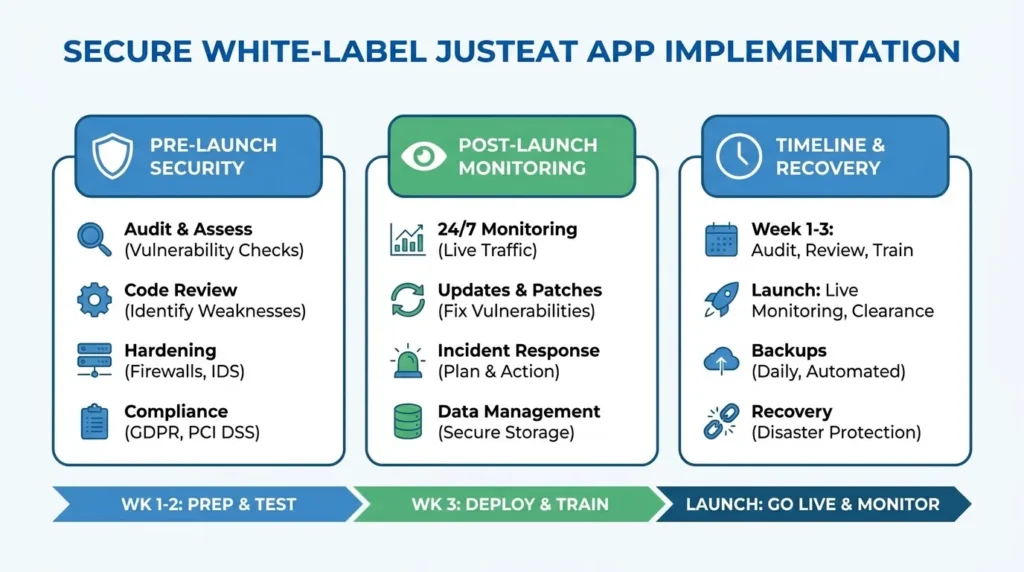
Pre-Launch Security
Security Audit Process
Before launch, a full vulnerability assessment must be conducted on mobile apps, web panels, and backend servers to detect security gaps.
Code Review Requirements
Independent code reviews help identify weak logic, insecure functions, and outdated dependencies that may later cause breaches.
Infrastructure Hardening
Cloud servers must be configured with firewalls, restricted ports, private networking, and intrusion detection systems.
Compliance Verification
GDPR, PCI DSS, and regional data laws must be verified before onboarding real users and processing live payments.
Staff Training Programs
Admin users, support teams, and delivery partners must be trained on secure login practices and data handling protocols.
Post-Launch Monitoring
Continuous Security Monitoring
Live traffic, access logs, and system activity must be monitored 24/7 to detect abnormal behavior in real time.
Regular Updates and Patches
Frameworks, libraries, and APIs must be updated frequently to remove newly discovered vulnerabilities.
Incident Response Planning
A documented breach response plan ensures fast action, legal compliance, and damage control during any security event.
User Data Management
Data must be stored only for legally permitted durations with strict role-based access.
Backup and Recovery Systems
Automated daily backups and disaster recovery setups protect the platform from ransomware and data loss incidents.
Security Implementation Timeline
- Week 1: Security audit, infrastructure setup, compliance verification
- Week 2: Code review, penetration testing, third-party integration audits
- Week 3: Monitoring tools deployment, staff training, breach response drill
- Launch Phase: Live monitoring, payment gateway certification, final security clearance
Legal & Compliance Considerations
Regulatory Requirements
Data Protection Laws by Region
White-label JustEat apps must comply with regional data laws such as GDPR in the EU and UK, DPDP Act in India, and CCPA in parts of the USA. These laws regulate how user data is collected, stored, processed, and transferred.
Industry-Specific Regulations
Food delivery platforms must follow digital payment regulations, consumer protection laws, and in some regions, food safety data handling standards.
User Consent Management
Explicit user consent must be taken for data collection, GPS tracking, marketing communication, and cookies. Consent logs must be securely stored.
Privacy Policy Requirements
A legally valid privacy policy must clearly define what data is collected, how it is used, and how users can request deletion.
Terms of Service Essentials
Terms must define platform responsibility, user obligations, liability limitations, and dispute resolution processes.
Liability Protection
Insurance Requirements
Cyber liability insurance protects against financial losses from data breaches, fraud, and legal claims.
Legal Disclaimers
Clear disclaimers reduce exposure in case of service failures, third-party integrations, or user misuse.
User Agreements
Strong user agreements limit misuse, fraud, and unauthorized access while protecting platform ownership rights.
Incident Reporting Protocols
Breach notifications must be sent to authorities and users within legally defined timelines.
Regulatory Compliance Monitoring
Ongoing audits and legal reviews are required to ensure continuous compliance as laws evolve.
Compliance Checklist by Region
| Region | Core Law | Payment Law | Breach Reporting Requirement |
|---|---|---|---|
| EU & UK | GDPR | PCI DSS | Within 72 Hours |
| India | DPDP Act | RBI Payment Rules | As per CERT-In |
| USA | CCPA | PCI DSS | State-Specific |
| Middle East | PDPL | Local Banking Laws | Mandatory Authority Notice |
Read more : – How to Hire the Best Justeat Clone Developer
Global Cost of Development for a JustEat-Like App
JustEat-Like Food Delivery App Development — Market Price by Tech Stack
The tech stack affects restaurant listings, order speed, live tracking, payment security, and platform scalability in a JustEat-like app. PHP/Laravel works well for cost-effective launches, Node.js/React.js supports real-time orders, notifications, and delivery updates, while Go microservices suit high-volume, multi-city food delivery platforms.
PHP/Laravel is often the most practical choice for launching a JustEat-like platform quickly and affordably. Node.js/Python fits real-time ordering and delivery workflows, while Go microservices are better suited for enterprise-scale food delivery platforms with high concurrency, multi-city operations, and complex infrastructure requirements.
These values reflect global development cost estimates. Final pricing varies based on customer, restaurant, and driver apps, menu management, order tracking, payments, commissions, security layers, compliance controls, admin features, and platform complexity.
Miracuves JustEat-Like App Solution Cost and Tech Stack
Miracuves Pricing for a JustEat-Like Food Ordering and Delivery App developed in PHP/Laravel with Flutter Apps for $3,399 USD (One-Time Price) in just 6 days
Get a fully developed, deployment-ready food delivery marketplace modeled after JustEat. Built on a stable PHP foundation, this complete package includes everything you need to launch and scale an online food ordering platform with secure customer, restaurant, payment, delivery, and administrative workflows:
- Core Workflows: Customer registration, restaurant discovery, menu browsing, cart checkout, order placement, restaurant acceptance, delivery partner assignment, live order tracking, cancellations, refunds, and customer notifications.
- Built-in Revenue Logic: Restaurant commissions, delivery charges, service fees, small-order fees, promoted restaurant listings, subscription plans, advertising placements, discount campaigns, and delivery partner payout setup.
- Management Hub: Centralized admin dashboard, customer management, restaurant management, menu controls, order monitoring, delivery partner management, payment records, refund handling, dispute management, and marketplace analytics.
- Launch-Ready: Fully prepared for your custom branding, configuration, payment gateway setup, map integration, restaurant onboarding, delivery zone configuration, and immediate market entry.
Why Is JustEat-Like App Development More Affordable?
Most food delivery platforms become expensive when businesses choose fully custom development from scratch. A JustEat-style app typically requires customer ordering, restaurant panels, menu management, delivery workflows, payment processing, live tracking, refunds, promotional tools, notifications, and centralized admin controls. Developing every component separately can significantly increase both cost and launch time.
We took a smarter, more practical approach:
- You Aren’t Paying for Ground-Up Development: Our food delivery marketplace engine is already developed, tested, and ready to deploy. You avoid the inflated cost and extended timeline associated with building every workflow from scratch.
- The Power of PHP: We built this solution on a reliable and cost-effective PHP architecture. It supports essential food delivery workflows such as restaurant management, menu updates, customer ordering, delivery assignment, payment handling, live tracking, refunds, and admin control.
You get a launch-ready JustEat-like food delivery platform with practical ordering, delivery, monetization, and security-focused features, along with source code access and faster deployment.
Note: This cost is for the solution, re-branding, deployment, and source code only. Payment gateway charges, hosting infrastructure, third-party map services, regional compliance requirements, and custom security integrations are not included.
Read More: A Full-Stack Developer’s Guide to Clone App Development
Why Miracuves White-Label JustEat App is Your Safest Choice
Miracuves Security Advantages
Enterprise-Grade Security Architecture
Miracuves apps are built on hardened server infrastructure with secure cloud environments, firewall protection, and intrusion detection systems from day one.
Regular Security Audits and Certifications
Every app undergoes periodic vulnerability assessments, penetration testing, and internal security reviews to ensure protection against new threats.
GDPR and CCPA Compliant by Default
Data protection frameworks are embedded into the app structure, including lawful data collection, encrypted storage, and user data control mechanisms.
24/7 Security Monitoring
System logs, server activities, and API usage are continuously monitored to detect abnormal behavior in real time.
Encrypted Data Transmission
All user data, order information, and communication between mobile apps and servers are protected using SSL and advanced encryption standards.
Secure Payment Processing
Only PCI DSS–compliant payment gateways are integrated to prevent card fraud, token leakage, and unauthorized transactions.
Regular Security Updates
Security patches, framework upgrades, and backend improvements are deployed regularly to keep the platform protected against emerging vulnerabilities.
Insurance Coverage Included
Businesses launching through Miracuves are supported with cyber risk mitigation frameworks that reduce financial and legal exposure.
Don’t compromise on security. Miracuves white-label JustEat app solutions come with enterprise-grade security built into the core. Our 9k+ successful projects have maintained zero major security breaches. Get a free security assessment and see why businesses trust Miracuves for safe, compliant platforms.
Conclusion
Don’t compromise on security. Miracuves white-label JustEat app solutions come with enterprise-grade security built into the core. Our successful projects have maintained zero major security breaches. Get a free security assessment and see why businesses trust Miracuves for safe, compliant platforms. Launching a white-label JustEat app is not just a technology decision—it is a trust decision. In today’s environment, where users are highly aware of privacy risks and regulators are strictly enforcing compliance, security can no longer be treated as a secondary feature. It is the foundation on which your brand reputation, customer loyalty, and long-term scalability depend.
FAQs
1. How secure is a white-label JustEat app compared to custom development ?
A professionally built white-label app with audits and certifications can be as secure as or more secure than many custom-built apps.
2. What happens if there is a security breach ?
Immediate isolation, investigation, user notification, regulatory reporting, and system patching are required as per law.
3. Who is responsible for security updates ?
The technology provider handles core updates, while the business owner ensures timely implementation and compliance.
4. How is user data protected in white-label apps ?
Through encryption, secure databases, role-based access control, and continuous monitoring.
5. What compliance certifications should I look for ?
ISO 27001, PCI DSS, GDPR compliance, and SOC 2 Type II are the most critical.
6. Can white-label apps meet enterprise security standards ?
Yes, if the provider follows modern security frameworks, audits, and global compliance rules.
7. How often should security audits be conducted ?
At least once every 6 to 12 months or after any major system update.
8. What is included in Miracuves security package ?
Encryption, compliance frameworks, payment security, regular audits, and live monitoring.
9. How to manage security in different countries ?
By aligning the app with region-specific data and payment laws before launch.
10. What insurance is needed for app security ?
Cyber liability and data breach insurance are essential for financial protection.
Related Articles:
Miracuves is an independent software development company. We are not affiliated with, connected to, sponsored by, or endorsed by any company or product named in this article.
Terms such as “X Clone” are used descriptively. It is how the software industry refers to building a platform with functionality comparable to a known service, and how clients search for it.
The entire design and codebase of our products is built by our own team. Our products contain no code, design, graphics, or content originating from any third-party website or applications.
All third-party names and marks referenced in this article are the property of their respective owners, referenced solely to identify the services discussed.