

Key Takeaways
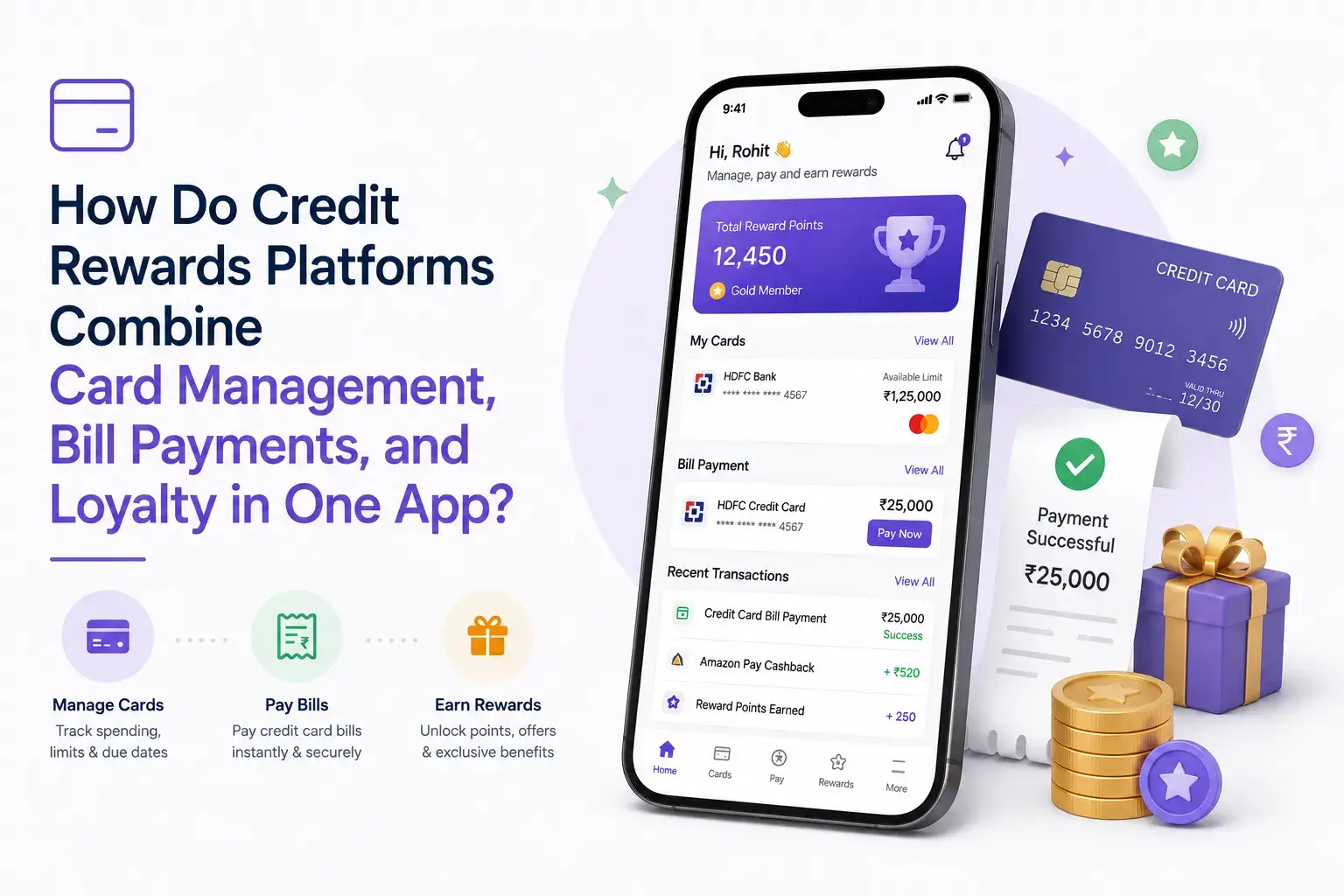
- A credit rewards platform combines credit card management, bill payments, rewards, offers, transaction tracking, and loyalty features within one digital app.
- Users can manage multiple cards, monitor due dates, make payments, track payment status, earn rewards, redeem benefits, and discover personalized offers from one account.
- The strongest platforms connect everyday financial activity with loyalty incentives, creating recurring engagement around card usage, bill payments, rewards, and redemption.
Card & Payment Signals
- Card management features can include multiple card profiles, due-date tracking, outstanding balances, spending summaries, payment reminders, and transaction history.
- Bill payment workflows connect payment gateways, banking integrations, payment confirmation, scheduled payments, failed-payment handling, refunds, and transaction records.
- Secure authentication, encryption, KYC workflows, fraud monitoring, payment reconciliation, notifications, and admin oversight support reliable fintech operations.
Loyalty Platform Insights
- Cashback, reward points, vouchers, partner offers, referral bonuses, membership benefits, and redemption options can turn routine bill payments into repeat engagement opportunities.
- Personalized rewards based on card usage, payment behavior, merchant categories, and user preferences can make loyalty programs more relevant and valuable.
- Miracuves develops customizable credit rewards platforms with card management, bill payments, loyalty programs, cashback, partner offers, referrals, payment integrations, analytics, security, and admin controls.
Credit rewards platforms are becoming one of the most interesting fintech product models because they turn a routine financial habit into a repeat engagement loop. Users already need to track credit cards, remember due dates, pay bills, check limits, monitor spending, and look for better rewards. A well-built platform brings all of that into one app instead of forcing users to jump between multiple banking apps.
For founders, the opportunity is not just in building another payment screen. The real opportunity is in combining card management, bill payment convenience, reward logic, loyalty partnerships, and financial visibility into one useful app experience.
That is why modern credit rewards platforms are designed as fintech engagement ecosystems. They help users manage their credit life more easily while giving platform operators multiple ways to build retention, partnerships, and monetization.
Miracuves helps founders plan and build fintech products around this type of connected workflow, especially when the goal is to launch a branded, scalable, source-code-owned app foundation without starting every module from zero.
What Is a Credit Rewards Platform?
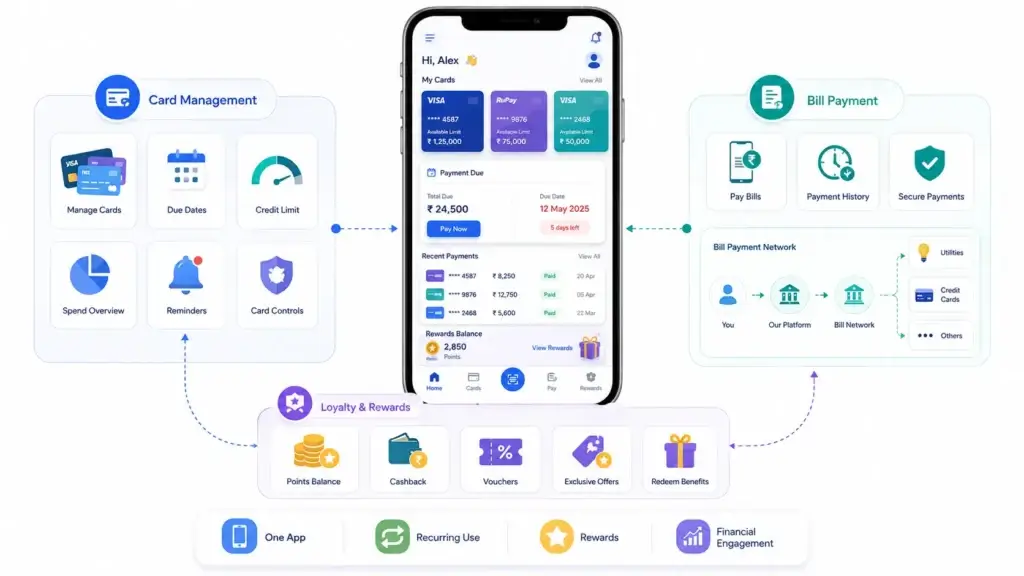
A credit rewards platform is a fintech app that helps users manage credit cards, pay bills, track due dates, view payment history, earn rewards, and redeem benefits through one interface.
The app usually connects three product layers.
The first layer is card management. Users can add or track multiple cards, see due dates, view outstanding balances, monitor available limits, and receive reminders.
The second layer is bill payment. Users can pay credit card bills, utility bills, or other supported payments from within the app. In India, credit card bill payments are often supported through bill payment infrastructure such as Bharat Bill Payment System, which RBI describes as a structured bill payment system with NPCI Bharat BillPay Limited as the central unit.
The third layer is loyalty and rewards. Users receive points, coins, cashback, vouchers, partner offers, or premium benefits for completing financial actions such as paying bills on time or using specific payment options.
When these three layers work together, the app becomes more than a payment tool. It becomes a recurring financial engagement product.
For readers comparing this model with normal banking apps, this guide on credit rewards platform vs traditional credit card app explains why rewards-led platforms offer more value beyond basic bill payments, card statements, and due-date tracking.
For readers who want to understand this model through a familiar fintech example, Miracuves’ guide on how a credit card rewards app works explains how bill payments, rewards, user engagement, and financial habits connect inside one app experience.
Why Card Management Is the First Layer of User Trust
Most credit card users do not struggle because they lack banking apps. They struggle because each bank app gives only a partial view. If a user has three, five, or ten cards, the friction grows quickly.
A credit rewards platform solves this by creating one dashboard for card-related visibility.
Users want to know:
- Which bill is due next?
- How much is outstanding?
- What is the available limit?
- Which card should be paid first?
- Which card has better rewards for upcoming spends?
- Which payment has already been completed?
This is why card management is the trust layer. Before users care about rewards, they need confidence that the app understands their credit situation accurately.
For founders, this means the dashboard cannot be treated as a simple UI screen. It should be designed as a financial control center. The clearer the card view, the more likely users are to return before every billing cycle.
How Bill Payments Turn the App Into a Monthly Habit
Bill payment is the utility layer of a credit rewards platform. It gives users a clear reason to open the app every month.
A strong bill payment flow usually includes bill fetch, amount confirmation, due-date reminders, payment initiation, transaction status updates, receipts, failed-payment handling, refund tracking, and payment history.
The best platforms reduce payment anxiety. They help users avoid missed deadlines, duplicate payments, late fees, and unnecessary confusion around whether a payment has been processed.
CRED’s 2026 multibill and autopay update is a useful market signal here. The company said users can pay multiple card bills in one flow or automate payments across issuing banks, which directly addresses the friction of tracking several cards and due dates.
For founders, the lesson is simple: bill payment is not just a feature. It is the recurring behavior that supports retention. Rewards may attract users, but reliable payments keep them coming back.
How Loyalty Converts Payment Utility Into Engagement
Payments solve a practical problem. Loyalty creates emotional and commercial stickiness.
A user may download the app to pay a bill, but they stay longer if the platform gives them visible value after the transaction. That value can appear as reward points, cashback, discount vouchers, partner benefits, premium memberships, referral bonuses, or personalized offers.
The loyalty layer usually works through a reward engine. This engine decides:
- Which user action earns rewards
- How many points are issued
- Whether rewards expire
- Which rewards can be redeemed
- Which partners are eligible
- Which campaigns apply to which user segment
- Whether rewards are fixed, tiered, seasonal, or behavior-based
This is where many fintech products become weak. They add rewards as a marketing feature instead of designing rewards as a business system.
A sustainable rewards platform must balance user motivation with business cost. If rewards are too weak, users lose interest. If rewards are too generous, the platform’s margins suffer. The strongest model gives users a reason to return without making every transaction financially expensive for the business.
The Three-Layer Product Model Behind Credit Rewards Platforms
| Layer | What It Does | Business Value | Founder Decision |
|---|---|---|---|
| Card Management | Tracks cards, limits, due dates, bills, and statements | Builds trust and daily visibility | Make the dashboard useful before adding too many offers |
| Bill Payments | Allows users to pay bills and view transaction status | Creates recurring monthly usage | Prioritize reliability, status updates, and reconciliation |
| Loyalty Rewards | Gives users points, cashback, vouchers, or partner benefits | Improves retention and monetization | Build configurable reward rules from the admin panel |
| Partner Offers | Connects brands, merchants, and financial products | Opens revenue channels | Start with relevant offers, not random discount clutter |
| Admin Control | Manages users, campaigns, disputes, payments, and reporting | Helps operate the business safely | Invest in backend controls from day one |
Why These Apps Work Better When the Layers Are Connected
A card dashboard without payments is useful but limited. A payment app without rewards is functional but easy to replace. A rewards app without financial utility can feel shallow.
The product becomes stronger when all three layers support each other.
A user checks the app because they want to track their cards. The app reminds them that a bill is due. The user pays the bill. The platform rewards the action. The reward brings the user back to explore offers, refer friends, or use additional financial services.
That loop is the core of a credit rewards platform.
The founder’s goal should be to design this loop intentionally. Every feature should answer one question: does this make the user more likely to trust the app, pay through the app, or return to the app?
Core Features a Credit Rewards Platform Should Include
A credit rewards platform should not start with every possible fintech feature. It should begin with the core workflows that make the app reliable and useful.
The user-side app should include secure registration, user verification, card addition, card dashboard, bill reminders, payment flow, transaction history, reward wallet, offer discovery, notifications, referral options, and support access.
The admin panel should include user management, reward rule management, campaign controls, partner offer management, transaction monitoring, failed-payment visibility, dispute tracking, reports, and role-based access.
The partner side, if included, can allow merchants or brands to submit offers, track redemptions, manage campaign budgets, and view performance.
If you want a deeper breakdown of product modules such as bill payments, reward wallets, card management, notifications, user flows, and admin controls, this guide on credit card bill payment app features explains the core feature structure founders should consider before planning development.
Miracuves’ finance and banking solution ecosystem already includes card, reward, bill payment, admin, KYC, and payment rail considerations for fintech founders planning a launch-ready app foundation. Founders who want to explore this structure in more detail can also review the <a href=”https://miracuves.com/cred-clone/features/”>CRED clone features</a> page for a closer look at how card management, bill payments, rewards, and loyalty modules can be organized.
Founder Decision Signals
Speed
If the goal is to test a rewards-driven fintech idea quickly, a ready-made foundation can reduce the time spent building basic card, payment, and admin workflows from scratch.
Cost
The largest cost drivers are usually payment integrations, reward engine complexity, security controls, transaction reconciliation, and custom analytics.
Scalability
Billing cycles can create transaction spikes, so the backend must handle payment callbacks, notifications, reward calculations, and reporting without slowing down.
Market Fit
The platform should solve a real user habit first. Rewards should amplify useful behavior, not hide a weak product experience.
The Role of Admin Control in Credit Rewards Platforms
The admin dashboard is one of the most important parts of a credit rewards platform because it controls the business logic behind the user experience.
Without strong admin control, the platform operator cannot easily adjust reward campaigns, pause risky offers, manage failed payments, resolve user disputes, monitor suspicious activity, or evaluate partner performance.
A good admin dashboard should help the business manage:
- Users and verification status
- Linked cards and account activity
- Payment transactions and statuses
- Rewards issued and redeemed
- Cashback or points liabilities
- Partner campaigns and offer rules
- Complaints, disputes, and refunds
- Notification campaigns
- Reports and analytics
- Role-based team access
For founders, this matters because fintech products cannot depend on developers for every small business change. If the marketing team wants to launch a festival reward campaign, the admin panel should support it. If the finance team needs a transaction report, they should be able to access it. If support needs to check a failed payment, the system should show the right status clearly.
Monetization Models for Credit Rewards Platforms
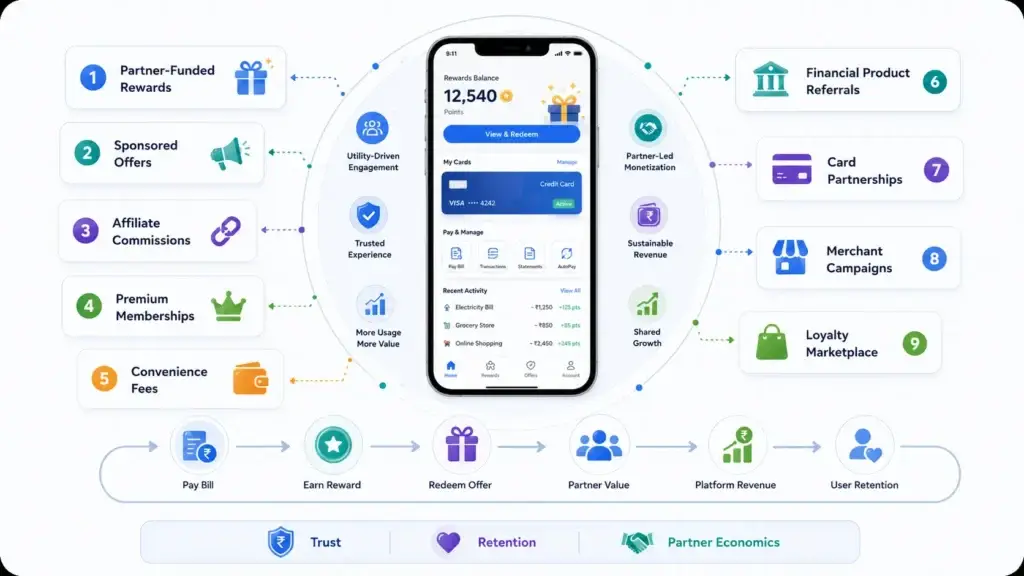
A credit rewards platform can make money through multiple channels, but the model should be planned carefully. The wrong revenue strategy can damage trust, especially in fintech.
Common monetization options include partner-funded rewards, sponsored offers, affiliate commissions, premium memberships, convenience fees where allowed, financial product referrals, card partnerships, merchant campaigns, and loyalty marketplace commissions.
The strongest platforms usually avoid depending on a single revenue stream. They combine utility-driven engagement with partner-led monetization.
For example, a user pays a credit card bill. The app rewards the transaction. The user then redeems a voucher from a partner brand. The partner receives traffic or conversion, the user receives value, and the platform earns through a commercial arrangement.
This is why the loyalty engine must be connected to the revenue model. Rewards should not be random. They should support retention, partner economics, and user trust at the same time.
For a deeper revenue-focused view, Miracuves’ guide on the credit rewards app business model explains how bill payments, partner offers, financial product referrals, loyalty campaigns, and user retention can connect into one monetization system.
Security and Compliance Considerations Founders Should Not Ignore
Credit rewards platforms handle sensitive financial activity, payment data, transaction history, and user behavior. Security should be treated as part of the product foundation, not as a later add-on.
Founders exploring broader fintech product planning can also browse Miracuves’ fintech app development insights to understand related models across payments, banking, investment, rewards, compliance workflows, and digital finance products.
Important layers include encrypted data transfer, encrypted storage, secure API integration, role-based access control, payment gateway security, audit logs, fraud monitoring, transaction monitoring, user verification, and admin activity logs.
For India-focused fintech products, founders should also understand the role of payment infrastructure, regulated payment participants, and bill payment rails. RBI’s BBPS direction explains the structured operating model around NPCI Bharat BillPay Limited, operating units, and agent networks.
The correct wording here is important. A platform can be built with a compliance-ready foundation and configured to support KYC, AML, transaction monitoring, and reporting workflows. Final compliance depends on jurisdiction, legal review, integrations, licenses, and the operating model.
Common Mistakes Founders Should Avoid
Building rewards before building utility
If users do not trust the card dashboard or payment flow, rewards will not fix the product. Start with accurate card visibility, reminders, payments, and transaction status clarity.
Making the reward system too expensive
Cashback and points can attract users, but unsustainable reward costs can weaken the business. Build configurable reward rules and partner-funded campaigns wherever possible.
Ignoring failed payment and dispute workflows
Payment confidence depends on clear status updates, receipts, refunds, and support visibility. A weak dispute process can damage trust quickly.
Treating the admin panel as optional
The admin dashboard controls reward campaigns, users, partners, payments, disputes, and reports. Without it, the platform becomes hard to operate at scale.
Ready-Made Foundation vs Custom Development
Founders usually have two practical routes.
A custom build offers maximum flexibility, but it requires more planning, design, development, testing, integrations, compliance preparation, and maintenance. This route makes sense when the business model is highly unique or when the platform needs unusual workflows from day one.
Founders planning budget and scope can review the credit rewards app development cost page to understand how features, integrations, reward logic, payment workflows, admin controls, and customization choices can influence the final development cost.
Miracuves supports founders with white-label and source-code-owned fintech solutions that can be adapted for credit bill payments, reward systems, card dashboards, loyalty logic, and admin operations. This helps reduce avoidable build risk while still giving room for customization.
Where Miracuves Fits Into This Product Model
A credit rewards platform should not blindly copy another fintech app. The smarter approach is to understand the proven behavior loop and then adapt it for a specific market, audience, and monetization model.
Miracuves can help founders plan the right foundation for:
- Credit card management workflows
- Bill payment journeys
- Reward wallet logic
- Partner offer systems
- Admin dashboards
- Transaction visibility
- User verification workflows
- Referral and loyalty campaigns
- Scalable backend architecture
- Source-code-owned product control
For founders exploring this space, Miracuves’ credit-card rewards and banking app solutions can provide a useful starting point for understanding how these modules fit together in a launch-ready fintech product. If you are evaluating a build partner, the credit rewards app development company page explains how Miracuves approaches planning, customization, admin control, and launch execution for credit rewards platforms.
Final Thoughts
Credit rewards platforms work because they connect a real user habit with a stronger product loop.
Card management gives users visibility. Bill payments give them monthly utility. Rewards and loyalty give them a reason to return, explore offers, and stay engaged. When these layers are supported by secure payment flows, configurable reward rules, partner campaigns, and strong admin controls, the platform becomes much more than a bill payment tool.
For founders, the main decision is not whether rewards should be added. The real decision is how rewards should support trust, retention, and monetization without weakening the business model.
Miracuves helps founders build ready-made and white-label fintech app solutions with source code, branded design, admin control, rewards workflows, and faster deployment. If you want to combine card management, bill payments, and loyalty in one app, explore the credit card rewards app solution to see how a launch-ready foundation can help you move faster without building every module from zero.
FAQs
What is a credit rewards platform?
A credit rewards platform is a fintech app that helps users manage credit cards, pay bills, track due dates, earn rewards, and redeem offers from one interface.
How do credit rewards platforms combine card management and bill payments?
They bring multiple credit cards into one dashboard, show due dates and outstanding balances, send reminders, and allow users to pay supported bills through integrated payment flows.
Why do credit rewards apps include loyalty programs?
Loyalty programs encourage users to return after completing routine financial actions. Rewards, cashback, vouchers, and partner offers help turn bill payments into a repeat engagement loop.
What features should a credit card rewards app include?
A strong app should include secure login, card dashboard, bill reminders, payment flow, transaction history, reward wallet, partner offers, referral system, support workflows, and an admin dashboard.
How do credit rewards platforms make money?
Common revenue models include partner-funded offers, affiliate commissions, sponsored campaigns, premium memberships, financial product referrals, convenience fees where allowed, and loyalty marketplace commissions.
Is security important in credit rewards app development?
Yes. These platforms handle sensitive financial and transaction data, so they need encrypted data handling, secure APIs, payment gateway security, role-based admin access, audit logs, and transaction monitoring.
Should founders build a credit rewards platform from scratch?
Custom development is useful for highly unique workflows. A ready-made foundation can be a faster and more cost-efficient route when the core model includes card management, bill payments, rewards, and admin controls.
Can Miracuves help build a credit rewards platform?
Yes. Miracuves can help founders build a white-label, source-code-owned fintech app foundation with card management, bill payment workflows, loyalty logic, rewards, partner offers, and admin control.
Miracuves is an independent software development company. We are not affiliated with, connected to, sponsored by, or endorsed by any company or product named in this article.
Terms such as “X Clone” are used descriptively. It is how the software industry refers to building a platform with functionality comparable to a known service, and how clients search for it.
The entire design and codebase of our products is built by our own team. Our products contain no code, design, graphics, or content originating from any third-party website or applications.
All third-party names and marks referenced in this article are the property of their respective owners, referenced solely to identify the services discussed.