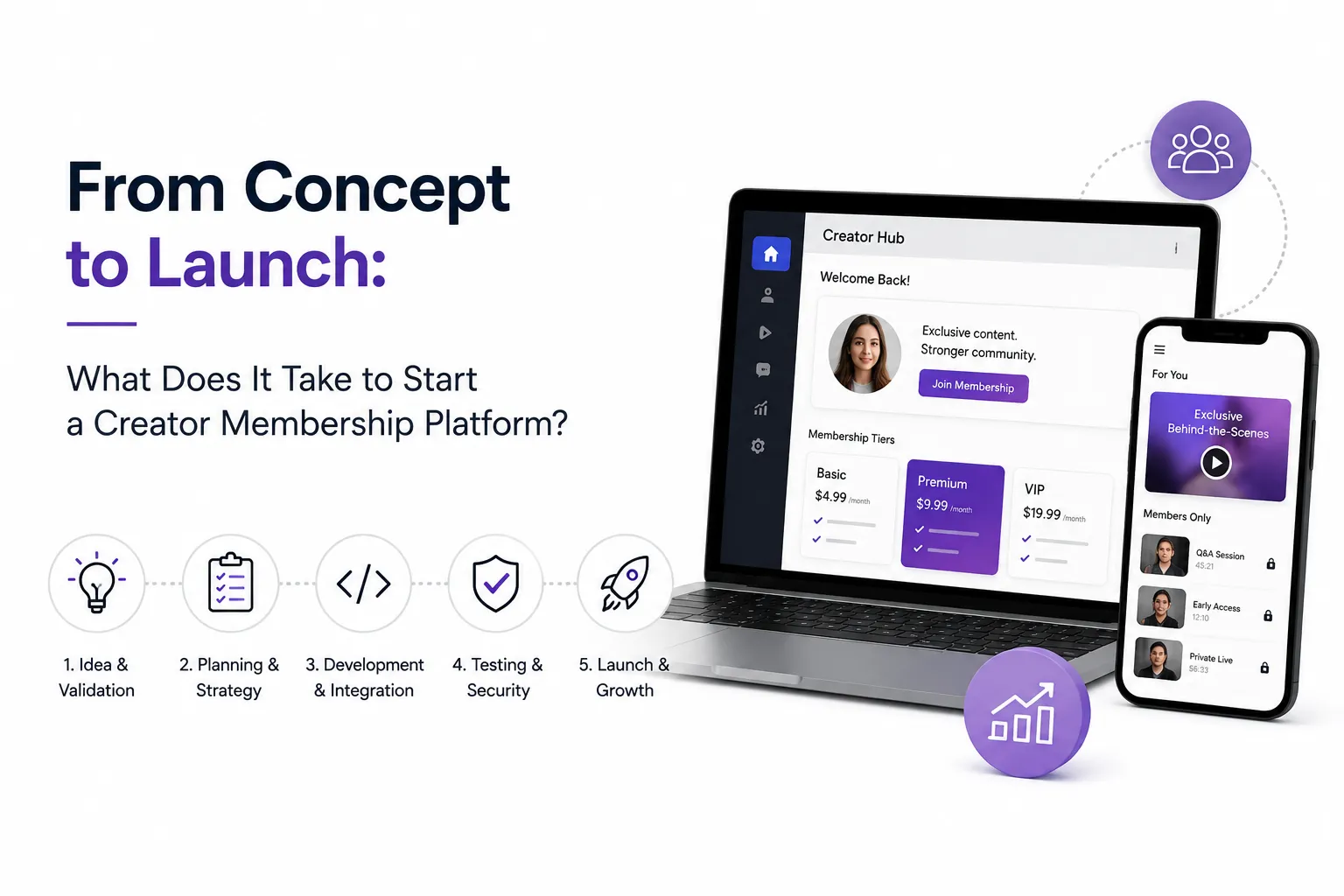
Key Takeaways
- Launching a creator membership platform begins with a clearly defined audience, creator category, and monetization model.
- Essential workflows include creator onboarding, membership tiers, gated content, payments, payouts, messaging, and administration.
- Trust and safety require creator verification, content moderation, reporting, blocking, privacy controls, and secure access.
- The platform should be tested with complete creator, fan, payment, payout, refund, and moderation journeys.
- A successful launch depends on operational readiness—not only an attractive interface or extensive feature list.
Launch Planning Signals
- Define whether creators will earn through subscriptions, paid posts, tips, bundles, messaging, or multiple revenue streams.
- Plan creator commissions, transaction fees, payout schedules, refunds, disputes, and financial reporting.
- Confirm support for creator dashboards, fan accounts, membership access rules, media publishing, and notifications.
- Review admin controls for users, creators, content, commissions, payouts, reports, permissions, and platform settings.
- Prepare platform policies, customer support, creator acquisition, content supply, analytics, and post-launch improvement plans.
Real Insights
- A creator platform needs more than profiles, content uploads, and a payment gateway to operate reliably.
- Adding too many monetization features before validating creator and fan demand can increase unnecessary complexity.
- Creator supply should be developed before launch because an empty platform provides little value to early users.
- Incomplete payout, moderation, and dispute workflows can create greater launch risk than missing secondary features.
- Miracuves develops customizable creator membership platforms with source-code ownership, white-label branding, monetization tools, safety workflows, and admin control.
The creator economy has moved beyond simple social media following. Today, creators want direct relationships with their audience, predictable income, paid communities, exclusive content access, private messaging, and better control over how their work is monetized.
That shift has created a strong opportunity for founders who want to launch a creator membership platform.
But building this kind of platform is not just about adding user profiles and a subscription button. A successful creator membership business needs a clear niche, creator onboarding strategy, payment and payout workflows, content access controls, moderation systems, subscription management, fan engagement tools, and admin-level visibility.
For founders, the real question is not only “How do I build the app?” The better question is:
What does it take to launch a creator membership platform that creators trust, fans enjoy, and the business can operate sustainably?
This guide breaks down the full journey from concept to launch, including planning, features, monetization, safety, development options, and founder decision signals.
What Is a Creator Membership Platform?
A creator membership platform is a digital product where creators can offer exclusive access to content, communities, messages, livestreams, digital products, or premium experiences in exchange for recurring payments or one-time purchases.
Unlike a normal social media app, the platform is designed around monetization and fan relationships.
Creators may use it to offer:
- Monthly subscription tiers
- Locked photos, videos, posts, or audio
- Private fan communities
- Pay-per-view content
- Paid direct messages
- Tips and donations
- Premium livestreams
- Digital downloads
- Creator bundles or limited access offers
For fans, the value is access. For creators, the value is monetization. For the platform operator, the value is building a marketplace where creators bring supply, fans create demand, and the platform earns through commissions, fees, subscriptions, or premium tools.
This is why the platform must be planned as a business ecosystem, not just an app interface.
Why Founders Are Exploring Creator Membership Platforms Now
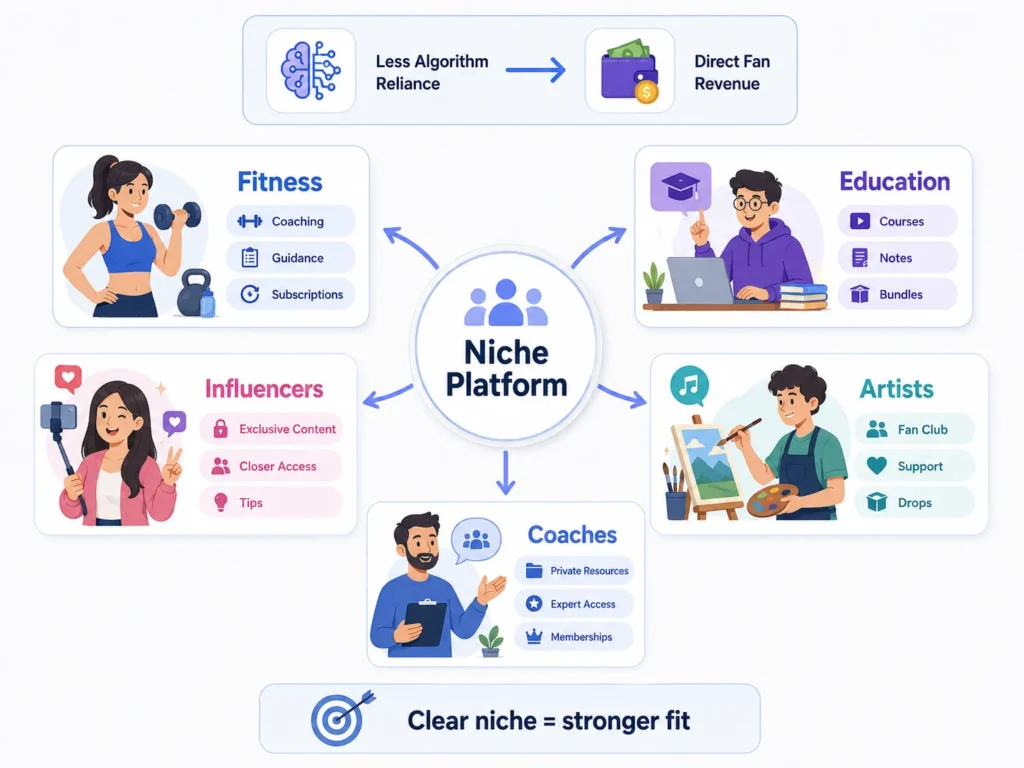
Image Source: AI-generated visual by Miracuves
Creators increasingly want alternatives to relying only on social media algorithms, ad revenue, or brand sponsorships. A membership model gives them a more direct way to earn from loyal audiences.
For founders, this creates an opportunity to build niche membership communities around specific creator categories such as fitness, coaching, music, gaming, education, lifestyle, regional influencers, fan clubs, artists, models, wellness experts, or premium communities.
The strongest opportunity usually comes from narrowing the platform’s positioning.
A broad “creator platform for everyone” may sound attractive, but it becomes harder to market, moderate, and differentiate. A focused platform can speak clearly to one creator segment and build a better product experience around that segment’s needs.
For example:
| Platform Focus | Creator Need | Fan Motivation | Business Opportunity |
|---|---|---|---|
| Fitness creators | Paid workout plans, progress content, private coaching | Accountability and premium guidance | Subscriptions, challenges, paid consultations |
| Educators | Courses, notes, livestreams, community access | Skill development | Course bundles, memberships, digital products |
| Influencers | Exclusive updates, behind-the-scenes content, fan interaction | Closer creator access | Subscriptions, tips, paid messages |
| Artists and performers | Premium media, early releases, fan clubs | Supporting creative work | Memberships, drops, community perks |
| Coaches and consultants | Private content, group sessions, member-only resources | Expert access | Paid communities, recurring memberships |
The business becomes stronger when the niche, monetization model, and feature set are aligned from the beginning.
Step 1: Define the Platform Concept Before Choosing Features
Many founders start by listing features. That is usually the wrong starting point.
Before deciding screens, tech stack, or development cost, define the platform concept clearly.
Ask:
- Who are the creators?
- Who are the paying members?
- What type of content or access will be sold?
- Why would creators join instead of using existing tools?
- Why would fans pay repeatedly?
- What level of moderation is required?
- Will the platform support safe-for-work, adult-permitted, education, fitness, entertainment, or mixed creator categories?
- Will the business earn from commission, subscriptions, platform fees, or premium tools?
This concept decides the product architecture.
A fitness membership platform may need program bundles, progress tracking, video libraries, and coaching sessions. A fan community platform may need tiered subscriptions, paid messages, tips, and content vaults. An education creator platform may need course modules, downloadable files, quizzes, and live sessions.
The better the concept, the easier it becomes to avoid unnecessary features.
Step 2: Validate Creator Supply and Fan Demand
A creator membership platform is a two-sided ecosystem. You need creators who are willing to publish exclusive content and fans who are willing to pay for access.
Before full development, founders should validate both sides.
Creator validation should answer:
- Are creators already monetizing their audience elsewhere?
- Do they have enough loyal followers to drive subscriptions?
- What tools are they currently missing?
- What payout terms would make them join?
- What content formats do they need?
- What platform policies matter to them?
Fan validation should answer:
- What would fans pay for?
- Do they prefer monthly memberships or one-time purchases?
- Are paid messages, tips, or premium videos relevant?
- What trust signals do they need before subscribing?
- What payment methods are preferred in the target market?
A founder does not need thousands of creators before launch. A focused group of early creators can be more useful than a broad but inactive marketplace. The early platform should prove that creators can publish, fans can pay, and the admin can manage operations without friction.
Step 3: Choose the Right Monetization Model
The monetization model shapes almost every product decision. A creator membership platform can earn revenue in several ways.
| Revenue Model | How It Works | Best For | Founder Consideration |
| Platform commission | The platform takes a percentage from creator earnings | Marketplaces with many creators | Requires transparent payout logic |
| Monthly subscriptions | Fans pay creators or the platform for access | Premium communities and content libraries | Needs retention-focused features |
| Pay-per-view content | Fans pay to unlock specific content | Premium videos, images, drops, or exclusive posts | Requires strong content access control |
| Paid messaging | Fans pay for private interaction | Influencer, coaching, and fan engagement platforms | Needs abuse reporting and message moderation |
| Tips and donations | Fans send voluntary payments | Creator support communities | Works well as an additional revenue layer |
| Featured creator placements | Creators pay or qualify for visibility boosts | Platforms with discovery feeds | Requires fair ranking and admin control |
| Premium creator tools | Creators pay for analytics, promotions, or advanced controls | Mature creator ecosystems | Better after initial traction |
The right monetization model depends on the niche. A coaching platform may rely on memberships and paid sessions. A fan community app may rely on subscriptions, tips, and paid messages. A digital content platform may rely heavily on locked content and PPV access.
Founders should avoid adding every revenue stream too early. Start with the monetization flows that match creator behavior and fan intent.
Step 4: Plan the Core Platform Modules
A creator membership platform usually needs four major user layers: fan, creator, admin, and payment operations.
Each layer has a different job.
Fan Side Features
Fans need a simple way to discover creators, view profiles, subscribe, unlock content, message creators, manage payments, and track their purchases.
Important fan features include:
- Signup and login
- Creator discovery
- Search and category filters
- Creator profiles
- Follow and subscribe options
- Subscription tier selection
- Locked content access
- Pay-per-view purchase flow
- Wallet or payment history
- Direct messaging
- Notifications
- Report or block options
- Account and privacy settings
The fan experience should reduce confusion. If users do not understand what they get after subscribing, conversion drops.
Creator Side Features
Creators need tools to publish, price, manage, and grow.
Important creator features include:
- Creator onboarding
- Profile setup
- Content upload
- Subscription tier creation
- Locked post publishing
- PPV content setup
- Paid message options
- Earnings dashboard
- Fan management
- Promotional offers
- Payout request tracking
- Analytics and engagement insights
- Verification status
- Content policy guidance
Creators will judge the platform by how easily they can earn and manage their audience. A beautiful design is not enough if uploads, pricing, payouts, or fan communication feel difficult.
Admin Dashboard Features
The admin dashboard is the control center of the business.
Important admin features include:
- User and creator management
- Creator approval workflows
- Content review queues
- Subscription and transaction monitoring
- Commission settings
- Payout management
- Report and abuse handling
- Category and tag management
- Featured creator controls
- Platform analytics
- Refund and dispute support
- Role-based admin access
- Notification management
- Policy and moderation settings
For founders, the admin layer matters because it determines how much control the platform operator has after launch. Without a strong admin dashboard, even small operational tasks become developer-dependent.
Core Features and Business Value
| Feature | Business Value | Founder Impact |
|---|---|---|
| Subscription tiers | Allows creators to price access at different levels | Improves monetization flexibility and fan segmentation |
| Locked content | Protects premium content behind paid access | Creates clear value for paying members |
| Paid messaging | Enables direct creator-fan monetization | Adds an engagement-driven revenue stream |
| Wallet and payout tracking | Creates transparency around earnings and withdrawals | Builds creator trust and reduces support issues |
| Moderation workflows | Helps manage reports, abuse, and policy violations | Protects platform reputation and operational stability |
| Admin analytics | Shows user, creator, revenue, and content activity | Helps founders make better growth decisions |
Step 5: Build Trust, Safety, and Moderation Into the Foundation
Creator platforms need trust from both creators and fans. This is especially important when users upload media, exchange private messages, make payments, or access restricted content.
Safety should not be treated as a future add-on. It should be part of the platform foundation.
Important trust and safety layers include:
- Creator verification
- User reporting
- Content moderation queues
- Admin review workflows
- Age-gating where relevant
- Abuse reporting
- Comment and message controls
- Payout monitoring
- Copyright or takedown request workflows
- Role-based admin permissions
- Activity logs
- Secure payment gateway integration
- Privacy-conscious data handling
The exact compliance requirements depend on the target market, content category, legal review, payment partners, and operating model. Founders should avoid making compliance assumptions without professional guidance.
A practical platform foundation should support the workflows needed for safe operations, while leaving room to configure policies for the business model and jurisdiction.
Step 6: Decide Between Custom Development and a Ready-Made Foundation
Once the concept, audience, features, and monetization model are clear, the founder must choose how to build.
There are usually three routes:
| Build Route | Best For | Advantages | Trade-Offs |
| Full custom development | Highly unique platform models with complex workflows | Maximum flexibility and original architecture | Higher cost, longer timeline, more execution risk |
| SaaS membership tools | Individual creators or very small communities | Fast setup and low technical responsibility | Limited ownership, limited customization, platform dependency |
| Ready-made white-label foundation | Founders launching a branded creator monetization business | Faster launch, existing modules, admin control, customization path | Needs careful vendor evaluation and scope clarity |
For many founders, a ready-made foundation is attractive because the core workflows already exist. This can reduce the time spent building common modules such as subscriptions, creator profiles, payment flows, content access, messaging, and admin management.
Miracuves supports this route with a ready-made creator subscription solution that can be customized around branding, platform policies, creator categories, and monetization needs. The benefit is not copying another platform. The benefit is starting from a working product foundation and shaping it for a specific market.
Learn more about Miracuves’ ready-made creator subscription solution for founders who want a faster route from idea to launch.
Founder Decision Signals
Speed
If your goal is to validate creator demand quickly, a ready-made foundation may help you launch faster than building every module from zero.
Cost
Pricing depends on features, integrations, platform scope, customization, and launch requirements. Avoid judging the build only by the lowest upfront quote.
Scalability
Scalability depends on media storage, payment reliability, backend structure, moderation workflows, and admin control—not just frontend design.
Market Fit
A focused creator niche can make onboarding, positioning, monetization, and moderation easier during the first launch phase.
Step 7: Prepare the Launch Roadmap
A creator membership platform launch should be structured in phases. Trying to launch with every possible feature can delay validation and increase risk.
A practical launch roadmap may look like this:
Phase 1: Concept and Niche Validation
Define the creator category, audience, platform rules, monetization model, and launch market. Speak with creators before finalizing the feature list.
Phase 2: Product Scope and Feature Prioritization
Separate must-have launch features from future enhancements. For the first version, prioritize signup, profiles, subscriptions, locked content, payments, payouts, messaging, moderation, and admin control.
Phase 3: Branding and Platform Setup
Prepare the platform name, visual identity, content policies, creator onboarding documents, support flows, commission logic, and payment gateway requirements.
Phase 4: Creator Onboarding
Recruit early creators before public launch. Help them set up profiles, pricing, content, and launch promotions.
Phase 5: Soft Launch
Test the product with a controlled group of users. Watch for payment issues, upload friction, subscription confusion, support tickets, and moderation gaps.
Phase 6: Public Launch and Growth
Start acquisition through creator-led promotions, referral campaigns, influencer partnerships, paid ads, SEO, social content, and community marketing.
Phase 7: Post-Launch Optimization
Use analytics to improve creator discovery, subscription conversion, retention, payout workflows, and content engagement.
The strongest launches are not just technical launches. They are operational launches.
Step 8: Create a Creator Onboarding Strategy
Creators are the supply side of the platform. Without creators, fans have no reason to subscribe.
A creator onboarding strategy should cover:
- Who qualifies as a creator
- How creators apply or sign up
- Whether verification is required
- What content categories are allowed
- How subscription pricing works
- How payouts are processed
- What promotion support creators receive
- What platform commission applies
- How disputes and reports are handled
Founders should also create creator education material. Many creators know how to post on social media, but not all know how to structure paid memberships.
Useful onboarding resources include:
- Pricing guide
- Content planning guide
- Membership tier examples
- Fan engagement tips
- Payout explanation
- Platform policy summary
- Launch checklist for creators
A creator membership business grows faster when creators understand how to earn, retain subscribers, and promote their page.
Step 9: Plan Fan Acquisition and Retention
Fans do not automatically arrive because the platform exists. The founder needs a clear acquisition and retention plan.
Fan acquisition can come from:
- Creator-led audience migration
- Influencer partnerships
- SEO landing pages
- Social media campaigns
- Referral rewards
- Paid advertising
- Community partnerships
- Email and notification campaigns
- Featured creator campaigns
Retention depends on the ongoing value fans receive after paying.
Retention features may include:
- New content alerts
- Renewal reminders
- Personalized recommendations
- Creator updates
- Member-only offers
- Exclusive drops
- Private communities
- Loyalty rewards
- Bundled subscriptions
For a membership product, the first payment matters, but renewals matter more. Founders should track churn, content frequency, fan engagement, creator response time, and refund reasons from the beginning.
Step 10: Understand What Affects Development Cost
The cost of building a creator membership platform depends on the product scope. Founders should be careful with fixed assumptions because pricing changes based on modules, integrations, platform type, and customization depth.
Key cost factors include:
- Android, iOS, web, or all platforms
- Creator dashboard complexity
- Fan app features
- Admin dashboard depth
- Payment gateway integrations
- Wallet and payout logic
- Subscription management
- Media upload and storage needs
- Video processing or streaming requirements
- Content moderation workflows
- Verification requirements
- Analytics and reporting
- UI/UX customization
- Source-code ownership
- Post-launch support
A ready-made white-label platform can be more cost-efficient when the founder needs common creator monetization workflows. Custom development may be better when the product requires unusual architecture, advanced AI tools, complex creator discovery logic, or a highly differentiated business model.
Miracuves can help founders evaluate whether a white-label creator monetization platform or custom development path makes more sense based on the launch scope.
Mistakes Founders Should Avoid
Starting with too broad a creator category
A platform for every type of creator is harder to position, market, moderate, and scale. A focused niche usually gives the first launch stronger clarity.
Ignoring payout and payment complexity
Creator trust depends heavily on accurate earnings, clear commissions, refund handling, payment reliability, and payout transparency.
Treating moderation as a future task
Reports, takedowns, creator verification, admin review queues, and abuse controls should be planned before launch, not after problems appear.
Choosing software only by price
The lowest quote can become expensive if the product lacks source-code access, customization flexibility, security workflows, admin control, or support.
What Makes a Creator Membership Platform Launch-Ready?
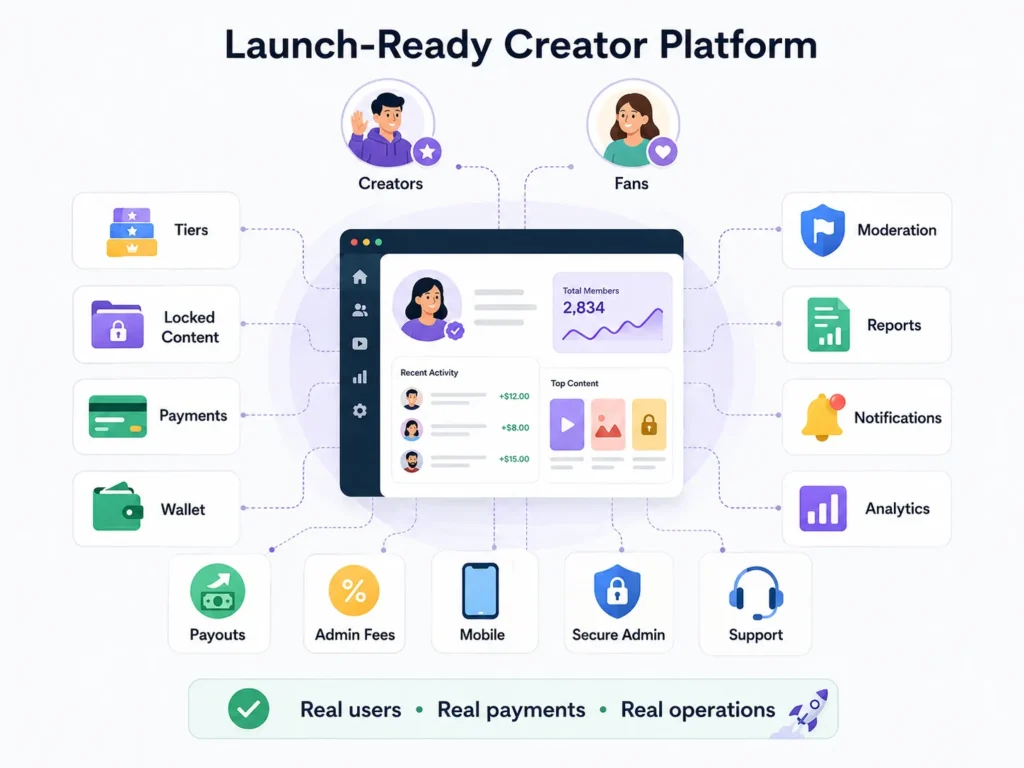
Image Source: AI-generated visual by Miracuves
A platform is launch-ready when it can support real users, real creators, real payments, and real admin operations.
Before launch, check whether the platform supports:
- Creator signup and verification
- Fan registration and account management
- Subscription tier setup
- Locked content publishing
- Paid content access
- Payment processing
- Wallet or transaction history
- Creator payout workflows
- Admin commission settings
- Content reports and review queues
- User blocking and abuse reports
- Notifications
- Platform policy pages
- Basic analytics
- Mobile responsiveness or mobile apps
- Secure admin access
- Support and dispute workflows
A product that looks good in a demo may still fail operationally if these workflows are incomplete.
This is where Miracuves’ ready-made app approach can help founders reduce early execution risk. Instead of starting with a blank development cycle, founders can begin with an existing product foundation and customize the experience around their creator category, business model, and brand.
When Should You Use a Ready-Made Creator Platform Foundation?
A ready-made foundation is usually a strong fit when:
- You want to launch faster
- You need common creator monetization features
- You want a branded platform under your own name
- You need admin control from day one
- You want source-code access for future flexibility
- You want to validate demand before investing in a long custom build
- Your platform model is similar to existing creator subscription patterns
- You need subscriptions, paid content, tips, messaging, and payouts as core workflows
It may not be the right fit if your idea requires completely new technology, complex AI-driven personalization, advanced marketplace ranking, unusual media infrastructure, or enterprise-grade custom workflows from day one.
The best decision depends on the gap between what the ready-made foundation already includes and what your business model uniquely requires.
Explore Miracuves’ launch-ready creator platform foundation if your goal is to start with existing monetization, creator, fan, and admin workflows.
Final Thoughts: Build the Business Model Before You Build Every Feature
Starting a creator membership platform is not only a development project. It is a business model decision.
Founders need to define the creator niche, fan value proposition, monetization structure, trust workflows, payment operations, moderation policy, and launch plan before scaling features. The platform must help creators earn, help fans access value, and help the operator manage the ecosystem with control.
A strong launch does not come from copying another app screen by screen. It comes from understanding why creator membership businesses work, choosing the right foundation, and customizing the platform around a clear market opportunity.
For founders who want to move faster, Miracuves offers a practical path through ready-made, white-label, source-code-owned creator platform solutions that can be shaped around the business model, branding, and launch strategy.
FAQs
What is a creator membership platform?
A creator membership platform is an app or website where creators can offer paid access to exclusive content, communities, direct messages, livestreams, digital products, or premium fan experiences. It usually includes subscriptions, locked content, payment processing, creator dashboards, fan accounts, and admin controls.
How do creator membership platforms make money?
They can earn through platform commissions, monthly subscriptions, pay-per-view content, paid messages, tips, featured creator placements, premium creator tools, or transaction fees. The best model depends on the creator niche and fan behavior.
What features are needed to launch a creator subscription platform?
Core features include creator profiles, fan accounts, subscription tiers, locked content, payment gateway integration, payout workflows, messaging, notifications, reporting, content moderation, analytics, and an admin dashboard.
Is a ready-made platform better than custom development?
A ready-made platform is better when founders want faster launch, lower early development risk, and existing creator monetization workflows. Custom development is better when the business model requires highly unique product logic or advanced architecture.
How do I choose a niche for a creator membership app?
Choose a niche based on creator demand, fan willingness to pay, monetization potential, content frequency, moderation needs, and market differentiation. Fitness, education, entertainment, coaching, influencers, artists, and premium communities are common examples.
What should founders check before launching a paid creator community?
Founders should check creator onboarding, payment reliability, subscription management, payout workflows, content access control, moderation policies, reporting tools, refund handling, admin permissions, and support processes.
Can a creator membership platform support different content categories?
Yes. A creator membership platform can be configured for different categories such as fitness, education, lifestyle, coaching, entertainment, music, art, fan clubs, or other premium communities. The platform rules, moderation workflows, and monetization model should match the chosen category.
Why is admin control important in a creator monetization platform?
Admin control helps the platform operator manage users, creators, content, payments, commissions, disputes, reports, categories, featured placements, and policy enforcement. Without strong admin tools, daily operations become harder to manage as the platform grows.
Miracuves is an independent software development company. We are not affiliated with, connected to, sponsored by, or endorsed by any company or product named in this article.
Terms such as “X Clone” are used descriptively. It is how the software industry refers to building a platform with functionality comparable to a known service, and how clients search for it.
The entire design and codebase of our products is built by our own team. Our products contain no code, design, graphics, or content originating from any third-party website or applications.
All third-party names and marks referenced in this article are the property of their respective owners, referenced solely to identify the services discussed.