


Key Takeaways
- An on-demand food delivery platform revenue model can combine restaurant commissions, delivery fees, service charges, subscriptions, promoted listings, advertising, and other transaction-based income streams.
- Each revenue source serves a different part of the marketplace: commissions monetize restaurant orders, delivery fees support fulfillment, subscriptions encourage repeat usage, and promotions monetize visibility.
- A sustainable model should balance platform revenue with restaurant margins, rider economics, customer affordability, order frequency, and long-term marketplace retention.
Revenue Model Signals
- Restaurant commissions can use percentage-based rates, fixed fees, tiered plans, category-specific pricing, or different structures depending on whether the platform handles delivery.
- Delivery and service fees may vary according to order value, distance, delivery zone, demand, time, rider availability, logistics cost, and customer membership status.
- Subscription plans can offer customers reduced delivery charges or exclusive benefits, while restaurant subscriptions may bundle lower commissions, analytics, marketing tools, or premium placement.
Monetization & Unit Economics Insights
- Promoted listings, sponsored restaurant placements, targeted offers, in-app advertising, campaign tools, and featured deals can create additional revenue beyond the core order transaction.
- Operators should monitor commission revenue, delivery margin, subscription conversion, promotional spend, average order value, order frequency, customer retention, rider cost, and contribution margin per order.
- Miracuves develops customizable food delivery platforms with commission management, delivery fees, subscriptions, promotions, restaurant tools, payments, payouts, analytics, and admin controls.
Food delivery platforms do not make money from one revenue stream alone. A sustainable on-demand delivery business usually combines merchant commissions, customer-paid delivery fees, subscription plans, sponsored placements, service charges, and operational controls that protect margin at the order level.
That is why understanding the Talabat revenue model is useful for founders. It shows that a food delivery marketplace is not just an ordering app. It is a commercial system where restaurants, customers, delivery partners, and the platform operator all interact inside the same transaction.
Before studying the revenue layer, founders should understand how a food delivery marketplace works across customers, restaurants, delivery partners, and the admin system. Once the operating flow is clear, it becomes easier to see where commissions, delivery fees, subscriptions, and promotions fit into the business model.
For a founder, the real question is not only “how does a food delivery platform earn?” The better question is: which revenue lines should be activated first, which ones depend on market maturity, and which ones can damage adoption if introduced too early?
This guide breaks down the core revenue streams behind modern on-demand food delivery platforms and explains how founders can think about commissions, delivery fees, subscriptions, and promotions before launching or scaling their own delivery marketplace.
Why Food Delivery Revenue Is More Than a Commission Percentage
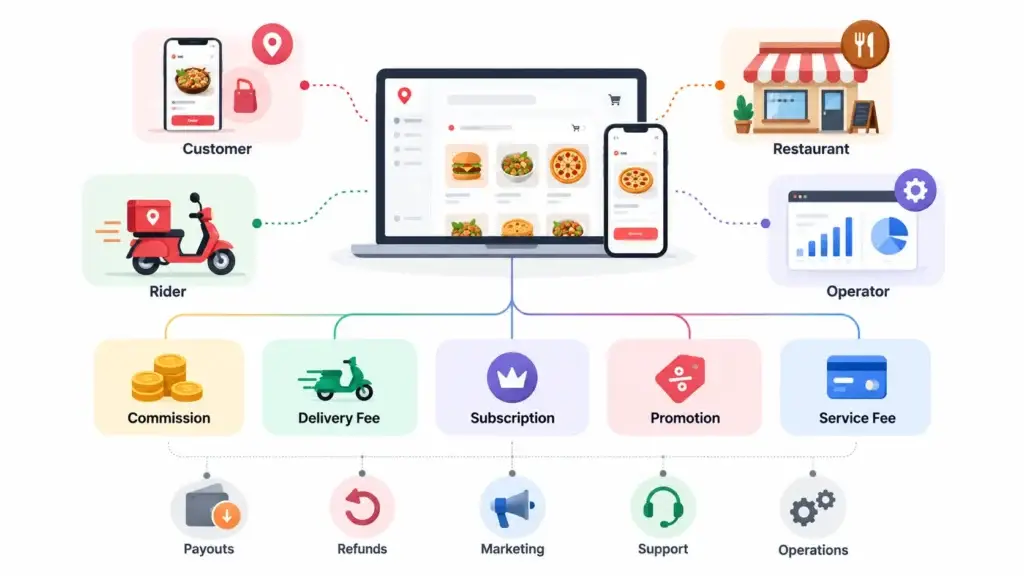
Many founders start by asking what commission rate a food delivery platform should charge. That is useful, but incomplete.
A commission only explains what the platform earns from the restaurant side. It does not explain delivery cost, customer willingness to pay, refund risk, promotional spend, payment delays, or restaurant retention. A platform can charge a reasonable commission and still struggle if delivery fees are underpriced, promotions are uncontrolled, or payout logic is not tracked correctly.
A food delivery marketplace has to balance four sides at once:
Customers want fast delivery, fair prices, easy checkout, offers, and reliability.
Restaurants want order volume, fair commission terms, predictable payouts, and control over menus.
Delivery partners need clear assignment logic, earnings visibility, distance-based workflows, and settlement clarity.
The platform operator needs enough margin per order to cover technology, support, delivery operations, refunds, marketing, and future growth.
This is why the strongest food delivery revenue model is layered. Each revenue stream plays a different role. Commission monetizes supply. Delivery fees support fulfilment. Subscriptions increase repeat usage. Promotions create visibility and paid growth opportunities. Service charges and small order fees help recover operational costs that may not be visible to the customer.
Core Revenue Stream 1: Restaurant Commissions
Restaurant commission is the most common and easiest-to-understand revenue stream in a food delivery marketplace.
The platform charges restaurants a percentage of each completed order. The logic is simple: the restaurant receives demand from the platform, and the platform earns a share for generating, processing, and supporting that order.
Commission can be structured in several ways:
| Commission Type | How It Works | Best For |
|---|---|---|
| Fixed commission | Same percentage for every restaurant | Simple early-stage operations |
| Category-based commission | Different rates by cuisine, category, or fulfilment type | Platforms with varied merchant types |
| Volume-based commission | Lower or higher rates based on order volume | Mature restaurant networks |
| Negotiated commission | Custom rates for strategic restaurants | Enterprise restaurants or anchor brands |
| Hybrid commission | Lower commission plus monthly plan or promotion spend | Restaurants that prefer predictable costs |
Commission is usually the first revenue stream a new platform should activate because it is directly linked to transactions. If no orders happen, no commission is charged. That makes it easier for restaurants to accept during early onboarding.
However, commission can become a source of friction if it is too high before the platform proves demand. Restaurants may join quickly, but they may stop giving priority to the platform if margins feel weak. A founder should treat commission as a balance between monetization and restaurant retention.
Founder Insight: Commission Should Not Be the Only Profit Lever
A platform that depends only on commission will eventually face pressure from restaurants asking for lower rates. A stronger model uses commission as the base layer and adds other monetization lines carefully as demand grows.
That is where delivery margin, merchant subscriptions, sponsored placements, customer memberships, and operational charges become important.
Core Revenue Stream 2: Delivery Fees and Delivery Fee Margin
Delivery fees are paid by customers, but the platform does not automatically keep the full amount.
The real revenue question is not “what delivery fee is charged?” The better question is: what margin remains after delivery cost is covered?
For example, if the customer pays a delivery fee but the actual delivery partner payout, distance cost, incentive, or operational expense is higher, the platform may lose money on the delivery side even while appearing to earn revenue.
Delivery fee margin depends on:
- Distance between restaurant and customer
- Rider availability
- Order density in the area
- Batch delivery possibilities
- Fuel or mobility cost
- Time of day
- Weather or demand pressure
- Free delivery offers
- Minimum order value
- Customer willingness to pay
A delivery fee can be flat, distance-based, zone-based, dynamic, or partially subsidized. The right approach depends on the market.
Flat Delivery Fee
A flat delivery fee is easy for customers to understand. It works well in compact delivery zones where fulfilment cost does not vary too much.
The risk is that the same flat fee may be profitable for short-distance orders and unprofitable for longer-distance ones.
Distance-Based Delivery Fee
A distance-based fee is more accurate because the customer pays more when the delivery cost is higher. This protects margin, especially in markets with wide coverage areas.
The risk is that customers may abandon checkout if the fee feels unpredictable.
Zone-Based Delivery Fee
A zone-based model gives the platform more control. Each zone can have its own delivery fee, minimum order amount, operating rules, and cash-handling logic.
This is especially useful for multi-market or multi-city food delivery businesses because one city may support higher delivery fees while another may need lower fees to build adoption.
Free Delivery and Subsidized Delivery
Free delivery can increase order conversion, but it is not free for the business. Someone pays for it: the platform, the restaurant, a sponsor, or a subscription program.
Founders should avoid treating free delivery as a permanent growth tactic unless there is a clear recovery path through membership, higher basket size, restaurant funding, or repeat order frequency.
Core Revenue Stream 3: Customer Subscriptions and Membership Plans
Subscription plans can turn occasional customers into recurring users.
A typical customer membership may offer:
- Free or reduced delivery
- Member-only discounts
- Priority support
- Exclusive restaurant offers
- Reduced service fees
- Special pricing during selected hours
- Loyalty points or wallet benefits
Subscriptions work best when customers already order frequently. If order frequency is low, the subscription may not feel valuable enough to renew.
The economics must be tested carefully. A subscription that waives delivery fees can attract the heaviest users, which means the platform may give away margin to the customers who cost the most to serve. This does not mean subscriptions are bad. It means they must be priced against real ordering behavior.
When Customer Subscriptions Make Sense
Customer subscriptions work better when:
- Customers order multiple times per month
- Delivery fees are visible enough to make savings attractive
- The platform has enough restaurant variety
- Payment renewal is simple
- The platform can track member profitability
- Benefits are limited by geography, basket value, or frequency if needed
When Subscriptions Can Hurt Margin
Subscriptions can hurt when they are launched too early. If the platform does not yet have strong restaurant coverage, fast delivery reliability, or repeat usage, customers may not see enough value.
They can also hurt if unlimited free delivery is offered without controls. A smarter model may include minimum basket values, selected restaurant eligibility, monthly limits, or zone-based rules.
Core Revenue Stream 4: Restaurant Subscription Plans
Customer subscriptions are not the only recurring revenue opportunity. Restaurants can also pay subscription plans.
A restaurant subscription plan may reduce commission, unlock extra features, improve visibility, or provide access to advanced tools. This creates predictable platform revenue and gives restaurants more choice in how they pay.
Restaurant plans can include:
- Lower commission tiers
- Featured listing credits
- Advanced menu tools
- Promotional campaign access
- Analytics dashboard access
- Multi-branch management
- Faster payout options
- Priority support
This model works well when restaurants already trust the platform and see consistent order value. A new platform should be careful with restaurant subscription plans at launch because merchants may not want to pay a fixed monthly fee before they see orders.
Commission vs Restaurant Subscription
| Model | How It Works | Advantage | Risk |
|---|---|---|---|
| Commission only | Restaurant pays per order | Easy to start, low upfront resistance | Platform depends heavily on order volume |
| Subscription only | Restaurant pays monthly fee | Predictable recurring revenue | Harder to sell before demand is proven |
| Hybrid model | Lower commission plus paid plan | Flexible for different restaurant types | Needs clear billing and entitlement control |
A hybrid model often works best because small restaurants can start with commission, while high-volume restaurants can move into paid plans once they understand platform value.
Core Revenue Stream 5: Promotions, Sponsored Listings, and Paid Visibility
Promotions are not only discounts. For a food delivery platform, promotions can become a revenue line when restaurants pay for visibility.
Common promotional revenue streams include:
- Sponsored restaurant placement
- Featured cuisine collections
- Banner placements
- Search result priority
- Deal-of-the-day sections
- Paid push notification campaigns
- Sponsored category visibility
- Festival or seasonal campaigns
- New restaurant launch promotions
This revenue stream depends on merchant density. If only a few restaurants exist in a category, paid placement has limited value. A restaurant pays for visibility because there is competition for attention. Without competition, sponsored placement may feel unnecessary.
When Promotion Revenue Works Best
Promotion revenue works when:
- Customers already browse multiple restaurants
- Similar restaurants compete for the same demand
- Search and category pages receive meaningful traffic
- Restaurants can track campaign performance
- The platform controls visibility surfaces
- The admin panel can manage campaigns without developer involvement
Promotion revenue is attractive because it does not always depend on delivery fulfilment. A sponsored placement can generate revenue even before the order is completed. But it must be handled carefully. If paid placement reduces customer trust or pushes irrelevant restaurants too aggressively, it can damage experience.
Once restaurants begin competing for visibility, a stronger food delivery promotion strategy can help the platform turn sponsored listings, featured placements, push campaigns, and seasonal offers into a structured monetization channel.
Core Revenue Stream 6: Service Fees, Small Order Fees, and Packaging Charges
Small fixed charges can become important at scale.
A food delivery order has operational costs that are not always covered by commission or delivery fees. Support tickets, payment processing, refunds, packaging, cash handling, and order management all create cost.
Service fees and small order fees help recover part of this cost.
Examples include:
| Fee Type | Purpose | Founder Consideration |
|---|---|---|
| Service fee | Helps cover platform operations | Must be transparent at checkout |
| Small order fee | Protects margin on low basket orders | Should encourage higher order value |
| Packaging charge | Covers restaurant or platform packaging cost | Should be clearly disclosed |
| Cash handling fee | Supports cash collection and reconciliation cost | Useful only where locally acceptable |
| Convenience fee | Covers digital ordering and support layer | Must be used carefully to avoid checkout drop-off |
The main risk with extra fees is customer resistance. A checkout page with too many small charges can feel unfair even if each charge is logically valid.
Founders should test how fees affect conversion, repeat orders, and support complaints. The goal is not to add every possible charge. The goal is to protect contribution per order without damaging customer trust.
How These Revenue Streams Work Together in a Real Order
A single food delivery order may contain several revenue lines at once.
The restaurant pays commission on the order value. The customer pays a delivery fee. The platform may collect a small service fee. A restaurant may pay for sponsored visibility that helped generate the order. A customer may be using a paid membership that changes the delivery fee. A promotion may reduce the customer price but be funded by the restaurant, the platform, or both.
This means the platform needs order-level reporting. Without clear reporting, revenue can look healthy while contribution per order is weak.
A founder should be able to see:
- Gross order value
- Restaurant commission
- Delivery fee collected
- Delivery cost
- Service fee
- Discount amount
- Who funded the discount
- Payment method
- Refund amount
- Restaurant payout
- Delivery partner payout
- Net contribution per order
If these numbers are collapsed into one revenue field, the operator cannot understand which orders are profitable and which ones are being subsidized.
Founders who want to connect these revenue streams with real platform operations can also explore the complete food delivery business model setup, including marketplace commissions, delivery charges, restaurant payouts, customer monetization, and recurring revenue opportunities.
Revenue Model by Platform Stage
Not every revenue stream should be launched on day one. The strongest food delivery platforms usually sequence monetization based on market maturity.
| Platform Stage | Revenue Lines to Prioritize | Why It Works |
|---|---|---|
| Early launch | Restaurant commission, basic delivery fee | Easy to explain and directly tied to orders |
| Initial traction | Small order fee, zone-based delivery pricing | Protects low-margin orders as volume grows |
| Growing restaurant density | Sponsored listings, featured placement | Merchants pay when visibility becomes valuable |
| Repeat customer base | Customer membership, loyalty plans | Works when order frequency is already proven |
| Mature marketplace | Restaurant plans, advanced promotions, dynamic pricing | Adds revenue depth without relying only on commission |
A new platform should avoid copying a mature platform’s full fee stack too early. Customers need trust first. Restaurants need order proof first. Once demand is visible, the platform can add more monetization layers.
Founder Decision Signals
Commission Readiness
If restaurants are not yet receiving consistent orders, keep commission simple and easy to accept.
Delivery Fee Control
If delivery cost changes by distance or zone, avoid one flat fee across every market.
Subscription Timing
Launch memberships after customers show repeat order behavior, not before the habit exists.
Promotion Value
Sell promoted visibility only when restaurants are competing for meaningful customer attention.
Why Cash, Wallets, and Payment Methods Change Revenue Logic
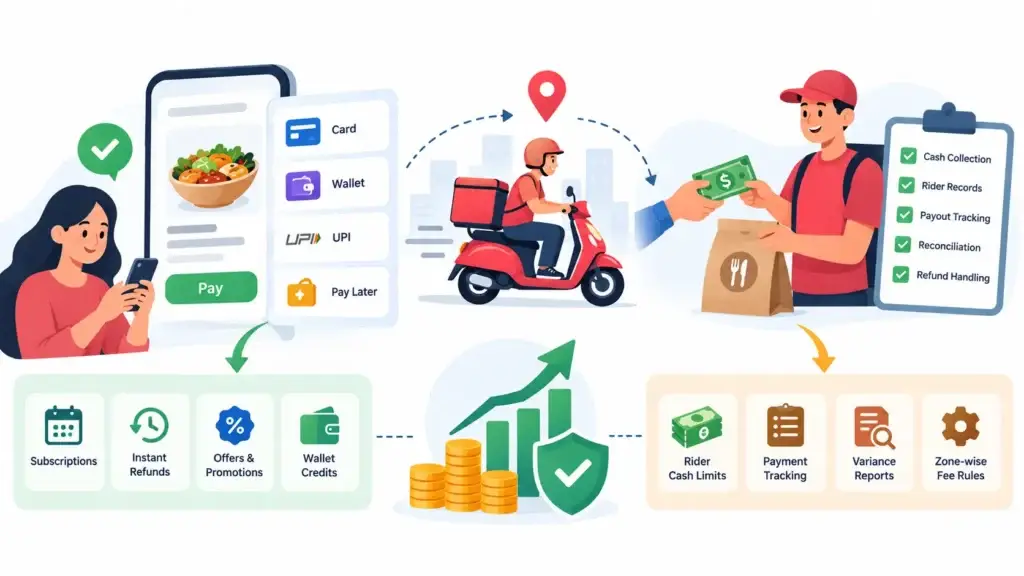
Payment method affects more than checkout convenience. It changes how quickly the platform receives money, how refunds are handled, and which revenue streams are practical.
Card and wallet payments make it easier to support automatic subscriptions, instant refunds, prepaid offers, wallet credits, and recurring memberships.
Cash on delivery can increase customer adoption in markets where digital payment behavior is still developing, but it adds reconciliation work. The platform must track what the rider collected, what the restaurant is owed, what commission belongs to the platform, and when cash is deposited.
For this reason, cash-heavy markets need stronger operational controls:
- Rider cash limits
- Cash collection records
- Restaurant payout tracking
- Refund approval workflows
- Variance reporting
- Payment-method-level reporting
- Zone-specific fee rules
For cash, wallet, refund, and payout-heavy operations, founders should also review payment security and payout controls so revenue tracking does not break during refunds, disputes, rider settlements, cash reconciliation, or suspicious transaction handling.
A revenue model that works in a card-first market may not work the same way in a cash-first market. Founders should avoid assuming that every monetization line can be copied across regions without adjustment.
Mistakes Founders Should Avoid When Designing Food Delivery Revenue
Launching Too Many Fees at Once
A new platform should not overwhelm customers with delivery fees, service fees, small order fees, packaging charges, and subscription prompts from day one.
Too many charges can reduce checkout completion before the platform has built trust. Start with the most necessary fees and add others only when the value is clear.
Treating Commission as Pure Profit
Commission is revenue, not profit. Support, refunds, payment processing, technology, onboarding, account management, and promotions all reduce the final margin.
This is also why delivery platform cost planning should include admin dashboards, payout logic, payment gateways, refund handling, campaign tools, reporting, and support workflows—not only customer-facing ordering screens.
The real measure is contribution per order, not headline commission rate.
Offering Unlimited Free Delivery Without Controls
Free delivery can increase order volume, but it can also attract low-margin orders. Use minimum basket values, selected zones, member rules, or restaurant-funded campaigns to protect margin.
Selling Promotions Before There Is Merchant Competition
Paid placement works when visibility is scarce. If a category has very few restaurants, promoted placement may not deliver enough value to merchants.
Build supply density first, then monetize visibility.
Ignoring Restaurant Payout Experience
Restaurants care about predictable settlement. If payout reports are unclear, restaurants lose trust even when order volume is strong.
A good platform should show commission, discounts, fees, taxes, and payouts in a way restaurants can understand.
Using One Revenue Rule for Every Market
Food delivery economics change by city, country, cuisine category, payment method, and customer behavior. A single global fee structure can hide losses in one zone while another zone looks profitable.
Zone-based revenue control gives the operator more flexibility.
What Founders Should Build Into the Platform From Day One
A food delivery revenue model is only useful if the software can support it.
Before launch, founders should make sure the platform can manage:
- Commission rules
- Restaurant-specific pricing
- Delivery fee settings
- Zone-based charges
- Subscription plans
- Sponsored placements
- Promo codes
- Wallets and refunds
- Cash-on-delivery reconciliation
- Restaurant payouts
- Delivery partner earnings
- Order-level reporting
- Admin permissions
- Tax and invoice records
- Customer loyalty rules
These controls depend on the right revenue-ready delivery platform features, especially when the business needs commission settings, zone-based delivery fees, restaurant management, delivery partner workflows, wallet handling, promotional campaigns, and admin-level reporting. The admin dashboard should allow the operator to test, adjust, and scale revenue rules as the market develops without depending on developers for every small operational change.
How Miracuves Helps Founders Build Revenue-Ready Delivery Platforms
Miracuves helps founders move from revenue strategy to execution with ready-made, white-label delivery app solutions built for admin control, source-code ownership, and faster launch.
For founders studying the Talabat revenue model, the key lesson is not to copy a brand. The better approach is to understand the operating logic behind a multi-market delivery marketplace: commissions, delivery fee margins, restaurant plans, customer memberships, promotions, wallet flows, cash handling, and payout control.
If the goal is to move from revenue planning to execution, Miracuves can work as a delivery platform development partner for founders who need ordering flows, restaurant tools, delivery partner modules, admin control, and monetization settings aligned from the start. This gives the business more time to focus on restaurant onboarding, local pricing, delivery operations, and revenue strategy instead of building every module from zero.
For eligible ready-made delivery scopes, Miracuves offers 6-day solution delivery with white-label branding and source-code ownership. Final scope, integrations, app store review, payment gateway onboarding, and custom requirements should always be confirmed before launch.
Final Thoughts
The strongest on-demand food delivery platforms do not depend on one revenue stream. They combine commissions, delivery fees, subscriptions, promotions, service charges, and operational controls in a way that fits the market.
Commission creates the base. Delivery fees protect fulfilment economics. Subscriptions improve repeat usage when customer behavior supports them. Promotions create merchant-funded visibility when restaurant density is strong. Service fees and small order fees help recover operational cost when used carefully.
For founders, the better decision is not to copy every revenue stream from a mature platform on day one. The better decision is to launch with the right foundation, activate revenue lines in the right sequence, and track contribution per order from the beginning.
A food delivery platform becomes stronger when the business model, admin dashboard, payment flow, restaurant payout logic, and customer experience are designed together.
FAQs
How do on-demand food delivery platforms make money?
On-demand food delivery platforms usually make money through restaurant commissions, delivery fees, customer subscriptions, restaurant plans, sponsored placements, service fees, small order fees, and promotional campaigns. The right mix depends on market maturity, customer behavior, restaurant density, and delivery cost.
What is the most important revenue stream in a food delivery marketplace?
Restaurant commission is usually the foundation because it is directly linked to completed orders. However, a platform should not depend on commission alone. Delivery fee margin, subscriptions, promotions, and service charges can improve revenue depth when introduced at the right stage.
Are delivery fees pure profit for the platform?
No. Delivery fees must be compared against delivery partner payout, distance cost, incentives, support, refunds, and operational expense. The platform only keeps delivery fee margin after fulfilment costs are covered.
When should a food delivery platform launch customer subscriptions?
Customer subscriptions work better after repeat ordering behavior is visible. If users already order frequently and delivery fees are meaningful, a membership plan can increase loyalty. Launching subscriptions too early can create weak adoption or margin loss.
How do restaurants benefit from paid promotions?
Restaurants benefit from paid promotions when the platform has enough customer traffic and merchant competition. Sponsored listings, featured placements, and campaign visibility can help restaurants reach more customers, especially in crowded categories.
What is the difference between restaurant commission and restaurant subscription plans?
Commission charges restaurants per order, while restaurant subscription plans charge a recurring fee for access to benefits such as lower commission, better visibility, analytics, or advanced tools. Many platforms use both models for different restaurant types.
Why is zone-based pricing important in food delivery?
Zone-based pricing helps the platform set different delivery fees, minimum order values, cash rules, and commission logic for different areas. This matters because delivery cost, customer behavior, and restaurant density can vary widely between markets.
Can Miracuves help build a delivery platform with multiple revenue streams?
Yes. Miracuves can help founders launch a white-label delivery marketplace with commission settings, delivery fee controls, restaurant workflows, customer ordering, delivery partner modules, admin dashboards, and source-code ownership. Eligible ready-made scopes can be delivered in 6 days, depending on final requirements.
Miracuves is an independent software development company. We are not affiliated with, connected to, sponsored by, or endorsed by any company or product named in this article.
Terms such as “X Clone” are used descriptively. It is how the software industry refers to building a platform with functionality comparable to a known service, and how clients search for it.
The entire design and codebase of our products is built by our own team. Our products contain no code, design, graphics, or content originating from any third-party website or applications.
All third-party names and marks referenced in this article are the property of their respective owners, referenced solely to identify the services discussed.



