


Marketing a professional networking platform is fundamentally different from promoting a conventional SaaS product or consumer social app. You are not only trying to convince people to register. You need enough of the right professionals to join, enough meaningful activity to make the network worth revisiting, and eventually enough employer or recruiter demand to turn professional identity into tangible opportunity.
This creates a difficult growth problem. An empty network gives new members little reason to stay. A large but inactive member database looks impressive in analytics but produces little value. Recruiters will not invest attention in a community where relevant candidates are difficult to find, while professionals will lose interest if opportunities, useful connections, and industry conversations remain scarce.
A stronger professional networking platform growth strategy therefore works as a connected system: acquire a focused member base, activate those members around useful professional actions, create repeatable interaction, attract hiring demand, and use that demand to make membership increasingly valuable.
This guide explains how founders and platform operators can build that system without confusing growth with raw registration numbers.
Key Takeaways
- A professional networking platform should optimize for network usefulness, not the largest possible signup count.
- Early growth works better when one profession, sector, geography, community, or use case reaches meaningful density before expansion.
- Member acquisition and recruiter acquisition should not operate as disconnected marketing funnels.
- Profile completion, useful connections, conversations, job interactions, and repeat activity are stronger early signals than downloads alone.
- Recruiter demand should be introduced when the member network is relevant enough to produce credible hiring outcomes.
- Trust, identity quality, moderation, and relevance directly affect long-term network growth.
- Founders should build several reinforcing growth loops instead of depending permanently on paid acquisition.
Why Professional Networking Platforms Have a Different Growth Problem
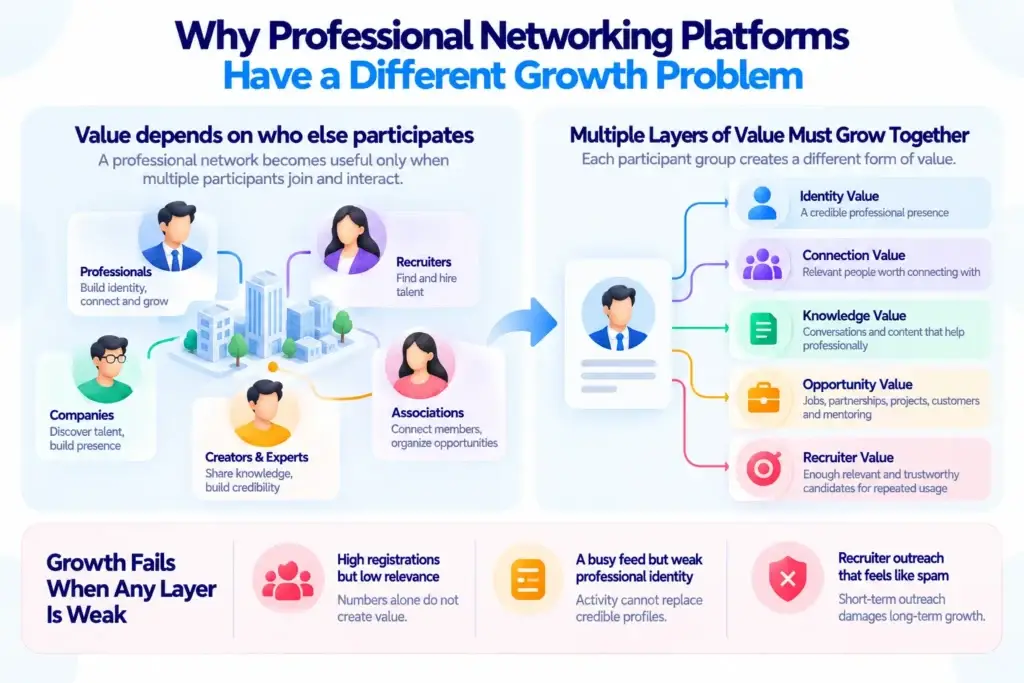
A productivity tool can deliver value to one customer in isolation. A professional network usually cannot. Much of its usefulness emerges from who else participates.
A designer may join because other designers, hiring managers, agencies, and potential collaborators are present. A recruiter may join because qualified professionals can be searched and contacted. A professional association may participate because its members can discover opportunities, discussions, events, or credentials relevant to their field.
This means founders are effectively building several connected forms of value at the same time:
- Identity value: members want a credible professional presence.
- Connection value: they need relevant people worth connecting with.
- Knowledge value: conversations and content should help them professionally.
- Opportunity value: jobs, partnerships, projects, customers, mentoring, or business relationships should emerge from participation.
- Recruiter value: hiring teams need enough relevant and trustworthy candidates to justify repeated usage.
The growth strategy fails when one of these layers is treated as an afterthought. Thousands of registrations cannot compensate for poor relevance. A busy feed cannot compensate for weak professional identity. And recruiter outreach cannot create sustainable demand if members perceive the platform primarily as a source of spam.
Start With Network Density, Not Maximum Reach
One of the most common mistakes in network businesses is treating total addressable audience as the first acquisition target. A founder identifies millions of potential professionals and immediately tries to market to all of them.
That produces reach without density.
Imagine acquiring 5,000 professionals scattered across dozens of industries, countries, experience levels, and career goals. The registration count may look encouraging, yet a new member could still struggle to discover ten people who matter to them.
Now imagine a smaller community concentrated around product managers in one geographic market, licensed healthcare professionals in one region, alumni from a group of institutions, independent architects, renewable-energy professionals, or another clearly defined segment. The total audience is smaller, but a new member has a better chance of immediately finding relevant profiles, conversations, employers, and opportunities.
That is why early-stage platform growth should usually ask:
- Which member group has the strongest reason to know one another?
- Which professional identity is underserved by broad networks?
- Where can we reach concentrated communities efficiently?
- Which employers desperately want access to this group?
- What specific recurring outcome would make members return?
The goal is not to make the network look large. The goal is to create a small market in which the network already feels alive.
For founders exploring niche positioning, the idea of building focused professional communities around a well-defined audience is particularly relevant. Narrow positioning can create stronger early relevance than launching as a general-purpose network from day one.
Define the Atomic Network Before Planning Acquisition
A useful way to think about early professional-network growth is to identify the smallest group of participants that can generate meaningful value for one another.
For an industry talent network, that might be experienced professionals plus several hiring organizations. For an alumni network, it could be graduates, mentors, hiring partners, and active community administrators. For a freelancer-oriented community, it might include specialized professionals, project buyers, and respected contributors who create useful discussions.
Once that group is identified, acquisition becomes much more precise. Instead of asking, “How do we get 100,000 users?” the team asks, “What group of participants must be present for the first 500 people to receive meaningful value?”
That change in framing affects marketing channels, onboarding, community operations, partnerships, content, and even which metrics deserve attention.
Member Acquisition: Find Professionals Who Increase Network Value
Not every signup contributes equally to a professional network. Some members bring expertise, credibility, hiring influence, useful conversations, or access to other communities. Others may create a profile and disappear permanently.
An effective acquisition strategy therefore evaluates member quality as well as acquisition cost.
1. Recruit Anchor Members Before Scaling Paid Acquisition
Anchor members are people whose participation makes the network more useful to others. They may be experienced professionals, respected practitioners, community organizers, hiring leaders, educators, mentors, specialists, or active contributors.
The objective is not celebrity. Relevance matters more.
A small professional platform for cybersecurity practitioners, for example, may gain more early value from fifty respected specialists who answer questions and share hiring knowledge than from thousands of general social-media followers who register through a giveaway.
Early outreach may therefore be deliberately manual. Founders can invite professionals individually, collaborate with associations, approach specialist communities, work with training organizations, partner with events, or bring existing offline networks online.
2. Acquire Cohorts Instead of Isolated Individuals
Individual acquisition forces every new member to enter an unfamiliar environment alone. Cohort acquisition creates immediate context.
A platform might onboard an alumni class, a professional chapter, a training cohort, a hiring community, a regional industry group, or employees from several organizations operating in the same sector.
Cohorts already contain relationships. Importing those relationships into the product helps the network avoid the feeling of an empty room.
3. Build Partnerships Around Existing Professional Distribution
Professional audiences often gather around institutions before they gather around apps. Industry associations, conferences, training programs, universities, certification bodies, newsletters, specialist publications, recruitment communities, and professional events already possess some form of concentrated distribution.
A growth partnership should create value for both sides. The platform could provide a persistent networking space after an event, a searchable member directory, a mentorship environment, career opportunities, specialist discussions, or a professional identity layer attached to a community that already exists.
This can be more defensible than purchasing anonymous traffic because members arrive with a shared context.
4. Use Content as an Acquisition Filter, Not Only a Traffic Channel
Content marketing should attract the type of professional the network needs.
A platform serving healthcare specialists should publish different material from one serving founders, designers, financial professionals, researchers, or independent consultants. Useful salary insights, hiring guides, credential discussions, career progression advice, specialist debates, event summaries, and industry operating knowledge can bring the right audience into the ecosystem.
The most important question is not “How much traffic did this article create?” but “Did this content bring people whose participation improves the network?”
Activation: Registration Is Not the Moment That Creates Value
A professional platform has not activated a member simply because an account exists.
The activation moment occurs when the member experiences the first credible reason to believe the network can help them professionally.
Depending on the platform, that moment could be:
- discovering several highly relevant professionals;
- receiving a meaningful connection request;
- getting a useful answer to a specialist question;
- finding a relevant job opportunity;
- having a recruiter view or save the profile;
- joining an active professional group;
- receiving an endorsement or recommendation;
- finding a mentor, customer, collaborator, or candidate.
Onboarding should therefore lead members toward useful professional outcomes rather than simply walking them through interface features.
Profile Completion Should Improve Matching
Asking members to complete a profile only because “complete profiles look better” is weak motivation. Each requested field should improve discovery, credibility, matching, or opportunity relevance.
Skills can improve candidate discovery. Location can improve local opportunity matching. Experience can improve recruiter filtering. Interests can improve community recommendations. Credentials can improve trust where professional qualifications matter.
The onboarding interface should communicate that exchange clearly: provide richer professional information and receive better network value in return.
Never Drop New Members Into an Empty Feed
An empty or irrelevant first session damages the perception of network quality immediately.
Early feeds often require deliberate seeding. Platform operators may need editorial content, prompts, expert discussions, community updates, industry questions, curated opportunities, or contributions from anchor members before organic activity is sufficient.
This is not artificial engagement. It is community operations during the period before member activity becomes self-sustaining.
Network Activity: Design for Useful Interaction Rather Than Maximum Posting
A professional network does not need the behavioral intensity of an entertainment feed to succeed. Ten useful interactions can create more professional value than hundreds of passive impressions.
Founders should therefore define what valuable activity means for their market.
| Activity | Why It Matters | Possible Growth Signal |
|---|---|---|
| Profile completion | Improves professional identity and discoverability | Members are investing in presence |
| Relevant connections | Builds graph density | Members can find useful people |
| Comments and replies | Creates professional conversation | Content produces interaction rather than passive consumption |
| Saved jobs or applications | Connects identity with opportunity | The network is producing career value |
| Recruiter searches | Creates demand for professional profiles | Hiring-side interest is developing |
| Messages between relevant members | Moves relationships beyond feed interaction | The graph is creating direct utility |
| Invitations | Expands the network through existing trust | Members perceive enough value to involve others |
| Repeat weekly participation | Demonstrates habit formation | The product is becoming part of professional routine |
The operator should resist vanity metrics that hide weak network quality. A spike in post impressions may look positive while connection acceptance, conversations, job activity, and cohort retention remain flat.
Create Engagement Loops Around Professional Outcomes
Notifications alone do not create retention. They merely remind people that the platform exists. The underlying reason to return has to be valuable.
A professional network can build return behavior around several genuine loops.
The Knowledge Loop
A member asks a specialist question, receives useful responses, follows knowledgeable participants, returns for future discussions, and eventually contributes expertise themselves.
The Opportunity Loop
A member improves their professional identity, becomes discoverable, receives an opportunity signal, sees the value of keeping the profile updated, and returns as new opportunities appear.
The Reputation Loop
A professional contributes knowledge, receives recognition, gains followers or recommendations, and becomes more willing to contribute because participation strengthens professional reputation.
The Connection Loop
A member discovers one useful person, that relationship reveals more relevant people, and the growing personal graph increases the probability of finding future value.
The Hiring Loop
Relevant professionals attract recruiters. Recruiter activity creates opportunities. Opportunities make the platform more attractive to additional professionals. More qualified professionals subsequently make recruiter participation more valuable.
This final loop is especially powerful because it connects member growth with demand-side growth rather than treating them as independent campaigns.
Recruiter Demand: Bring the Hiring Side in at the Right Moment
Recruiters can become one of the strongest sources of economic and behavioral pull in a professional network, but only when member supply is relevant enough to make recruiter activity productive.
Bringing recruiters into a weak network too aggressively creates a negative loop. Recruiters search, find few suitable candidates, stop returning, and become harder to win back later. Members may simultaneously receive irrelevant outreach, reducing trust.
The stronger approach is to establish candidate density first and then recruit employers whose hiring requirements closely match that member population.
Look for Recruiter Readiness Signals
A platform may be ready to increase recruiter acquisition when searches regularly return meaningful candidate sets, professional profiles contain enough information for hiring decisions, members respond to legitimate opportunities, and employers can differentiate candidates using relevant skills, credentials, experience, location, or industry information.
The objective is not simply to sell recruiter access. It is to make recruiter success possible.
Platforms where employment discovery is central should also consider how search quality affects this loop. Our guide to advanced job-search experiences in professional platforms explores that layer in greater depth.
Start With Recruiters Who Have Concentrated Demand
Early recruiter acquisition should mirror member acquisition. Focus creates liquidity.
If the platform initially serves a specific industry or profession, the first recruiter cohort should have recurring demand for those professionals. Specialist staffing firms, industry employers, associations with hiring partners, and companies with repeated role requirements may provide better early fit than broad employer outreach.
The stronger the overlap between member supply and employer demand, the faster the network can demonstrate real professional outcomes.
Treat Jobs as Network Activity, Not Just Listings
A job listing should create activity throughout the network rather than exist as an isolated classified advertisement.
Relevant roles can produce profile updates, applications, referrals, recruiter searches, conversations, company follows, saved opportunities, and invitations to colleagues. That means hiring activity can strengthen several engagement loops at once.
Operators should therefore measure whether jobs increase member activity beyond the application itself. Do members return more frequently when relevant opportunities exist? Do job seekers improve profiles? Do professionals invite colleagues? Do recruiters save searches or return to the candidate network?
Those behaviors indicate that hiring is becoming part of the network rather than a separate tab nobody visits.
Build a Member-to-Recruiter Growth Flywheel
The strongest growth model is not a straight funnel. It is a flywheel in which improvements on one side strengthen the other.
Professional Network Growth Flywheel
1. Acquire Relevant Members
Concentrate acquisition around a profession, sector, geography, community, or professional use case where participants have reasons to interact.
2. Activate the Network
Help members complete useful identities, discover relevant people, participate in discussions, and encounter professional opportunities.
3. Attract Relevant Employers
Bring recruiters whose hiring demand closely matches the member base rather than attempting broad employer acquisition too early.
4. Convert Demand Into Member Value
Jobs, profile discovery, legitimate outreach, referrals, and hiring outcomes give members another strong reason to maintain their presence.
As the flywheel strengthens, recruiter activity improves the value proposition for members, member growth expands the candidate pool, and successful professional interactions create referral stories that lower dependence on paid acquisition.
Turn Member Success Into an Acquisition Channel
Referral programs work best when users have something meaningful to refer.
A generic “invite five friends” reward may generate registrations but not necessarily useful participants. Professional referrals should instead connect to a clear outcome.
A recruiter might invite colleagues to collaborate on hiring. A member might invite former coworkers because the group becomes more valuable with familiar professionals present. An association might invite its chapter. A mentor might invite a mentee. A hiring manager might invite specialist candidates to apply for a role.
These invitations carry contextual trust. The recipient knows why they are joining.
That is usually stronger than a broad referral mechanic designed purely to increase invite volume.
Use Community Programming to Create Predictable Reasons to Return
Early networks cannot always wait for spontaneous user-generated activity. Operators may need to actively program the community.
Recurring professional rituals can create a calendar around which activity forms: weekly hiring threads, portfolio reviews, industry roundups, expert Q&As, mentoring sessions, professional challenges, salary discussions, local meetups, virtual networking events, or specialist AMAs.
The key is consistency. A useful event every Tuesday can create more reliable retention than sending generic notifications seven days a week.
As organic participation grows, platform-led programming can gradually shift toward member-led programming.
Separate Pre-Launch Acquisition From Post-Launch Growth
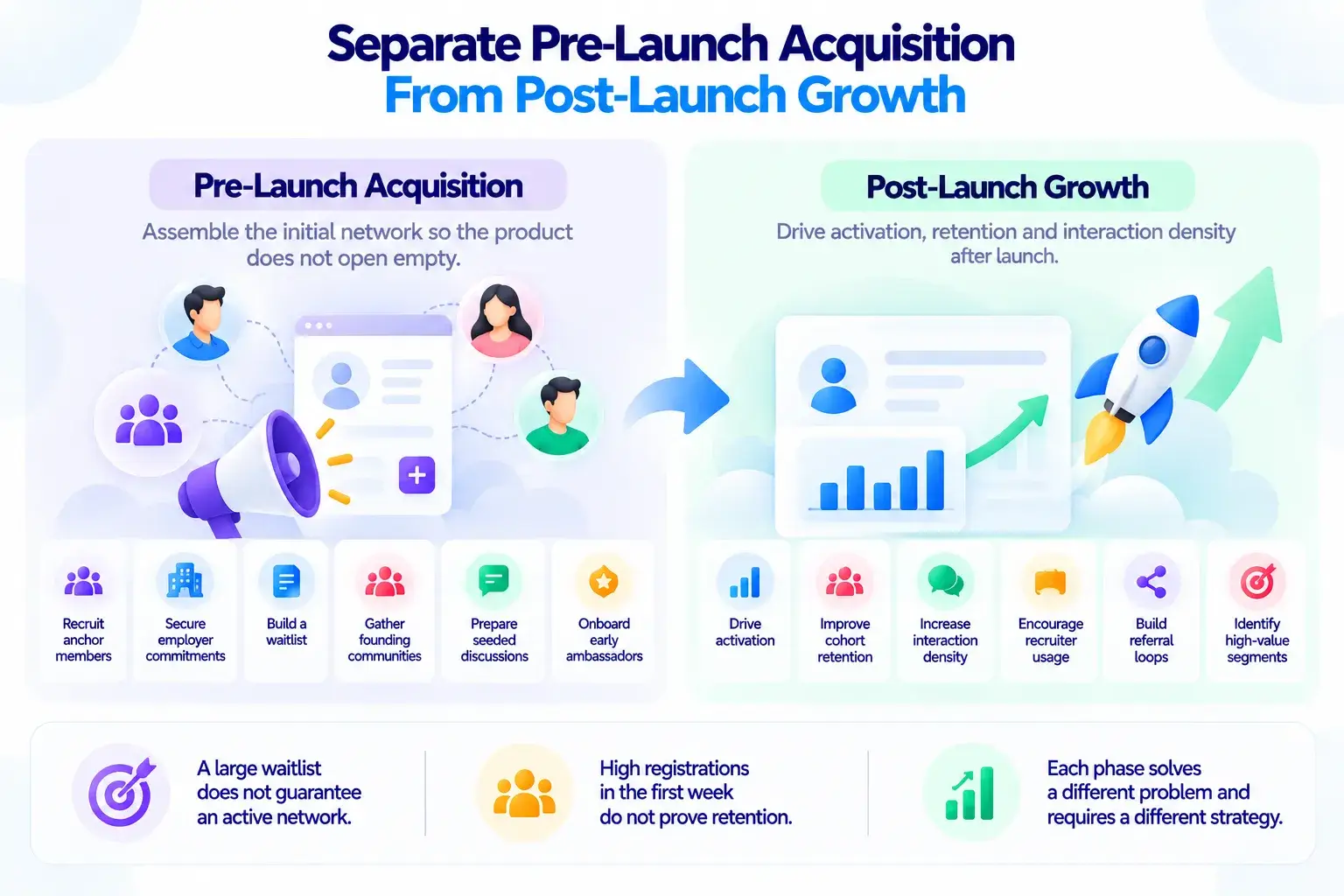
Pre-launch activity exists to solve a different problem from post-launch growth.
Before launch, the objective is to assemble enough of the initial network that the product does not open empty. Founders may recruit anchor members, secure employer commitments, build a waitlist, gather founding communities, prepare seeded discussions, and onboard early ambassadors.
After launch, the emphasis changes toward activation, cohort retention, interaction density, recruiter usage, referral loops, and identifying which segments repeatedly create value.
These phases should not be confused. A large waitlist does not automatically produce an active network, and a high number of first-week registrations does not prove retention.
For a detailed phase-by-phase distinction, see our guide to pre-launch versus post-launch marketing for professional-network startups.
Trust Is a Growth Mechanism on Professional Networks
Professional networks depend heavily on credibility because users make higher-stakes decisions than they do in casual entertainment communities. They may evaluate employers, candidates, credentials, business partners, professional advice, or career opportunities based on what they see.
Spam, fake profiles, impersonation, misleading jobs, abusive outreach, and poorly moderated content therefore create growth problems, not merely policy problems.
If members stop trusting outreach, they respond less often. If recruiters distrust profile information, candidate discovery becomes less valuable. If conversations become dominated by spam, experienced professionals contribute less. Each failure weakens network activity.
Founders should treat identity quality, reporting, moderation, permission-aware administration, suspicious-activity signals, and privacy-conscious data handling as part of the network foundation. For a deeper treatment of this layer, see our professional networking platform safety analysis.
Growth Metrics That Reveal Whether the Network Is Becoming Useful
Professional platform dashboards can easily become overloaded with registrations, sessions, page views, and impressions. These figures are useful but incomplete.
A stronger measurement model follows the network journey from acquisition to utility.
| Growth Layer | Metrics to Watch | Question the Metric Answers |
|---|---|---|
| Acquisition | Qualified registrations by segment, acquisition source, cohort acceptance | Are we attracting people relevant to the network? |
| Profile activation | Profile completion, skills added, credential completion | Are members creating usable professional identities? |
| Graph activation | Relevant connections sent/accepted, follows, group joins | Can users find people worth connecting with? |
| Engagement | Meaningful comments, replies, messages, saved posts, repeat contributors | Are interactions professionally useful? |
| Opportunity activity | Job views, saves, applications, referrals, recruiter profile views | Does the network create professional opportunities? |
| Recruiter liquidity | Searches producing suitable candidates, outreach response, repeat recruiter sessions | Can employers reliably find relevant people? |
| Retention | Weekly and monthly cohort return, retained activated members | Does utility persist after onboarding? |
| Network-driven acquisition | Invites, referrals, organization-led onboarding | Is the network beginning to acquire participants through itself? |
The most useful metric will differ by business. A recruiting-focused platform may care deeply about candidate-search success. An association network may prioritize active-member retention. An alumni product may focus on mentoring relationships and introductions.
The principle remains the same: measure the behavior that represents value, not just the behavior that is easiest to count.
Segment Retention Before Looking at One Platform-Wide Number
Overall retention can hide where the network is actually working.
Suppose senior engineers return frequently, junior professionals return occasionally, recruiters in one specialization are highly active, and generalist recruiters rarely come back. A single platform-wide retention percentage averages those behaviors into one number and removes the insight.
Segment retention by profession, geography, seniority, acquisition source, organization, recruiter type, or community cohort. The segment showing unusually strong retention may reveal the platform’s most defensible early market.
This can influence everything from marketing spend to partnerships and product prioritization.
When Paid Acquisition Helps and When It Hides a Weak Network
Paid marketing can accelerate professional-network growth, but timing matters.
If newly acquired users enter a low-density environment and disappear, increasing advertising spend simply purchases more churn. That makes acquisition more expensive without solving the underlying problem.
Paid acquisition becomes more useful once the team knows which member segment activates reliably, what action predicts retention, which positioning attracts relevant professionals, and whether the destination experience gives those professionals something valuable to do.
At that stage, advertising amplifies a working loop instead of compensating for a broken one.
Founder Decision Signals: Is Your Professional Network Ready to Scale?
Acquisition
You know which professional segment consistently activates instead of treating every signup as equally valuable.
Engagement
Members generate useful interactions without the operations team manually creating every conversation.
Recruiter Demand
Employers can find relevant professionals and return because searches produce credible hiring possibilities.
Retention
The strongest member cohorts return because professional value exists, not merely because reminders pull them back.
If these signals are absent, scaling acquisition is unlikely to solve the problem. The stronger priority is often improving the value experienced inside the existing network.
Common Growth Mistakes Professional Networking Founders Should Avoid
Mistakes Founders Should Avoid
Chasing registrations instead of density
A fragmented audience can produce impressive signup numbers while leaving every individual member with too few relevant people to discover.
Acquiring recruiters before candidate supply is useful
Recruiters who repeatedly search an empty or irrelevant talent pool have little reason to return. Recruiter acquisition should follow real candidate relevance.
Treating all engagement as equal
Professional value may come from a small number of high-intent conversations, referrals, searches, or applications. Raw post volume can therefore be misleading.
Expanding categories too early
A network that has not achieved density in one segment usually becomes even less useful when it spreads acquisition across several unrelated audiences.
Using notifications to compensate for weak utility
Notifications can trigger a return visit, but they cannot manufacture professional value. Retention must ultimately come from relevant people, knowledge, reputation, or opportunity.
Ignoring trust until scale
Fake identities, spam, irrelevant recruiter outreach, and misleading opportunities damage the interactions on which network growth depends.
A Practical 90-Day Growth Sequence for an Early Professional Network
Growth plans should respond to actual platform data, but founders can use a staged sequence to avoid trying to scale every side simultaneously.
Days 1–30: Build the Core Member Network
Concentrate on the smallest viable professional community. Recruit anchor members, onboard existing groups, seed specialist discussions, complete important profiles, and personally observe where new users fail to discover relevant people.
At this stage, founder involvement is useful. Manual onboarding, introductions, curated groups, and direct conversations can reveal what an automated product experience must eventually reproduce.
Days 31–60: Strengthen Repeat Activity
Study which actions predict return behavior. Improve recommendations, community programming, professional content, introductions, messaging triggers, and opportunity discovery around those behaviors.
Begin measuring cohorts based on professional segment and acquisition source. Stop spending heavily on channels that create registrations without activation.
Days 61–90: Build Demand Around Proven Member Supply
Approach employers, recruiters, or organizations whose needs directly match the strongest member segment. Observe candidate searches, recruiter response, member reactions to outreach, and whether job activity increases retention.
The aim is not to “monetize the database.” It is to prove that the network can repeatedly connect professional supply with meaningful demand.
How Technology Choices Affect the Growth Strategy
Growth strategy is not independent of product architecture. A founder may know exactly what the network needs operationally but still struggle if the platform cannot support segmentation, role-specific workflows, search, messaging, moderation, analytics, and controlled experimentation.
The underlying platform should make it practical to distinguish member types, understand activity, govern professional interactions, adapt onboarding, manage opportunities, and introduce new workflows without rebuilding the product every time the growth strategy changes.
This is where a ready-made product foundation can change the founder’s sequence of work. Instead of spending the initial phase rebuilding standard networking mechanics, the team can devote more attention to the difficult market problem: finding the right community, activating it, and creating enough supply-demand density for network effects to begin forming.
Where Miracuves Fits Into the Growth Journey
Miracuves helps founders who want the technology foundation for a professional network without rebuilding every core workflow from zero. Its professional networking platform solution provides a ready-made foundation that can be branded and adapted around the operator’s audience, market positioning, and growth model.
For founders specifically evaluating a LinkedIn Clone, the important strategic distinction is that purchasing software does not solve network growth automatically. Product readiness and market readiness are different problems. The technology can help you move to market faster; acquisition, community density, recruiter demand, positioning, trust, and retention still require disciplined execution by the operator.
Where the ready-made scope fits the requirement, Miracuves offers a 6-day deployment path. That speed can be strategically useful because it lets the founding team spend less time rebuilding standard platform mechanics and more time validating the professional community itself.
Founders who want to understand the commercial mechanics separately can review the professional network business model. Keeping that discussion on its dedicated page allows this guide to stay focused on acquisition, activity, retention, and demand rather than mixing growth strategy with pricing or monetization detail.
Final Thoughts: Grow the Network Before You Try to Grow the Numbers
A professional networking platform becomes valuable when the right people can repeatedly find the right people, information, reputation signals, and opportunities. That makes growth a network-design problem before it becomes a media-buying problem.
Start by creating density inside a clearly defined professional segment. Acquire members who increase network value. Design onboarding around a real activation moment. Measure useful interactions rather than superficial activity. Introduce recruiters when candidate supply is strong enough to make their participation productive. Then use successful interactions to create referrals, stronger retention, and increasingly efficient acquisition.
The long-term objective is a network in which acquisition, engagement, professional opportunity, and demand reinforce one another. When that begins to happen, marketing stops being the only engine pushing the platform forward. The network itself starts contributing to growth.
FAQs
How do you grow a new professional networking platform?
Start with a concentrated professional segment instead of trying to acquire everyone. Recruit credible anchor members, onboard existing communities or cohorts, create useful professional activity, and measure whether members are finding relevant people and opportunities. Broader acquisition should follow once the initial network shows repeat engagement and retention.
What is the most important metric for a professional network?
There is no single universal metric, but early operators should prioritize evidence of network utility over total registrations. Useful measures include activated profiles, relevant connections, meaningful conversations, weekly retained members, successful recruiter searches, job interactions, and referral-driven acquisition.
When should a professional networking platform start acquiring recruiters?
Recruiter acquisition becomes more effective once the platform contains enough relevant, credible, and searchable professional profiles to produce useful candidate results. Bringing employers in before that point can create poor recruiter retention and irrelevant outreach for members.
How can a professional network increase member retention?
Retention improves when members repeatedly receive professional value. That may come from relevant connections, expert conversations, reputation building, job opportunities, recruiter discovery, mentoring, industry knowledge, or useful communities. Notifications can support these loops, but they cannot replace them.
Should a professional networking platform target one niche first?
For many early networks, a focused market makes it easier to create density. A concentrated profession, sector, geography, association, or community increases the probability that members discover relevant people and that employers find relevant talent. Expansion can follow after the first segment demonstrates repeat value.
How does recruiter demand help a professional network grow?
Recruiter demand creates professional opportunities for members, which can increase the value of maintaining an accurate profile and returning to the platform. More active and relevant members can then make the network more useful to additional recruiters, creating a reinforcing demand loop.
Does paid advertising work for professional networking platforms?
Paid acquisition can work once the platform understands which audience activates and retains. Spending heavily before the network provides sufficient value often produces expensive registrations followed by churn. Paid media should amplify a functioning acquisition and activation model rather than compensate for weak network utility.
Miracuves is an independent software development company. We are not affiliated with, connected to, sponsored by, or endorsed by any company or product named in this article.
Terms such as “X Clone” are used descriptively. It is how the software industry refers to building a platform with functionality comparable to a known service, and how clients search for it.
The entire design and codebase of our products is built by our own team. Our products contain no code, design, graphics, or content originating from any third-party website or applications.
All third-party names and marks referenced in this article are the property of their respective owners, referenced solely to identify the services discussed.



