



















Microdrama streaming is not a normal OTT business with shorter episodes. It is a mobile-first entertainment model built around emotional hooks, fast continuation, regional storytelling, and flexible monetization.
That difference matters even more when a founder wants to launch across multiple regions.
A multi-region microdrama platform cannot use one content library, one pricing model, one ad strategy, and one payment flow everywhere. Viewers in the US, India, Southeast Asia, Latin America, and the Middle East may all enjoy short episodes, but they do not always respond to the same genre mix, pricing logic, dubbing quality, ad frequency, or payment method.
The strongest go-to-market strategy for a multi-region microdrama streaming platform is a localized wedge strategy: start with one or two high-potential regions, test story hooks before full production, adapt monetization by market, and expand only after the platform has proven retention, unlock behavior, and acquisition efficiency.
For founders planning a faster launch, Miracuves helps build white-label short-drama streaming platforms with branded design, admin control, monetization workflows, and source-code ownership. The strategy still matters because even the strongest platform foundation needs the right regional rollout plan.
Key Takeaways
- A multi-region microdrama GTM strategy should start with region-by-region validation, not a global launch from day one.
- The strongest launch model combines story hook testing, localized content packaging, hybrid monetization, and phased market expansion.
- Microdrama platforms should test thumbnails, teasers, first episodes, cliffhangers, unlock points, and payment behavior before scaling spend.
- Different regions may need different pricing, currencies, languages, ad tolerance, payment rails, and content acquisition strategies.
- Miracuves helps founders move from strategy to execution with ready-made and white-label video platform foundations.
Why Multi-Region Microdrama Launches Need a Different GTM Strategy
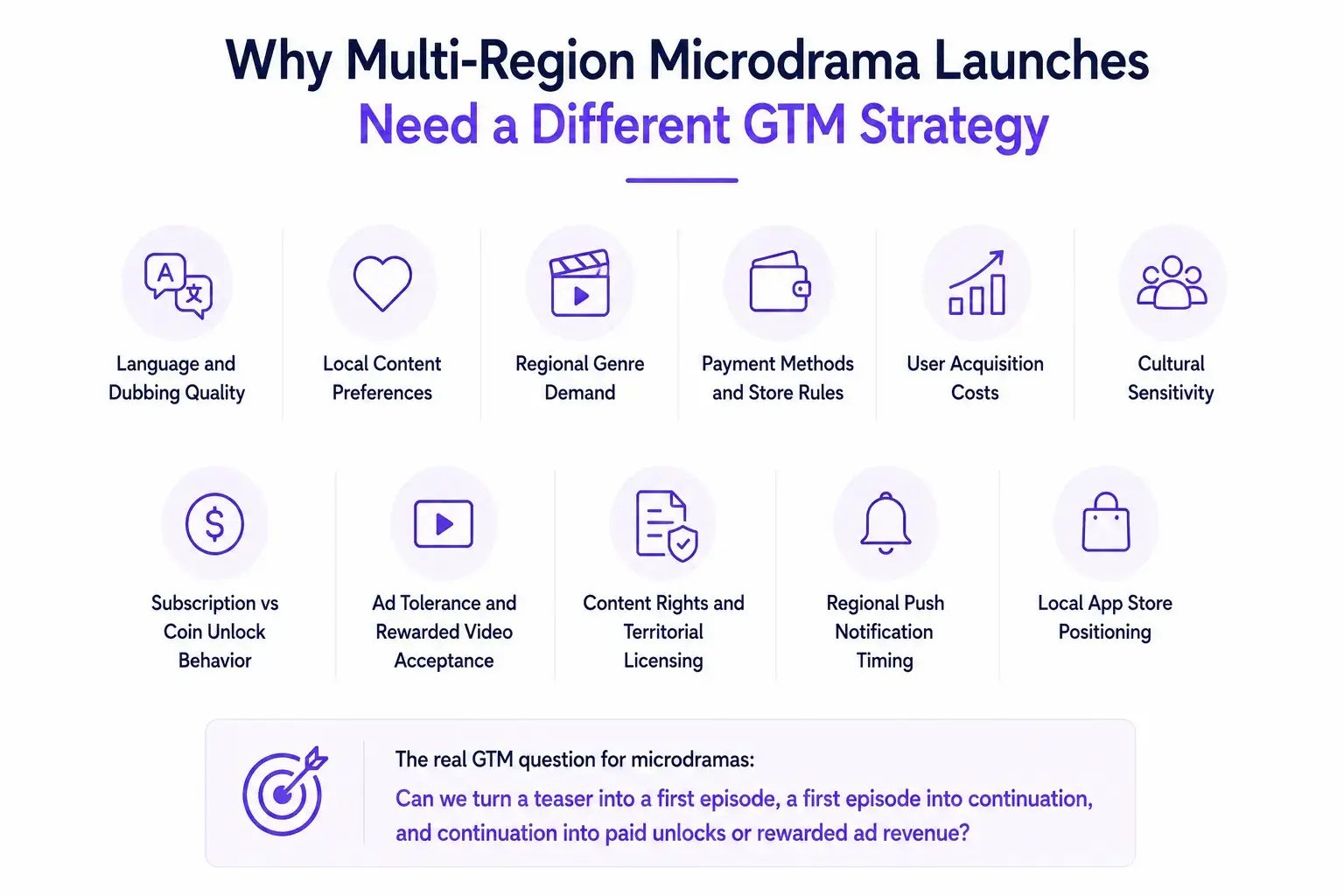
A single-region entertainment launch is already difficult. A multi-region launch adds more variables:
- Language and dubbing quality
- Local content preferences
- Regional genre demand
- Payment methods and store billing rules
- User acquisition costs
- Cultural sensitivity
- Subscription vs coin unlock behavior
- Ad tolerance and rewarded video acceptance
- Content rights and territorial licensing
- Regional push notification timing
- Local app store positioning
For a traditional OTT platform, the early GTM question is often: “Can we acquire enough subscribers for this catalog?”
For a microdrama platform, the better question is: “Can we turn a teaser into a first episode, a first episode into continuation, and continuation into paid unlocks or rewarded ad revenue?”
That is why the GTM strategy must be built around behavioral testing, not only brand awareness.
The Best GTM Model: Localized Wedge + Hook Testing + Hybrid Monetization
The strongest go-to-market model for a multi-region microdrama streaming platform has four layers:
- Choose one launch wedge market first
- Test story hooks before scaling production
- Use hybrid monetization by region
- Expand only when retention and unlock behavior prove demand
This approach helps founders avoid one of the most expensive mistakes in entertainment apps: launching everywhere before knowing where the platform actually converts.
A practical GTM path could look like this:
| GTM Stage | Founder Goal | What to Test | Success Signal |
|---|---|---|---|
| Region selection | Choose the first market wisely | Language, payment readiness, genre demand, CAC | Strong teaser response and affordable installs |
| Hook testing | Validate story demand | Ads, thumbnails, opening scenes, titles | High click-through and first episode starts |
| Soft launch | Test product-market behavior | Free episode flow, unlock point, ad tolerance | Strong episode 2–5 continuation |
| Monetization test | Find revenue model fit | Coins, rewarded ads, VIP, bundles | Repeat unlocks or rewarded ad completion |
| Regional expansion | Add similar markets | Dubbing, subtitles, local payment rails | Lower launch friction in second market |
| Scale phase | Increase spend and catalog | Content pipeline, acquisition channels | Stable retention and predictable payback logic |
Step 1: Select Regions Based on Monetization Readiness, Not Just Downloads
Downloads are useful, but they do not tell the full story.
A region with high downloads but weak payment conversion may need an ad-supported or rewarded unlock strategy. A region with smaller volume but higher spending power may support coin packs, VIP plans, or premium episode bundles.
Founders should evaluate each target region using a practical scorecard.
| Region Selection Factor | Why It Matters | Founder Decision |
|---|---|---|
| Mobile-first viewing behavior | Microdramas work best when users already consume vertical video heavily | Prioritize markets where short-form video habits are strong |
| Language concentration | Localization becomes easier when one language unlocks a large user base | Start with fewer languages before expanding |
| Payment readiness | Coin unlocks depend on frictionless payment behavior | Check app store billing, cards, wallets, and local payment methods |
| Ad tolerance | Some markets prefer free viewing with ads over direct payment | Test rewarded ads and ad-supported unlocks |
| Content genre fit | Romance, revenge, family drama, thriller, fantasy, and local melodrama perform differently by market | Test genre hooks before producing full seasons |
| Content rights clarity | Territorial licensing can block scale if ignored early | Secure region-specific rights before launch |
| Acquisition cost | Paid social is often central to discovery | Launch where teaser ads can acquire users efficiently |
A strong first market is not always the biggest market. It is the market where content, pricing, payment, and acquisition can work together.
Step 2: Test Story Hooks Before Producing Full Seasons
Microdrama growth starts before the app install.
The first growth asset is usually not the app store page. It is the teaser: a betrayal scene, revenge setup, romantic conflict, inheritance twist, family secret, or dramatic cliffhanger that makes the viewer want to know what happens next.
Before investing heavily in full content production, founders should test:
- Story premise
- Main character conflict
- Opening scene
- Thumbnail
- Title
- Teaser length
- Language version
- Subtitle style
- Dubbing quality
- Cliffhanger placement
- Call-to-action into the app
The goal is to identify which stories create curiosity strong enough to drive app installs and episode continuation.
A simple pre-launch testing loop:
- Create 5–10 story concepts.
- Produce teaser creatives for each concept.
- Run small-budget tests across relevant short-form ad channels.
- Measure click-through rate, video completion, landing page visits, and install intent.
- Produce full episodes only for winning story angles.
- Use the same winning hooks inside the app onboarding and first feed.
This turns GTM from a guessing exercise into a learning system.
Step 3: Localize the Content Strategy, Not Just the Interface
Translation is not the same as localization.
A microdrama platform may translate buttons, subtitles, and descriptions into another language, but that does not guarantee the story will feel native to the viewer. Regional audiences respond to different pacing, family structures, relationship dynamics, humor, social tension, moral codes, and emotional triggers.
Founders should choose the right localization depth based on market priority.
| Localization Level | What It Includes | Best For | Risk |
|---|---|---|---|
| Subtitles only | Original audio with translated subtitles | Fast testing in secondary markets | Lower emotional connection |
| Dubbing | Local voice tracks over original visuals | Faster scale in markets where dubbing is accepted | Poor dubbing can reduce trust |
| Cultural adaptation | Adjusted titles, thumbnails, descriptions, and marketing angles | Mid-priority regions with strong demand | Requires local creative judgment |
| Local remake | Same concept recreated with local actors and settings | High-priority regions | Higher production cost |
| Native originals | Stories created specifically for one region | Long-term brand building | Requires deeper content investment |
The founder decision is simple: use lighter localization to test markets, then invest in deeper localization only where demand is proven.
Step 4: Build Monetization Around Regional Payment Psychology
Microdrama monetization usually depends on continuation. The viewer watches free starter episodes, reaches a cliffhanger, and then decides whether to unlock the next episode, watch an ad, buy coins, or subscribe.
That decision changes by market.
Some viewers are comfortable buying coin packs. Others prefer rewarded ads. Some regions respond to low-cost story bundles. Others may prefer VIP access for heavy viewers.
A multi-region platform should avoid one fixed monetization model across all markets.
| Monetization Model | How It Works | Strong Use Case |
|---|---|---|
| Free starter episodes | First few episodes are free before the lock appears | Reduces first-session friction |
| Coin unlocks | Users buy coins and spend them on premium episodes | Works when users accept microtransactions |
| Rewarded ads | Users watch ads to unlock episodes or earn coins | Useful in price-sensitive regions |
| VIP subscription | Users pay for broader access, fewer ads, or early episodes | Works for heavy viewers and loyal fans |
| Story bundles | Users buy access to a complete series or season | Useful when subscription trust is low |
| Limited-time unlocks | Time-bound offers encourage faster continuation | Helps monetize users near cliffhangers |
| Regional pricing | Pricing changes by country, currency, and payment behavior | Essential for multi-region growth |
The smartest model is often hybrid. A platform may use coin unlocks in one market, rewarded ads in another, and VIP bundles for loyal users across all regions.
Step 5: Connect Paid Acquisition With Episode-Level Analytics
Microdrama user acquisition is highly creative-driven.
A founder may run paid campaigns across short-form video platforms, social feeds, influencer clips, search ads, or app install campaigns. But the real GTM advantage comes from connecting ad performance to in-app episode behavior.
The platform should answer questions like:
- Which teaser drove the most first episode starts?
- Which story had the strongest episode 3 continuation?
- Which language version produced better unlock behavior?
- Which ad creative attracted users who watched but did not pay?
- Which region had low install cost but weak retention?
- Which payment offer worked after the first cliffhanger?
- Which push notification brought users back to continue the story?
Without episode-level analytics, founders may scale the wrong creative, wrong market, or wrong story.
The goal is not only cheaper installs. The goal is profitable continuation.
Step 6: Design the Product Foundation for Regional Control
A multi-region microdrama platform needs more than video playback.
It needs operational controls that allow the founder or platform team to adjust each region without asking developers for every small change.
Important regional control layers include:
- Multi-language content management
- Subtitle and dubbing management
- Country-level catalog visibility
- Regional pricing and currency settings
- Episode unlock thresholds
- Coin pack configuration
- Rewarded ad rules
- Payment gateway routing
- Push notification scheduling by timezone
- Local homepage banners
- Genre-specific rails by region
- Rights and territory controls
- Admin access controls
- Moderation and abuse reporting
- Revenue analytics by market
This is where the platform foundation affects GTM speed. If every region requires custom development, expansion becomes slow. If regional controls are configurable from the admin dashboard, the team can test faster.
For founders comparing build options, Miracuves’ short-drama streaming app foundation can support faster launch planning with branded design, monetization flows, admin control, and source-code ownership.
Step 7: Use a Phased Rollout Instead of a Simultaneous Global Launch
A simultaneous launch across many countries sounds ambitious, but it can hide problems.
If retention is weak, the team will not know whether the issue is the story, pricing, language, onboarding, payment method, buffering, ad creative, or region fit. A phased rollout creates cleaner learning.
A practical multi-region rollout may look like this:
| Rollout Phase | Focus | Founder Action |
|---|---|---|
| Phase 1: Pilot market | Validate hook and continuation | Launch 1–2 genres with limited ad spend |
| Phase 2: Similar market cluster | Test repeatability | Add markets with language or genre overlap |
| Phase 3: Monetization expansion | Improve revenue per user | Test coins, rewarded ads, VIP, bundles |
| Phase 4: Content scale | Grow catalog depth | Produce or license more winning genres |
| Phase 5: Regional brand building | Build defensibility | Invest in local originals, creators, partnerships |
| Phase 6: Platform optimization | Reduce operational friction | Improve CDN, analytics, admin workflows, payment routing |
This model helps founders scale with evidence instead of expansion pressure.
Step 8: Align Content Supply With GTM Demand
Microdrama platforms can fail even after strong launch campaigns if the content pipeline is not ready.
Viewers who like a story want continuation. They may finish dozens of short episodes quickly. If the platform cannot offer fresh seasons, similar titles, or new regional stories, early growth may fade.
Founders should plan the content engine around:
- Launch catalog size
- Genre diversity
- Episode release calendar
- Local dubbing capacity
- Creator or studio onboarding
- Content review process
- Regional licensing rights
- Cost per finished minute
- Production turnaround
- Reuse of winning story templates
- Analytics-backed renewal decisions
A good GTM strategy does not only acquire viewers. It tells the content team what to produce next.
Read more: How Can a Microdrama Streaming Platform Expand Into Multiple Language Markets?
Founder Decision Signals for a Multi-Region Microdrama Platform
Founder Decision Signals
Speed
Use a launch-ready foundation when the main risk is market validation, not building basic streaming, wallet, and admin modules from zero.
Cost
Do not spend heavily on multi-region production until teaser tests show which stories, genres, and languages create continuation.
Scalability
Choose a platform foundation that supports regional pricing, language control, CDN-backed playback, episode analytics, and configurable unlock models.
Market Fit
Expand region by region only after the first market proves strong first-session viewing, repeat continuation, and monetization behavior.
Mistakes Founders Should Avoid During Multi-Region Launch
Mistakes Founders Should Avoid
Launching too many countries before proving one market
A wide launch can create confusing data. Start with one strong wedge market, learn what drives continuation, then expand into similar regions.
Using the same monetization model everywhere
Coin unlocks, rewarded ads, subscriptions, and bundles perform differently by region. The platform should allow regional pricing and access rules.
Treating localization as basic translation
Microdrama depends on emotional connection. Titles, thumbnails, voices, pacing, and cultural context must feel natural in priority markets.
Scaling paid ads without episode-level analytics
Install volume alone does not prove GTM success. Founders need to track first episode starts, continuation, unlocks, ad completions, and returns.
What Platform Features Matter Most for Multi-Region GTM?
Multi-Region Microdrama Platform Features and Business Value
| Feature | Business Value | Founder Impact |
|---|---|---|
| Regional content controls | Allows different catalogs by country or language | Supports licensing, localization, and phased expansion |
| Coin wallet and episode unlocks | Monetizes continuation after strong cliffhangers | Helps test paid behavior without forcing full subscriptions |
| Rewarded ad unlocks | Gives users a free path to continue watching | Useful for price-sensitive or ad-friendly markets |
| Multi-language CMS | Manages subtitles, descriptions, titles, and local assets | Reduces operational friction during regional rollout |
| Episode-level analytics | Tracks drop-offs, continuation, unlocks, and returns | Shows which stories and markets deserve more budget |
| Admin pricing controls | Lets teams configure regional coin packs and offers | Improves monetization testing without constant engineering work |
| CDN-backed streaming | Improves playback speed across regions | Protects retention when traffic scales |
| Push notification scheduling | Brings users back at the right local time | Supports daily continuation and new episode campaigns |
How Miracuves Helps Founders Move From GTM Strategy to Launch
A multi-region microdrama strategy works only when the platform can support fast testing, regional control, and monetization flexibility.
Miracuves helps founders build ready-made and white-label video streaming platforms with branded design, admin dashboards, source-code ownership, monetization workflows, and configurable app modules. For founders planning a short-drama business, the platform can be aligned around vertical episodes, free starter episodes, coin unlocks, rewarded ads, subtitles, language controls, and regional rollout needs.
Explore Miracuves’ microdrama streaming solution for short-form episodic platforms if you want the product foundation behind this GTM strategy.
For broader video platform planning, you can also review Miracuves’ video content platform solutions and the guide on video streaming infrastructure for short video apps.
Miracuves | White-Label Micro-Drama Software
Build Your Own Micro-Drama Platform With Smarter Content Discovery
Launch a branded short-drama streaming platform and explore customization opportunities for content discovery, viewer engagement, and personalized episode recommendations. Discover our White Label Micro Drama App and discuss how custom AI personalization could fit your platform requirements.
Prefer a scheduled discussion? Book a Consultation
Final Thoughts: The Winning GTM Strategy Is Regional Before It Becomes Global
The strongest go-to-market strategy for a multi-region microdrama streaming platform is not to launch everywhere at once.
It is to prove one market, one audience, one story hook, and one monetization loop first.
Once the platform knows which teasers create installs, which episodes drive continuation, which unlock points convert, which payment methods work, and which regions respond profitably, expansion becomes smarter. The founder is no longer scaling hope. They are scaling evidence.
A microdrama platform succeeds when content, product, pricing, and acquisition work as one system. For multi-region founders, that system must be localized, measurable, and flexible from the beginning.
FAQs
What is the best go-to-market strategy for a multi-region microdrama platform?
The strongest strategy is a localized wedge approach. Start with one or two priority regions, test story hooks through teaser campaigns, launch with a focused content catalog, measure episode continuation, and expand only after retention and monetization behavior are proven.
Should a microdrama platform launch globally from day one?
A global launch is usually risky because it creates too many variables at once. A phased rollout helps founders understand whether success or failure is caused by content, language, pricing, payment methods, ads, or product experience.
Which monetization model works best for short drama streaming apps?
There is no single model that works everywhere. Many microdrama platforms use hybrid monetization, including free starter episodes, coin unlocks, rewarded ads, VIP subscriptions, story bundles, and regional pricing.
Why is localization important for microdrama platforms?
Microdrama depends on emotional connection. Subtitles may help with access, but deeper localization may require dubbing, local titles, adapted thumbnails, culturally familiar storylines, or locally produced originals.
What should founders test before producing full microdrama seasons?
Founders should test story premises, teaser clips, thumbnails, titles, opening scenes, character conflicts, dubbing quality, subtitles, and cliffhanger timing before investing in full production.
What analytics matter most for microdrama GTM?
Important metrics include first episode starts, episode-to-episode continuation, drop-off points, unlock conversion, rewarded ad completion, repeat viewing, push notification return rate, and revenue by region.
How does a ready-made platform help with regional expansion?
A ready-made platform can reduce development time by providing core app flows, admin controls, monetization modules, video playback, and configuration layers. This allows founders to spend more time testing content, pricing, and acquisition instead of building every module from zero.
Can Miracuves help launch a short-drama streaming platform?
Yes. Miracuves helps founders launch white-label and ready-made video streaming platforms with branded design, admin dashboards, source-code ownership, monetization workflows, and faster deployment options.
Miracuves is an independent software development company. We are not affiliated with, connected to, sponsored by, or endorsed by any company or product named in this article.
Terms such as “X Clone” are used descriptively. It is how the software industry refers to building a platform with functionality comparable to a known service, and how clients search for it.
The entire design and codebase of our products is built by our own team. Our products contain no code, design, graphics, or content originating from any third-party website or applications.
All third-party names and marks referenced in this article are the property of their respective owners, referenced solely to identify the services discussed.