



















Key Takeaways
- Vertical Drama Streaming App Monetization works best when coins, VIP access, rewarded ads, and episode unlocks operate as one connected revenue system.
- Free opening episodes should build enough story interest before introducing paid or reward-based unlocks.
- Coin unlocks provide flexible episode-level spending without forcing every viewer into a subscription.
- VIP should reward frequent viewers without removing every reason to purchase coins or premium access.
- Rewarded ads should reduce churn for hesitant users while remaining limited enough to protect paid conversions.
Monetization Signals
- If users leave at the first paywall, the unlock may appear before enough emotional interest has been created.
- If ad usage is high but coin purchases are low, rewarded access may be too generous.
- If repeat coin buyers ignore VIP, the subscription benefits may need stronger value.
- Different genres and series should be able to use different free windows, coin prices, and unlock points.
- Operators should track unlock rates, coin purchases, VIP conversion, rewarded ad completion, episode drop-off, and revenue by genre.
Real Insights
- A paywall performs better after curiosity has been earned through story progression and strong cliffhangers.
- Not every viewer needs the same monetization path; new users, returning viewers, heavy viewers, and superfans behave differently.
- Episode-level pricing gives operators more flexibility than applying one fixed monetization rule across the entire catalog.
- Admin control is critical because coin prices, VIP benefits, ad limits, rewards, and campaigns will change after launch.
- The strongest path is: free sampling → build story interest → introduce unlock → offer coins or limited ads → encourage repeat spending → position VIP for loyal viewers → optimize using retention and revenue data.
A Vertical Drama Streaming App is not monetized like a traditional OTT platform.
Traditional streaming platforms usually depend on monthly subscriptions, large content libraries, and long viewing sessions. Vertical drama platforms work differently. They are built around short, emotional, mobile-first episodes where users move quickly from one scene to the next. The business model depends on when viewers become invested, how friction is introduced, and what access option they choose when the next episode is locked.
For founders, this creates a very different monetization challenge.
A vertical drama streaming app may offer several ways to access premium episodes, but these payment methods must operate through one coordinated entitlement system.
Coin purchases, VIP subscriptions, and rewarded-ad unlocks create different types of access. The platform must determine which access rule applies to each viewer, whether that access is still valid, and whether an episode can be played without charging the viewer again.
This requires coordination between the wallet, subscription records, ad-reward validation, episode access rules, payment services, and viewing history.
For founders evaluating vertical drama software, the important technical question is not simply whether the app supports coins, VIP, and advertising. It is whether the platform can manage these models consistently while protecting purchase records, preventing duplicate charges, and maintaining a reliable viewing experience.
Why Monetization Works Differently in a Vertical Drama Streaming App
A Vertical Drama Streaming App is built around mobile attention.
Viewers are not opening the app to browse slowly through a large catalog. They are usually pulled into a story through a strong hook, a dramatic conflict, or a cliffhanger. The episode length is short, the viewing format is vertical, and the next episode often becomes the most important conversion point.
This is why monetization cannot be added casually after launch.
If the first locked episode appears too early, users may leave before they care about the story. If too many episodes are free, the app may build engagement without revenue. If VIP access removes every paid action, coin purchases may drop. If rewarded ads are too generous, users may learn to avoid spending completely.
A strong monetization model gives each access path a clear role:
| Monetization Layer | Main Purpose | Best Used For | Risk If Misused |
|---|---|---|---|
| Coin unlocks | Direct episode revenue | Cliffhanger-driven continuation | Can feel restrictive if introduced too early |
| VIP access | Loyalty and convenience | Heavy viewers and repeat users | Can reduce coin revenue if too broad |
| Rewarded ads | Retention support | Free users and hesitant users | Can train users not to pay |
| Episode unlocks | Content access control | Premium episodes and high-value story points | Can cause drop-off if unclear or unfair |
The goal is not to force every viewer into the same payment path. The goal is to let each viewer progress based on their level of interest.
How SVOD, TVOD and AVOD Work Together
A vertical drama platform can support three monetization models:
- SVOD: Subscription-based viewing through an active VIP plan.
- TVOD: Individual episode purchases using coins or direct payments.
- AVOD: Advertising-supported access through eligible rewarded-ad interactions.
All three models should connect to a common episode-access system.
When a viewer requests a locked episode, the system should:
- Check whether the episode is already unlocked.
- Check whether an active VIP plan grants access.
- Check for any valid temporary or reward-based entitlement.
- Display the available purchase or rewarded-ad options if access is unavailable.
- Validate the completed transaction or reward.
- Record the entitlement and allow playback.
- Preserve the unlock record for future viewing sessions.
The system must also handle expired subscriptions, refunded purchases, incomplete payments, repeated ad callbacks, and entitlement restoration.
This architecture helps the platform maintain consistent access rules while supporting multiple revenue models.
Coin-Based Episode Unlocks: The Core Revenue Engine
Coins are one of the most common monetization layers in short-drama and micro drama apps because they allow users to pay for specific episodes instead of subscribing to the entire platform.
This matters because not every viewer wants a monthly plan.
Some users only care about one series. Some users are willing to pay for the next few episodes after a strong cliffhanger. Some users want flexible spending instead of a recurring subscription. Coin-based access gives them that middle path.
A strong coin system usually includes:
- Coin packs
- Bonus coin rules
- Purchased coin balance
- Reward coin balance
- Episode-level coin pricing
- Unlock confirmation
- Auto-unlock settings
- Wallet history
- Refund or support visibility
- Admin pricing control
For founders, the real value is flexibility. A romance series, revenge drama, thriller, fantasy show, and regional family drama may not all convert at the same unlock point. The app should allow the platform operator to adjust coin pricing by series, episode, genre, audience segment, or campaign.
Where Coin Unlocks Work Best
Coin unlocks work best when the viewer already feels emotional momentum.
For example, the first few episodes may introduce the characters and conflict. Once the story reaches a strong unresolved moment, the app can ask the user to unlock the next episode with coins. This feels more natural than locking content before the user understands the storyline.
A practical setup may look like this:
| Episode Stage | Monetization Role |
|---|---|
| Opening episodes | Free access to build interest |
| First major cliffhanger | Soft coin unlock or ad-supported unlock |
| Mid-series tension point | Stronger coin unlock |
| Final arc | Higher-value unlock or VIP access |
| Bonus content | Coins, VIP, or limited-time campaign |
The unlock point should be based on story behavior, not a fixed rule copied across every series.
VIP Access: The Loyalty Layer for Frequent Viewers
VIP access is useful, but it should be designed carefully.
Many founders make the mistake of treating VIP as “everything becomes free.” That may work for some platforms, especially if catalog depth is large. But in a coin-driven drama app, unlimited VIP access can reduce per-episode revenue if it is not balanced properly.
A better way to think about VIP is this:
VIP should reduce friction for loyal users without destroying the coin economy.
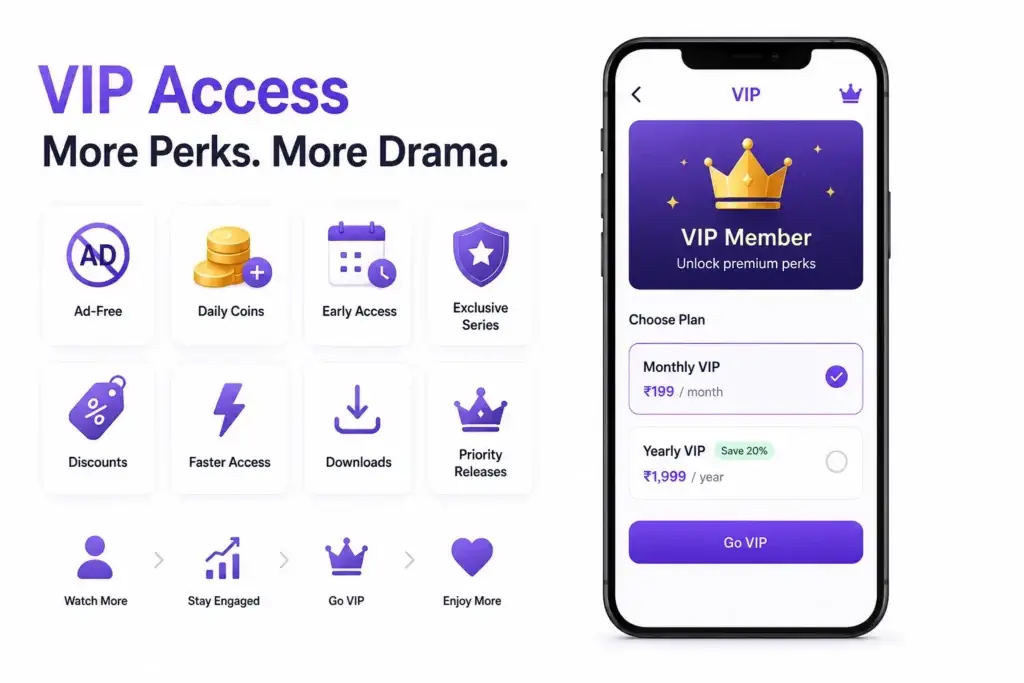
VIP access can include:
- Ad-free viewing
- Daily bonus coins
- Early access to new episodes
- Exclusive series
- Discounted episode unlocks
- Faster episode access
- Offline downloads for unlocked content
- Priority access to premium releases
This makes VIP valuable without always removing every monetization trigger.
When VIP Should Be Introduced
VIP is most useful when the platform has enough repeat viewing behavior.
If users are only sampling one or two episodes, VIP may feel premature. But once users start following multiple series, returning daily, or buying coins frequently, a VIP plan becomes easier to position.
A founder can use behavior-based triggers such as:
- User has unlocked several episodes
- User has watched multiple series
- User returns several days in a row
- User runs out of coins repeatedly
- User watches many rewarded ads
- User reaches a premium episode cluster
At that point, VIP becomes a convenience upgrade rather than a forced upsell.
Rewarded Ads: The Retention Safety Net
Rewarded ads are powerful because they give non-paying users a way to continue.
In a Vertical Drama Streaming App, a hard paywall can create drop-off. If a user reaches a locked episode but does not want to buy coins, the app needs a softer alternative. Rewarded ads can help bridge that gap.
A viewer may be offered:
- Watch an ad to unlock one episode
- Watch an ad to earn a small number of coins
- Complete a daily task to receive reward coins
- Return tomorrow for a check-in reward
- Try VIP for a smoother experience
This keeps the user inside the app instead of ending the session immediately.
But rewarded ads should not become unlimited free access. If users can unlock too much content through ads, the app may reduce coin purchases and VIP upgrades. Rewarded ads should be capped by frequency, user segment, episode type, and content value.
Smart Rewarded Ad Rules
A stronger rewarded ad model may include:
| Rule | Why It Matters |
|---|---|
| Daily ad limits | Prevents unlimited free unlocking |
| Episode-level ad eligibility | Keeps premium episodes protected |
| Reward coin caps | Controls monetization leakage |
| New-user ad support | Helps early retention |
| Low-balance ad prompts | Saves users from churn |
| Region-based ad strategy | Supports markets with lower paid conversion |
Rewarded ads are not only an ad revenue tool. They are a retention mechanism.
Episode Unlocks: Where Storytelling Meets Revenue
Episode unlocking is the point where content strategy and monetization meet.
The platform must decide:
- How many episodes should be free?
- Which episodes should be locked?
- Should users unlock with coins, ads, VIP, or direct purchase?
- Should the unlock be permanent or time-limited?
- Should different series have different rules?
- Should campaigns temporarily reduce unlock cost?
- Should VIP users get full access or partial benefits?
These decisions affect both revenue and retention.
A weak unlock strategy can make users feel blocked. A strong unlock strategy makes the next step feel natural because the user already wants to continue.
For founders, the most important lesson is this: a paywall only works after curiosity has been earned.
Recommended Monetization Mix by User Type
Not every viewer should see the same monetization path.
A new user needs sampling. A curious viewer needs flexible unlock options. A frequent viewer may want VIP. A high-intent fan may spend more through coin packs. A price-sensitive user may stay engaged through ads.
For a deeper breakdown of revenue streams, pricing logic, and monetization layers, explore the Vertical Drama Streaming App business model before finalizing your coin, VIP, ad, and episode unlock strategy.
| User Type | Best Monetization Path | Founder Goal |
|---|---|---|
| First-time viewer | Free episodes and onboarding rewards | Build story interest |
| Curious viewer | Small coin unlocks or rewarded ads | Encourage first conversion |
| Returning viewer | Coin packs and limited offers | Build repeat purchase behavior |
| Heavy viewer | VIP access and ad-free benefits | Increase loyalty |
| Superfan | VIP plus premium unlocks | Capture high-intent demand |
| Dormant user | Bonus coins or free episode campaigns | Re-engage without discounting everything |
This is why segmentation matters. A vertical drama platform should not use one rigid monetization rule for every viewer.
Founder Decision Signals: Which Monetization Model Should You Prioritize?
Before choosing the build route, founders should review the development cost of Vertical Drama Streaming platforms, including features, integrations, customization, payment flows, and admin controls.
Speed
If you want to test the market quickly, start with a simple mix of free episodes, coin unlocks, and rewarded ads before adding complex subscription tiers.
Cost
Building wallet logic, purchase history, ad rewards, VIP rules, and admin pricing controls from zero can increase development scope. A ready-made foundation can reduce avoidable effort.
Scalability
If you plan to grow the catalog, you need episode-level pricing, user segmentation, analytics, payment records, and admin permissions from the beginning.
Market Fit
If your audience is still learning the short-drama format, rewarded ads and free opening episodes can help build habit before stronger paid conversion starts.
What Admin Controls Should a Monetization-Ready Platform Include?
A Vertical Drama Streaming App should give the platform operator control after launch.
Monetization will change once real users start watching, paying, dropping off, or returning. If every coin price, ad reward, or VIP rule requires developer support, the business becomes slow.
Founders can also review the core Vertical Drama Streaming App features to understand how video playback, episode access, coin wallets, VIP rules, admin controls, and user engagement modules work together.
A strong admin dashboard should support:
- Series management
- Episode upload and ordering
- Free episode threshold
- Coin pack management
- Episode-level coin pricing
- Reward coin rules
- VIP plan management
- Ad unlock settings
- Daily check-in rewards
- Referral or promotional rewards
- User wallet history
- Purchase records
- Unlock history
- Regional pricing support
- Campaign controls
- Revenue analytics
- Content moderation and abuse reporting
- Role-based admin access
This is where many generic video platforms fall short. They may support video uploads and subscriptions, but they do not always support the detailed wallet and unlock logic needed for short-drama monetization.
Miracuves helps founders plan this control layer through ready-made and white-label entertainment app solutions where monetization rules, admin dashboards, and source-code ownership are part of the product foundation.
Payment and App Store Considerations Founders Should Not Ignore
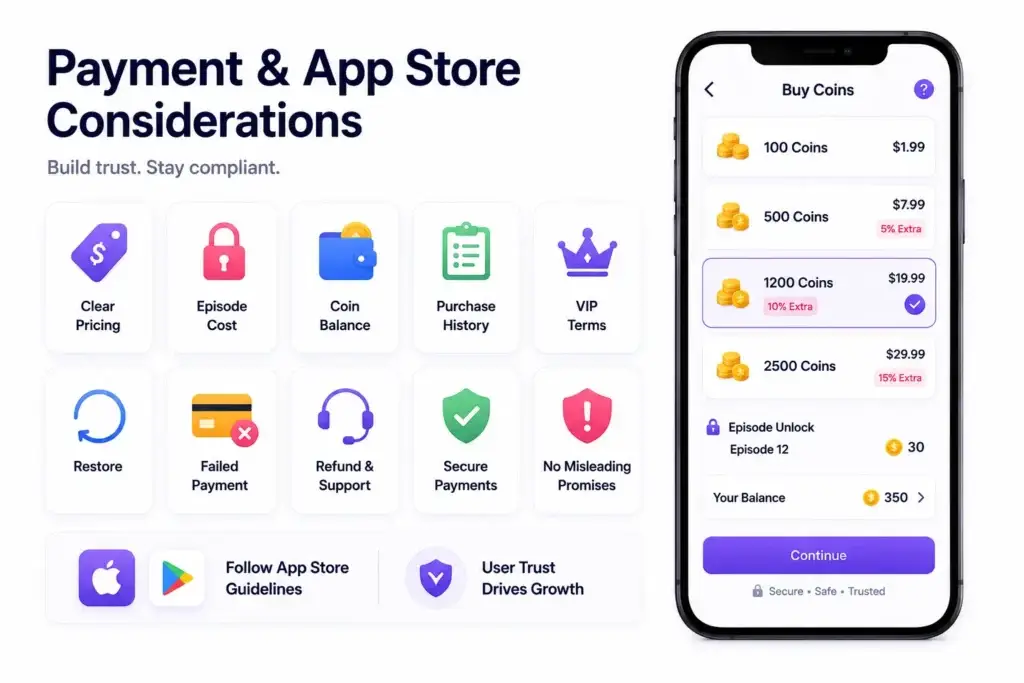
Coins, subscriptions, and paid episode unlocks are digital purchases. That means founders must think carefully about app store payment rules, user purchase clarity, refund flows, and platform policies.
A practical monetization setup should include:
- Clear pricing before users buy coins
- Clear episode cost before unlock
- Visible coin balance
- Purchase history
- Transparent VIP renewal terms
- Restore purchase support where required
- Failed payment handling
- Refund and support workflows
- Secure payment gateway integration
- No misleading unlock promises
For mobile apps, founders should review Apple App Store and Google Play payment requirements before launch. The app should be configured according to the target market, app distribution channel, and selected payment model.
This is not just a compliance issue. It affects user trust.
If users do not understand what they bought, what they unlocked, or how long access lasts, the platform may face complaints, refunds, poor reviews, and lower retention.
Monetization Metrics Every Founder Should Track
A monetization model should never be static.
Once the app goes live, founders should measure where viewers continue, where they pay, where they hesitate, and where they leave. Revenue alone is not enough. The stronger insight comes from comparing revenue with retention.
| Metric | What It Reveals |
|---|---|
| Free-to-locked episode conversion | Whether users care before the first paywall |
| Episode unlock rate | Which story points drive action |
| Coin purchase rate | How many viewers are willing to spend |
| Average coin spend per series | Which content generates direct revenue |
| Rewarded ad completion rate | Whether users accept ad-based access |
| VIP conversion rate | Whether frequent viewers see subscription value |
| Episode drop-off rate | Where monetization creates too much friction |
| Repeat viewing frequency | Whether the platform is building habit |
| Refund or complaint patterns | Whether pricing or access feels unclear |
| Revenue by genre | Which content categories deserve more investment |
These metrics help the founder improve the monetization mix without guessing.
Once founders know which episodes drive unlocks, purchases, VIP upgrades, and repeat viewing, they can use a stronger vertical drama growth strategy to improve acquisition, retention, content promotion, and long-term monetization.
For example, if users watch many free episodes but rarely unlock paid ones, the story hook may be weak or the paywall may appear too early. If rewarded ad completion is high but coin purchases are low, ad rewards may be too generous. If users buy coins repeatedly but ignore VIP, the subscription benefits may not be strong enough.
Common Monetization Mistakes Founders Should Avoid
Locking Episodes Before the Viewer Cares
A paywall only works when curiosity exists. If the lock appears before the viewer understands the characters, conflict, or emotional hook, the user may leave instead of unlocking.
Making Rewarded Ads Too Generous
Rewarded ads should reduce churn, not replace every paid action. Unlimited ad unlocks can weaken coin purchases and VIP upgrades.
Offering VIP Without Clear Value
VIP should feel meaningfully better than free access. Ad-free viewing, bonus coins, early access, and exclusive content can make the plan easier to justify.
Using One Monetization Rule for Every Series
Different genres convert differently. A thriller, romance, revenge drama, or regional story may need different free episode windows and unlock points.
How a Ready-Made Platform Helps Founders Move Faster
Building a short-drama monetization system from scratch can become complex quickly.
The app does not only need video streaming. It needs a wallet, ledger, episode access rules, coin packs, rewarded ads, VIP plans, user history, admin control, payment integration, campaign settings, content moderation, and analytics.
For founders who want to validate the opportunity faster, a ready-made foundation can reduce avoidable development effort. Instead of spending months building basic monetization infrastructure, the team can focus on branding, content acquisition, pricing experiments, user acquisition, and retention testing.
Before choosing the right build route, founders can compare vertical drama streaming app platforms to understand how monetization workflows, episode unlocks, admin controls, source-code ownership, and launch speed differ across available options.
If you need a vertical drama app development partner, Miracuves can help you plan the app structure, monetization workflows, admin dashboard, and launch-ready product foundation.
A launch-ready short-drama app foundation from Miracuves can support founders who want to enter the vertical drama market with white-label branding, admin control, monetization workflows, and source-code ownership.
The point is not to copy another platform blindly. The point is to start with a proven product structure, customize it for your audience, and keep enough control to adjust the business model after launch.
Final Thoughts: Monetization Balance Decides Platform Health
A Vertical Drama Streaming App succeeds when storytelling, access, and monetization work together.
Coins help monetize high-intent moments. VIP access supports frequent viewers who want convenience. Rewarded ads keep hesitant users engaged. Episode unlocks help the platform protect premium content and test pricing by series.
But none of these models should operate alone.
The strongest approach is a flexible monetization system where founders can adjust free episodes, coin pricing, VIP benefits, ad unlock rules, and campaign offers from the admin panel. That control matters because user behavior changes after launch.
For founders comparing ready-made and custom build paths, Miracuves’ clone app development services can help convert a proven app concept into a branded, scalable, and monetization-ready product.
For founders entering the short-drama market, the smarter decision is not simply choosing one revenue model. It is building a platform where the monetization model can evolve with the audience.
Miracuves helps founders launch video-first, monetization-ready platforms with white-label branding, source-code ownership, admin workflows, and faster execution support.
FAQs
What is a Vertical Drama Streaming App?
A Vertical Drama Streaming App is a mobile-first entertainment platform where users watch short scripted drama episodes in portrait format. These apps usually include vertical video playback, episode libraries, watch history, coin wallets, VIP access, rewarded ads, paid episode unlocks, and admin controls.
How does a Vertical Drama Streaming App make money?
A Vertical Drama Streaming App can make money through coin-based episode unlocks, VIP subscriptions, rewarded ads, premium series access, sponsored content, brand partnerships, content licensing, and promotional bundles.
Why do short drama apps use coins?
Coins allow users to unlock individual episodes without committing to a full subscription. This works well for viewers who are interested in one specific story and prefer flexible spending over a recurring plan.
Should VIP access unlock every episode?
Not always. VIP can unlock full access in some business models, but it can also offer ad-free viewing, daily bonus coins, early access, discounts, or exclusive content. The right approach depends on catalog size, user behavior, and coin revenue goals.
Are rewarded ads useful for vertical drama platforms?
Yes. Rewarded ads can help retain users who are not ready to pay. They work best as a support mechanism for free users, low-balance users, or new viewers. However, they should be capped so they do not replace paid unlocks completely.
How many free episodes should a vertical drama app offer?
There is no fixed number for every app. The free episode window should depend on story pacing, genre, audience behavior, and the strength of the first major cliffhanger. The goal is to build enough curiosity before introducing a paid or reward-based unlock.
What admin features are important for monetization?
Important admin features include coin pack management, episode pricing, free episode controls, VIP plan settings, rewarded ad limits, wallet history, purchase records, campaign rules, revenue analytics, user access controls, and content moderation tools.
Can Miracuves help build a vertical drama streaming platform?
Yes. Miracuves helps founders build video-first app platforms with branded design, monetization workflows, admin dashboards, source-code ownership, and faster deployment support.
Miracuves is an independent software development company. We are not affiliated with, connected to, sponsored by, or endorsed by any company or product named in this article.
Terms such as “X Clone” are used descriptively. It is how the software industry refers to building a platform with functionality comparable to a known service, and how clients search for it.
The entire design and codebase of our products is built by our own team. Our products contain no code, design, graphics, or content originating from any third-party website or applications.
All third-party names and marks referenced in this article are the property of their respective owners, referenced solely to identify the services discussed.