





















Key Takeaways
- A multi-vendor ecommerce marketplace must connect buyer, seller, product, order, payment, delivery, and admin workflows.
- Core features include seller onboarding, catalogue management, inventory control, search, checkout, commissions, payouts, and reporting.
- Development cost depends on platform coverage, integrations, customization, automation, security, scalability, and support.
- Source-code ownership gives founders greater control over branding, workflows, hosting, and future product expansion.
- Founders should evaluate operational completeness instead of comparing only initial pricing or total feature counts.
Marketplace Evaluation Signals
- Confirm whether customer, seller, delivery, and administrator interfaces are included in the quoted scope.
- Test seller registration, product approval, inventory updates, order processing, returns, and payout workflows.
- Review buyer search, recommendations, cart, checkout, payment, tracking, ratings, and customer-support journeys.
- Check admin controls for commissions, sellers, products, orders, disputes, refunds, promotions, permissions, and reports.
- Clarify costs for payment gateways, logistics integrations, app publishing, hosting, customization, maintenance, and post-launch support.
Real Insights
- An attractive storefront cannot compensate for weak seller operations, inaccurate inventory, or unreliable order processing.
- Marketplace complexity increases when products from multiple sellers appear within the same cart and order.
- Advanced search and recommendations become valuable only when product data and catalogue structure are accurate.
- A low initial price can create higher long-term costs when integrations, source code, documentation, or essential modules are excluded.
- Miracuves develops customizable multi-vendor ecommerce marketplaces with buyer, seller, delivery, payment, commission, and admin workflows.
Live streaming entertainment platforms do not earn only because people watch videos. They earn because viewers participate in real time, creators receive direct support, and the platform turns attention into a structured monetization system.
That is why virtual gifts, in-app coins, creator wallets, agency commissions, and revenue split logic matter so much. A live entertainment app can have beautiful streaming quality, but if the earning model is confusing, creators will not stay. If the gift economy is weak, viewers will not spend. If payouts are not controlled properly, the platform operator will struggle with trust, disputes, and financial reporting.
For founders, the real question is not simply, “Can we add live streaming?” The stronger question is, “Can we build a live entertainment ecosystem where viewers spend, creators earn, and the platform keeps a sustainable margin?”
This guide explains how live streaming entertainment platform monetization works, how virtual gifts create revenue, how creator earnings are calculated, what revenue split models founders can use, and what admin controls are needed before launching a gifting-led social platform.
Why Monetization Works Differently in Live Entertainment Platforms
Traditional video platforms often depend on advertising, subscriptions, or content licensing. Live streaming entertainment platforms work differently because the value is created in the moment.
A viewer is not just watching a video. They are reacting to a host, joining a live room, competing in gift battles, supporting a performer, helping a creator rank higher, or participating in a social event. This real-time interaction creates monetization opportunities that static content cannot easily match.
The strongest live entertainment platforms usually combine three layers:
- Viewer spending: coins, gifts, premium rooms, subscriptions, badges, boosts, and paid interactions.
- Creator earnings: gift rewards, bonuses, agency incentives, live milestones, and withdrawal systems.
- Platform revenue: gift commissions, coin purchase margins, subscriptions, advertising, agency shares, and promotional placements.
For founders, this means monetization should not be treated as a small add-on after the video feature is built. It should be part of the product architecture from the beginning.
How Virtual Gifts Create Revenue in Live Streaming Apps
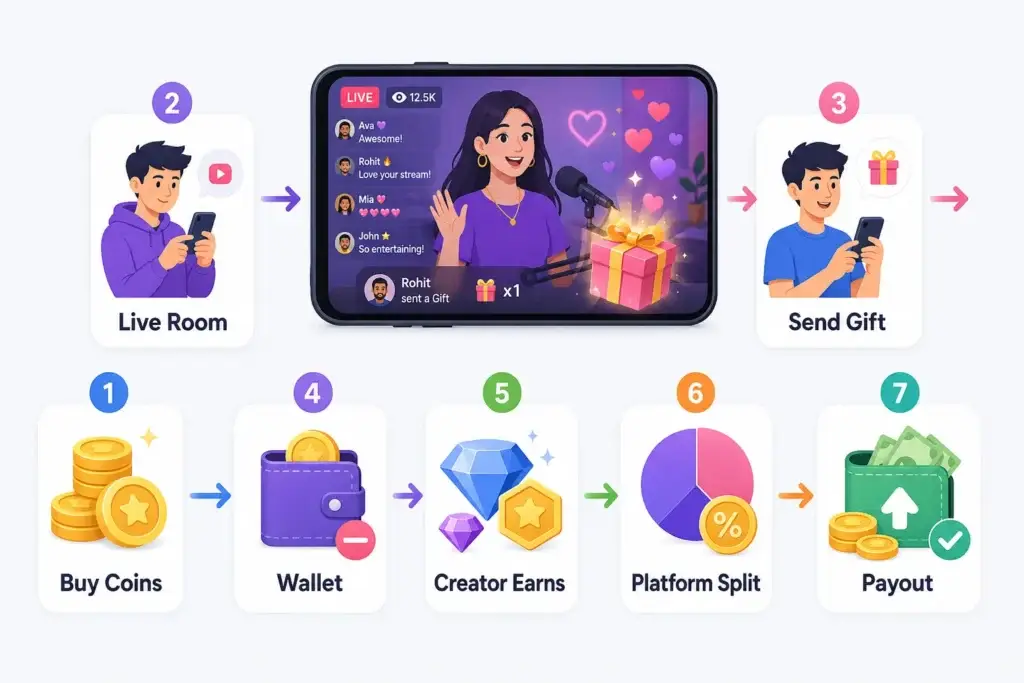
Image Source: AI-generated visual by Miracuves
Virtual gifts are digital items viewers buy and send to creators during live sessions. These gifts may appear as animations, badges, emojis, stickers, luxury effects, room highlights, or leaderboard actions.
Behind the animation, however, a gift is a financial event.
A typical virtual gifting flow looks like this:
- A viewer buys coins or credits through the app.
- The viewer enters a live room and selects a gift.
- The gift value is deducted from the viewer’s wallet.
- The gift animation appears in the room.
- The creator receives reward value in diamonds, beans, points, or another internal earning unit.
- The platform applies a predefined revenue split.
- The creator can request withdrawal after meeting payout rules.
This model works because it connects emotional engagement with instant spending. A viewer can support a creator publicly, gain visibility in the room, participate in competitions, or help the host climb a leaderboard.
For the platform operator, the gift system creates repeat transactions. Instead of relying only on monthly subscriptions, the platform earns each time a viewer purchases and spends coins.
The Core Components of a Virtual Gifting Economy
A strong virtual gifting economy needs more than a gift drawer. It needs clear rules across wallet, pricing, conversion, fraud control, and creator payouts.
| Monetization Component | What It Does | Why It Matters for Founders |
|---|---|---|
| Coin Wallet | Stores user-purchased credits | Allows viewers to spend quickly inside live rooms |
| Gift Catalog | Defines gift names, prices, categories, and animations | Lets operators create low-value, mid-value, and premium gifting tiers |
| Creator Earning Unit | Converts gift value into creator-side rewards | Separates viewer spending from payout accounting |
| Revenue Split Engine | Divides value between platform, creator, agency, and others | Protects platform margin while keeping creators motivated |
| Withdrawal System | Lets creators request payouts | Builds trust and supports professional creators |
| Admin Review | Approves, rejects, or holds suspicious payouts | Reduces payout abuse and financial disputes |
| Reports and Analytics | Tracks gifts, top spenders, top creators, room revenue, and payout trends | Helps operators improve monetization strategy |
A founder should think of virtual gifts as a controlled micro-transaction system, not only as a fun engagement feature.
Creator Earnings: What Makes Hosts Stay on a Live Streaming Platform?
Creators stay where they can earn consistently, understand the rules, and build a community. If the earning system feels unclear or unfair, even talented hosts will move to another platform.
A creator earnings model usually includes:
- Gift-based earnings from viewers
- Live session bonuses
- Agency-managed host incentives
- Event rewards
- Leaderboard prizes
- Premium room earnings
- Subscription or fan club income
- Co-host or PK battle rewards
- Referral or invite bonuses
The important point is that creator earnings should be predictable enough to build trust, but flexible enough for the platform operator to adjust campaigns, events, categories, and regional payout rules.
For example, a new platform may use higher creator incentives in the first few months to attract hosts. Later, it may introduce segmented splits based on creator level, monthly gift volume, room category, or agency contribution.
This is why the admin panel matters. Without admin control over earnings, withdrawal approvals, gift performance, and creator activity, the operator has very little room to manage the business.
Read More: Why Startups Choose a Ready-Made Live Streaming Entertainment Platform Over Custom Development
Understanding Revenue Splits in Live Entertainment Apps
Revenue split is the percentage logic that decides how much value goes to each participant after a viewer sends a gift or buys a monetized item.
A simple model may divide revenue between:
- Platform
- Creator
A more advanced live entertainment platform may divide value across:
- Platform operator
- Host or creator
- Talent agency
- Family or creator group
- Co-hosts
- Event pool
- Regional partner
- Payment processing or tax reserve
The right revenue split depends on the business model. A creator-first platform may offer higher creator earnings. An agency-led platform may reserve a share for talent recruiters. A social gaming live room may distribute earnings differently between hosts and competition winners.
Example Revenue Split Structures
| Model | Platform Share | Creator Share | Other Share | Best For |
|---|---|---|---|---|
| Creator-first model | Moderate | Higher | None or low | New platforms trying to attract strong hosts |
| Agency-led model | Moderate | Balanced | Agency commission | Markets where agencies recruit and manage streamers |
| Event-based model | Flexible | Performance-based | Prize pool or event pool | Competitions, battles, tournaments, and live campaigns |
| Premium-room model | Higher | Balanced | Optional partner share | Exclusive rooms, subscriber-only sessions, niche communities |
| Regional partner model | Configurable | Configurable | Partner or local operator share | Multi-region entertainment platforms |
The mistake many founders make is locking themselves into one revenue split too early. A scalable platform should allow splits to be adjusted by room type, creator level, campaign, country, agency, or platform strategy.
Why In-App Coins Are Better Than Direct Payments for Live Gifts
In-app coins make live entertainment monetization smoother because viewers can buy once and spend repeatedly.
Direct payment for every gift creates too much friction. A viewer may hesitate if they have to complete payment steps during a live moment. Coins reduce that hesitation because the spending action becomes instant once the wallet is funded.
Coins also give the platform more control over:
- Gift pricing
- Bonus coin campaigns
- First-purchase offers
- Regional pricing
- Refund policies
- Wallet balances
- Spending analytics
- Fraud signals
- Creator reward conversion
For founders, this improves both user experience and financial visibility. The platform can track not only how much users spend, but where they spend, which creators drive higher gift volume, and which rooms convert viewers into paying supporters.
Monetization Models Beyond Virtual Gifts
Virtual gifts are powerful, but they should not be the only revenue stream. A stronger live streaming entertainment business usually combines multiple monetization layers.
1. Platform Commission on Gifts
The platform keeps a percentage of gift value before allocating creator rewards. This is often the core revenue engine for gifting-led live entertainment apps.
2. Coin Purchase Margin
The platform may create pricing bundles where users buy coins in packs. Larger bundles can include bonus coins, helping increase prepaid wallet balances and repeat spending.
3. Premium Live Rooms
Creators or platform operators can run paid rooms for exclusive performances, coaching, fan interactions, private communities, or special events.
4. Creator Subscriptions
Fans can subscribe to creators for exclusive badges, private content, subscriber-only rooms, or priority interactions.
5. Live Battles and Competitions
PK battles, contests, and leaderboard events encourage gifting because viewers want to help their favorite creators win.
6. Agency and Host Networks
Talent agencies can recruit creators, manage performance, and earn a share from host activity. This model helps platforms scale creator supply faster.
7. In-App Advertising
Ads can support revenue, but founders should use them carefully. Too many ads can reduce live room engagement, especially when gifting is the primary monetization model.
8. Paid Boosts and Featured Placement
Creators may pay or qualify for promoted visibility in discovery sections, category pages, or event banners.
9. Brand Sponsorships
As the platform grows, branded live events, sponsored challenges, and creator-led campaigns can become valuable revenue channels.
Founder Decision Signals for Live Streaming Monetization
Creator Supply
If your platform depends on live hosts, your earning model must be attractive enough to bring creators in before large viewer demand exists.
Gift Liquidity
If viewers buy coins but do not spend them, the product has a conversion problem. Gift pricing, room energy, and creator prompts need improvement.
Revenue Control
If every creator, agency, and region needs the same split, the business may become rigid. Configurable split logic gives operators room to experiment.
Payout Trust
If creators cannot understand earnings or withdrawals, trust breaks quickly. Transparent ledgers, payout history, and admin review are essential.
What Admin Controls Are Needed for Creator Earnings and Revenue Splits?
The admin panel is where monetization becomes manageable. Without a strong admin layer, the platform operator may struggle to control gift pricing, creator payouts, agency commissions, disputes, fraud, and financial records.
A monetization-ready admin dashboard should include:
- Gift catalog management
- Coin package management
- Creator wallet tracking
- Viewer wallet tracking
- Gift transaction history
- Revenue split settings
- Creator withdrawal requests
- Payout approval and rejection
- Agency commission tracking
- Room-level revenue analytics
- Top creator reports
- Top spender reports
- Suspicious activity flags
- Refund and dispute records
- Audit logs for admin actions
This matters because gifting platforms involve many small transactions. A single live room can generate hundreds or thousands of gift events. Each event needs accurate balance movement, split calculation, reporting, and room broadcast behavior.
Miracuves’ live entertainment platform foundation is built around these operator needs, including gifting, wallet flows, creator-side earnings, withdrawal logic, moderation, and admin visibility. Founders who want a faster route to launch can explore the platform through Miracuves’ launch-ready live streaming app solution .
The Role of Agencies in Live Streaming Entertainment Monetization
In many live entertainment markets, agencies help platforms scale creator supply. They recruit hosts, train them, manage live schedules, monitor performance, and encourage creators to stay active.
An agency layer can support:
- Host recruitment
- Creator onboarding
- Contract management
- Performance tracking
- Earnings visibility
- Sub-agency structures
- Host transfers
- Creator targets
- Agency commission payouts
This model is especially useful when a founder wants to launch with professional creators rather than relying only on organic user-generated live streams.
From a revenue perspective, agencies create a more structured creator network. The platform can assign agency-level incentives, reward high-performing managers, and grow regional creator communities faster.
However, agency monetization must be carefully controlled. If agency commissions reduce creator earnings too aggressively, hosts may leave. If agency rules are not transparent, disputes can increase. A clear split structure protects all sides: platform, creator, agency, and viewer experience.
How Live Battles Increase Gift Spending
Live battles, often called PK battles or creator competitions, are powerful because they turn gifting into a public, time-limited event.
Instead of sending gifts only as appreciation, viewers send gifts to help their favorite host win. This adds urgency, competition, social proof, and community participation.
A strong live battle system may include:
- Two or more competing hosts
- Real-time gift score
- Countdown timer
- Viewer contribution display
- Winner animation
- Ranking boost
- Reward pool
- Post-battle results
- Event-based gift campaigns
For founders, live battles are valuable because they can increase gift frequency and session duration. Viewers stay longer when the outcome is not yet decided. Creators promote battles because winning improves visibility and status.
The business opportunity is not only the battle itself. It is the repeated loop of competition, gifting, recognition, ranking, and creator motivation.
How to Design a Sustainable Creator Payout System
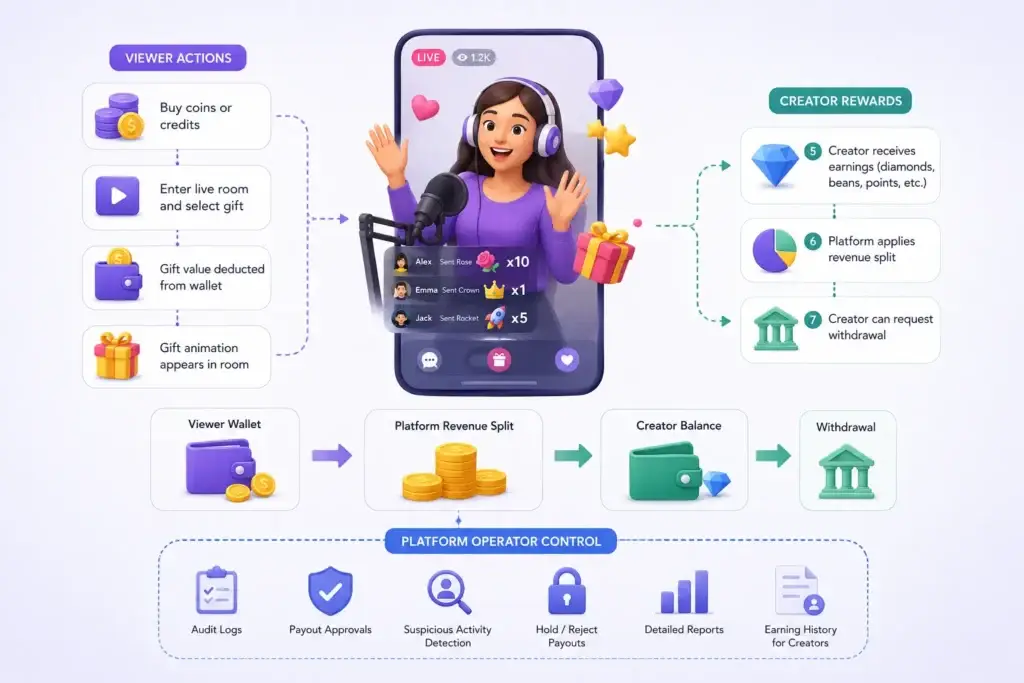
Image Source: AI-generated visual by Miracuves
A creator payout system should balance creator motivation with platform safety.
The payout flow should answer these questions clearly:
- What earning unit does the creator receive?
- How does gift value convert into creator balance?
- What is the minimum withdrawal threshold?
- How often can creators request payout?
- Which payment methods are supported?
- What happens if suspicious activity is detected?
- Can admins hold or reject payouts?
- Are agency shares calculated before or after creator rewards?
- Are taxes, fees, or payment gateway charges handled separately?
- Can creators see detailed earning history?
A good payout system gives creators confidence while giving operators control. It should show creators how much they earned, from which rooms, during which sessions, and from which monetization sources.
For the platform, the payout system should include audit logs, approval workflows, and reporting. This reduces confusion when creators ask why a payout was delayed, adjusted, approved, or rejected.
Common Mistakes Founders Make With Live Streaming Monetization
Treating gifts as only animations
Virtual gifts are part of the financial system. If the wallet, split, creator balance, and transaction record are not designed properly, the platform can face payout confusion and user trust issues.
Using one fixed revenue split for every creator
New creators, top hosts, agencies, regional partners, and event campaigns may need different earning rules. Fixed splits can limit growth experiments.
Ignoring creator-side transparency
Creators need to understand how earnings are calculated. A poor earnings dashboard can create support tickets, disputes, and creator churn.
Launching without moderation and abuse controls
Live rooms move fast. Platforms need room monitoring, report queues, abuse reporting, creator verification, and payout checks to protect users and platform reputation.
Virtual Gifts vs Subscriptions vs Ads: Which Revenue Model Should Lead?
The right monetization model depends on the platform’s audience behavior.
| Revenue Model | Works Best When | Founder Consideration |
|---|---|---|
| Virtual Gifts | Viewers form emotional connections with hosts | Strong for entertainment, social discovery, karaoke, gaming, and creator-led live rooms |
| Subscriptions | Creators offer recurring exclusive value | Better for loyal fan communities and premium access |
| Ads | Platform has large viewer traffic | Usually weaker in early-stage platforms without scale |
| Paid Rooms | Hosts offer special performances or niche access | Useful for premium sessions, classes, fan calls, and events |
| Agency Commissions | Creator recruitment is managed professionally | Strong for markets where talent networks drive supply |
| Brand Campaigns | Platform has creator reach and audience segments | Better after traction, trust, and audience data exist |
Most founders should not choose only one model. A healthy live entertainment app can combine virtual gifts for real-time revenue, subscriptions for recurring income, paid rooms for premium access, and campaigns for growth-stage monetization.
What Founders Should Build Before Scaling Monetization
Before pushing aggressive monetization, founders should make sure the product foundation is ready.
Important launch layers include:
- Stable live room experience
- Low-latency chat and reactions
- Gift catalog and gift animation logic
- Coin wallet and payment integration
- Creator earnings dashboard
- Withdrawal request flow
- Admin approval system
- Revenue split configuration
- Live room moderation
- User and creator reporting
- Agency or host management if relevant
- Analytics for gifts, revenue, creators, and retention
The biggest risk is launching monetization before trust exists. Viewers need confidence that coins work. Creators need confidence that earnings are tracked. Operators need confidence that payouts can be controlled.
This is where a ready-made platform foundation can reduce execution risk. Instead of building every wallet, gift, room, payout, and admin module from zero, founders can start with a working architecture and customize it around their market.
How Miracuves Helps Founders Build a Monetization-Ready Live Entertainment Platform
A successful live entertainment platform is not built around streaming alone. It needs a complete monetization layer where viewer wallets, virtual gifts, creator earnings, live room formats, moderation controls, gift catalogs, payout workflows, and revenue split rules work smoothly together.
Miracuves helps founders move faster with ready-made, white-label live entertainment app foundations designed for real platform operations. Instead of building every wallet, gifting, payout, and admin module from zero, founders can start with a launch-ready structure and customize it around their brand, creator model, gift economy, audience type, and revenue strategy.
For founders planning to build a social live entertainment product, Miracuves’ live streaming platform foundation offers a practical next step when you are ready to review features, deployment scope, demos, pricing, and platform readiness. This blog helps you understand the monetization logic first, so your buying decision is based on how the business model should actually work.
Related reading: From Host Recruitment to Revenue Split and Live Streaming Entertainment Platform Go-to-Market Strategy.
Final Thoughts: Monetization Is the Real Product Layer
Live streaming entertainment platforms succeed when creators, viewers, and operators all have a reason to stay.
Viewers need exciting ways to participate. Creators need earning potential and transparent payouts. Platform operators need sustainable revenue, configurable splits, moderation controls, and analytics.
Virtual gifts may look simple on the surface, but the real business value sits underneath: wallet logic, gift pricing, split calculation, creator earnings, agency controls, withdrawal approvals, and trust systems.
For founders, the smarter move is not to add monetization at the end. It is to build the live entertainment platform around monetization from day one. That is how a platform becomes more than a streaming app. It becomes a creator economy business.
FAQs
How do live streaming entertainment platforms make money?
Live streaming entertainment platforms make money through virtual gifts, in-app coins, platform commissions, premium rooms, subscriptions, paid boosts, advertising, brand campaigns, and agency-led creator monetization. The strongest model usually combines viewer spending with creator incentives and platform revenue control.
What are virtual gifts in a live streaming app?
Virtual gifts are digital items viewers purchase and send to creators during live streams. They may appear as animations, badges, stickers, or special effects. Behind the visual layer, each gift triggers wallet deduction, creator reward calculation, and platform revenue split logic.
How do creators earn from live streaming platforms?
Creators can earn from gifts, paid rooms, subscriptions, event bonuses, fan clubs, battles, agency incentives, and promotional campaigns. A good creator earnings system should include transparent wallet balances, earning history, withdrawal requests, and payout status tracking.
What is a revenue split in live streaming monetization?
A revenue split defines how gift or transaction value is divided between the platform, creator, agency, co-host, event pool, or regional partner. Revenue splits should be configurable because different room types, creator levels, and business models may need different payout logic.
Why are coins used in live streaming apps?
Coins reduce payment friction. Viewers buy coin packages once and spend instantly during live rooms. This helps platforms increase gift activity, track wallet behavior, run bonus campaigns, and manage gift pricing more effectively.
Should a new live streaming platform use ads or virtual gifts first?
For social live entertainment platforms, virtual gifts are often more aligned with real-time engagement than ads. Ads usually work better after traffic scales. A new platform may start with gifts, paid rooms, and creator incentives, then add advertising and brand campaigns later.
What admin features are needed for live streaming monetization?
Important admin features include gift catalog management, coin package settings, wallet tracking, creator earnings reports, withdrawal approvals, revenue split configuration, agency commission tracking, moderation queues, dispute records, and audit logs.
How can Miracuves help with live streaming platform monetization?
Miracuves can help founders build a white-label live entertainment platform with virtual gifting, wallet flows, creator earnings, admin control, revenue split logic, and customizable business rules. This helps founders move faster than building every monetization module from zero.
Miracuves is an independent software development company. We are not affiliated with, connected to, sponsored by, or endorsed by any company or product named in this article.
Terms such as “X Clone” are used descriptively. It is how the software industry refers to building a platform with functionality comparable to a known service, and how clients search for it.
The entire design and codebase of our products is built by our own team. Our products contain no code, design, graphics, or content originating from any third-party website or applications.
All third-party names and marks referenced in this article are the property of their respective owners, referenced solely to identify the services discussed.