
























Key Takeaways
- Live Social Audio Platform should manage large voice rooms with clear host, moderator, speaker, and listener roles.
- Large rooms should work like a stage, with controlled movement between audience and speakers instead of open microphones for everyone.
- Hand-raise queues, speaker limits, mute controls, and real-time presence help keep conversations organized as audiences grow.
- Moderation needs to happen during the live session through reporting, removal, role controls, and admin review workflows.
- Audio quality, room-state synchronization, engagement tools, monetization, and operator visibility should work together without disrupting the conversation.
Room Quality Signals
- If too many users speak at once, speaker limits and host-controlled promotion should be strengthened.
- If users see stale speaker or mute states, the real-time event and presence layer needs improvement.
- High attendance with low listening time can indicate weak room structure even when user acquisition is strong.
- High hand-raise activity with low acceptance may require better queue management, co-host support, or timed speaker slots.
- Rising report frequency in specific room categories can signal the need for stronger moderation rules and operator oversight.
Real Insights
- Room capacity matters less than whether users can follow the conversation comfortably.
- Listener participation should stay visible through reactions, chat, follows, gifts, polls, and hand raises without interrupting speakers.
- Monetization features such as gifts, VIP priority, and paid rooms should support the experience rather than dominate it.
- Large-room scalability depends on RTC infrastructure, reconnection logic, event synchronization, monitoring, and controlled audio publishing.
- The strongest flow is: join as listener → engage without interruption → raise hand → enter queue → receive host approval → speak with limited permissions → return to listener mode.
A Social Audio Platform becomes exciting when rooms grow.
More listeners mean more energy. More speakers mean better discussion. More creators mean stronger community activity. More gifts, comments, follows, and reactions can also create better monetization opportunities.
But large voice rooms create a serious product challenge.
When too many people want to speak, the conversation can become noisy. When room state lags, users lose trust. When moderation is weak, the host loses control. When audio quality drops, listeners leave. When a room has no structure, growth turns into chaos.
This is why large-room management is one of the most important parts of building a Live Social Audio Platform.
A strong Social Audio Platform should not treat a large room like a simple group call. It needs host controls, speaker roles, listener permissions, hand-raise queues, moderation tools, live presence, real-time state updates, scalable audio infrastructure, and admin visibility.
For founders, the goal is not only to support more users in a room. The goal is to keep the room listenable, safe, engaging, and monetization-ready as the audience grows.
Why Large Voice Rooms Break Without Structure
Small audio rooms feel easy to manage.
A few people join, one person speaks, another responds, and the conversation flows naturally. But once the room grows, the same structure stops working. If everyone can speak at once, the room becomes difficult to follow. If listeners cannot request speaking access clearly, they interrupt or leave. If hosts cannot mute or remove disruptive users, the room loses quality.
A large live audio room needs structure because it behaves more like a stage than a private call.
There are usually four layers of participation:
| Room Role | Purpose | Why It Matters in Large Rooms |
|---|---|---|
| Host | Owns the room and controls the flow | Keeps the session organized |
| Moderator | Supports safety and room discipline | Helps manage reports, disruptions, and speaker behavior |
| Speaker | Participates in the live conversation | Adds value without overwhelming the room |
| Listener | Joins, reacts, follows, gifts, or requests to speak | Keeps the audience engaged without creating noise |
This role system is what protects quality. The more people join, the more important permissions become.
Without clear roles, a Social Audio Platform becomes hard to scale because every room depends on the host manually handling chaos.
The Room Should Work Like a Stage, Not a Group Call
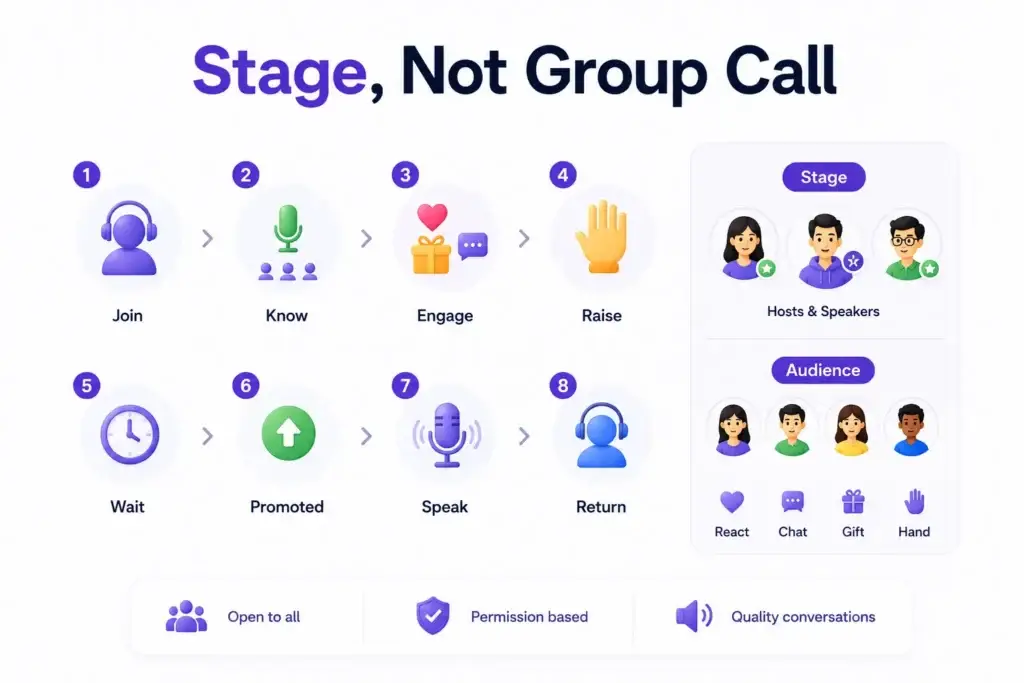
One of the biggest product mistakes in social audio is treating every voice room like a conference call.
A group call is designed for equal participation. A large live audio room is different. It needs a stage, an audience, and controlled movement between both.
The best room design gives users a clear path:
- Join as a listener.
- Understand who is hosting and speaking.
- React, follow, chat, or send gifts without interrupting.
- Raise a hand to request speaking access.
- Wait in a queue.
- Get promoted by the host or moderator.
- Speak with limited room permissions.
- Return to listener status when done.
This structure keeps the room open but controlled.
The listener does not feel ignored because there is a visible participation path. The host does not lose control because speaking access is permission-based. The speaker does not compete with unlimited noise because the stage is limited.
That is how large rooms stay conversational instead of becoming chaotic.
Speaker Queue Management Keeps Conversation Quality High
The hand-raise queue is one of the most important features in a large Social Audio Platform.
It gives listeners a respectful way to participate without interrupting the room. It also gives hosts a structured way to select speakers, control timing, and keep the conversation focused.
A good speaker queue should include:
- Hand-raise request
- Request timestamp
- User profile preview
- Host approval
- Moderator approval
- Speaker promotion
- Speaker demotion
- Queue removal
- Request expiry
- Speaker limit rules
- Optional priority rules for VIP users or verified creators
For founders, this feature is more than a user experience detail. It affects retention.
When listeners feel they have a fair chance to participate, they stay longer. When hosts can manage speakers easily, they run better rooms. When conversations stay clean, audiences return.
Speaker Limits Prevent Room Fatigue
A large audio room does not need unlimited speakers.
In fact, too many speakers can reduce quality. Users may talk over each other, conversations may lose direction, and listeners may struggle to understand who matters.
A strong platform should let hosts define or follow speaker limits.
For example:
| Room Type | Suggested Speaker Logic |
|---|---|
| Casual hangout | More flexible speaker count |
| Expert discussion | Smaller speaker panel |
| Creator fan room | Host-led with selected speakers |
| Paid room | Strict speaker and moderator controls |
| Debate room | Timed speaker turns and stronger moderation |
| Community event | Host, co-hosts, invited speakers, and audience queue |
The right speaker limit depends on the room format.
A founder should not assume that bigger always means better. The best room is not the room where everyone can speak. It is the room where the right people can speak at the right time.
Live Presence Must Stay Accurate
In live audio, stale room state damages trust.
Users need to know who is inside the room, who is speaking, who is muted, who joined, who left, and whether their own action worked. If the app shows the wrong speaker state or delays room updates, users feel disconnected from the experience.
A large Social Audio Platform should update room state in real time.
Important presence events include:
- User joined
- User left
- User raised hand
- User cancelled request
- Host promoted speaker
- Host demoted speaker
- Speaker muted
- Speaker unmuted
- Moderator joined
- Gift sent
- Room topic changed
- Room closed
- User removed
These events need to reach every relevant participant quickly.
This is why large audio rooms need a strong real-time event layer. Polling is usually not enough for a room that depends on live state. Users should not need to refresh the app to know who is speaking.
Audio Quality Depends on Infrastructure and Room Rules
Conversation quality is not only about moderation.
It also depends on audio performance. A room may have strong hosts and good speakers, but if the audio cuts, delays, echoes, or fails to connect, users will leave.
A scalable live audio platform needs planning around:
- RTC provider selection
- Audio token generation
- Low-latency joining
- Region selection
- Reconnection handling
- Network fallback
- Speaker audio publishing
- Listener audio subscription
- Device permission handling
- Background behavior
- Event synchronization
- Monitoring and error logs
Large rooms also need product rules that protect audio quality.
For example, the app may limit the number of active speakers, separate speakers from listeners, mute new speakers by default, or prevent unauthorized audio publishing. These controls reduce technical load and make the conversation easier to follow.
Moderation Must Happen During the Room, Not After It
Live audio moderation cannot depend only on after-the-fact review.
In a large voice room, disruption happens in real time. A user may interrupt, spam chat, abuse the microphone, harass speakers, or derail the session. If the host or moderator cannot act immediately, the room quality can collapse quickly.
Room quality also depends on choosing the right access model. This guide on private and public voice rooms explains how visibility, permissions, VIP access, host controls, and moderation should change by room type.
A practical moderation system should include:
- Per-user mute
- Remove from speaker panel
- Remove from room
- Block user
- Report user
- Temporary room restriction
- Moderator assignment
- Admin review queue
- Room-level rules
- Banned-word filters for text chat
- Activity logs
- Role-based access control
The goal is not to over-control every conversation. The goal is to give hosts and operators enough tools to protect the room.
For founders, moderation is also a business issue. Poorly managed rooms affect retention, brand safety, creator trust, and advertiser confidence.
Chat, Reactions, and Gifts Should Support the Conversation
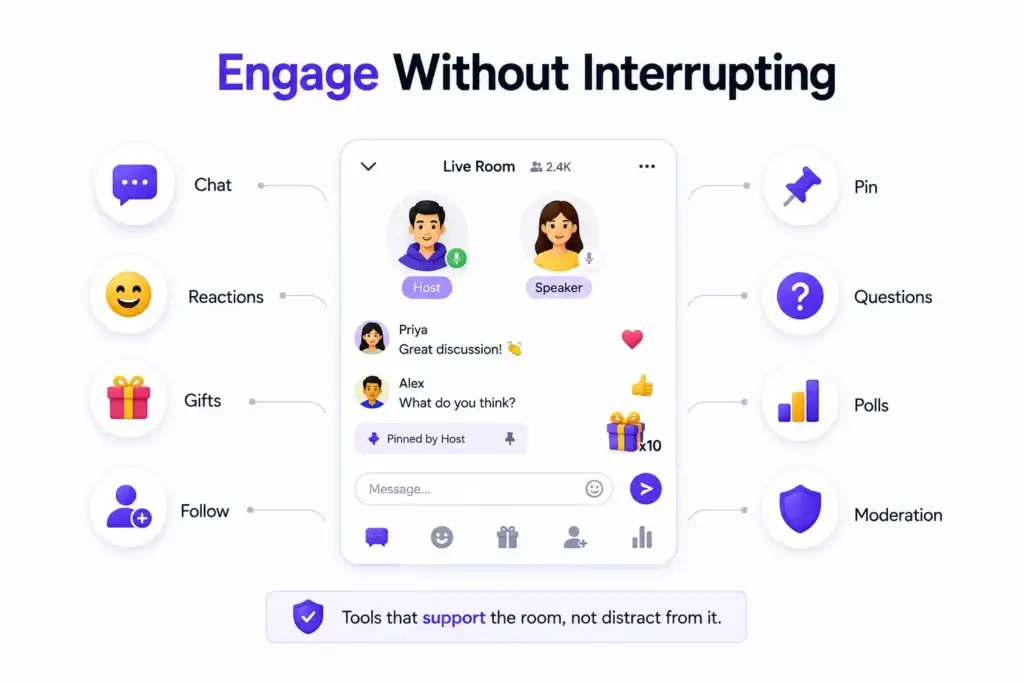
Large rooms often need more than voice.
Listeners may not always want to speak, but they still want to participate. Chat, reactions, gifts, follows, polls, and profile interactions give them ways to engage without interrupting the speaker flow.
However, these features must be designed carefully.
If chat moves too fast, it becomes noise. If gifts take over the screen, they distract from the discussion. If reactions are too aggressive, they can disrupt the mood of the room.
A balanced engagement system should include:
- In-room chat with rate limits
- Emoji reactions
- Gift animations with sensible visibility
- Follow host or speaker actions
- Pin important messages
- Highlight audience questions
- Polls or quick prompts
- Room topic reminders
- Moderation for chat content
The best engagement tools support the room. They should not compete with the conversation.
Admin Controls Needed for Large Voice Room Operations
A Social Audio Platform needs an operator console because room quality cannot depend only on hosts.
Platform operators need visibility into users, rooms, reports, monetization, and performance. They should be able to monitor active rooms, investigate complaints, review suspicious behavior, manage room categories, and adjust platform rules.
Admin Controls for Large Voice Rooms
| Admin Control | What It Manages | Founder Impact |
|---|---|---|
| Room monitoring | Active rooms, participants, hosts, speakers, and reports | Helps operators detect quality and safety issues early |
| User management | User profiles, status, bans, reports, and account history | Protects community quality as the audience grows |
| Moderator controls | Role assignment, permissions, report queues, and actions | Creates operational discipline beyond the host level |
| Room category settings | Topics, visibility, room limits, private access, and discovery rules | Improves room discovery and user experience |
| Engagement controls | Gifts, reactions, chat rules, missions, and leaderboards | Keeps monetization and engagement aligned with room quality |
| Analytics dashboard | Room duration, listener retention, speaker activity, gifts, and reports | Helps founders understand which room formats actually work |
| Safety logs | Moderation actions, reports, removals, and operator decisions | Improves trust, review workflows, and internal accountability |
Founders can also review the live social audio platform features to understand how audio rooms, hand-raise flows, host permissions, gifting, VIP access, moderation, and operator controls work together.
Room Analytics: Measuring Quality Beyond Attendance
A large room is not successful only because many users joined.
Founders need to measure whether the conversation actually worked. A room with thousands of joins but low listening time, high exits, many reports, and weak creator earnings may not be healthy.
Useful room-quality metrics include:
| Metric | What It Reveals |
|---|---|
| Average listening time | Whether users stayed for the conversation |
| Speaker-to-listener ratio | Whether the room was structured or overcrowded |
| Hand-raise acceptance rate | Whether listeners had a path to participate |
| Speaker duration | Whether a few users dominated the room |
| Drop-off after speaker change | Whether certain segments weakened engagement |
| Report frequency | Whether moderation issues affected trust |
| Gift activity | Whether the room generated creator value |
| Follow conversion | Whether listeners connected with hosts or speakers |
| Return attendance | Whether users came back to similar rooms |
| Room completion rate | Whether the event held attention until the end |
Analytics should help the operator improve room formats.
For example, if large rooms get strong attendance but weak retention, the host structure may need improvement. If hand-raise requests are high but acceptance is low, the platform may need queue management, co-hosts, or timed speaker slots. If reports rise in certain room categories, moderation rules may need tightening.
Founder Decision Signals: What Should You Prioritize First?
Speed
Start with host controls, speaker roles, listener mode, hand-raise queues, mute controls, and basic moderation before adding complex room formats.
Cost
Large-room support can increase development scope because it touches RTC usage, socket infrastructure, moderation, analytics, admin controls, and QA testing.
Scalability
If the platform expects high concurrent rooms, plan real-time broadcasting, room state synchronization, reconnect logic, event monitoring, and infrastructure scaling early.
Market Fit
If your audience depends on creator-led rooms, expert sessions, fan communities, or paid groups, conversation quality should be treated as a core product metric.
Before choosing the full build scope, founders should review the social audio platform development cost, including RTC infrastructure, mobile apps, moderation workflows, payment systems, admin dashboards, and customization requirements.
Monetization Should Not Damage Conversation Quality
Large voice rooms can create strong monetization opportunities.
Hosts can receive gifts. VIP users can access premium rooms. Communities can run paid events. Brands can sponsor rooms. Users can buy avatar upgrades, badges, profile items, or coin packages.
But monetization should not overwhelm the conversation.
If gift animations become too distracting, serious listeners may leave. If paid users dominate the speaker queue unfairly, free users may feel ignored. If VIP rooms remove too much public activity, discovery may weaken.
A healthy monetization model balances revenue with room quality.
| Monetization Feature | Quality Risk | Better Approach |
|---|---|---|
| Virtual gifts | Can distract from speakers | Use controlled animation timing and visibility |
| VIP speaker priority | Can feel unfair | Combine priority with host approval |
| Paid private rooms | Can reduce public activity | Keep public discovery strong |
| Sponsored rooms | Can feel promotional | Match sponsors with relevant communities |
| Coin-based boosts | Can create spam | Add rate limits and admin rules |
For a deeper revenue view, explore the audio app business model and how coins, gifts, VIP access, platform fees, premium rooms, and creator earnings can work together.
Common Mistakes That Hurt Large Voice Rooms
Letting Everyone Speak by Default
A room where every participant can speak may feel democratic, but it becomes difficult to manage as attendance grows. Large rooms need listener mode, speaker roles, and host approval.
Adding Gifts Without Conversation Rules
Gifting can support creator earnings, but uncontrolled animations, spam, or paid visibility can distract from the actual discussion.
Ignoring Real-Time Room State
If users cannot see who joined, who is speaking, who is muted, or whether their request worked, the platform feels unreliable.
Delaying Moderation Until After Launch
Live communities need reporting, mute controls, removal actions, role permissions, and admin queues early because disruption happens in real time.
How a Ready-Made Platform Helps Founders Manage Large Rooms Faster
Building large-room social audio infrastructure from zero can become complex quickly.
The platform needs live audio rooms, host permissions, listener mode, hand-raise queues, real-time presence, speaker state updates, chat, gifts, wallet flows, VIP access, moderation queues, room analytics, notifications, and admin controls. Each module must stay synchronized while users are interacting in real time.
Founders comparing build routes can also review this guide on a ready-made live social audio platform to understand why startups often choose launch-ready room, gifting, VIP, moderation, and admin workflows over custom development from zero.
A ready-made foundation can help founders reduce avoidable development work and focus on community strategy, host onboarding, creator growth, monetization experiments, and room quality.
Miracuves helps founders build social entertainment platforms with white-label branding, admin dashboards, source-code ownership, monetization workflows, and faster deployment support. If you want a launch-ready foundation for live rooms, speaker controls, gifting, moderation, and large-audience engagement, explore this ready-made live social audio platform from Miracuves.
You can also work with a audio platform development partner if you need help planning room logic, RTC workflows, moderation controls, wallet systems, creator monetization, and launch execution.
For broader entertainment products, explore Miracuves’ digital entertainment solutions for live streaming, creator platforms, social audio, short video, and video-first community products.
Related reading: travel platform business model breakdown and Voice Room Architecture in a Live Social Audio Platform.
Final Thoughts: Large Rooms Need Control Before They Need More Capacity
A Social Audio Platform does not become strong simply by allowing more people into a room.
Large-room success depends on structure. Hosts need control. Speakers need clear permissions. Listeners need ways to participate without interrupting. Moderators need tools to act in real time. Operators need analytics and admin visibility. Infrastructure needs to keep room state, audio events, gifts, and presence synchronized.
For founders, the priority should be conversation quality before raw room size.
A room that supports thousands of listeners but feels chaotic will not build a healthy community. A room that uses structured roles, hand-raise queues, moderation, smart engagement tools, and scalable real-time architecture has a better chance of retaining users and supporting monetization.
Miracuves helps founders move faster with white-label, source-code-owned app foundations designed for social audio, creator engagement, monetization, moderation, and long-term product growth.
For founders comparing ready-made and custom build routes, Miracuves’ clone app development services can help turn a proven app concept into a branded, scalable, and monetization-ready product.
FAQs
What is a Social Audio Platform?
A Social Audio Platform is a voice-first community app where users join live audio rooms, listen to speakers, raise hands, participate in conversations, follow hosts, send gifts, access premium rooms, and interact in real time.
Why do large voice rooms need speaker roles?
Large voice rooms need speaker roles because open microphones can quickly become noisy. Host, speaker, listener, and moderator permissions help keep the conversation organized and easier to follow.
How does a hand-raise queue improve live audio rooms?
A hand-raise queue gives listeners a structured way to request speaking access. Hosts can review requests, promote selected users, control the flow, and prevent interruptions.
What features help maintain conversation quality in large rooms?
Important features include host controls, speaker limits, hand-raise queues, mute controls, moderator roles, live presence, room reporting, chat rate limits, and real-time room state updates.
How can a Social Audio Platform manage moderation?
A Social Audio Platform can manage moderation through user reporting, mute controls, room removal, speaker demotion, moderator assignment, banned-word filters for text chat, admin review queues, and activity logs.
What metrics should founders track for large voice rooms?
Founders should track average listening time, speaker-to-listener ratio, hand-raise acceptance rate, drop-off, report frequency, gift activity, follow conversion, return attendance, and room completion rate.
Can Miracuves help build a live social audio platform?
Yes. Miracuves helps founders build social audio platforms with live rooms, speaker controls, gifting, VIP access, moderation workflows, admin dashboards, white-label branding, source-code ownership, and faster deployment support.
Miracuves is an independent software development company. We are not affiliated with, connected to, sponsored by, or endorsed by any company or product named in this article.
Terms such as “X Clone” are used descriptively. It is how the software industry refers to building a platform with functionality comparable to a known service, and how clients search for it.
The entire design and codebase of our products is built by our own team. Our products contain no code, design, graphics, or content originating from any third-party website or applications.
All third-party names and marks referenced in this article are the property of their respective owners, referenced solely to identify the services discussed.