


Key Takeaways
- Regional Ecommerce Marketplace vs Global Marketplace is mainly a decision about operational control, launch scope, seller strategy, logistics, payments, localization, support, and growth capacity.
- A regional marketplace usually gives startups tighter control over seller onboarding, delivery zones, local payment methods, customer support, and early market validation.
- A global marketplace can offer wider reach but requires stronger multi-currency support, cross-border logistics, localization, seller verification, tax workflows, and customer support.
- More products and more countries do not automatically create stronger market fit; buyer trust, seller quality, delivery reliability, and support often matter more during early growth.
- Founders should choose the model their team can operate, fund, improve, and scale without losing control of core marketplace workflows.
Marketplace Model Signals
- Regional models fit founders who need faster validation, closer seller relationships, local delivery control, simpler payments, and manageable launch costs.
- Global models fit businesses that already have international sellers, logistics partnerships, multi-currency payments, funding, localization resources, and support capacity.
- Logistics becomes significantly more complex across borders because of customs, multiple carriers, return costs, delivery delays, duties, and tracking differences.
- Localization should cover more than translation, including pricing, currency, tax rules, categories, payment methods, delivery promises, promotions, and return expectations.
- Development scope usually increases with the number of countries, currencies, languages, payment gateways, delivery integrations, seller rules, tax workflows, and admin permissions.
Real Insights
- A regional launch does not prevent global expansion; it can give founders a controlled environment to validate demand, seller quality, payments, and delivery before adding complexity.
- Global reach should not be chosen only because the addressable market appears larger. Wider reach also increases coordination, support, compliance, logistics, and financial-reporting requirements.
- A smaller, well-managed regional catalog can create a better buyer experience than a large global catalog with inconsistent sellers, delivery times, and return policies.
- Strong admin control becomes more important during multi-market expansion because sellers, commissions, delivery zones, products, payments, promotions, and refunds may need different rules by market.
- The practical decision flow is: evaluate market demand → assess seller readiness → define delivery capability → confirm payment coverage → calculate localization needs → review support capacity → estimate development and operating cost → choose regional or global scope → expand only when the first operating model is stable.
Choosing between a regional marketplace model and a global marketplace model is one of the first strategic decisions ecommerce founders need to make. Both models can work, but they require very different planning around sellers, buyers, logistics, payments, localization, compliance workflows, customer support, and growth cost.
A local-first marketplace focuses on serving selected countries, cities, or regions with stronger operational control. A global marketplace tries to serve multiple markets at wider scale, often requiring more complex currency handling, logistics partnerships, tax rules, seller onboarding, catalog localization, and customer support.
For startups, the question is not simply which model sounds bigger. The stronger question is:
Which model can your team operate, fund, launch, and improve without losing control?
This guide compares both marketplace models so founders can choose the right launch path before investing in development, marketing, seller acquisition, and operations.
For founders planning a multi-market commerce launch, Miracuves offers a multi-market retail marketplace solution with seller workflows, buyer journeys, payment logic, delivery operations, admin control, source-code ownership, and 6-day deployment where applicable.
What Is a Regional Marketplace Model?
A regional marketplace model focuses on serving a specific geography such as a country, state, city cluster, or trade region. The platform may still support multiple seller types and product categories, but the business is designed around local market behavior.
This model usually gives startups more control over:
- Seller onboarding
- Delivery zones
- Local payment methods
- Cash collection where relevant
- Regional language needs
- Tax and invoice workflows
- Customer support expectations
- Category demand
- Promotions and seasonal campaigns
- Local brand positioning
A regional approach is not small by default. A well-planned local-first commerce platform can become highly scalable. The key advantage is that founders can validate one market deeply before expanding into other regions.
This model is useful when founders want to build seller trust, manage fulfillment more carefully, and understand buyer behavior before taking on more complex cross-border operations.
What Is a Global Marketplace Model?
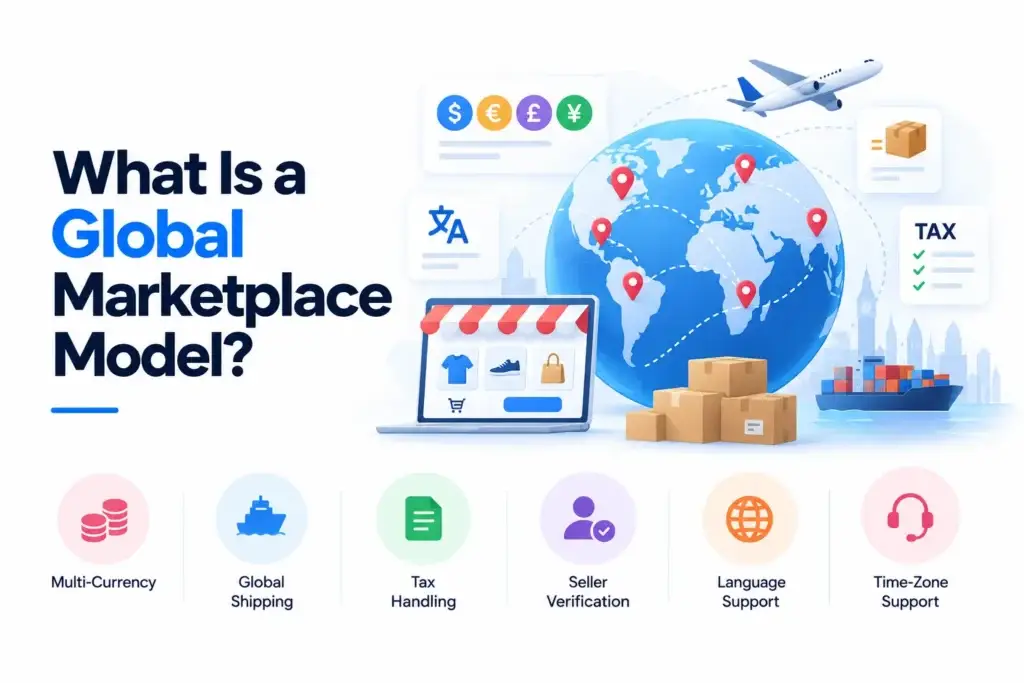
A global marketplace model is built to serve buyers and sellers across multiple countries or international regions. It may support cross-border sellers, global shipping, multi-currency payments, language localization, regional tax rules, and different delivery promises by market.
This model can offer larger reach, but it also creates more operational complexity.
Founders may need to plan:
- Multi-currency pricing
- Cross-border shipping
- Regional tax handling
- International seller verification
- Country-specific catalog restrictions
- Local language support
- Time-zone-based customer support
- International returns
- Payment gateway coverage
- Country-specific delivery expectations
- Dispute handling across different markets
A global model is attractive because the addressable market looks bigger. But for startups, bigger reach also means bigger coordination. The platform needs stronger backend logic, admin control, support workflows, and financial reporting from the beginning.
Regional vs Global Marketplace Model: Quick Comparison
| Comparison Area | Local-First Marketplace | Global Marketplace |
|---|---|---|
| Launch scope | Starts with one country, city cluster, or region | Starts across multiple countries or international markets |
| Seller onboarding | Easier to verify and support sellers locally | More complex due to documents, rules, language, and seller locations |
| Buyer trust | Can grow through local relevance and faster support | Needs stronger trust-building because buyers may deal with distant sellers |
| Logistics | Easier to manage with local delivery zones or regional partners | More complex due to international shipping, customs, returns, and delivery timelines |
| Payments | Can focus on preferred local payment methods | Needs broader payment coverage and multi-currency support |
| Catalog | Easier to localize by category and regional demand | Requires product rules, translations, pricing, and availability by country |
| Marketing | Can focus on local SEO, city campaigns, seller communities, and regional offers | Requires larger brand-building, paid campaigns, localization, and broader acquisition budgets |
| Support | Easier to manage in one language or time zone | Requires multilingual and time-zone-aware support |
| Cost control | Easier for early-stage startups to control | Higher development, integration, and operational planning needs |
| Best fit | Founders validating market demand and seller supply | Businesses with capital, partnerships, and international execution capacity |
The local-first model usually gives startups a more practical launch path. The global model can be powerful, but it should be chosen when the team has the funding, operational readiness, logistics partners, and technical foundation to support it.
Seller Strategy: Local Depth vs International Reach
Seller strategy changes significantly between the two models.
In a local-first commerce platform, founders can build close relationships with sellers. They can train vendors, help with catalog uploads, verify business information, understand category gaps, and solve early operational issues faster.
This works well for startups because early seller quality matters more than raw seller count.
A global model, on the other hand, may allow more sellers across different markets. But it also requires stricter verification, catalog rules, payout logic, seller support, and marketplace policies.
Founders should ask:
- Can sellers manage their own catalog?
- Do sellers need onboarding support?
- Will the platform verify business documents?
- Can sellers ship reliably?
- How will seller payouts work?
- Will sellers follow category and product standards?
- How will seller performance be measured?
- What happens when sellers fail fulfillment?
For a feature-level view of seller onboarding, catalog management, buyer journeys, delivery workflows, and admin operations, explore these multi-seller marketplace features.
Buyer Experience: Regional Relevance vs Global Selection
A local-first marketplace can win by offering regional relevance. Buyers may prefer platforms that understand local product demand, payment habits, delivery expectations, language, customer support needs, and return preferences.
This model can create trust through:
- Local sellers
- Faster delivery promises
- Familiar payment methods
- Region-specific deals
- Local customer support
- Relevant categories
- Easier returns
- Clear product availability
A global marketplace usually wins through wider selection, broader seller access, and larger product variety. But more variety can also create trust issues if delivery takes longer, returns are unclear, or seller quality varies widely.
Startups should not assume that more products automatically create a better buyer experience. A smaller but well-managed catalog can outperform a larger but messy catalog during early launch.
The founder decision is simple:
Do buyers need more selection, or do they need more trust, speed, and local relevance?
For many early-stage startups, trust and reliability are stronger growth drivers than unlimited catalog size.
Logistics: The Biggest Difference Between Both Models
Logistics is where the two models separate most clearly.
A local-first platform can usually begin with controlled delivery zones, regional courier partners, store pickup, seller-managed fulfillment, or platform-managed delivery teams. This gives founders more visibility into delivery speed, failed orders, cash collection, and returns.
A global model needs more complex logistics planning. Cross-border delivery may involve different shipping partners, customs, tracking gaps, duties, taxes, delivery delays, return complexity, and customer expectations.
| Logistics Area | Local-First Model | Global Model |
|---|---|---|
| Delivery zone | Defined by city, region, or country | Defined across many countries or trade routes |
| Delivery speed | Easier to control | Harder to standardize |
| Tracking | Easier with local partners | Depends on international carrier integrations |
| Returns | Easier to manage regionally | More expensive and slower |
| Cash collection | Possible where locally relevant | Harder across borders |
| Failed delivery | Easier to investigate | More difficult across multiple partners |
| Support impact | Lower complexity | Higher ticket volume and resolution time |
Founders should choose logistics based on operational reality, not only customer promise. Fast delivery messaging is useful only when the backend can support it.
Payments, Currency, and Settlement Logic
Payment planning is another major difference.
A local-first marketplace can focus on payment methods buyers already use in the region. This may include cards, wallets, bank transfers, cash collection, or local payment gateways.
A global marketplace needs wider payment support. It may require multi-currency pricing, currency conversion rules, regional gateway coverage, country-specific payment failures, international refunds, and more detailed seller settlement reports.
Founders should evaluate:
- Which payment methods are necessary at launch?
- Is cash payment required?
- Will the platform support multiple currencies?
- How will refunds be processed?
- How will seller payouts work?
- Will payout cycles vary by region?
- How will delivery fees be separated?
- How will tax and service fees be shown?
- What payment records should admins see?
- What financial reports do sellers need?
For deeper monetization planning, review this commerce revenue structure to understand commissions, seller plans, promoted placements, delivery fees, and settlement workflows.
Localization: More Than Translation
Localization is not only language. It affects product categories, pricing, payment methods, taxes, delivery expectations, support scripts, promotional calendars, product descriptions, and trust signals.
A local-first model may need one language, one currency, and one delivery promise at launch. A global model may need different experiences by country.
Localization can include:
- Local language content
- Region-specific product categories
- Currency display
- Tax and invoice rules
- Delivery promises by location
- Local holiday campaigns
- Customer support tone
- Return-policy expectations
- Product restrictions by market
- Seller dashboard language
Startups often underestimate localization cost. Translating the app interface is only the visible part. The more difficult part is making the marketplace logic match each market.
A founder should not enter multiple markets unless the platform can adapt without creating operational confusion.
Revenue Model Differences
Both marketplace models can use similar revenue streams, but the timing and complexity differ.
Common monetization options include:
| Revenue Stream | Local-First Model | Global Model |
|---|---|---|
| Seller commission | Simple to start and easier to explain | May vary by country, category, or seller region |
| Listing fees | Useful for curated local sellers | Harder if seller acquisition is competitive |
| Subscription plans | Works after sellers see traction | Can vary by country and seller size |
| Promoted listings | Useful once local buyer traffic grows | Requires larger traffic volume and ad controls |
| Delivery fees | Easier to calculate regionally | More complex with cross-border logistics |
| Service fees | Can be tested gradually | May need region-specific rules |
| Payment handling fees | Easier with local gateways | More complex with currency and gateway variation |
| Brand advertising | Useful in strong local categories | Requires scale and reporting depth |
A local-first model usually allows startups to start with a simpler revenue structure. A global model may need more advanced commission, payment, tax, and settlement rules from the beginning.
Founders should keep monetization simple during early validation. Complex revenue logic should not delay the first stable launch.
Cost and Development Scope: Which Model Is Easier to Launch?
A local-first model is usually easier to scope because the platform can start with a defined region, limited categories, selected sellers, focused payment methods, and manageable logistics.
You can also use this retail marketplace features and cost guide to compare which modules are essential for launch and which can wait.
A global model usually costs more to plan and develop because it needs broader operational support.
Cost-driving factors include:
- Number of countries or regions
- Multi-currency setup
- Tax and invoice rules
- Payment gateway coverage
- Cross-border delivery logic
- Seller verification complexity
- Multi-language support
- Country-specific catalog rules
- Return and refund workflows
- Admin permissions
- Reporting and settlement depth
- Third-party integrations
- Scalability requirements
For scope and budgeting, founders can review this marketplace cost planning guide before finalizing launch requirements.
The smartest path is not always the biggest build. It is the build that gives the startup enough control to launch, validate, and expand without rebuilding core workflows later.
Operational Control: Why Admin Systems Matter More in Multi-Market Growth
The admin dashboard is where marketplace strategy becomes daily execution. It controls sellers, buyers, product listings, categories, commissions, payments, delivery zones, refunds, banners, notifications, reports, and disputes.
For a local-first model, the admin dashboard helps founders manage the first market carefully. For a global model, admin control becomes even more important because different markets may need different rules.
A strong admin system should support:
- Seller approval
- Product approval
- Category control
- Commission settings
- Payment records
- Refund handling
- Delivery zone management
- Promotion setup
- Banner control
- Dispute management
- Reports and analytics
- Role-based access
Without strong admin control, every operational change becomes slow. This is risky when the marketplace grows across regions.
Founders should not treat the admin dashboard as a secondary backend. It is the control layer that helps the business adapt after launch.
Security and Trust Risks in Both Models
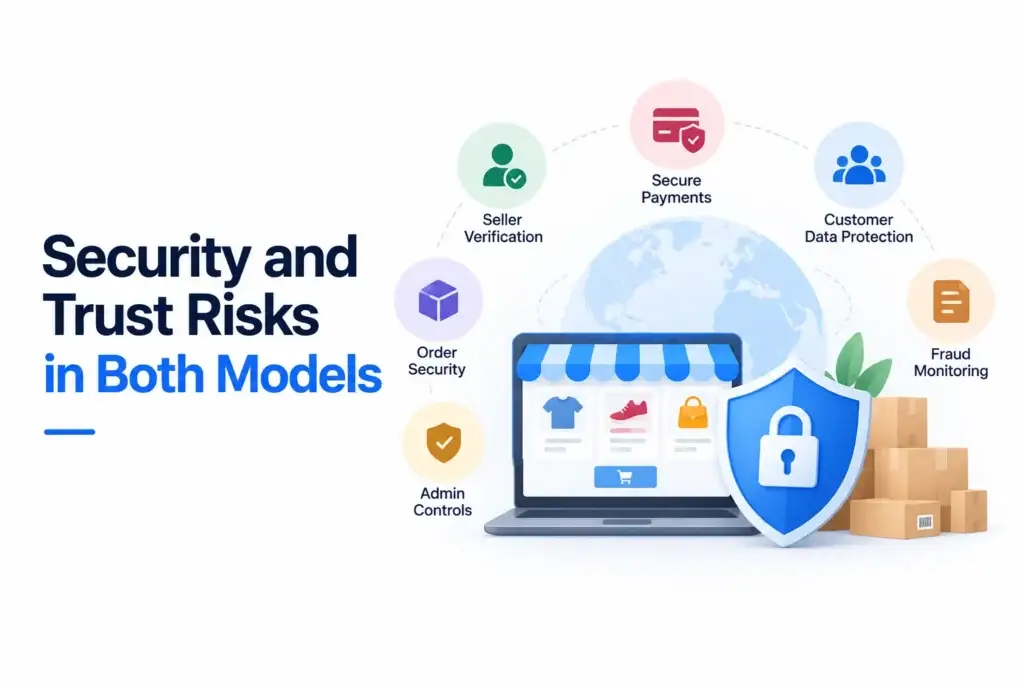
Trust is important in any marketplace, but risk increases as the platform adds more sellers, regions, payments, and delivery partners.
A local-first model may have fewer moving parts, but still needs seller verification, secure payment handling, customer data protection, order records, refund workflows, and admin permissions.
Founders should also review marketplace security planning to understand how seller accounts, payments, customer data, orders, refunds, and admin controls affect long-term trust.
A global model may need stronger security planning because more markets create more account, payment, data, and dispute scenarios.
Founders should review:
- Seller account protection
- Buyer data handling
- Secure payment gateway integration
- Refund approval workflows
- Activity logs
- Admin role permissions
- Fraud monitoring signals
- Dispute records
- Order status history
- Seller payout visibility
Founders should also review marketplace security planning to understand how seller accounts, payments, customer data, orders, refunds, and admin controls affect long-term trust.
Security should be treated as a product foundation, not a launch add-on.
When a Regional Model Fits Startups Better
A local-first model is usually better when the startup wants to validate demand with controlled risk.
It may be the right choice when:
- The founder understands one market deeply
- Seller relationships are local or regional
- Delivery operations need close control
- Buyer trust depends on local familiarity
- Payment methods are region-specific
- The budget needs discipline
- The team is small
- The marketplace needs faster launch
- Customer support should stay manageable
- The business wants to test before expanding
This approach helps founders learn from real transactions before increasing complexity.
A local-first launch does not prevent expansion. It simply creates a stronger foundation before entering additional markets.
When a Global Model May Fit Better
A global model may fit startups or businesses that already have stronger resources, partnerships, category depth, and operational readiness.
It may make sense when:
- Sellers are already available across markets
- The business has logistics partnerships
- Multi-currency payments are required from the start
- There is funding for international acquisition
- Support can handle different languages and time zones
- The catalog has cross-border demand
- The team can manage returns and disputes across regions
- The platform needs to serve multiple countries from day one
A global model should not be chosen only because it sounds larger. It should be chosen when the startup can support the complexity behind the larger reach.
Founder Decision Signals: Which Model Should You Choose?
Choose Local-First If
You need faster validation, closer seller relationships, local delivery control, simpler payments, and manageable launch cost.
Choose Global If
You already have sellers, logistics, payments, support, and funding ready for multi-country operations.
Watch Cost Scope
Multi-currency, localization, tax rules, shipping, support, and international returns can increase development and operational complexity.
Protect Market Fit
Start with the model your team can operate well. Expansion is easier when the first market is stable.
Ready-Made Marketplace Foundation vs Custom Development
Founders usually compare two build paths: starting with a ready-made foundation or investing in custom development from zero.
| Build Path | Best For | Business Impact |
|---|---|---|
| Ready-made foundation | Founders who want faster validation with proven marketplace workflows | Helps launch faster because buyer, seller, payment, delivery, and admin foundations already exist |
| Custom development | Businesses with highly unique marketplace workflows | Offers deeper flexibility but usually requires more planning, time, and budget |
| Hybrid approach | Founders who need speed with selected custom workflows | Balances faster launch with market-specific configuration |
Founders comparing technical routes can also read this commerce app development guide before deciding between a ready-made foundation and a custom build.
A ready-made foundation can be useful when the business needs common commerce workflows such as seller onboarding, product catalog, checkout, payments, orders, delivery coordination, returns, payouts, and admin control.
Custom development is better when the marketplace requires unique workflow logic, advanced integrations, unusual settlement rules, or highly specific enterprise operations.
Founders comparing technical routes can also read this commerce app development guide before deciding between a ready-made foundation and a custom build.
If your marketplace requires a fully tailored build, Miracuves also offers custom mobile app development for unique product workflows.
Common Mistakes Founders Should Avoid
Choosing Global Reach Before Operational Readiness
Wider reach sounds attractive, but it can create payment, logistics, support, return, tax, and seller management complexity before the startup is ready.
Assuming More Products Means Better Market Fit
A large catalog does not guarantee trust or conversion. Product quality, seller reliability, delivery clarity, and support experience matter more during early launch.
Ignoring Local Payment and Delivery Behavior
Buyers may prefer specific payment methods, delivery timelines, or support channels. The platform model should reflect real market behavior.
Building Without Admin Flexibility
Founders need control over sellers, products, commissions, refunds, delivery zones, promotions, and reports. Weak admin control slows every market decision.
Where Miracuves Fits Into Marketplace Model Planning
Miracuves helps founders launch ready-made and white-label marketplace platforms with source-code ownership, branded design, seller workflows, buyer journeys, payment logic, delivery operations, admin control, and deployment support.
For founders choosing between local-first and global marketplace models, the value is practical. Instead of building every standard workflow from zero, they can start with a structured commerce foundation and customize it around market scope, seller strategy, localization, payment requirements, delivery rules, and growth plans.
Where applicable, Miracuves supports 6-day deployment for ready-made marketplace solutions, depending on selected modules, branding, configuration, integrations, and final scope.
If your next step is vendor evaluation, review how to choose a marketplace development partner based on source-code ownership, deployment support, customization, and technical fit.
Final Thoughts
Choosing between a local-first marketplace and a global marketplace is not only a growth decision. It is an operations decision.
A regional launch gives startups more control over sellers, delivery, payments, customer support, catalog quality, and market validation. A global model can create wider reach, but it usually needs stronger funding, infrastructure, localization, logistics, payment coverage, and support systems.
The better model is the one your team can execute well.
For many startups, the strongest path is to validate one market deeply, build seller and buyer trust, refine the operating model, and then expand with confidence. Miracuves helps founders move faster with ready-made, white-label, source-code-owned marketplace solutions designed for practical launch execution and scalable growth.
FAQs
What is the difference between a regional marketplace and a global marketplace?
A regional marketplace focuses on selected locations with local sellers, payment methods, delivery rules, and customer behavior. A global marketplace serves multiple countries or international markets and usually needs multi-currency support, localization, cross-border logistics, and more complex operations.
Which marketplace model is better for startups?
A local-first model is often better for startups because it is easier to validate, operate, and improve. A global model can work when the business already has seller supply, logistics partnerships, payment coverage, funding, and support capacity.
Why is a regional model easier to launch?
It usually has fewer moving parts. Founders can begin with selected sellers, defined delivery zones, local payment methods, focused categories, and simpler support workflows.
When should a startup choose a global marketplace model?
A startup should consider a global model when it has enough capital, international seller access, logistics partnerships, multi-currency payment support, localization resources, and customer support coverage.
What cost factors change between regional and global marketplace models?
Cost changes based on the number of regions, currencies, languages, payment gateways, delivery integrations, seller verification rules, tax workflows, return policies, admin controls, and scalability needs.
Does a global marketplace always generate more revenue?
Not always. Wider reach does not guarantee profitability. Global operations can increase delivery costs, support needs, localization work, return complexity, and payment handling costs.
Can Miracuves help founders launch a marketplace faster?
Yes. Miracuves helps founders launch ready-made and white-label marketplace solutions with source-code ownership, branded design, admin control, marketplace workflows, and 6-day deployment where applicable.
What should founders decide before building?
Founders should decide market scope, seller strategy, product categories, payment methods, delivery model, localization needs, revenue streams, refund rules, support workflows, and admin controls before development begins.
Miracuves is an independent software development company. We are not affiliated with, connected to, sponsored by, or endorsed by any company or product named in this article.
Terms such as “X Clone” are used descriptively. It is how the software industry refers to building a platform with functionality comparable to a known service, and how clients search for it.
The entire design and codebase of our products is built by our own team. Our products contain no code, design, graphics, or content originating from any third-party website or applications.
All third-party names and marks referenced in this article are the property of their respective owners, referenced solely to identify the services discussed.