Key Takeaways
- A ready-made short-form video platform gives startups prebuilt modules for vertical video feeds, uploads, editing, discovery, engagement, moderation, monetization, and admin management.
- Compared with custom development, an existing platform foundation can reduce repeated engineering work across video processing, recommendations, creator workflows, notifications, and social interactions.
- Source-code ownership, customization flexibility, streaming performance, scalability, security, integrations, and long-term product control should guide the final development decision.
Ready-Made Platform Signals
- Prebuilt features can include vertical feeds, video recording, uploads, filters, likes, comments, shares, follows, hashtags, search, notifications, creator profiles, and moderation tools.
- Founders can customize branding, feed logic, video categories, creator tools, monetization rules, advertising, virtual gifts, subscriptions, recommendations, and engagement workflows.
- Modular architecture makes it easier to add live streaming, AI recommendations, advanced editing, creator analytics, loyalty features, localization, and new monetization models as usage grows.
Startup Decision Insights
- Startups should compare development effort, video infrastructure, customization depth, source-code access, moderation needs, scalability, integrations, maintenance, and total ownership requirements.
- Custom development may suit highly differentiated video products, while a customizable ready-made platform can help teams validate content supply, engagement, retention, and monetization without rebuilding standard modules from scratch.
- Miracuves develops customizable short-form video platforms with vertical feeds, creator tools, video processing, recommendations, engagement features, monetization, analytics, moderation, and admin controls.
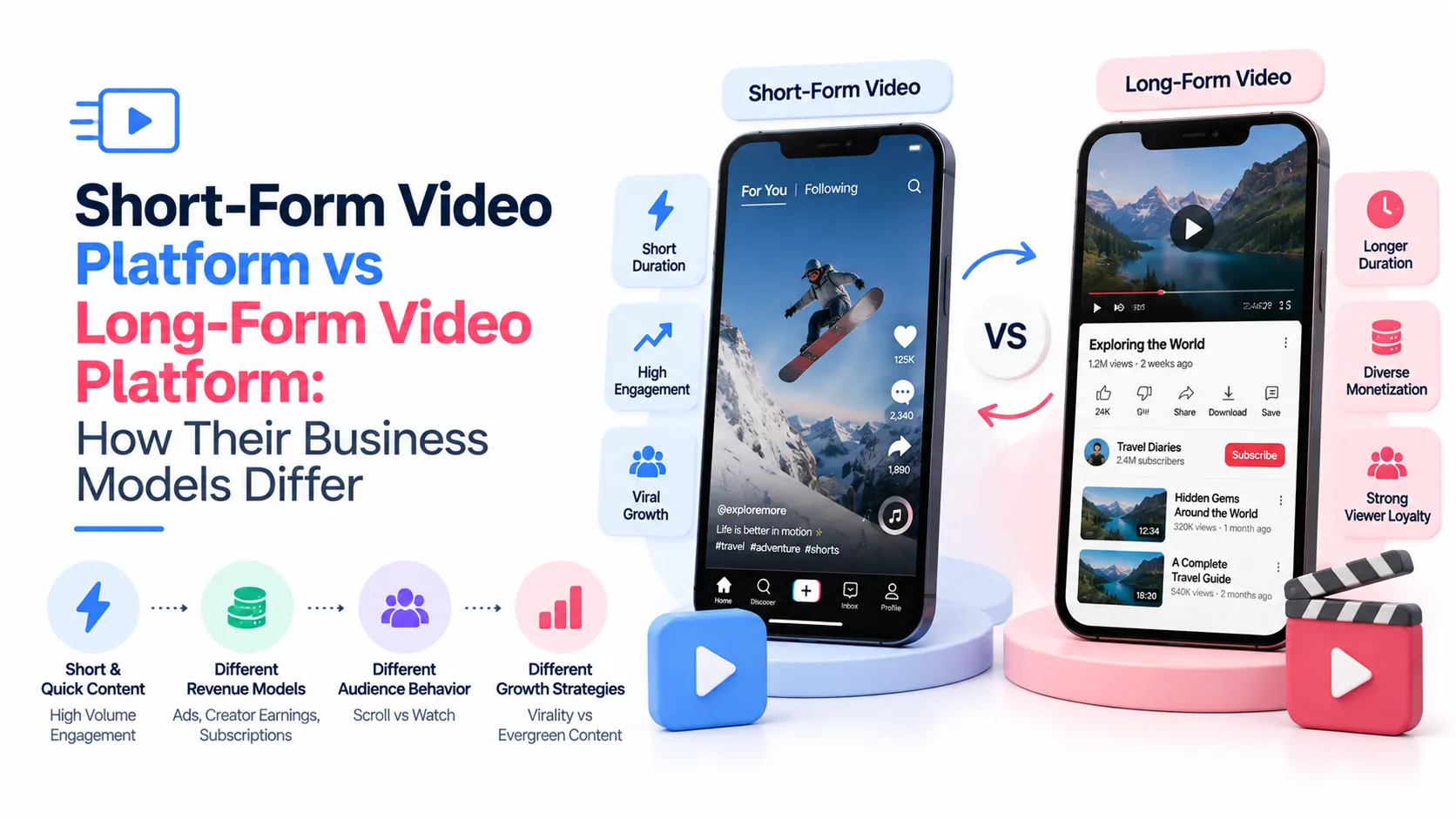
A video platform is not just a place where users upload and watch content. It is a business model shaped by content length, creator behaviour, user attention, monetization design, moderation effort, infrastructure cost, and admin control.
For founders, the choice between a short-form video platform and a long-form video platform is not only a product decision. It directly affects how quickly users engage, how creators earn, how the platform monetizes, how much backend infrastructure is required, and how the business scales after launch.
Short-form platforms usually depend on fast discovery, frequent posting, swipe-based consumption, recommendation feeds, trends, creator participation, live interaction, and commerce-driven engagement. Long-form platforms usually depend on deeper watch time, creator channels, search behaviour, structured libraries, subscriptions, advertising inventory, memberships, and premium content access.
This guide breaks down how both models work, where they differ, and how founders can choose the right video platform business model before investing in development.
What Is a Short-Form Video Platform Business Model?
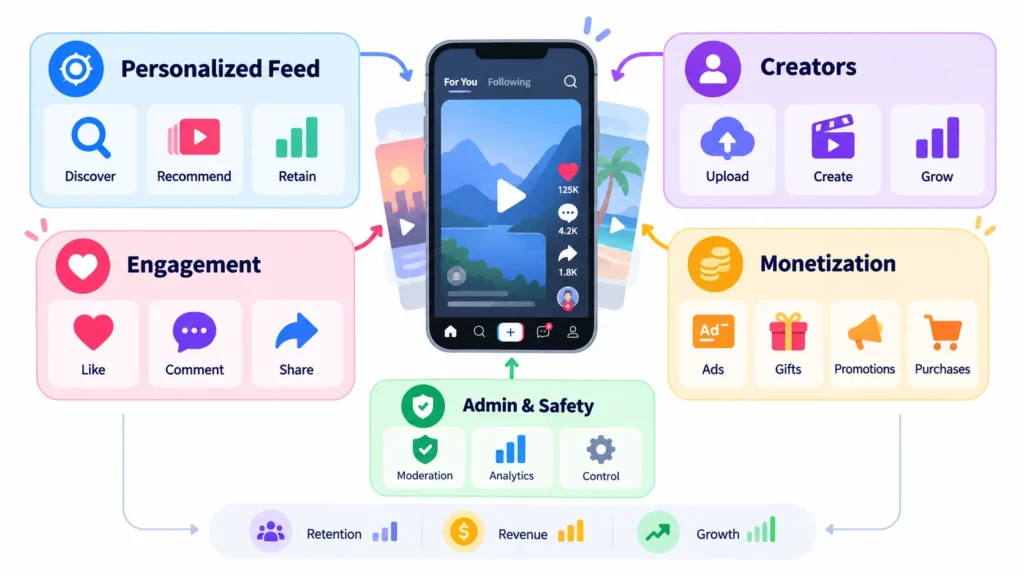
A short-form video platform business model is built around quick content consumption and rapid content discovery. Users do not need to search deeply or follow many creators before seeing relevant videos. The platform uses a personalized feed to keep users watching, reacting, sharing, commenting, and returning frequently.
This model works well when the platform wants to encourage frequent creator participation. Short videos are easier to produce than long episodes, tutorials, shows, or premium content libraries. That makes the creator entry barrier lower, especially for regional communities, entertainment niches, fan communities, lifestyle categories, education snippets, product discovery, fitness, beauty, music, comedy, and creator-led commerce.
From a business perspective, the short-form model usually depends on volume. More uploads create more testing opportunities for the recommendation engine. More feed interactions create more behavioural signals. More engagement creates more ad inventory, creator monetization opportunities, and community activity.
A founder choosing this model should think beyond video upload and playback. The real business layer includes feed personalization, content moderation, creator rewards, live streaming, virtual gifting, paid promotions, in-app purchases, brand campaigns, analytics, and admin control.
What Is a Long-Form Video Platform Business Model?
A long-form video platform business model is built around deeper content consumption. Instead of relying only on quick scrolling, it depends on longer sessions, structured content, creator channels, search behaviour, content libraries, playlists, premium access, subscriptions, and stronger creator-audience relationships.
This model is useful when users want depth. Examples include education, expert interviews, podcasts, tutorials, documentaries, product reviews, professional training, fitness programs, entertainment series, spiritual content, coaching, media libraries, and premium creator communities.
Long-form platforms often monetize through advertising, subscriptions, memberships, paid access, rentals, sponsorships, pay-per-view content, course-style monetization, and premium creator plans. The revenue opportunity can be strong, but the platform usually needs a more structured content ecosystem.
A founder choosing this model should focus on content organization, creator profiles, search, watch history, recommendations, payment access, content rights, subscription management, video hosting, and user retention over longer viewing journeys.
Short-Form vs Long-Form Video Platform Business Model Comparison
| Business Factor | Short-Form Video Platform | Long-Form Video Platform | Founder Implication |
|---|---|---|---|
| Core content experience | Quick vertical videos, fast scrolling, rapid discovery | Longer videos, structured viewing, deeper sessions | Choose based on how much time users are expected to spend per piece of content |
| Discovery model | Personalized feed, trends, recommendations, engagement signals | Search, channels, playlists, recommendations, subscriptions | Short-form depends heavily on feed quality; long-form depends more on structure and content depth |
| Creator behaviour | Frequent posting, lower production barrier, fast experimentation | Planned content, higher production effort, deeper audience trust | Creator onboarding and incentive design will differ |
| Monetization | Ads, live gifts, paid boosts, brand campaigns, social commerce, creator incentives | Ads, subscriptions, memberships, rentals, premium libraries, sponsorships | Revenue modules must match content format and audience intent |
| Engagement pattern | Frequent short sessions, reactions, comments, shares, repeat scrolling | Longer sessions, watch history, playlists, saved content, returning subscribers | Analytics should measure different success signals |
| Infrastructure demand | High upload volume, transcoding, CDN usage, feed performance, moderation queues | Larger file sizes, streaming quality, storage, search, content libraries | Backend planning depends on content frequency and file size |
| Moderation need | High because of frequent user-generated content and live interactions | High for comments, uploads, copyright issues, and premium content governance | Safety workflows should be planned before launch |
| Best suited for | Creator communities, entertainment, product discovery, local content, trends, social commerce | Education, expert content, premium media, tutorials, series, podcasts, training | The right model depends on the business goal, not only the content format |
Why the Business Model Should Be Decided Before the Feature List
Many founders start with features first. They list video upload, likes, comments, profiles, payments, analytics, and admin dashboards. That approach often creates confusion because the same feature can serve different business goals in different video models.
For example, a recommendation feed in a short-form platform is the heart of user retention. It decides what users see next, how quickly new creators are discovered, and which content receives distribution. In a long-form platform, recommendations still matter, but search, playlists, channels, watch history, and content categories may have equal or greater importance.
The same is true for monetization. In a short-form platform, creator rewards, live gifting, paid promotions, commerce links, and brand campaigns can become important earlier. In a long-form platform, subscriptions, premium libraries, memberships, paid courses, and content bundles may be more practical.
The business model should guide the feature list because every feature adds design effort, backend logic, testing, infrastructure planning, operational complexity, and maintenance responsibility. Before locking the scope, founders should review the major video platform development cost factors so they can avoid building unnecessary modules too early.
How Short-Form Video Platforms Make Money
Short-form video platforms usually monetize attention, interaction, and creator participation. The platform creates a high-frequency engagement loop where users watch more videos, creators publish more content, and the business builds revenue opportunities around discovery.
Common revenue streams include:
- In-feed advertising
- Sponsored content placements
- Paid content promotion
- Live gifting and virtual rewards
- Creator subscription features
- Brand collaboration tools
- Affiliate commerce
- Product discovery and social selling
- Premium creator tools
- Platform commissions on transactions
Founders who want to go deeper into ads, live gifting, paid promotions, subscriptions, creator rewards, and platform commissions can review this short-form video monetization model before finalizing how the platform should generate revenue.
The strength of this model is speed. Content can spread quickly, creators can test ideas rapidly, and users can consume many pieces of content in one session. That makes short-form platforms attractive for founders targeting entertainment, regional content, creator communities, lifestyle commerce, events, local influencers, and niche social platforms.
The challenge is control. More content volume means more moderation, more spam risk, more creator payout complexity, more recommendation tuning, and more backend load. A founder should treat the admin panel, moderation workflow, analytics dashboard, and payout management system as core business infrastructure.
How Long-Form Video Platforms Make Money
Long-form video platforms usually monetize depth, trust, and repeat viewing. Users may spend more time with each creator, follow structured content journeys, subscribe to channels, buy premium access, or pay for specialized content.
Common revenue streams include:
- Video advertising
- Premium subscriptions
- Channel memberships
- Paid courses or learning libraries
- Pay-per-view content
- Content rentals
- Sponsorships
- Creator memberships
- Paid communities
- Bundled media access
- Enterprise or institutional access where relevant
The strength of this model is retention through value. Long-form content can build authority, trust, and repeated audience relationships. A creator who publishes training, expert guidance, entertainment series, interviews, or premium lessons can attract users who return for depth rather than only quick discovery.
The challenge is supply. Long-form content usually takes more time to create. The platform may also need stronger content categorization, search, storage, subscription logic, rights management, and premium access controls.
Founder Decision Signals: Which Model Fits Your Startup?
Speed
Choose short-form if your platform needs frequent uploads, fast creator onboarding, and rapid content testing. Choose long-form if content depth and structured viewing matter more than launch velocity alone.
Monetization
Short-form works well for ads, gifting, paid boosts, and creator commerce. Long-form is stronger for subscriptions, memberships, premium libraries, paid learning, and sponsorship-led revenue.
Scalability
Short-form platforms must handle high content volume and feed performance. Long-form platforms must handle storage, streaming quality, search, subscriptions, and content library management.
Market Fit
Short-form is useful for entertainment, trends, regional creators, and product discovery. Long-form is useful for education, expert content, media libraries, coaching, and premium creator ecosystems.
Product Features That Change by Business Model
A video platform may look similar on the surface, but the backend priorities change depending on the model.
Before listing the modules, founders should connect each feature to a real business outcome. This creator platform feature stack can help compare user-side, creator-side, feed, monetization, moderation, and admin modules before deciding what belongs in the first launch version.
For a short-form platform, the product usually needs:
- Vertical video feed
- Quick video recording and upload
- Editing tools, filters, sounds, and effects
- Creator profiles
- Likes, comments, shares, saves, and follows
- Recommendation engine
- Live streaming
- Virtual gifts or creator rewards
- Paid promotion tools
- Content moderation queue
- Creator analytics
- Admin dashboard for users, videos, reports, payments, and campaigns
For a long-form platform, the product usually needs:
- Channel or creator pages
- Long video upload and playback
- Categories, playlists, and collections
- Search and filters
- Watch history and continue watching
- Subscription or membership logic
- Premium content access
- Payment gateway integration
- Video quality options
- Content library management
- Creator revenue reporting
- Admin dashboard for content, users, payments, plans, reports, and moderation
The important point is not which feature list is longer. The important point is which features support the revenue model. A platform designed for short-form discovery should not be overloaded with long-form subscription complexity too early. A platform designed for premium education or media should not depend only on quick feed engagement.
Short-Form Platforms Need Stronger Discovery Loops
Short-form video businesses usually grow when the discovery loop works well. A discovery loop connects user behaviour, content ranking, creator feedback, and repeat engagement.
A simple short-form discovery loop looks like this:
- A creator uploads content.
- The platform tests the video with a small audience.
- Users watch, skip, like, comment, share, or follow.
- The system uses engagement signals to decide wider distribution.
- Creators learn what works and upload more.
- Users return because the feed feels increasingly relevant.
Discovery quality depends on more than showing random popular videos. Founders should understand how custom video feed architecture affects relevance, retention, creator visibility, content testing, and long-term engagement.
This loop is powerful because users can discover new creators without searching for them. It also helps new creators gain visibility faster if their content performs well.
For founders, this means the recommendation feed is not just a feature. It is a growth engine. The platform must track engagement signals, content categories, watch behaviour, creator consistency, moderation status, and user preferences. Without this layer, short-form platforms can feel random, repetitive, or low-quality.
Founders planning a mobile-first creator community can explore Miracuves’ white-label short-video platform to understand how feed, creator, monetization, and admin workflows can be brought together in a launch-ready product foundation.
Long-Form Platforms Need Stronger Content Depth
Long-form video businesses grow when users trust the content library. Instead of relying only on fast scrolling, the platform must help users find, save, continue, organize, and pay for content that has deeper value.
A long-form content loop often looks like this:
- A creator publishes a detailed video, series, lesson, show, or premium asset.
- The platform organizes it through categories, search, playlists, and creator pages.
- Users watch for a longer session or save it for later.
- The platform recommends related videos or paid access options.
- Users subscribe, join a membership, buy premium access, or return for the next upload.
- Creators build authority and long-term audience value.
This model is stronger when the audience wants depth. It works well for learning, coaching, expert communities, premium entertainment, internal training, niche media, and content libraries.
For founders, this means search, categorization, subscription logic, and content management should be treated as core features. If users cannot find valuable content easily, the business model weakens even if the video player works well.
Monetization Strategy: Fast Attention vs Deep Commitment
The biggest difference between short-form and long-form monetization is the type of user commitment being monetized.
Short-form platforms monetize fast attention. Users may watch many videos in a short session. Revenue is created through ad impressions, live interactions, creator promotions, virtual gifts, affiliate commerce, and brand-led discovery. The platform benefits when users keep scrolling and creators keep posting.
Long-form platforms monetize deeper commitment. Users may subscribe, follow specific creators, purchase content, join paid communities, or return to a structured library. Revenue is created through advertising, premium access, memberships, subscriptions, rentals, sponsorships, and bundled content.
Neither model is automatically better. The right choice depends on the audience.
A fashion discovery app, regional entertainment app, sports fan app, music community, or local creator network may benefit from short-form monetization. A learning platform, professional training app, wellness program, podcast network, premium content library, or expert community may benefit from long-form monetization.
If short-form is the primary direction, founders can compare different creator monetization models before deciding whether ads, subscriptions, gifting, paid boosts, brand campaigns, or commerce-led revenue should come first.
Admin Control Is Where the Business Model Becomes Manageable
A video platform cannot scale on the front end alone. Once users and creators become active, the business needs backend control.
For short-form platforms, admins may need to manage:
- Reported videos
- Creator accounts
- Content categories
- Trending content
- Live sessions
- Virtual gifts
- Ad campaigns
- Paid boosts
- Creator payouts
- Abuse reports
- Spam and bot activity
- Regional content rules
- User engagement analytics
For long-form platforms, admins may need to manage:
- Content libraries
- Creator channels
- Subscription plans
- Premium access rules
- Payment records
- Video categories
- Copyright or ownership reports
- User watch behaviour
- Membership revenue
- Refunds or disputes
- Featured content
- Search visibility
- Creator performance
This is where many founders underestimate complexity. The user app may look simple, but platform operations require dashboards, permissions, logs, reports, moderation workflows, and scalable backend logic. As content volume grows, a scalable video platform backend helps support feed performance, moderation queues, creator activity, payment records, analytics, and admin workflows without slowing down daily operations.
Security, Moderation, and Trust Matter in Both Models
Video platforms deal with user-generated content, creator accounts, comments, payments, reports, and sometimes live interactions. That makes safety and trust part of the product foundation.
Important security and moderation layers include:
- Secure user authentication
- Role-based admin access
- Encrypted data transfer
- Secure API communication
- Content reporting
- Manual and automated moderation queues
- Creator verification where relevant
- Payment gateway security
- Activity logs
- Abuse and spam monitoring
- Permission-based dashboards
- Account suspension and appeal workflows
Founders should plan video platform security and moderation early because user-generated content, creator accounts, comments, payments, reports, and live interactions all affect user trust and platform reputation.
Short-form platforms may face higher moderation volume because users upload frequently. Long-form platforms may require stronger content rights management, premium access protection, and payment control.
A platform can support compliance-ready workflows, but final legal and regulatory requirements depend on the target market, content category, user age group, monetization method, payment providers, and legal review.
Should Founders Build Short-Form, Long-Form, or Hybrid?
A short-form model is usually a better fit when the startup wants frequent content creation, rapid engagement, mobile-first usage, creator discovery, social interaction, trends, live gifting, or commerce-led engagement.
A long-form model is usually a better fit when the startup depends on expert content, education, premium access, channels, subscriptions, searchable libraries, structured learning, entertainment series, or deeper creator relationships.
A hybrid model can also work. For example, short videos can drive discovery while long-form content, paid lessons, live sessions, or premium libraries create deeper monetization. However, founders should be careful with hybrid models in the first release. Building too many content formats at once can increase development time, infrastructure planning, testing effort, moderation workload, and admin complexity.
A smarter path is to identify the primary content loop first. Once the core audience behaviour is validated, the platform can expand into additional formats.
Ready-Made vs Custom Development for Video Platforms
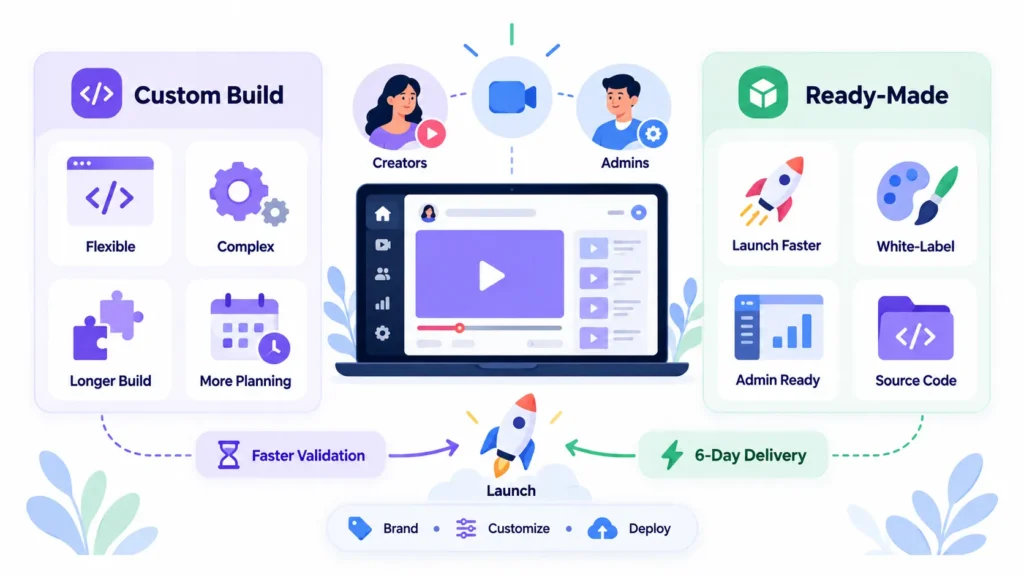
Founders usually have two development routes.
A custom build gives more flexibility when the product has highly unique workflows, unusual content rights, advanced enterprise requirements, or complex integrations. However, it usually requires more planning, design, development, testing, infrastructure setup, and iteration before launch.
A ready-made video sharing platform helps founders move faster when the core business model is already clear. Instead of building every user, creator, video, monetization, and admin module from zero, the founder starts from a launch-ready base and customizes branding, workflows, features, integrations, and monetization logic.
Miracuves helps founders launch branded video platforms with ready-made foundations, admin dashboards, source-code ownership, and faster deployment. For short-form creator businesses, the 6-day solution delivery model can be useful when the founder wants to validate demand quickly without waiting months for a first market version.
Mistakes Founders Should Avoid
Choosing a Format Without Understanding the Revenue Model
Short videos and long videos create different monetization paths. A founder should define whether the business will earn from ads, subscriptions, creator commissions, live gifts, paid access, sponsorships, commerce, or premium memberships before finalizing the feature list.
Launching Too Many Formats Too Early
A platform with short videos, long videos, live streaming, subscriptions, courses, creator stores, and paid communities may sound attractive, but it can become difficult to build and manage. Start with the strongest content loop first.
Treating Moderation as a Later Feature
User-generated content needs safety workflows from the beginning. Reporting, review queues, admin permissions, content rules, and activity logs protect the user experience and the platform’s reputation.
Ignoring Creator Incentives
A video platform grows only when creators have a reason to publish consistently. Analytics, earnings visibility, audience growth tools, rewards, promotions, and creator support workflows should be part of the business model.
Building Without Admin Control
Founders need control over users, creators, videos, payments, reports, campaigns, subscriptions, and moderation. Without a strong admin layer, simple operational decisions become slow and expensive.
How Miracuves Helps Founders Launch Video Platforms Faster
Miracuves helps founders convert video platform ideas into launch-ready digital products with branded design, creator workflows, monetization modules, admin control, and source-code ownership.
When execution support matters, choosing the right short-form video development partner helps founders avoid delays around scope planning, architecture decisions, creator workflows, launch preparation, and post-launch customization.
For short-form video businesses, Miracuves can support the core platform foundation with creator profiles, vertical feed experiences, upload workflows, engagement tools, monetization options, moderation workflows, and admin dashboards. For founders who want faster validation, Miracuves’ ready-made approach can support 6-day solution delivery where the selected scope matches the existing product foundation.
The goal is not to copy an existing platform blindly. The stronger approach is to choose a focused audience, define the right content loop, select the monetization model, and launch with enough control to learn from real users.
If your product is focused on short-form discovery, creator engagement, and mobile-first monetization, you can explore Miracuves’ launch-ready creator video app foundation as a practical next step.
Final Thoughts
The difference between a short-form video platform and a long-form video platform is not only content duration. It is the difference between fast discovery and deep engagement, high-frequency creation and structured publishing, feed-driven growth and library-driven retention, quick attention monetization and premium commitment monetization.
For founders, the right question is not which model is more popular. The right question is which model matches the audience, creator supply, revenue strategy, moderation capacity, infrastructure plan, and launch timeline.
A focused short-form platform can help founders build a creator-led community around fast engagement and mobile-first discovery. A focused long-form platform can help founders build deeper value through premium content, subscriptions, and structured creator relationships. A hybrid model can work, but only when the core content loop is clear.
Choose the model first. Then build the platform around it.
FAQs
What is the difference between a short-form video platform and a long-form video platform?
A short-form video platform focuses on quick videos, fast discovery, frequent posting, mobile-first engagement, and personalized feeds. A long-form video platform focuses on deeper viewing, creator channels, search, playlists, subscriptions, premium content, and structured libraries.
Which video platform business model is better for startups?
The better model depends on the startup’s audience and revenue strategy. Short-form is useful for entertainment, trends, creator communities, and commerce-led discovery. Long-form is stronger for education, expert content, premium media, coaching, and subscription-based content.
How do short-form video platforms make money?
Short-form video platforms can earn through in-feed ads, sponsored content, creator promotions, virtual gifts, live interactions, affiliate commerce, brand campaigns, and platform commissions.
How do long-form video platforms make money?
Long-form video platforms can earn through video advertising, subscriptions, memberships, premium access, paid courses, rentals, sponsorships, and bundled content libraries.
Can a startup combine short-form and long-form video features?
Yes, a startup can combine both models. Short videos can drive discovery, while long-form content can support deeper monetization. However, founders should avoid launching too many formats at once because it can increase cost, infrastructure needs, and moderation complexity.
What features are important for a short-form video platform?
Important features include vertical video feed, video upload, creator profiles, engagement tools, recommendation engine, live streaming, creator monetization, content moderation, reporting, analytics, and admin control.
What features are important for a long-form video platform?
Important features include creator channels, long video playback, categories, playlists, search, watch history, subscriptions, premium access, payment workflows, content management, analytics, and admin dashboards.
How fast can Miracuves help launch a video platform?
Miracuves offers faster launch support through ready-made and white-label platform foundations. Where the selected scope matches the ready-made solution, 6-day solution delivery can help founders move from idea to launch faster.
Miracuves is an independent software development company. We are not affiliated with, connected to, sponsored by, or endorsed by any company or product named in this article.
Terms such as “X Clone” are used descriptively. It is how the software industry refers to building a platform with functionality comparable to a known service, and how clients search for it.
The entire design and codebase of our products is built by our own team. Our products contain no code, design, graphics, or content originating from any third-party website or applications.
All third-party names and marks referenced in this article are the property of their respective owners, referenced solely to identify the services discussed.