


Key Takeaways
- A Travel booking platform security should protect traveler accounts, personal information, booking details, payments, partner connections, and administrative access through layered security controls.
- Core protections include secure authentication, encrypted data, payment security, API authorization, role-based permissions, fraud monitoring, session controls, and audit logging.
- Trust depends on keeping search, reservation, checkout, cancellation, refund, supplier integration, and customer-support workflows secure throughout the complete travel booking journey.
Security & Access Signals
- Traveler security should include strong authentication, encrypted credentials, secure sessions, account recovery, privacy controls, suspicious-login monitoring, and protection of personal booking information.
- Payment workflows should support trusted gateways, transaction verification, tokenization, refund controls, fraud detection, reconciliation, and secure handling of payment-related data.
- API security should use authentication tokens, rate limiting, input validation, object-level authorization, permission checks, monitoring, and separate access rules for travelers, suppliers, agents, and admins.
Trust & Operations Insights
- Role-based access controls should ensure that travelers, hotel or activity partners, support agents, finance teams, and administrators can access only the data and actions required for their responsibilities.
- Operators should monitor failed payments, unusual account activity, API errors, permission changes, booking manipulation, refund anomalies, suspicious transactions, and administrative actions.
- Miracuves develops customizable regional travel booking platforms with secure traveler accounts, payments, supplier APIs, booking workflows, access controls, fraud monitoring, analytics, and admin management.
A regional travel booking platform does not win trust only by showing attractive destinations, hotel photos, or low prices. It wins trust when travelers feel safe creating accounts, sharing personal details, making payments, managing bookings, requesting refunds, and contacting hosts or travel operators.
Security is not a technical checkbox hidden behind the product. It is part of the customer experience.
When a traveler books a stay, tour, transfer, event, or local experience, the platform handles sensitive information: names, contact details, travel dates, guest counts, payment activity, booking history, messages, cancellation requests, refunds, and sometimes identity or business verification records.
For founders, this means one thing: trust and security must be designed into the booking platform before launch.
A regional travel marketplace needs strong traveler protection, secure payment flows, trusted supplier connections, API safeguards, role-based dashboards, audit logs, and admin visibility. Without those layers, even a well-designed booking app can become risky to operate.
Why Trust Is the Core Product Layer in Travel Booking
A travel booking platform is more than a listings directory. It manages a real transaction between travelers and service providers.
A traveler expects the platform to answer practical questions:
- Is this listing real?
- Is the price accurate?
- Is the date actually available?
- Is my payment safe?
- Will I receive confirmation?
- Can I cancel or request a refund?
- Can I contact the host or operator?
- Will my data be handled responsibly?
- What happens if a booking fails?
These questions are trust signals. If the platform does not answer them clearly, users may leave before completing the booking.
For founders, trust has to be built across the full booking journey: search, listing details, availability, pricing, payment, confirmation, communication, cancellation, review, and payout.
What Makes Regional Travel Platforms More Sensitive?
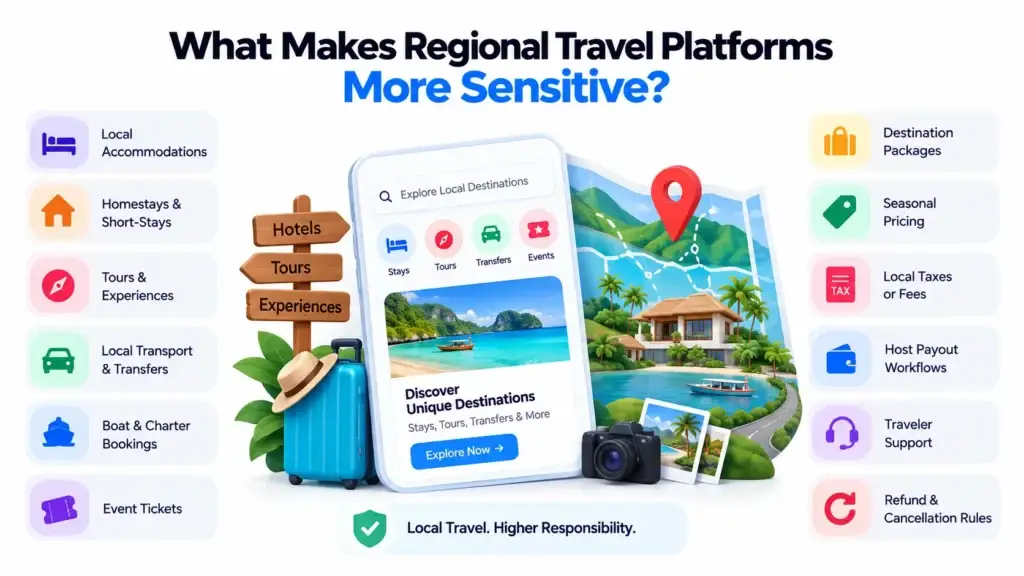
Regional travel platforms often serve specific destinations, local hosts, boutique hotels, tours, transfers, event operators, and experience providers. This creates a strong niche opportunity, but it also increases operational responsibility.
A regional platform may need to manage:
- Local accommodations
- Homestays and short-stay rentals
- Tours and experiences
- Local transport or transfers
- Boat or charter bookings
- Event tickets
- Destination packages
- Seasonal pricing
- Local taxes or fees
- Host payout workflows
- Traveler support requests
- Refund and cancellation rules
The risk is not only technical. It is operational.
If availability is wrong, a traveler may arrive with no valid booking. If pricing is unclear, support tickets increase. If supplier access is weak, unauthorized listing changes may occur. If refund rules are not controlled, the platform can lose revenue and trust at the same time.
Traveler Data Protection: What Needs to Be Secured
Traveler data should be protected from the moment a user creates an account.
A travel booking platform may store or process:
- Name and contact details
- Login credentials
- Travel dates
- Guest count
- Saved listings
- Booking history
- Payment references
- Refund requests
- Support messages
- Reviews and ratings
- Identity or document details where required
- Location or device signals where enabled
Founders should treat this data as a responsibility, not just a database record.
Important security layers include encrypted data transfer, encrypted data storage, secure authentication, password policies, session timeout, account recovery controls, consent management, and activity logs.
The platform should also collect only what it needs. More data does not always create a better product. Sometimes it simply increases risk.
Payment Security: Protecting Checkout, Refunds, and Payouts
Travel payments can be complex because money may move between travelers, the platform, hosts, vendors, and payment gateways.
A secure checkout flow should protect:
- Card or wallet payments
- Deposits and partial payments
- Service fees
- Host fees
- Coupons and discounts
- Refunds
- Cancellation charges
- Wallet credits
- Host payouts
- Payment gateway callbacks
- Failed payment states
The user should never feel uncertain after payment. A booking platform should clearly show whether payment is pending, confirmed, failed, refunded, partially paid, or under review.
Payment security should also include tokenized payment handling where available, secure payment gateway integration, webhook verification, server-side amount validation, and admin visibility into payment status.
Founders who want to connect payment safety with commissions, service fees, host payouts, and platform revenue can review the Travel Booking Platform business model before finalizing monetization rules.
Travel Booking Security Layers and Business Impact
| Security Layer | What It Protects | Founder Impact |
|---|---|---|
| Secure authentication | Traveler, host, vendor, and admin accounts | Reduces account takeover risk and protects booking access. |
| Payment gateway security | Checkout, deposits, refunds, and payment status | Protects revenue flows and improves booking confidence. |
| API access control | Hotel, inventory, payment, maps, and notification integrations | Reduces exposure from weak third-party connections. |
| Role-based permissions | Admin, support, finance, vendor, and host actions | Limits sensitive changes to the right team members. |
| Audit logs | Price edits, refund changes, booking status updates, and admin actions | Helps operators investigate disputes and internal errors. |
| Fraud monitoring | Suspicious bookings, repeated refunds, fake listings, and abuse patterns | Protects platform reputation and marketplace quality. |
API Security: The Hidden Risk in Travel Booking Platforms
Regional travel platforms often depend on multiple integrations. These may include hotel inventory, payment gateways, maps, email, SMS, tax tools, channel managers, analytics, and customer support systems.
Every integration creates a potential trust point.
Weak API security can expose booking data, pricing rules, traveler details, supplier records, or payment status. That is why API access should not rely on static keys, open endpoints, or poorly documented integration logic.
A safer API setup should include:
- Token-based access
- API key rotation
- Webhook signature verification
- Environment-specific credentials
- Rate limiting
- Permission-based API scopes
- Input validation
- Error logging
- Integration monitoring
- Secure storage of secrets
- Partner-level access controls
For travel founders, API security is not only a developer concern. If an integration fails, travelers may see wrong prices, wrong availability, delayed confirmations, or failed payments.
Access Controls for Travelers, Hosts, Vendors, and Operators
A regional travel marketplace has multiple user roles. Each role should access only what it needs.
A traveler should manage bookings, payments, messages, reviews, and profile details. A host should manage listings, availability, pricing, booking requests, messages, and payout requests. A support agent may need booking visibility but should not change payout settings. A finance user may need refund and payout records but not full platform configuration. An operator should control platform-wide rules.
Role-based access control helps prevent both external abuse and internal mistakes.
Useful access-control layers include:
- Traveler account permissions
- Host dashboard permissions
- Vendor approval workflows
- Support-team roles
- Finance-team roles
- Super-admin controls
- Two-factor authentication for sensitive roles
- Activity logs
- Admin session timeout
- Approval workflows for high-risk actions
- Restricted refund and payout permissions
A platform becomes risky when every internal user has access to everything.
For a broader feature-level view of travel booking flows, this guide on travel booking app features explains the user, vendor, booking, payment, and admin modules founders should consider.
Booking Fraud, Refund Abuse, and Fake Listings
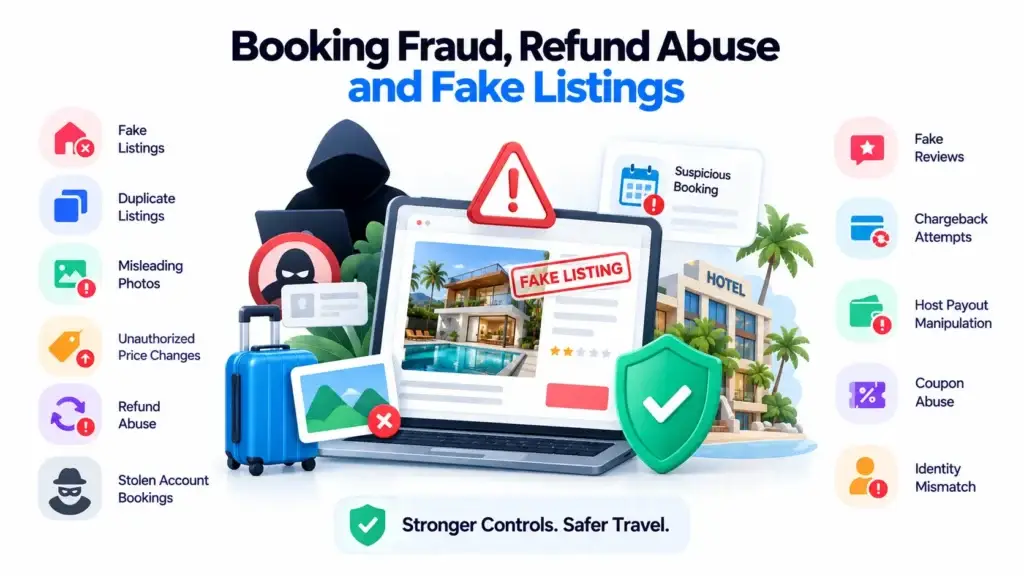
Travel marketplaces can face fraud in several forms.
Common examples include:
- Fake listings
- Duplicate listings
- Misleading property photos
- Unauthorized price changes
- Repeated refund abuse
- Suspicious last-minute bookings
- Stolen account bookings
- Chargeback attempts
- Fake reviews
- Host payout manipulation
- Coupon abuse
- Identity mismatch between traveler and booking
The solution is not only blocking users. A better trust system gives the operator enough visibility to detect patterns, review suspicious behavior, and apply rules without harming legitimate users.
Important controls include listing approval, host verification, booking history, refund logs, payout review, coupon limits, review moderation, dispute workflows, and suspicious activity flags.
Secure Booking Flow: From Search to Host Payout
A secure booking platform should protect every stage of the transaction.
The flow usually looks like this:
- Traveler searches by destination, date, guest count, service type, or price range.
- Platform checks availability against real inventory.
- Pricing is calculated on the server.
- Coupons, taxes, service fees, deposits, and host fees are applied.
- Traveler enters details and confirms payment.
- Gateway response is verified before booking status changes.
- Host or vendor receives booking notification.
- Traveler receives confirmation.
- Booking is completed, canceled, refunded, or disputed based on rules.
- Host payout is reviewed and settled.
Founders planning listings, availability, pricing, checkout, reviews, payouts, and operator dashboards can review the Travel Booking Platform features that support a scalable rental and travel booking product.
The security principle is simple: do not trust sensitive actions from the browser alone. Pricing, availability, payment status, commission, refund eligibility, and payout records should be controlled by backend logic and admin rules.
Founder Decision Signals for Travel Platform Security
Traveler Trust
If users hesitate at checkout, improve transparency around booking status, payment confirmation, cancellation rules, refunds, and support access.
Supplier Control
If hosts or vendors manage listings, use approval workflows, activity logs, availability controls, and restricted dashboard permissions.
Payment Safety
If deposits, partial payments, refunds, wallets, or host payouts are involved, secure the payment flow with gateway verification and admin review.
API Reliability
If the platform depends on hotels, inventory, maps, payment, or notification APIs, secure every integration with tokens, scopes, monitoring, and logs.
Security Checklist for Regional Travel Booking Platforms
Before launch, founders should confirm:
- Traveler login and account recovery are secure
- Sensitive traveler data is encrypted
- Password and session policies are defined
- Payment gateway integration is secure
- Payment status is verified before confirmation
- Pricing is calculated server-side
- Availability is validated before checkout
- Coupons and discounts have usage rules
- Refunds and cancellations follow admin-controlled rules
- Host/vendor onboarding includes verification where needed
- Listing approval workflows are available
- Reviews can be moderated
- Suspicious bookings can be flagged
- Admin roles are permission-based
- Finance roles are separated from support roles
- Payout requests can be reviewed
- API keys and webhooks are protected
- Audit logs are available for sensitive actions
- Backups, SSL, and server security are configured
- Support teams can view booking status clearly
A travel platform is safer when security supports real operations, not just login screens.
Mistakes Founders Should Avoid
Treating Security as a Post-Launch Fix
Security affects login, payments, listings, refunds, payouts, APIs, and admin operations. Adding it after launch can create expensive rework and user-trust issues.
Giving Vendors Too Much Dashboard Access
Hosts and vendors should manage their own listings and bookings, but sensitive actions such as refunds, payout rules, fee settings, and platform policies should stay restricted.
Trusting Frontend Pricing and Availability
Availability, pricing, discounts, taxes, deposits, service fees, and commission should be validated on the server to reduce manipulation and booking disputes.
Ignoring Audit Logs
When a booking, refund, payout, or listing dispute happens, the operator needs to know who changed what, when it changed, and why the change occurred.
How Miracuves Helps Founders Build Safer Booking Platforms
Miracuves helps founders build ready-made and white-label travel and rental marketplace platforms with branded interfaces, admin dashboards, source-code ownership, booking workflows, payment integrations, host controls, and customization support.
For founders evaluating a launch-ready rental and booking product, Miracuves’ regional booking marketplace platform can help review guest search, host listing control, availability, pricing, payments, reviews, payouts, and operator workflows.
Businesses exploring destination-focused platforms can also review Miracuves’ travel booking solutions for related launch paths across travel and hospitality use cases.
If your goal is to build a broader marketplace with listings, bookings, payments, reviews, and governed payouts, the listings marketplace solutions page can help you compare adjacent models.
If you are comparing budget and rollout scope, review Miracuves’ guide on Travel Booking Platform development cost. For vendor evaluation, this page on choosing a booking platform development partner can help you understand what to check before selecting a team.
When the ready-made scope fits the rollout requirement, Miracuves can support 6-day solution delivery, helping founders move faster without building every booking, payment, host, refund, review, and admin workflow from zero.
Final Thoughts: Safer Travel Platforms Build Stronger Marketplace Trust
Trust is the real foundation of a regional travel booking platform.
Travelers need confidence that their booking is real, their payment is secure, their data is handled responsibly, and support is available when something changes. Hosts and vendors need clear dashboard access, payout visibility, booking rules, and fair review systems. Operators need admin control, audit logs, refund visibility, API monitoring, and fraud signals.
The safest platforms do not hide complexity. They organize it.
For readers moving from security planning into product execution, this guide explains building a regional travel booking app from core workflows to launch planning.
For founders, the stronger decision is to build security into the booking journey from the beginning: account access, traveler data, listings, availability, pricing, checkout, confirmations, cancellations, refunds, reviews, payouts, APIs, and admin roles.
Founders should also plan how they will attract travelers, hosts, and early bookings. This guide on travel booking platform launch marketing explains what to prioritize before and after going live.
A regional travel platform that protects trust can earn repeat bookings, stronger vendor participation, and better long-term marketplace credibility.
FAQs
Why is security important in a regional travel booking platform?
Security is important because travel platforms handle traveler data, booking details, payments, refunds, host records, vendor access, and support conversations. Weak security can damage user trust, revenue, and marketplace reputation.
What traveler data should a booking platform protect?
A booking platform should protect names, contact details, login credentials, travel dates, booking history, payment references, support messages, reviews, and any identity or verification information collected during the booking process.
How can travel platforms secure payments?
Travel platforms can secure payments through trusted payment gateway integration, tokenized payment handling where available, server-side amount validation, webhook verification, payment status tracking, refund controls, and admin visibility.
Why are APIs risky in travel booking platforms?
APIs connect the platform to payment gateways, maps, inventory systems, hotel systems, notifications, analytics, and other tools. Weak API keys, open endpoints, poor validation, or unsecured webhooks can expose sensitive booking and payment data.
What is role-based access control in a booking platform?
Role-based access control means each user type only gets the permissions they need. Travelers, hosts, vendors, support agents, finance teams, and operators should not all have the same level of access.
How can a travel platform prevent fake listings and booking fraud?
A platform can reduce fraud with host verification, listing approval, review moderation, suspicious booking flags, refund monitoring, coupon limits, payout review, and audit logs for sensitive changes.
What should founders check before launching a travel booking platform?
Founders should check authentication, encryption, payment security, server-side pricing, availability validation, refund workflows, host access, API protection, audit logs, backup policies, admin roles, and support visibility.
Can Miracuves help launch a secure regional travel booking platform?
Yes. Miracuves helps founders launch ready-made and white-label booking marketplace platforms with branded design, admin dashboards, payment workflows, host controls, source-code ownership, and customization support. A 6-day launch may apply when the ready-made scope matches the project requirement.
Miracuves is an independent software development company. We are not affiliated with, connected to, sponsored by, or endorsed by any company or product named in this article.
Terms such as “X Clone” are used descriptively. It is how the software industry refers to building a platform with functionality comparable to a known service, and how clients search for it.
The entire design and codebase of our products is built by our own team. Our products contain no code, design, graphics, or content originating from any third-party website or applications.
All third-party names and marks referenced in this article are the property of their respective owners, referenced solely to identify the services discussed.



