

Key Takeaways
- A ready-made brokerage platform gives fintech startups a faster foundation for testing trader demand and operations.
- Custom development offers deeper flexibility but requires more time, budget, planning, engineering, and testing.
- Both approaches must support onboarding, KYC, funding, account management, reporting, and admin control.
- Source-code ownership allows founders to customize workflows, integrations, reports, and user experiences later.
- The right choice depends on the startup’s validation stage, product complexity, regulatory position, and available resources.
Platform Decision Signals
- Choose a ready-made foundation when launch speed and early market validation are the main priorities.
- Consider custom development when the business requires proprietary execution, liquidity, or risk-management logic.
- Validate user onboarding, KYC reviews, deposits, withdrawals, account statuses, and transaction records.
- Review admin permissions, audit logs, reports, support workflows, partner tools, and integration flexibility.
- Compare total ownership costs, including customization, data providers, payment gateways, maintenance, and compliance operations.
Real Insights
- Early-stage founders rarely need every institutional feature before validating their brokerage concept.
- A ready-made product becomes restrictive when it lacks source-code access or meaningful customization options.
- Custom development becomes risky when teams underestimate funding states, security, audit logs, and admin operations.
- Compliance-ready software can support operating workflows but cannot replace licensing or qualified legal review.
- Miracuves develops source-code-owned brokerage platforms with KYC, funding workflows, trader accounts, reporting, and admin controls.
Launching a fintech trading business is not the same as launching a simple mobile app.
A normal app can often begin with user profiles, payments, notifications, and a basic admin panel. A brokerage-style platform is different. It has to support onboarding, identity checks, account status, funding workflows, client communication, partner referrals, transaction records, reporting, support, and operational control before the business can handle real users with confidence.
That is why many fintech founders compare two routes before entering the market: using a ready-made brokerage platform or investing in custom trading platform development from scratch.
Both routes can work. The better choice depends on business maturity, capital, regulation, technical complexity, and how quickly the founder needs to validate demand.
For early-stage fintech startups, the real question is not, “Can we build a custom platform?” The better question is, “Should we spend months building core brokerage workflows before we know whether the market will respond?”
What Is a Ready-Made Brokerage Platform?
A ready-made brokerage platform is a prebuilt software foundation designed around the workflows a brokerage-style fintech business needs. It is not only a trading screen. It usually includes the surrounding product and operations layer that helps users register, verify accounts, fund accounts, access dashboards, connect to trading environments, receive support, and interact with the platform under the business’s own brand.
For the operator, the value sits in the control layer. The business needs dashboards for users, documents, financial records, partner activity, reporting, support, risk review, admin access, and configurable workflows.
A ready-made platform can usually be branded, configured, integrated, and extended based on the founder’s business model. This is why it is often useful for fintech startups that want to enter the market faster without designing every module from zero.
The important point is this: ready-made does not mean rigid. A strong ready-made foundation should still allow customization, branding, integrations, and source-code-level flexibility.
What Is Custom Trading Platform Development?
Custom trading platform development means building the product from the ground up based on a founder’s specific requirements. The product team defines the architecture, user journeys, trading workflows, admin logic, integrations, reporting, and compliance workflows from scratch.
This route can make sense when the business has a highly unique trading model, proprietary execution logic, institutional-grade infrastructure requirements, or an internal engineering team capable of maintaining a complex fintech stack over time.
Custom development offers maximum freedom. But freedom comes with responsibility. Every onboarding rule, KYC state, wallet status, admin permission, partner payout, audit trail, notification, vendor integration, and reporting workflow has to be designed, developed, tested, and maintained.
For a funded fintech company with a clear regulatory path and deep technical resources, custom development may be the right long-term direction. For an early-stage founder trying to validate a brokerage concept, it can become expensive and slow before the business has proof of demand.
Ready-Made Brokerage Platform vs Custom Trading Platform: Strategic Comparison
| Decision Area | Ready-Made Brokerage Platform | Custom Trading Platform |
|---|---|---|
| Launch Speed | Faster because core workflows already exist and can be configured. | Slower because each workflow must be planned, built, tested, and refined. |
| Startup Validation | Better for testing market demand, onboarding flows, partner channels, and user interest early. | Better when the business model is already proven and requires unique platform logic. |
| Cost Control | More predictable starting point because the core foundation is already available. | More variable because discovery, rework, integrations, and compliance workflows can expand scope. |
| Customization | Suitable for branding, workflow changes, integrations, and market-specific adjustments. | Maximum flexibility for highly unique business logic and proprietary systems. |
| Operational Readiness | Can include onboarding, admin controls, funding flows, reporting, and role permissions from the beginning. | Requires every operational module to be designed and implemented manually. |
| Founder Focus | Lets founders spend more time on licensing, partnerships, acquisition, positioning, and validation. | Requires heavy involvement in product architecture, feature scope, testing, and technical delivery. |
| Best Fit | Early-stage fintech startups, brokerage operators, IB-led businesses, and teams seeking faster launch. | Large fintech companies, proprietary trading systems, and businesses with complex internal requirements. |
Why Startup Validation Changes the Development Decision
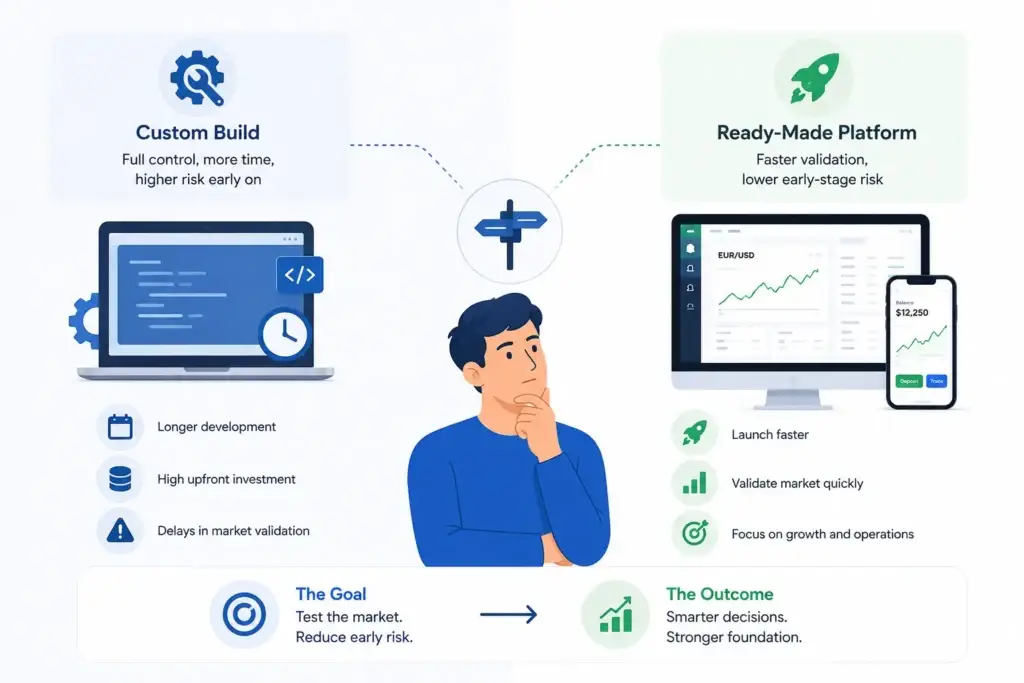
Image Source: AI-generated visual by Miracuves
Many founders think the biggest risk is choosing the wrong technology stack. In reality, the bigger early-stage risk is often building too much before proving the market.
A fintech trading startup has to validate several things:
- Will users trust the brand enough to register?
- Can onboarding be completed without confusion?
- Do users understand the account types and platform flow?
- Can the business acquire traders through direct marketing, partners, or IB networks?
- Are payment, funding, support, and verification workflows practical?
- Can the admin team manage daily operations without depending on developers for every change?
A custom build may be attractive because it gives full control. But during validation, full control can become a distraction. The founder may spend months perfecting infrastructure while the real market questions remain unanswered.
A ready-made brokerage platform gives founders a faster way to test the business model. Instead of waiting for every module to be built, they can focus on positioning, user acquisition, partner outreach, operational workflows, and market response.
This is especially useful for founders entering forex, CFD, prop trading, partner-led brokerage, or trading education models where the product needs more than a frontend interface.
The Brokerage Operations Layer Matters More Than Most Founders Expect
A trading interface is only one part of the user journey.
Before a user can trade, they may need to create an account, submit documents, complete KYC, choose account type, fund their account, understand platform access, receive support, and view transaction history. After that, the operator needs to manage approvals, records, withdrawals, partner attribution, risk signals, reports, and role-based access.
This is the brokerage operations layer.
A strong brokerage platform should help manage:
- Client registration and onboarding
- Identity verification workflows
- KYC and AML workflow support
- Account approval and status tracking
- Deposits and withdrawal records
- Admin review queues
- User dashboards
- Partner or IB programme workflows
- CRM and support visibility
- Audit logs and activity records
- Role-based access control
- Compliance-ready reporting structures
- Vendor integration readiness
When this layer is missing, the product may look polished on the frontend but become difficult to operate once real users arrive.
This is where ready-made brokerage foundations become useful. They give founders a structured starting point for the operational layer, while custom development requires the team to discover and build each process manually.
When a Ready-Made Brokerage Platform Is the Better Choice
A ready-made brokerage platform is usually the stronger choice when speed, validation, and operational structure matter more than building a fully proprietary system from day one.
It is a practical route when:
- The founder wants to validate demand before committing to a long custom build.
- The brokerage model depends on user onboarding, funding, partners, and admin control.
- The team needs a branded platform faster.
- The business wants source-code ownership but does not want to start from zero.
- The founder wants to test acquisition channels, IB networks, or prop-style workflows.
- The platform needs to be customized around a specific market, brand, or operating model.
- The team prefers to invest time in licensing, vendors, partnerships, and growth instead of rebuilding standard workflows.
For founders who want a faster route, Miracuves offers a ready-made brokerage operations platform that can support branded launch, admin workflows, source-code ownership, and market-specific customization.
When Custom Trading Platform Development Makes More Sense
Custom development is not wrong. It is just not always the best first move.
A custom trading platform may be the right choice when:
- The business has proprietary trading logic.
- The company needs a unique execution engine.
- The platform must support institutional-grade architecture.
- The product roadmap is clearly validated.
- The business has regulatory clarity and technical leadership.
- The founder has the budget and time to build, test, and maintain the platform.
- Existing ready-made foundations cannot support the required workflows.
Custom development gives the business deeper flexibility. But it should be chosen for a strategic reason, not simply because “custom” sounds more premium.
For many startups, a phased approach works better. Start with a ready-made brokerage foundation, validate the model, learn from users, then extend or rebuild specific modules when the business has stronger evidence.
Founder Decision Signals
Speed
Choose a ready-made brokerage platform when your priority is faster launch, early validation, and reducing the time spent building standard workflows from scratch.
Cost
Choose a ready-made foundation when you want a more predictable starting point. Choose custom development when you have the budget to support longer discovery, engineering, testing, and integration cycles.
Scalability
Choose custom development when your business depends on highly unique infrastructure. Choose ready-made when you need a scalable foundation that can be customized as the model matures.
Market Fit
Choose ready-made when the main goal is proving whether users, partners, and operators will actually use the platform before investing in deeper proprietary systems.
Key Modules Founders Should Validate Before Scaling
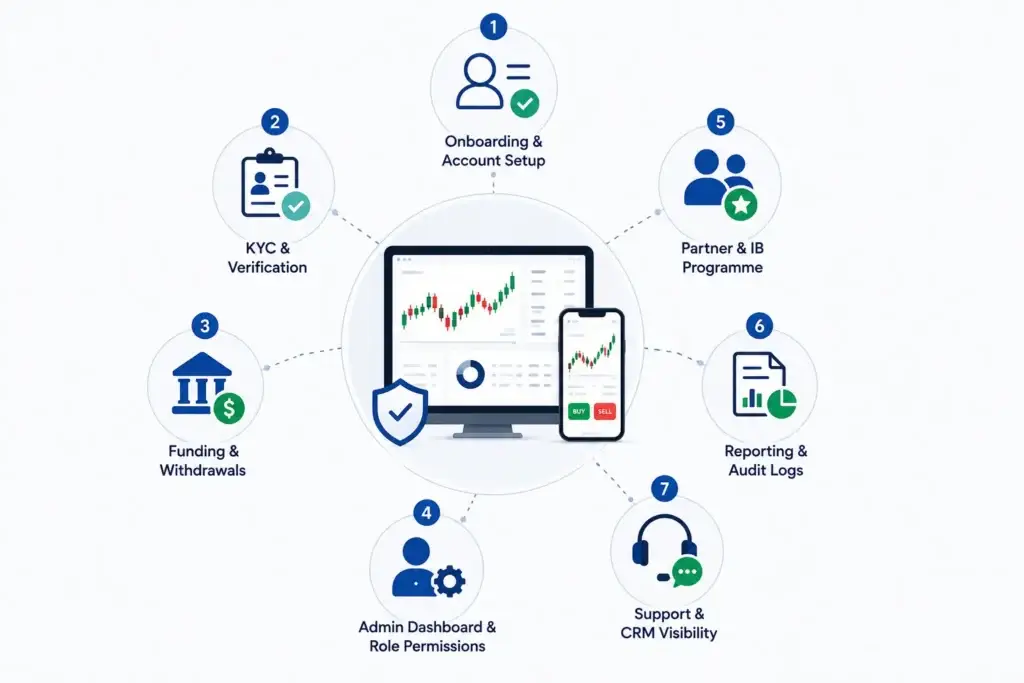
Image Source: AI-generated visual by Miracuves
Before investing heavily in a full custom platform, founders should validate the modules that directly affect user trust and operating efficiency.
1. Onboarding and Account Setup
The onboarding flow decides whether users move from interest to activation. A brokerage startup should review how users register, submit information, select account type, understand risk notices, and move toward verification.
If this journey feels confusing, user acquisition spend may be wasted.
2. KYC and Verification Workflow
KYC workflow support is not only a compliance checkbox. It affects user trust, admin workload, onboarding speed, and operational control.
The platform should allow the business to review user documents, track status, manage verification outcomes, and maintain clear records. Final compliance depends on jurisdiction, legal review, vendor integrations, and operating model.
3. Funding and Withdrawal Records
Funding workflows need clarity. Users want to know whether deposits, withdrawals, and transaction statuses are visible and understandable. Operators need records that help them manage requests, investigate issues, and maintain accountability.
A weak funding workflow creates support pressure and trust issues.
4. Admin Dashboard and Role Permissions
The admin dashboard is where the business actually runs. Founders should validate whether the internal team can manage users, documents, funding records, partner activity, support tickets, reports, and platform settings.
Role-based access control matters because not every team member should have the same level of permission.
5. Partner and IB Programme Logic
Many brokerage businesses grow through partners, affiliates, or introducing brokers. If partner attribution, referrals, commission tracking, and payout visibility are not planned early, the business may struggle to scale its acquisition channels.
6. Reporting and Audit Logs
Fintech operations need clear records. Audit logs and reporting workflows help the business review actions, monitor activity, and prepare for internal checks or jurisdiction-specific reporting needs.
7. Support and CRM Visibility
A trading business cannot rely only on a beautiful user interface. Users need support when verification, funding, account access, or platform navigation becomes confusing.
CRM and support visibility help the team respond faster and understand recurring friction points.
Why Source-Code Ownership Matters in Brokerage Platform Development
Source-code ownership is especially important in fintech because the product will rarely remain static.
A brokerage startup may need to adjust onboarding rules, add payment vendors, connect KYC tools, change partner logic, refine admin roles, update reporting formats, localize the product, or extend the platform into new markets.
Without source-code ownership, the business may become dependent on the original vendor for every meaningful change. That can slow down iteration and create long-term operating risk.
A source-code-owned platform gives founders more control over future customization, technical audits, vendor transitions, and product expansion. This does not remove the need for strong engineering discipline, but it gives the business more flexibility than a closed platform model.
Miracuves positions its fintech and brokerage solutions around source-code ownership, white-label branding, admin control, and faster deployment for founders who want a practical foundation without giving up long-term flexibility.
Security and Compliance Workflows Should Be Planned Early
Security should not be treated as a final checklist item. In brokerage and fintech platforms, security affects user trust, admin discipline, transaction visibility, and operational credibility.
Important security and control layers may include:
- Encrypted data transfer
- Encrypted data storage
- Role-based access control
- Audit logs
- KYC workflow support
- AML workflow support
- Fraud monitoring signals
- Transaction monitoring
- Admin access controls
- User verification
- Secure payment gateway integration
- Activity logs
- Permission-based dashboards
- Compliance-ready workflows
A ready-made brokerage foundation can help founders start with these workflows in mind. However, regulatory approval, licensing, payment integrations, KYC vendors, AML rules, and reporting formats depend on the target jurisdiction and should be reviewed with legal and compliance professionals.
Cost Logic: Why Ready-Made Can Be More Practical for Validation
The cost of a trading platform is not only the cost of design and development. Founders also need to consider discovery, architecture, integrations, testing, compliance workflow planning, admin tools, user support systems, infrastructure, QA, and post-launch changes.
Custom development may look attractive at the idea stage, but the scope can expand quickly when the team starts defining real brokerage workflows.
A ready-made platform can reduce cost uncertainty because the core foundation already exists. Instead of paying to discover and build every standard module from scratch, the founder can invest in branding, configuration, integrations, and market-specific customization.
Final pricing still depends on features, integrations, selected modules, vendor connections, jurisdiction needs, branding, and customization scope. Founders should request a current quote based on their actual launch requirements.
Mistakes Founders Should Avoid
Building the trading screen before the operating layer
A trading interface may look impressive, but the business still needs onboarding, funding records, admin workflows, verification queues, reports, and support visibility. Without this layer, operations become fragile.
Choosing custom development without validation
Custom development can be powerful, but it is risky when the market, audience, acquisition model, and partner strategy are still unproven.
Ignoring vendor integration complexity
Payment gateways, KYC vendors, liquidity providers, trading terminals, CRM tools, and reporting systems all introduce scope. Founders should plan integrations before promising launch dates.
Treating compliance as a later-stage task
Compliance workflows influence onboarding, data handling, reporting, user verification, transaction review, and admin permissions. They should be considered early, even if final compliance depends on jurisdiction and legal review.
A Practical Decision Framework for Fintech Founders
The right platform decision depends on the founder’s current stage.
If you are validating a market, building a partner network, testing user acquisition, or preparing a branded brokerage launch, a ready-made brokerage platform is usually more practical. It gives you the operating foundation needed to test demand faster.
If you already have a validated brokerage model, proprietary trading logic, deep technical resources, and long-term infrastructure requirements, custom trading platform development may be the better strategic investment.
A hybrid route is also possible. Many founders begin with a ready-made foundation, validate the business model, then customize deeper workflows as the company grows. This helps avoid overbuilding too early while still keeping room for long-term product control.
How Miracuves Helps Founders Move From Validation to Launch
Miracuves helps fintech founders launch ready-made and white-label brokerage-style platforms with source-code ownership, admin control, branded design, and customization support.
For founders comparing ready-made brokerage software with custom trading platform development, the Miracuves approach is built around one practical idea: start with the operating foundation, then customize around the business model.
That means the founder does not have to begin with a blank screen. Instead, the launch can start from structured workflows for onboarding, user dashboards, funding records, admin control, partner logic, reporting, and compliance-ready operations.
To review the productized brokerage platform option, visit the Miracuves brokerage platform solution.
Final Thoughts: Build for Validation First, Then Scale With Clarity
The choice between a ready-made brokerage platform and a custom trading platform should not be driven by ego, trend, or assumptions about what sounds more premium.
It should be driven by stage.
If the business is still validating demand, testing acquisition, building partner relationships, and preparing operational workflows, a ready-made brokerage foundation can reduce avoidable development risk. It helps founders move faster while still keeping room for branding, customization, source-code ownership, and future expansion.
If the business has a proven model and needs proprietary infrastructure, custom development can become the right next step.
For most fintech startups, the smarter path is not always the longest build. It is the path that gets the right operating foundation into the market early enough to learn, adapt, and grow.
FAQs
What is the difference between a ready-made brokerage platform and a custom trading platform?
A ready-made brokerage platform starts with prebuilt workflows for onboarding, account management, funding records, admin control, reporting, and partner operations. A custom trading platform is built from scratch around unique requirements. Ready-made platforms are usually better for faster validation, while custom builds are better for highly specialized long-term product logic.
Is a ready-made brokerage platform suitable for fintech startup validation?
Yes. A ready-made brokerage platform can help fintech startups validate user demand, onboarding workflows, partner channels, and operational processes faster than a ground-up custom build. It gives founders a structured foundation before they invest in deeper proprietary development.
When should a founder choose custom trading platform development?
Custom development makes sense when the business has proprietary trading logic, institutional requirements, unique integrations, regulatory clarity, strong funding, and technical leadership. It is usually better after the business model is clear and the company knows exactly what needs to be custom.
Does a ready-made brokerage platform remove the need for compliance planning?
No. A ready-made platform can support compliance-ready workflows such as KYC, AML support, audit logs, transaction records, and admin permissions. Final compliance depends on jurisdiction, legal review, vendor integrations, licensing, and the operating model.
Why is source-code ownership important for fintech platforms?
Source-code ownership gives founders more control over customization, integrations, audits, reporting changes, vendor transitions, and future product expansion. This matters because fintech platforms often need ongoing updates as the business grows.
Is ready-made brokerage software less flexible than custom development?
It depends on the provider and architecture. A weak ready-made product can be restrictive, but a strong source-code-owned platform can support branding, workflow customization, integrations, and future extension. Custom development offers maximum flexibility but requires more time, planning, and investment.
What should founders validate before scaling a brokerage platform?
Founders should validate onboarding, KYC workflow, funding records, admin control, user dashboards, partner logic, support workflows, reporting, and acquisition channels. These areas show whether the business can operate in the real market, not just whether the app looks good.
How can Miracuves help with brokerage platform launch?
Miracuves helps founders launch ready-made, white-label fintech and brokerage-style platforms with source-code ownership, branded design, admin dashboards, and customization support. Founders can use this foundation to move from idea to market validation faster.
Miracuves is an independent software development company. We are not affiliated with, connected to, sponsored by, or endorsed by any company or product named in this article.
Terms such as “X Clone” are used descriptively. It is how the software industry refers to building a platform with functionality comparable to a known service, and how clients search for it.
The entire design and codebase of our products is built by our own team. Our products contain no code, design, graphics, or content originating from any third-party website or applications.
All third-party names and marks referenced in this article are the property of their respective owners, referenced solely to identify the services discussed.