

Key Takeaways
- A real-time microblogging platform needs account protection, spam control, and content moderation working as connected safety layers.
- Secure registration, multi-factor authentication, session management, and recovery controls help prevent account takeovers.
- Rate limits and behavioral signals can reduce fake accounts, automated posting, suspicious links, and repetitive engagement.
- User reporting, automated detection, and human review should work together to support fair and consistent moderation.
- Trust and safety must be included in the product foundation because unsafe conversations can reduce retention, creator participation, and monetization.
Trust and Safety Signals
- Verify accounts through email or phone and monitor repeated registrations from suspicious devices, addresses, or network patterns.
- Set practical limits for posts, replies, follows, mentions, messages, hashtags, and link sharing.
- Give users controls for blocking, muting, message requests, mentions, tagging, and profile visibility.
- Provide administrators with moderation queues, report categories, role-based permissions, enforcement actions, and escalation workflows.
- Maintain audit logs for account restrictions, content removal, report decisions, administrator activity, and policy enforcement.
Real Insights
- Keyword filters alone cannot control evolving abuse; platforms also need behavioral analysis, rate limits, reporting, and human judgment.
- Automated systems can prioritize suspicious activity, but sensitive cases and appeals still require contextual human review.
- Giving every administrator unrestricted access increases internal risk and weakens accountability.
- Safety controls should protect genuine conversations without creating unnecessary friction for legitimate users.
- Miracuves develops source-code-owned microblogging platforms with account security, spam controls, moderation workflows, audit logs, admin tools, and six-day delivery where the ready-made scope applies.
A real-time microblogging platform grows on speed. Users post instantly, reply quickly, share opinions publicly, and expect conversations to move without friction. That speed is what makes the product engaging, but it also creates risk. Fake accounts, spam replies, impersonation, harassment, unsafe content, API abuse, and account takeovers can spread faster than a platform operator can manually control them.
That is why trust and safety in real-time microblogging platforms cannot be treated as a post-launch improvement. For founders building a public conversation platform, safety is part of the product foundation. Users will not keep posting if they feel exposed. Creators will not build audiences if spam ruins engagement. Advertisers and partners will not trust a platform where moderation is unclear.
This guide explains how account protection, spam control, and content moderation should work inside a real-time microblogging platform. It is written for founders, product teams, and platform operators who want to launch with stronger safety controls without turning the user experience into a slow, over-restricted system.
Why Trust and Safety Decide Whether a Microblogging Platform Can Scale
Real-time social platforms are not only content products. They are trust systems. Every post, repost, reply, message, follow, mention, and report creates a signal about whether users feel safe enough to continue participating.
For a founder, the business risk is simple. A platform can have strong features and still fail if users feel the environment is chaotic, spam-heavy, or unsafe. Trust issues reduce posting frequency, lower creator confidence, increase support load, and make monetization harder.
Safety also affects platform operations. Without proper admin tools, the team may depend on manual checks, scattered reports, or developer intervention for every abuse case. That slows response time and creates inconsistent enforcement.
Founder insight: In a real-time microblogging product, safety is not just about preventing bad behavior. It is about keeping useful conversations visible, protecting legitimate users, and giving platform operators enough control to respond before small issues become public trust problems.
The Three Safety Layers Every Real-Time Microblogging Platform Needs

Image Source: AI-generated visual by Miracuves
A safer microblogging platform usually needs three connected layers: account protection, spam control, and content moderation. Each layer solves a different problem, but they become stronger when they share signals.
| Safety Layer | What It Protects | Why It Matters for Founders |
|---|---|---|
| Account Protection | User identity, login sessions, profiles, private messages, and recovery access | Prevents account takeover, impersonation, suspicious login activity, and trust loss |
| Spam Control | Feeds, replies, mentions, hashtags, follows, links, and direct messages | Protects engagement quality and reduces bot-driven noise before it affects retention |
| Content Moderation | Posts, media, comments, reports, user behavior, and policy enforcement | Helps operators manage unsafe content, abuse reports, disputes, and community standards |
Many founders make the mistake of treating these as separate features. In practice, they overlap. A fake account may spam replies, send suspicious messages, upload harmful media, and trigger user reports. If the platform cannot connect those events, abuse becomes harder to detect and slower to control.
Account Protection Starts Before the First Post
Account protection is the first trust layer because every action on the platform begins with identity. If users cannot trust account access, profile ownership, and recovery workflows, they will not trust the rest of the platform.
Secure Sign-Up and Login Workflows
A microblogging platform should make sign-up simple, but not careless. New account creation should support email or phone verification, password protection, session handling, and suspicious activity checks. For public communities, the platform operator may also need controls for limiting mass sign-ups from repeated devices, disposable emails, or abusive IP patterns.
The goal is not to block genuine users. The goal is to reduce automated account creation and make it harder for spam networks to enter the platform at scale.
Multi-Factor Authentication and Recovery Controls
Multi-factor authentication adds another layer of defense for users who want stronger account protection. This is especially useful for creators, public figures, moderators, advertisers, admins, and high-visibility accounts.
Recovery workflows also matter. A weak recovery process can become an attacker’s easiest entry point. Password reset links, OTP flows, backup email changes, and device updates should be handled carefully with activity alerts and session checks.
Session Monitoring and Suspicious Login Alerts
Users should be able to understand where their account is active. Device history, login alerts, and the ability to revoke unknown sessions can reduce damage after suspicious access.
For the platform operator, suspicious login data also helps identify broader attack patterns. Multiple failed attempts, unusual geography, repeated device fingerprints, or sudden changes in account behavior can become early risk signals.
Spam Control Should Protect Conversation Quality Without Killing Growth
Spam is not only an annoyance. On a microblogging platform, spam can damage the feed experience, bury useful conversations, manipulate trends, overload notifications, and push real users away.
The challenge is balance. If spam controls are too weak, the platform becomes noisy. If they are too strict, genuine users may feel blocked or punished. A founder needs flexible controls that can adapt as the community grows.
Rate Limits for Posting, Replies, Follows, and Messages
Rate limiting is one of the most practical spam control tools. It helps limit how often a user can post, reply, follow, mention, send messages, or perform repeated actions in a short period.
Effective rate limits should consider account age, verification status, trust score, past reports, and user behavior. A new account posting hundreds of replies in minutes should not receive the same freedom as an established account with a healthy history.
Link, Hashtag, and Mention Abuse Controls
Microblogging platforms often attract spam through links, hashtags, and mentions. These features are important for discovery, but they can also be abused for scams, phishing, fake promotions, and artificial visibility.
- Limit repetitive hashtag use from new or low-trust accounts.
- Flag suspicious links for review before they spread widely.
- Control bulk mentions that target many users at once.
- Detect repeated copy-paste comments across multiple posts.
- Allow users to restrict who can mention or message them.
These controls improve user experience because they protect attention. Users should feel that replies and notifications are useful, not polluted by automated noise.
Bot Detection Through Behavior Patterns
Keyword filters alone are not enough to stop spam. Modern spam often changes wording, uses images, rotates links, and mimics normal user behavior. A stronger approach looks at behavior patterns.
Useful signals may include posting frequency, account age, repeated messages, identical replies, abnormal follow patterns, login sources, device repetition, report history, and unusual engagement spikes.
The platform does not need to ban every suspicious account instantly. In many cases, it can reduce reach, require verification, hold content for review, limit actions temporarily, or escalate the account to a moderation queue.
Content Moderation Needs Clear Rules and Practical Workflows
Content moderation is where platform values become operational decisions. A founder may define community guidelines, but the platform still needs workflows to report, review, hide, restore, suspend, or escalate content.
Without moderation workflows, every abuse case becomes reactive. Users report harmful content, the team searches manually, and decisions become inconsistent. This is risky for both user trust and platform reputation.
User Reporting and Abuse Categories
A reporting system should be easy for users and structured for admins. Instead of a generic report button, the platform should allow users to choose relevant categories such as spam, impersonation, harassment, harmful media, privacy violation, fake account, or suspicious link.
Structured categories help the moderation team prioritize cases. A suspicious link campaign may need faster review than a low-severity content disagreement. Clear categorization also helps the admin dashboard show trends over time.
Moderation Queue for Review and Enforcement
A moderation queue gives the operator a central place to review reported content, flagged accounts, hidden posts, repeated offenders, and policy actions. This matters because real-time platforms move quickly. If the operator cannot see issues in one place, response time suffers.
- Review reported posts, replies, profiles, media, and messages where applicable.
- See report reason, reporting user, reported user, timestamp, and content context.
- Take actions such as hide, restore, delete, warn, suspend, or ban.
- Track which admin took action and why.
- Escalate sensitive cases for higher-level review.
This is where admin control becomes a business advantage. A founder can enforce safety standards without depending on developers for every operational action.
Automated Detection Should Support, Not Replace, Human Review
Automation helps detect patterns faster than a human team can. It can flag repeated spam, suspicious links, abusive keywords, mass mentions, and risky media uploads. But automated systems can make mistakes, especially when context matters.
The stronger model is assisted moderation. Automation identifies possible risk. Human review handles judgment, appeals, and sensitive decisions. This creates a more practical balance between speed and fairness.
Founder Decision Signals
Speed
If conversations are real-time, moderation workflows must also be fast. Delayed action can allow harmful behavior or spam to spread before the team responds.
Cost
Better admin tools reduce manual effort. Without clear queues, logs, and filters, support teams spend more time investigating basic issues.
Scalability
Safety systems should handle more users, more posts, more reports, and more edge cases without requiring a complete rebuild.
Market Fit
Different communities need different safety rules. A founder should be able to adjust controls based on audience, region, niche, and platform goals.
Admin Controls That Make Trust and Safety Operational
Trust and safety cannot depend only on front-end features. The real control layer sits inside the admin console. This is where platform operators review users, manage reports, monitor activity, apply restrictions, and understand risk patterns.
For a microblogging platform, the admin console should not be an afterthought. It should give the business team enough control to operate the platform without requesting engineering support for every moderation decision.
Trust and Safety Features That Help Platform Operators
| Feature | Business Value | Founder Impact |
|---|---|---|
| Role-Based Admin Access | Limits what each team member can view or change | Reduces internal risk and supports safer operational control |
| Audit Logs | Records admin actions, timestamps, affected users, and reasons | Creates accountability and helps review disputes or enforcement decisions |
| Report Queue | Centralizes reported content, users, and abuse signals | Improves response speed and prevents safety issues from getting lost |
| User Restriction Tools | Allows warnings, temporary limits, suspensions, and bans | Gives operators flexible enforcement instead of only deleting accounts |
| Spam Pattern Monitoring | Tracks repeated posts, links, mentions, and suspicious behavior | Helps stop abuse campaigns before they damage community trust |
Privacy and Direct Message Safety Should Not Be Ignored
Microblogging platforms often focus on public posts, replies, hashtags, and trends. However, private interactions also affect user trust. Direct messages, account discovery, blocked users, muted users, mention controls, and privacy settings decide how safe people feel on the platform.
This is especially important for creators, public-facing users, and active community members who may receive spam links, unwanted messages, impersonation attempts, or repeated mentions. A platform should give users control over who can message, mention, tag, or interact with them.
Useful Privacy Controls for Microblogging Platforms
- Block and mute controls: Help users stop unwanted interactions.
- Message request filtering: Keeps unknown messages away from the main inbox.
- Reply and mention controls: Let users manage who can reply, tag, or mention them.
- Profile visibility settings: Control what user details are publicly visible.
- Private abuse reporting: Allows users to report scams, threats, impersonation, or harmful messages.
- Session visibility: Helps users detect suspicious logins and revoke unknown access.
Privacy-conscious data handling also matters. Admin dashboards should avoid showing unnecessary personal data and should use role-based access, permission controls, and activity logs.
Why Direct Message Safety Matters
Direct messages support networking, private conversations, creator-fan communication, and community building. But they can also be misused for spam, scams, phishing, harassment, and impersonation.
A safer messaging system should include message request filters, bulk messaging limits, suspicious link controls, new-account restrictions, and clear reporting options. Admin review of private content should be permission-based and used only for genuine safety cases.
Compliance-Ready Workflows Build Long-Term Platform Trust
Compliance needs vary by market, audience, data type, hosting setup, and business model. Software alone does not guarantee compliance, but the platform can include workflows that make compliance preparation easier.
Useful compliance-ready workflows include:
- User consent records: Track acceptance of terms, privacy policies, and community guidelines.
- Account deletion and data requests: Give users a clear process for account or data-related actions.
- Audit logs: Record admin actions such as report reviews, suspensions, and content removal.
- Role-based admin access: Limit sensitive data access based on team responsibility.
- Content reporting history: Maintain records of reports, decisions, and escalation notes.
- Secure data handling: Support encrypted transfer, secure storage, and controlled access.
The goal is to build a safer operating foundation. Final compliance still depends on jurisdiction, legal review, integrations, policies, and how the business operates the platform.
Common Trust and Safety Mistakes Founders Should Avoid
Launching Without a Moderation Queue
If reports are scattered across emails, support chats, or manual spreadsheets, the team will struggle to respond quickly. A moderation queue gives operators one place to review and act.
Relying Only on Keyword Filters
Spam and abuse often change wording. Behavior signals, user reports, rate limits, and admin review are more useful than simple blocked-word lists alone.
Giving Every Admin Full Access
Admin access should match responsibility. Role-based access control reduces internal risk and protects sensitive user data.
Ignoring Audit Logs
Without audit logs, it becomes difficult to know who took action, when it happened, and why. This weakens accountability and dispute handling.
How Miracuves Helps Founders Launch Safer Microblogging Platforms
Miracuves helps founders build launch-ready social platforms with the operational layers needed to manage users, conversations, content, reports, and admin workflows. For a real-time microblogging product, that means the platform should not only support posting and engagement. It should also support account protection, moderation visibility, privacy-conscious workflows, and scalable admin control.
A ready-made approach can help founders move faster because the core product foundation is already available. Miracuves’ 6-day delivery model is especially useful for teams that want to validate a niche community, creator network, internal social product, or public conversation platform without spending months building every module from zero.
For founders comparing build options, the smarter question is not only “Can the platform post in real time?” It is also “Can the platform operator control abuse, protect users, review reports, and adapt safety rules as the community grows?”
To explore a launch-ready microblogging platform with admin control and source-code ownership, visit Miracuves’ real-time social networking solution.
Trust and Safety Checklist Before Launch
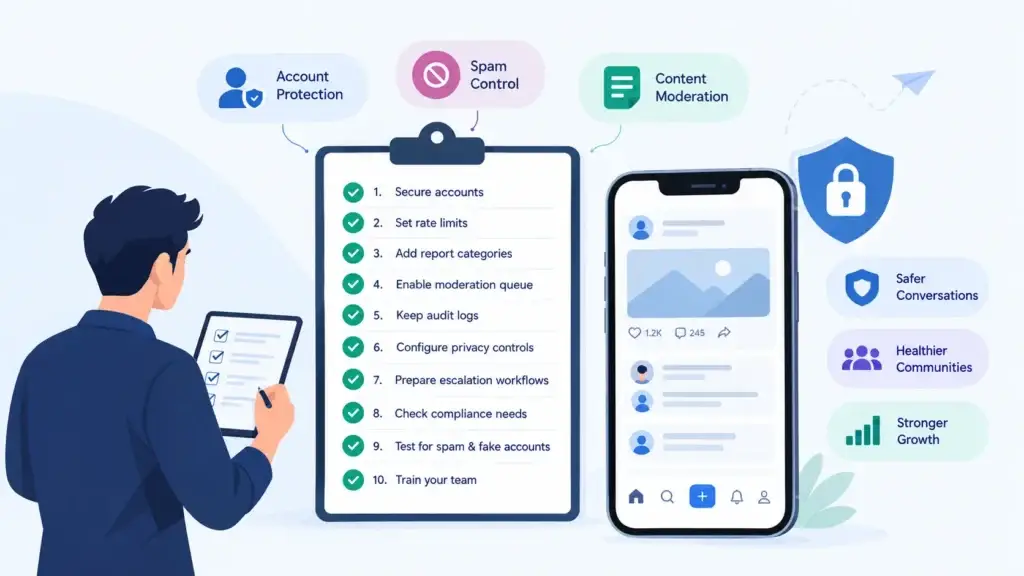
Image Source: AI-generated visual by Miracuves
Before launching a real-time microblogging platform, founders should review whether the safety foundation is strong enough for real users, real conversations, and real operational pressure.
- Confirm that account sign-up, login, recovery, and session controls are secure.
- Set posting, reply, mention, follow, and message rate limits for risky behavior.
- Create report categories that match the platform’s community rules.
- Give admins a centralized moderation queue with clear action options.
- Enable audit logs for admin actions and enforcement decisions.
- Add privacy controls for blocking, muting, mentions, messages, and profile visibility.
- Prepare escalation workflows for sensitive or repeated abuse cases.
- Review compliance needs based on target market, user data, and operating model.
- Test how the platform handles spam bursts, fake accounts, and suspicious login activity.
- Train the operating team on moderation rules before opening the platform publicly.
Final Thoughts: Safer Platforms Create Stronger Communities
A real-time microblogging platform succeeds when people trust the space enough to participate. Features bring users in, but trust keeps them active. Account protection reduces identity risk. Spam control protects conversation quality. Content moderation helps the platform respond when users, posts, or behavior cross safety boundaries.
For founders, the right approach is to build trust and safety into the product foundation from the beginning. A platform that launches with admin control, reporting workflows, audit logs, privacy settings, and abuse prevention is easier to operate and safer to scale.
Miracuves supports founders who want to launch faster without ignoring the trust layer that real communities need. With the right foundation, a microblogging platform can move quickly while still giving users, creators, and operators a safer environment to grow.
FAQs
What is trust and safety in a real-time microblogging platform?
Trust and safety refers to the systems that protect users, accounts, conversations, and platform operations. It includes account protection, spam control, content moderation, abuse reporting, privacy controls, and admin enforcement workflows.
Why is spam control important for microblogging platforms?
Spam control protects feed quality, replies, mentions, hashtags, direct messages, and user attention. Without it, automated accounts and repetitive content can reduce engagement and make genuine conversations harder to find.
What account protection features should a microblogging platform include?
Important account protection features include secure login, email or phone verification, multi-factor authentication, session management, suspicious login alerts, password recovery controls, and the ability to revoke unknown sessions.
How should content moderation work in a real-time social platform?
Content moderation should combine user reporting, automated risk detection, admin review queues, clear policy categories, enforcement actions, and audit logs. This helps operators respond quickly while keeping decisions more consistent.
Can a microblogging platform use automation for moderation?
Yes. Automation can flag spam, suspicious links, repeated abuse, risky uploads, and unusual behavior. However, human review is still important for context, appeals, sensitive cases, and final enforcement decisions.
How can founders prepare a microblogging platform for safer launch?
Founders should prepare secure account workflows, rate limits, report categories, moderation queues, admin roles, audit logs, privacy controls, and escalation rules before launch. This makes the platform easier to manage when real users begin posting.
Miracuves is an independent software development company. We are not affiliated with, connected to, sponsored by, or endorsed by any company or product named in this article.
Terms such as “X Clone” are used descriptively. It is how the software industry refers to building a platform with functionality comparable to a known service, and how clients search for it.
The entire design and codebase of our products is built by our own team. Our products contain no code, design, graphics, or content originating from any third-party website or applications.
All third-party names and marks referenced in this article are the property of their respective owners, referenced solely to identify the services discussed.