
Key Takeaways
- An app with 1,000 downloads can earn very different revenue depending on the monetization model and user intent.
- Downloads alone do not create income; active users, paid conversions, repeat usage, and transaction volume matter more.
- Subscriptions, commissions, in-app purchases, service fees, ads, and premium features are common revenue paths.
- Revenue depends on retention, pricing, conversion rate, user quality, niche demand, and payment frequency.
- A smaller app can outperform a larger one when users complete paid actions regularly inside the platform.
Revenue Signals
- Founders need to track installs, active users, free-to-paid conversion, average order value, churn, and lifetime value.
- Subscription apps need pricing plans, billing cycles, trial logic, renewal handling, payment retries, and cancellation control.
- Marketplace apps need commissions, service fees, vendor payouts, transaction tracking, refunds, and dispute workflows.
- Ad-supported apps need strong daily usage, session time, impressions, click-through rates, and advertiser demand.
- Admin dashboards should show revenue, paid users, transactions, refunds, subscriptions, retention, and monetization performance.
Real Insights
- A 1,000-download app with low engagement may earn almost nothing if users do not return or pay.
- A niche B2B, subscription, or marketplace app can earn more from fewer users when every user has commercial intent.
- Ad revenue usually needs large traffic volume, while subscriptions and transactions can monetize smaller audiences faster.
- Founders should design monetization before launch instead of waiting until downloads arrive.
- Miracuves builds monetization-ready apps with subscriptions, commissions, service fees, payment workflows, analytics dashboards, and admin control.
Founders usually ask one question before launching an app: how much can a 1000 downloads app make?
The honest answer depends on the business model, not the download count. If the app is a broad consumer product earning through ads, 1,000 downloads may generate only limited monthly revenue. That does not automatically mean the idea is weak. It usually means the monetization strategy needs to be stronger.
Downloads alone do not build the business. Revenue yield does.
A free consumer app often needs massive traffic because each user contributes very little value. A vertical B2B app works differently. If those 1,000 downloads come from business owners, agencies, operators, coaches, clinics, trainers, creators, consultants, local service providers, or niche teams with real budgets, the same 1,000 installs can support a profitable subscription model.
That is why founders should think beyond vanity metrics and focus on building high-intent yield. Miracuves helps founders move faster with ready-made clone app solutions that can be adapted for niche markets, subscription models, and business-focused app ideas.
The B2C Download Trap: Why Broad App Metrics Are a Distraction
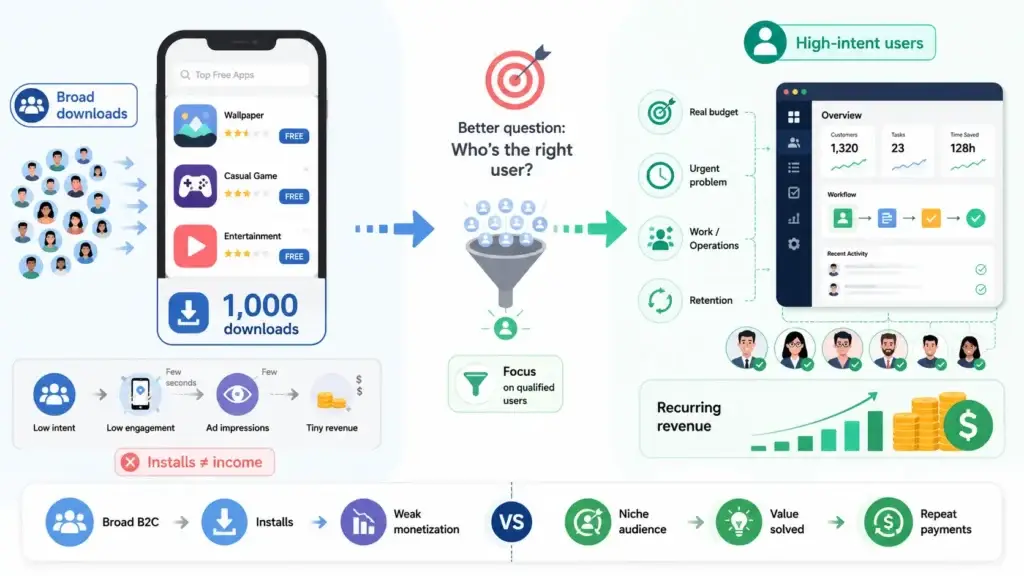
The biggest mistake founders make is treating every download as equal.
A teenager downloading a free wallpaper app, a casual user installing a game, and a business owner downloading a workflow app are not financially equal. One may never pay. One may watch a few ads. One may pay $250 every month if the app saves time, improves operations, helps them manage customers, or gives their team a better workflow.
That is why “1,000 downloads” is an incomplete metric.
A better question is:
How many of those 1,000 downloads belong to users with a real budget, an urgent problem, and a reason to keep paying?
This is where consumer app logic breaks down. Consumer apps usually need massive scale because each user contributes a tiny amount of revenue. Ads only pay after impressions happen. In Google AdMob, eCPM means estimated revenue per 1,000 ad impressions, calculated as total earnings divided by impressions and multiplied by 1,000.
That means downloads do not pay you. Active usage creates impressions. Impressions create ad revenue. If users install the app and leave, the revenue model collapses.
For niche entrepreneurs, community builders, and specialized SaaS creators, this is good news. You do not need to win the entire consumer market. You need to serve a narrow audience that already understands the value of the problem you solve.
Read More: The 4 Types of Apps That Actually Generate High-Volume Revenue
Financial Modeling: Low-Margin Ads vs. High-Yield Vertical Subscriptions
Let’s use a simple model.
Assume a free consumer app gets 1,000 downloads.
Out of those users:
30% become monthly active users
Each active user opens the app 20 times per month
Each session shows 2 ads
The app earns $2.50 eCPM as a working scenario
The monthly ad revenue formula is:
Ad Revenue = (Active Users × Sessions × Ads Per Session ÷ 1,000) × eCPM
So the math becomes:
1,000 downloads × 30% active rate = 300 active users
300 active users × 20 sessions = 6,000 sessions
6,000 sessions × 2 ads = 12,000 ad impressions
12,000 impressions ÷ 1,000 × $2.50 eCPM = $30/month
This is not a business. It is a signal that the model needs scale.
Even if the eCPM increases to $10, the same app produces only:
12,000 ÷ 1,000 × $10 = $120/month
At $50 eCPM, which would be unusually strong for many broad app categories, the app still makes:
12,000 ÷ 1,000 × $50 = $600/month
The problem is not the math. The problem is the model.
Now compare that with a high-intent B2B subscription app.
Assume the same 1,000 downloads come from a specialized niche. Examples could include fitness studios, independent clinics, local agencies, creator communities, event operators, consultants, property managers, training businesses, or trade associations.
If 10% convert into paying business accounts:
1,000 downloads × 10% = 100 paying businesses
100 businesses × $250/month = $25,000 MRR
$25,000 × 12 = $300,000 ARR
This is the High-Intent Subscription Yield variable.
The founder did not need more downloads. The founder needed a better economic target.
Read More: Designing a Peer-to-Peer Rental Engine: Solving the Availability Challenge
The High-Intent Subscription Yield Variable
High-intent subscription yield measures how much revenue a focused group of users can produce when the app solves a budget-backed business problem.
The formula is simple:
Monthly Revenue = Downloads × Qualified User Rate × Paid Conversion Rate × Monthly Subscription Price
A consumer founder usually asks:
“How do I get more downloads?”
A B2B subscription founder asks:
“How do I attract fewer but more valuable users?”
That shift changes the entire business.
Here is the comparison:
| Model | Downloads | Paying Logic | Monthly Revenue |
|---|---|---|---|
| Free consumer app with ads | 1,000 | 12,000 impressions at $2.50 eCPM | $30 |
| Free consumer app with stronger ads | 1,000 | 12,000 impressions at $10 eCPM | $120 |
| Niche B2B subscription app | 1,000 | 100 businesses at $250/month | $25,000 |
| B2B app with 50 paying businesses | 1,000 | 50 businesses at $250/month | $12,500 |
| B2B app with 25 paying businesses | 1,000 | 25 businesses at $250/month | $6,250 |
The insight is direct: a small app audience can become financially meaningful if the audience is commercial, narrow, and willing to pay for operational value.
For founders building around recurring revenue, this model sits closer to SaaS & Web App Development than traditional consumer app marketing. The priority is not just acquisition volume. It is pricing power, retention, account expansion, and repeat business value.
Why Ads Fail Small Apps Faster Than Founders Expect
Ads are not bad. They are simply scale-dependent.
An ad-supported model works when the app has high retention, large daily usage, strong geographies, strong advertiser demand, and enough impressions to make the revenue meaningful.
For a small app, the issue is leverage.
If your goal is $5,000/month and your ad model earns $2.50 per 1,000 impressions, you need:
$5,000 ÷ $2.50 × 1,000 = 2,000,000 monthly ad impressions
If each download generates 12 monthly ad impressions under the earlier model, you need roughly:
2,000,000 ÷ 12 = 166,667 downloads
That is only to reach $5,000/month in ad revenue under that scenario.
A B2B subscription app can reach the same level with:
20 businesses × $250/month = $5,000/month
That is the practical founder lesson. Consumer ads demand reach. B2B subscriptions demand relevance.
Read More: The Pre-Launch Compliance Checklist: Meeting Enterprise Security Standards
Configuring Your Paywall Engine for Day-1 B2B Profitability
A B2B subscription app cannot be treated like a consumer app with a payment button added later. It needs the planning discipline of a web app development company that understands dashboards, portals, user roles, payment logic, and admin workflows from the beginning.
The paywall should protect the features that create measurable business utility.
That may include:
- User seats
- Team or organization workspaces
- Premium dashboards
- Booking or workflow limits
- Customer records
- Reporting and analytics
- Automated reminders
- Branded portals
- Document or content storage
- Payment collection
- Role-based access
- Priority support
- Advanced integrations
The key is to avoid charging for access alone. Businesses pay when the app becomes part of their workflow.
For example, a local fitness studio may not pay $250/month for “an app.” It may pay $250/month for member scheduling, trainer allocation, push notifications, class packages, renewals, customer engagement, and branded mobile access.
A coaching community may not pay $250/month for content hosting. It may pay for private member access, course delivery, event calendars, recurring billing, discussion features, and admin visibility.
A niche service operator may not pay for software because it is attractive. It pays because the app reduces manual work and helps collect revenue.
That is how high-intent yield is created.
Payment Math: B2B Subscriptions Keep More Revenue Predictable
Payment fees matter, but they do not destroy the B2B model.
If a founder charges 100 businesses $250/month through a direct online payment flow, gross revenue is:
100 × $250 = $25,000/month
Using Stripe’s standard online pricing of 2.9% + 30¢ per successful card charge as a reference, each $250 transaction would have an estimated processing cost of $7.55. Across 100 accounts, that equals about $755/month.
Estimated monthly revenue after that processing example:
$25,000 − $755 = $24,245/month
Estimated annualized revenue after that processing example:
$24,245 × 12 = $290,940/year
If the subscription is sold through app-store in-app purchase systems, app-store service fees may apply. Google Play lists 15% for automatically renewing subscriptions, and Apple’s Small Business Program provides a reduced 15% commission rate for eligible developers.
At a 15% fee, the same $25,000/month gross subscription model becomes:
$25,000 × 85% = $21,250/month
That is still dramatically stronger than small-scale ad revenue.
The exact payment route depends on product category, platform rules, region, billing design, and legal review. But the core lesson remains: high-ticket recurring revenue gives founders more room to build a real company.
Founder Decision Signals
Speed
If your niche is already defined, speed matters more than broad experimentation. A launch-ready app foundation lets you test pricing, onboarding, and subscription packaging faster.
Cost
Ad-supported consumer apps often require large acquisition budgets before meaningful revenue appears. B2B subscription apps can validate with fewer but higher-value users.
Scalability
The scalable layer is not just user growth. It is admin control, billing logic, roles, analytics, support workflows, and upgrade paths.
Market Fit
A small number of paying businesses is a stronger validation signal than thousands of free users who do not return or pay.
Why White-Label Frameworks Reduce the Cost of Testing a Paid Niche
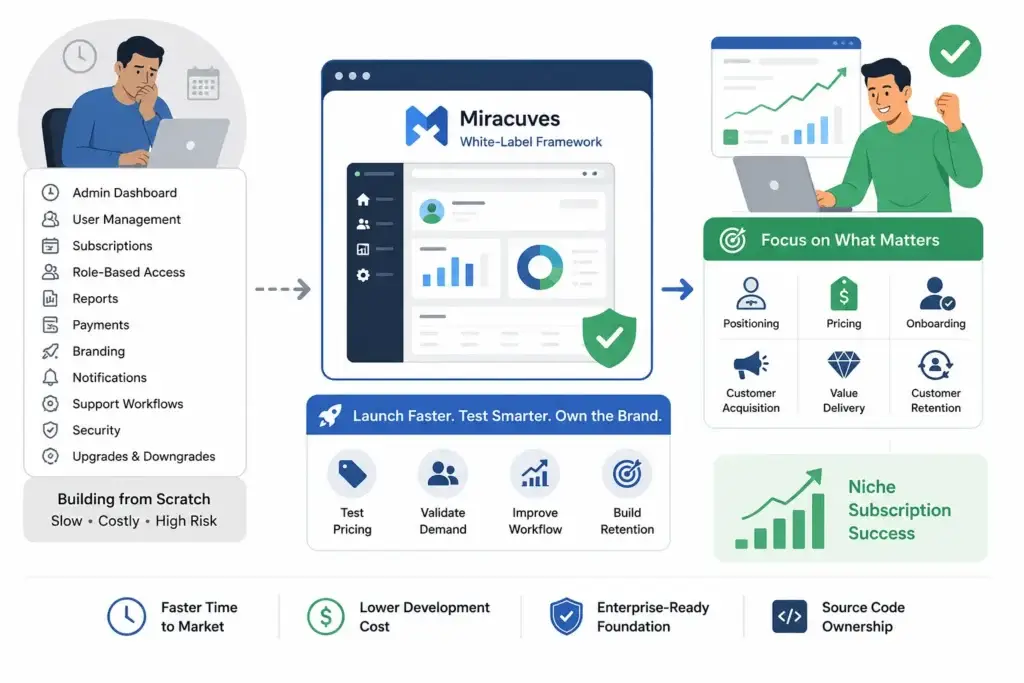
The challenge with a B2B subscription app is not only building the interface. The harder work is creating the operational layer behind the business.
A strong B2B app needs:
- Admin dashboard
- User and account management
- Subscription controls
- Role-based access
- Reporting
- Notifications
- Payment gateway integration
- Branding control
- Support workflows
- Data security basics
- Upgrade and downgrade logic
Building this from zero can slow down validation. For a founder testing a niche, delay is expensive because the market may already be moving.
That is where a ready-made white-label framework becomes useful.
Miracuves helps founders start from an existing product foundation instead of beginning with a blank technical roadmap. For founders building a niche subscription app, a full stack app development approach can connect the front end, backend, database, payments, admin dashboard, and deployment layer without forcing the team to rebuild every common module from zero.
A founder can use a white-label app foundation to test questions such as:
- Will this niche pay $250/month?
- Which feature creates the strongest upgrade trigger?
- Does the buyer want a team plan or a single-account plan?
- Which workflow saves enough time to justify a recurring fee?
- Can the app become a system of record for the customer?
Those questions matter more than chasing raw install volume.
For founders exploring this route, Miracuves offers ready-made clone app solutions, full-stack app development, software development services that can support branded launch, admin control, and source-code ownership.
What a High-Yield B2B App Should Include
A small-audience subscription app must create value immediately. The user should understand why the product is worth paying for before the trial ends.
| Product Layer | What It Does | Why It Protects Revenue |
|---|---|---|
| Subscription tiers | Separates starter, growth, and premium access | Lets founders monetize different customer sizes |
| Admin dashboard | Controls users, payments, content, and reports | Reduces operational dependency on developers |
| Role-based access | Gives different permissions to owners, staff, and managers | Makes the app usable for real teams |
| Usage limits | Controls seats, bookings, records, storage, or workflows | Creates natural upgrade triggers |
| Branded experience | Adds logo, colors, domain, and business identity | Makes the app feel owned by the customer |
| Payment integration | Handles recurring billing and renewals | Turns the app into predictable revenue |
| Analytics | Tracks usage, churn signals, and feature adoption | Helps founders improve pricing and retention |
The goal is not to lock users behind a frustrating paywall. The goal is to show enough value that paying becomes the logical next step.
Read More: The Staffing Trap: The True Financial Cost of Building an Internal Dev Team
The 1,000-Download Revenue Model Founders Should Actually Use
Here is a practical model for niche entrepreneurs.
Start with 1,000 high-intent downloads.
Segment them into four groups:
Curious visitors
Problem-aware prospects
Trial users
Paying businesses
The founder’s job is not to monetize everyone. The founder’s job is to identify the 5% to 10% with the strongest pain and convert them into recurring accounts.
A realistic planning model could look like this:
| Funnel Stage | Count | Meaning |
|---|---|---|
| Total downloads | 1,000 | Niche-targeted installs |
| Qualified users | 400 | Users who match the target business profile |
| Trial users | 200 | Users who test a business workflow |
| Paying accounts at 25% trial conversion | 50 | Strong early niche traction |
| Monthly subscription | $250 | B2B price point |
| Monthly recurring revenue | $12,500 | Validation-ready revenue base |
This model is much more useful than asking how many ads 1,000 users can watch.
A founder with 50 paying businesses has proof. A founder with 1,000 free users and no monetization may only have curiosity.
Mistakes Founders Make When Monetizing 1,000 Downloads
Measuring downloads instead of qualified accounts
Downloads feel exciting, but they do not show who has budget, urgency, or repeat usage. Track qualified business users, trial activation, and paid conversion instead.
Adding ads to a product that should be subscription-first
Ads may reduce trust in professional tools. If the app saves time, manages customers, or supports business workflows, a clean subscription model may create stronger revenue.
Building without billing logic
If subscriptions, plan limits, invoices, renewals, and admin controls are not planned early, monetization becomes harder to retrofit later.
Serving a broad audience with no budget
A narrow audience with a painful business problem can outperform a large audience that only wants free access.
The Founder’s Cost Analysis: Traffic Is Expensive, Yield Is Efficient
Consumer apps often need large acquisition budgets because the revenue per user is low. If a founder spends heavily to acquire free users, the payback can become painful unless retention and monetization are exceptional.
A B2B subscription app has a different financial profile.
The founder can spend more to acquire a customer because each customer may produce recurring revenue. At $250/month, even a six-month customer creates $1,500 in gross revenue. A twelve-month customer creates $3,000.
That gives the founder more room for:
- Sales calls
- Niche community partnerships
- LinkedIn outreach
- Webinars
- Industry newsletters
- Referral programs
- Partner channels
- Paid search for high-intent keywords
- Direct demos
This is why high-intent yield matters. The founder is no longer trying to turn passive attention into pennies. The founder is turning business pain into recurring revenue.
Where Miracuves Fits in This Model
A niche B2B app succeeds when the founder can move quickly from idea to paid validation.
That requires a product foundation with:
- Branded web and mobile access
- Admin dashboard
- User management
- Subscription-ready workflows
- Secure payment integration
- Reporting
- Customizable modules
- Source-code ownership where relevant
- Post-launch flexibility
Miracuves supports founders with white-label and ready-made app foundations that can be adapted for niche markets. For teams that need deeper customization, integrations, or workflow logic, Miracuves’ software development services can help extend the product beyond the first launch version while keeping the business focused on customer discovery, offer design, onboarding, pricing, and retention.
Final Thoughts: 1,000 Downloads Are Enough When the Users Are Valuable
So, how much can an app with 1,000 downloads actually make?
The answer depends on the type of users, the monetization model, and how much value the app creates for its audience. A broad consumer app may generate very little revenue if it depends mainly on ads, low engagement, and passive users. In that model, revenue is usually tied to impressions, which means the app needs a large number of active users opening the app frequently before the income becomes meaningful.
A niche B2B subscription app can perform very differently. If 1,000 downloads come from a focused business audience and 100 of those users become paying customers at $250 per month, the app can generate $25,000 in monthly recurring revenue. Even if only 25 businesses subscribe at the same price, the app can still generate $6,250 per month.
That is why founders should stop treating downloads as the main goal. The stronger goal is high-intent subscription yield, where a smaller number of users with a clear problem, stronger willingness to pay, and recurring business needs can create more revenue than thousands of casual free users.
The real question is not whether 1,000 downloads are enough. The real question is whether those 1,000 users have a strong enough reason to pay.
FAQs
How much can a 1000 downloads app make?
A 1,000-download app can make almost nothing or become a meaningful revenue asset depending on the monetization model. A free consumer app relying on ads may only earn a small amount because revenue depends on impressions. A niche B2B subscription app can generate thousands per month if a small percentage of users become paying business accounts.
Can 1,000 app downloads make $10,000 per month?
Yes, but usually not through low-margin ads. For example, 40 paying B2B customers at $250/month equals $10,000 in monthly recurring revenue. This requires a high-intent niche, clear business value, and subscription-ready product design.
Why do app downloads not equal revenue?
Downloads only show installs. They do not prove active usage, retention, payment intent, or business value. Revenue comes from users who engage, convert, renew, purchase, or create monetizable impressions.
Is ad revenue a good model for small apps?
Ad revenue can work, but it usually needs high traffic and strong engagement. Small apps often struggle with ads because they do not generate enough impressions. Subscription, B2B SaaS, paid tools, or marketplace monetization may be stronger for niche apps.
What is a high-intent app user?
A high-intent app user has a clear problem, budget, and reason to act. In B2B apps, this could be a business owner, manager, creator, agency, clinic, trainer, consultant, or operator who needs software to save time, organize work, or generate revenue.
What is the best monetization model for a niche app?
For niche business audiences, a subscription model is often stronger than ads because it creates predictable recurring revenue. The right model depends on the niche, product value, payment behavior, and how often users rely on the app.
How can Miracuves help with B2B subscription apps?
Miracuves can help founders launch ready-made and white-label app solutions with branding, admin control, source-code ownership, and subscription-ready workflows where relevant. This helps founders test niche demand faster instead of building every module from zero.
Miracuves is an independent software development company. We are not affiliated with, connected to, sponsored by, or endorsed by any company or product named in this article.
Terms such as “X Clone” are used descriptively. It is how the software industry refers to building a platform with functionality comparable to a known service, and how clients search for it.
The entire design and codebase of our products is built by our own team. Our products contain no code, design, graphics, or content originating from any third-party website or applications.
All third-party names and marks referenced in this article are the property of their respective owners, referenced solely to identify the services discussed.