Let’s not sugarcoat it—YouTube changed the internet forever. It created a whole new class of creators, gave birth to multi-billion-dollar content empires, and turned “subscribe and like” into part of our everyday vocabulary. So, when startups dream of building a YouTube clone, they’re chasing something real. A gold mine, even.
But here’s the trap: most founders think a sleek video player and an upload button are all they need. They pour resources into development, launch a platform, and… tumbleweeds. No creators. No views. No traction. Just dead pixels.
At Miracuves, we’ve partnered with media visionaries and startup hustlers to bring video-sharing dreams to life. And every successful YouTube alternative we’ve built had one thing in common: avoiding the five mistakes we’re about to unpack.
Read More : Pre-launch vs Post-launch Marketing for YouTube Clone Startups
The 5 Most Common Mistakes When Building a YouTube Clone
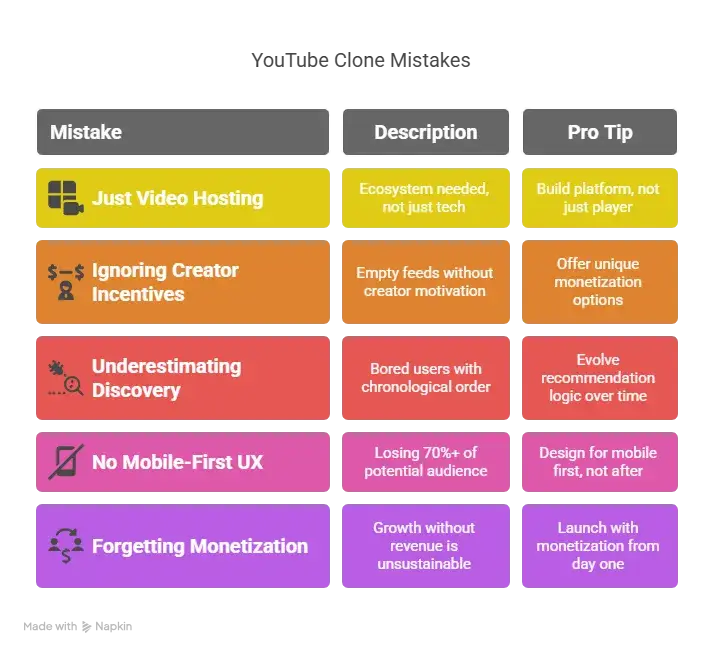
1. Thinking It’s Just About Video Hosting
Let’s be clear: YouTube is not just a video hosting site. It’s an ecosystem. A recommendation engine, a monetization platform, a content discovery machine, and a community hub all rolled into one.
Startups often invest in the tech—cloud storage, file uploads, and adaptive streaming—but skip the actual value drivers. Things like suggested videos, playlists, creator channels, and engagement loops.
Pro Tip:
Build not just the player, but the platform. Recommendation engines, channel subscriptions, and creator pages aren’t nice-to-haves—they’re the backbone of retention.
2. Ignoring Creator Incentives
Without creators, you don’t have a platform. It’s that simple. YouTube knew this from the start—which is why it rolled out Partner Program monetization, fan donations, and exclusive content tools.
Startups that ignore this end up with empty feeds. Creators need reasons to stay: views, fans, and revenue.
Pro Tip:
Even basic monetization—like tipping, sponsored videos, or affiliate links—can go a long way. Give creators something they can’t get elsewhere.
3. Underestimating the Power of Discovery
Here’s where many clones die: discoverability. If your homepage shows trending uploads in chronological order, users will get bored—fast.
YouTube thrives on its algorithm. It recommends based on watch history, engagement, subscriptions, and session length. This keeps viewers glued and creators happy.
Pro Tip:
Start with simple “related video” logic, then evolve. Tag-based recommendations, trending based on likes/views, and watch history personalization can be game-changers.
4. Launching Without Mobile-First UX
Your audience isn’t on desktops—they’re on phones. YouTube knows this, and its mobile UX is laser-optimized: swipe gestures, tap-to-fullscreen, mini-player, smooth autoplay.
Startups that treat mobile as an afterthought lose out on 70%+ of their audience.
Pro Tip:
Design for mobile-first, not mobile-friendly. Minimize taps to view, swipe, and comment. Use sticky players and gesture navigation.
Build Your Own Video Streaming Platform with Miracuves
5. Forgetting About Monetization (Until It’s Too Late)
Yes, user growth is important—but growth without revenue is a runway killer. YouTube monetized early with ads, memberships, and Super Chats.
Most clones wait until traffic is high, but by then it’s hard to retrofit monetization into user habits.
Pro Tip:
Launch with ad spaces, brand integrations, or subscription tiers from day one. Make monetization native to your platform.
Read More : Best YouTube Clone Scripts in 2025: Features & Pricing Compared
“`htmlConclusion
YouTube didn’t just build a website. It built a platform that powers economies, voices, and entire subcultures. Your clone doesn’t need to be a full-scale replica—but it does need to think beyond videos and into community, content lifecycle, and creator support.
You don’t need a hundred engineers. You need the right direction.
At Miracuves, we help innovators launch high-performance app clones that are fast, scalable, and monetization-ready. Ready to turn your idea into reality? Let’s build together.
FAQs
Is it legal to build a YouTube clone?
Yes, as long as you don’t copy branding, logos, or proprietary code. Building a similar platform model is fair game.
How do I attract creators to a new video platform?
Incentivize early. Offer monetization, promotion, and engagement tools. Build creator-first, not just audience-first.
Should I start with long-form or short-form video?
Depends on your niche. Short-form is easier for mobile growth, long-form is better for depth and monetization.
What’s the biggest tech challenge?
Scalable video delivery—compression, encoding, streaming. Use CDNs and transcoding services to stay fast.
Can I monetize from day one?
Absolutely. Use pre-roll ads, paid promotions, or premium content access. Don’t wait to implement monetization.
Do I need a recommendation algorithm right away?
Not complex AI at first. But yes, even a basic “related content” engine helps reduce bounce and increase session time.
Related Articles
Miracuves is an independent software development company. We are not affiliated with, connected to, sponsored by, or endorsed by any company or product named in this article.
Terms such as “X Clone” are used descriptively. It is how the software industry refers to building a platform with functionality comparable to a known service, and how clients search for it.
The entire design and codebase of our products is built by our own team. Our products contain no code, design, graphics, or content originating from any third-party website or applications.
All third-party names and marks referenced in this article are the property of their respective owners, referenced solely to identify the services discussed.