
Key Takeaways
- A digital banking platform marketing strategy should move users from awareness and sign-up to verification, account funding, first transaction, and repeat financial activity.
- Growth depends on reducing friction across onboarding, KYC, account setup, money transfers, card usage, bill payments, savings, and other high-value banking actions.
- Successful marketing should measure activation and retention rather than focusing only on app installs, registrations, or low-intent promotional traffic.
Acquisition & Activation Signals
- User acquisition can combine referral programs, paid campaigns, content marketing, partnerships, financial education, targeted offers, and trust-focused messaging.
- Activation improves when users can complete registration, identity verification, account funding, beneficiary setup, and their first transfer or payment with minimal friction.
- Teams should track signup completion, KYC completion, funded accounts, first-transaction rate, activation time, onboarding drop-off, acquisition cost, and channel-level conversion.
Repeat Usage Insights
- Repeat usage can grow through reliable transfers, recurring payments, transaction reminders, useful notifications, rewards, personalized offers, transparent fees, and strong customer support.
- Operators should monitor repeat transaction rate, transaction frequency, active users, retention cohorts, payment volume, feature adoption, dormant accounts, and customer lifetime value.
- Miracuves develops customizable digital banking platforms with onboarding, KYC workflows, payments, transfers, account management, transaction monitoring, analytics, notifications, security, and admin controls.
Marketing a digital banking platform is not just about getting app downloads. A banking user does not become valuable when they install the app. They become valuable when they trust the platform enough to verify their identity, add funds, complete the first transaction, return for repeated financial activity, and recommend the product to others.
That is why a strong digital banking platform marketing strategy must be built around the full user journey, not only awareness campaigns. Founders need to think beyond ads, influencers, and launch announcements. The real question is: what happens after a user clicks “sign up”?
If onboarding is confusing, users drop off. If verification feels risky, they pause. If funding the account is unclear, they leave. If the first transaction does not feel useful, they may never return. In fintech, marketing performance depends heavily on product trust, onboarding clarity, transaction confidence, and repeat value.
This guide explains how founders can market a digital banking platform from user sign-up to first transaction and repeat usage. It also shows how product features, admin control, communication, referrals, and retention workflows work together to create sustainable fintech growth.
For founders who want to launch faster, Miracuves offers a white-label digital banking foundation that can be customised with branding, source code, admin workflows, transaction modules, and launch-ready fintech features. This keeps the product foundation connected to the marketing strategy without turning this blog into a direct solution-page copy.
Why Digital Banking Marketing Must Focus on Activation
Many fintech founders make the mistake of treating marketing as a traffic problem. They invest in paid ads, social campaigns, app store visibility, influencer content, and launch PR, but they do not connect those campaigns to activation.
In digital banking, activation usually means the user has completed a meaningful financial action. That action may be identity verification, adding money, ordering a card, completing a transfer, paying a bill, creating a savings goal, inviting a business team member, or using a budgeting tool.
A registration is only a signal of interest. A first transaction is a stronger signal of trust.
This is why the marketing funnel for a digital banking platform should be measured in stages:
| Funnel Stage | User Question | Marketing Job | Product Requirement | Key Metric |
|---|---|---|---|---|
| Awareness | Why should I care? | Communicate the main financial problem clearly | Strong positioning and landing page | Qualified traffic |
| Sign-up | Is this worth trying? | Reduce hesitation and explain value | Simple registration flow | Sign-up conversion |
| Verification | Is this safe? | Explain why KYC is needed | Secure identity workflow | Verification completion |
| Funding | How do I start? | Guide the user to add money or connect an account | Funding methods and instructions | Funded accounts |
| First transaction | Does this solve my problem? | Nudge the first useful financial action | Transfer, card, wallet, bill, or payment flow | First transaction rate |
| Repeat usage | Why should I come back? | Build habits through value and reminders | Insights, notifications, rewards, controls | Repeat transaction rate |
| Advocacy | Should I invite others? | Turn satisfied users into referrers | Referral logic and reward tracking | Referral activation |
A strong activation funnel also needs a clear revenue logic behind it. Founders should understand how sign-ups, funded accounts, first transactions, subscriptions, card usage, transfer fees, and repeat activity connect to the wider digital banking revenue model. Without that clarity, marketing teams may drive traffic but fail to connect user actions with sustainable business growth.
The strongest digital banking marketing does not stop at getting attention. It helps the user move from curiosity to trust and from trust to recurring financial behavior.
Build Trust Before Asking Users to Move Money
A digital banking platform asks users to do something sensitive: share personal information, complete identity verification, add funds, move money, or manage financial activity. That means trust is not a branding layer. It is part of conversion.
Before a user signs up, the landing page and campaign messaging should answer basic trust questions:
- What financial problem does this platform solve?
- Who is the platform built for?
- What can users do after signing up?
- What information is required during onboarding?
- How are payments, cards, transfers, or wallets handled?
- What fees, limits, or conditions should users know?
- What support is available if something goes wrong?
Founders should avoid vague promises such as “smarter banking for everyone.” A better approach is to choose one clear user problem and build the message around it.
For example, a digital banking product for freelancers may lead with faster access to payments, multi-currency balance visibility, and simple expense tracking. A product for small businesses may lead with team spending control, employee cards, reporting, and approval workflows. A consumer-focused finance app may lead with budgeting, instant card controls, and transparent account activity.
The more specific the promise, the easier it is for marketing to attract the right users.
Turn Sign-Ups Into Verified Users
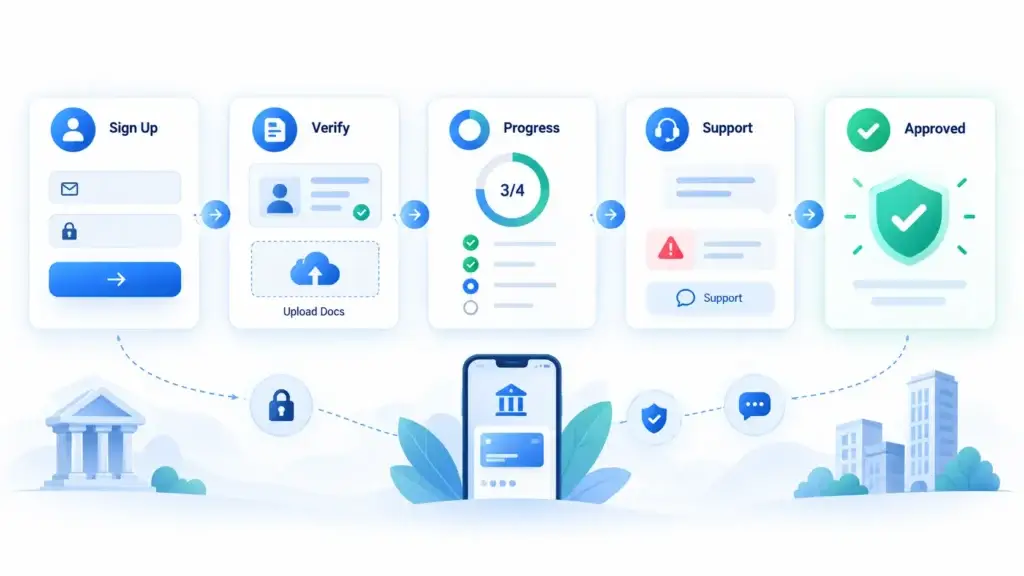
After sign-up, the next major challenge is verification. Many users abandon fintech onboarding because verification feels long, unclear, or risky. Marketing can reduce this friction by educating users before and during onboarding.
Instead of treating KYC as a cold compliance step, explain it in user-friendly language. Tell users why verification is required, what documents may be needed, how long the process may take, and what happens after approval.
Good onboarding communication should include:
- A short explanation of the verification process
- A clear progress indicator
- Document upload guidance
- Error messages that explain how to fix issues
- Security reassurance without exaggerated claims
- Support access if verification fails or pauses
- A next-step prompt after verification is complete
The goal is not to hide verification. The goal is to make it understandable.
A digital banking platform that guides users through verification can improve trust and reduce drop-off before the first financial action. This is also where secure onboarding and verification workflows become important, because users need to understand how identity checks, account protection, transaction monitoring, and data security support a safer fintech experience.
Make the First Transaction the Core Growth Milestone
The first transaction is one of the most important moments in the fintech customer journey. It proves that the user has moved beyond exploration and trusted the platform enough to perform a financial action.
Depending on the product model, the first transaction may be:
- Adding money to a wallet
- Sending money to another user
- Making a card payment
- Creating a virtual card
- Paying a bill
- Converting currency
- Receiving a payment
- Creating a savings goal
- Inviting a team member to a business account
These first-value actions work better when the platform already has the right product modules in place. Features such as wallet funding, virtual cards, transaction history, money transfers, spending controls, notifications, and admin oversight form the operational base behind core digital banking features. Marketing can bring users in, but the product must give them a clear reason to complete their first action.
The marketing team should define this first-value action early. Without a clear activation event, campaigns may optimize for shallow metrics such as installs, registrations, or clicks.
A better approach is to design campaigns around the user’s next financial step.
For example, after verification, the user may receive a simple email or in-app message that says:
“Your account is ready. Add money now to make your first payment or transfer.”
That message is direct, useful, and connected to the product journey. It does not distract the user with every feature available in the platform.
Create Repeat Usage Through Financial Habits
A digital banking platform grows when users return regularly. Repeat usage comes from habit, utility, and confidence. The product must become part of the user’s financial routine.
Retention can be improved through features and communication that help users manage money more clearly. These may include spending summaries, transaction alerts, transfer reminders, card controls, budget tracking, recurring payment visibility, savings goals, rewards, account insights, and business finance reports.
That is why founders should think about feature adoption as part of marketing, not only product design. Card controls, spending insights, transfer reminders, budgeting tools, account alerts, and transaction summaries can all support mobile banking feature adoption when users understand how those features fit into their daily financial routines.
The key is relevance. Sending more notifications does not automatically improve retention. Users return when communication helps them understand or complete a financial task.
Useful retention messages may include:
- “Your monthly spending summary is ready.”
- “Your transfer has been completed.”
- “You have a recurring payment due soon.”
- “Your card limit is close to being reached.”
- “You can save this recipient for faster future transfers.”
- “Your business expense report is ready for review.”
- “Your verification needs one more document.”
Each message should answer three questions: what happened, why it matters, and what the user should do next.
Segment Marketing by User Need
Digital banking platforms often serve multiple audiences, but each audience has a different reason to sign up and transact. Marketing performs better when campaigns are segmented around real financial needs.
| User Segment | Main Pain Point | Best Marketing Angle | Activation Event |
|---|---|---|---|
| Freelancers | Managing income from different clients or locations | Easier payment visibility and expense control | Receive or track first payment |
| Travelers | Managing spending across currencies | Card control, exchange visibility, and safer travel spending | First card transaction |
| Small businesses | Team spending and financial oversight | Employee cards, approvals, reports, and admin visibility | Invite first team member |
| Everyday consumers | Budgeting and account control | Spending insights, alerts, and simple money management | Add money or create first budget |
| Remittance users | Sending money to family or partners | Transparent transfer flow and status tracking | First transfer |
| Startup teams | Managing operational finance | Multi-user access and reporting | Create first business account workflow |
A single generic message will rarely work across all groups. A freelancer may care about getting paid. A traveler may care about card control. A business owner may care about approvals and reporting.
The product may be the same platform, but the campaign should speak to the specific financial job the user wants to complete.
Founder Decision Signals
Speed
If the market opportunity is time-sensitive, a ready-made digital banking foundation can help founders move from planning to launch faster.
Trust
Marketing should not promise more than the product can prove through onboarding, verification, transaction visibility, and support workflows.
Activation
The strongest milestone is not registration. It is the first meaningful financial action completed by a verified user.
Retention
Repeat usage depends on useful financial routines such as alerts, insights, transfers, budgeting, cards, and business controls.
Use Content Marketing to Reduce Financial Hesitation
Content marketing is especially important in fintech because users need clarity before taking action. They may search for information about digital wallets, virtual cards, transaction fees, KYC documents, account security, transfer timing, business banking features, or budgeting tools.
A strong content strategy should support every stage of the journey.
Awareness content helps users understand the financial problem. Consideration content explains available solutions. Activation content helps users complete onboarding and their first transaction. Retention content teaches users how to get more value from the platform.
Useful content topics may include:
- How digital banking platforms work
- How to complete KYC for a finance app
- How virtual cards help control online spending
- How business teams can manage employee expenses
- How to send money safely through a digital wallet
- How to read transaction history and account activity
- How budgeting tools improve monthly money decisions
- What users should know before using a mobile banking app
This type of content does more than attract search traffic. It reduces support questions, improves onboarding confidence, and helps users understand the value of the product.
For broader fintech positioning, founders can also explore Miracuves’ fintech app development services to understand how product strategy, compliance-ready workflows, and launch execution connect.
Build Referral Loops Around Real Activation
Referral programs can work well for digital banking platforms, but only when they are connected to genuine user value. A referral reward should not simply pay users for empty sign-ups. It should encourage actions that prove meaningful adoption.
A practical referral flow may look like this:
Existing user invites a friend → invited user signs up → invited user completes verification → invited user completes the first qualifying transaction → reward is approved.
This structure protects the business from low-quality registrations and helps the platform focus on active users.
Referral campaigns also perform better when they are planned across both launch stages. A founder may use early-access campaigns, waitlists, referral rewards, and education before launch, then shift toward activation, reactivation, and retention after launch. This is why a clear pre-launch and post-launch fintech marketing plan can help teams avoid treating every user the same way.
The admin system should be able to track:
- Referral source
- Campaign link
- User registration
- Verification completion
- First qualifying action
- Reward eligibility
- Suspicious activity
- Reward status
- Referred user retention
Without this backend control, referral campaigns can become expensive without producing long-term growth.
The strongest referral programs are easy to understand, simple to share, and tied to a product experience users already value.
Use Lifecycle Campaigns to Move Users Forward
Lifecycle marketing helps users move from one stage to the next. Instead of sending the same message to every user, the platform should communicate based on behavior.
| User Stage | Marketing Message Goal | Example Campaign |
|---|---|---|
| Registered but not verified | Explain why verification is needed | “Complete verification to activate your account.” |
| Verified but not funded | Guide the first funding step | “Add money to start using your account.” |
| Funded but inactive | Encourage first financial action | “Make your first payment, transfer, or card transaction.” |
| First transaction completed | Reinforce trust and next use case | “Your first transaction is complete. Here’s what you can do next.” |
| Active user | Build habit and feature depth | “View your monthly spending insights.” |
| Business user | Expand account usage | “Invite your team and set spending limits.” |
| At-risk user | Reconnect with a practical reason | “Your account is ready when you need it. Review your latest activity.” |
| Support user | Resolve friction and rebuild confidence | “Here’s the status of your request and next steps.” |
Lifecycle marketing works because it respects context. A user who has not completed verification does not need a premium upgrade message. A funded user who has not transacted needs guidance toward first value. An active business user may need deeper reporting or team controls.
The right message at the right stage can improve conversion without feeling aggressive.
App Store Optimization for Digital Banking Platforms
App store optimization helps users discover and evaluate the app before installation. For finance apps, the app store page must do more than look attractive. It must build confidence quickly.
Important ASO elements include:
- Clear app title and subtitle
- Benefit-led screenshots
- Trust-focused feature descriptions
- Simple explanation of account setup
- Transparent mention of supported use cases
- Ratings and review management
- Regular updates and release notes
- Keywords related to mobile banking, digital wallet, budgeting, cards, transfers, and business finance
Screenshots should show real user outcomes, not just interface screens. For example, instead of showing only a dashboard, highlight actions such as tracking spending, creating a card, sending money, reviewing transactions, or managing team expenses.
A user should understand the platform’s value before downloading it.
Paid Marketing Should Optimize for Activated Users
Paid ads can create fast visibility, but fintech advertising becomes inefficient when campaigns optimize only for installs or sign-ups. Founders should measure how paid users behave after registration.
Useful paid marketing metrics include:
- Cost per verified user
- Cost per funded account
- Cost per first transaction
- Cost per repeat user
- Cost per active business account
- Retention by campaign
- Support requests by acquisition channel
- Revenue per active user
These metrics also help founders understand whether acquisition spend is realistic for the product stage. Paid marketing should be compared against platform setup, integrations, compliance workflows, support needs, and operating costs. Founders who are planning their budget can review the digital banking app development cost factors before scaling paid campaigns too aggressively.
A campaign that produces low-cost registrations may still fail if those users never verify or transact. A more expensive campaign may perform better if it brings users who complete high-value financial actions.
Founders should connect ad platforms, analytics, CRM, referral tracking, and admin reporting so marketing spend can be evaluated against real product usage.
Admin Analytics: The Hidden Engine Behind Growth
Marketing teams often focus on visible assets: landing pages, ads, emails, videos, and app store listings. But the admin dashboard is just as important because it shows whether growth is healthy.
A strong admin layer helps the operating team monitor:
- User sign-ups
- Verification status
- Funding behavior
- Transaction volume
- Failed transactions
- Referral performance
- Reward approvals
- Support tickets
- Disputes
- Suspicious activity
- User segments
- Campaign performance
- Retention by cohort
- Revenue by user type
Without admin visibility, founders may not know where users are dropping off or which campaigns are attracting valuable customers.
This is where product and marketing connect. If a campaign drives sign-ups but verification completion is low, the onboarding flow may need improvement. If many users fund accounts but do not transact, the first-action prompt may be unclear. If repeat usage is weak, retention messaging or feature adoption may need work.
For founders planning to build the product foundation behind these campaigns, Miracuves’ <a href=”https://miracuves.com/revolut-clone/”>launch-ready digital banking platform</a> includes a white-label approach, source-code ownership, admin control, and fast deployment support.
Align Monetization With User Trust
A digital banking platform should not introduce monetization in a way that damages trust. Users are sensitive to hidden fees, unclear charges, confusing limits, and unexpected deductions.
Common monetization paths may include:
- Subscription plans
- Transfer fees
- Card-related fees
- Foreign exchange margins
- Business account plans
- Premium reporting tools
- Partner revenue
- Embedded finance services
- Paid support or account management
- Usage-based business features
The right model depends on the target user, financial partners, geography, compliance requirements, and product scope. A consumer product may need a freemium model to build adoption. A business finance product may be able to charge earlier if it saves time, improves control, or reduces administrative work.
Marketing should explain value before asking users to pay. Pricing pages, upgrade prompts, and plan comparisons should clearly show what the user receives.
Trust is easier to maintain when users understand what they are paying for.
Security and Compliance Messaging Should Be Clear, Not Exaggerated
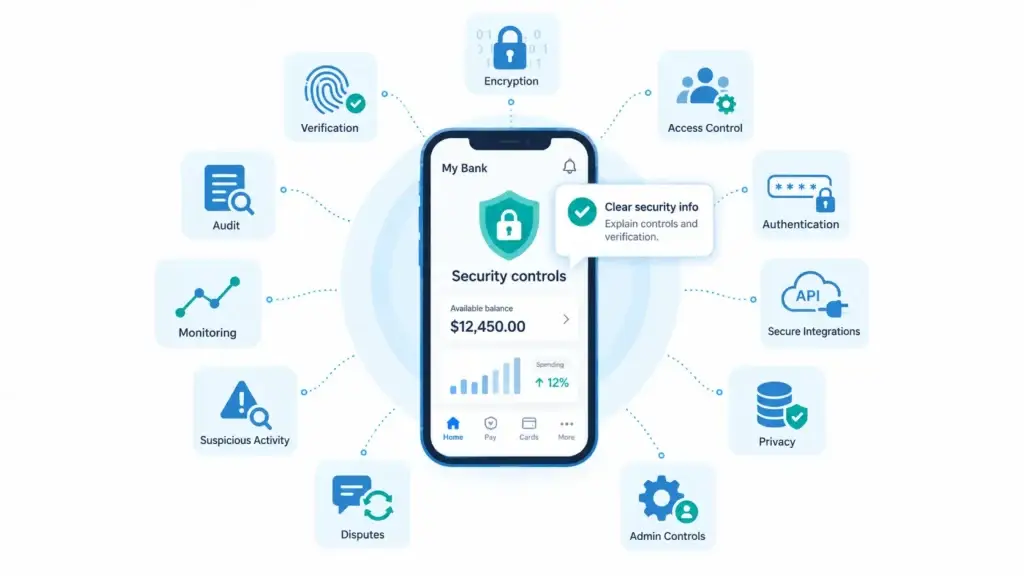
Security is a major part of fintech marketing, but it must be handled carefully. Founders should avoid claims that sound universal or unsupported. Instead, marketing should explain the controls, workflows, and safeguards that help users feel informed.
Useful security and trust topics include:
- Encrypted data transfer
- Secure authentication
- Role-based access control
- Audit logs
- User verification
- Transaction monitoring
- Secure API integrations
- Suspicious activity review
- Dispute management
- Admin permission controls
- Privacy-conscious data handling
A platform may support compliance-ready workflows, but final compliance depends on jurisdiction, legal review, financial partners, integrations, and the operating model. Marketing should communicate responsibly and avoid promises that the product or business has not verified.
This type of careful language builds more trust than exaggerated security claims.
Mistakes Founders Should Avoid
Scaling Ads Before Fixing Onboarding
If users are dropping off during registration, verification, or funding, paid ads will only make the problem more expensive. Fix the onboarding journey before increasing acquisition spend.
Measuring Sign-Ups Instead of First Transactions
Sign-ups are useful, but they are not enough. The first transaction shows stronger intent, trust, and product value.
Using the Same Message for Every Audience
Freelancers, consumers, travelers, remittance users, and business teams have different needs. Segment campaigns around user problems, not generic banking language.
Hiding Fees or Limits
Financial users want clarity. If pricing, fees, limits, or account conditions are unclear, trust weakens quickly.
Treating Referrals as Discounts
Referral programs need attribution, eligibility rules, fraud checks, and reward controls. They should support activation, not just registrations.
Ignoring Admin Reporting
Without admin analytics, founders cannot understand which campaigns create verified users, transactions, repeat usage, and revenue.
Overpromising Compliance
A safer approach is to explain compliance-ready workflows and confirm that final obligations depend on the target market and legal review.
How Miracuves Helps Founders Launch Faster
A marketing strategy performs better when the product foundation can support the promise. Founders need onboarding flows, account workflows, transaction visibility, admin controls, referral tracking, notifications, analytics, security layers, and custom branding before campaigns scale.
Miracuves helps founders build ready-made and white-label fintech platforms with source code, branded design, admin dashboards, monetization-ready workflows, and faster launch support. Where the ready-made scope fits, Miracuves can support 6-day solution delivery so founders can move faster without building every module from zero.
This matters because marketing cannot compensate for a weak product foundation. A strong digital banking platform gives founders the control needed to test positioning, launch campaigns, measure activation, improve retention, and build repeat usage.
At this stage, founders are not only choosing software. They are choosing the team and product foundation that will support onboarding, verification, transaction flows, security workflows, admin reporting, user engagement, and future growth. If you are comparing build options, it helps to choose the right fintech development partner based on platform readiness, source-code access, launch speed, customization flexibility, and long-term control.
Final Thoughts
A digital banking platform marketing strategy should not end at awareness. The real growth path begins when users sign up, complete verification, add funds, complete their first transaction, return for repeated financial activity, and trust the product enough to recommend it.
For founders, the strongest marketing system is built around product proof. Clear onboarding supports trust. Transparent fees reduce hesitation. First-transaction nudges improve activation. Lifecycle campaigns improve retention. Admin analytics show what is working. Referral logic turns satisfied users into growth channels.
The goal is not to copy another finance brand. The goal is to build a platform, message, and growth journey that match your own target market.
With Miracuves, founders can launch faster using a customisable digital banking app foundation designed for branding, admin control, source-code ownership, and faster market entry.
FAQs
What is a digital banking platform marketing strategy?
A digital banking platform marketing strategy is a plan for acquiring, activating, retaining, and monetizing users for a mobile or web-based finance product. It includes positioning, onboarding, KYC education, first-transaction nudges, referral campaigns, lifecycle messaging, app store optimization, paid ads, content marketing, and retention workflows.
Why is first transaction more important than sign-up?
A sign-up shows interest, but a first transaction shows trust and product value. In fintech, users become more meaningful when they complete actions such as adding money, making a payment, sending funds, creating a card, or using a financial feature.
How can a digital banking app improve onboarding conversion?
A digital banking app can improve onboarding conversion with simple registration, clear KYC instructions, progress indicators, transparent document requirements, helpful error messages, secure verification flows, and timely reminders for incomplete steps.
What channels work best for digital banking platform growth?
Useful channels include SEO, paid search, app store optimization, referral programs, lifecycle email, in-app notifications, finance creator content, partnership campaigns, community marketing, and educational content. The best channel depends on the target segment and activation goal.
How do you improve repeat usage in a digital banking platform?
Repeat usage improves when the app helps users complete recurring financial tasks. Spending insights, card controls, transfers, savings goals, bill reminders, transaction alerts, business reports, and personalised lifecycle messages can encourage users to return.
What should founders track after launching a digital banking platform?
Founders should track sign-up conversion, verification completion, funded accounts, first transaction rate, repeat usage, referral activation, support volume, failed transactions, retention by channel, revenue per active user, and churn reasons.
Why does admin control matter for fintech marketing?
Admin control helps founders understand user behavior, campaign quality, verification progress, referral performance, support issues, transaction activity, disputes, and retention. Without admin visibility, marketing decisions are based on incomplete data.
Can Miracuves help launch a digital banking platform faster?
Yes. Miracuves helps founders build ready-made and white-label digital banking platforms with source code, branded design, admin workflows, and faster deployment. Where the ready-made scope fits, Miracuves can support 6-day solution delivery.
Miracuves is an independent software development company. We are not affiliated with, connected to, sponsored by, or endorsed by any company or product named in this article.
Terms such as “X Clone” are used descriptively. It is how the software industry refers to building a platform with functionality comparable to a known service, and how clients search for it.
The entire design and codebase of our products is built by our own team. Our products contain no code, design, graphics, or content originating from any third-party website or applications.
All third-party names and marks referenced in this article are the property of their respective owners, referenced solely to identify the services discussed.