


























Key Takeaways
- A cross-border payment platform should protect user accounts, payment instructions, beneficiary data, transfer workflows, administrative actions, and financial records through layered security controls.
- Strong protection combines identity verification, multi-factor authentication, encryption, transaction monitoring, fraud detection, access controls, audit logs, and secure API communication.
- Security should cover the complete transaction lifecycle, from account access and recipient creation to transfer authorization, payout processing, reconciliation, refunds, and administrative investigation.
User & Transfer Security Signals
- User protection can include MFA, device recognition, session controls, secure password handling, identity verification, login monitoring, account recovery safeguards, and suspicious-access alerts.
- Transfer security should verify beneficiaries, apply transaction limits, screen unusual payment behavior, detect velocity anomalies, require step-up authentication, and control high-risk transfers.
- Encryption in transit and at rest, tokenization, secure key management, API authentication, webhook validation, idempotency, and tamper-resistant transaction records help protect payment data and transfer integrity.
Admin & Operational Control Insights
- Administrative systems should use role-based access, least-privilege permissions, approval workflows, privileged-action controls, session monitoring, and detailed audit trails for sensitive operations.
- Operations teams should monitor failed logins, account changes, transfer reversals, payout exceptions, unusual admin activity, provider errors, compliance alerts, reconciliation differences, and security incidents.
- Miracuves develops customizable cross-border payment platforms with identity controls, transfer security, transaction monitoring, role-based administration, audit logging, reconciliation, compliance workflows, and operational dashboards.
A cross-border payment platform does not become safe because it has a clean interface, fast transfers, or a modern wallet dashboard. Security depends on how the platform protects users, verifies identities, monitors transactions, manages financial data, controls administrator access, and responds when something looks suspicious.
For founders, this matters because cross-border payments sit at the intersection of money movement, identity verification, currency conversion, payment partners, local regulations, and operational risk. A weak control in one layer can create problems across the entire business.
This guide explains the security controls a cross-border payment platform should use across three critical areas:
- Users
- Transfers
- Admin operations
It is written for founders, fintech startups, product teams, and business operators who want to understand what to inspect before launching or scaling a multi-currency payment product.
Industry security frameworks also reinforce this layered view. PCI DSS provides technical and operational requirements for environments that store, process, or transmit cardholder data, while FATF guidance remains important for AML/CFT risk management and payment transparency in cross-border transfers.
Why Security Controls Matter More in Cross-Border Payments
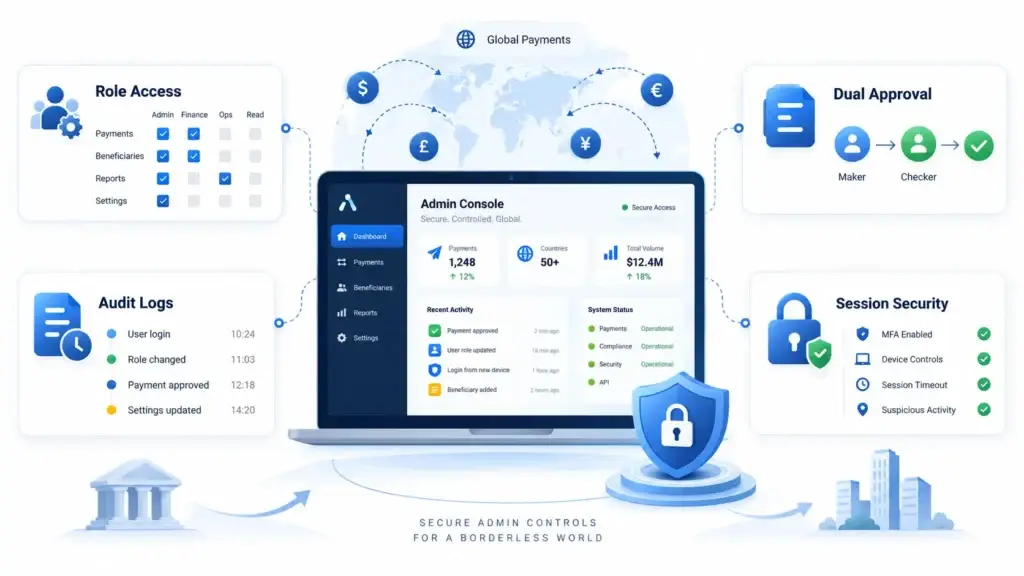
A local wallet app may deal with domestic balances, payments, and user accounts. A cross-border payment platform has more moving parts.
It may need to manage:
- Multi-currency wallets
- Currency conversion
- Sender and receiver details
- Transfer limits
- Payment partner integrations
- Banking-as-a-Service connections
- Card or account rails
- Beneficiary management
- KYC and AML checks
- Fraud signals
- Failed transfers
- Refunds and reversals
- Reconciliation
- Admin approvals
- Regulatory reporting support
This creates a broader risk surface. A transfer may pass through several systems before it reaches the final beneficiary. Each system needs proper authentication, authorization, logging, encryption, validation, and monitoring.
Security should therefore be treated as a product foundation, not a feature checklist.
User Security Controls Every Cross-Border Payment Platform Should Use
User security starts before the first transfer. The platform needs to know who the user is, protect their account access, and prevent account takeover attempts.
1. Secure Registration and Identity Verification
A payment platform should not allow high-risk financial activity without a clear onboarding and verification flow.
Useful controls include:
- Email and mobile verification
- Identity document capture
- Selfie or liveness verification where required
- Address verification where relevant
- Business verification for company accounts
- Risk-based onboarding rules
- KYC provider integration
- Manual review queues for flagged users
For founders, the goal is not just to collect documents. The goal is to create a reliable user-verification workflow that supports the platform’s operating model and target market.
A low-risk user may be allowed to explore the app with limited functionality. A user attempting higher-value transfers, business payouts, or cross-border transactions may need stronger verification before access is expanded.
2. Strong Login and Authentication Controls
A secure cross-border payment app should protect login sessions with more than a password.
Important authentication controls include:
- Multi-factor authentication
- Biometric login support
- One-time passcodes
- Device recognition
- Session expiry
- Refresh-token controls
- Suspicious login detection
- Password reset protection
- Rate limiting against repeated login attempts
Authentication should be designed around user convenience and risk. For example, viewing a balance may require normal authentication, while adding a new beneficiary or sending a high-value transfer may require step-up verification.
For a wider product-planning view, founders can also review this digital banking app feature checklist to connect security controls with onboarding, wallet, card, transfer, notification, and admin modules.
3. Device and Session Risk Monitoring
Many payment attacks begin with a compromised device, stolen credentials, or unusual login behavior.
The platform should monitor signals such as:
- New device login
- Unusual location
- VPN or proxy risk
- Multiple failed attempts
- Rapid beneficiary changes
- Sudden transfer activity
- Session reuse
- Token abuse
These signals should not always block a user instantly. In some cases, they should trigger additional verification, transfer delay, manual review, or alerting.
4. User Data Privacy and Secure Storage
Cross-border payment platforms often store sensitive personal and financial information. This may include names, addresses, identity documents, bank details, account activity, transfer history, and support records.
Security controls should include:
- Encrypted data transfer
- Encrypted data storage
- Restricted access to sensitive fields
- Data minimization
- Secure file storage for documents
- Access logs for sensitive records
- Retention rules
- User consent records
- Privacy-conscious data handling
The platform should not expose sensitive user data to support agents, finance teams, or administrators unless the role genuinely requires it.
Transfer Security Controls for Cross-Border Payments
Transfer security is the heart of a payment platform. A system can have secure logins and still fail if transfer workflows are poorly controlled.
1. Beneficiary Verification and Change Controls
Before money moves, the platform should confirm where it is going.
Useful controls include:
- Beneficiary name validation
- Account or wallet detail verification
- Bank detail checks where available
- Beneficiary approval workflow
- Step-up authentication for new beneficiaries
- Cooling-off periods for risky beneficiary changes
- Alerts when a new beneficiary is added
- Admin review for flagged destinations
This reduces the risk of account takeover leading directly to unauthorized transfers.
2. Transaction Limits and Velocity Rules
Not every user should be allowed to move unlimited value from day one.
A secure platform should allow configurable limits based on:
- KYC level
- User risk score
- Country corridor
- Currency
- Payment method
- Account age
- Business type
- Transfer frequency
- Historical behavior
- Compliance review status
Velocity rules help identify abnormal patterns, such as many small transfers, repeated failed attempts, sudden high-value transfers, or rapid changes in destination accounts.
Transfer limits, FX rules, card activity, and transaction fees also affect the multi-currency fintech business model, because revenue depends on how safely and profitably money moves through the platform.
3. KYC, AML, and Sanctions Screening Workflows
Cross-border platforms should support Know Your Customer and Anti-Money Laundering workflows. This does not mean the software alone makes a business compliant. Final compliance depends on jurisdiction, legal review, financial partners, operating model, policies, and licensing responsibilities.
The software foundation should support:
- Customer due diligence
- Enhanced due diligence for higher-risk users
- Sanctions screening support
- Politically exposed person screening support
- Adverse media review support where required
- AML rule configuration
- Risk scoring
- Suspicious activity flags
- Manual review queues
- Case notes
- Decision logs
- Reporting exports
FATF recommendations are widely used in AML/CFT frameworks, and payment transparency remains especially important in cross-border transfers.
4. Fraud Monitoring and Risk Scoring
Fraud detection should not depend only on manual checks.
A cross-border payment platform should monitor patterns such as:
- New user sends high-value transfer immediately
- Multiple accounts use the same device
- Several users send funds to the same beneficiary
- Frequent failed payment attempts
- Unusual currency conversion patterns
- Rapid beneficiary creation and deletion
- Mismatch between sender profile and transaction behavior
- Repeated refunds or reversals
- Suspicious login followed by transfer attempt
A strong fraud-monitoring workflow should combine automated rules with human review. Automation helps detect risk at scale, while human review helps reduce false positives and improve decision quality.
5. Transfer Status, Reconciliation, and Ledger Accuracy
Security is not only about preventing hackers. It is also about preserving financial accuracy.
A platform should prevent:
- Duplicate transfers
- Incorrect balances
- Broken reversals
- Webhook replay issues
- Failed provider updates
- Unclear transfer statuses
- Incorrect FX calculations
- Reconciliation gaps
- Manual adjustment abuse
Important controls include:
- Idempotency keys
- Immutable transaction records
- Webhook signature verification
- Provider event logs
- Transfer state machine logic
- Reconciliation reports
- Maker-checker approvals
- Refund and reversal workflows
- Ledger audit trails
For founders, this is one of the most important sections to inspect. If the ledger is unreliable, the business may face user complaints, partner disputes, reporting issues, and financial exposure.
Founders who want to compare these security layers against the full product scope can review the complete fintech app feature set before finalizing user onboarding, wallet, transfer, card, and admin workflows.
API Security Controls for Payment Platforms
Most modern payment platforms depend on APIs. They connect mobile apps, web dashboards, KYC providers, payment gateways, card processors, banking partners, notification systems, analytics tools, and internal admin panels.
This makes API security a core product requirement.
OWASP’s API Security Top 10 highlights common API risk categories such as broken object-level authorization, broken authentication, unrestricted resource consumption, broken function-level authorization, and unsafe API consumption. These risks are especially relevant in fintech products because APIs often expose account, transfer, identity, and admin functions.
A secure payment API should include:
- Strong authentication
- Object-level authorization
- Function-level authorization
- Rate limiting
- Input validation
- Webhook verification
- API versioning
- Secrets management
- Request logging
- Error handling
- Abuse detection
- Partner access controls
- Secure third-party integration review
A common mistake is assuming that an encrypted API is automatically secure. Encryption protects data in transit, but it does not solve weak authorization, excessive permissions, exposed endpoints, or unsafe third-party integrations.
Admin Operation Controls: The Layer Founders Often Underestimate
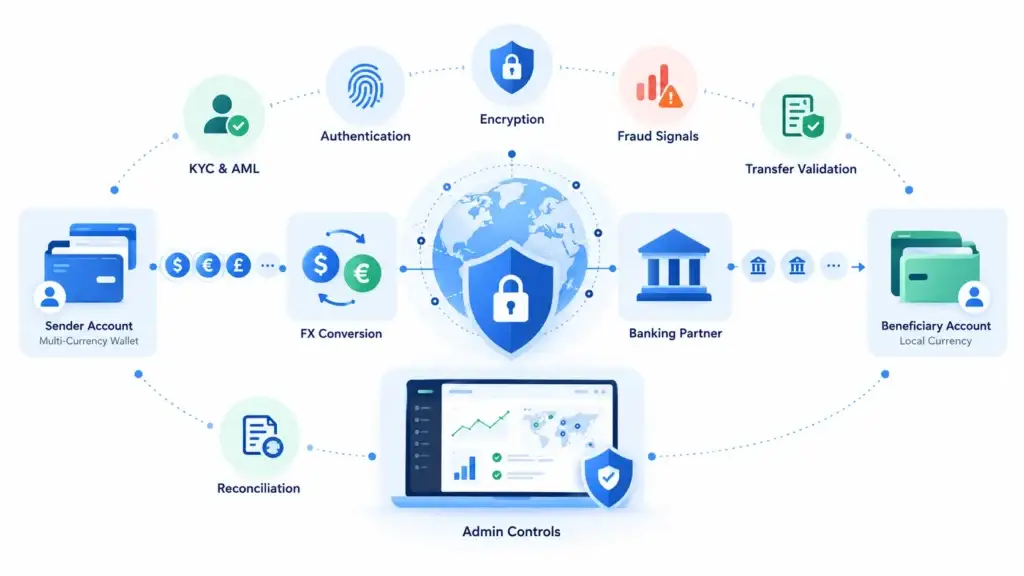
Admin access is one of the highest-risk areas in any fintech product. An administrator may be able to view users, approve documents, modify limits, review transactions, adjust fees, resolve disputes, export data, manage providers, or change platform settings.
That means admin controls must be stricter than normal user controls.
1. Role-Based Access Control
Every admin user should only access the areas needed for their role.
Possible admin roles may include:
- Support agent
- Compliance reviewer
- Finance operator
- Risk analyst
- Operations manager
- Super admin
- Technical admin
- Reporting user
A support agent may need to view basic user information and support tickets. A compliance reviewer may need access to KYC documents and risk notes. A finance operator may need reconciliation reports. A technical admin may need system logs but not full identity documents.
This separation reduces insider risk and accidental misuse.
2. Maker-Checker Approval for Sensitive Actions
High-risk admin actions should not depend on one person.
Use maker-checker approval for:
- Changing transfer limits
- Approving high-risk users
- Manually adjusting balances
- Overriding blocked transactions
- Changing fee settings
- Approving refunds
- Modifying provider settings
- Exporting sensitive reports
- Disabling risk rules
This gives the business a second layer of accountability before critical financial changes go live.
3. Audit Logs for Every Sensitive Action
A cross-border payment platform should maintain clear audit logs.
Logs should capture:
- Who performed the action
- What changed
- When it changed
- Which record was affected
- Previous and new values where appropriate
- IP address or device context
- Approval status
- Reason notes
- Escalation history
Audit logs are important for investigations, partner reviews, internal governance, and compliance workflows. They also help founders understand whether a problem came from user behavior, provider failure, admin action, or system error.
4. Admin Session Security
Admin accounts need stronger protection than normal user accounts.
Controls should include:
- Mandatory multi-factor authentication
- Shorter session duration
- IP restrictions where practical
- Device controls
- Privileged access review
- Admin activity monitoring
- Inactive account removal
- Access revocation after employee exit
- Separate production and staging access
Weak admin governance can expose the platform even if the user-facing app is secure.
Founder Decision Signals
User Trust
If users cannot verify identity, secure login, manage devices, and receive alerts, they may not trust the platform with cross-border transfers.
Transfer Safety
Strong transfer controls reduce risks around fraud, failed payments, duplicate transactions, beneficiary abuse, and reconciliation gaps.
Admin Control
Role-based permissions, approval flows, and audit logs help prevent internal misuse and support operational accountability.
Launch Readiness
A ready-made foundation can speed up launch, but each deployment still needs market-specific configuration, testing, provider setup, and legal review.
Data Protection Controls for Cross-Border Payment Platforms
Cross-border platforms may store and transfer data across markets, providers, and infrastructure regions. This requires careful data governance.
Important controls include:
- Data classification
- Encrypted databases
- Encrypted backups
- Secure document storage
- Restricted access to identity files
- Tokenized payment details where applicable
- Data retention policies
- Secure deletion workflows
- Data export controls
- Access monitoring
- Backup recovery testing
- Privacy notice alignment
- Data-processing agreements with providers
Payment data, identity documents, transaction records, and admin notes should not be treated equally. Each category needs its own access and retention rules.
Infrastructure and Cloud Security Controls
A secure app can still be exposed by weak infrastructure.
Infrastructure controls should cover:
- Network segmentation
- Private databases
- Firewall rules
- Secure cloud roles
- Secrets management
- Environment separation
- Patch management
- Vulnerability scanning
- Backup security
- Disaster recovery
- Monitoring and alerting
- Production access control
- CI/CD pipeline protection
NIST Cybersecurity Framework 2.0 organizes cybersecurity around Govern, Identify, Protect, Detect, Respond, and Recover functions, which is a useful model for payment platforms that need both preventive controls and response readiness.
For a founder, this means security should not stop at the app interface. The hosting layer, deployment pipeline, cloud permissions, monitoring setup, and backup process matter just as much.
Security Control Table for Cross-Border Payment Platforms
| Control Area | What It Should Protect | Practical Controls | Founder Impact |
|---|---|---|---|
| User onboarding | Fake accounts, weak identity checks, risky users | KYC, document verification, liveness checks, risk scoring | Helps build a safer user base before money movement begins |
| Login security | Account takeover and unauthorized access | MFA, biometrics, device recognition, session controls | Reduces fraud risk and improves user confidence |
| Transfer workflows | Unauthorized or suspicious transfers | Beneficiary checks, step-up verification, transaction limits | Makes money movement safer and more controlled |
| AML workflows | Financial crime and suspicious activity | Screening support, monitoring rules, review queues, audit notes | Supports compliance operations without claiming automatic compliance |
| Ledger accuracy | Balance errors and reconciliation gaps | Idempotency, immutable records, webhook verification, reconciliation | Protects financial accuracy and reduces operational disputes |
| API security | Data exposure and unauthorized actions | Auth, authorization, rate limits, secure webhooks, logging | Protects integrations and partner-connected workflows |
| Admin operations | Insider risk and unauthorized changes | Role-based access, maker-checker approval, audit logs | Gives operators visibility and accountability |
| Infrastructure | Cloud exposure and system compromise | Network rules, secrets management, backups, monitoring | Reduces technical risk beyond the visible app |
| Incident response | Delayed reaction to security events | Alerts, escalation paths, investigation logs, recovery plans | Helps the team respond faster when issues occur |
Common Security Mistakes Founders Should Avoid
Mistake 1: Treating Compliance Modules as Compliance Approval
Software can support KYC, AML, reporting, data protection, and audit workflows. It cannot guarantee regulatory approval by itself.
Final compliance depends on jurisdiction, legal review, financial partners, licenses, policies, contracts, and operating responsibilities.
Founders should also include KYC checks, screening tools, provider fees, monitoring workflows, and admin controls in their fintech development cost planning, because security decisions can directly affect launch scope and ongoing operations.
Use the phrase “compliance-ready foundation” carefully. It means the platform can support compliance workflows. It does not mean the business is automatically approved to operate in every market.
Mistake 2: Focusing Only on User Login Security
Many founders ask about 2FA, biometrics, and password safety. These are important, but they are only one layer.
A payment platform also needs transfer limits, beneficiary controls, transaction monitoring, API security, admin approvals, reconciliation, and incident response.
Mistake 3: Giving Too Much Admin Access Too Early
In early-stage fintech operations, small teams often share admin access. This may feel faster, but it creates risk.
Every admin user should have their own account, role, permissions, and activity logs. Shared admin credentials should be avoided.
Mistake 4: Ignoring Failed Transfers and Reversals
Successful transfers are not the only workflow that matters.
Failed, delayed, refunded, reversed, disputed, or partially processed transfers should have clear status logic and audit trails. Without this, operations teams may struggle to explain what happened.
Mistake 5: Launching Without Provider Responsibility Mapping
Cross-border payment platforms often depend on KYC providers, banking partners, card processors, payment gateways, FX providers, notification tools, and analytics systems.
For a broader product-planning perspective, this guide on common mistakes in fintech app development explains where founders often lose time, budget, or product clarity during launch planning.
Before launch, the founder should know:
- Which provider handles which function
- What data is shared
- Who is responsible for failures
- How incidents are escalated
- How reconciliation is performed
- What logs are available
- What compliance obligations remain with the business
How Miracuves Supports Secure Cross-Border Payment Platform Launches
Miracuves helps founders build ready-made and white-label fintech platforms with source-code ownership, branded design, admin dashboard control, and faster deployment.
For cross-border payment and digital banking use cases, a strong foundation may include user onboarding flows, account dashboards, transaction history, multi-currency workflows, BaaS-ready integrations, admin control, and compliance workflow support.
The key advantage is speed with structure. Instead of building every user, transfer, wallet, admin, and reporting module from zero, founders can start with a launch-ready product foundation and configure it around their market, provider stack, compliance needs, and business model.
For suitable white-label deployments, Miracuves highlights a 6-day launch timeline, complete source codes, rebranding, app publishing support, and support coverage on its fintech money page.
If you are planning a branded digital banking or cross-border payment product, you can explore Miracuves’ “ready-made digital banking foundation to understand how product modules, admin operations, source-code ownership, and deployment support can fit together.
Security Review Checklist Before Launch
Before launching a cross-border payment platform, founders should review these questions.
User Controls
- Are users verified before higher-risk activity?
- Is MFA available?
- Are suspicious logins detected?
- Can users manage devices and sessions?
- Are sensitive documents protected?
- Are password reset flows secure?
Transfer Controls
- Are transaction limits configurable?
- Are new beneficiaries protected by verification?
- Are high-risk transfers reviewed?
- Are failed transfers handled clearly?
- Are FX rates and fees logged?
- Are refunds and reversals traceable?
AML and Risk Controls
- Are KYC workflows configurable?
- Is screening support available?
- Are suspicious activity flags available?
- Can compliance teams add review notes?
- Are high-risk users escalated?
- Can reports be exported when needed?
Admin Controls
- Are roles separated by responsibility?
- Is maker-checker approval available for sensitive actions?
- Are admin actions logged?
- Is production access limited?
- Can inactive admin accounts be removed?
- Are exports restricted?
Technical Controls
- Are APIs protected with authentication and authorization?
- Are webhooks verified?
- Are secrets stored securely?
- Are databases private?
- Are backups encrypted?
- Are vulnerabilities reviewed?
- Are incident-response steps documented?
When a Ready-Made Foundation Makes Sense
A ready-made fintech foundation can be useful when a founder wants to launch faster, validate demand, reduce development uncertainty, and avoid rebuilding common product modules from scratch.
It is especially useful when the founder already knows the target market, core customer journey, revenue model, and provider stack.
However, a ready-made platform still needs proper configuration. Security controls must be aligned with:
- Target countries
- User types
- Transfer corridors
- Currencies
- KYC requirements
- Payment partners
- BaaS providers
- Risk appetite
- Data policies
- Admin team structure
- Launch scope
If the next decision is choosing the right build partner, this guide on selecting a white-label fintech development partner can help founders evaluate technical depth, provider readiness, admin controls, source-code ownership, and post-launch support.
The right decision is not simply “ready-made or custom.” The better question is:
Which product foundation gives the business the fastest safe path to launch, test, operate, and improve?
Final Thoughts
A secure cross-border payment platform is not defined by one feature, one badge, or one integration. It is defined by the strength of its user controls, transfer controls, admin controls, data protection, infrastructure security, and operational readiness.
Founders should inspect the complete control layer before launch.
The strongest platforms make it clear who can access the system, how users are verified, how transfers are monitored, how suspicious activity is handled, how administrators are controlled, how incidents are escalated, and how financial records remain traceable.
For a founder, the real question is not only:
“Can this platform send money across borders?”
The better question is:
“Can this platform protect users, transfers, data, operations, and business trust while the product scales?”
FAQs
What are the most important security controls for a cross-border payment platform?
The most important controls include KYC workflows, multi-factor authentication, transaction monitoring, sanctions screening support, role-based admin access, audit logs, secure APIs, encrypted data storage, reconciliation, and incident-response planning.
Why is admin access security important in payment platforms?
Admin users may be able to approve users, change limits, review transactions, export reports, manage fees, or override workflows. Without role-based permissions, maker-checker approvals, and audit logs, the platform may face insider risk or operational errors.
Does a payment platform become compliant if it has KYC and AML features?
No. KYC and AML features support compliance workflows, but final compliance depends on the operating jurisdiction, licenses, legal review, payment partners, policies, integrations, and business model.
What is transaction monitoring in cross-border payments?
Transaction monitoring is the process of reviewing payment activity for suspicious behavior, unusual patterns, high-risk corridors, velocity changes, beneficiary risk, failed transfers, and other signals that may require review.
How should a platform protect users from account takeover?
It should use multi-factor authentication, device recognition, session controls, suspicious login alerts, password reset protection, rate limiting, and step-up verification for risky actions such as adding beneficiaries or sending high-value transfers.
What API security controls are needed for fintech platforms?
Fintech APIs should include strong authentication, authorization, rate limiting, input validation, webhook verification, logging, error handling, secrets management, and secure third-party integration controls.
Can Miracuves help launch a cross-border payment platform faster?
Yes. Miracuves helps founders launch ready-made and white-label fintech platforms with source-code ownership, branded design, admin dashboards, and 6-day delivery for suitable deployments. Final scope depends on features, integrations, compliance workflows, and customization needs.
Should founders choose a ready-made fintech foundation or custom development?
A ready-made foundation is useful when speed, validation, and core product readiness matter. Custom development may be better for highly unique workflows or complex regulated requirements. Many founders start with a ready-made foundation and customize it around their market, provider stack, and operating model.
Miracuves is an independent software development company. We are not affiliated with, connected to, sponsored by, or endorsed by any company or product named in this article.
Terms such as “X Clone” are used descriptively. It is how the software industry refers to building a platform with functionality comparable to a known service, and how clients search for it.
The entire design and codebase of our products is built by our own team. Our products contain no code, design, graphics, or content originating from any third-party website or applications.
All third-party names and marks referenced in this article are the property of their respective owners, referenced solely to identify the services discussed.