Key Takeaways
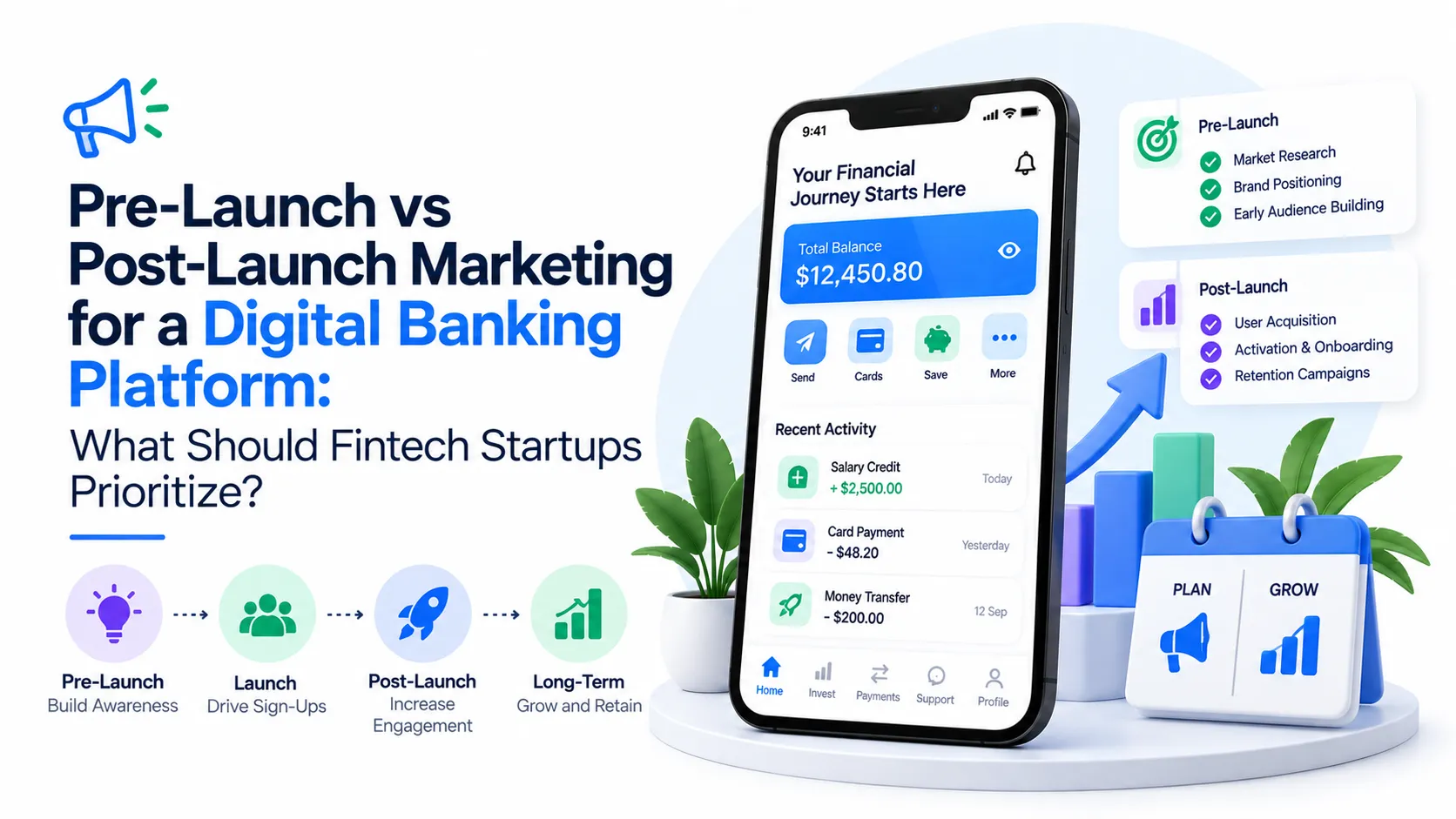
- A digital banking platform marketing strategy should divide priorities between pre-launch demand generation and post-launch activation, transaction growth, retention, and repeat usage.
- Pre-launch marketing should build credibility, educate target users, validate positioning, attract early sign-ups, and prepare acquisition channels before the product becomes widely available.
- Post-launch marketing should focus on moving registered users through KYC, account funding, first transactions, card usage, transfers, and other recurring financial activities.
Pre-Launch Marketing Signals
- Landing pages, waitlists, educational content, early-access programs, referral campaigns, partnerships, community outreach, and product explainers can help create initial demand.
- Messaging should clearly communicate target users, account features, cards, transfers, FX, fees, security, convenience, and the practical financial problems the platform intends to solve.
- Founders should track waitlist growth, qualified leads, referral sign-ups, content engagement, acquisition-channel interest, cost per lead, and early feature demand before scaling promotion.
Post-Launch Growth Insights
- After release, marketing should optimize signup completion, KYC conversion, funded accounts, first transfers, card activation, feature adoption, referrals, and repeat transactions.
- Retention campaigns can use personalized onboarding, transaction reminders, educational messages, relevant offers, rewards, notifications, and lifecycle communication based on user behavior.
- Miracuves develops customizable digital banking platforms with onboarding, accounts, cards, transfers, FX, analytics, notifications, security controls, transaction monitoring, and admin management.
Launching a digital banking platform is not the same as launching a normal mobile app. A food delivery app asks users to place an order. A social app asks users to create a profile. A fintech app asks users to share identity details, trust transaction flows, connect money movement, and believe that the platform can handle financial activity responsibly. This is why founders need to understand the broader fintech app development ecosystem before planning pre-launch or post-launch campaigns.
That is why fintech marketing cannot begin on launch day.
Pre-launch marketing helps startups create trust, collect early demand, validate positioning, and educate users before the product is publicly available. Post-launch marketing turns that early interest into verified accounts, wallet funding, first transactions, referrals, retention, and long-term usage.
For founders, the real question is not whether pre-launch or post-launch marketing is more important. The better question is:
What should your fintech startup prioritize at each stage so marketing supports real product adoption instead of only creating surface-level attention?
Why Marketing a Digital Banking Platform Requires More Trust Than a Normal App
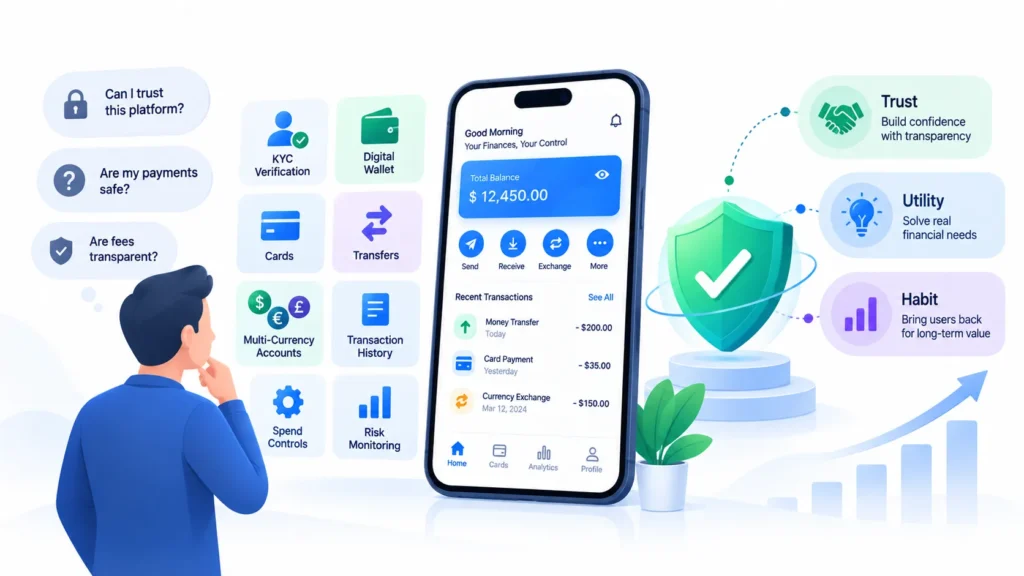
A digital banking platform usually includes sensitive financial workflows such as user onboarding, KYC verification, digital wallets, cards, transfers, payment history, multi-currency accounts, spend controls, transaction limits, and admin-level risk monitoring.
That means users are not only asking, “Is this app useful?”
They are also asking:
- Can I trust this platform with my financial data?
- Is the onboarding process safe and clear?
- What happens if a payment fails?
- Are fees, limits, and transaction rules transparent?
- Is support available when money movement goes wrong?
- Does this app solve a real financial problem better than my current option?
This makes digital banking platform marketing deeply trust-led. Users may click an ad because the offer looks attractive, but they will only complete verification, fund an account, or transact when the product experience feels credible.
Marketing and product readiness must work together. If the campaign promises fast transfers but the onboarding flow is confusing, users will leave. If the landing page talks about security but the app does not explain verification clearly, trust weakens. If the app has useful features but no education, users may never understand why they should switch.
Strong fintech marketing connects three layers:
- Trust — why users should believe the platform
- Utility — what financial problem the app solves
- Habit — why users should return after the first transaction
This is where many fintech startups fail. They promote features before building confidence. A better approach is to treat marketing as a trust system, not just an acquisition channel.
What Is Pre-Launch Marketing for a Digital Banking Platform?
Pre-launch marketing includes all the activities completed before the platform is available for public use.
For a fintech startup, this phase is not only about hype. It is about building credibility, testing demand, refining messaging, and preparing the first user group before paid acquisition begins.
The best pre-launch strategy helps founders answer questions such as:
- Which customer segment has the strongest pain point?
- Which financial use case creates the most interest?
- Are users more interested in cards, transfers, wallets, budgeting, business finance, or multi-currency access?
- What trust objections appear before signup?
- Which message drives serious waitlist intent, not just casual clicks?
- What content do users need before they feel ready to try the product?
A strong pre-launch campaign reduces uncertainty. It gives founders real feedback before they invest heavily in launch campaigns, paid ads, partnerships, or app store promotion.
For fintech startups using a ready-made foundation, this phase can move faster because product screens, user journeys, admin workflows, and core fintech modules can be prepared earlier for demos, walkthroughs, and market education. Founders exploring this route can review a white-label digital banking platform as a supporting product path without building every wallet, onboarding, transfer, and admin workflow from zero.
What Is Post-Launch Marketing for a Digital Banking Platform?
Post-launch marketing begins when users can access the app, register, verify, fund, transact, refer others, or actively use the platform.
At this stage, the marketing goal changes. The startup is no longer only creating interest. It is now converting attention into measurable financial behavior.
Post-launch marketing should focus on:
- App installs
- Account registrations
- KYC or identity verification completion
- Wallet funding or first deposit
- First successful transaction
- First card action
- First transfer
- Referral participation
- Repeat usage
- Subscription or premium feature adoption
- Support satisfaction
- Retention by user segment
The biggest mistake is treating downloads as the main success metric.
In fintech, an install without verification, funding, or transaction activity has limited business value. A startup needs to define its activation event clearly. For one product, activation may mean completing identity verification. For another, it may mean adding money to a wallet, making the first transfer, ordering a card, or inviting a business team member.
Without a defined activation event, marketing can generate activity without creating business progress.
Pre-Launch vs Post-Launch Marketing: Clear Comparison for Fintech Startups
| Marketing Layer | Pre-Launch Focus | Post-Launch Focus | Founder Impact |
|---|---|---|---|
| Primary Goal | Build awareness, trust, and early demand | Drive activation, retention, referrals, and revenue | Helps founders move from market interest to actual usage |
| User Mindset | Curious but cautious | Interested but needs proof through experience | Messaging must move from promise to product evidence |
| Best Channels | Landing pages, waitlists, educational content, fintech communities, founder-led content, PR | Lifecycle emails, push notifications, app store optimization, retargeting, referrals, support content | Each stage needs a different funnel strategy |
| Core Content | Problem education, product preview, trust signals, fee clarity, launch updates | Onboarding guides, transaction education, feature adoption, referral campaigns, retention content | Content should reduce friction at each user stage |
| Key Metrics | Waitlist signups, survey responses, email engagement, demo interest, referral intent | Verification rate, first transaction rate, retention, CAC, revenue per active user | Founders should measure quality, not only volume |
| Main Risk | Building attention without serious intent | Spending on acquisition before activation works | Both phases need analytics and user feedback |
Pre-Launch Marketing Strategies That Build Fintech Trust
Start With One Clear Financial Problem
Many digital banking startups try to promote every feature at once. They talk about wallets, cards, transfers, budgeting, FX conversion, business accounts, analytics, rewards, and subscriptions in the same campaign.
That creates confusion.
Before launch, founders should choose one sharp market-entry angle. Examples include:
- A smarter money app for freelancers
- A multi-currency wallet for frequent travelers
- A digital finance platform for remote teams
- A budgeting-first app for young professionals
- A cross-border payment product for families and small businesses
- A business banking tool for SMEs
This does not mean the platform cannot support multiple features. It means the first campaign needs one clear reason to care.
A fintech startup should avoid sounding like a generic banking alternative. The stronger position is to solve one painful financial workflow better than the user’s current option.
Build a Waitlist That Measures Intent, Not Just Emails
A waitlist should not be a passive email collection form.
For a digital banking platform, the waitlist should qualify demand and reveal user motivation. A strong waitlist can ask:
- What financial problem are you trying to solve?
- What do you currently use for payments, transfers, or money management?
- Are you most interested in cards, wallets, transfers, budgeting, or business finance?
- Which country, currency, or payment corridor matters most to you?
- Would you use this for personal finance, freelance payments, travel, or business operations?
- What would make you trust a new digital banking product?
These questions help founders understand who is serious and why they care.
This also connects the waitlist to a broader fintech app marketing strategy, where early demand, referral intent, product education, onboarding messaging, and trust-building campaigns work together instead of operating as separate activities.
A stronger waitlist can also include referral logic. Users can move up the list by inviting others, completing a survey, joining a private community, or attending a product walkthrough. This helps the startup measure motivation, not just email volume.
Use Educational Content Before Promotional Content
Fintech users need clarity before they trust a new platform.
They want to understand how money moves, how fees work, why verification is required, what limits apply, and how support handles issues.
Pre-launch content should answer practical questions such as:
- How does a multi-currency wallet work?
- Why does identity verification matter in fintech apps?
- What should users compare before choosing a money transfer product?
- How do virtual cards improve spending control?
- What should freelancers check before accepting cross-border payments?
- How can small businesses manage digital finance more efficiently?
This type of content builds trust because it helps before it sells.
Founders can turn these topics into blog posts, LinkedIn explainers, email sequences, short videos, landing page sections, webinars, product teasers, and app walkthroughs.
For related content planning, founders can also explore Miracuves’ guide on fintech content marketing strategy for money transfer apps.
Show Product Proof Before the App Goes Live
A fintech product cannot depend only on a polished landing page. Users need evidence that the product is real, structured, and thoughtfully built.
Product proof works best when it shows real user journeys instead of vague feature promises. Founders can highlight core digital banking app features such as onboarding, wallet setup, transaction history, card controls, admin dashboards, verification flows, and user account management to help early users understand what the platform will actually deliver.
Before launch, founders can share:
- App interface previews
- Onboarding flow previews
- Verification journey examples
- Fee explanation examples
- Admin dashboard screenshots
- Security principles
- Product roadmap notes
- Founder updates
- Short videos showing wallet, transfer, or card workflows
The goal is not to reveal sensitive infrastructure or private technical details. The goal is to reduce uncertainty.
A product preview can help users understand what they will experience after launch. It can also help partners, investors, early adopters, and community members evaluate whether the platform feels credible.
Prepare Compliance-Sensitive Messaging
Fintech marketing must be careful with claims. Before promoting wallets, payments, KYC, cards, transfers, or transaction safety, founders should understand how a white-label fintech security guide frames user trust, verification, risk controls, data protection, and compliance-ready workflows.
Avoid saying the platform is fully compliant everywhere, regulator-approved, risk-free, or guaranteed to save money unless those claims are verified, legally reviewed, and accurate for the target market.
Better marketing explains:
- The product mission
- The intended customer problem
- The onboarding process
- The role of verification
- The security principles
- The role of payment, banking, or BaaS partners
- The markets or services available at launch
- Any product limitations users should understand
Final compliance depends on jurisdiction, legal review, licensing, integrations, and operating model. Marketing should support trust without overstating legal or operational readiness.
Build Founder-Led Trust Before Paid Ads
Paid ads can help a fintech startup grow, but they should not be the only pre-launch channel.
Before the product goes live, founder-led trust can be more powerful. Founders can explain why the product is being built, which problem it solves, how users will be protected, and what the first version will focus on.
Useful pre-launch trust channels include:
- Founder LinkedIn posts
- Product build updates
- Waitlist emails
- Finance community discussions
- Niche creator collaborations
- Educational webinars
- Private beta communities
- Early adopter interviews
This helps the startup create a human layer around a sensitive product category. Users are more likely to trust a financial product when the team communicates clearly and consistently.
Post-Launch Marketing Strategies That Turn Interest Into Usage
Optimize the First 10 Minutes of Onboarding
The first post-launch challenge is not getting installs. It is getting users through the first meaningful action.
For a digital banking platform, onboarding may include:
- Account registration
- Email or mobile verification
- KYC or identity steps
- Wallet setup
- Card selection
- First deposit or top-up
- First transfer
- Security settings
- Notification permissions
Every extra step can create drop-off.
Good onboarding should explain what is happening, why it matters, and what users get after completing the step. The user should never feel confused while sharing sensitive information.
The best onboarding flows do not only move users forward. They build confidence at every step.
Define the Activation Event Clearly
A fintech startup needs one clear activation metric.
Examples include:
- User completes identity verification
- User funds the wallet
- User completes the first transaction
- User exchanges currency
- User orders or activates a card
- User creates a spending goal
- User invites another user
- Business user adds a team member
Without a defined activation event, marketing may optimize for the wrong outcome.
A campaign may produce many installs. But if only a small percentage of users complete verification or transact, growth quality is weak. The better question is not “How many users came in?” but “How many users reached the action that proves product value?”
Segment Retargeting by Drop-Off Stage
Not all inactive users are the same.
A user who installed the app but never registered needs a different message from a user who registered but did not complete verification. A verified user who never funded the wallet needs a different campaign from a user who completed one transaction but never returned.
Useful fintech retargeting segments include:
- Installed but not registered
- Registered but not verified
- Verified but not funded
- Funded but no transaction
- First transaction completed but no repeat usage
- Card ordered but not activated
- Referral started but not completed
- Dormant high-value user
Each segment needs a specific message. A generic “come back” campaign is usually too weak for fintech behavior change.
Use Lifecycle Emails and Push Notifications Carefully
Push notifications and emails can build habits, but they can also damage trust if they feel aggressive.
For fintech apps, lifecycle messages should be useful, timely, and behavior-based.
Examples include:
- Your verification is almost complete.
- Your card setup is ready.
- Your first transfer can be completed in a few steps.
- Your monthly spending summary is available.
- Your payment was received.
- Your referral reward is ready after verification.
- Your account settings need attention.
A financial app should not sound desperate. It should sound clear, helpful, and controlled.
The right lifecycle strategy helps users understand the next best action without overwhelming them.
Build Referral Loops Around Real Financial Value
Referral campaigns work best when the reward is connected to meaningful product behavior.
Examples include:
- Invite a friend and both receive wallet credit after verification
- Refer a business user and unlock reduced transfer fees for a limited period
- Refer three verified users and unlock premium feature access
- Invite a freelancer community and receive early access to business finance tools
The important rule is simple: do not reward low-quality signups that never activate.
A stronger referral program rewards verified users, completed transactions, funded accounts, or repeat product activity. This protects the startup from vanity growth and improves the quality of acquired users.
Turn Support Into a Retention Channel
Post-launch fintech marketing is not only ads, emails, and push notifications. Support is part of the growth system.
When users ask about failed payments, transfer delays, verification issues, account limits, card controls, refunds, or transaction history, their support experience directly affects retention.
Founders should track:
- Common support questions
- Repeated complaint categories
- Time to first response
- Resolution satisfaction
- Support issues by acquisition channel
- Confusing onboarding steps
- Product areas causing distrust
These insights should feed back into landing pages, FAQs, onboarding screens, product education, and lifecycle campaigns.
In fintech, support content is not just customer service. It is trust infrastructure.
Use Product Analytics to Improve Campaign Quality
Post-launch marketing should be data-informed.
Important metrics for a digital banking platform include:
- Cost per registered user
- Cost per verified user
- Cost per activated user
- Registration-to-verification rate
- Verification-to-first-transaction rate
- First-to-second transaction rate
- Referral conversion rate
- Retention by user segment
- Revenue per active user
- Support tickets per active user
- Dormancy rate
- Churn reasons
These metrics help founders understand whether growth is healthy or only surface-level.
A fintech app with fewer but highly activated users may be more valuable than an app with many low-intent installs.
What Should Fintech Startups Prioritize First?
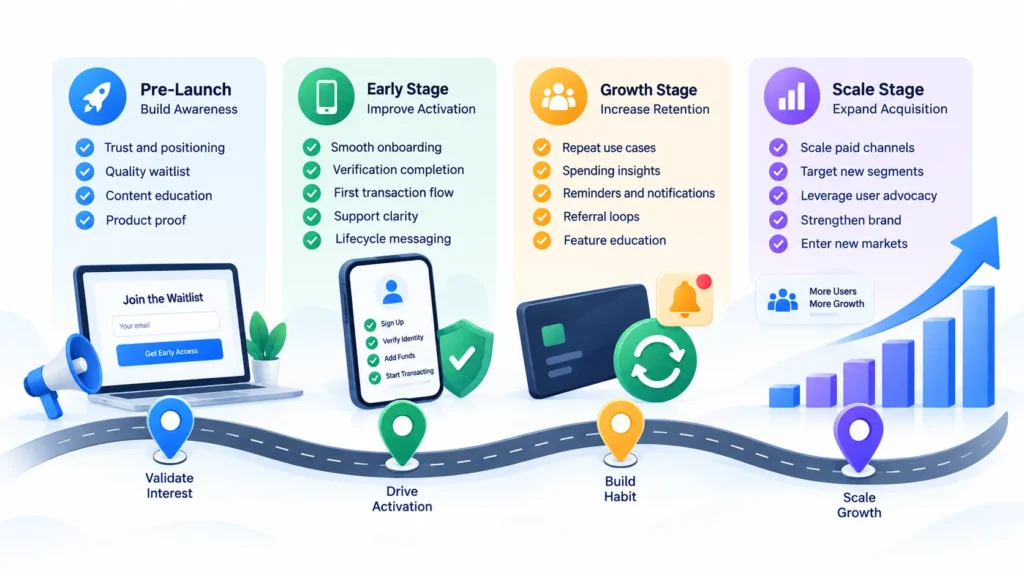
The answer depends on the startup stage.
If the product is not live yet, prioritize trust, positioning, waitlist quality, content education, and product proof. Do not rush into expensive acquisition campaigns before users understand why the product exists.
If the product is live but activation is weak, prioritize onboarding, verification completion, first transaction flow, support clarity, and lifecycle messaging. Paid acquisition should not scale until the funnel can convert.
If the product has good activation but low retention, prioritize repeat use cases, spending insights, reminders, referral loops, feature education, and habit-building content. At this stage, founders should also revisit the digital banking business model to ensure marketing campaigns are supporting revenue behavior, not only user growth.
If the product has strong retention, then scale acquisition channels more aggressively. At that stage, the startup has stronger evidence that users not only join but return.
Founder Decision Signals
Pre-Launch Priority
Focus on trust, waitlist quality, product education, and positioning before investing heavily in paid acquisition.
Post-Launch Priority
Focus on verified users, funded accounts, first transactions, repeat usage, and retention instead of only measuring installs.
Product Readiness
Marketing works better when onboarding, verification, admin controls, support flows, and transaction journeys are ready to support user expectations.
Growth Quality
A smaller user base with strong activation is usually more useful than broad traffic that never completes meaningful financial actions.
Common Mistakes Fintech Startups Should Avoid
Launching With Hype but No Trust
A fintech product cannot survive on excitement alone. Users need clarity around verification, security, fees, support, limits, and transaction reliability.
Targeting Everyone at Once
A broad audience creates weak messaging. Start with one clear user segment and expand after the product proves traction.
Scaling Ads Before Activation Works
Paid acquisition can increase traffic, but it will also expose weak onboarding. Fix registration, verification, funding, and first transaction drop-offs before scaling spend.
Measuring Downloads Instead of Financial Actions
Installs are not enough. Track verified users, funded wallets, completed transfers, repeat activity, and revenue per active user.
Making Compliance Claims Too Aggressively
Fintech messaging should be careful, accurate, and legally reviewed where needed. Trust grows when claims are clear and responsible.
How Miracuves Helps Fintech Founders Move From Marketing Plan to Launch Execution
Marketing works better when the product foundation can support the promise.
Miracuves helps founders build ready-made and white-label fintech platforms with branded design, admin dashboards, source-code ownership, and faster deployment. For founders planning a digital banking, wallet, remittance, or multi-currency finance product, a launch-ready foundation can reduce the time spent building common workflows from zero. Founders comparing launch scope, integrations, and budget can also review the digital banking platform development cost before deciding how much customization they need.
This matters for both marketing stages.
Once the marketing plan is clear, the next decision is execution. A reliable fintech platform development team should understand onboarding, wallet logic, transaction workflows, admin control, user verification, security layers, and post-launch support.
Before launch, founders can prepare product walkthroughs, landing pages, demo journeys, onboarding education, and investor conversations faster. After launch, they can focus on activation, retention, feedback, and monetization instead of waiting months for core app flows to be built.
For startups that want to evaluate a ready-made product route, Miracuves’ digital banking app foundation can be explored as the next step. Standard ready-made deployment can be delivered in 6 days, while deeper customization, integrations, and compliance-heavy requirements may need additional planning based on scope.
Final Thought
The real difference between pre-launch and post-launch marketing is the business job each phase performs.
Pre-launch marketing earns trust before users can transact. It validates positioning, builds an early audience, explains the product, and identifies user objections before launch.
Post-launch marketing turns early interest into product behavior. It improves onboarding, activates users, encourages transactions, builds referrals, strengthens retention, and turns support insights into better growth decisions.
For fintech startups, both phases matter. A strong waitlist without post-launch activation creates vanity traction. A strong launch without pre-launch trust can waste acquisition budget.
The better strategy is to connect both phases into one fintech growth system. The goal is not only to launch a digital banking platform. The goal is to build a product users trust enough to verify, fund, transact, return to, and recommend.
FAQs
What is pre-launch marketing for a digital banking platform?
Pre-launch marketing is the strategy used before the app goes live. It includes positioning, waitlist building, educational content, product previews, founder-led updates, community building, and trust-focused messaging.
What is post-launch marketing for a digital banking app?
Post-launch marketing begins after users can access the app. It focuses on installs, registration, identity verification, wallet funding, first transaction, repeat usage, referrals, retention, and revenue growth.
Should fintech startups prioritize pre-launch or post-launch marketing?
Fintech startups should prioritize pre-launch marketing before public release and post-launch marketing after users can interact with the product. The two phases should work together, not compete for attention.
What is the most important metric after launching a fintech app?
The most important metric depends on the product model, but common activation metrics include verification completion, wallet funding, first transaction, card activation, or repeat usage.
Why is trust important in digital banking platform marketing?
Trust is important because users share identity information, connect financial behavior, and depend on the platform for money movement. Marketing must explain security, verification, fees, support, and product value clearly.
How can fintech startups reduce onboarding drop-off?
Startups can reduce drop-off by simplifying registration, explaining verification steps, showing progress indicators, offering helpful support, reducing unnecessary friction, and guiding users toward the first meaningful action.
How does Miracuves help digital banking startups launch faster?
Miracuves helps founders build white-label fintech platforms with branded design, source-code ownership, admin control, and launch-ready workflows. Standard ready-made deployment can be delivered in 6 days, depending on the selected scope and customization needs.
Miracuves is an independent software development company. We are not affiliated with, connected to, sponsored by, or endorsed by any company or product named in this article.
Terms such as “X Clone” are used descriptively. It is how the software industry refers to building a platform with functionality comparable to a known service, and how clients search for it.
The entire design and codebase of our products is built by our own team. Our products contain no code, design, graphics, or content originating from any third-party website or applications.
All third-party names and marks referenced in this article are the property of their respective owners, referenced solely to identify the services discussed.