

Key Takeaways
- Fan Monetization Platform Paid Calls need accurate session pricing, duration tracking, wallet billing, revenue splits, payout records, and admin controls to work reliably.
- Creators can use per-minute, fixed-session, tiered, subscriber-only, premium availability, or package-based pricing models.
- Duration tracking should record actual start time, end time, billable duration, grace periods, extensions, wallet deductions, and session adjustments.
- Revenue splits can divide paid-call earnings between the creator, platform, and manager or agency based on configurable rules.
- Paid calls should connect with creator dashboards, wallets, payouts, dispute handling, reporting, moderation, and split-ledger records rather than operating as a standalone call feature.
Paid Call Signals
- A practical billing flow is: creator pricing → fan booking → wallet authorization → session start → duration tracking → final charge → revenue split → ledger update.
- Wallet pre-authorization can confirm sufficient balance before a call begins and release unused funds when a session ends early.
- Creators should see gross call revenue, platform deductions, manager shares, net earnings, and payout status clearly.
- Admins should control pricing limits, commission settings, grace periods, no-show rules, refunds, disputes, payout holds, and suspicious activity.
- Fans should see pricing, expected duration, remaining time, extension options, call receipts, and support or refund options before and after each session.
Real Insights
- A paid-call feature becomes a monetization system only when pricing, timing, billing, revenue splits, and payouts are connected.
- Timestamped session records help resolve disputes when calls start late, disconnect, end early, or run longer than planned.
- One pricing model should not be forced on every creator because celebrities, influencers, coaches, and subscription creators may need different rules.
- Paid calls also require trust and safety controls such as identity verification, reporting, blocking, moderation queues, and session metadata logs.
- The strongest paid-call workflow is: set price → authorize payment → connect session → track duration → calculate charge → split revenue → update ledger → release payout.
A Fan Monetization Platform can earn through subscriptions, pay-per-view content, tips, paid messages, live sessions, custom requests, and creator-led communities. But paid calls are one of the most direct monetization layers because fans pay for real-time access to a creator’s time.
For a creator, a paid call is not just another content format. It is a premium interaction. For a fan, it is more personal than watching a video or unlocking a post. For the platform owner, it creates a new revenue stream that depends on accurate pricing, timing, billing, split calculation, and payout control.
That is why paid calls need more than a basic audio or video call feature.
A serious creator platform, influencer platform, celebrity platform, or influencer video platform should answer practical questions before launch:
How does a creator set call pricing?
Is the fan charged per minute or per session?
What happens if the call ends early?
Can the fan extend the session?
How is the creator’s earning calculated?
Does the platform take a commission?
Can a manager or agency receive a share?
Does the admin dashboard show call history, duration, wallet deductions, and payout status?
Miracuves helps founders build ready-made and white-label creator monetization platforms with paid content, fan subscriptions, paid calls, creator dashboards, wallets, payout logic, admin control, and source-code ownership. The goal is not to copy another platform blindly. The goal is to build a monetization-ready product foundation that fits your business model.
What Paid Calls Mean in a Fan Monetization Platform
Paid calls allow fans to pay for direct audio or video interaction with creators. The session may be booked in advance, started instantly, requested by a fan, approved by a creator, or managed by a platform team.
Paid calls can work across many creator economy models:
- A celebrity platform offering personalized fan conversations
- An influencer platform offering paid advice, shoutouts, or private access
- A video creation platform offering live creator-fan sessions
- An influencer video platform offering premium one-to-one video calls
- A creator monetization platform offering paid audio calls, paid video calls, and live fan engagement
- A subscription based creator platform where paid calls become an add-on beyond monthly access
The business value is simple: creators can monetize time, not only content.
A fan may subscribe for monthly content but still pay extra for a private call. A follower may not want a long-term subscription but may pay for a short one-time session. A high-value fan may buy longer calls, premium availability, or personalized video interaction.
For founders, paid calls increase monetization flexibility. But they also increase operational complexity because time-based billing must be accurate.
Why Paid Calls Are Different From Subscriptions and PPV Content
Subscriptions are predictable. A fan pays a recurring amount for access. PPV content is transactional. A fan pays once to unlock a specific media item. Paid calls are more dynamic because the final value may depend on time, availability, session quality, call completion, and real-time billing.
This creates different product requirements.
A paid call workflow must manage:
- Creator availability
- Fan booking requests
- Session approval or rejection
- Wallet balance authorization
- Call start and end time
- Billable duration
- Grace period rules
- Extension logic
- Cancellation rules
- No-show handling
- Refund or dispute review
- Creator earnings
- Platform commission
- Manager or agency share
- Payout status
- Admin audit logs
Without these controls, paid calls can create confusion. Fans may question charges. Creators may question earnings. Admins may struggle to resolve disputes. Finance teams may find it difficult to reconcile payouts.
A strong Fan Monetization Platform should make the call experience simple on the front end and precise in the backend.
Session Pricing Models for Paid Creator Calls
Paid-call pricing should match the platform’s creator category, audience behavior, and operating model. Not every creator should be forced into the same pricing format.
Paid Call Pricing Models for Creator Platforms
| Pricing Model | How It Works | Best For |
|---|---|---|
| Per-minute pricing | The fan pays based on the actual number of billable minutes used. | Creators who want flexible earning based on session length. |
| Fixed-duration session | The fan pays a fixed amount for a set call length, such as 5, 10, 15, or 30 minutes. | Celebrity calls, coaching sessions, fan shoutouts, and scheduled access. |
| Tiered call pricing | Different call lengths or access types are priced differently. | Creators with different fan segments and premium access levels. |
| Subscriber-only pricing | Only subscribers can book calls, or subscribers get reduced pricing. | Subscription based creator platform models that want to increase retention. |
| Premium availability pricing | Fans pay more for priority slots, urgent requests, or limited-time availability. | High-demand creators, celebrities, and influencer-led communities. |
| Package-based pricing | Fans buy a bundle of call credits or sessions in advance. | Coaching, mentoring, fan clubs, and repeat creator-fan relationships. |
The best pricing model depends on the product strategy.
If the platform is built around casual fan access, per-minute pricing may work well. If the platform is built around premium celebrity interactions, fixed-duration sessions may feel more controlled. If the platform supports agencies or creator managers, tiered pricing can help different creators follow different monetization rules.
A ready-made platform should allow the operator to configure pricing rules instead of hardcoding one call model for every creator.
How Duration Tracking Should Work
Duration tracking is the backbone of paid-call monetization.
The platform should not simply show that a call happened. It should capture the details required for billing, payout, dispute resolution, and reporting.
A strong duration tracking system should record:
- Session ID
- Creator ID
- Fan ID
- Scheduled time
- Actual start time
- Actual end time
- Connection status
- Billable duration
- Free grace period, if any
- Extension minutes
- Wallet authorization amount
- Final deducted amount
- Creator gross earning
- Platform commission
- Manager or agency share
- Refund or adjustment status
- Payout status
- Admin notes
- Dispute history
This matters because paid calls involve live behavior. Calls can fail. A fan can disconnect. A creator may join late. A session may run longer than expected. A fan may request extra minutes. A platform may need to refund a partial amount.
If duration tracking is weak, the business loses trust.
Creators need confidence that their time is being counted correctly. Fans need confidence that they are not overcharged. Admins need evidence when resolving complaints. Platform owners need accurate revenue records.
Session Billing Flow: From Booking to Split Ledger
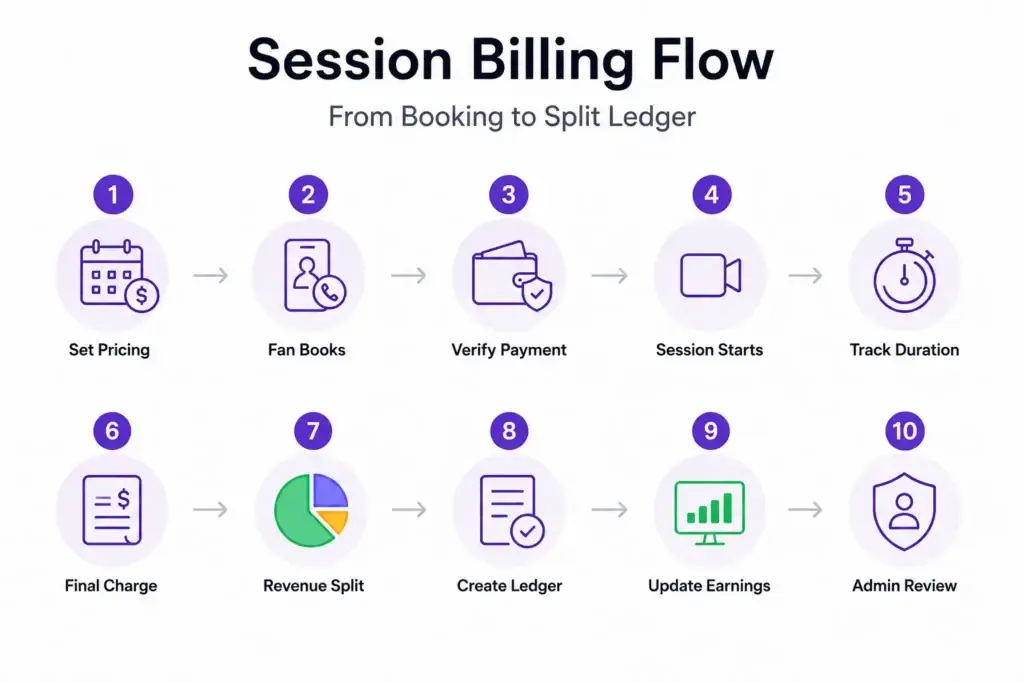
A practical paid-call billing flow may look like this:
- Creator sets call availability and pricing
The creator or admin defines per-minute pricing, fixed session pricing, available slots, subscriber rules, and call type. - Fan requests or books a call
The fan chooses audio or video, views the price, confirms duration, and accepts the billing terms. - Platform checks wallet balance or payment authorization
The platform confirms whether the fan has enough balance, card authorization, or wallet credits before the call starts. - Session starts with a timestamp
Billing logic begins only when the platform-defined start condition is met. - Duration is tracked during the call
The system monitors connected time, remaining balance, grace period, and extensions. - Call ends and final charge is calculated
The platform applies pricing rules, minimum charge rules, rounding logic, and any adjustments. - Revenue split is calculated
The final call revenue is divided between creator, platform, and manager or agency where applicable. - Ledger records are created
The call history, charge, deductions, split, payout status, and audit record are saved. - Creator dashboard updates earnings
The creator sees gross call revenue, deductions, net earnings, pending payout, and call performance. - Admin dashboard supports review
The operator can review call logs, disputes, refunds, payout holds, and suspicious activity.
This workflow is what turns paid calls from a simple feature into a monetization system.
Wallet Deductions and Pre-Authorization Rules
Paid calls become easier to manage when the platform uses a wallet or pre-authorization flow. Without this layer, a fan may start a call and fail payment after the session ends.
A wallet-based model can help with:
- Confirming balance before the call starts
- Reserving estimated session value
- Deducting only the final billable amount
- Releasing unused balance after early call end
- Supporting extensions during live sessions
- Reducing failed payment risk
- Showing fans clear spend history
- Giving creators accurate earning visibility
For fixed-duration calls, the platform may charge the full amount upfront. For per-minute calls, the platform may reserve a minimum balance and then deduct based on actual usage. For longer calls, the platform may check balance in intervals and end the call automatically if the fan cannot pay for additional minutes.
Founders should decide these rules before launch because billing friction directly affects fan trust.
Creator Revenue Splits for Paid Calls
Paid calls can generate strong creator earnings, but revenue splits must be transparent.
A platform may use a simple two-way split:
- Creator share
- Platform share
A managed creator operation may use a three-way split:
- Creator share
- Manager or agency share
- Platform share
A celebrity platform may use additional rules:
- Talent share
- Manager share
- Platform commission
- Payment processing deduction
- Tax or withholding logic where applicable
- Refund or dispute adjustment
The key is consistency.
Every paid call should create a ledger entry showing the total amount collected, deductions, split percentages, net earning, payout status, and any adjustment. That record protects the relationship between the creator, the platform, and the finance team.
Before expanding paid calls into subscriptions, PPV unlocks, tips, private messaging, and creator payouts, founders should understand how a creator platform business model connects revenue streams, platform commissions, creator earnings, and operational control.
How Paid Calls Support a Creator Monetization Platform
Paid calls can become one of the most valuable revenue layers in a creator monetization platform because they sell scarcity: creator time.
A creator can publish content at scale, but live access is limited. That makes paid calls useful for:
- Premium fan interaction
- Personalized advice
- Celebrity shoutouts
- Private consultations
- Creator coaching
- Fan loyalty rewards
- Subscriber upgrades
- Time-limited campaigns
- Event-based access
- High-value direct engagement
For a subscription based creator platform, paid calls can also improve retention. Fans who pay monthly may receive early booking access, discounted call rates, priority slots, or exclusive call availability.
Founders who want a launch-ready subscription based creator platform should review whether the product foundation supports paid content, fan subscriptions, paid calls, payout control, reporting tools, and moderation workflows before launch.
Paid Calls Across Creator, Fan, and Admin Panels
Paid-call monetization touches every panel in the platform.
Creator Panel
Creators should be able to manage:
- Audio call availability
- Video call availability
- Per-minute rates
- Fixed session packages
- Subscriber-only pricing
- Call request approvals
- Upcoming sessions
- Completed calls
- Missed calls
- Session earnings
- Refund or dispute alerts
- Payout status
- Fan notes where appropriate
- Blocked users
- Availability calendar
Fan Panel
Fans should be able to view:
- Creator call pricing
- Available time slots
- Audio or video call options
- Wallet balance
- Estimated session cost
- Call terms before joining
- Remaining time during a call
- Extension options
- Session receipts
- Refund or support request options
- Call history
Admin Panel
Admins should be able to control:
- Creator pricing limits
- Platform commission settings
- Call duration rules
- Grace period settings
- Refund policies
- No-show rules
- Wallet deductions
- Split-ledger records
- Suspicious call activity
- User reports
- Creator payout holds
- Call dispute review
- Role-based staff access
- Revenue analytics
These workflows work best when they are connected to the wider creator platform features, including subscriptions, payouts, agency management, creator dashboards, moderation tools, and admin-level access controls.
Duration-Based Billing Rules Founders Should Decide Early
Paid-call billing should not be left vague. The platform should define rules before the first creator goes live.
Important questions include:
- Does billing start when the creator joins, when the fan joins, or when both are connected?
- Is there a free grace period?
- Is the call rounded up by minute, second, or block?
- Is there a minimum charge?
- Can fans extend the session?
- Can creators end calls early?
- What happens if the fan disconnects?
- What happens if the creator disconnects?
- What happens if network quality is poor?
- Are missed sessions refundable?
- Does the platform charge cancellation fees?
- Are refunds deducted from creator earnings or platform margin?
- Can admins manually adjust disputed sessions?
- Are call records locked after payout approval?
Clear rules prevent disputes and make the creator relationship easier to manage.
Trust and Safety for Paid Calls
Paid calls create direct interaction between creators and fans, so safety controls matter.
A fan monetization platform should include:
- Age verification where required
- Creator identity verification
- Fan reporting tools
- Creator reporting tools
- Block and mute controls
- Call request screening
- Suspicious activity flags
- Session metadata logs
- Abuse reporting
- Refund and dispute workflows
- Admin review queues
- Role-based moderation access
- Content and conduct policies
A paid call should feel premium, but it should also feel controlled. Creators should not feel forced into unsafe interactions. Fans should understand pricing and behavior rules. Admins should be able to intervene when reports, payment issues, or abuse patterns appear.
If you are planning a safer creator platform, paid-call workflows should be planned alongside verification, consent, reporting, content protection, admin roles, wallets, and creator monetization.
Video Infrastructure for Paid Calls
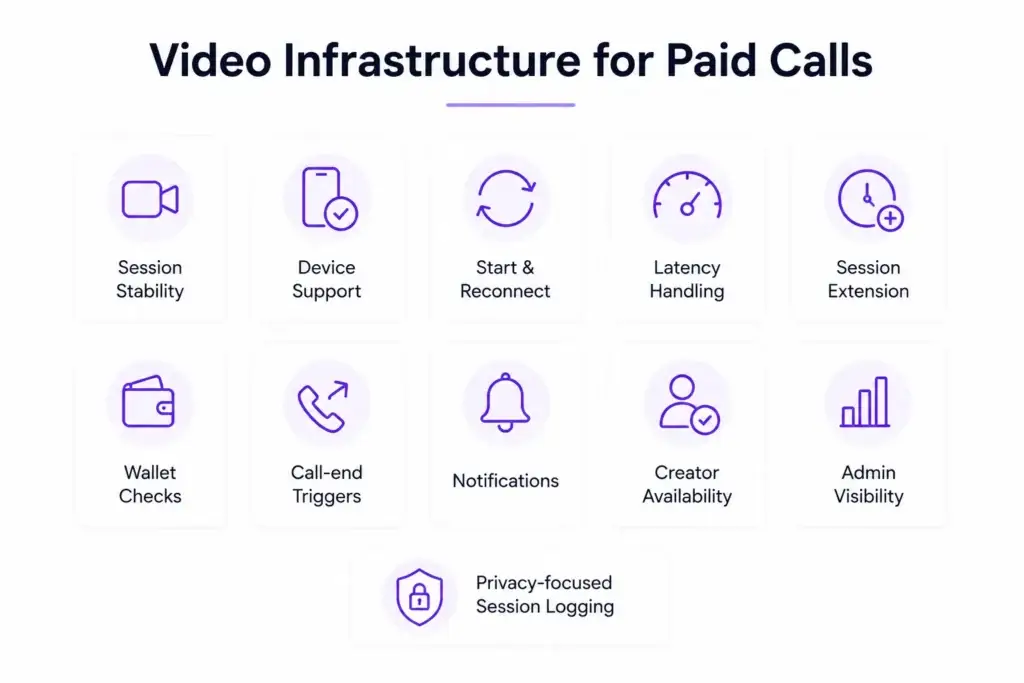
Paid video calls require more planning than text or locked content because they depend on real-time connection quality.
A video-heavy product should consider:
- Audio and video session stability
- Device compatibility
- Call start and reconnect behavior
- Latency and connection handling
- Session extension logic
- Wallet balance checks during calls
- Call-end triggers
- Notification delivery
- Creator availability sync
- Admin visibility into failed sessions
- Privacy-conscious session logging
For founders building a video-heavy product, Miracuves also provides video content platform solutions that can support uploads, streaming, media workflows, creator discovery, and monetized video experiences.
This is especially useful when a platform combines paid calls with short videos, premium media, livestreams, creator profiles, and fan engagement loops.
Paid Calls in Influencer and Celebrity Platforms
Paid calls are not limited to adult creator monetization. They can also work for mainstream creator economy use cases.
A growing influencer platform may use paid calls for:
- Fan conversations
- Creator consultations
- Coaching sessions
- Brand advice
- Personalized shoutouts
- Campaign access
- Community Q&A sessions
- Private video interactions
- Creator-led workshops
A celebrity platform may use paid calls for limited-time availability, premium fan clubs, event-based access, or managed booking flows. In those cases, session pricing, approval rules, and manager permissions become especially important.
For high-demand creators, the product should support pricing flexibility and operational control. Not every creator should have the same call rate, same calendar rules, or same payout schedule.
Founder Decision Signals
Monetization Fit
If your creators have loyal fans who want direct access, paid calls can add a premium revenue layer beyond subscriptions, PPV content, and tips.
Billing Accuracy
If pricing depends on time, the platform must track duration, wallet deductions, extensions, refunds, and split calculations accurately.
Creator Trust
Creators are more likely to promote paid calls when they can see clear earnings, deductions, payout status, and session history.
Operational Control
Admins need rules for no-shows, disputes, refunds, blocked users, call reports, payout holds, and revenue reconciliation.
Ready-Made Platform vs Custom Paid-Call Development
Founders usually have three practical build routes.
| Build Route | What It Means | Best For | Paid-Call Consideration |
|---|---|---|---|
| Basic call integration | Add a simple audio or video call tool to an existing app | Small experiments with limited monetization | May not include wallet deductions, duration tracking, split ledger, or dispute handling |
| Ready-made platform | Start with an existing creator monetization foundation | Founders who want faster validation | Stronger if it already includes wallets, subscriptions, paid content, creator dashboards, and admin controls |
| Custom development | Build paid-call workflows from zero | Highly differentiated businesses | More flexible, but requires deeper planning around billing, RTC, wallets, payouts, and moderation |
| Hybrid customization | Use a ready-made platform and customize paid-call rules | Most founder-led creator economy launches | Balances speed with pricing flexibility, split logic, and operational control |
A ready-made platform can help reduce development time when the foundation already includes creator onboarding, paid content, wallets, session logs, payout workflows, and admin control. Customization is still important because call pricing, duration rules, and split logic should match the business model.
If your platform needs paid audio calls, paid video calls, session pricing, duration tracking, revenue splits, wallet billing, and payout visibility, working with a creator platform development company can help you plan the right launch-ready foundation before the product goes live.
Read more- Reasons startup choose our Ismygirl clone over custom development
Mistakes Founders Should Avoid
Adding paid calls without wallet logic
If the platform cannot authorize balance before a call starts, failed payments and disputes can increase quickly.
Using one pricing model for every creator
A celebrity, coach, influencer, and new creator may need different pricing rules. Flexible pricing helps the platform support more creator types.
Ignoring duration disputes
Calls can disconnect, start late, or end early. Without timestamped records, admin teams may struggle to resolve billing complaints.
Not connecting calls to the split ledger
Paid calls should feed into the same earning and payout logic as subscriptions, PPV unlocks, tips, and messages.
Making payout reports too vague
Creators need visibility into gross call revenue, platform deductions, manager shares, net earnings, and payout status.
Skipping safety controls
Paid calls create direct interaction. Reporting, blocking, age checks, identity verification, and moderation workflows should be planned before launch.
Paid-Call Launch Checklist
Before launching paid calls inside a Fan Monetization Platform, founders should confirm:
- Can creators set per-minute or fixed-session pricing?
- Can admins set minimum and maximum call prices?
- Can fans see pricing before joining?
- Is wallet balance checked before the call starts?
- Is unused balance released after the session ends?
- Does the platform track start time, end time, and billable duration?
- Are grace periods, rounding rules, and minimum charges defined?
- Can fans extend the session?
- Can creators approve or reject requests?
- Are no-show and cancellation policies configured?
- Are failed connections recorded?
- Can admins review disputed calls?
- Are refunds and adjustments connected to the ledger?
- Are revenue splits calculated automatically?
- Can creator, manager, and platform shares be tracked separately?
- Are payout holds available for disputed sessions?
- Are call reports and abuse reports routed to moderation queues?
- Are creator earnings visible in the dashboard?
- Are session records locked after payout approval?
This checklist does not replace legal, payment, or compliance review. It helps founders prepare the product and operations layer before monetizing live creator-fan interaction.
Read more- Fan Monetization Platform Age Verification and Geo-Blocking: Controls for Regional Operations
How Miracuves Helps Founders Build Paid-Call Monetization Workflows
Miracuves helps founders build ready-made and white-label solutions with creator profiles, fan subscriptions, paid content, wallets, payouts, admin dashboards, paid messaging, reporting tools, and paid-call monetization workflows.
Related reading: If you are comparing ready-made options before launch, this creator platform features and pricing can help you understand what modules, controls, and platform decisions to review before choosing your product foundation.
Final Thoughts: Paid Calls Need More Than a Call Button
Paid calls can become a powerful revenue layer in a Fan Monetization Platform because they monetize direct creator access. But the business only works well when pricing, timing, billing, splits, payouts, and disputes are handled clearly.
A simple call button is not enough.
Founders need session pricing, duration tracking, wallet authorization, extension logic, call history, revenue split records, payout workflows, and admin controls. Creators need transparent earnings. Fans need clear pricing. Admins need reliable records. Platform owners need a model that can scale without manual reconciliation.
The stronger decision is to treat paid calls as a complete monetization workflow from the beginning. When paid calls are connected to subscriptions, content, wallets, creator dashboards, and split-ledger logic, the platform becomes easier to operate, easier to trust, and easier to grow.
FAQs
What are paid calls in a Fan Monetization Platform?
Paid calls are audio or video sessions where fans pay to speak directly with creators. The platform can charge per minute, per session, by package, or through subscriber-only pricing.
How should paid call pricing work in a creator platform?
Paid call pricing can be per-minute, fixed-duration, tiered, package-based, or creator-specific. The best model depends on creator demand, fan behavior, content category, and whether the platform is self-serve, agency-managed, or celebrity-led.
Why is duration tracking important for paid calls?
Duration tracking records when a call starts, when it ends, how long it lasted, how much was billable, and how earnings should be split. This protects billing accuracy, creator trust, and dispute resolution.
How are creator revenue splits calculated for paid calls?
Creator revenue splits are usually calculated from the final billable session amount. The platform can divide revenue between the creator, platform owner, and manager or agency based on configured split rules.
Should paid calls use wallet deductions?
Wallet deductions are useful because they let the platform authorize balance before the call starts, deduct the final billable amount, release unused balance, and reduce failed payment risk.
Can paid calls work inside a subscription based creator platform?
Yes. A subscription based creator platform can offer paid calls as an extra monetization layer. Subscribers may get early access, discounted call rates, exclusive booking slots, or premium creator interaction.
What should admins control in paid-call workflows?
Admins should control pricing limits, commission rules, duration settings, grace periods, refund rules, no-show policies, payout holds, dispute review, moderation queues, and call revenue reports.
How can Miracuves help with paid-call creator platform development?
Miracuves helps founders build ready-made and white-label creator platforms with subscriptions, paid content, paid messaging, paid calls, creator wallets, payout workflows, admin dashboards, reporting tools, and source-code ownership. d
Miracuves is an independent software development company. We are not affiliated with, connected to, sponsored by, or endorsed by any company or product named in this article.
Terms such as “X Clone” are used descriptively. It is how the software industry refers to building a platform with functionality comparable to a known service, and how clients search for it.
The entire design and codebase of our products is built by our own team. Our products contain no code, design, graphics, or content originating from any third-party website or applications.
All third-party names and marks referenced in this article are the property of their respective owners, referenced solely to identify the services discussed.