Key Takeaways
- Ready-Made vs Custom Fan Monetization Platform decisions should balance launch speed, control, scalability, monetization depth, payment complexity, and long-term product differentiation.
- A ready-made platform is better suited to founders who need faster validation with existing creator, fan, subscription, PPV, wallet, payout, moderation, and admin workflows.
- Custom development makes more sense when the business depends on unique creator interactions, proprietary workflows, advanced AI, deep integrations, complex payment routing, or enterprise architecture.
- A hybrid approach can combine a ready-made foundation with custom business logic for payments, access controls, creator onboarding, agency permissions, analytics, and regional rules.
- Source-code ownership, admin control, configurable monetization, payment flexibility, and future extensibility should be reviewed before choosing either route.
Decision Signals
- Choose ready-made when launch speed, market validation, standard monetization workflows, and lower early execution risk matter most.
- Choose custom development when the product itself is the competitive advantage and standard creator-platform workflows cannot support the required business model.
- Payment and payout requirements should influence the decision because subscriptions, PPV, wallets, tips, paid calls, refunds, splits, and payout holds need reliable backend logic.
- Video-heavy platforms need additional consideration around uploads, streaming, CDN delivery, paid calls, moderation, bandwidth, and playback security.
- Scalability should be judged by architecture, media handling, transaction accuracy, moderation capacity, admin operations, and source-code extensibility rather than by the label “ready-made” or “custom.”
Real Insights
- Ready-made should not mean rigid; a strong foundation should still support branding, configurable workflows, payment choices, admin settings, and source-code ownership.
- Full custom development can become risky when creator demand, fan behavior, and monetization are not yet validated.
- The hybrid route often gives founders a practical balance by avoiding the need to rebuild standard modules while reserving custom development for genuine differentiation.
- A long feature list is less important than how well creator, fan, payment, payout, access, moderation, and admin workflows connect.
- The strongest decision path is: define launch urgency → map required workflows → identify what must be unique → review ownership and scalability → choose ready-made, hybrid, or custom.
A Fan Monetization Platform can look simple on the surface. Creators publish content. Fans subscribe, unlock posts, send tips, buy messages, or join paid calls. The platform owner earns through commissions, subscriptions, payment activity, promotions, or creator service fees.
But behind that simple experience is a complex product system.
A serious creator monetization platform needs creator onboarding, fan registration, subscription access, gated content, pay-per-view unlocks, private messaging, wallet transactions, payout logic, revenue splits, moderation, verification, reporting, analytics, and admin control.
That is why one of the first decisions founders face is this:
Should you launch with a Ready-Made vs Custom Fan Monetization Platform or invest in fully custom development?
There is no single answer for every business. A ready-made platform gives speed. Custom development gives deeper control. The right choice depends on your market timing, budget, feature requirements, creator category, payment complexity, access-control needs, and long-term roadmap.
For many founders, the strongest path is not “ready-made vs custom” as a hard choice. It is understanding which parts of the platform should be launch-ready from day one and which parts deserve custom development company market validation.
Miracuves helps founders build ready-made and white-label creator solution platforms with source-code ownership, branded design, admin dashboards, creator monetization workflows, payment setup, access controls, and customization support. The goal is not to copy another platform blindly. The goal is to launch faster with enough control to adapt, monetize, and scale.
What a Ready-Made Fan Monetization Platform Means
A ready-made platform is a pre-built software foundation that already includes the core workflows needed to launch. Instead of building every module from zero, the founder starts with existing app flows, backend logic, admin tools, monetization features, and deployment-ready components.
For a Fan Monetization Platform, a ready-made foundation may include:
- Creator registration
- Fan registration
- Creator profiles
- Subscription access
- Gated content
- Pay-per-view content
- Paid messaging
- Tips and wallet spending
- Paid audio or video calls
- Media upload workflows
- Creator earnings dashboard
- Fan dashboard
- Admin dashboard
- Revenue split settings
- Payout controls
- Payment gateway setup
- Content moderation
- Reporting tools
- Verification workflows
- Access-control rules
- Source-code handover
- White-label branding
A ready-made platform works best when the business model follows a proven creator economy pattern but still needs branding, configuration, payment setup, and selected customization.
This is why founders use ready-made platforms for creator subscription platforms, influencer platforms, celebrity platforms, fan communities, premium content businesses, and niche membership products.
The value is speed. But the platform should still provide enough control to customize the business model, creator categories, payment rules, moderation policies, and future roadmap.
What Custom Fan Monetization Platform Development Means
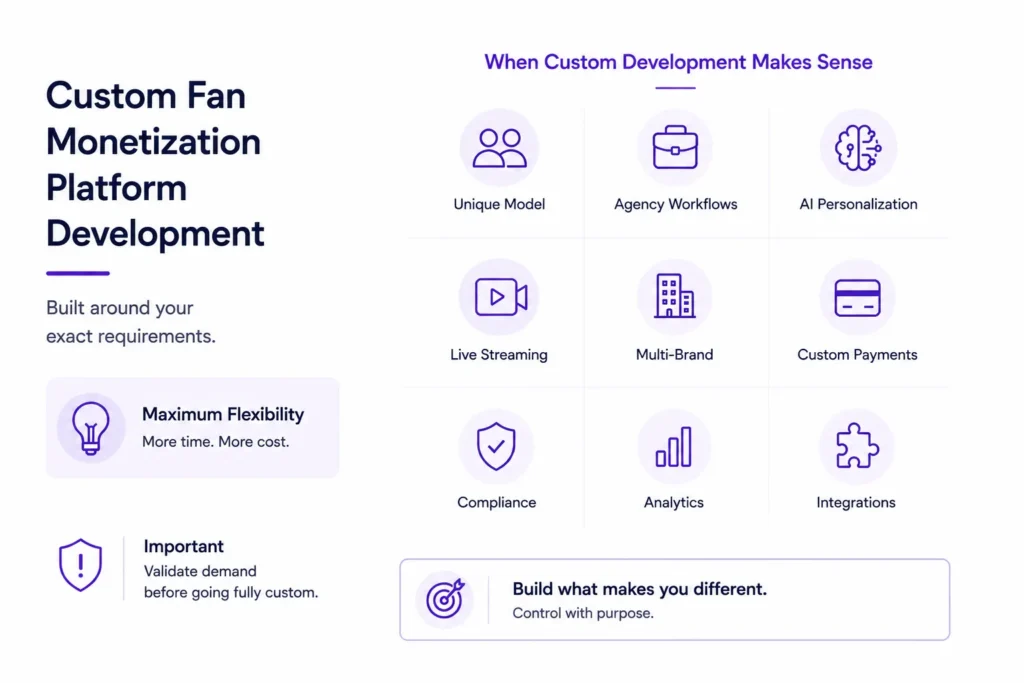
Custom development means building the platform around your exact requirements from the beginning. The product team designs the user experience, backend architecture, monetization logic, payment flows, admin dashboard, infrastructure, and integrations from scratch.
Custom development is useful when the business model is highly differentiated.
For example, custom development may make sense if the platform needs:
- A unique creator-fan interaction model
- Complex agency or manager workflows
- Deep AI personalization
- Advanced live streaming logic
- Custom video editing or video creation tools
- Multi-brand operating structure
- Advanced compliance workflows
- Custom payment routing
- Proprietary recommendation systems
- Complex content ownership logic
- Enterprise-grade analytics
- Deep integrations with internal business systems
A fully custom creator platform gives maximum flexibility, but it also requires more time, budget, technical planning, testing, QA, infrastructure decisions, and post-launch maintenance.
For founders who have not yet validated creator demand, custom development can become risky because the team may spend heavily before knowing which creators, fans, payment models, or content categories will actually work.
Ready-Made vs Custom: The Core Difference
The real difference is not only cost or timeline. It is where the founder wants to spend effort.
A ready-made platform reduces early development effort by using a proven foundation. Custom development increases flexibility by designing everything around the founder’s exact vision.
Ready-Made vs Custom Fan Monetization Platform
| Comparison Area | Ready-Made Platform | Custom Development |
|---|---|---|
| Launch speed | Faster because core workflows are already built. | Slower because product discovery, design, development, testing, and deployment start from zero. |
| Upfront development effort | Lower because existing modules reduce build complexity. | Higher because every module needs planning, engineering, and QA. |
| Branding control | Strong when the solution is white-label and supports custom branding. | Very strong because every interface can be designed from scratch. |
| Feature flexibility | Good when the existing feature set matches the business model. | High when the business needs unique workflows or deep product differentiation. |
| Payment customization | Efficient when standard subscriptions, PPV, wallets, tips, and payouts are already supported. | Better for complex payment routing, special contracts, or enterprise finance rules. |
| Scalability | Depends on code quality, architecture, hosting, media handling, and source-code access. | Can be designed for scale from the beginning, but requires larger technical investment. |
| Risk profile | Lower early-stage risk when founders need faster market validation. | Higher early-stage risk if the market, creator category, or monetization model is not validated. |
| Best fit | Founders who want faster launch with proven creator monetization workflows. | Funded teams with unique product requirements and longer planning cycles. |
The founder’s decision should not be emotional. It should be based on product readiness, launch urgency, available budget, creator demand, monetization depth, and the amount of control required.
Comparing Speed: How Fast Do You Need to Launch?
Speed matters in creator economy businesses because creator demand, audience behavior, and monetization trends can move quickly.
A founder may already have:
- A creator network ready to onboard
- An influencer agency looking for a branded platform
- A celebrity-led fan product idea
- A niche community with paid access demand
- A video creator audience ready for subscription content
- A business model that needs validation before raising capital
In these cases, a ready-made platform can be useful because the core workflows are already available. The founder can focus on branding, creator onboarding, payment setup, content policy, access rules, and go-to-market planning instead of spending months building basic login, profiles, subscriptions, and admin panels.
Custom development is slower because it begins with discovery, wireframes, design, architecture, sprint planning, development, QA, integrations, deployment, and post-launch fixes.
That does not make custom development bad. It simply means custom development is better when the business has enough time, funding, and clarity to justify the build.
For early validation, speed usually matters more than perfect uniqueness. For long-term defensibility, deeper customization may become more important.
Comparing Control: What Do You Need to Own and Change?
Control has multiple layers.
Many founders think control only means owning the brand. But in a Fan Monetization Platform, control also includes:
- Source-code ownership
- Hosting flexibility
- Payment gateway choice
- Commission settings
- Creator pricing rules
- Subscription tiers
- PPV pricing
- Paid call rules
- Wallet logic
- Payout approval
- Access-control settings
- Moderator permissions
- Regional rules
- Creator verification
- Admin analytics
- Roadmap flexibility
A weak ready-made platform may give fast launch but limited control. A strong ready-made platform should provide white-label branding, configurable workflows, admin management, and source-code ownership so the founder is not locked into a rigid system.
Custom development gives deeper control because every workflow can be built around the business. But that control comes with responsibility. The founder must manage discovery, engineering decisions, QA, infrastructure, documentation, updates, and future maintenance.
A practical founder should ask:
Do I need full custom architecture now, or do I need enough control to launch, learn, and improve?
That question usually creates better decisions than simply asking which option is cheaper.
Read more- Fan Monetization Platform Paid Calls: Session Pricing, Duration Tracking, and Creator Revenue Splits
Comparing Scalability: What Needs to Scale First?
Scalability is often misunderstood.
A platform is not scalable only because it can handle more users. A creator monetization platform must scale across:
- Creator onboarding
- Fan subscriptions
- Payment transactions
- Wallet balances
- PPV purchases
- Paid messaging
- Paid audio and video calls
- Media uploads
- Video streaming
- Creator payouts
- Content moderation
- Reports and disputes
- Admin permissions
- Revenue analytics
- Regional access rules
- Creator support workflows
A video creation platform or influencer video platform also needs scalability across storage, streaming, compression, thumbnails, moderation, bandwidth, and playback quality. Video-heavy products usually require more technical planning than simple text or image-based communities.
A ready-made platform can scale well if it is built with clean architecture, source-code access, configurable modules, secure APIs, and strong backend planning. Custom development can also scale well, but only if the team makes the right architecture decisions from the start.
Scalability should not be judged by the label “ready-made” or “custom.” It should be judged by the platform foundation.
Important scalability questions include:
- Can the backend support more creators and fans?
- Can media storage and streaming scale?
- Can payments and payouts remain accurate at higher volume?
- Can admins manage reports without manual chaos?
- Can creator earnings be calculated clearly?
- Can new monetization modules be added later?
- Can the source code be extended by another team?
- Can access rules support different creator categories or regions?
If the answer is yes, the platform has a better chance of scaling.
Where Ready-Made Platforms Usually Win
A ready-made platform usually wins when founders want to reduce early execution risk.
It is especially useful when:
- The business model is proven
- The founder wants faster launch
- The platform needs standard creator monetization workflows
- The budget does not support a long custom build
- The team wants to validate market demand first
- The creator category is clear but not technically unique
- The platform needs subscriptions, PPV, messaging, wallets, payouts, and admin control quickly
- Branding matters, but full custom architecture is not necessary on day one
A ready-made platform can also be useful for agencies, creator networks, influencers, and media operators who already have supply but need a product foundation.
For example, a small influencer platform may not need custom architecture in the beginning. It may need creator onboarding, fan subscriptions, locked content, paid messaging, wallet payments, payouts, and moderation. If those workflows already exist in a ready-made platform, the founder can launch faster and customize based on real user behavior.
Where Custom Development Usually Wins
Custom development wins when the platform itself is the competitive advantage.
It is useful when:
- The user experience must be completely unique
- The platform needs unusual monetization logic
- The business has complex agency or enterprise workflows
- The product requires custom AI, recommendation, or moderation systems
- The founder needs deep integration with existing systems
- The platform needs advanced analytics or proprietary dashboards
- The content model is not supported by normal creator subscription products
- The team has enough time, budget, and technical leadership
- The product roadmap is already validated and funded
Custom development also works well when the founder knows exactly what needs to be built and why. Without that clarity, custom development can become a long and expensive guessing exercise.
The risk is not that custom development is bad. The risk is building too much before knowing which creators and fans will actually use the platform.
The Hybrid Approach: Ready-Made Foundation With Custom Business Logic
For many founders, the best answer is a hybrid approach.
A hybrid approach starts with a ready-made platform foundation and customizes the parts that create business advantage.
The foundation may include:
- Creator accounts
- Fan accounts
- Subscription plans
- Gated content
- PPV unlocks
- Paid messaging
- Wallet transactions
- Creator payouts
- Admin controls
- Reporting tools
- Moderation workflows
Then the custom layer can focus on:
- Unique creator onboarding
- Special revenue split rules
- Custom fan engagement flows
- Payment gateway preferences
- Regional access controls
- Brand-specific user experience
- Agency or manager permissions
- Premium video workflows
- Custom analytics
- Creator discovery
- Campaign tools
- Advanced moderation rules
This approach works because founders do not spend custom-development budget rebuilding generic workflows. They spend it on differentiation.
Miracuves often supports this kind of practical path: start with a launch-ready product foundation, then customize the workflows that matter most to the niche, business model, creator category, and scaling plan.
How Monetization Depth Changes the Decision
A Fan Monetization Platform becomes more complex as monetization expands.
A basic version may include only subscriptions. A stronger creator monetization platform may include:
- Monthly subscriptions
- Tiered subscription plans
- PPV content
- Locked messages
- Paid audio calls
- Paid video calls
- Tips and gifts
- Wallet top-ups
- Paid livestream access
- Personalized requests
- Featured creator placements
- Creator shop
- Agency revenue splits
- Platform commissions
The deeper the monetization, the more important backend accuracy becomes.
Every revenue action should connect to:
- Fan payment history
- Creator earnings
- Platform commission
- Refund rules
- Wallet balance
- Payout status
- Admin reporting
- Dispute handling
Before expanding monetization across subscriptions, PPV unlocks, tips, private messaging, paid calls, and creator payouts, founders should understand how a creator platform business model connects revenue streams, platform commissions, creator earnings, and operational control.
If the ready-made platform already supports these flows, it can save time. If the platform needs unusual monetization rules, custom development or hybrid customization may be necessary.
How Access Controls Affect Ready-Made vs Custom Decisions
Access control is a major decision point.
A platform must know who can view, unlock, message, subscribe, stream, withdraw, moderate, approve, or manage each part of the system.
A simple ready-made platform may support basic locked content. A stronger platform should support more detailed access rules, such as:
- Free user access
- Subscriber access
- PPV unlock access
- Creator-only tools
- Manager permissions
- Admin permissions
- Moderator roles
- Paid call eligibility
- Wallet spending limits
- Age or identity verification status
- Region-based restrictions
- Content-category restrictions
- Payout approval status
A custom platform gives more freedom to define complex access logic. But a well-built ready-made platform should already support common rules for subscriptions, paid content, messaging, payouts, and moderation.
These safety and access workflows work best when they are connected to the wider creator platform features, including subscriptions, payouts, agency management, creator dashboards, moderation tools, and admin-level access controls.
Payment and Payout Control: A Critical Comparison Point
Payments are where weak platforms break.
A Fan Monetization Platform may need to support one-time purchases, recurring billing, wallets, paid messages, PPV unlocks, tips, paid calls, refunds, chargebacks, creator revenue splits, manager shares, payout approvals, and transaction reports.
A ready-made platform is valuable if these workflows are already included or configurable. It becomes risky if payment logic is shallow.
Custom development gives the freedom to build payment flows exactly around the business, but it also requires deeper engineering, testing, gateway coordination, and financial reconciliation.
Founders should evaluate:
- Which payment gateways are supported?
- Does the platform support recurring subscriptions?
- Can fans use wallet balance?
- Can creators receive earnings reports?
- Can admins approve payouts?
- Can the platform handle refunds?
- Are revenue splits configurable?
- Are transaction logs exportable?
- Can disputed payouts be held?
- Can payment rules differ by creator or region?
If payment and payout workflows are central to the business, they should never be treated as simple add-ons.
Video Creation Platform Requirements
If your Fan Monetization Platform includes video, the build decision becomes more serious.
A video creation platform may need:
- Video uploads
- Video compression
- Thumbnail generation
- Secure media storage
- Streaming playback
- Paid video unlocks
- Live sessions
- Paid video calls
- Replay access
- Media moderation
- Watermarking
- Download restrictions
- CDN delivery
- Bandwidth planning
- Creator video analytics
A basic ready-made platform may not handle video at the level your business needs. A stronger ready-made foundation may be enough if it already supports media upload, gated video access, and streaming workflows. Custom development may be better if video editing, personalized feeds, advanced streaming, or creator video tools are the core differentiation.
For founders building a video-heavy product, Miracuves also provides video content platform solutions that can support uploads, streaming, media workflows, creator discovery, and monetized video experiences.
Influencer and Celebrity Platform Requirements
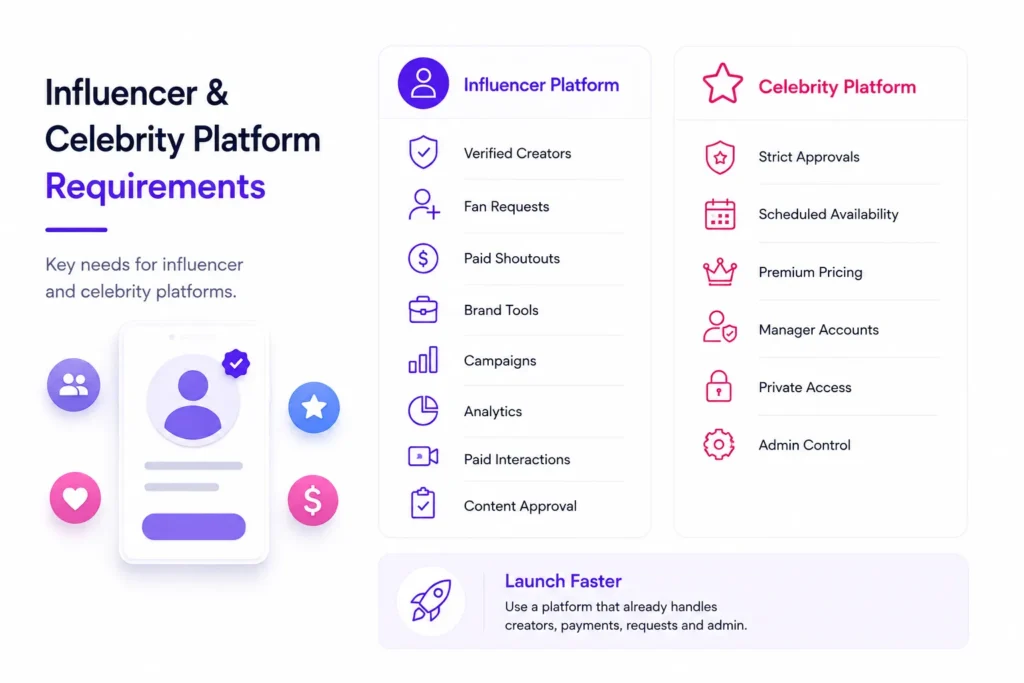
An influencer platform or celebrity platform may need a different structure from a general fan subscription product.
A growing influencer platform may require:
- Verified creator profiles
- Fan request workflows
- Paid shoutouts
- Brand collaboration tools
- Manager permissions
- Campaign dashboards
- Creator discovery
- Audience analytics
- Premium fan access
- Paid calls or video messages
- Agency-level reporting
- Content approval workflows
A celebrity platform may need stricter approval flows, reputation protection, scheduled availability, premium pricing control, and manager-managed accounts.
In these cases, a ready-made platform can help if it already supports creator profiles, fan payments, requests, paid interactions, and admin workflows. Custom development may be needed if the business model depends on unique campaign logic, talent management, or premium booking systems.
When a Ready-Made Platform Is the Better Choice
Choose a ready-made platform when your priority is faster launch and practical validation.
It is usually the better choice when:
- You want to launch quickly
- You need a branded platform without building from zero
- Your monetization model is similar to known creator economy workflows
- You need subscriptions, PPV, paid messaging, wallets, or payouts
- You want source-code ownership and future customization
- You have creators ready to onboard
- You want to test a niche market before investing heavily
- You need admin control from day one
- You want predictable setup and deployment planning
Founders who want a launch-ready subscription based creator platform should review whether the product foundation supports paid content, fan subscriptions, creator payouts, access rules, reporting tools, and moderation workflows before launch.
The key is not to choose any ready-made platform. The key is to choose one that has enough operational depth.
When Custom Development Is the Better Choice
Choose custom development when differentiation is more important than speed.
It is usually the better choice when:
- You have a validated business model
- You need unique product architecture
- You have complex integrations
- You need custom AI, recommendation, or video workflows
- You need enterprise-grade analytics
- You have strong funding and a longer runway
- You need complete product differentiation
- Your workflow does not fit standard creator monetization patterns
- Your internal team can support ongoing development
Custom development gives freedom, but it should be used carefully. It is strongest when the founder knows exactly what should be different and why that difference creates business value.
If the custom requirements are not clear, a hybrid path may be safer.
Founder Decision Signals
Speed
If creators or fans are already waiting, a ready-made platform can help you launch faster and validate demand before spending heavily on custom development.
Control
If your monetization, payments, access rules, or creator workflows are highly unique, custom development or hybrid customization may be better.
Scalability
If your platform will be video-heavy or payment-heavy, review backend architecture, media handling, source-code access, and admin control before choosing any route.
Market Fit
If the business model is not validated yet, start with the smallest serious product foundation that can test creator demand, fan payments, and retention.
Ready-Made vs Custom Decision Checklist
Before choosing a build route, answer these questions:
- How fast do you need to launch?
- Do you already have creators ready to onboard?
- Is your monetization model already validated?
- Do you need subscriptions, PPV, paid messages, tips, wallets, paid calls, or live sessions?
- Do creators need advanced dashboards?
- Do fans need wallet history or saved payment access?
- Will managers or agencies operate creator accounts?
- Do you need custom revenue split rules?
- Which payment gateways are required?
- Do you need regional payment options?
- Will the platform be video-heavy?
- Do you need livestreaming or paid video calls?
- Do you need age verification, creator verification, or consent workflows?
- Do you need geo-blocking or content access controls?
- Do admins need moderation queues and audit logs?
- Do you need full source-code ownership?
- Can your team maintain a custom build after launch?
- What must be unique on day one?
- What can be customized after validation?
If most answers are standard creator monetization needs, a ready-made platform or hybrid route may be practical. If many answers require unusual product logic, custom development may be justified.
Read more- Fan Monetization Platform Age Verification and Geo-Blocking: Controls for Regional Operations
Mistakes Founders Should Avoid
Choosing ready-made only because it is faster
Speed is useful, but the platform still needs strong payments, payouts, admin controls, moderation, source-code access, and customization flexibility.
Choosing custom development before validating demand
Full custom development can become expensive if the creator category, fan behavior, or monetization model has not been tested yet.
Ignoring source-code ownership
Without source-code ownership or extension rights, future customization, integrations, hosting changes, and scaling decisions can become difficult.
Underestimating payment and payout logic
Subscriptions, PPV unlocks, wallets, tips, paid messages, paid calls, refunds, and creator splits need reliable transaction records and admin visibility.
Treating scalability as only a server problem
Scalability also includes media handling, moderation queues, creator support, access control, payment reconciliation, and admin operations.
Buying a feature list instead of a product foundation
A long feature list is not enough. Founders should check how well the workflows connect across creator, fan, payment, payout, and admin panels.
How Miracuves Helps Founders Choose the Right Path
Miracuves helps founders choose between ready-made, hybrid, and custom creator platform development based on launch goals, monetization model, creator category, payment needs, and long-term control.
Related reading: If you are comparing ready-made options before launch, this creator platform features and pricing can help you understand what modules, controls, and platform decisions to review before choosing your product foundation.
Final Thoughts: Speed, Control, and Scalability Should Work Together
A Fan Monetization Platform should not be judged only by how fast it can launch or how custom it can become. The stronger decision is to balance speed, control, and scalability based on the founder’s current stage.
A ready-made platform is useful when the business needs faster validation with proven creator, fan, payment, and admin workflows. Custom development is useful when the platform needs unique architecture, advanced workflows, or long-term product differentiation. A hybrid approach often gives founders the best of both: launch faster with a working foundation, then customize the parts that create competitive advantage.
For founders, the smartest path is not always the longest build. It is the build route that gets the right product into the market with enough control to monetize, learn, improve, and scale.
FAQs
What is a ready-made Fan Monetization Platform?
A ready-made Fan Monetization Platform is a pre-built software foundation that helps founders launch creator profiles, fan subscriptions, gated content, PPV unlocks, paid messaging, wallets, payouts, and admin workflows faster than building everything from zero.
What is custom creator platform development?
Custom creator platform development means building the platform around exact business requirements, user journeys, backend architecture, payment flows, creator tools, admin dashboards, integrations, and scalability needs from scratch.
Is a ready-made platform better than custom development?
A ready-made platform is better when speed, validation, and proven workflows matter most. Custom development is better when the platform needs highly unique features, deep integrations, or custom architecture.
Can a ready-made platform still be scalable?
Yes, a ready-made platform can be scalable if it has clean architecture, source-code ownership, configurable modules, secure APIs, media handling, payment tracking, admin control, and the ability to extend features over time.
When should founders choose custom development?
Founders should choose custom development when the business model is validated, the product needs unique workflows, the platform experience is the competitive advantage, and the team has enough budget, time, and technical support.
What is the hybrid approach?
The hybrid approach starts with a ready-made platform foundation and customizes important business logic such as payment gateways, access controls, creator workflows, agency permissions, video features, analytics, or regional rules.
Does a subscription based creator platform need custom development?
Not always. A subscription based creator platform can start with a ready-made foundation if it supports subscriptions, gated content, creator payouts, admin controls, reporting, and customization. Custom development is useful when the workflow is highly unique.
How can Miracuves help with ready-made or custom creator platform development?
Miracuves helps founders build ready-made, white-label, hybrid, and custom creator platforms with branding, source-code ownership, creator monetization workflows, admin dashboards, payment setup, access controls, and scalable product planning.
Miracuves is an independent software development company. We are not affiliated with, connected to, sponsored by, or endorsed by any company or product named in this article.
Terms such as “X Clone” are used descriptively. It is how the software industry refers to building a platform with functionality comparable to a known service, and how clients search for it.
The entire design and codebase of our products is built by our own team. Our products contain no code, design, graphics, or content originating from any third-party website or applications.
All third-party names and marks referenced in this article are the property of their respective owners, referenced solely to identify the services discussed.