
Key Takeaways
- Fan Monetization Platform Go-to-Market Strategy should begin with creator acquisition, followed by fan conversion, retention, and scalable growth.
- Founders should secure quality creator supply before spending heavily on fan acquisition because creators create the value fans pay for.
- Fan conversion improves when creator profiles clearly explain exclusive content, pricing, subscription benefits, paid interactions, and payment options.
- Retention depends on consistent creator activity, welcome flows, PPV drops, paid messages, live sessions, loyalty rewards, and renewal campaigns.
- Go-to-market performance should be measured through creator activation, fan conversion, first purchase rate, renewals, churn, revenue per fan, and creator retention.
Growth Signals
- Early creators should have audience trust, consistent publishing habits, and clear monetization readiness.
- Direct creator outreach, agency partnerships, talent managers, creator communities, and niche networks can work better than broad advertising during launch.
- Creator-led promotion should drive fans to creator-specific landing pages rather than a generic marketplace homepage.
- Paid acquisition should scale only after creator profiles, pricing, checkout, welcome content, and retention flows are working reliably.
- A practical launch sequence is: creator supply → creator activation → fan traffic → first payment → repeat engagement → retention → expansion.
Real Insights
- A platform with strong technology but weak creator supply can still feel empty and struggle to convert fans.
- Creators are more likely to stay when onboarding is simple, monetization is clear, payouts are transparent, and promotional support is available.
- Fans convert better when the offer is specific, such as weekly premium content, private updates, PPV drops, or paid sessions.
- Retention improves platform economics because recurring subscribers reduce dependence on constant new-user acquisition.
- The strongest GTM model is: recruit creators → help them launch → convert existing audiences → retain paying fans → optimize the funnel → scale proven niches.
A Fan Monetization Platform does not grow just because the product is live. The launch only begins when creators join, fans discover them, payments happen, and subscribers keep coming back.
That is where go-to-market strategy matters.
A founder may have a Fan Monetization Platform Go-to-Market Strategy with subscriptions, gated content, pay-per-view unlocks, paid messages, tips, paid calls, wallets, payouts, and admin controls. But if the platform has no clear creator acquisition plan, no fan conversion path, and no retention system, the product can feel empty even if the technology is strong.
The real challenge is not only building a creator monetization platform. The real challenge is building a marketplace rhythm where creators publish consistently, fans understand the value, and paid relationships continue beyond the first transaction.
For founders launching a ready-made platform, video creation platform, subscription based creator platform, celebrity platform, influencer platform, or influencer video platform, the strongest go-to-market strategy connects three things:
Creator acquisition.
Fan conversion.
Fan and creator retention.
Miracuves helps founders launch ready-made and white-label solution platforms with creator monetization workflows, admin dashboards, subscription tools, payment logic, payout visibility, and source-code ownership. But even with a launch-ready product foundation, growth depends on how well the founder activates the creator side, builds demand, and keeps fans engaged after payment.
Why Go-to-Market Strategy Matters for Fan Monetization Platforms
A Fan Monetization Platform is a two-sided growth system.
On one side, creators need a place to publish, monetize, communicate, and manage earnings. On the other side, fans need a reason to subscribe, unlock content, message creators, join paid sessions, or stay active.
If either side is weak, the platform struggles.
A platform with fans but no strong creators has nothing valuable to sell. A platform with creators but no conversion engine becomes a content directory with poor revenue. A platform with one-time buyers but poor retention becomes dependent on constant acquisition.
This is why go-to-market planning should begin before development is finished.
Founders should define:
- Which creator niche will launch first
- Which creator segment has the strongest audience trust
- Which fan behavior the platform wants to monetize
- Which revenue stream will lead the first version
- Which acquisition channels creators already use
- Which offer will convince fans to subscribe
- Which retention loops will keep fans paying
- Which metrics will show whether the strategy is working
A creator monetization platform is not only a technology decision. It is a marketplace strategy decision.
Start With the Supply Side: Creator Acquisition
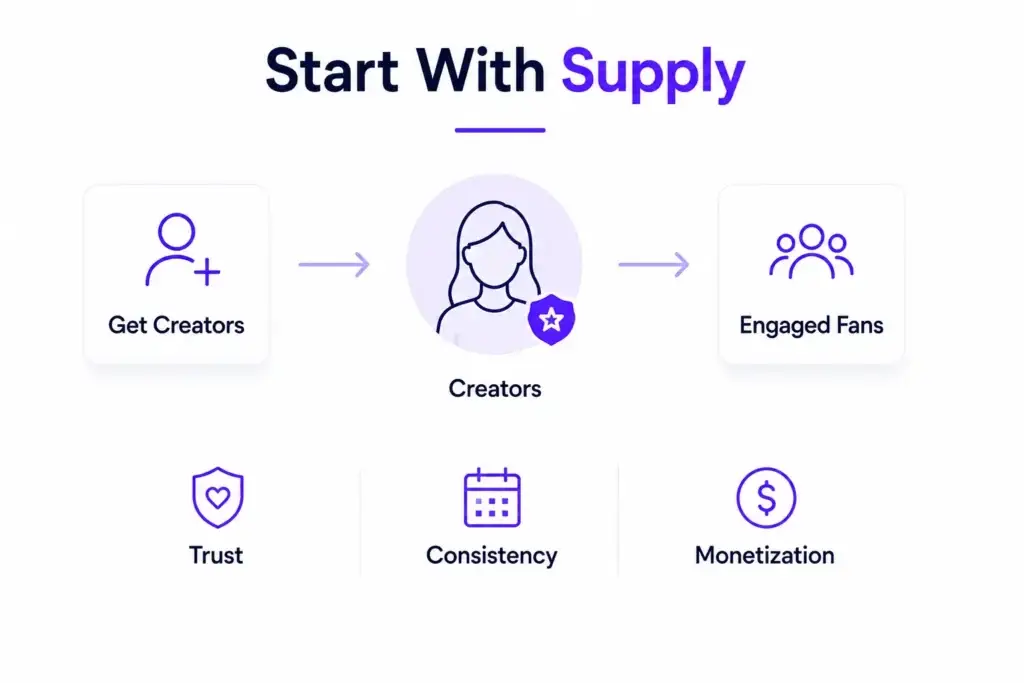
Creator acquisition is the first growth priority because creators create the value fans pay for.
Many founders make the mistake of trying to acquire fans before the platform has enough creator supply. That usually leads to poor conversion because users arrive, browse empty profiles, and leave.
A stronger launch starts with a focused creator acquisition plan.
Instead of trying to onboard every creator category at once, founders should identify one high-potential niche. This could be fitness creators, lifestyle influencers, premium video creators, coaches, consultants, celebrities, fan communities, artists, educators, adult creators where legally permitted, or niche entertainment personalities.
The best early creators usually have three traits:
- Audience trust
Their followers already pay attention and respond to their content. - Content consistency
They can publish regularly enough to keep fans engaged. - Monetization readiness
They understand subscriptions, paid content, private engagement, or exclusive community value.
A ready-made platform can help creators start faster because the core workflows are already available. But the founder still needs a creator acquisition message that explains why creators should join.
Creator Acquisition Channels That Work Better Early
The best creator acquisition channels depend on the niche, but the early-stage goal is usually direct outreach rather than broad advertising.
Founders can start with:
- Instagram creator outreach
- TikTok creator outreach
- YouTube creator communities
- Twitter/X creator circles
- Influencer agencies
- Talent managers
- Fan club operators
- Coaching communities
- Newsletter creators
- Podcast creators
- Creator economy Facebook groups
- Reddit niche communities where self-promotion is allowed
- Existing creator marketplaces
- Local celebrity or micro-celebrity networks
- Event-based creator partnerships
At launch, direct relationships usually work better than anonymous ads. Creators need to trust the platform before they bring their audience.
A founder should avoid generic outreach like “Join our platform and earn more.” That message is too weak.
A stronger creator pitch should answer:
- What kind of creator is this platform built for?
- How does the creator earn?
- What percentage or payout logic applies?
- How quickly can the creator start?
- What content can they monetize?
- How does the platform protect content?
- What admin or support help is available?
- How does the creator bring existing fans?
- What makes this platform better for their niche?
Creator acquisition is not just recruitment. It is positioning.
Creator Acquisition Strategy by Launch Stage
| Launch Stage | Creator Goal | Best GTM Action |
|---|---|---|
| Pre-launch | Secure early creator commitments. | Build a waitlist, offer founder creator benefits, and onboard creators manually. |
| Soft launch | Activate a small group of high-quality creators. | Help creators set profiles, pricing, content calendars, and launch offers. |
| Public launch | Drive fan traffic from creator audiences. | Use creator-led announcements, limited-time offers, referral links, and launch campaigns. |
| Growth stage | Expand creator categories carefully. | Recruit creators based on conversion data, retention quality, and fan spending behavior. |
| Scaling stage | Build repeatable creator acquisition systems. | Add agency partnerships, creator success playbooks, onboarding automation, and performance dashboards. |
Build a Creator Offer That Is Easy to Say Yes To
Creators will not join only because a platform exists. They need a reason to believe the platform can help them earn, engage, and protect their audience relationship.
A strong creator offer can include:
- Early creator status
- Lower platform commission for founding creators
- Profile setup support
- Content migration support
- Launch campaign support
- Featured placement during launch
- Fast payout visibility
- Creator analytics
- Custom branding or verified badges
- Referral rewards
- Support for subscriptions, PPV, tips, paid messages, and paid calls
- Content protection and reporting tools
- Clear creator success playbook
The offer should not promise guaranteed earnings. It should promise a serious product foundation, clear monetization tools, and practical support.
A creator platform becomes easier to sell when the founder can explain exactly how creators will onboard, publish, price, promote, earn, withdraw, and retain fans.
Creator Onboarding Should Remove Friction
Even interested creators can drop off if onboarding is confusing.
A strong creator onboarding flow should guide creators through:
- Account setup
- Identity or eligibility verification where required
- Profile completion
- Bio and niche positioning
- Subscription pricing
- PPV content setup
- Welcome content upload
- Paid messaging settings
- Paid call availability if enabled
- Payout details
- Content policy review
- Fan promotion guide
- Launch checklist
This is especially important for celebrity platforms and influencer platforms where creators may have managers, assistants, or agencies involved. The platform should support creator approval, staff access, payout visibility, and content review workflows.
These creator-side workflows work best when they are connected to the wider creator platform features, including subscriptions, payouts, agency management, creator dashboards, moderation tools, and admin-level access controls.
Fan Conversion Starts Before the Fan Lands on the Platform
Fan conversion does not begin on the checkout page. It begins when a creator communicates the value of joining.
A fan needs to understand why they should leave a free social platform and pay for access somewhere else.
The conversion message should answer:
- What exclusive content is available?
- How often will the creator post?
- What do subscribers get that free followers do not?
- Is there a launch discount?
- Is there a limited-time offer?
- Can fans send paid messages?
- Can fans unlock premium content?
- Can fans join live sessions or paid calls?
- Is payment simple?
- Can fans cancel easily?
- Is the platform safe and private?
A weak conversion message says: “Subscribe for exclusive content.”
A stronger conversion message says: “Join for weekly behind-the-scenes videos, private updates, subscriber-only messages, and first access to limited paid sessions.”
Specificity improves conversion because fans understand what they are buying.
Fan Conversion Funnel for a Creator Platform
A Fan Monetization Platform should be measured like a funnel.
A simple funnel includes:
- Discovery
The fan sees the creator on social media, search, email, community, or paid promotion. - Click
The fan clicks the creator’s platform link. - Profile view
The fan views the creator profile and understands the offer. - Signup
The fan creates an account. - First payment
The fan subscribes, tips, unlocks PPV content, pays for a message, or books a call. - Repeat engagement
The fan returns to consume more content or interact again. - Retention
The fan renews, upgrades, or continues spending over time.
The founder should not only look at total revenue. They should track where people drop off.
If social reach is high but clicks are low, the creator’s promotion needs better positioning. If clicks are high but subscriptions are low, the profile page or offer may be weak. If subscriptions are high but retention is low, the content rhythm may not match expectations.
Founder Decision Signals
Creator Supply
If your platform has no committed creators before launch, fan acquisition will be difficult. Secure creator supply first.
Offer Clarity
If fans do not understand what they get after paying, conversion will suffer even if the product design looks strong.
Payment Friction
If checkout, wallet setup, or subscription renewal feels confusing, fans may leave before the first transaction.
Retention Quality
If creators publish inconsistently after launch, subscriber churn can rise quickly. Retention needs a content rhythm.
Landing Pages Should Sell the Creator, Not Only the Platform
A common mistake is making every fan land on a generic platform homepage. Fans usually come because of a specific creator, not because they searched for the platform brand.
That means creator profile pages are conversion assets.
A strong creator profile should include:
- Creator name and category
- Clear value proposition
- Public preview content
- Subscription benefits
- Paid content examples
- Pricing clarity
- Welcome message
- Fan trust signals
- Posting frequency
- Limited-time offer
- Clear subscribe button
- Payment method clarity
- Safe reporting and support options
For a video creation platform or influencer video platform, previews matter even more. Fans should see enough free content to understand creator style, but not so much that the premium offer loses value.
The platform must balance preview and exclusivity.
Pricing Strategy for Fan Conversion
Pricing can make or break conversion.
A creator monetization platform may support many pricing models:
- Free follow with paid upgrades
- Monthly subscriptions
- Tiered subscriptions
- PPV content
- Paid messages
- Paid calls
- Tips
- Bundled access
- Limited-time discounts
- Annual plans
- Subscriber-only offers
- Creator-specific pricing
- Premium fan clubs
The best pricing strategy depends on the creator category.
A celebrity platform may perform better with premium pricing, limited availability, and paid requests. A coaching creator may use packages, calls, and subscriptions. A lifestyle influencer may use lower subscription pricing with higher PPV upsells. A niche video creator may combine a monthly membership with premium video unlocks.
Before expanding monetization across subscriptions, PPV unlocks, tips, private messaging, paid calls, and creator payouts, founders should understand how a creator platform business model connects revenue streams, platform commissions, creator earnings, and operational control.
Fan Retention Is Where Platform Economics Improve
Acquisition gets attention, but retention protects the business.
If fans subscribe once and leave, the platform must constantly replace them. If fans stay, renew, upgrade, tip, unlock PPV content, and join paid sessions, revenue becomes more stable.
Retention depends on both product design and creator behavior.
A subscription based creator platform should encourage creators to keep fans engaged through:
- Regular posting schedules
- Subscriber-only content drops
- Welcome messages
- Renewal reminders
- Fan milestones
- Private updates
- Polls and requests
- Paid message campaigns
- Limited PPV drops
- Live sessions
- Paid calls
- Loyalty rewards
- Tier upgrades
- Creator announcements
- Community rituals
The platform should make these actions easy. If creators have to manage everything manually, retention becomes harder.
Founders who want a launch-ready subscription based creator platform should review whether the product foundation supports paid content, fan subscriptions, creator payouts, access rules, reporting tools, and moderation workflows before launch.
Retention Loops Founders Should Build Into the Product
Retention loops are product and content patterns that bring fans back.
Useful retention loops include:
| Retention Loop | How It Works | Why It Helps |
|---|---|---|
| Welcome sequence | New fans receive a welcome message, pinned content, or starter offer. | Helps convert first-time subscribers into active fans. |
| Weekly content rhythm | Creators publish on predictable days. | Gives fans a reason to return regularly. |
| PPV drops | Creators release premium unlocks beyond the subscription. | Increases revenue per fan without raising base subscription price. |
| Paid message campaigns | Creators send paid or personalized messages to selected fans. | Creates direct engagement and upsell opportunities. |
| Live or paid sessions | Fans join scheduled livestreams or one-to-one interactions. | Builds stronger creator-fan relationships. |
| Loyalty rewards | Long-term fans receive exclusive discounts, badges, or early access. | Reduces churn and rewards subscriber tenure. |
| Upgrade prompts | Fans are encouraged to move to higher tiers or premium access. | Improves monetization depth. |
| Win-back campaigns | Expired subscribers receive targeted reactivation offers. | Recovers revenue that would otherwise be lost. |
A ready-made platform should support at least some of these loops through notifications, messaging, subscription logic, PPV tools, creator dashboards, and admin settings.
Creator Retention Matters Too
Fan retention is important, but creator retention is just as important.
A platform can lose momentum if creators stop posting, delay payouts, ignore messages, or move audiences elsewhere. The founder needs a creator success system, not just a signup form.
Creator retention improves when creators have:
- Clear onboarding
- Fast profile setup
- Transparent earnings
- Payout visibility
- Fair revenue split logic
- Content protection
- Reporting tools
- Audience analytics
- Promotional support
- Creator success guidance
- Responsive platform support
- Product updates based on feedback
Creators stay where they earn, feel protected, and see growth potential.
This is why admin dashboards matter after launch. Founders need visibility into creator activity, content frequency, subscriber growth, revenue by creator, payout status, churn signals, and support requests.
Use Launch Campaigns to Create Early Momentum
A Fan Monetization Platform should not launch quietly.
A launch campaign creates urgency and gives creators a reason to bring fans to the platform.
Launch campaign ideas include:
- Founding creator week
- Early subscriber discount
- First 100 fan access
- Limited PPV bundle
- Fan giveaway
- Creator livestream launch
- VIP fan club opening
- Referral rewards
- Paid call launch event
- Exclusive video drop
- Creator leaderboard
- Social media countdown
- Email waitlist activation
- Community announcement campaign
The launch offer should be easy to understand and easy to share.
For example:
“Join this week for founder subscriber access and get the first premium drop included.”
That is stronger than simply saying “Our platform is live.”
Go-to-Market Strategy for Video-Heavy Creator Platforms
A video-heavy product needs a different GTM strategy because video can drive stronger emotional connection, but also requires stronger content planning.
A video creation platform may need:
- Preview clips for acquisition
- Premium full-length videos for conversion
- Short-form teasers on social channels
- Livestream events for launch campaigns
- Paid video calls for high-value fans
- Creator video calendars
- Video unlock campaigns
- Behind-the-scenes content
- Personalized video requests
- Video analytics for creator coaching
For founders building a video-heavy product, Miracuves also provides video content platform solutions that can support uploads, streaming, media workflows, creator discovery, and monetized video experiences.
A video GTM strategy should not depend only on uploads. It should connect clips, previews, premium unlocks, fan messages, live events, and retention campaigns.
Go-to-Market Strategy for Influencer and Celebrity Platforms
A growing influencer platform needs stronger positioning because influencer audiences are often spread across multiple social channels.
The GTM strategy may include:
- Creator-led social promotion
- Fan club migration
- Brand collaboration campaigns
- Paid shoutout offers
- Personalized request workflows
- Limited celebrity availability
- VIP fan access
- Community challenges
- Affiliate codes
- Manager-led creator onboarding
- Campaign dashboards
- Audience analytics
A celebrity platform may rely more on exclusivity, scarcity, and premium access. An influencer platform may rely more on repeat engagement, brand campaigns, community rewards, and content rhythm.
In both cases, the platform should help creators turn existing attention into owned audience monetization.
Paid Acquisition Should Come After Conversion Basics
Paid ads can help, but they should not be the first growth dependency.
Before spending heavily on paid acquisition, founders should confirm:
- Creator profiles are complete
- Landing pages explain the offer
- Payment flow works smoothly
- Subscription pricing is clear
- Welcome content is ready
- First purchase offers exist
- Retention content is planned
- Email or notification flows are active
- Analytics are installed
- Creator referral links are trackable
If conversion is weak, paid ads only amplify the leak.
A better early approach is to use creator-owned distribution first: social audiences, email lists, broadcast channels, communities, and fan groups. Once the funnel converts, paid campaigns can scale what is already working.
Read more- Fan Monetization Platform Paid Calls: Session Pricing, Duration Tracking, and Creator Revenue Splits
Analytics That Matter After Launch
A creator monetization platform should track more than total revenue.
Important go-to-market metrics include:
- Number of active creators
- Creator activation rate
- Average creator profile completion
- Creator posting frequency
- Creator-to-fan conversion rate
- Profile views
- Signup conversion rate
- Subscriber conversion rate
- First purchase rate
- PPV unlock rate
- Paid message conversion
- Tip conversion
- Paid call booking rate
- Renewal rate
- Churn rate
- Average revenue per paying fan
- Revenue per creator
- Payout completion time
- Report volume
- Refund rate
- Fan lifetime value
- Creator retention rate
These metrics help founders diagnose the real problem.
If active creators are low, fix creator acquisition. If profile views are high but subscriptions are low, fix the offer. If subscribers churn quickly, fix content rhythm and retention. If refunds are high, fix expectations and payment clarity.
Launch Roadmap: First 90 Days
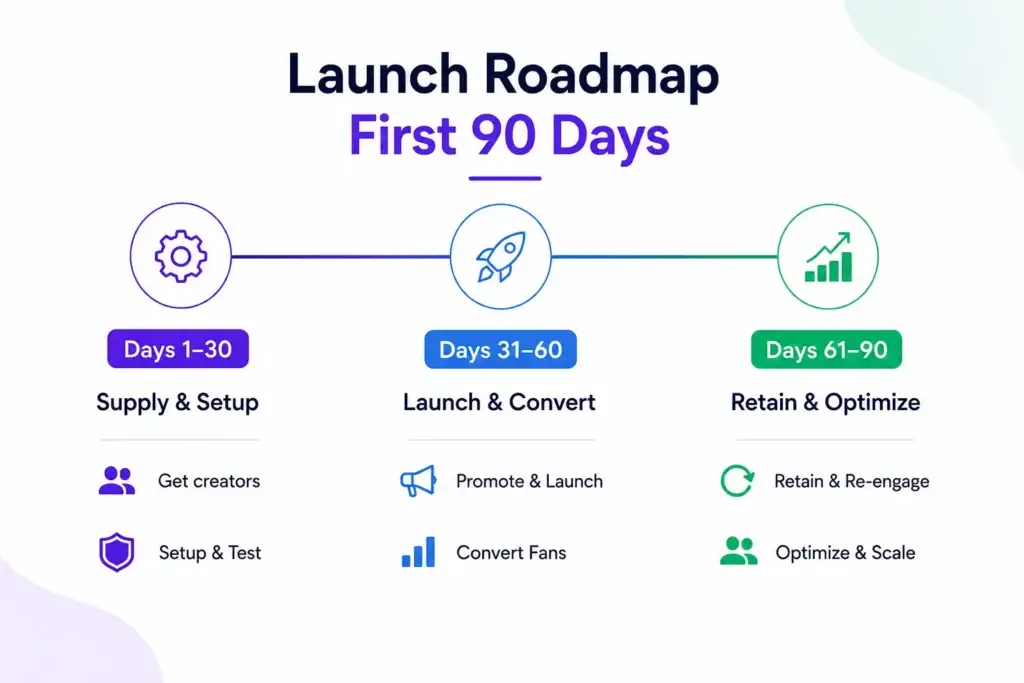
A practical go-to-market roadmap can help founders avoid random execution.
Days 1–30: Supply and Setup
Focus on creator acquisition and product readiness.
- Recruit 10–30 early creators depending on niche
- Help creators complete profiles
- Configure pricing and subscription tiers
- Prepare launch content calendars
- Set payout rules
- Set moderation policies
- Build creator promotion assets
- Test payment flows
- Prepare fan onboarding
- Create launch landing pages
- Build email and social announcement sequences
Days 31–60: Launch and Convert
Focus on bringing creator audiences to the platform.
- Run creator-led announcements
- Promote limited-time subscriber offers
- Launch exclusive content drops
- Track profile visits and conversion
- Test pricing and offer wording
- Send welcome messages
- Encourage first PPV purchases
- Launch live sessions or paid calls
- Monitor support requests
- Resolve payment friction quickly
- Share creator success learnings
Days 61–90: Retain and Optimize
Focus on renewal, repeat spending, and creator consistency.
- Analyze churn and renewal behavior
- Identify top-performing creators
- Coach creators with low conversion
- Improve landing pages
- Add win-back campaigns
- Test loyalty rewards
- Launch creator referral programs
- Expand high-performing niches
- Improve notifications
- Review payout and support workflows
- Build a repeatable creator acquisition process
This roadmap gives founders a structured way to move from product launch to marketplace learning.
Mistakes Founders Should Avoid
Launching before creators are ready
A platform with incomplete creator profiles, weak content, or unclear pricing will struggle to convert fans even if the product is technically live.
Trying to target every creator niche at once
Broad positioning creates weak messaging. Start with a creator segment where the audience, offer, and monetization model are clear.
Driving traffic before fixing the offer
If fans do not understand why they should subscribe or pay, more traffic will not solve the conversion problem.
Ignoring creator success after onboarding
Creators need guidance on pricing, posting rhythm, fan messaging, PPV drops, and retention. Without support, creator activity may fade.
Measuring only revenue
Total revenue is useful, but founders also need activation, conversion, retention, churn, payout, and creator activity metrics.
Using paid ads too early
Paid campaigns should scale a working funnel. If the landing page, pricing, payment flow, or retention offer is weak, ad spend can be wasted.
How a Ready-Made Platform Supports Go-to-Market Speed
A ready-made platform helps founders move faster because they are not starting from a blank development roadmap.
Instead of building creator accounts, fan registration, subscriptions, gated content, payments, payouts, dashboards, and admin control from zero, the founder can focus on launch decisions:
- Which creator niche should launch first?
- Which creators should be onboarded manually?
- Which offer should fans see first?
- Which subscription tier should be promoted?
- Which content should be free preview vs premium?
- Which payment method should be prioritized?
- Which retention loop should launch in month one?
- Which creator metrics should be reviewed weekly?
This matters because go-to-market speed is not only about deploying software. It is about reaching real creators and fans faster.
A ready-made platform gives the product foundation. The founder still needs positioning, onboarding, launch campaigns, creator education, fan conversion, and retention operations.
Read more- Ready-Made vs Custom Fan Monetization Platform: Comparing Speed, Control, and Scalability
How Miracuves Helps Founders Plan Creator Platform GTM
Miracuves helps founders build and launch creator platforms around the actual business model, not only a generic feature list.
Related reading: If you are comparing ready-made options before launch, this creator platform features and pricing can help you understand what modules, controls, and platform decisions to review before choosing your product foundation.
Final Thoughts: GTM Turns a Platform Into a Business
A Fan Monetization Platform does not become successful because it has subscriptions, PPV content, messages, wallets, or creator dashboards. Those features create the foundation. Go-to-market strategy creates the movement.
Founder success depends on recruiting the right creators, helping them launch properly, converting fans with clear offers, and building retention loops that keep subscribers active.
The strongest approach is to think in stages: creator supply first, fan conversion second, retention third, and scale after the funnel proves itself. A ready-made platform can help founders move faster, but the growth engine still depends on niche positioning, creator trust, content rhythm, payment clarity, and operational discipline.
If the platform helps creators earn, helps fans understand value, and helps admins measure what is working, the business has a better chance of moving from launch to sustainable growth.
FAQs
What is a Fan Monetization Platform go-to-market strategy?
A Fan Monetization Platform go-to-market strategy is the plan for launching and growing the platform by acquiring creators, converting fans into paying users, increasing repeat engagement, and improving retention over time.
Should founders acquire creators or fans first?
Founders should usually acquire creators first because creators create the value fans pay for. Once creator profiles, content, pricing, and launch offers are ready, fan acquisition becomes easier.
How do creator platforms convert fans into paying subscribers?
Creator platforms convert fans through clear creator profiles, exclusive offers, strong previews, simple pricing, easy payment flow, welcome content, limited-time campaigns, and creator-led promotion from existing social audiences.
Why is retention important for a creator monetization platform?
Retention is important because recurring fans create more stable revenue. If fans churn quickly, the platform must constantly acquire new users to replace lost subscribers.
What creators should a new platform recruit first?
A new platform should recruit creators with audience trust, consistent content habits, monetization readiness, and a clear reason for fans to pay for exclusive access.
Can a ready-made platform support go-to-market speed?
Yes. A ready-made platform can support go-to-market speed by reducing development time and giving founders a working foundation for creator profiles, subscriptions, gated content, payments, payouts, admin control, and moderation.
How can an influencer platform improve fan conversion?
An influencer platform can improve conversion by using creator-led campaigns, personalized offers, paid shoutouts, exclusive content, fan request workflows, strong profile pages, and clear payment options.
How can Miracuves help with creator platform launch strategy?
Miracuves helps founders build ready-made and white-label creator platforms with subscriptions, gated content, paid interactions, wallets, payouts, admin dashboards, source-code ownership, and customization support for launch and growth planning.
Miracuves is an independent software development company. We are not affiliated with, connected to, sponsored by, or endorsed by any company or product named in this article.
Terms such as “X Clone” are used descriptively. It is how the software industry refers to building a platform with functionality comparable to a known service, and how clients search for it.
The entire design and codebase of our products is built by our own team. Our products contain no code, design, graphics, or content originating from any third-party website or applications.
All third-party names and marks referenced in this article are the property of their respective owners, referenced solely to identify the services discussed.