

Key Takeaways
- A live social audio platform can monetize through virtual gifts, creator commissions, premium rooms, subscriptions, coin purchases, paid interactions, and platform fees.
- Creators can earn when listeners purchase virtual currencies, send gifts, join paid audio rooms, subscribe to premium access, or support hosts during live sessions.
- Strong monetization depends on balancing creator earnings, listener spending, platform commissions, reward mechanics, payment costs, and repeat live-audio engagement.
Monetization Signals
- Virtual gifts can use coins, diamonds, badges, animations, rankings, and gifting events to turn real-time listener participation into measurable creator revenue.
- Creator earnings workflows should track gift value, platform commission, bonuses, eligible balances, withdrawal requests, payout status, and transaction history.
- Platform fees can be structured around virtual currency purchases, gift transactions, paid rooms, memberships, premium creator tools, withdrawals, or other value-added services.
Creator & Platform Revenue Insights
- Operators should track paying listeners, gift conversion, average gift value, creator earnings, coin purchases, payout ratios, revenue per room, and repeat spender activity.
- Transparent earning rules, clear gift values, reliable payouts, creator analytics, loyalty rewards, and engaging live-room experiences can strengthen monetization without weakening user trust.
- Miracuves develops customizable live social audio platforms with virtual gifts, coin wallets, creator earnings, paid rooms, subscriptions, platform fees, payouts, analytics, moderation, and admin controls.
Live social audio platform monetization is not only about adding a payment button inside an audio room. It is about designing a system where listeners want to support creators, creators trust the payout logic, and the platform owner has enough control to manage revenue without hurting community growth.
This matters because social audio apps behave differently from video platforms, marketplaces, or subscription communities. The product is live. The value is created in the moment. A host says something, the room reacts, a listener sends a gift, other users notice it, and the creator feels rewarded immediately.
That is why virtual gifts, creator earnings, and platform fees are three of the most important monetization layers in a live social audio product. They are connected. If one layer is unclear, the whole revenue model becomes harder to trust.
Why Monetization Works Differently in Live Social Audio
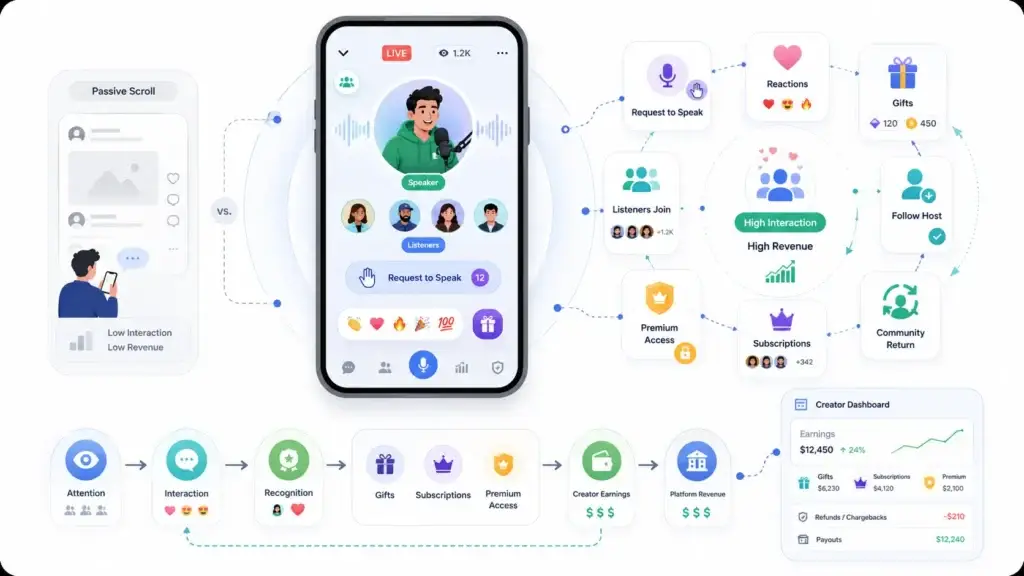
A live social audio platform does not monetize audio alone. It monetizes the relationship between speakers, listeners, rooms, and communities.
In a normal content feed, users scroll privately. In a live audio room, users participate publicly. They join as listeners, request to speak, react to hosts, follow creators, send gifts, and return to rooms where they feel recognized.
This public participation changes the economics. A user may not pay just to enter a room on day one, especially if the community is still small. But the same user may send a small gift when a host answers their question, gives them attention, or creates a moment that the room notices.
That is the core monetization difference. Social audio revenue grows from interaction density. More familiar rooms create stronger creator relationships. Stronger relationships create more reasons to gift, subscribe, or pay for premium access.
Large creator platforms already show this direction. YouTube’s virtual item system lets viewers buy Jewels, send Gifts during live streams, and creators earn Rubies from those gifts. X also uses creator dashboards to show estimated revenue share payments, refunds, chargebacks, and payout thresholds for monetization products.
For founders, the lesson is simple: monetization should feel native to the conversation, not bolted onto it later.
How Virtual Gifts Turn Conversations Into Transactions
Virtual gifts work because they are not just payments. They are signals.
When a listener sends a gift inside a live room, three things happen at once. The creator gets rewarded, the sender becomes visible, and the room sees a moment of appreciation. That visibility is what makes gifting different from a hidden payment.
A simple gift can say “good point.” A larger animated gift can say “I support this creator.” A rare gift can create status for the sender. This is why successful gift economies usually need more than one gift price. They need a ladder.
A live audio platform can use:
| Gift Layer | User Intent | Business Value |
|---|---|---|
| Small gifts | Quick appreciation | Encourages frequent micro-spending |
| Mid-value gifts | Visible support | Builds creator loyalty and room activity |
| Premium gifts | Status and spectacle | Increases high-intent spending |
| Seasonal gifts | Cultural relevance | Creates timely spending moments |
| Creator-specific gifts | Community identity | Helps rooms develop their own rituals |
The important part is not the animation alone. It is the context. A gift has more value when the host acknowledges it, when the room can see it, and when the sender feels noticed.
For a deeper breakdown of how virtual gifting in creator apps increases engagement and earnings, Miracuves has also covered how coins, gift catalogues, live reactions, creator rewards, and wallet-based monetization work together across creator platforms.
This is why gift design should connect with room UX. The platform should show gifts clearly, avoid interrupting the audio experience, and give creators simple ways to thank supporters without breaking the flow of conversation.
The Coin Wallet Is the Engine Behind Virtual Gifts
Most virtual gift systems use an in-app currency such as coins, credits, jewels, beans, or diamonds. The name can change, but the logic is usually similar.
Users buy a coin package. They spend coins on gifts. Creators receive an earnings balance based on the platform’s conversion rules. The platform manages the difference between purchase value, app-store or payment fees, creator share, and platform margin.
This structure matters because it reduces transaction friction. A listener does not need to enter card details every time they want to support a creator. They can buy coins once and spend them quickly during live moments.
For founders, the coin wallet should answer these operational questions:
- What coin packages will users buy?
- Which gifts cost how many coins?
- What does the creator receive after a gift is sent?
- What portion does the platform keep?
- How are refunds, failed payments, and chargebacks handled?
- What payout threshold should creators meet before withdrawal?
- Can the admin update gift prices without developer support?
App-store economics also matter. Apple’s Small Business Programme offers a reduced 15% commission for eligible developers up to the defined proceeds threshold, while Apple’s standard commission remains 30% for apps selling digital goods and services above that threshold. Google Play states that developers selling digital goods are subject to a service fee, but there is not one single fee for every developer; Google says 99% of developers subject to the fee qualify for 15% or less.
That means founders should not model creator payouts from gross revenue alone. They should model what remains after store fees, payment gateway charges, taxes where applicable, refunds, and platform rules.
This is also why the cost of building a live audio platform should be evaluated around real-time rooms, wallet accuracy, payment flows, payout handling, refund logic, and admin fee controls—not just the number of screens.
Creator Earnings Are the Reason Hosts Keep Coming Back
A live audio platform needs hosts. Without hosts, rooms stay empty. Without active rooms, users have no reason to return. Without repeat participation, monetization has no foundation.
This is why creator earnings are not just a finance feature. They are a supply-side retention feature.
Creators need to know:
- How much they earned
- Which rooms generated earnings
- Which gifts were received
- What platform fee was deducted
- What refunds or chargebacks affected their balance
- When they can withdraw
- Which payout method is available
- Whether taxes or verification steps are required
A vague creator dashboard damages trust. If creators cannot understand their statement, they may assume the platform is underpaying them even when the calculation is correct.
A strong creator earnings system should include a wallet balance, gift history, payout request flow, transaction status, minimum withdrawal threshold, dispute handling, and admin-side audit logs.
Miracuves’ creator economy platform development approach treats payout clarity as a serious product layer, not just a reporting feature. For platforms where creators earn through gifts, subscriptions, live sessions, or paid access, payout statements, chargeback handling, transaction records, and admin controls directly affect whether creators stay loyal to the platform.
For founders, this is the real point: creators do not stay only because the app looks good. They stay when they can earn, understand their earnings, and trust the platform.
Platform Fees Are the Operator’s Revenue Lever
A platform fee is the percentage or margin the platform keeps from creator earnings, gift conversions, paid rooms, subscriptions, or other monetized actions.
In a live social audio product, the platform fee should not be treated as one fixed number forever. Early creators may need a more generous share so they feel motivated to host. Later, when the platform has stronger demand, the operator may introduce differentiated fees, premium creator programs, agency partnerships, or lower fees for high-performing hosts.
That is why admin control matters. If the platform fee is hard-coded, every change becomes a development task. If it is configurable, the operator can adjust monetization strategy based on real behavior.
A practical platform fee system may include:
| Fee Type | Where It Applies | Why It Matters |
|---|---|---|
| Gift commission | Each virtual gift sent | Core revenue from live engagement |
| Withdrawal fee | Creator cashout | Helps cover payout processing costs |
| Premium room fee | Paid access rooms | Monetizes exclusive live sessions |
| Subscription fee | Monthly creator or VIP plans | Adds recurring revenue |
| Agency share | Managed creator programs | Supports host recruitment models |
| Promotion fee | Featured rooms or creators | Monetizes discovery once traffic grows |
The strongest model is not always the highest fee. If the platform keeps too much too early, creators may leave. If it keeps too little, the operator may struggle to cover infrastructure, moderation, support, and payment costs.
The right fee is a business decision. The product should make that decision easy to change.
Monetization Models That Fit Live Social Audio Platforms
A live social audio platform can make money through several revenue streams, but they should not all be launched at once.
Virtual Gifts and Coin Sales
This is usually the most natural early monetization layer because it fits the live-room experience. Users spend when they feel emotionally connected to a host or moment.
The platform earns through coin sales, gift margins, or creator-earnings commission. The creator receives a balance that can later be withdrawn based on platform rules.
VIP Access and Premium Memberships
VIP access works when users want status, badges, exclusive rooms, better visibility, or special community perks. It should not block the basic room experience too early.
The founder should first ask: does status matter inside this community? If users already recognize regular speakers, hosts, and supporters, VIP access can become valuable.
Paid Rooms
Paid rooms work best for expert sessions, coaching, entertainment events, private communities, fan conversations, or invite-only discussions.
They work poorly when the platform has weak discovery or no trusted hosts. Charging for unknown rooms too early creates friction before the platform has proven value.
Creator Subscriptions
Subscriptions give creators recurring revenue. They work when creators have a loyal audience and can offer ongoing access, private sessions, exclusive rooms, or bonus content.
For the platform, subscriptions add predictability. For the creator, they reduce dependence on one-time gifts.
Avatar Shops and Cosmetic Upgrades
Cosmetics are useful when identity is visible. In live audio, this can include profile frames, badges, room entry effects, supporter labels, or premium avatars.
These features work because users want to be recognized inside communities they care about.
Sponsorships and Featured Rooms
Sponsorships become useful after the platform has consistent activity. Before that, they are difficult to sell because advertisers need audience volume and predictable engagement.
Early-stage founders should usually prioritize gifts, coin wallets, creator earnings, and VIP access before relying on ads.
White-Label Licensing
White-label licensing is a different revenue model. Instead of monetizing end users directly, the platform operator can deploy branded versions for communities, agencies, influencers, or media brands.
This works when the product has repeatable infrastructure and the operator wants revenue from deployments, partnerships, or managed communities.
Founder Decision Signals Before Turning Monetization On
Room Activity
Turn on gifts when users return to the same rooms and recognize hosts, not when the room list is still empty.
Creator Supply
Launch creator earnings when hosts are producing repeat sessions and need a reason to stay loyal to the platform.
Fee Control
Use admin-configurable platform fees so the operator can test creator splits without waiting for a code release.
Payout Trust
Add payout statements, transaction history, and dispute handling before promising creators a serious earning path.
<style> .miracuves-signal-box { background: #ffffff; border: 1px solid #f1d5dc; border-radius: 18px; padding: 26px; margin: 30px 0; } .signal-grid { display: grid; grid-template-columns: repeat(2, minmax(0, 1fr)); gap: 18px; } .signal-grid div { background: #fff7f9; padding: 18px; border-radius: 14px; } .signal-grid h4 { margin: 0 0 8px; color: #a70d2a; } .signal-grid p { margin: 0; line-height: 1.6; } @media(max-width: 768px) { .signal-grid { grid-template-columns: 1fr; } } </style>
The Right Monetization Sequence for a New Social Audio Platform
A common mistake is launching too many paid features before the community has enough energy.
A better sequence is:
| Stage | Monetization Focus | Why |
|---|---|---|
| Pre-launch | No heavy monetization | Build host supply and community positioning first |
| Early rooms | Free access and engagement loops | Users need a reason to return before they pay |
| Repeat rooms | Virtual gifts and coin wallet | Gifting works when users recognize hosts |
| Emerging creators | Creator earnings and low platform fee | Hosts need proof that the platform can reward them |
| Stronger community | VIP access and cosmetics | Status has value once members know each other |
| Mature platform | Sponsorships, paid rooms, licensing | These need trust, volume, or proven operations |
This staged approach protects the platform from asking for money before it has earned attention.
For founders planning a stronger live social audio business model, it helps to map coin sales, virtual gifts, creator payouts, VIP access, and platform fees as connected revenue levers rather than separate features.
Miracuves’ own social audio business model content makes a similar strategic point: monetization should follow room activity, creator emergence, and community depth rather than being forced into empty rooms.
Mistakes That Damage Creator Trust and Platform Revenue
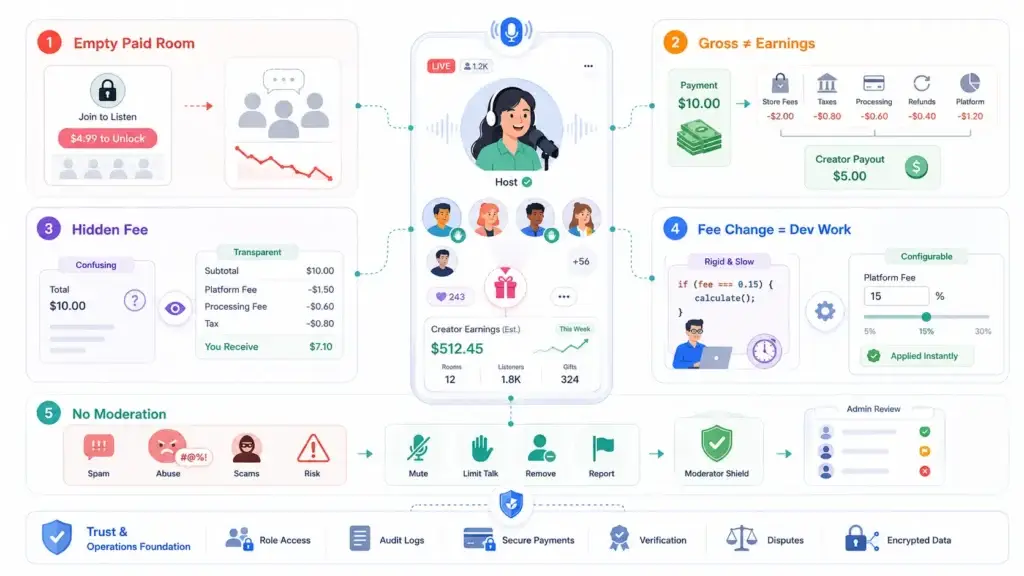
Charging Before the Room Has Value
A paid room with no audience is not premium. It is empty. Founders should avoid putting access fees in front of the first user experience unless the platform already has trusted hosts or a migrated community.
Treating Gross Revenue as Creator Earnings
If a user spends $10, the creator does not automatically receive a fixed percentage of $10. Store fees, payment processing, taxes, refunds, chargebacks, platform commission, and conversion rules may all affect the final amount.
Creators need clarity, not optimistic screenshots.
Hiding the Platform Fee
A hidden fee creates suspicion. A clear fee creates expectations. The creator dashboard should show the platform fee, transaction history, and payout status in simple language.
Making Fee Changes Developer-Dependent
If every platform-fee update requires developer work, the business cannot adapt quickly. Monetization rules should live in the admin dashboard where possible.
Ignoring Moderation
Live audio can create real-time safety issues. Abuse reporting, moderator roles, room controls, account restrictions, and admin review workflows protect user trust. This is especially important when creators earn money, because money attracts spam, fraud, and coordinated abuse.
Security and compliance should be treated as foundation layers, not marketing extras. Practical controls can include role-based access, audit logs, encrypted data handling, secure payment integration, user verification, and dispute management.
What a Monetization-Ready Admin Dashboard Should Control
The admin dashboard is where the platform owner turns monetization from an idea into an operating system.
A strong admin should control:
| Admin Area | Why It Matters |
|---|---|
| Coin packages | Allows the operator to price user spend clearly |
| Gift catalog | Lets the platform test gift tiers and seasonal items |
| Creator earnings | Shows creator balances, payouts, and transaction history |
| Platform fee | Gives the operator control over commission strategy |
| Withdrawal settings | Defines minimum payout, payout timing, and payment rails |
| Refund and chargeback logs | Protects financial accuracy |
| VIP plans | Supports recurring monetization |
| Room reports | Connects monetization with safety |
| Analytics | Shows gift volume, active hosts, paying users, and room performance |
Without this control layer, the founder becomes dependent on developers for routine business changes.
For founders who want to understand the product modules behind this control layer, the live audio platform features page explains how room workflows, gifting, wallet logic, moderation, creator tools, and admin controls support a monetization-ready social audio app.
How Miracuves Helps Founders Build Monetization-Ready Audio Platforms
Miracuves helps founders build ready-made and white-label app foundations with source-code ownership, branded design, admin control, and faster launch paths.
For live social audio and creator economy platforms, the monetization layer should not be treated as a later plugin. The app foundation should already support room engagement, wallet logic, virtual gifts, creator dashboards, payout workflows, moderation, and admin-side fee controls.
Founders exploring this category can review Miracuves’ live social audio platform to understand how live rooms, creator rewards, wallet logic, moderation, payout workflows, and admin controls work together in a launch-ready product foundation.
The main advantage is speed with control. A launch-ready foundation helps founders test whether people join rooms, follow hosts, send gifts, and return before spending months building every workflow from zero.
For a broader build-vs-ready-made perspective, this guide on choosing a ready-made live social audio platform explains why founders often prefer a structured foundation when validating live rooms, gifting, VIP access, creator engagement, and admin operations.
When comparing a social audio app development company, founders should check whether the team understands real-time audio rooms, virtual gift systems, creator payout reconciliation, wallet logic, platform-fee controls, and creator trust—not just frontend app design.
Final Thoughts: Monetization Should Strengthen the Community, Not Tax It Too Early
The best live social audio monetization model is not the one with the most revenue streams. It is the one that matches the community’s stage.
Virtual gifts work when users feel connected to creators. Creator earnings work when hosts can understand and trust their payouts. Platform fees work when the operator can adjust rules without damaging creator loyalty.
For founders, the goal is not to copy another platform’s monetization menu. The goal is to build a revenue system that fits how people talk, support, return, and belong inside live rooms.
Miracuves helps founders move faster with source-code-owned, white-label app foundations designed for social interaction, creator monetization, admin control, and scalable product growth.
FAQs
What is live social audio platform monetization?
Live social audio platform monetization is the process of generating revenue from live voice-based communities through virtual gifts, coin wallets, creator earnings, premium rooms, VIP access, subscriptions, sponsorships, and platform fees.
How do virtual gifts work in live audio apps?
Virtual gifts usually work through an in-app currency. Users buy coins or credits, spend them on gifts during live rooms, and creators receive an earnings balance based on the platform’s conversion and fee rules.
Why are virtual gifts effective in social audio platforms?
Virtual gifts are effective because they are public and immediate. When a listener sends a gift, the creator gets rewarded, the sender becomes visible, and the room experiences a shared moment of support.
How do creators earn from live social audio platforms?
Creators can earn from virtual gifts, paid rooms, VIP communities, subscriptions, tips, sponsored sessions, and other monetized interactions. A strong platform should show earnings clearly through a creator dashboard and payout statement.
What is a platform fee in a creator economy app?
A platform fee is the share the platform keeps from creator earnings, gift transactions, paid rooms, subscriptions, or withdrawals. It helps the operator cover infrastructure, moderation, support, payment processing, and business margin.
Should a new social audio app launch with paid rooms?
Not always. Paid rooms work better when the platform already has trusted hosts or an existing community. Early-stage platforms usually need free rooms, engagement loops, and creator activity before access fees make sense.
What should founders check before adding creator payouts?
Founders should check wallet accuracy, payout thresholds, refund handling, chargeback rules, tax documentation needs, creator verification, payment integrations, admin controls, and clear earnings statements.
Can Miracuves help build a monetization-ready social audio platform?
Yes. Miracuves helps founders build white-label social and creator platforms with live room workflows, virtual gifts, creator earnings, admin controls, wallet logic, and source-code ownership.
Miracuves is an independent software development company. We are not affiliated with, connected to, sponsored by, or endorsed by any company or product named in this article.
Terms such as “X Clone” are used descriptively. It is how the software industry refers to building a platform with functionality comparable to a known service, and how clients search for it.
The entire design and codebase of our products is built by our own team. Our products contain no code, design, graphics, or content originating from any third-party website or applications.
All third-party names and marks referenced in this article are the property of their respective owners, referenced solely to identify the services discussed.