


















Key Takeaways
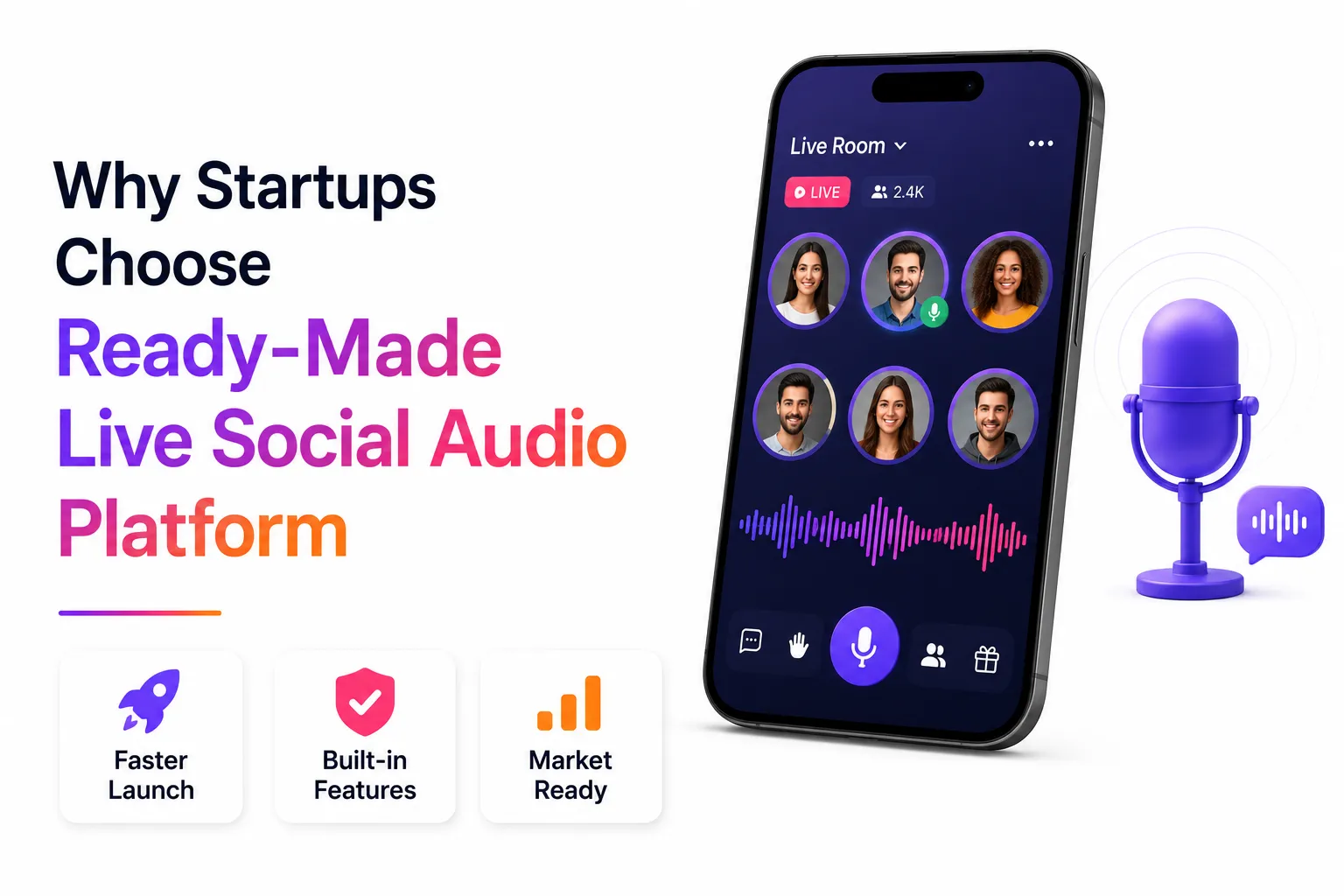
- Ready-Made Live Social Audio Platform helps startups launch with live rooms, user roles, gifting, VIP access, moderation, analytics, and admin controls already structured.
- A ready-made foundation can shorten market validation by reducing the need to build standard real-time workflows from zero.
- Built-in monetization through coins, virtual gifts, VIP access, private rooms, and platform fees gives founders an earlier revenue path.
- Admin controls should let operators manage users, rooms, creators, reports, gifts, earnings, VIP plans, and platform settings.
- Custom development remains useful when the product depends on proprietary technology, unusual workflows, or deeply specialized integrations.
Launch Signals
- Choose ready-made when validating community behavior is more urgent than building unique infrastructure.
- Real-time room joining, presence, mute controls, speaker promotion, and permissions must remain stable as usage grows.
- Moderation, reporting, room controls, and review queues should be included from launch rather than added later.
- Source-code ownership gives startups more flexibility to extend monetization, integrations, analytics, and community workflows.
- Founders should validate whether users join rooms, follow hosts, send gifts, return, and invite others before overbuilding advanced features.
Real Insights
- Social audio products are difficult because the user experience depends on multiple real-time systems working together.
- A faster launch is valuable only when the platform also provides enough operational control after users arrive.
- Ready-made development reduces avoidable execution work but should still allow branding, monetization, rules, and integrations to be customized.
- Live community trust depends on active moderation operations as well as the tools provided by the platform.
- The strongest path is: launch core rooms → onboard hosts → validate engagement → test gifting and VIP → strengthen moderation → measure retention → customize based on real user behavior.
Building a Social Audio Platform looks simple from the outside.
Users enter live rooms. Hosts speak. Listeners join. Some users raise hands, send gifts, follow creators, join private rooms, or upgrade to premium access.
But behind that simple experience is a difficult product layer.
A live audio platform needs real-time voice infrastructure, room permissions, speaker controls, moderation workflows, user profiles, wallet logic, gifting systems, VIP access, push notifications, analytics, admin controls, and scalable backend architecture. If one layer fails, the entire user experience feels broken.
That is why many startups compare two routes before building: custom development from scratch or a Ready-Made Live Social Audio Platform foundation.
Custom development gives full flexibility, but it also comes with more planning, longer execution, higher technical risk, and a larger testing burden. A ready-made platform helps founders start with working product flows, then customize branding, monetization, community rules, and launch scope around their market.
For startups trying to validate a voice-first community, the smarter decision is often not the longest build. It is the build that gets the right product into users’ hands faster, with enough control to improve after launch.
Why Social Audio Products Are Harder to Build Than They Look
A social audio app is not just a chat app with microphones.
The experience depends on real-time coordination. When someone joins a room, the participant list must update immediately. When a listener raises a hand, the host should see it. When a speaker is muted, the state must change for everyone. When a room becomes crowded, the app must keep audio quality stable while maintaining permissions, reactions, reporting, and room visibility.
For founders planning high-audience conversations, this guide on large voice room management explains how speaker queues, host controls, moderation, and real-time room state help protect conversation quality.
That creates several product challenges:
- Real-time room joining and leaving
- Host, speaker, listener, and moderator roles
- Hand-raise and speaker promotion workflows
- Live presence updates
- Audio mute, unmute, and removal controls
- Private room access
- Gift sending and wallet balance updates
- Creator earnings logic
- VIP access and premium room rules
- Abuse reporting and moderation queues
- Push notifications and room discovery
- Admin dashboard visibility
If a startup builds all of this from zero, the team must not only design the user interface. It must also build the backend logic, real-time event system, payment workflows, testing process, and operating controls.
That is where ready-made development becomes attractive.
Ready-Made vs Custom Development: The Real Startup Tradeoff
The decision is not simply “fast vs flexible.”
A better comparison is: what does the startup need to prove first?
If the founder needs to validate whether a specific community wants live voice interaction, creator rooms, gifting, private rooms, and VIP access, then building every module from scratch may delay the most important test. The startup may spend months building infrastructure before learning whether the audience even returns to the rooms.
A ready-made Social Audio Platform helps founders start with existing core flows and focus on market validation.
| Decision Area | Ready-Made Social Audio Platform | Custom Development |
|---|---|---|
| Launch speed | Faster because core modules already exist | Slower because product flows are built from zero |
| Technical risk | Lower for standard room, user, wallet, and admin workflows | Higher if the real-time system is untested |
| Flexibility | Customizable around branding, rules, monetization, and integrations | Highest flexibility if the concept is very unique |
| Cost control | Easier to scope early | Can expand as features, testing, and infrastructure grow |
| Best for | Startups validating a proven voice-first model | Startups building a highly original product architecture |
| Founder focus | Community, creators, monetization, and growth | Product discovery, engineering management, and QA |
Custom development is not wrong. It is simply heavier.
For startups, the key is to avoid paying for maximum flexibility before they know what users actually want.
Why Startups Prefer Ready-Made Social Audio Platforms
Startups usually choose ready-made platforms for one reason: they want to reduce avoidable uncertainty.
A founder launching a social voice app already has enough risks to manage. They need to attract creators, seed communities, define room categories, encourage repeat visits, manage moderation, and design monetization. Adding a long technical build increases pressure before the market test even begins.
A ready-made platform can help because the foundation already includes essential app logic.
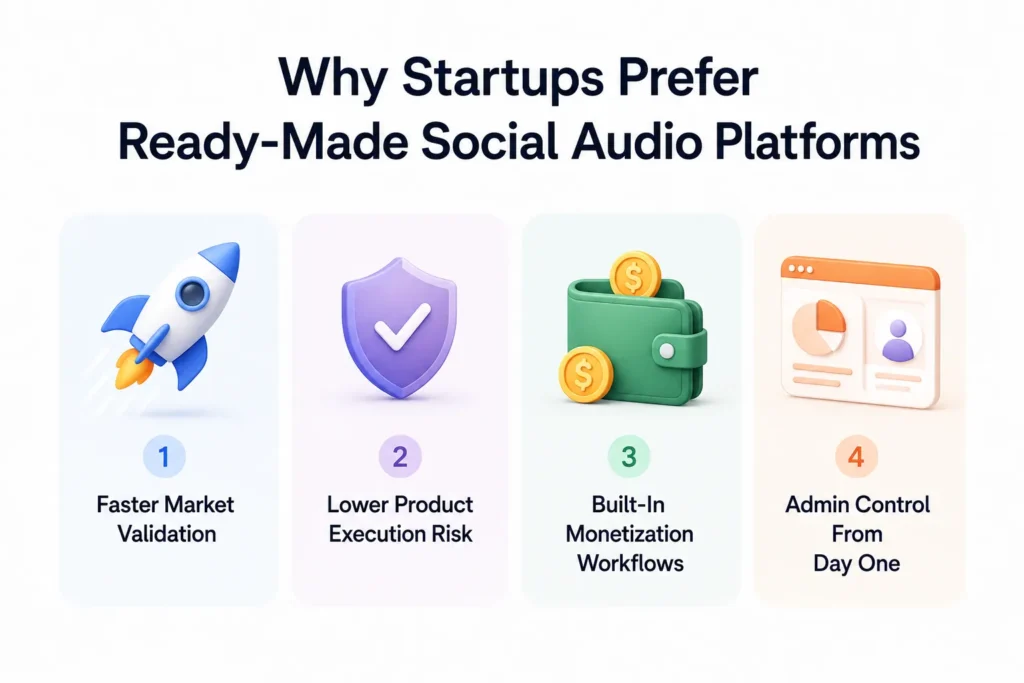
1. Faster Market Validation
Speed matters because social products depend on behavior.
A founder cannot validate a voice-first community through wireframes alone. Users need to join rooms, follow hosts, speak, listen, react, send gifts, and return. That requires a working product.
A ready-made app foundation helps startups move from idea to live testing faster, especially when the goal is to launch a branded version, onboard early users, and measure engagement before investing in deeper custom features.
2. Lower Product Execution Risk
Real-time products are sensitive.
A small delay in presence updates, room joining, mute controls, or speaker promotion can damage trust. Users may forgive a missing advanced feature, but they will not forgive an unstable live room.
Ready-made platforms reduce risk when the core workflows have already been structured around common social audio behavior.
3. Built-In Monetization Workflows
Most startups do not want only conversation. They want a business model.
A monetization-ready voice community platform may include:
- Coin packages
- Virtual gifts
- Creator earnings
- Platform fees
- VIP access
- Avatar shop or profile upgrades
- Private rooms
- Premium access rules
- Wallet history
- Withdrawal workflows
- Admin revenue controls
If these modules are added later, the product may need major rework. A ready-made platform gives founders a clearer route to monetization from the beginning.
4. Admin Control From Day One
A social audio business needs operational control.
Founders and operators need to manage users, rooms, creators, reports, payments, gifts, earnings, VIP plans, app settings, and platform rules. Without an admin dashboard, the business becomes dependent on developers for everyday changes.
A good admin panel should let the operator:
- Review users and creators
- Manage room categories
- Monitor reported content
- Control VIP plans
- Manage gifts and coin packages
- Review creator earnings
- Track revenue
- Send notifications
- Manage moderation queues
- Adjust platform settings
Admin control is not a backend extra. It is how the founder runs the business after launch.
What a Ready-Made Social Audio Platform Should Include
A startup should not choose a ready-made platform only because it launches faster.
The foundation must include the right product layers. Otherwise, the founder may save time at the beginning but face limitations after launch.
Core Modules a Social Audio Platform Should Include
| Module | Why It Matters | Founder Impact |
|---|---|---|
| Live audio rooms | Allows users to join real-time voice conversations | Creates the core community experience |
| Host, speaker, and listener roles | Controls who can speak, listen, moderate, or manage the room | Prevents room chaos as communities grow |
| Hand-raise workflow | Lets listeners request to speak without interrupting the room | Improves room quality and host control |
| Live presence system | Shows who is in the room and who is actively participating | Builds trust in real-time interaction |
| Gifting and coin wallet | Allows users to support hosts or creators through virtual gifts | Creates a direct monetization layer |
| VIP access | Offers premium benefits, paid access, or special membership features | Supports recurring revenue and loyalty |
| Moderation tools | Supports reporting, review queues, role control, and platform safety | Protects community trust and brand reputation |
| Admin dashboard | Manages users, rooms, monetization, reports, notifications, and analytics | Gives the operator business control after launch |
Founders should also understand how private and public voice rooms affect access control, moderation, VIP communities, room discovery, and community safety.
Founders can also review the live social audio platform features to understand how audio rooms, user roles, live presence, gifting, VIP access, moderation, and operator controls work together.
Where Custom Development Still Makes Sense
Ready-made development is not the answer for every startup.
Custom development may be the better route when the product depends on a unique interaction model, proprietary recommendation engine, advanced audio processing, complex enterprise workflows, unusual compliance requirements, or deep integrations with existing business systems.
Custom development may be more suitable when:
- The core product model is not similar to any existing social audio format
- The startup needs a proprietary audio engine
- The platform requires enterprise-grade custom workflows
- The product depends on a unique creator monetization structure
- The app needs advanced AI moderation across audio, image, and video
- The founder has funding, time, and technical leadership already in place
- The business cannot launch without several custom integrations
The key is clarity.
If your differentiation is community, niche, branding, creator acquisition, regional targeting, monetization rules, or go-to-market strategy, then ready-made development may be enough to launch and validate. If your differentiation is the core technology itself, then custom development may be necessary.
Founder Decision Signals: Ready-Made or Custom?
Speed
Choose ready-made if you need to test live rooms, gifting, VIP access, and user engagement quickly instead of waiting through a long custom build cycle.
Cost
Choose ready-made if your first goal is controlled spending and faster validation. Choose custom if you have a large feature roadmap that cannot fit standard social audio workflows.
Scalability
Choose a platform that can support RTC planning, user growth, moderation, payments, and source-code access so your team can extend it after launch.
Market Fit
Choose ready-made when the market risk is bigger than the engineering risk. First prove that users join, talk, gift, return, and invite others.
Before choosing the build path, founders should review the social audio platform development cost, including real-time audio infrastructure, payment rails, mobile scope, moderation, admin controls, and customization requirements.
Monetization: Why Ready-Made Platforms Give Startups a Faster Revenue Path
A social audio startup needs revenue options from the beginning.
Audience growth matters, but communities are hard to sustain without monetization. Hosts and creators need incentives. Platform operators need revenue controls. Users need simple ways to spend, support, subscribe, or access premium experiences.
A ready-made Social Audio Platform can support monetization faster because the core business logic is already part of the product foundation.
Common monetization options include:
| Revenue Model | How It Works | Why Startups Use It |
|---|---|---|
| Coin packages | Users buy coins and spend them inside the platform | Supports flexible micro-spending |
| Virtual gifts | Users send gifts to hosts or creators | Encourages creator earnings and community support |
| VIP access | Users pay for premium benefits or status | Creates recurring or membership-style revenue |
| Private rooms | Hosts create restricted or paid spaces | Useful for niche communities and creator-led groups |
| Avatar or profile upgrades | Users purchase identity and status items | Adds gamified personalization |
| Platform fees | The operator keeps a margin from transactions | Creates direct marketplace revenue |
| Sponsorships | Brands support rooms, events, or creator sessions | Works when the community has a defined audience |
For a deeper revenue breakdown, explore the social audio app business model and how coins, gifting, VIP access, platform fees, avatar shops, and licensing can work together.
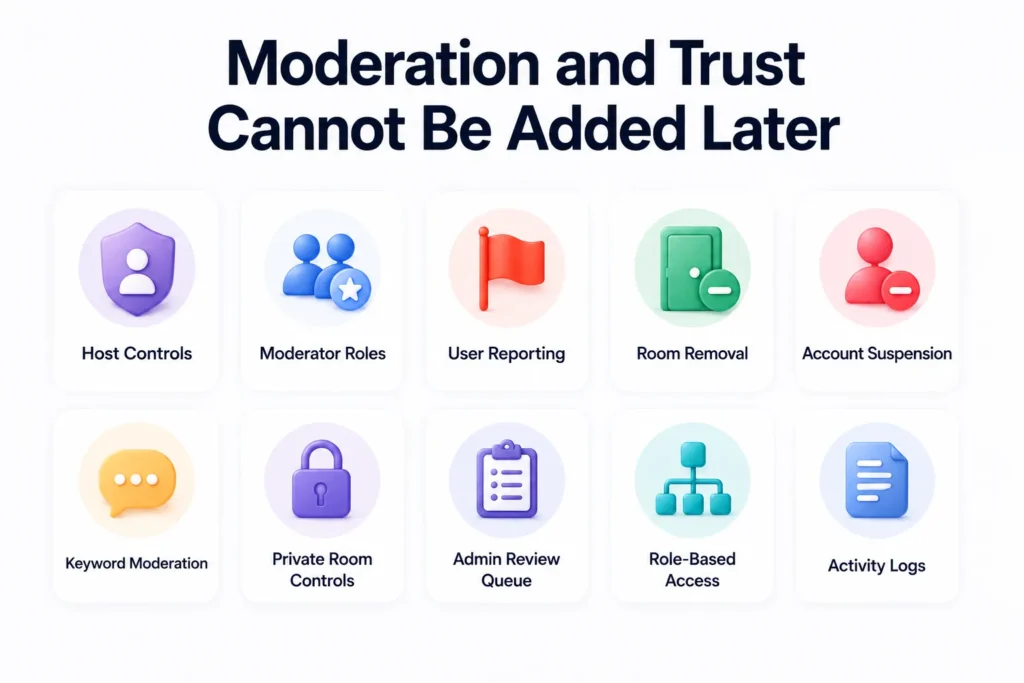
Moderation and Trust Cannot Be Added Later
Live communities need trust from the first day.
In text-based platforms, harmful content may be reviewed after posting. In live audio, the damage can happen in the moment. That is why moderation tools, user reporting, room controls, and admin queues should be part of the launch foundation.
A practical trust layer may include:
- Host controls
- Moderator roles
- User reporting
- Room removal
- Account suspension
- Keyword or text moderation
- Private room controls
- Admin review queue
- Role-based access control
- Activity logs
- Payment and withdrawal review
Founders should be careful with exaggerated safety claims. A platform can support moderation workflows, reporting tools, and admin controls, but final trust operations depend on staffing, policies, market rules, and ongoing review.
A ready-made platform is useful when it gives the operator a starting control layer. But community safety still requires active operating discipline.
Why Source-Code Ownership Matters for Startups
Some founders focus only on launch speed, but ownership matters just as much.
A hosted-only platform may help a startup go live, but it can become restrictive if the business later needs custom monetization, regional payment rails, advanced analytics, new room formats, or deeper moderation tools.
Source-code ownership gives the startup more long-term flexibility.
It allows the business to:
- Customize product workflows
- Add new monetization rules
- Integrate market-specific payments
- Improve analytics
- Extend creator features
- Modify admin permissions
- Scale infrastructure with its own team
- Avoid dependency on a locked platform provider
For early-stage founders, this matters because the first version is rarely the final version. The platform should be flexible enough to evolve after real users reveal what they want.
Common Mistakes Startups Make When Choosing the Build Route
Building From Scratch Before Validating the Community
A startup may spend months building infrastructure before proving that users want to join rooms, follow hosts, send gifts, or return daily. Validate behavior before overbuilding.
Choosing a Ready-Made Platform Without Admin Control
A fast launch is not enough if the operator cannot manage users, rooms, gifts, reports, VIP plans, notifications, and revenue settings from a dashboard.
Ignoring Real-Time Infrastructure Costs
Live audio depends on real-time communication usage. Founders should plan RTC minutes, regions, scaling, and provider costs before launch.
Treating Moderation as a Future Feature
Social audio communities can create live safety issues. Reporting, role controls, moderation queues, and operator policies should be part of the first launch plan.
How Miracuves Helps Startups Launch Faster
Miracuves helps founders build ready-made and white-label social entertainment platforms with branded design, admin dashboards, monetization workflows, source-code ownership, and faster deployment support.
Many founders explore digital entertainment solutions before deciding how to structure live rooms, creator communities, paid access, gifting, and moderation workflows.
For founders planning a voice-first community, the value is not just speed. The value is starting with the core product flows already structured: audio rooms, user roles, live presence, gifting, VIP access, creator earnings, moderation, analytics, and admin controls.
Instead of spending the first stage of the business rebuilding common platform logic, startups can focus on:
- Choosing the right niche
- Recruiting hosts and creators
- Defining room categories
- Building community habits
- Testing pricing and gifting
- Improving onboarding
- Measuring retention
- Expanding monetization after launch
If you want a launch-ready foundation for live rooms, gifting, VIP access, and creator engagement, explore this ready-made live audio and social entertainment platformfrom Miracuves.
You can also work with a social audio platform development partner if you need help planning product scope, monetization workflows, room logic, admin controls, and launch execution.
For broader social products, Miracuves’ social media app development services can support communities, feeds, messaging, live interaction, creator tools, and scalable social workflows.
Related reading: Voice Room Architecture in a Live Social Audio Platform and Why Startups Choose a Ready-Made Multi-Asset Investment Platform Over Custom Development.
Final Thoughts: Startups Need Launch Speed and Long-Term Control
A Social Audio Platform succeeds when users return to conversations, hosts build communities, creators earn, and the operator can manage growth without losing control.
Custom development can be valuable when the product idea is deeply unique. But for many startups, the bigger risk is not lack of custom code. The bigger risk is spending too long before testing whether the market cares.
A ready-made platform gives founders a faster path to launch, validate, monetize, and learn. The right foundation should include real-time audio rooms, user roles, gifting, VIP access, moderation, admin controls, analytics, and source-code ownership.
For startups, the goal is not to copy another app. The goal is to use a proven product structure, customize it for a specific audience, and build a community that can grow beyond the first launch.
Miracuves helps founders move faster with ready-made, white-label, source-code-owned app foundations designed for social interaction, monetization, admin control, and scalable product growth.
FAQs
What is a Social Audio Platform?
A Social Audio Platform is a voice-first community app where users join live rooms, listen to speakers, participate in conversations, follow hosts, send gifts, access premium rooms, and interact through real-time audio experiences.
Why do startups choose ready-made social audio platforms?
Startups choose ready-made social audio platforms because they reduce development time, lower execution risk, include common product workflows, support faster validation, and give founders more time to focus on community growth and monetization
Is custom development better than a ready-made social audio app?
Custom development is better when the product requires unique architecture, proprietary audio technology, complex integrations, or highly specialized workflows. A ready-made platform is usually better when the founder wants faster launch, proven core flows, admin control, and quicker market validation.
What features should a social audio app include?
A social audio app should include live audio rooms, host and speaker roles, listener controls, hand-raise workflows, user profiles, room discovery, gifting, coin wallets, VIP access, moderation tools, notifications, analytics, and an admin dashboard.
How can a social audio platform make money?
A social audio platform can make money through coin packages, virtual gifts, creator earnings margins, VIP subscriptions, private rooms, avatar upgrades, paid communities, sponsorships, and platform fees.
Why is moderation important in live audio apps?
Moderation is important because live conversations happen in real time. Reporting tools, moderator roles, room controls, account restrictions, and admin review queues help protect user trust and platform reputation.
What should startups check before choosing a ready-made platform?
Startups should check source-code ownership, real-time audio stability, admin dashboard depth, monetization modules, payment integration, moderation tools, mobile app quality, scalability options, support terms, and customization flexibility.
Can Miracuves help launch a social audio platform?
Yes. Miracuves helps founders launch social audio and live entertainment platforms with white-label branding, source-code ownership, live room workflows, gifting, VIP access, admin dashboards, and faster deployment support.
Miracuves is an independent software development company. We are not affiliated with, connected to, sponsored by, or endorsed by any company or product named in this article.
Terms such as “X Clone” are used descriptively. It is how the software industry refers to building a platform with functionality comparable to a known service, and how clients search for it.
The entire design and codebase of our products is built by our own team. Our products contain no code, design, graphics, or content originating from any third-party website or applications.
All third-party names and marks referenced in this article are the property of their respective owners, referenced solely to identify the services discussed.