
Key Takeaways
- Live Streaming Platform Economy should separate viewer spending, creator earnings, gift value, loyalty rewards, and platform-controlled adjustments.
- Viewer coins and creator rewards should use separate balances because purchased and earned value follow different rules.
- Every purchase, gift, reward, commission, refund, withdrawal, and adjustment should be recorded in an auditable wallet ledger.
- Revenue splits should support configurable creator, platform, agency, campaign, and regional rules.
- Admin controls should provide clear visibility into coin bundles, gifts, commissions, payouts, refunds, fraud signals, and transaction history.
Economy Signals
- Coins or credits can handle viewer spending while creator rewards represent potentially withdrawable earnings.
- Gift value can control pricing, rankings, creator rewards, PK battles, and platform commission without becoming a separate user balance.
- Bonus and promotional coins should remain distinguishable from purchased currency to prevent inaccurate payout calculations.
- High-volume gifting requires idempotent transactions, real-time deductions, event handling, and audit logs to prevent double-spending.
- Agency-led platforms need additional tracking for host assignments, commission structures, sub-agencies, performance, and payout visibility.
Real Insights
- A streaming wallet should operate as an accountable ledger rather than a single editable balance.
- Virtual gifts are not only animations; they connect viewer spending, creator rewards, rankings, commissions, and platform revenue.
- Refund and chargeback rules should be planned before launch because reversed purchases can affect gifts and creator earnings.
- Hard-coded commission rules can become restrictive as the platform adds agencies, creator tiers, countries, campaigns, and new gift categories.
- The strongest flow is: purchase coins → credit viewer wallet → send gift → deduct coins → calculate creator reward → record platform and agency shares → verify payout eligibility → review withdrawal → process payout.
A Live Streaming Entertainment Platform does not become profitable just because it has video rooms, chat, and a gift button.
The real monetization engine sits underneath the interface.
Viewers buy platform currency. They spend that currency on virtual gifts, paid rooms, VIP access, games, or creator interactions. Creators receive reward value. Agencies may receive a share. The platform keeps a configurable commission. Admins must be able to audit every transaction, refund edge case, payout request, and suspicious spending pattern.
That is why a multi-currency economy should not be treated as a small feature. It is one of the most important business systems inside a Live Streaming Platform Economy.
For startups, the challenge is not only deciding whether to use coins, diamonds, beans, points, credits, or rewards. The bigger decision is how each currency behaves, who can earn it, who can spend it, whether it can be withdrawn, and how the platform reconciles the flow when thousands of users are gifting in real time.
This guide explains how founders can structure a multi-currency economy for a live entertainment product without creating confusion for viewers, creators, agencies, or operators.
Why Live Streaming Platforms Need More Than One Currency
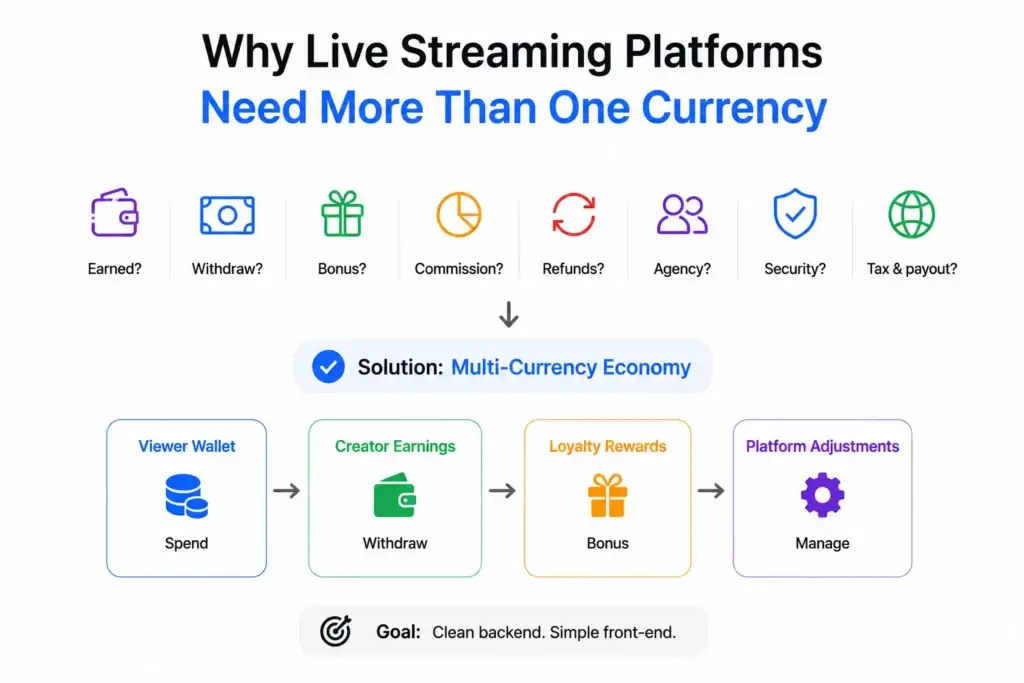
A simple one-wallet system may look attractive in the beginning. A user buys coins, sends gifts, and the creator receives money.
But once the platform grows, one balance becomes difficult to manage.
The platform needs to answer questions like:
- Was this balance purchased, earned, rewarded, gifted, refunded, or adjusted manually?
- Can this balance be withdrawn as real money?
- Should bonus credits be treated the same as purchased coins?
- Should a creator receive the full gift value or only the reward value after platform commission?
- What happens if the viewer requests a refund after sending gifts?
- How does the platform calculate agency commission?
- How should suspicious transactions be reviewed?
- How are country-specific tax, payout, and payment gateway rules handled?
A multi-currency economy solves this by separating user spending, creator earnings, loyalty rewards, and platform-controlled adjustments.
The goal is not to make the user experience complicated. The goal is to keep the backend clean while the front-end feels simple.
The Four Currency Layers a Startup Should Consider
A live streaming product does not always need four public-facing currencies, but it should have clear internal separation between different money states.
Here is a practical structure founders can use.
Recommended Multi-Currency Structure for Live Streaming Apps
| Currency Layer | Who Uses It? | Purpose | Withdrawable? |
|---|---|---|---|
| Coins / Credits | Viewers | Purchased with real money and spent on gifts, premium access, games, boosts, or paid interactions. | No |
| Gift Value | System | Defines how much each virtual gift costs and how much value it contributes to rankings, PK battles, or creator rewards. | No |
| Creator Rewards | Hosts / Streamers | Represents earnings received after gifts, commissions, campaign bonuses, or performance rewards. | Usually yes, subject to platform rules |
| Points / XP | Viewers and creators | Used for loyalty, levels, missions, badges, leaderboards, and engagement incentives. | No |
This model lets the platform separate spending behavior, creator earnings, gamification, and accounting logic.
For example, a viewer may buy 1,000 coins. They send a 200-coin animated gift. The creator receives a reward value based on the platform’s configured split. The viewer may also receive XP for gifting activity, while the gift value may count toward a room leaderboard or PK battle score.
To the viewer, this feels like one quick gift action. To the backend, it creates several controlled events.
Currency Flow: From Viewer Purchase to Creator Payout
A healthy streaming economy needs a clear transaction path.
The common flow looks like this:
- Viewer purchases a coin bundle using real money.
- Payment gateway or app store confirms the payment.
- Platform credits coins to the viewer wallet.
- Viewer sends a gift during a live stream.
- Coins are deducted from the viewer wallet.
- Gift animation appears in the live room.
- Creator receives reward value.
- Platform commission is recorded.
- Agency or family share is calculated if applicable.
- Creator requests withdrawal after reaching payout eligibility.
- Admin reviews, approves, or rejects the payout request.
- Final payout is processed through the selected payout rail.
This flow should be designed before development begins. If the platform adds payout rules later, it may become difficult to reconcile old gift activity with new creator balances.
For founders planning a gift-led entertainment app, Miracuves’ launch-ready live streaming entertainment solution can be used as the commercial reference point, while this article focuses only on the currency architecture behind the business model.
Why Viewer Coins and Creator Earnings Should Be Separate
One of the biggest mistakes startups make is using the same balance for viewer purchases and creator earnings.
That creates confusion because purchased currency and earned value behave differently.
Viewer coins are usually:
- Bought using real money
- Spent inside the platform
- Not withdrawable
- Subject to refunds, failed payments, chargebacks, and bonus offers
- Controlled by payment gateway rules and platform policies
Creator earnings are usually:
- Earned through gifts, paid access, campaigns, or commissions
- Withdrawable after eligibility checks
- Subject to platform commission
- Subject to agency or partner splits
- Reviewed for fraud, abuse, and policy violations
- Connected to payout workflows
Keeping these balances separate protects the business.
If a user buys promotional bonus coins, those coins should not automatically become withdrawable earnings at full value. If a payment is reversed, the platform needs to know which gift transactions were funded by that purchase. If a creator violates policy, the platform may need to hold or review earnings before payout.
A separated model gives the operator more control.
How Gift Value Should Be Designed
Virtual gifts are emotional products. A small heart, a premium sports car, a festival gift, or a leaderboard gift all carry different psychological value.
But every gift also has backend value.
A gift catalog should define:
- Gift name
- Gift category
- Coin price
- Animation type
- Sound effect if applicable
- Availability by country or campaign
- Visibility in live rooms
- Reward value to creator
- Platform commission
- Agency or family split
- Leaderboard weight
- Refund eligibility
- Event or seasonal status
Not every expensive gift should behave the same way. Some gifts may be designed for emotional support. Some may push a creator higher in rankings. Some may be used in PK battles. Some may unlock room effects or badges.
The founder’s job is to decide how gifts support engagement, creator earnings, and platform revenue at the same time.
Building a Double-Entry Ledger for Streaming Wallets
A live streaming wallet should not be a simple balance field.
It should behave like an auditable ledger.
Every wallet event should create a record. That includes:
- Coin purchase
- Payment confirmation
- Bonus coin credit
- Gift spend
- Creator reward credit
- Platform commission
- Agency commission
- Refund
- Chargeback
- Withdrawal request
- Withdrawal approval
- Withdrawal rejection
- Manual admin adjustment
- Promotional campaign credit
- Penalty or earnings hold
A ledger-based approach helps the platform answer what happened, when it happened, who triggered it, and which wallet balance changed.
This matters when creators ask why their earnings changed. It matters when users dispute a gift purchase. It matters when the admin team investigates fraud. It also matters when the business prepares financial reports.
A strong ledger turns monetization from guesswork into an accountable operating system.
Founder Decision Signals for Multi-Currency Economy Design
Speed
If you want to launch faster, do not delay currency design until after the app interface is complete. Gifting, rewards, and payouts affect the database, admin panel, payment integrations, and creator experience.
Trust
If creators cannot understand their earnings, they may leave. Wallet history, gift records, payout status, and transparent reward rules help build creator confidence.
Scalability
If thousands of gifts are sent during live rooms, the economy must handle real-time deductions, idempotent transactions, event queues, and audit logs without double-spending.
Monetization
If the platform depends on gifts, VIP access, paid rooms, games, or agency-led host recruitment, each revenue stream needs configurable commission and reporting logic.
How Revenue Splits Should Work in a Live Entertainment App
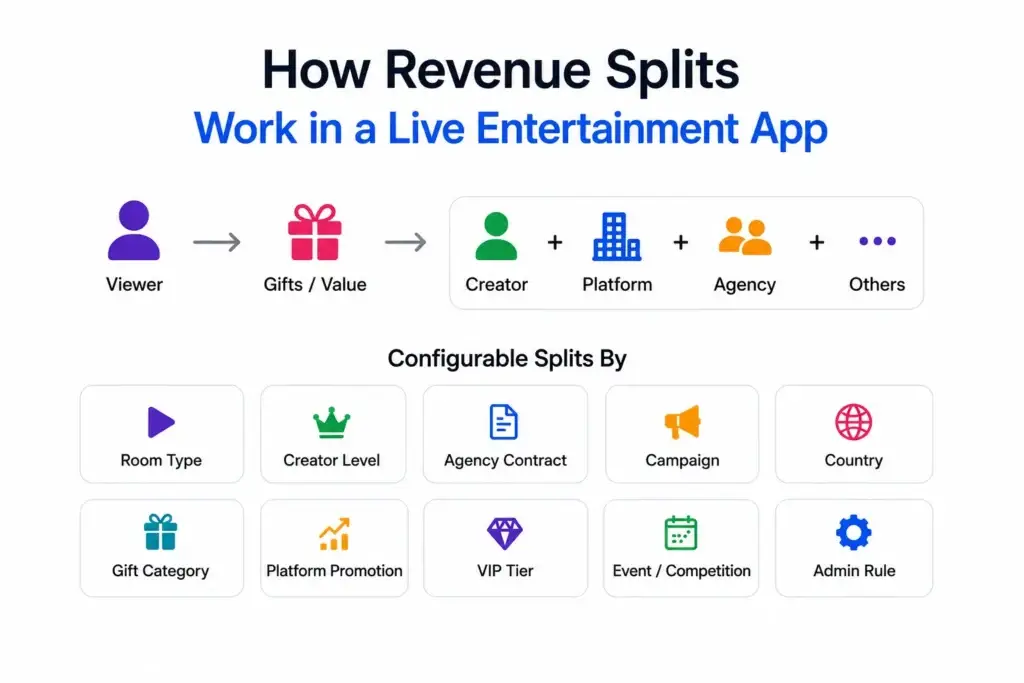
A Live Streaming Entertainment Platform usually has more than two participants in the economy.
The value may move between:
- Viewer
- Creator or host
- Platform operator
- Talent agency
- Sub-agency
- Family or creator group
- Campaign sponsor
- Payment provider
- App store or payment gateway
This is why a fixed “creator gets X percent” model can become too limited.
A better structure allows configurable splits by:
- Room type
- Creator level
- Agency contract
- Campaign
- Country
- Gift category
- Platform promotion
- VIP user tier
- Event or competition
- Manual admin rule
For example, a premium creator under an agency contract may have a different payout rule than a new independent host. A seasonal gift may have a different platform commission than a standard gift. A PK battle may distribute reward value differently from a normal solo stream.
Startups should not overcomplicate the model on day one, but the backend should be flexible enough to support these rules later.
Admin Controls Every Streaming Economy Needs
The admin dashboard is where the business model becomes controllable.
A founder should be able to manage:
- Coin bundle pricing
- Bonus coin campaigns
- Gift catalog
- Gift value
- Gift animation status
- Creator reward percentage
- Platform commission
- Agency commission
- Payout thresholds
- Withdrawal rules
- Spending limits
- Country-level availability
- Refund policies
- Chargeback review
- Fraud monitoring
- Creator eligibility
- Suspicious transaction flags
- Manual adjustments
- Revenue reports
- Wallet history
- Audit logs
Miracuves already covers a wider live streaming feature breakdown for founders who want to understand how gifting, rooms, agencies, moderation, and admin controls connect inside a commercial platform.
These controls also affect the final build scope. Founders who want to understand how wallet logic, payment processing, streaming infrastructure, host acquisition, and moderation staffing influence budget can review Miracuves’ live streaming development cost factors.
Multi-Currency Economy and Talent Agencies
Many live entertainment platforms grow through talent agencies, creator managers, or host recruitment networks.
In that model, the platform is not only paying creators. It may also need to track agency performance.
The system should support:
- Agency onboarding
- Host assignment
- Agency commission
- Sub-agency structures
- Host transfer rules
- Agency-level reports
- Creator performance dashboards
- Contract-based revenue shares
- Withdrawal visibility
- Dispute handling
This is especially important for regional entertainment markets where creators may join through recruiters rather than directly through the app.
If the agency layer is not built properly, operators may end up managing commissions through spreadsheets. That becomes risky once gifts, rooms, rankings, and creator payouts start scaling.
Refunds, Chargebacks, and Bonus Coins
Refund logic is one of the least glamorous but most important parts of streaming economy design.
A viewer may buy coins and later request a refund. A payment gateway may reverse a transaction. A user may claim unauthorized spending. A creator may receive gifts funded by refunded coins. A fraud team may detect suspicious gifting behavior between related accounts.
The platform needs rules for:
- Refunding unused coins
- Handling coins already spent on gifts
- Reversing creator rewards where appropriate
- Freezing suspicious earnings
- Marking bonus coins separately from purchased coins
- Preventing bonus abuse
- Handling failed payment callbacks
- Managing app store refund events
- Recording every reversal in the ledger
Bonus coins also need special treatment.
If a user buys 1,000 coins and receives 100 bonus coins, those bonus coins should be tracked separately. Otherwise, promotional credits may accidentally become withdrawable creator earnings at full commercial value.
Security and Fraud Controls for Virtual Economies
A gift economy creates real money movement, so it also attracts abuse.
Founders should prepare for:
- Self-gifting loops
- Fake creator accounts
- Stolen payment methods
- Chargeback abuse
- Bot-driven gift inflation
- Agency commission manipulation
- Withdrawal fraud
- Account takeover
- Regional pricing abuse
- Manual admin misuse
Important security layers include:
- Role-based admin access
- Transaction monitoring
- Spending limits
- Withdrawal review
- Creator verification
- Payment gateway verification
- Audit logs
- Suspicious activity flags
- Device and account risk signals
- Secure API integration
- Encrypted data transfer
- Admin approval controls
A streaming economy should be designed with trust from the beginning. Once creators believe the platform cannot protect earnings or payouts, retention becomes harder.
How Multi-Currency Design Supports Better Monetization
A structured currency economy gives the founder more than one revenue stream.
It can support:
- Coin bundle purchases
- Virtual gifts
- Premium gift categories
- Paid private rooms
- VIP subscriptions
- Game participation
- PK battle spending
- Room boosts
- Creator campaigns
- Agency-led growth
- Withdrawal fees where appropriate
- Sponsored gift campaigns
- Limited-time event gifts
For platforms that plan to combine virtual gifts with VIP plans, creator subscriptions, account tiers, or usage-based billing, Miracuves’ SaaS-style subscription can help founders think beyond one-time coin purchases.
Each monetization stream should connect back to the same wallet and ledger foundation.
That is the difference between adding features randomly and building a monetization-ready product.
For a deeper business-side explanation, founders can review Miracuves’ live streaming revenue model guide, which explains how coin sales, gifting, commission, VIP access, agency shares, and withdrawals can work together.
Common Mistakes Startups Should Avoid
Using One Balance for Everything
Purchased coins, bonus credits, creator rewards, loyalty points, and withdrawable earnings should not be treated as the same thing. Each balance has different business and accounting rules.
Making Gifts Only Visual
A gift is not just an animation. It is a transaction, engagement signal, ranking input, creator reward, and platform revenue event.
Ignoring Refund and Chargeback Scenarios
If refund logic is not planned early, the platform may struggle to reverse gift-funded earnings or identify suspicious spending patterns.
Leaving Commission Rules Hard-Coded
Platform share, creator reward, agency commission, campaign rules, and regional pricing should be configurable from admin controls where possible.
Ready-Made vs Custom Economy Architecture
Startups usually have two routes.
If your startup needs implementation support, choosing the right live streaming development partner matters because the provider should understand creator rewards, revenue splits, wallet records, agency logic, and payout transparency—not just video rooms and gift animations.
They can build the live streaming economy from zero, or they can start with a ready-made foundation and customize the business rules.
| Build Route | Best For | Strength | Risk |
|---|---|---|---|
| Fully custom build | Large teams with unique economy rules and long development runway | Maximum control over every workflow | Higher time, cost, QA, and architecture risk |
| Ready-made foundation | Founders who want faster validation with proven room, gifting, wallet, and admin flows | Faster launch and lower starting complexity | Still needs careful configuration and pre-launch hardening |
| Hybrid approach | Startups with a known model but market-specific customization needs | Balanced speed and flexibility | Requires clear scope control |
Miracuves helps founders build ready-made and white-label entertainment platforms with source-code ownership, branded design, admin dashboards, and monetization-ready workflows. For broader products across streaming, video, creator monetization, and entertainment commerce, you can explore Miracuves’ digital entertainment app solutions.
If your team wants a broader service discussion beyond one product category, Miracuves’ white-label clone app development services can help map the right route between ready-made deployment and custom development.
Final Thoughts: A Streaming Economy Should Be Simple for Users and Precise for Operators
A Live Streaming Entertainment Platform succeeds when the economy feels effortless to users and transparent to creators.
Viewers should be able to buy coins, send gifts, join paid rooms, and support creators without confusion. Creators should be able to understand what they earned and when they can withdraw. Agencies should know how their share is calculated. Admins should be able to audit every purchase, gift, reward, refund, adjustment, and payout.
That requires a clear multi-currency structure.
For startups, the strongest decision is to design the economy before scaling the audience. A beautiful live room may attract users, but a trusted wallet and payout system is what keeps creators and operators aligned for the long term.
FAQs
What is a multi-currency economy in a Live Streaming Entertainment Platform?
A multi-currency economy is a structured system where different balances are used for different purposes. Viewers may buy coins, creators may earn rewards, the platform may track gift value, and users may collect points or XP for engagement. This separation helps with monetization, payouts, refunds, and reporting.
Why should viewer coins and creator earnings be separate?
Viewer coins and creator earnings behave differently. Coins are usually purchased and spent inside the platform, while creator earnings may become withdrawable after platform rules, commission, and verification checks. Keeping them separate helps prevent confusion during refunds, chargebacks, and payout reviews.
How do virtual gifts work in live streaming apps?
Viewers buy platform currency, spend it on virtual gifts during live streams, and creators receive reward value based on the platform’s configured rules. The platform may also keep a commission, count the gift toward rankings, and record the transaction in the wallet ledger.
What wallet features are important for a live streaming startup?
Important wallet features include coin bundles, gift spending, creator reward balances, payout requests, refund handling, bonus credits, commission settings, transaction history, fraud monitoring, admin adjustments, and audit logs.
Can a live streaming platform use gifts and subscriptions together?
Yes. Many entertainment platforms combine virtual gifts with VIP subscriptions, paid private rooms, premium access, games, creator campaigns, and platform commissions. The right model depends on the audience, creator supply, and regional payment behavior.
What should admins control in a streaming economy?
Admins should control coin bundle pricing, gift catalog values, creator reward percentages, platform commission, agency shares, payout thresholds, refund policies, fraud flags, spending limits, country availability, and transaction reports.
Why is a ledger important for live streaming monetization?
A ledger records every wallet movement, including purchases, gifts, rewards, refunds, withdrawals, bonuses, and manual adjustments. This helps the platform audit activity, resolve disputes, detect fraud, and maintain creator trust.
Can Miracuves help build a monetization-ready live streaming platform?
Yes. Miracuves helps founders launch ready-made and white-label live entertainment platforms with branded design, source-code ownership, admin dashboards, gifting workflows, wallet logic, creator rewards, and faster deployment support.
Miracuves is an independent software development company. We are not affiliated with, connected to, sponsored by, or endorsed by any company or product named in this article.
Terms such as “X Clone” are used descriptively. It is how the software industry refers to building a platform with functionality comparable to a known service, and how clients search for it.
The entire design and codebase of our products is built by our own team. Our products contain no code, design, graphics, or content originating from any third-party website or applications.
All third-party names and marks referenced in this article are the property of their respective owners, referenced solely to identify the services discussed.