
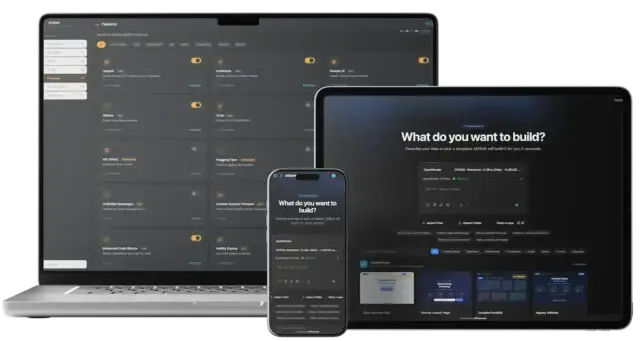
Bigo Live Clone Development Cost: $4,299, Fixed
The white-label live-streaming platform is $4,299 as a one-time purchase, deployed in six working days. That covers the full monorepo, the NestJS backend, the 44-route web app, the 15-route admin panel and the Expo mobile build. It does not cover the pre-production list the documentation names, and that list is on this page rather than in a footnote.
Get a Fixed Quote →See FeaturesWhat a Bigo-Style Platform Costs Each Way
Four routes to a live-streaming platform, and what each one actually costs you in money, time and ownership.
| Route | Typical cost | What you end up owning |
|---|---|---|
| Freelance team | $12,000 - $50,000 | One room format and a gift button. The currency model and the agency layer are what run out of budget first. |
| Miracuves ready-made | $4,299 fixed | The whole platform, full monorepo included, deployed in six working days on infrastructure you control. |
| Custom agency build | $80,000 - $300,000 | A bespoke platform, and a timeline measured in quarters before the first host goes live. |
| Enterprise programme | Six figures and up | A senior team over eighteen to thirty months, which is the honest figure for building this economy from nothing. |
The ranges above are market observations for comparable scope, not quotes from us. Our number is the one in the highlighted row and it does not move after scoping.
What the Price Includes
You receive a complete, deployable platform: the application source, the schema behind it, and the documentation a technical buyer will ask for.
Everything transfers with full ownership: no runtime licence, no per-seat fee and no dependency on our roadmap.
What Moves the Number
The base price is fixed. These are the things that genuinely sit outside it, and they are the reason this page is longer than most.
Pre-production hardening
The documentation names ten immediate items: demo credentials, a global guard, RBAC alignment, admin cookies, secret rotation, HTTPS, upload limits and password hashing. For a platform holding member balances and paying hosts, this is the first thing to schedule rather than the last.
A test suite
There are zero test files in the build today. A unit, integration and end-to-end suite is scoped work with a testing roadmap in the documentation to follow, and it is the item most worth budgeting for before you take real traffic.
Mobile parity
The Expo app covers core viewer and host flows and is graded a stub. Bringing it to parity with the 44-route web app is the most commonly requested addition, and if mobile is your primary surface it is not optional.
Observability
No structured logging, APM, metrics or alerting exists today. On a live medium where an incident happens while the room is open, adding this is what makes incident response possible rather than guesswork.
Prisma migrations
The schema is applied with db push, which is unsafe once production data exists. Converting to a migration history is early, cheap and important, and it costs far less before your first real user than after.
Multi-instance scale
The Socket.IO Redis adapter needed for multi-instance deployment is not installed. Adding it alongside connection pooling and clustering is what takes the platform past a single server, and streaming concurrency reaches that ceiling quickly.
Each of these is scoped and quoted before work starts. They are named here because a $4,299 platform with an unpriced hardening list is not actually a $4,299 platform.
The Six-Day Path to Live
What happens in the six working days, in the order it happens.
Scope, supply and the split
We confirm your market, where your first hosts come from, whether you are working with agencies, and how the platform, agency and host split should sit. A streaming platform with no hosts is an empty room, and supply is the thing to solve before the software.
Branding across three surfaces
Name, logo, colour scheme and splash across the web application, the admin panel and the Expo build, plus the gift catalog artwork and the thirteen legal and policy pages that a streaming platform needs from day one.
Deploy and wire your accounts
The monorepo and its PostgreSQL 16 database go onto your infrastructure. Agora, Stripe, Twilio, Firebase Cloud Messaging, SMTP and MinIO are connected with credentials you hold, because every one of those is an account you should own rather than one we hold for you.
Economy, splits and catalogs
The four currencies configured, the platform, agency and host split set with per-room-type and per-region overrides, the gift catalog priced, VIP tiers defined, withdrawal fee and approval thresholds set, and the game catalog enabled to the extent you are launching with it.
Operator walkthrough and handover
Staff accounts with the right roles, then we run a host application through approval, send a gift and follow the split, and approve a withdrawal, so the money path is understood before it carries anyone's earnings. The monorepo lands in your repository.
Hardening window
Sixty days of launch guidance, six months of priority bug fixes and twelve months of updates. For this platform specifically we recommend scheduling the hardening, migration and observability work inside that window rather than treating it as optional.
Six working days is the deployment window, not a production-readiness certificate. The pre-production list above runs alongside it on its own schedule.
Regional Development Rates
We do not publish a dollar figure for a from-scratch build, because the honest measure is time: an eighteen to thirty month programme with a senior team. Here are the rates that let you size that yourself.
| Region | Senior engineer, blended hourly | What an 18-30 month programme implies |
|---|---|---|
| North America | $120 - $220 | The high end of any build-versus-buy comparison, and the reason most operators in this bracket buy |
| Western Europe | $90 - $170 | Comparable to North America once employer costs and notice periods are included |
| Gulf and Middle East | $60 - $130 | Often the market being sold into, which makes local hiring attractive and the timeline no shorter |
| Eastern Europe | $45 - $95 | The common outsourcing choice, where the risk shifts from cost to specification quality |
| Latin America | $40 - $85 | Time-zone overlap with North America is the usual reason, not the rate |
| South and Southeast Asia | $25 - $60 | The lowest rate, and the one where real-time streaming and virtual-economy experience varies most between teams |
Why we give you the rate instead of the total
A from-scratch total depends on your team size, your region, and how much of the currency and split work you model correctly at the start rather than rebuild after the first payout dispute. Publishing one number would mean inventing four assumptions and presenting them back to you as a finding. The rate and the duration let you build the estimate from your own inputs.
Rates are indicative blended figures for real-time platform engineering, not quotes. They exist so you can do the arithmetic rather than take ours on trust.
Why the Price Is Fixed, Not "Starting At"
What a fixed number commits us to
The scope is the demo. What you see across the three surfaces is what ships. There is no discovery phase that discovers the price was optimistic, because the platform already exists and is already running.
No cut of your gifts. We take nothing from coin sales, gift commission, agency share, withdrawal fees, VIP subscriptions or game participation. Every one of those levers is yours to set and yours to keep.
No per-seat fee. Your thousandth host costs you nothing extra from us, which matters in a category where supply growth is the whole strategy.
The gaps are priced before purchase, not after. The pre-production list is published on the hub and repeated on this page. Each item is scoped and quoted before work starts, so the total cost of getting to production is a number you can see rather than one you discover.
This is the honest position: the platform is a genuine head start on a large build, and it is not production-hardened on day six. Both of those are true and both are stated.
Hidden Costs Most Quotes Leave Out
None of these are ours to charge. They are yours to budget, and on a streaming platform several of them are large.
Agora streaming minutes
Real-time video is billed per minute per participant. On a platform designed to keep rooms open this is the single largest recurring cost, and it scales with success rather than with revenue.
Payment processing
Coin purchases carry gateway fees, and app-store purchases carry considerably more. Model both before you price your coin packages.
Host acquisition
The hardest cost in this category. Agencies expect a share, and a platform without hosts has nothing to watch. Budget for supply before you budget for marketing.
Live moderation staffing
Reports, strikes and appeals are built. Somebody has to work them while rooms are open, and in a live medium that is a staffed rota rather than a queue somebody checks daily.
Media storage and delivery
Short videos up to 200MB each, plus the square feed, accumulate quickly. Storage and egress on MinIO or your chosen provider is a growing line from launch.
The hardening list itself
Uniquely on this platform, the pre-production work is a real budget line rather than a footnote. Price it in at the start and the six-day deployment is a genuine head start.
Streaming minutes and host acquisition are the two that decide unit economics. Both scale with exactly the growth you are working for.
Who you hire decides what the number means
The six-step process, the pre-production list in full, the questions worth asking any provider and the red flags worth walking away from - on the Development Company page.
Frequently Asked Questions
Is $4,299 really the whole price?
What does the hardening work actually cost?
Do you take a percentage of gifts or coin sales?
Can I launch on this without the hardening work?
What are the ongoing costs I cannot avoid?
Why is there no from-scratch dollar figure here?
One fixed price, and an honest list beside it
Bring your market and your host supply plan. We will tell you what ships on day six, what the hardening costs, and in what order to do it, before you commit to anything.
Explore the Bigo Live Clone
Five pages on this product. You are on Development Cost.
Development Cost
The fixed price and what drives it.
$4,299 fixed. Six days. Full monorepo.
Fifteen room formats, seventy-four models, the four-currency economy, the agency and family layers and the operator panel, deployed on your infrastructure with the pre-production list priced up front rather than discovered later.
Talk to Us →Miracuves is an independent software development company. We are not affiliated with, connected to, sponsored by, or endorsed by Bigo Live.
“Bigo Live Clone” is used descriptively. It is how the software industry refers to building a platform with functionality similar to Bigo Live, and how clients search for it.
The entire design and codebase is built by our own team. The product contains no code, design, graphics, or content originating from the Bigo Live website or applications.
Bigo Live and all other third-party names and marks are the property of their respective owners, referenced here solely to describe the category of software offered.