





















Key Takeaways
- Yacht Marketplace Lead Qualification should combine buyer details, vessel preferences, budget, timeline, engagement behavior, and service needs before broker follow-up.
- Serious buyer intent can appear through repeated vessel views, saved listings, comparison activity, viewing requests, finance interest, and survey questions.
- Lead scoring helps brokers prioritize buyers based on readiness, fit, and high-intent actions without ignoring early-stage prospects.
- Qualified leads should be routed to the right broker based on listing ownership, region, vessel type, specialization, language, or availability.
- CRM stages, response-time tracking, role-based access, and admin reporting help keep valuable buyer opportunities organized and measurable.
Qualification Signals
- Budget range and buying timeline help brokers understand whether the inquiry matches the vessel and how quickly follow-up should happen.
- Repeated views, saved yachts, specification downloads, video engagement, and compare-list activity can reveal intent before a buyer submits a form.
- Viewing requests, survey questions, financing needs, and matching vessel preferences are strong indicators of purchase readiness.
- Incomplete leads can be moved through clarification or nurture workflows before valuable broker time is used.
- Buyer types such as ready buyers, research buyers, upgrade buyers, service buyers, and future buyers should receive different follow-up paths.
Real Insights
- A long inquiry form is not automatically better; the platform should collect the most useful qualification details first and gather missing information later.
- Lead scoring should guide broker priority rather than replace human judgment because yacht purchases remain relationship-driven decisions.
- Buyer behavior should appear inside the broker lead record so follow-up reflects the full search and engagement journey, not only the final message.
- Shared inboxes weaken ownership and accountability, while structured routing makes broker assignment, response time, and lead outcomes easier to track.
- The strongest flow is: capture buyer behavior → collect inquiry details → score readiness and fit → classify lead type → route to the right broker → add CRM context → track response → nurture or progress the buyer through the sales pipeline.
A Yacht Marketplace Platform should not treat every inquiry as equal.
Some visitors are serious buyers comparing vessels before scheduling a viewing. Some are early-stage researchers. Some are service prospects looking for finance, survey, valuation, or transport support. Others may be casual browsers with no purchase timeline. If all inquiries go directly to brokers without context, the team spends too much time chasing weak leads and too little time advising real buyers.
That is why lead qualification matters.
For Yacht Marketplace Lead Qualification founders, the goal is not only to collect buyer names and phone numbers. The real goal is to understand intent before broker follow-up begins. A strong lead workflow captures what the buyer wants, how soon they may act, whether their budget fits, which vessels they viewed, what services they need, and which broker should own the next step.
Why Lead Qualification Matters in Yacht Marketplaces
Yacht sales are high-value, low-frequency transactions. Unlike standard ecommerce, the buyer journey is slower, more personal, and more consultative. A buyer may compare several vessels, ask about ownership history, request documents, discuss financing, schedule a survey, and speak with multiple stakeholders before moving forward.
For founders who want to understand the broader inquiry-to-lead journey, this guide on qualified broker leads explains how search behavior, vessel inquiries, broker routing, CRM notes, and response tracking work together before follow-up.
This creates a problem for brokers.
If every form submission is treated as a hot lead, brokers waste time. If every inquiry is delayed until manually reviewed, serious buyers may lose interest. Lead qualification solves this by helping the platform separate urgent, high-fit buyers from casual or early-stage interest.
A qualified yacht buyer lead should help answer:
- What type of vessel is the buyer interested in?
- What budget range are they working with?
- Are they ready to buy, researching, or planning for later?
- Which listings have they viewed, saved, or compared?
- Are they asking about viewing, survey, finance, transport, or valuation?
- Does the buyer’s location match the vessel or broker region?
- Has the buyer inquired before?
- Which broker should respond?
- What should the broker say first?
The stronger this context, the better the first broker conversation becomes.
What Makes a Yacht Buyer Lead “Serious”?
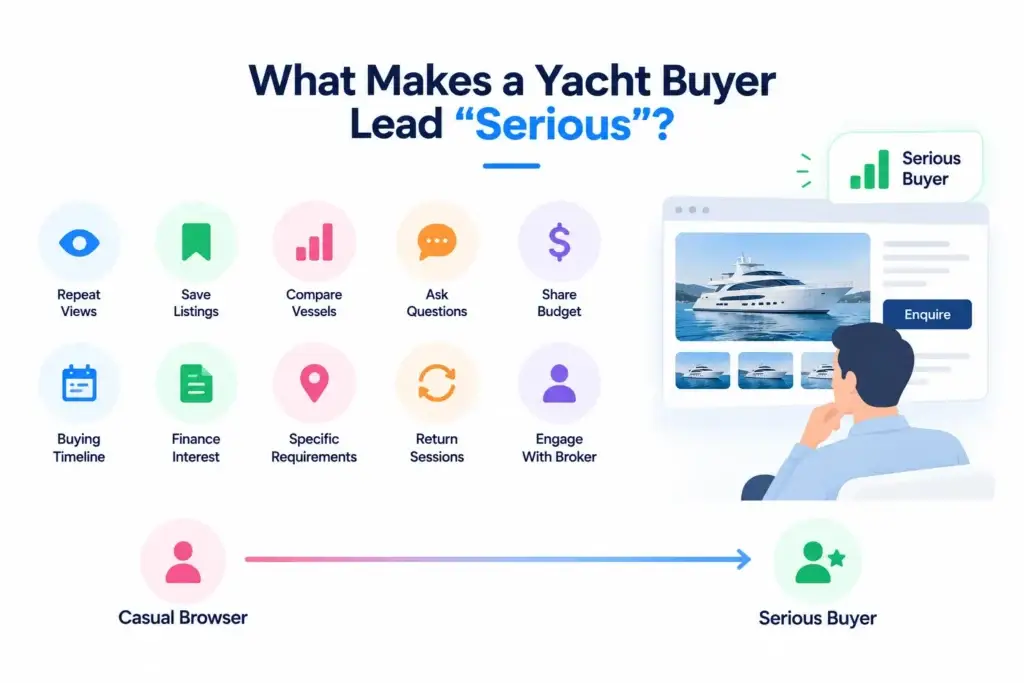
A serious buyer is not always the person who writes the longest message. In yacht marketplaces, seriousness is usually shown through a mix of stated intent and behavioral intent.
A serious buyer may:
- View the same vessel multiple times
- Save or shortlist similar listings
- Compare vessels within a specific price and size range
- Ask about availability, ownership documents, viewing, or survey
- Share a realistic budget range
- Mention a buying timeline
- Ask about financing or trade-in options
- Request similar alternatives
- Return to the platform across multiple sessions
- Engage with broker messages
- Ask location-specific or usage-specific questions
A casual browser may only view one listing, ask a vague question, or provide no context.
This does not mean casual leads have no value. Some buyers start casually and become serious later. But brokers need a way to know which leads deserve immediate attention and which should enter a nurture workflow.
The Core Lead Qualification Flow
A Yacht Marketplace Platform should qualify leads through a structured journey, not through one generic contact form.
Lead Qualification Flow for Yacht Marketplace Platforms
| Stage | What the Platform Captures | How It Helps Brokers |
|---|---|---|
| Listing Engagement | Views, saves, comparisons, repeat visits, photo gallery engagement, and specification downloads. | Shows which vessels and categories are attracting the buyer. |
| Inquiry Capture | Name, contact method, message, preferred vessel, budget range, location, and buying timeline. | Turns anonymous interest into a structured lead record. |
| Intent Scoring | Viewing requests, finance interest, survey questions, trade-in needs, and repeated engagement. | Helps brokers identify high-intent buyers faster. |
| Lead Routing | Listing broker, vessel location, buyer region, broker specialization, language preference, and availability. | Sends the inquiry to the right person instead of a shared inbox. |
| CRM Context | Buyer profile, previous inquiries, saved vessels, notes, follow-up tasks, and pipeline stage. | Gives brokers continuity before making contact. |
| Follow-Up Readiness | Recommended next action, response priority, missing details, and suggested alternative vessels. | Improves the quality and speed of broker follow-up. |
1. Start With Better Inquiry Forms
Many yacht listing platforms collect only basic details: name, email, phone number, and message. That may be enough to create a contact, but it is not enough to qualify the buyer.
A better inquiry form should collect practical buying context without becoming too long.
Useful fields include:
- Preferred contact method
- Vessel of interest
- Buying timeline
- Approximate budget range
- Preferred location or cruising region
- Current ownership status
- Trade-in interest
- Finance interest
- Survey requirement
- Transport support requirement
- Intended use: private, charter, liveaboard, family cruising, business, racing, or long-distance cruising
- Interest in similar vessels
- Message or special request
The form should feel helpful, not heavy. The buyer should understand that these questions allow the broker to respond with better recommendations.
Founder Insight
Do not ask every qualification question at once. Ask the most useful questions first, then let brokers or automated follow-up collect missing details later.
2. Use Vessel Engagement Signals to Detect Intent
A serious buyer often reveals intent before sending a message.
A Yacht Marketplace Platform should capture behavioral signals from the browsing journey. These signals help brokers understand whether the inquiry is random or part of a focused search.
Important engagement signals include:
- Repeated views of the same vessel
- Views of similar yachts in the same length range
- Saved listings
- Compare-list activity
- Search filters used repeatedly
- Photo gallery depth
- Video tour views
- Specification sheet downloads
- Broker profile views
- Return visits over multiple days
- Clicks on finance, survey, or transport options
For example, a buyer who views five 50–60 ft motor yachts in the Mediterranean and saves three listings is showing stronger intent than someone who opens one luxury yacht listing once.
These signals should appear inside the broker lead record, not remain hidden in analytics.
3. Score Leads Based on Readiness, Fit, and Action
Lead scoring helps broker teams prioritize follow-up without ignoring lower-intent buyers.
A simple score can combine three areas:
- Readiness
How soon does the buyer plan to act? - Fit
Does the buyer’s budget, location, and vessel preference match the listing? - Action
Has the buyer taken high-intent actions such as requesting a viewing, asking about survey, or sharing financing needs?
A practical lead scoring model may look like this:
| Signal | Score Impact | Broker Interpretation |
|---|---|---|
| Vague message with no timeline | Low | Needs nurture or clarification. |
| Budget range provided | Medium | Buyer may be serious enough for broker follow-up. |
| Multiple saved listings | Medium | Buyer is comparing options. |
| Repeated views of one vessel | Medium to high | Listing interest is becoming stronger. |
| Viewing request | High | Broker should respond quickly. |
| Survey or finance question | High | Buyer may be closer to transaction planning. |
| Matching budget and vessel range | High | Strong fit for broker qualification. |
Lead scoring should guide priority, not replace human judgment. Yacht purchases are relationship-driven, so brokers still need context, empathy, and advisory skill.
4. Separate Buyer Types Before Broker Follow-Up
Not every inquiry has the same purpose.
A yacht marketplace should classify incoming leads into practical buyer types so brokers know how to respond.
Common lead categories include:
| Buyer Type | Typical Signals | Best Follow-Up |
|---|---|---|
| Ready Buyer | Budget, timeline, viewing request, specific vessel interest. | Fast broker call and appointment scheduling. |
| Research Buyer | Saves vessels, compares listings, asks broad questions. | Educational follow-up and curated alternatives. |
| Upgrade Buyer | Already owns a boat and asks about trade-in or valuation. | Broker-led consultation and valuation path. |
| Service Buyer | Asks about survey, transport, finance, or insurance. | Route to broker or service partner workflow. |
| Future Buyer | Interested but no immediate timeline. | Nurture sequence and saved search alerts. |
| Low-Fit Inquiry | Budget mismatch, unclear intent, unrelated request. | Clarifying message or lower-priority follow-up. |
This segmentation prevents brokers from responding the same way to every inquiry.
5. Route Qualified Leads to the Right Broker
A high-quality lead can lose value if it goes to the wrong person.
Lead routing should match the buyer inquiry with the broker most likely to handle it well. This may depend on listing ownership, region, vessel category, buyer language, broker availability, or specialization.
Routing rules may consider:
- Listing broker
- Vessel location
- Buyer region
- Vessel type
- Broker specialization
- Broker office
- Language preference
- Existing buyer relationship
- Lead source
- Response-time performance
- Service request type
- Manual admin assignment
A buyer asking about a sailing yacht in Greece should not automatically go to a broker specializing in sportfishing vessels in Florida. Routing should protect both speed and relevance.
6. Give Brokers Context Before They Reply
Broker follow-up becomes stronger when the lead record contains context.
Instead of seeing only “John asked about Vessel X,” the broker should see:
- Buyer contact details
- Vessel of interest
- Search and filter behavior
- Saved vessels
- Similar listings viewed
- Budget range
- Buying timeline
- Location preference
- Message history
- Previous inquiries
- Service interests
- Suggested next action
- Missing qualification details
This turns follow-up from a cold response into a guided sales conversation.
A broker can say, “I noticed you were comparing three flybridge yachts in the same range. This vessel fits your search, but I can also share two similar options that may match your cruising plans.”
That level of relevance improves trust.
7. Use CRM Stages to Keep Leads From Getting Lost
A qualified lead should move through a visible pipeline.
A broker CRM should help the team track where each buyer stands and what needs to happen next.
Common yacht lead stages include:
- New inquiry
- Needs qualification
- Qualified buyer
- Broker contacted
- Details sent
- Viewing scheduled
- Sea trial or survey discussion
- Offer stage
- Negotiation
- Closed
- Lost
- Nurture
The CRM should also support follow-up reminders, private notes, task ownership, and lead source tracking. This matters because yacht buyers may take weeks or months to move forward. Without CRM discipline, valuable relationships sit inside inboxes and spreadsheets.
8. Identify Missing Information Before Broker Time Is Used
A lead may be promising but incomplete.
Instead of immediately sending every incomplete inquiry to a broker, the platform can ask for missing details through automated or semi-automated follow-up.
Missing details may include:
- Budget range
- Buying timeline
- Preferred location
- Vessel usage
- Finance interest
- Trade-in status
- Current ownership
- Viewing availability
- Similar vessel interest
For example, if a buyer sends “Is this available?” without budget or timeline, the platform can ask a short follow-up question before broker escalation.
This helps protect broker time while still keeping the buyer engaged.
9. Track Response Time and Broker Accountability
Lead qualification does not end when the broker receives the inquiry.
The platform should track what happens next.
Important response metrics include:
- Time from inquiry to broker assignment
- Time from assignment to first broker view
- Time from inquiry to first reply
- Unanswered qualified leads
- Leads reopened after inactivity
- Broker follow-up completion
- Viewing request response rate
- Lost lead reason
- Lead source quality
This helps marketplace operators understand whether lead quality, broker response, or routing rules need improvement.
Without response tracking, the platform may generate valuable leads but still fail to convert them because follow-up is inconsistent.
10. Protect Lead Data With Role-Based Access
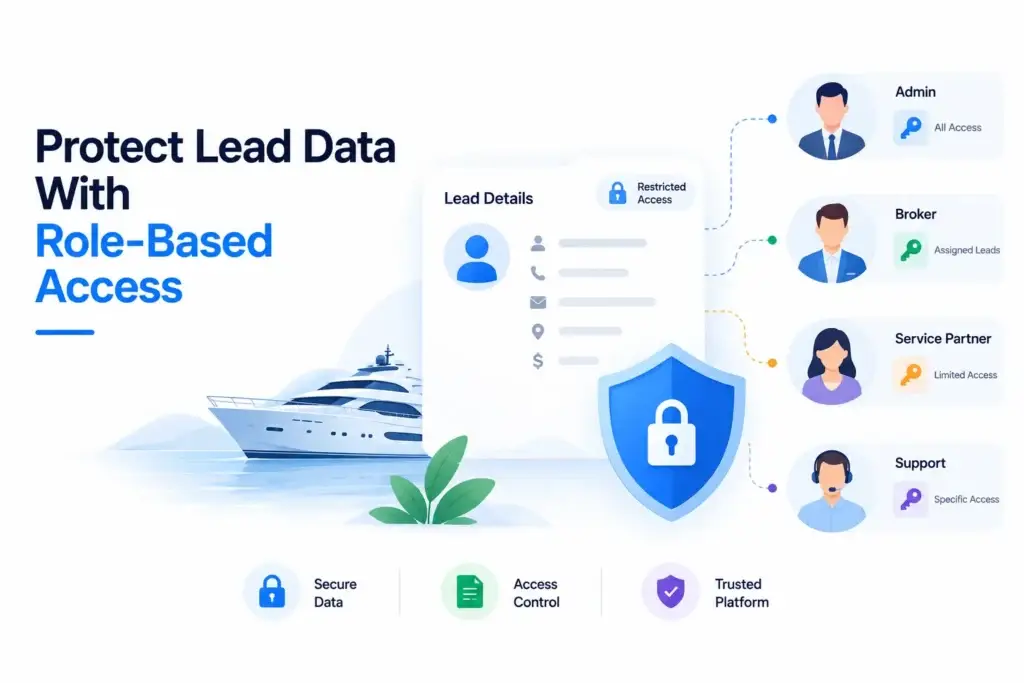
Lead data may include buyer identity, contact details, budget, purchase timeline, location, financing interest, service needs, and private notes.
This information should not be available to everyone.
A Yacht Marketplace Platform should use role-based access control so brokers, admins, service partners, and support teams see only what they need.
Security controls should include:
- Broker-specific lead access
- Admin permission levels
- Inquiry activity logs
- Secure data storage
- Encrypted data transfer
- Access restrictions for exported leads
- Internal note privacy
- Service partner access limits
- Suspicious inquiry monitoring
- Spam and fake lead detection
Lead qualification works only when buyers and brokers trust the platform with sensitive information.
A lead-ready yacht marketplace also needs trust controls before brokers handle buyer inquiries. Dealer verification, listing moderation, dispute handling, spam checks, and buyer protection workflows help reduce weak or risky leads. This trust and safety guide explains how marketplace controls protect buyers, brokers, and listings. <
Founder Decision Signals
Speed
If brokers are missing inquiries or replying late, lead routing, priority scoring, and response tracking should be planned before launch.
Cost
Lead qualification features affect build scope because forms, scoring, CRM stages, broker dashboards, notifications, and admin reports all need backend logic.
Scalability
If the platform will support many brokers, offices, regions, or service partners, build role-based access and lead ownership rules early.
Market Fit
If buyers need advisory support before purchase, the marketplace should qualify intent and guide broker follow-up instead of acting like a simple listing directory.
How Lead Qualification Connects With Marketplace Features
Lead qualification is not one isolated module. It depends on the full marketplace feature foundation.
Vessel listings, search filters, saved searches, inquiry forms, broker dashboards, CRM stages, notifications, service queues, admin reports, and permission controls should work together. If these modules are disconnected, the broker sees only a message, not the buyer journey behind it.
A strong marine marketplace feature set should help founders connect vessel discovery, buyer behavior, inquiry capture, broker CRM, routing logic, response tracking, and admin visibility in one operational flow.
How Lead Qualification Supports Marketplace Revenue
Qualified buyer leads create commercial value because brokers, dealers, and service partners are more likely to pay for a platform that delivers usable intent.
Lead qualification works better when buyers receive the right support before broker follow-up. This includes help with finance, insurance, survey, transport, valuation, and service questions. Founders can review these buyer support workflows to understand how support services strengthen the buyer journey.
A yacht marketplace may monetize through broker subscriptions, premium listing visibility, featured placements, service leads, valuation tools, reporting, or regional licensing. But these revenue streams become stronger when the platform can show lead quality, not just visitor traffic.
For founders planning monetization, this marine marketplace business model explains how subscriptions, listing upgrades, service modules, and qualified lead workflows can support marketplace revenue.
What Founders Should Plan Before Building Lead Qualification Workflows
Before development begins, founders should define what “qualified” means for their marketplace.
Important planning questions include:
- Which buyer details are required?
- Which fields should remain optional?
- What buyer actions count as strong intent?
- How should lead scores be calculated?
- Which leads should go directly to brokers?
- Which leads should enter nurture?
- How are brokers assigned?
- Can brokers reassign leads?
- What CRM stages are needed?
- What notifications should brokers receive?
- What reports should admins review?
- How will fake or spam inquiries be filtered?
- How will service leads be routed?
Lead qualification, CRM logic, service queues, broker dashboards, notifications, and reporting can affect platform scope. Founders comparing build planning can review this yacht marketplace development cost guide before finalizing the product roadmap.
Choosing the Right Partner for Broker-Ready Marketplace Development
Lead qualification workflows require more than front-end forms. The development partner should understand listing logic, broker CRM, buyer behavior tracking, routing rules, admin reporting, permission control, and long sales cycles.
Before choosing a build team, founders can use this marine marketplace development partner checklist to evaluate source-code ownership, customization flexibility, broker workflow depth, launch support, and long-term platform control.
Common Mistakes Founders Should Avoid
Sending every inquiry straight to brokers
Not every inquiry is ready for a broker call. Some need clarification, nurture, or service routing before they become useful sales opportunities.
Using long forms that reduce inquiry volume
Lead qualification should collect useful context without overwhelming buyers. Keep the first form focused and collect deeper details later when needed.
Ignoring buyer behavior before the form submission
Saved listings, repeated views, compare activity, and search filters can reveal intent before the buyer writes a message. This context should be visible to brokers.
Using one shared inbox for all leads
Shared inboxes make ownership unclear and response tracking difficult. Lead routing should assign responsibility to the right broker or team.
Not measuring follow-up quality
A lead is not truly managed until the platform tracks assignment, first response, next action, stage movement, and outcome.
How Miracuves Helps Founders Build Lead-Ready Yacht Marketplaces
Miracuves helps founders build white-label marketplace platforms where listing quality, buyer trust, broker follow-up, and admin visibility matter.
For yacht marketplaces, the product foundation should support vessel listings, buyer inquiry forms, saved searches, broker CRM, lead scoring, service queues, response tracking, admin dashboards, and permission-based access. This allows founders to launch with a clear workflow instead of stitching together forms, spreadsheets, and separate CRM tools later.
If your platform needs custom buyer journeys, mobile app experiences, broker dashboards, CRM workflows, advanced search, or third-party integrations, Miracuves also offers custom mobile app development services to shape the marketplace around your audience and operational model.
Miracuves offers a broker-ready yacht marketplace foundation for founders who want to move faster with vessel listings, inquiry management, broker workflows, admin control, and source-code ownership.
Final Thoughts
A Yacht Marketplace Platform becomes more valuable when it helps brokers identify serious buyers before follow-up begins.
The strongest marketplaces do not only collect inquiries. They capture buyer behavior, qualify intent, score readiness, route leads to the right broker, store CRM context, protect lead data, and track follow-up outcomes.
For founders, the decision is simple: do not build a listing platform that leaves brokers guessing. Build a marketplace that turns buyer interest into structured, qualified, and actionable broker opportunities.
FAQs
What is lead qualification in a Yacht Marketplace Platform?
Lead qualification is the process of identifying which buyer inquiries are serious enough for broker follow-up. It uses buyer details, vessel preferences, budget, timeline, engagement behavior, and service needs to judge readiness.
How can a yacht marketplace identify serious buyers?
A yacht marketplace can identify serious buyers through signals such as repeated listing views, saved vessels, comparison activity, budget range, buying timeline, viewing requests, finance interest, survey questions, and direct broker messages.
Why should yacht buyer leads be scored?
Lead scoring helps brokers prioritize follow-up. High-intent buyers can receive fast attention, while early-stage or incomplete leads can enter nurture or clarification workflows.
What information should a yacht inquiry form collect?
A yacht inquiry form should collect contact details, preferred contact method, vessel of interest, budget range, buying timeline, location preference, current ownership status, finance interest, trade-in interest, and any special request.
How does broker CRM help with lead qualification?
Broker CRM stores buyer profiles, inquiry history, saved vessels, notes, tasks, pipeline stages, and follow-up records. This gives brokers context before they reply and helps prevent valuable leads from getting lost.
What is lead routing in yacht marketplaces?
Lead routing assigns inquiries to the right broker or team based on listing ownership, vessel location, buyer region, broker specialization, language preference, availability, or existing relationship.
Should all buyer inquiries go directly to brokers?
Not always. High-intent inquiries should be routed quickly, but vague or incomplete inquiries may need clarification, nurture, or service routing before broker time is used.
How does lead qualification support marketplace revenue?
Qualified leads increase the value of broker subscriptions, listing upgrades, service leads, reporting tools, and marketplace partnerships because brokers are more likely to pay for usable buyer intent than generic traffic.
Miracuves is an independent software development company. We are not affiliated with, connected to, sponsored by, or endorsed by any company or product named in this article.
Terms such as “X Clone” are used descriptively. It is how the software industry refers to building a platform with functionality comparable to a known service, and how clients search for it.
The entire design and codebase of our products is built by our own team. Our products contain no code, design, graphics, or content originating from any third-party website or applications.
All third-party names and marks referenced in this article are the property of their respective owners, referenced solely to identify the services discussed.