Key Takeaways
- Video Streaming Platform Security should protect four connected layers: premium content, viewer accounts, payments and subscriptions, and viewer data.
- Premium content protection can include DRM, encrypted storage, signed playback URLs, access tokens, watermarking, device controls, geo-rules, and secure offline downloads.
- Account security should include strong authentication, suspicious login detection, device management, session controls, secure recovery flows, and rate limiting.
- Payment security must connect transaction status with entitlement logic so subscriptions, rentals, purchases, refunds, and failed renewals grant the correct access.
- Viewer data should be protected through encrypted transfer, limited collection, role-based access, clear consent, retention rules, and privacy-conscious analytics.
Security Signals
- Playback authorization should confirm entitlement before every protected streaming session.
- Secure payment integrations should use tokenized references, signed webhooks, idempotent event handling, reconciliation, and restricted refund permissions.
- Admin dashboards should use role-based permissions, activity logs, approval workflows, and stronger authentication for sensitive actions.
- API security should include authentication, rate limits, request validation, expiring tokens, webhook verification, and separation between public and admin endpoints.
- Offline playback should use encrypted downloads, device binding, expiry rules, access revalidation, and automatic cleanup when entitlement ends.
Real Insights
- DRM alone is not enough; streaming security also depends on accounts, payments, entitlements, APIs, admin permissions, and privacy controls.
- Payment processing and content access should never be treated as separate systems because every successful or reversed transaction changes viewing rights.
- Device and concurrent-stream limits are both security controls and monetization controls because they help enforce different subscription plans.
- Not every team member needs access to personal viewer records; analytics should separate business insights from sensitive individual data wherever possible.
- The strongest security path is: protect content → secure accounts → validate payments → enforce entitlements → protect viewer data → secure APIs and admin actions → monitor continuously.
Video streaming platforms are no longer simple media players with login screens. They manage licensed content, subscriptions, rentals, watch history, user profiles, payment events, device activity, recommendations, and admin operations. That makes security a business foundation, not just a technical checklist.
For founders, the real question is not “Should my platform be secure?” The better question is: which parts of the platform create the highest business risk if they are not protected from day one?
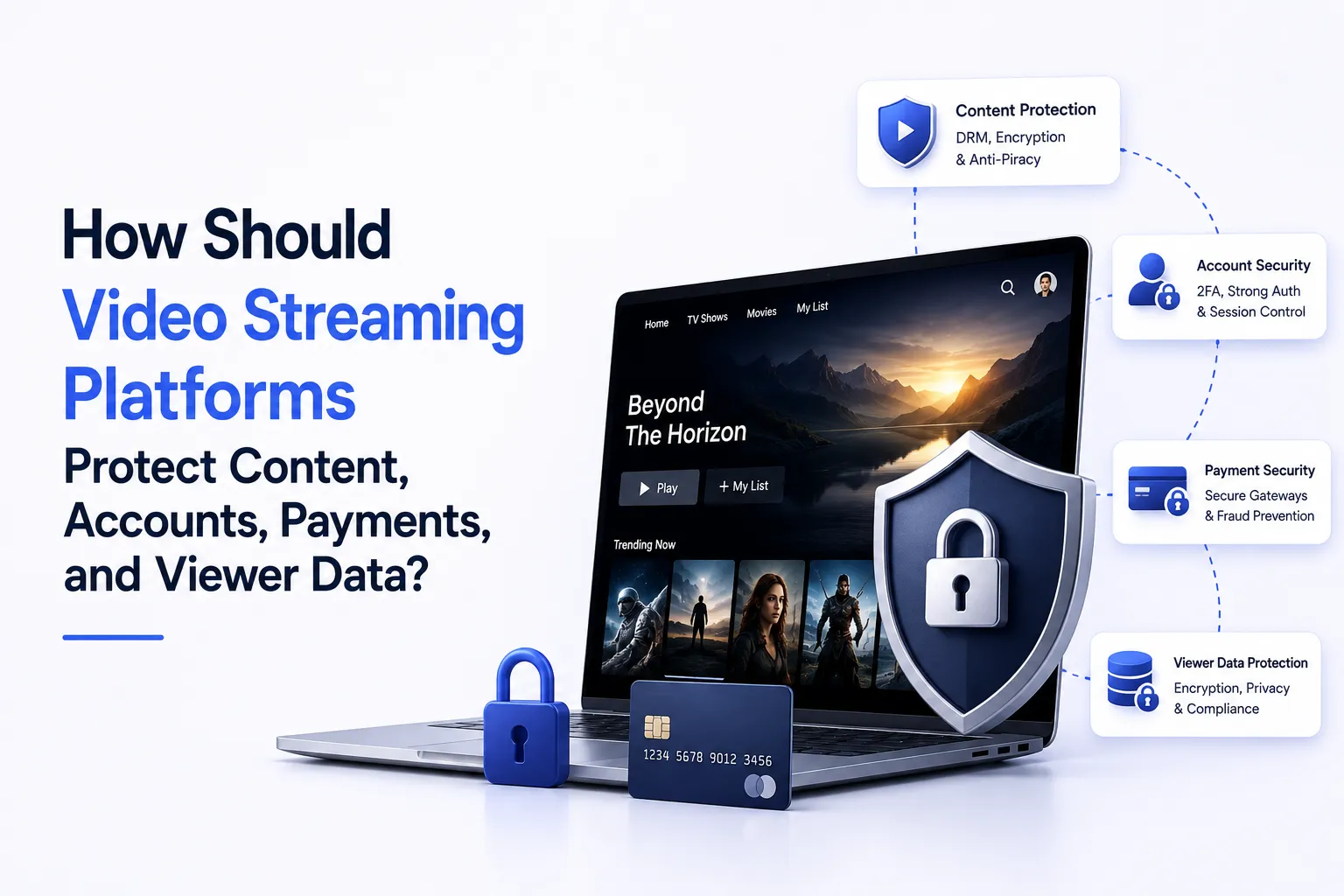
A streaming product usually has four sensitive layers working together:
- The content users pay to watch
- The accounts viewers use to access the platform
- The payments and subscriptions that unlock revenue
- The viewer data that powers personalization and retention
If one layer fails, the impact spreads quickly. Weak content protection can hurt licensing confidence. Poor account security can increase abuse and support tickets. Payment errors can damage trust. Mismanaged viewer data can create privacy and compliance concerns.
That is why founders planning a secure Video Streaming Platform Security need to think beyond the player interface. A scalable OTT or VOD platform needs content protection, role-based access, secure payment workflows, admin visibility, privacy-conscious data handling, and operational controls that can grow with the business.
Founders building secure streaming products should also understand how their platform fits into the wider entertainment technology ecosystem. A video streaming product is not only about video playback; it connects content libraries, subscriptions, user profiles, monetization, recommendations, and admin control. For a broader view of this category, you can explore Miracuves’ entertainment app solutions.
Miracuves helps founders build launch-ready, white-label video streaming app solutions with branded user experiences, admin control, monetization workflows, and source-code ownership. But regardless of the build path, security should be planned as part of the product architecture.
Why Security Matters More for Video Streaming Platforms Than Basic Apps
A normal content website may store articles, contact forms, and basic user records. A streaming platform is more complex because every action connects to content access, payments, and personal behavior.
A viewer may subscribe, create multiple profiles, stream premium content, download videos offline, save watchlists, receive recommendations, and switch between devices. Behind that experience, the platform must decide who can access which content, for how long, on which device, under which payment status, and with what usage limits.
That is where risk increases.
A video streaming platform usually handles:
- Licensed or creator-owned video assets
- Viewer names, emails, devices, locations, and watch history
- Subscription plans, rental windows, purchases, and renewals
- Payment gateway records and transaction states
- Admin users with access to content, plans, refunds, and reports
- APIs connecting mobile apps, web apps, smart TV apps, and dashboards
- Content partner or creator workflows where applicable
Security problems in this environment are not only technical problems. They can affect revenue, content partnerships, brand trust, customer support, and investor confidence.
A secure streaming product usually starts with the right platform foundation. Before adding advanced protection layers such as DRM, payment rules, device limits, or viewer privacy workflows, founders should first define the type of video product they want to launch. Miracuves’ video content platform solutions help founders understand how OTT, creator-led, short video, and streaming platforms can be structured for growth.
For example, if a user pays for a movie rental but the entitlement system fails, the issue becomes a revenue and support problem. If admin permissions are too broad, a junior support user may accidentally change subscription plans or access sensitive records. If premium content is stored without proper access controls, piracy risk increases.
Founders should therefore treat security as a product decision, not a post-launch patch.
The Four Security Layers Every Streaming Founder Should Understand
A strong security plan for video streaming platforms should be organized around the business assets being protected. This makes it easier for founders, product teams, and developers to prioritize what matters first.
How Video Streaming Platforms Should Protect Premium Content
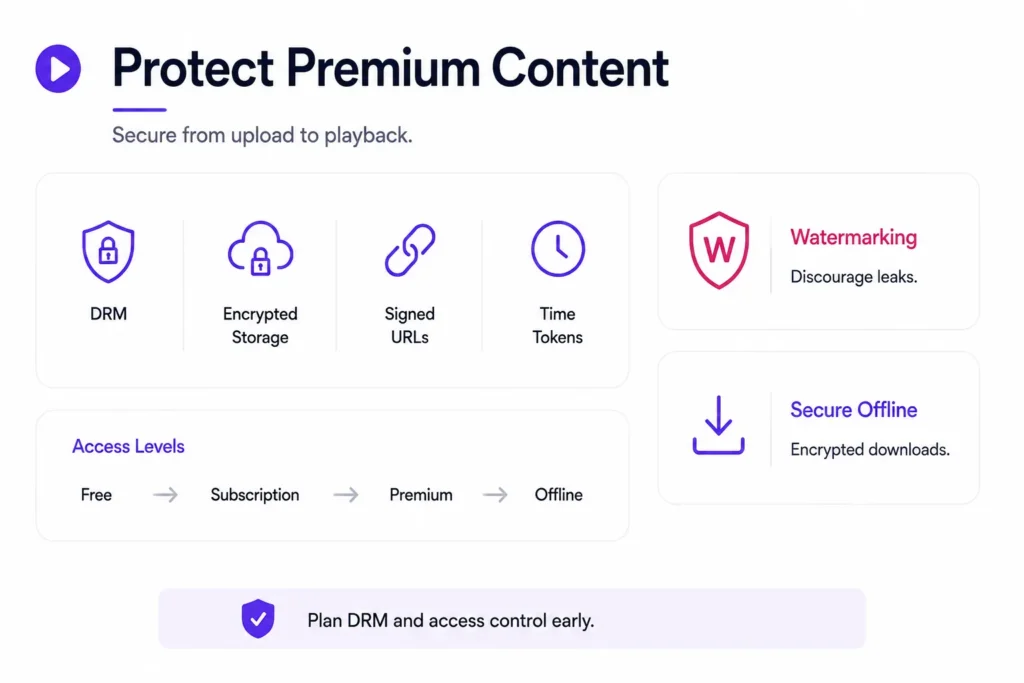
Content is the economic core of a streaming business. Whether the platform offers movies, web series, creator videos, fitness lessons, sports clips, educational courses, or short dramas, every premium title needs controlled access.
The most important mistake founders make is assuming that content protection means hiding video files behind a login screen. That is not enough. Secure streaming requires a chain of protection from upload to playback.
A stronger content protection setup usually includes:
- DRM for premium content
- Encrypted video storage
- Signed URLs or tokenized playback links
- Time-limited access tokens
- Device-based playback controls
- Geo-access rules where licensing requires them
- Watermarking for sensitive or high-value content
- Offline download restrictions
- Playback authorization before each session
- Admin-controlled publishing and takedown workflows
DRM and Multi-Device Playback
Digital rights management helps control how protected videos are accessed and played across devices. A serious streaming platform may need different DRM paths for Android, iOS, web browsers, smart TVs, and offline playback.
For founders, this matters because users expect content to work smoothly across devices, while content owners expect access to remain controlled. The platform must balance both sides.
A practical approach is to map content sensitivity first:
- Free trailers may only need basic access rules.
- Subscription-only videos may need signed playback URLs and token checks.
- Licensed movies, paid courses, or exclusive shows may need DRM and stricter device controls.
- Offline downloads may need encrypted storage, expiry windows, and revalidation.
Not every first launch needs the most advanced content protection stack. But if the business depends on licensed, paid, or exclusive content, DRM and entitlement logic should be planned early.
Content protection also depends on how video libraries are sourced, organized, and updated. If a platform relies on licensed catalogs, third-party metadata, or external content providers, the integration layer should be planned carefully. Founders can learn more about this in Miracuves’ guide on content acquisition APIs for video streaming platforms.
Watermarking and Leak Accountability
Watermarking does not stop every form of piracy, but it can help identify where leaks came from. Visible watermarks can discourage casual screen recording, while forensic watermarking can support investigation for high-value content.
For founders working with studios, creators, or education partners, watermarking can also become a trust signal. It shows that the platform is not only focused on playback but also on protecting the commercial value of the content library.
Secure Offline Viewing
Offline downloads can improve retention, especially for users with unstable internet access. But offline viewing also increases security risk if videos are stored as unprotected files.
A safer offline architecture should include encrypted downloads, license expiry, device binding, download limits, subscription validation, and automatic cleanup when access ends. Offline playback should feel simple to the user while still being controlled by the platform.
How Streaming Platforms Should Protect User Accounts
Account security is one of the most overlooked parts of streaming app development. Many founders focus on content piracy but ignore login abuse, password reuse, fake signups, account sharing, and session hijacking.
A streaming account can be valuable because it may contain paid access, family profiles, viewing history, payment status, stored devices, and premium subscriptions. If attackers gain access, they may resell accounts, misuse subscriptions, change profile data, or trigger support disputes.
A secure account layer should include:
- Strong password rules
- Multi-factor authentication where appropriate
- Email or phone verification
- Suspicious login detection
- Device management
- Session expiry controls
- Rate limiting on login attempts
- Protection against credential stuffing
- Secure password reset workflows
- Activity alerts for sensitive changes
Device and Session Controls
Streaming users expect to watch across phones, browsers, tablets, and TVs. That flexibility is useful, but it also creates access-control complexity.
The platform should let admins define device limits, concurrent streaming rules, profile limits, and session behavior. For example, a family plan may allow more active devices than a basic mobile plan. A rental purchase may allow access only for a limited viewing window. A suspicious login from a new country may require additional verification.
This is not only a security feature. It is also a monetization control.
Without device and session rules, subscription plans become harder to enforce. With clear rules, the platform can support different pricing models while protecting paid access.
Account Recovery Should Not Become an Attack Path
Password reset and account recovery flows should be designed carefully. A weak recovery system can bypass strong login security.
Good recovery workflows should use verified channels, time-limited reset links, limited attempts, device context, and clear alerts when account details change. Admin teams should also have activity logs so they can review disputes around email changes, password resets, or suspicious access.
How Streaming Platforms Should Secure Payments and Entitlements
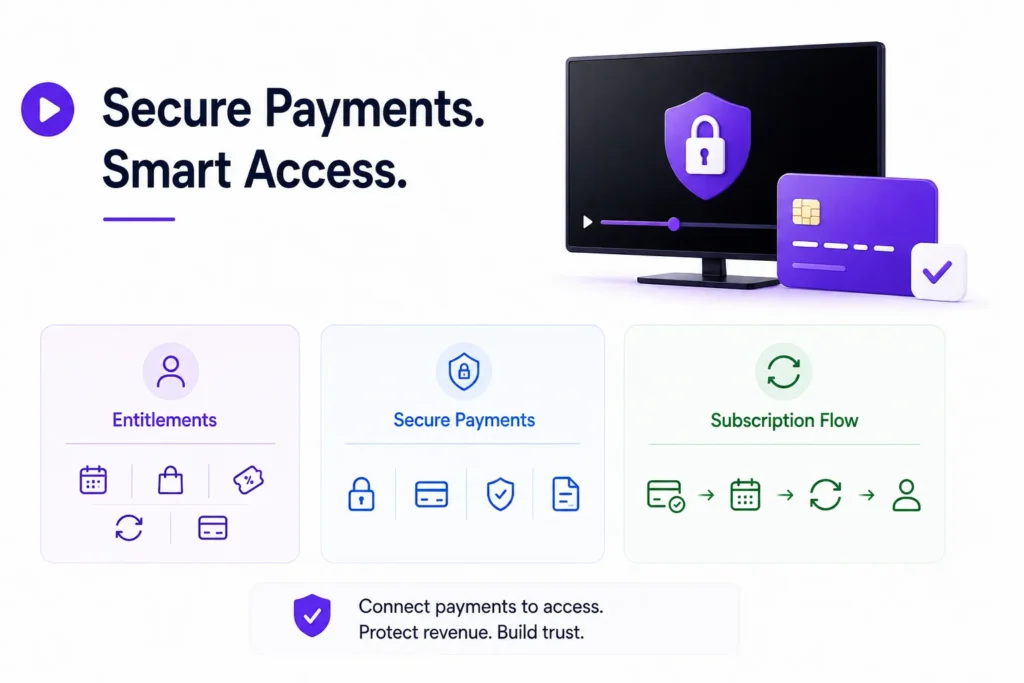
Payments are not separate from streaming access. In a video streaming platform, every payment event must connect to an entitlement decision.
An entitlement is the platform’s answer to a simple question: is this user allowed to watch this content right now?
That answer may depend on:
- Active subscription status
- Rental purchase window
- One-time purchase access
- Free trial period
- Coupon or promotional access
- Failed renewal
- Refund status
- Chargeback status
- Regional content rules
- Device or profile limits
If payment logic and entitlement logic are not connected properly, users may lose access after paying, keep access after canceling, or receive the wrong content rights. These issues quickly become support, revenue, and trust problems.
Secure Payment Gateway Integration
Streaming platforms should use secure payment gateway integration rather than storing raw card details inside the app. Payment providers can support tokenized payment handling, recurring billing, failed payment recovery, invoices, and refunds.
The platform should also protect payment workflows with:
- HTTPS across payment pages and APIs
- Tokenized payment references where supported
- Signed webhook validation
- Idempotent webhook handling
- Payment status reconciliation
- Admin logs for refunds and adjustments
- Limited admin permissions for financial actions
- Fraud monitoring for unusual transaction behavior
Idempotency is especially important. If a user taps twice, a webhook retries, or a payment provider sends duplicate events, the system should not create duplicate charges or duplicate access records.
Subscription Renewals and Failed Payments
Recurring payments create ongoing operational complexity. A platform must know what to do when a renewal succeeds, fails, retries, or is refunded.
A strong subscription workflow should define:
- When access starts
- When access pauses
- How grace periods work
- How failed payment retries are handled
- What users see when payment fails
- How admins review disputed access
- How refunds affect entitlement records
For founders, this is where revenue protection and user experience meet. If the system is too strict, paying users may lose access unfairly. If it is too loose, the platform may leak premium access.
How Viewer Data Should Be Protected
Viewer data is valuable because it powers personalization, recommendations, watch progress, content decisions, and retention campaigns. But it is also sensitive because it reflects user behavior.
A streaming platform may collect:
- Names and emails
- Login history
- Device identifiers
- IP-based location signals
- Watch history
- Search history
- Watchlist activity
- Ratings and likes
- Payment status
- Subscription preferences
- Profile-level viewing patterns
Viewer data becomes especially important when the platform uses recommendations, watch history, genre-based rows, personalized feeds, or continue-watching features. The goal is to improve discovery without overexposing personal data. For founders planning personalization workflows, Miracuves’ guide on video streaming content discovery explains how discovery systems can improve engagement.
Founders should not collect viewer data just because it might be useful later. The stronger approach is to collect what the platform needs, explain why it is collected, protect it properly, and limit who can access it.
Privacy-Conscious Data Handling
Viewer data protection should include:
- Encrypted data transfer
- Encrypted storage for sensitive records
- Role-based access control
- Permission-based dashboards
- Activity logs for admin access
- Clear privacy notices
- Consent workflows where required
- Data deletion or export workflows where applicable
- Retention policies for old records
- Limited access to behavioral analytics
This matters because streaming personalization depends on trust. Users may accept recommendations, continue watching prompts, and personalized rows when they understand the value. But if data handling feels unclear or excessive, it can damage confidence.
Analytics Without Overexposure
Admins need analytics, but not every team member needs access to personal viewer records.
A safer analytics layer separates operational insights from personal details. For example, an admin may need to know which shows have high completion rates, which devices are buffering, or which subscription plans convert best. They may not need to see individual viewer identity unless resolving a support issue.
This separation helps the platform make data-driven decisions without exposing more personal data than needed.
APIs, Admin Dashboards, and Backend Security
Streaming platforms often run across multiple surfaces: mobile apps, web apps, smart TV apps, content dashboards, admin panels, payment gateways, analytics tools, and notification systems. These surfaces communicate through APIs.
If APIs are weak, attackers may try to access content, manipulate accounts, abuse free trials, scrape metadata, or bypass payment checks.
Important API and backend controls include:
- Secure API authentication
- Rate limiting
- Input validation
- Access tokens with expiry
- Service-level permissions
- Signed playback requests
- Webhook signature verification
- Audit logs for sensitive events
- Monitoring for unusual traffic
- Separation between public and admin APIs
The admin dashboard needs special attention because it controls content, users, payments, subscriptions, reports, refunds, and platform settings. Admin access should never be treated like a normal user login.
A secure admin dashboard should include role-based access, permission-based views, multi-factor authentication, activity logs, approval workflows for sensitive actions, and restricted access for payment or content changes.
Founder Decision Signals: What Should You Secure First?
Not every founder needs every advanced security feature on day one. But every serious streaming platform needs a security roadmap based on business risk.
Content Value
If your platform depends on licensed, paid, exclusive, or creator-owned content, prioritize DRM, signed URLs, watermarking, download controls, and entitlement checks early.
Revenue Model
If you offer subscriptions, rentals, purchases, credits, or bundles, payment security and entitlement accuracy should be treated as core product logic.
User Growth
If you expect fast signup growth, protect login, account recovery, device sessions, rate limits, and suspicious activity workflows before abuse becomes expensive.
Data Sensitivity
If personalization, analytics, family profiles, or regulated markets are part of the roadmap, build privacy-conscious data handling from the beginning.
Security Features Video Streaming Platforms Should Prioritize
A secure video streaming platform should not depend on one tool or one vendor. The right approach is layered security.
Security should be planned alongside the platform’s core product modules. Features such as subscription access, video libraries, watchlists, downloads, payment flows, admin dashboards, and multi-device streaming all create different security requirements. Founders can review the broader video streaming platform features to understand how these modules connect with access control and viewer experience.
| Security Area | Practical Features | Why It Matters |
|---|---|---|
| Content Access | DRM, signed URLs, tokenized playback, access expiry | Helps protect premium videos from unauthorized viewing |
| Account Safety | MFA, device limits, session control, suspicious login alerts | Reduces account takeover and subscription abuse |
| Payment Security | Secure gateway, tokenized payments, webhook validation, refund logs | Protects revenue accuracy and user trust |
| Viewer Privacy | Consent workflows, encrypted storage, retention policies | Supports privacy-conscious data handling |
| Admin Control | Role-based access, audit logs, approval workflows | Reduces internal misuse and operational mistakes |
| API Security | Authentication, rate limits, request validation, monitoring | Protects app surfaces from abuse |
| Offline Playback | Encrypted downloads, license expiry, device binding | Reduces risk from downloadable premium content |
| Moderation | Content review, abuse reports, copyright reporting | Protects platform reputation and partner trust |
Common Security Mistakes Founders Should Avoid
Treating DRM as the Only Security Layer
DRM helps protect playback, but it does not replace account security, payment logic, admin permissions, API protection, or privacy workflows.
Connecting Payments Without Entitlement Logic
A payment gateway can process money, but the platform still needs accurate rules for who can watch what, when access starts, and when access ends.
Giving Admin Users Too Much Access
Every admin should not have the ability to change plans, approve refunds, publish content, view personal data, and update security settings.
Collecting Viewer Data Without a Clear Purpose
Personalization is useful, but unnecessary data collection increases privacy risk and makes platform governance harder as the product grows.
How Security Supports Monetization in Video Streaming Platforms
Security does not only prevent problems. It also supports monetization.
A streaming platform can only sell subscriptions, rentals, purchases, premium bundles, or pay-per-view access when the backend can enforce who owns what. Without access control, monetization becomes fragile.
Monetization and security are closely connected in streaming products. A subscription, rental, pay-per-view, freemium when access starts, and when access expires. Founders planning revenue logic can explore Miracuves’ guide to the video streaming platform business model.
Security supports revenue in several ways:
- DRM protects premium content value.
- Entitlement rules enforce subscriptions and rentals.
- Device limits support plan differentiation.
- Payment logs reduce refund disputes.
- Fraud monitoring protects promotional offers.
- Admin controls prevent accidental pricing or access changes.
- Secure downloads make offline viewing safer.
- Viewer privacy improves trust in personalization.
For example, a platform selling short-drama episode unlocks needs accurate credit deduction, episode access, payment records, refunds, and watch history. A sports streaming platform needs region rules, high-concurrency playback protection, and anti-restreaming workflows. A learning video platform needs course access, progress tracking, account controls, and secure certificates where applicable.
The monetization model decides the security priorities.
What a Secure First Launch Should Include
Founders do not need to overbuild every enterprise-grade security feature before launch. But a first version should include enough protection to support real users, real payments, and real content.
Security choices can also influence development scope. DRM, secure offline downloads, payment gateway workflows, fraud monitoring, admin permissions, and privacy controls may all affect the final build plan. Founders should define these requirements early when estimating video streaming platform development cost.
A practical first-launch security checklist includes:
- Secure login and password reset workflows
- HTTPS across web, mobile APIs, admin, and payment flows
- Secure payment gateway integration
- Subscription and entitlement rules
- Role-based admin access
- Content upload and publishing controls
- Signed playback URLs or access tokens
- Basic DRM planning for premium content
- Activity logs for users, payments, and admin actions
- Privacy-conscious data collection
- Refund and dispute visibility
- API rate limiting and monitoring
- Backup and recovery planning
- Moderation and reporting workflows where users or creators upload content
This level of planning helps founders avoid rebuilding core workflows later.
For infrastructure-related planning, read Miracuves’ guide on video streaming infrastructure and its guide on cloud infrastructure for video platforms.
How Miracuves Helps Founders Build Secure Video Streaming Platforms
Miracuves helps founders build ready-made and customisable video streaming app solutions with white-label branding, admin control, monetization workflows, source-code ownership, and scalable backend planning.
For founders building an OTT, VOD, creator-led, education, sports, or entertainment streaming product, the platform foundation can include:
- User app experience
- Web streaming experience
- Admin dashboard
- Video content management
- Subscription and rental workflows
- Payment gateway integration
- Entitlement management
- User and device controls
- Content moderation
- Analytics and reporting
- Secure API workflows
- Cloud and CDN planning
- Source-code ownership
- White-label branding
Building a secure streaming platform requires more than attractive screens. Founders need the right mix of video infrastructure, payment logic, admin control, user access rules, data protection, and monetization workflows. Working with an experienced video streaming platform development company can help align these layers from the foundation stage instead of fixing them after launch.
If your business needs a ready-made OTT foundation, you can explore Miracuves’ white-label video streaming platform for subscription, rental, playback, admin, and monetization workflows.
Final Thoughts: Secure Streaming Is a Business Architecture Decision
The strongest video streaming platforms are not protected by one plugin, one gateway, or one DRM provider. They are protected by a complete architecture where content, accounts, payments, viewer data, APIs, and admin actions work together safely.
For founders, this is a practical business decision. If your content is valuable, protect playback. If your subscriptions matter, protect entitlement logic. If your audience is growing, protect accounts and sessions. If personalization is part of your product, protect viewer data with care.
Security does not need to slow the launch. But it should shape the foundation. A platform that launches with the right access controls, payment logic, privacy workflows, and admin visibility is easier to scale than one that treats security as a late-stage patch.
Miracuves helps founders move from idea to launch faster with ready-made and white-label app solutions built for branding, admin control, monetization, and source-code ownership.
FAQs
What security features should video streaming platforms include?
Video streaming platforms should include secure login, encrypted data transfer, DRM planning, signed playback URLs, tokenized payment handling, subscription entitlement checks, role-based admin access, activity logs, API protection, content moderation, and privacy-conscious viewer data handling.
How do video streaming platforms protect premium content?
They can protect premium content through DRM, encrypted storage, signed playback links, access tokens, watermarking, device controls, geo-access rules, secure offline downloads, and entitlement validation before playback.
Why is account security important for streaming apps?
Account security is important because streaming accounts often include paid subscriptions, device access, watch history, profile data, and payment status. Weak login and recovery workflows can lead to account abuse, unauthorized viewing, and support disputes.
How should streaming platforms protect payments?
Streaming platforms should use secure payment gateway integration, tokenized payment references where supported, signed webhook validation, idempotent payment handling, refund logs, reconciliation reports, and limited admin permissions for financial actions.
What is entitlement management in a video streaming platform?
Entitlement management decides whether a user has the right to watch specific content. It connects payment status, subscription plans, rentals, purchases, trial access, refund status, device limits, and regional rules to playback permission.
Do all video streaming platforms need DRM?
Not all platforms need advanced DRM from day one. Free video libraries may start with basic access controls, but paid, licensed, exclusive, educational, creator-owned, or offline content should plan DRM or stronger playback protection early.
How can viewer data be protected in streaming apps?
Viewer data can be protected through encrypted transfer, secure storage, limited data collection, clear consent workflows, role-based admin access, retention rules, activity logs, and privacy-conscious analytics design.
Can a white-label streaming platform be secure?
Yes, a white-label streaming platform can be secure if it is built with strong architecture, secure APIs, admin access controls, payment protection, content security, activity logs, and privacy-conscious workflows. Security depends on engineering quality, configuration, integrations, and operational processes.
Miracuves is an independent software development company. We are not affiliated with, connected to, sponsored by, or endorsed by any company or product named in this article.
Terms such as “X Clone” are used descriptively. It is how the software industry refers to building a platform with functionality comparable to a known service, and how clients search for it.
The entire design and codebase of our products is built by our own team. Our products contain no code, design, graphics, or content originating from any third-party website or applications.
All third-party names and marks referenced in this article are the property of their respective owners, referenced solely to identify the services discussed.