

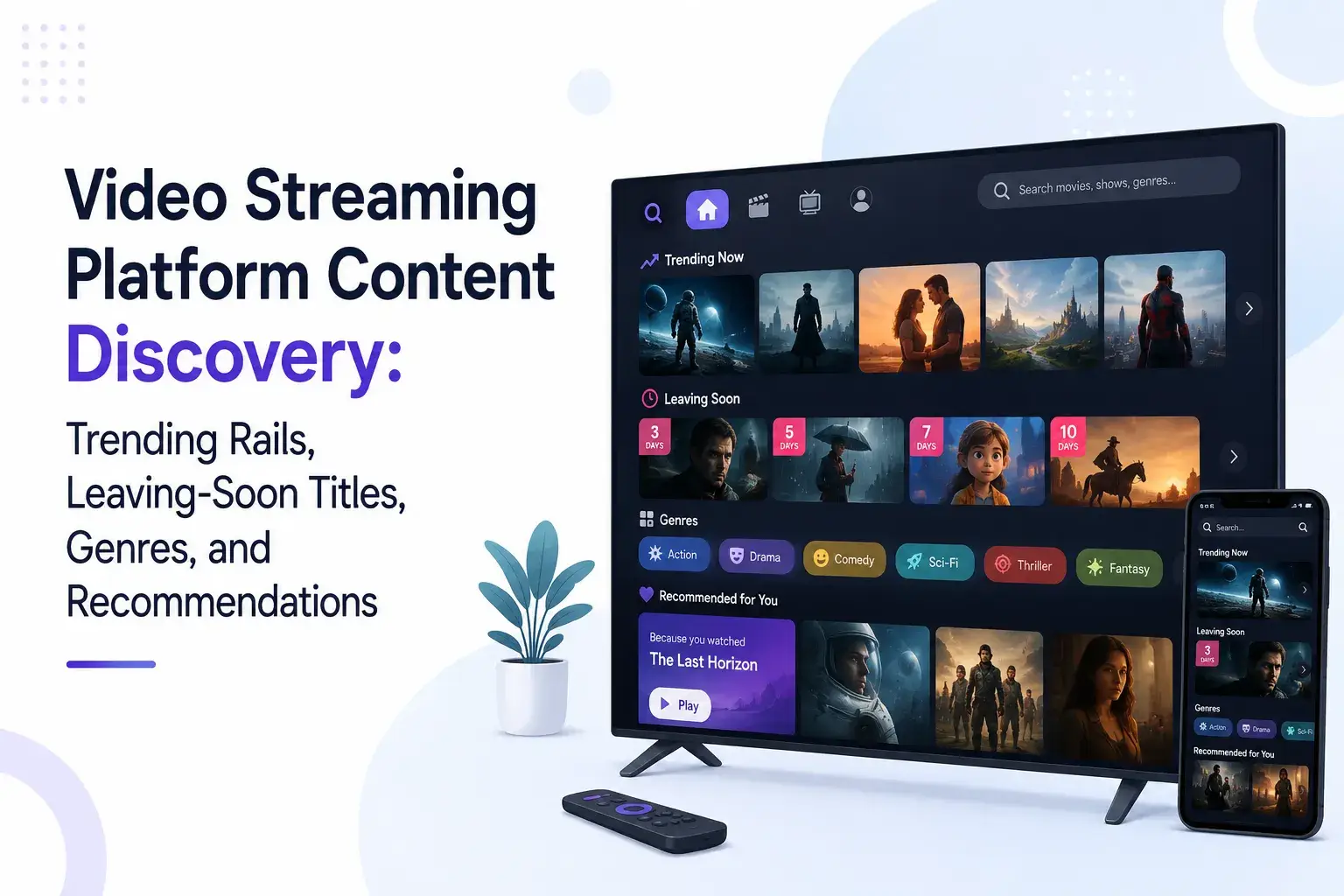
Key Takeaways
- Content discovery helps viewers find relevant titles without manually searching through the complete streaming library.
- Trending, leaving-soon, genre, continue-watching, and personalized rails serve different viewer needs.
- Accurate metadata improves browsing, search results, recommendations, and catalog organization.
- Effective discovery can increase watch time, content consumption, subscription value, and viewer retention.
- A large content library provides limited value when users cannot quickly decide what to watch.
Content Discovery Signals
- Use trending rails to highlight titles receiving strong recent viewing or engagement activity.
- Create leaving-soon sections using accurate content-rights and availability data.
- Organize titles by genre, language, mood, format, audience, and regional availability.
- Combine rule-based and behavior-based recommendations as viewing data becomes available.
- Give administrators control over rail names, title placement, visibility rules, ordering, and scheduling.
Real Insights
- A bigger catalog does not automatically improve retention when viewers struggle to choose a title.
- Recommendation quality depends heavily on accurate metadata and meaningful viewer-behavior data.
- New streaming platforms can begin with controlled recommendation rules before investing in advanced AI models.
- Search supports viewers with clear intent, while discovery helps users who have not decided what to watch.
- Miracuves develops video-streaming platforms with configurable content rails, personalized profiles, search, recommendations, metadata management, and admin controls.
A video streaming platform does not win only because it has a large content library. It wins when users can quickly find something worth watching.
For founders building an OTT product, content discovery is one of the most important retention layers. A viewer may open the app with no clear title in mind. They scroll through the homepage, check what is trending, browse genres, look at new releases, compare recommendations, and decide within seconds whether the platform feels useful.
That moment matters.
If the homepage feels random, users leave. If categories feel messy, they stop exploring. If recommendations repeat the same titles, the platform feels shallow. If expiring titles are not highlighted, the business loses a chance to create urgency.
This is why modern streaming apps rely on structured discovery systems such as trending rails, leaving-soon collections, genre-based browsing, personalized rows, watch history signals, and editorial curation.
For founders planning a video streaming platform, this blog explains how content discovery works from a business, user experience, and platform strategy perspective. It also shows where discovery logic fits into a scalable OTT product foundation.
What Is Content Discovery in a Video Streaming Platform?
Content discovery is the system that helps viewers find what to watch.
It includes the homepage layout, search experience, category pages, recommendations, trending sections, filters, banners, watchlists, continue-watching rows, genre pages, language collections, and personalized suggestions.
For a streaming business, discovery is not just a design feature. It affects:
- Watch time
- Subscription retention
- Content visibility
- New release performance
- User satisfaction
- Library utilization
- Revenue from subscriptions, ads, rentals, or pay-per-view
- Perceived value of the platform
A platform may have hundreds or thousands of titles, but if users only see the same few rows, the rest of the library becomes invisible. Good discovery turns the content library into a usable product.
For example, a regional OTT app may have films, dramas, documentaries, short videos, and live events. Without proper discovery rails, users may struggle to understand what the platform offers. With clear rails such as “Trending in Tamil Drama,” “New This Week,” “Leaving Soon,” “Family Picks,” and “Because You Watched,” the same content becomes easier to explore.
Why Discovery Matters More Than Library Size Alone
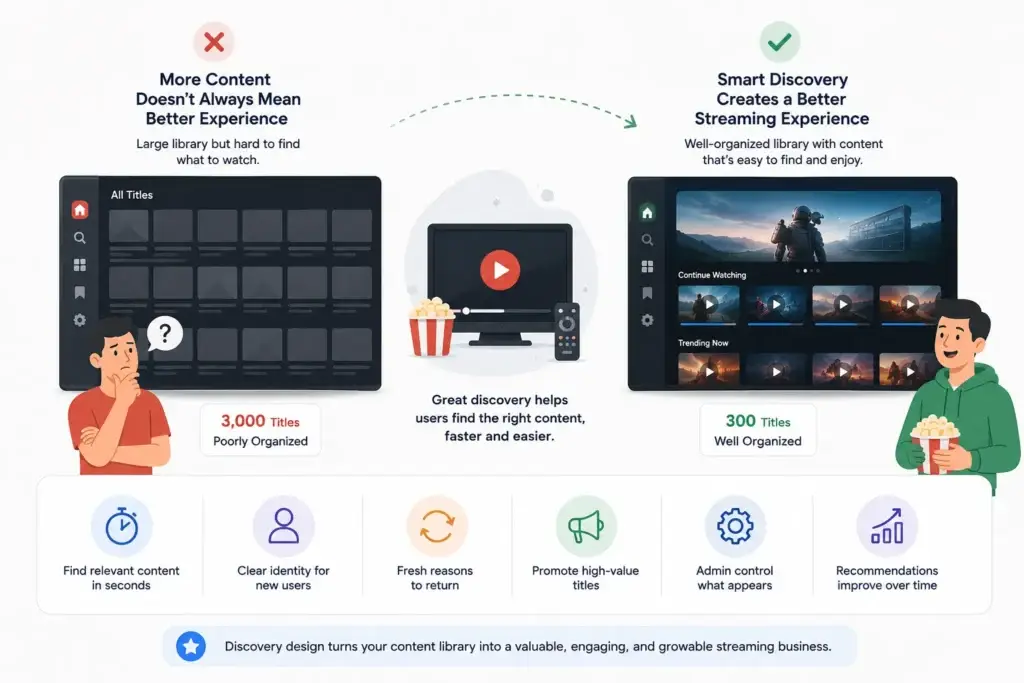
Image Source: AI-generated visual by Miracuves
Many new OTT founders assume that a bigger library automatically creates a better product. That is only partly true.
A large content library can help, but only when users can navigate it easily. Otherwise, more content can create more confusion.
The real question is not only, “How many titles do we have?” It is:
- Can users find something relevant in the first few seconds?
- Can new users understand the platform’s content identity?
- Can returning users see fresh options?
- Can the platform promote high-value titles?
- Can the admin team control what appears on the homepage?
- Can recommendations improve as more user behavior data becomes available?
A niche streaming app with 300 well-organized titles may feel more valuable than a platform with 3,000 poorly arranged titles. The difference is discovery design.
This is especially important for founders who are building subscription-based or hybrid OTT platforms. Users need repeated reasons to return. Content discovery creates those reasons by making the library feel alive.
Core Discovery Rails Every Streaming Platform Should Consider
Discovery rails are horizontal content rows that group titles around a specific reason to watch. They are common in modern OTT interfaces because they help users scan quickly without opening too many pages.
A rail should not be random. Each rail should answer a user question.
For example:
- “What is popular right now?”
- “What can I finish quickly?”
- “What is new this week?”
- “What matches my previous viewing?”
- “What should I watch before it disappears?”
- “What is available in my language?”
- “What is suitable for family viewing?”
For founders, rails are useful because they connect content strategy with user behavior. The homepage becomes a business tool, not only a visual layout.
Content Discovery Rails and Their Business Value
| Discovery Rail | Viewer Purpose | Business Value |
|---|---|---|
| Trending Now | Shows what other users are actively watching. | Creates social proof and increases engagement with high-performing titles. |
| Leaving Soon | Highlights titles that may become unavailable soon. | Creates urgency and helps maximize value from expiring content rights. |
| New Releases | Helps users find recently added movies, shows, or episodes. | Supports launch campaigns and keeps the platform feeling fresh. |
| Because You Watched | Suggests related titles based on viewing behavior. | Improves personalization and encourages longer sessions. |
| Genre Collections | Lets users browse by mood, format, or content type. | Improves navigation and increases visibility for deeper catalog titles. |
| Editor’s Picks | Shows curated recommendations selected by the content team. | Gives the platform editorial control over strategic or premium titles. |
Trending Rails: Helping Viewers Follow What Feels Popular
A trending rail shows titles that are gaining attention. It may be based on watch count, completion rate, likes, shares, search volume, new subscriptions generated, recent spikes, or a combination of engagement signals.
For users, trending sections reduce decision fatigue. Instead of browsing the entire catalog, they can start with what others are watching.
For platform operators, trending rails help amplify momentum. If a new show is performing well, surfacing it more prominently can increase watch time and improve the perceived freshness of the app.
However, trending logic should be designed carefully.
A simple “most watched all time” row can become stale because the same old titles may dominate forever. A stronger approach uses time-based freshness, such as:
- Trending today
- Trending this week
- Popular in your region
- Popular in your language
- Rising fast
- Most watched by similar users
- Trending in action movies
- Trending among family viewers
This gives the platform more flexibility and prevents the homepage from feeling repetitive.
Founder Insight
A trending rail is not only a popularity feature. It is a trust signal. When users see that other people are watching a title, they feel more confident choosing it. This is especially useful for new platforms that need to build viewing habits quickly.
Leaving-Soon Titles: Creating Urgency Without Feeling Pushy
Leaving-soon titles are movies, shows, or episodes that may be removed from the platform after a specific date. This usually happens because of licensing windows, regional content rights, seasonal deals, or limited-time promotional access.
For users, this rail answers a simple question: “What should I watch before it disappears?”
For founders, this feature can help increase content consumption before a license expires. Without a leaving-soon rail, users may never know that a title is about to become unavailable.
A strong leaving-soon experience should include:
- Clear labels such as “Leaving Soon” or “Available Until [Date]”
- A dedicated homepage rail
- Title-level expiry information
- Watchlist reminders
- Push notifications where appropriate
- Admin-side control for publishing and unpublishing dates
- Regional access rules if title availability differs by location
The goal is not to pressure users aggressively. The goal is to make availability transparent and useful.
Why This Matters for OTT Operations
Content rights are a real operational layer in streaming businesses. If a platform licenses regional films, live event recordings, documentaries, or partner content, availability may change. The admin dashboard should allow the content team to manage expiry dates, visibility, and promotional placement without depending on developers for every update.
This is where a ready-made video streaming solution with strong content management workflows becomes useful. Founders evaluating an OTT streaming platform foundation should review whether the admin panel can manage content visibility, categories, expiry windows, homepage banners, and recommendation rows in a practical way.
Genre Navigation: Helping Users Browse by Mood and Intent
Genres are one of the oldest and most useful discovery tools in video streaming. Users may not always know the exact title they want, but they often know the mood or category they are interested in.
Common genre filters include:
- Action
- Drama
- Comedy
- Thriller
- Romance
- Documentary
- Kids
- Family
- Horror
- Sci-fi
- Reality
- Sports
- Anime
- Regional cinema
- Short films
- Live events
But genre navigation should go beyond basic labels.
A strong OTT platform can combine genres with language, region, format, duration, audience type, and release timing. For example:
- Hindi crime dramas
- Tamil family movies
- 30-minute comedy episodes
- New documentaries
- Kids content under 20 minutes
- Regional thrillers
- Award-winning films
- Weekend binge shows
This type of layered browsing helps users narrow their choices faster.
Genre Pages Should Not Be Empty Category Dumps
Many streaming platforms make the mistake of creating genre pages that simply list every title under one category. That can feel overwhelming.
A better genre page includes curated sections such as:
- Most watched in this genre
- New in this genre
- Critically acclaimed picks
- Short watches
- Recommended for you
- Similar to titles you watched
- Popular by language
- Hidden gems
This makes each genre page feel intentional and useful.
Recommendation Systems: Turning User Behavior Into Better Viewing Paths
Recommendations are personalized content suggestions based on user behavior, content metadata, and platform rules.
A recommendation system may use signals such as:
- Watch history
- Search history
- Watchlist activity
- Completion rate
- Skipped titles
- Preferred genres
- Preferred languages
- Device usage
- Profile type
- Rating or like behavior
- Similar users’ viewing patterns
- Recently watched titles
- Time of day or session behavior
The purpose is simple: help each user find relevant content faster.
For founders, recommendation systems should be treated as a gradual maturity layer. The first version of a platform may begin with rule-based recommendations. Over time, the platform can move toward more advanced personalization as user data grows.
Rule-Based Recommendations
Rule-based recommendations are controlled by predefined logic.
For example:
- Show action movies after a user watches an action movie.
- Show new releases in the user’s preferred language.
- Show kids’ content inside a child profile.
- Recommend titles from the same actor, director, or franchise.
- Promote premium titles to users on higher plans.
This is easier to launch and works well for early-stage platforms.
Behavior-Based Recommendations
Behavior-based recommendations improve as the platform collects data. They may consider what a user watches, ignores, searches, completes, or adds to a watchlist.
For example, if a user watches several regional thrillers and completes most of them, the platform can show similar thrillers higher on the homepage.
Hybrid Recommendations
Hybrid recommendations combine business rules, content metadata, and user behavior. This is often more practical for growing OTT businesses because the platform operator still needs control over promotional priorities.
For example, the system may recommend personalized content but also give visibility to new releases, sponsored titles, seasonal collections, or premium content campaigns.
The Role of Metadata in Better Video Streaming Content Discovery
Recommendations are only as strong as the metadata behind the content.
Metadata is the information attached to each movie, show, episode, or video. It helps the platform understand what the title is about and where it should appear.
Important metadata fields include:
- Title
- Description
- Genre
- Subgenre
- Language
- Cast
- Director
- Release year
- Runtime
- Rating
- Age classification
- Tags
- Mood
- Region
- Content type
- Season and episode structure
- Trailer availability
- Subtitle and audio language
- Availability window
- Subscription access level
- Related titles
For founders, metadata discipline matters because it affects search, recommendations, genre pages, homepage rails, and reporting.
If metadata is incomplete, users may not find relevant titles. If genres are inconsistent, recommendations become weaker. If expiry dates are missing, leaving-soon rails cannot work properly. If language tags are poorly managed, regional discovery suffers.
A streaming platform’s content management system should make metadata entry practical for the admin or content team.
Homepage Design: How to Structure Discovery Without Overwhelming Users
The homepage is the most important discovery surface in a streaming app.
A good homepage should balance business priorities with viewer intent. If every row is promotional, users may feel the app is pushing content. If every row is algorithmic, the business may lose control over launches, partnerships, or premium titles.
A practical homepage structure may include:
- Hero banner for major releases or strategic campaigns.
- Continue watching row for returning users.
- Trending now rail.
- Personalized recommendations.
- New releases.
- Genre-based collections.
- Leaving-soon titles.
- Editor’s picks.
- Language or region-specific rows.
- Subscription-exclusive or premium access titles.
The order can change based on user type. A new user may need more curated rows. A returning user may need continue watching and personalized rows first. A child profile may need age-appropriate collections. A sports viewer may need live and upcoming events.
Founder Decision Signal
The homepage should not be hardcoded in a way that requires developer support for every change. A strong admin dashboard should allow the platform operator to manage banners, rails, categories, featured titles, and content priority from the backend.
Speed
If your platform needs to launch quickly, start with practical discovery modules such as homepage rails, genre pages, search, watchlist, and continue watching before investing in complex personalization.
Content Control
Your admin panel should let the content team manage categories, banners, featured titles, leaving-soon labels, and promotional collections without waiting for development changes.
Retention
Discovery features should help users return regularly by showing new releases, personalized suggestions, unfinished titles, and relevant genre collections.
Monetization
Discovery logic should support subscriptions, rentals, premium releases, ad-supported titles, sponsored rows, or bundled content depending on the business model.
Search vs Discovery: Why Streaming Platforms Need Both
Search and discovery are related, but they solve different problems.
Search helps users find something specific. Discovery helps users decide what to watch when they are unsure.
A viewer uses search when they already know the movie, actor, show, or genre they want. A viewer uses discovery when they are browsing casually.
Both systems should work together.
For example, if a user searches for “crime thriller,” the platform can show:
- Matching titles
- Related genres
- Popular crime shows
- Recently added thrillers
- Similar recommendations
- Language-specific crime dramas
Search should not end at a blank results page. Even when exact matches are limited, the app can guide users toward related content.
For new platforms, this is important because the library may not be huge at launch. Smart related suggestions can prevent dead ends and make the catalog feel more useful.
Personalization by Profile: Why One Account May Need Multiple Discovery Experiences
Many streaming users share accounts across family members. That means one subscription may include very different viewing preferences.
A parent may watch documentaries. A child may watch cartoons. Another user may prefer regional drama. Another may watch sports highlights.
If the platform treats the entire account as one person, recommendations become messy.
User profiles help solve this problem.
A strong profile-based discovery system can support:
- Separate watch history
- Separate watchlists
- Age-based restrictions
- Different language preferences
- Personalized recommendations
- Individual continue-watching rows
- Profile-specific genre behavior
This improves user satisfaction because each viewer gets a more relevant experience.
For founders, profiles also improve analytics. The business can better understand audience segments, viewing preferences, and content demand.
Read More:Video Streaming Platform vs Subscription-Only OTT Software: Which Gives Operators More Flexibility?
Content Discovery and Monetization: How Rails Influence Revenue
Discovery features can directly support monetization.
For subscription-based platforms, discovery helps users feel that the plan is worth renewing. For rental or pay-per-view platforms, discovery can promote premium titles. For ad-supported platforms, discovery can increase watch time and ad inventory. For hybrid platforms, homepage rails can guide users toward the right paid or free experience.
Examples of monetization-focused rails include:
- Premium releases
- Included with your plan
- Rent now
- Free with ads
- Subscriber-only picks
- Popular rentals
- New pay-per-view events
- Bundle recommendations
- Upgrade to watch
- Limited-time access
The key is to keep monetization helpful rather than intrusive. If every row pushes payment, users may lose trust. If paid content is presented with clear value and transparent access rules, discovery can support revenue without damaging the experience.
Admin Control: The Backend Layer Behind Smarter Content Discovery
Content discovery is not only a frontend feature. It depends heavily on backend control.
The admin dashboard should allow platform operators to:
- Create and edit genres
- Add custom tags
- Manage homepage rails
- Feature specific titles
- Schedule banners
- Set content availability dates
- Create leaving-soon collections
- Publish or unpublish titles
- Control regional access
- Manage subscription-based visibility
- Review title performance
- Track views, completion, and engagement
- Send notifications for new releases or expiring titles
Without this backend layer, the platform becomes difficult to operate. The team may need developers for simple content updates, which slows down campaigns and increases operational friction.
For founders comparing OTT product options, admin control should be a serious evaluation point. A Video Streaming Platform is more useful when the business can manage content discovery, subscriptions, and homepage visibility from a practical control panel.
Common Mistakes Founders Make With OTT Content Discovery
Building a Homepage With Random Content Rows
Every row should have a purpose. Random collections make the platform feel unorganized and reduce the chance that users will find something relevant quickly.
Ignoring Metadata Quality
Weak metadata damages search, recommendations, genre pages, and reporting. A strong content team should tag every title consistently.
Over-Personalizing Too Early
Advanced personalization needs enough user behavior data. Early-stage platforms should begin with practical rule-based recommendations and improve over time.
Not Showing Expiring Titles
If licensed content is leaving soon, users should know. A leaving-soon rail can increase urgency and help the platform extract more value before expiry.
Making Admin Changes Too Developer-Dependent
Content teams should be able to update rails, banners, genres, and visibility settings from the admin panel. Otherwise, basic operations become slow and expensive.
Practical Discovery Setup for a New Streaming Platform
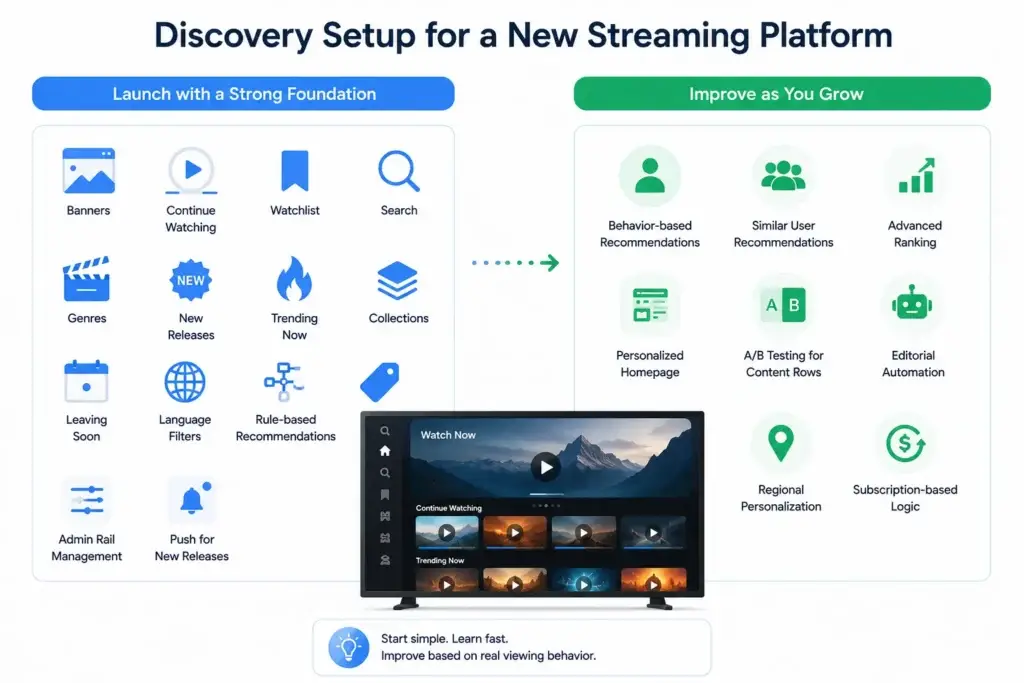
Image Source: AI-generated visual by Miracuves
A new OTT platform does not need the most advanced recommendation engine on day one. It needs a clean discovery foundation that users can understand and the business can manage.
A practical first version can include:
- Homepage banners
- Continue watching
- Watchlist
- Search
- Genre pages
- New releases
- Trending now
- Featured collections
- Leaving-soon titles
- Language filters
- Basic rule-based recommendations
- Admin-side content tagging
- Admin-side rail management
- Push notifications for major releases
This gives the founder enough discovery depth to launch, learn, and improve.
As the platform grows, it can add:
- User behavior-based recommendations
- Similar user recommendations
- Advanced ranking rules
- Personalized homepage ordering
- A/B testing for content rows
- Editorial automation
- Regional personalization
- Subscription-based recommendation logic
The smarter path is to launch with a solid foundation and improve based on actual viewing behavior.
How Miracuves Supports Discovery-Ready Streaming Platform Launches
Miracuves helps founders build white-label video streaming platforms that can be shaped around their brand, content library, audience behavior, and revenue model. Instead of treating the app as a basic video upload system, Miracuves focuses on the full OTT experience.
A discovery-ready streaming platform should support:
- User profiles for personalized viewing experiences
- Content organization through genres, tags, categories, and collections
- Trending rails, new-release sections, and leaving-soon title visibility
- Subscription, rental, or premium content access rules
- Smooth playback journeys across devices
- Search, watchlist, and continue-watching flows
- Recommendation logic based on content type, viewing behavior, and platform rules
- Admin control for managing homepage rows, banners, content visibility, and promotions
- Secure access, reporting, and content performance tracking
For a streaming business, this foundation matters because discovery directly affects engagement. Viewers need clear paths to trending titles, genre collections, new releases, continue-watching rows, and personalized suggestions. At the same time, the platform operator needs backend control to manage content visibility, monetization rules, and campaign priorities.
Founders planning a premium OTT product can use Miracuves’ ready-made video streaming solution as a faster starting point, then customize key discovery and business layers such as:
- Homepage rail structure
- Genre and language collections
- Subscription flows
- Content management logic
- Recommendation sections
- Promotional banners
- User experience and branding
- Admin dashboard workflows
This gives businesses a practical way to launch faster, reduce development effort, and avoid building every streaming module from zero.
Final Thoughts: Discovery Turns a Streaming Library Into a Product
Content discovery is where a streaming platform becomes more than a video library.
Trending rails show momentum. Leaving-soon titles create urgency. Genres help users browse with intent. Recommendations make the experience feel personal. Admin controls help the business manage the homepage, categories, metadata, and promotions without constant technical dependency.
For founders, the goal is not to copy the biggest streaming platforms feature by feature. The stronger decision is to build a discovery-ready platform that fits your audience, your content rights, your monetization model, and your launch strategy.
Miracuves supports founders with ready-made OTT app foundations that can be customized for content discovery, subscription access, user profiles, video playback, admin control, and faster market validation.
FAQs
What is content discovery in a video streaming platform?
Content discovery is the way users find movies, shows, episodes, live content, or videos inside a streaming platform. It includes homepage rails, search, genres, watchlists, recommendations, trending titles, new releases, and personalized content rows.
Why are trending rails important for OTT platforms?
Trending rails help users see what is popular or gaining attention. They reduce decision fatigue, create social proof, and help the platform promote content that is already generating viewer interest.
What does “leaving soon” mean in a streaming app?
Leaving-soon titles are videos that may become unavailable after a specific date because of licensing, content rights, regional restrictions, or limited-time deals. Highlighting them helps users watch the content before it expires.
How do genre pages improve video app navigation?
Genre pages help users browse based on mood, category, language, or content type. A strong genre page can include trending titles, new releases, short watches, recommended content, and curated collections within that genre.
Do new streaming platforms need advanced AI recommendations from day one?
Not always. Early-stage platforms can begin with rule-based recommendations using genres, language, watch history, and manual curation. More advanced personalization can be added as the platform collects more user behavior data.
What metadata is important for OTT content discovery?
Important metadata includes title, description, genre, language, cast, director, runtime, age rating, tags, release year, content type, subtitle options, availability window, and subscription access level.
How does content discovery support OTT monetization?
Discovery can promote subscription-only titles, rentals, premium releases, ad-supported videos, limited-time content, and personalized recommendations. Better discovery can increase watch time, retention, and paid content visibility.
What should founders check before building a streaming app discovery system?
Founders should check whether the platform supports homepage rail management, genre control, metadata tagging, search, watchlists, recommendations, leaving-soon labels, user profiles, admin control, and content performance reporting.
Miracuves is an independent software development company. We are not affiliated with, connected to, sponsored by, or endorsed by any company or product named in this article.
Terms such as “X Clone” are used descriptively. It is how the software industry refers to building a platform with functionality comparable to a known service, and how clients search for it.
The entire design and codebase of our products is built by our own team. Our products contain no code, design, graphics, or content originating from any third-party website or applications.
All third-party names and marks referenced in this article are the property of their respective owners, referenced solely to identify the services discussed.