Key Takeaways
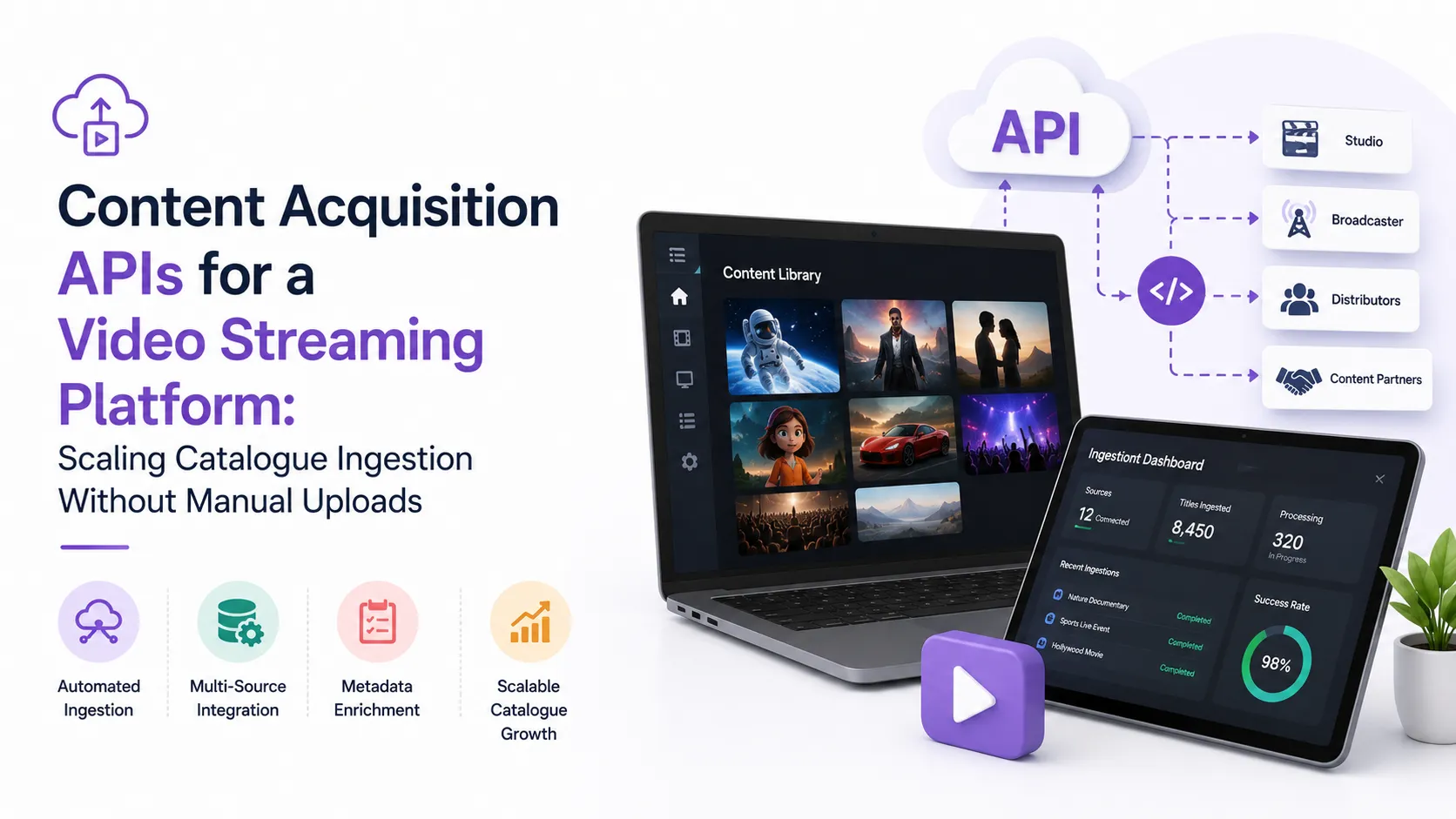
- A video streaming platform can use content acquisition APIs to ingest movies, series, episodes, metadata, artwork, subtitles, and availability data without relying on manual uploads.
- Automated catalogue ingestion connects content providers, APIs, metadata services, storage, transcoding, DRM, and content management workflows in one pipeline.
- Scalable acquisition reduces repetitive admin work while helping operators keep large content libraries accurate, synchronized, searchable, and ready for distribution.
API & Catalogue Signals
- Content APIs can import titles, genres, cast, descriptions, release data, thumbnails, trailers, language information, licensing windows, and regional availability.
- Webhook events, scheduled synchronization, duplicate detection, metadata mapping, validation rules, and error handling help maintain catalogue consistency across multiple providers.
- Ingestion pipelines should connect media storage, transcoding, subtitle processing, DRM, moderation, publishing rules, and CMS approval before content becomes available to viewers.
Scaling Insights
- Operators should monitor API limits, ingestion failures, processing queues, metadata quality, duplicate records, publishing status, and provider synchronization as catalogue volume grows.
- A modular ingestion architecture makes it easier to add new content partners, formats, regions, languages, licensing rules, and automated workflows without rebuilding the platform.
- Miracuves develops customizable video streaming platforms with content acquisition APIs, catalogue management, transcoding, DRM, metadata workflows, analytics, automation, and admin controls.
Video streaming platforms do not scale only because they have a good player, attractive interface, or subscription model. They scale when the backend can keep bringing new content into the platform quickly, cleanly, and reliably.
For a small video app, manual uploads may feel manageable. A team can upload a few videos, add titles, write descriptions, choose categories, attach thumbnails, and publish content manually. But once the platform starts working with studios, creators, distributors, regional content partners, live events, or large archives, manual upload becomes a bottleneck.
That is where content acquisition APIs become important.
A content acquisition API helps a video streaming platform receive video files, metadata, thumbnails, subtitles, rights information, language details, and publishing rules from external sources without depending on repetitive manual uploads. Instead of treating ingestion as a content team task, the platform treats it as a structured workflow.
For founders building video-first products, this matters because catalogue growth is directly linked to user retention, monetization, and operational speed. If content cannot enter the system fast enough, the platform cannot keep viewers engaged. If metadata is inconsistent, search and recommendations suffer. If rights windows are handled manually, publishing mistakes can create business and legal risk.
Miracuves helps founders build video platforms with scalable backend workflows, API-first architecture, admin control, white-label branding, and source-code ownership. For founders planning an OTT streaming platform, catalogue ingestion should be planned as a core product layer, not an afterthought.
Need a build beyond a ready-made base? Our video streaming app development service covers custom players, apps and back ends.
Why Manual Catalogue Uploads Break as Video Platforms Grow
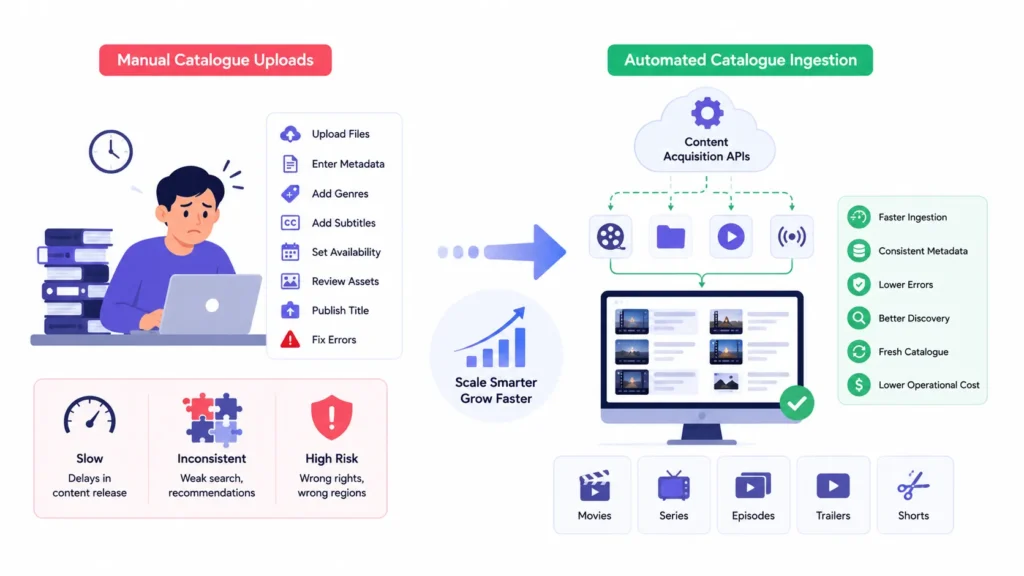
Manual upload is useful when a platform is testing its first content library. It gives the team control and helps founders understand the operational flow. But it becomes inefficient when the platform starts adding hundreds or thousands of titles.
A manual workflow usually depends on people doing repeated tasks:
uploading source files, entering metadata, assigning genres, checking thumbnails, attaching subtitles, setting availability, reviewing assets, publishing titles, and correcting errors.
This creates several problems.
The first problem is speed. A video catalogue may include movies, web series, episodes, trailers, short clips, language versions, subtitles, artwork, and promotional assets. Uploading everything manually delays release schedules.
The second problem is inconsistency. Two team members may write metadata differently. One may use “comedy drama,” another may use “dramedy.” One may add actor names in full, another may use abbreviations. These small differences weaken search, filtering, recommendations, and analytics.
The third problem is risk. If rights windows, region restrictions, or subscription availability are entered incorrectly, content may be published too early, expire too late, or appear in the wrong market.
For a video streaming business, ingestion is not just a backend activity. It affects catalogue freshness, viewer discovery, content partner trust, monetization, and operational cost.
What Content Acquisition APIs Actually Do
A content acquisition API is a structured interface that allows external systems to send content data into a video streaming platform.
This content data may include:
- Video source files
- Trailer files
- Episode files
- Series hierarchy
- Title, description, genre, and tags
- Cast and crew details
- Language and subtitle files
- Thumbnail and banner artwork
- Rights windows
- Region availability
- Subscription, rental, or pay-per-view rules
- Content ratings
- Publishing status
- Partner or distributor identity
In practical terms, a content acquisition API connects the platform to the source of content.
That source could be a studio’s content management system, a distributor feed, a creator upload portal, a cloud storage bucket, an MRSS feed, a media asset management system, or another OTT platform migration source.
Readers who are still mapping the broader streaming workflow can also review how a subscription video app works before planning deeper backend automation. This helps connect catalogue ingestion with user access, content libraries, subscriptions, playback, and admin control.
Modern ingestion systems often use APIs, cloud storage, watch-folders, live encoders, or feeds to bring video and metadata into the platform before validation, transcoding, indexing, and publishing.
The goal is not only to upload files faster. The real goal is to convert external content into clean, searchable, rights-aware, monetization-ready titles inside the streaming platform.
How API-Driven Catalogue Ingestion Works
A scalable catalogue ingestion workflow usually follows a clear sequence.
First, the external content source sends a request to the platform. This may include metadata, media file locations, artwork links, subtitle files, and rights information.
Second, the platform validates the request. It checks required fields, file formats, asset availability, duplicate title rules, language metadata, rights windows, and partner permissions.
Third, the platform creates a content object inside the CMS. This object may represent a movie, episode, trailer, short video, course, event recording, or creator upload.
Fourth, the platform pulls or receives media assets. Some systems allow content to be ingested from a remote URL. Mux, for example, allows a video file URL to be posted through its API so the file can be ingested, turned into an asset, and prepared for streaming.
Fifth, the platform triggers transcoding and packaging. AWS Elemental MediaConvert describes this pattern as taking an input file and turning it into one or more output files based on transcoding settings.
Sixth, the platform updates status using callbacks or webhooks. This matters because video processing is not instant for large assets. Mux describes webhooks as callbacks that notify the application when events occur, such as an asset becoming ready or failing during processing.
Finally, the content becomes available for review, scheduling, or publishing inside the admin dashboard.
This is the difference between upload and ingestion. Upload only moves a file. Ingestion turns that file into a usable video product.
Core API Modules Needed for Scalable Video Ingestion
A video streaming platform does not need one giant ingestion API. It needs a set of focused APIs that work together.
| API Module | What It Does | Founder Impact |
|---|---|---|
| Partner authentication API | Verifies studios, creators, distributors, or internal teams before accepting content | Prevents unauthorized uploads and protects catalogue quality |
| Asset submission API | Accepts video file URLs, direct uploads, or storage references | Reduces manual file handling |
| Metadata API | Receives titles, descriptions, genres, cast, language, and tags | Improves search, discovery, and recommendation quality |
| Artwork API | Accepts posters, thumbnails, banners, and preview images | Keeps the viewing experience visually consistent |
| Subtitle and track API | Adds subtitles, captions, audio tracks, and language versions | Supports accessibility and regional expansion |
| Rights and availability API | Defines regions, release windows, expiry dates, and access rules | Reduces publishing mistakes |
| Transcoding trigger API | Starts encoding, packaging, and rendition generation | Moves content from raw asset to playable format |
| Webhook API | Sends status updates for success, failure, processing, or publishing readiness | Reduces manual status checking |
| Admin review API | Routes content to approval, rejection, correction, or scheduled publishing | Gives operators control before content goes live |
This modular approach helps founders avoid building a fragile ingestion system. Each layer has a clear job, and each part can be improved as the platform grows. These ingestion modules should also connect with the wider set of video streaming app features, including content management, user access, monetization rules, admin controls, and playback workflows.
Metadata Mapping: The Layer That Makes Content Discoverable
Content acquisition APIs are only useful when metadata is clean.
A video file without accurate metadata is difficult to search, recommend, monetize, organize, or report on. Viewers do not search for file names. They search for genres, actors, topics, moods, languages, regions, seasons, and categories.
Metadata mapping converts incoming partner data into the platform’s internal structure.
For example, one distributor may call a field “movie_name.” Another may call it “title.” A studio may use “releaseYear,” while another source uses “year_of_release.” A strong ingestion system maps these variations into one consistent internal format.
Clean metadata supports:
- Search filters
- Category pages
- Personalized recommendations
- Continue-watching rows
- Genre collections
- Regional libraries
- Subscription access
- Advertising segments
- Content analytics
- Rights enforcement
Enveu notes that clean metadata at ingestion helps power search, recommendations, categorization, and rights enforcement downstream.
For founders, this is where catalogue ingestion becomes a growth decision. Better metadata helps users find the right content faster, which can improve watch time and retention.
Rights, Availability, and Content Governance
A video streaming platform must know who can watch a title, where they can watch it, when it becomes available, and how it should be monetized.
This is why rights data should be part of the content acquisition API.
A rights-aware ingestion system can capture:
- Start date
- End date
- Country or region availability
- Language availability
- Device restrictions
- Subscription tier
- Rental or purchase rules
- Free-trial eligibility
- Partner ownership
- Content rating
- Age controls where relevant
Amazon’s catalog ingestion documentation shows how media metadata can be structured in a catalog file and uploaded for ingestion, after which Amazon processes and consolidates the metadata so content can be surfaced across devices.
For independent streaming platforms, the same principle applies: the catalogue must be structured before it can be trusted at scale.
Rights control is especially important for platforms working with licensed content, regional distributors, sports recordings, education videos, or premium creator libraries. Without this layer, a platform can accidentally make content available in the wrong country, wrong subscription plan, or wrong time window. This is also where the platform’s OTT business model becomes important, because catalogue availability must align with subscriptions, rentals, ads, pay-per-view access, and regional content rules.
Background Processing and Webhooks for Reliable Ingestion
Video ingestion should not depend on a person refreshing a dashboard.
Large files take time to move, inspect, transcode, package, and publish. Some files fail. Some metadata is incomplete. Some thumbnails are missing. Some subtitles do not match the video duration.
That is why the ingestion layer should use background processing.
When a new asset enters the platform, the system should place heavy tasks into background queues. These tasks may include:
- File download or upload processing
- Virus or integrity checks
- Format validation
- Transcoding
- Thumbnail generation
- Subtitle parsing
- Metadata normalization
- Duplicate detection
- AI-assisted tagging where appropriate
- Moderation checks
- Publishing preparation
Webhooks then notify the platform when a task is complete or when something fails. Brightcove’s Dynamic Ingest API, for example, recommends callbacks to track ingest job progress, and its process includes creating a video object through a CMS API before sending the ingest request.
This matters because content teams need clear status, not guesswork.
A good admin dashboard should show whether a title is pending, processing, failed, ready for review, scheduled, published, or expired. This keeps the content pipeline transparent and prevents silent failures.
Founders planning deeper streaming infrastructure can also read Miracuves’ guide on <a href=”https://miracuves.com/blog/background-processing-creator-platforms/”>background processing for creator platforms</a>, because many of the same queue-based principles apply to video ingestion, encoding, notifications, moderation, and analytics.
Admin Controls Founders Should Plan Before Scaling
A content acquisition API should never publish every incoming asset automatically without control.
Automation should reduce manual work, not remove business judgment.
The admin dashboard should allow operators to:
- Approve or reject incoming content
- Edit metadata before publishing
- Review failed ingest jobs
- Retry failed processing tasks
- View partner-specific submissions
- Manage duplicate titles
- Check rights windows
- Assign monetization rules
- Preview videos before publishing
- Schedule launch dates
- Track ingestion history
- View logs for sensitive changes
This is where many streaming platforms become operationally weak. They build the upload feature but forget the control layer.
For founders, the admin layer is what turns ingestion automation into a manageable business workflow. Without it, automation can create a faster mess.
Manual Uploads vs API-Based Catalogue Ingestion
| Area | Manual Upload Workflow | API-Based Catalogue Ingestion |
|---|---|---|
| Speed | Slower for large libraries | Faster for bulk and partner-driven ingestion |
| Metadata quality | Depends on human consistency | Can be validated and mapped automatically |
| Error handling | Often handled manually | Can use retries, logs, and status callbacks |
| Partner onboarding | Requires repeated coordination | Partners can submit through structured flows |
| Rights management | Risk of manual mistakes | Rights fields can be checked before publishing |
| Scalability | Breaks as volume grows | Designed for larger catalogues |
| Admin control | Usually simple upload review | Can support approvals, queues, and audit logs |
| Best fit | Small early-stage library | Growing OTT, creator, education, sports, or niche streaming platform |
API-based ingestion can also affect development scope because the platform may need partner authentication, metadata validation, webhook handling, queue processing, rights management, and admin review workflows. Founders comparing build options can review the OTT app development cost guide to understand how features, backend complexity, integrations, and customization influence the final project scope.
The decision is not manual uploads or APIs forever. Many platforms start with manual uploads and later add API-based ingestion. The key is to avoid building the first version in a way that blocks future automation.
Founder Decision Signals
Speed
If your content team spends more time uploading and fixing files than planning releases, catalogue ingestion needs automation.
Cost
Manual operations may look cost-efficient early, but repeated metadata correction, failed uploads, and delayed publishing increase hidden operating costs.
Scalability
If you plan to work with creators, studios, distributors, or regional libraries, API-first ingestion gives the platform room to grow.
Market Fit
A streaming platform can test more categories, languages, and content formats faster when ingestion does not depend on manual uploads.
Where Content Acquisition APIs Fit in the Streaming Architecture
A video streaming platform usually has several major layers:
content sources, ingestion APIs, processing queues, storage, transcoding, CMS, search, recommendations, monetization, CDN delivery, player apps, and admin dashboards.
Content acquisition APIs sit near the beginning of this chain, but their impact reaches every layer after that.
If the acquisition API accepts poor metadata, the CMS becomes messy.
If the API does not validate rights windows, the monetization layer becomes risky.
If the ingestion system does not trigger transcoding properly, playback readiness is delayed.
If the API does not send status events, admins cannot know what is happening.
This is why founders should treat content acquisition APIs as part of the product foundation. They are not just developer endpoints. They shape the content supply chain of the streaming business.
For a broader infrastructure view, read Miracuves’ guide on video streaming infrastructure for short video apps. It explains how upload systems, file validation, encoding workflows, CDN delivery, adaptive playback, and backend scalability affect performance.
For founders comparing a fully custom OTT backend with a ready-made streaming platform foundation, the decision often depends on ownership, feature coverage, launch speed, pricing logic, and how much catalogue automation is needed from day one. Miracuves’ guide on ready-made streaming platform features and pricing can help readers understand how OTT foundations are usually evaluated before deeper customization.
Common Content Sources That APIs Can Connect
A video streaming platform may acquire content from multiple sources.
Studios may provide films, series, documentaries, or licensed content libraries. Creators may upload short videos, courses, livestream recordings, or premium content. Distributors may provide bulk catalogues through feeds. Broadcasters may provide live-to-VOD assets. Education companies may push course videos and lesson metadata. Sports businesses may upload match recordings, highlights, and event clips.
Each source has different ingestion needs.
A studio catalogue may need strict rights windows, metadata accuracy, subtitles, posters, and quality checks. A creator platform may need faster upload processing, moderation queues, creator attribution, and monetization rules. A sports platform may need event tagging, team names, match dates, highlight markers, and pay-per-view logic.
The API layer should be flexible enough to support these workflows without forcing every content partner into the same manual process.
Security and Access Control for Content Acquisition APIs
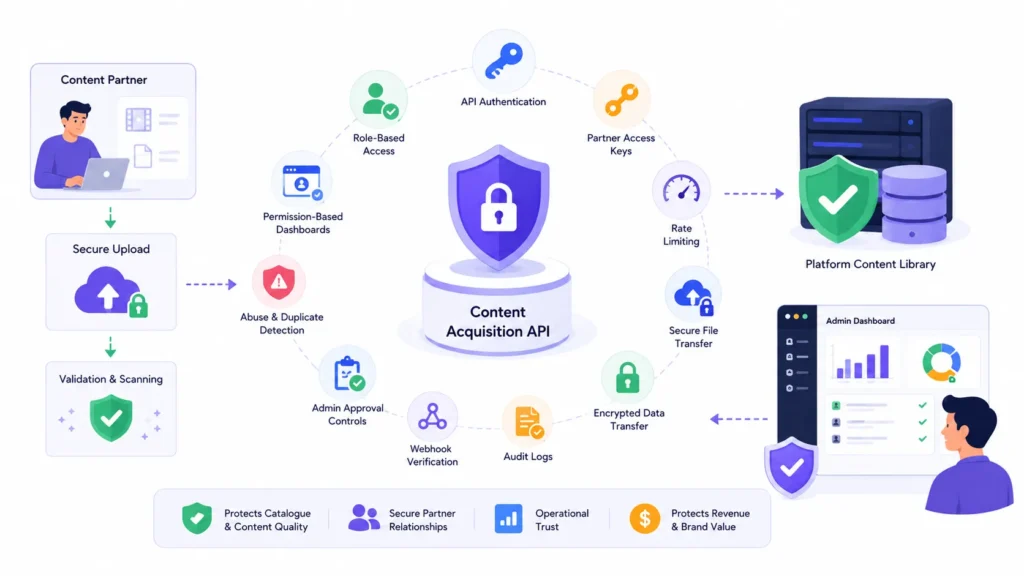
Content acquisition APIs should be protected carefully because they control what enters the platform.
Important security layers include:
- API authentication
- Partner-specific access keys
- Role-based access control
- Rate limiting
- Secure file transfer
- Encrypted data transfer
- Signed upload URLs
- Audit logs
- Webhook signature verification
- Admin approval controls
- Abuse and duplicate detection
- Permission-based dashboards
The goal is not only to protect files. The goal is to protect the platform’s catalogue, brand, revenue model, and content partner relationships. For a deeper look at risks around user access, payments, content protection, and platform trust, read Miracuves’ guide on video platform security risks.
If a partner account is compromised, a weak API could allow unauthorized content injection, incorrect metadata updates, or harmful files entering the processing pipeline. Strong permissions, review workflows, and logs help reduce that risk.
Mistakes Founders Should Avoid
Building Only a Manual Upload CMS
A manual CMS may look enough during the first release, but it creates operational friction when the content library grows. Founders should at least design the backend in a way that allows API-based ingestion later.
Ignoring Metadata Normalization
Content discovery depends on clean metadata. If genres, language names, categories, cast details, and tags are inconsistent, the platform will struggle with search, recommendations, and reporting.
Publishing Without Rights Validation
Streaming platforms should not treat every ingested asset as ready to publish. Availability windows, region rules, access tiers, and expiry dates must be reviewed before content goes live.
Forgetting Failed Ingest Recovery
Every ingestion pipeline will face failures. Files may be corrupted, links may expire, subtitles may mismatch, and metadata may be incomplete. The system should show clear errors and allow safe retries.
Treating API Integration as a One-Time Feature
Content acquisition APIs evolve as the platform adds partners, formats, languages, subscription models, and monetization rules. The API should be documented, versioned, and monitored from the beginning.
How Miracuves Helps Founders Build Scalable Video Catalogue Workflows
Miracuves helps founders launch video platforms with ready-made and white-label foundations that can support streaming workflows, admin control, monetization modules, and source-code ownership. Miracuves’ video content platform solutions are positioned around white-label video streaming apps, viewer tools, creator and admin systems, streaming engines, content management, and monetization-ready foundations.
For founders planning API-driven catalogue ingestion, Miracuves can support the product thinking behind:
- Content acquisition API architecture
- Metadata mapping workflows
- Admin review dashboards
- Video upload and processing flows
- Queue-based background processing
- Transcoding integration
- Content status tracking
- Partner-specific ingestion rules
- Rights and availability management
- Secure API communication
- Scalable backend structure
Founders can also explore Miracuves’ video content platform solutions and API development services to plan how ingestion automation should connect with the wider app ecosystem. If you are evaluating a technical partner for a subscription-based video product, Miracuves’ OTT app development company page explains how structured video platform development can connect product strategy, backend architecture, admin control, and launch execution.
Final Thoughts: Catalogue Ingestion Is a Growth Layer, Not a Back-Office Task
A video streaming platform becomes harder to operate when content growth depends on manual uploads. The larger the catalogue becomes, the more important it is to manage ingestion through APIs, metadata rules, rights validation, status tracking, background processing, and admin review.
Content acquisition APIs help founders build a cleaner content supply chain. They reduce repetitive work, improve publishing speed, protect catalogue quality, and make the platform more scalable as content partners increase.
For founders, the real decision is not whether the first version can upload videos. The real decision is whether the platform can keep ingesting, organizing, validating, and publishing content as the business grows.
Miracuves helps founders build video platforms with the product foundation needed for faster launch, stronger admin control, scalable workflows, and long-term customization.
FAQs
What are content acquisition APIs for a video streaming platform?
Content acquisition APIs are backend interfaces that help a video streaming platform receive videos, metadata, artwork, subtitles, rights data, and publishing rules from external sources such as studios, creators, distributors, cloud storage, or content feeds.
Why should a video streaming platform avoid manual catalogue uploads?
Manual uploads become slow and inconsistent as the content library grows. They can create metadata errors, delayed releases, duplicate entries, missing subtitles, incorrect rights windows, and higher operational workload.
How does API-based video content ingestion work?
API-based ingestion usually receives content data from an external system, validates the metadata and file references, creates a content object in the CMS, triggers media processing, updates status through webhooks, and prepares the title for review or publishing.
What metadata should be included during video catalogue ingestion?
Important metadata includes title, description, genre, category, cast, crew, language, subtitles, thumbnails, release year, duration, rating, region availability, subscription tier, rental rules, and expiry dates.
How do webhooks help in video ingestion workflows?
Webhooks notify the platform when an ingestion event happens, such as upload completion, processing success, transcoding failure, or asset readiness. This reduces manual checking and helps admins respond faster.
Should content acquisition APIs publish videos automatically?
Not always. For most professional platforms, the better workflow is automated ingestion followed by admin review, rights validation, quality checks, and scheduled publishing.
What is the difference between video upload and video ingestion?
Video upload only moves a file into the system. Video ingestion includes file transfer, validation, metadata mapping, transcoding, indexing, rights checks, and preparation for publishing or playback.
How can Miracuves help with video streaming catalogue ingestion?
Miracuves can help founders plan and build video platform workflows with API-first ingestion, admin dashboards, metadata handling, background processing, streaming infrastructure, monetization modules, and source-code ownership.
Miracuves is an independent software development company. We are not affiliated with, connected to, sponsored by, or endorsed by any company or product named in this article.
Terms such as “X Clone” are used descriptively. It is how the software industry refers to building a platform with functionality comparable to a known service, and how clients search for it.
The entire design and codebase of our products is built by our own team. Our products contain no code, design, graphics, or content originating from any third-party website or applications.
All third-party names and marks referenced in this article are the property of their respective owners, referenced solely to identify the services discussed.