
Key Takeaways
- A multi-asset investment platform can bring stocks, mutual funds, ETFs, bonds, and other supported investment products into one digital investing experience.
- Core features include digital onboarding, KYC, market data, asset discovery, watchlists, investment orders, portfolio tracking, payments, reports, alerts, and admin controls.
- Development cost depends on supported asset classes, market data and broker integrations, compliance workflows, security requirements, mobile and web scope, analytics, and customization depth.
Feature & Cost Signals
- Investor features may include asset search, live prices, charts, SIP or recurring investments, order history, holdings, performance dashboards, fund transfers, and personalized alerts.
- Cost can increase with real-time data feeds, multiple brokerage or investment APIs, advanced portfolio analytics, automated KYC, payment integrations, reporting, and multi-asset transaction logic.
- Security, encryption, authentication, audit logs, role-based permissions, risk controls, data protection, regulatory requirements, and scalable infrastructure should be planned as core platform components.
Founder Evaluation Insights
- Founders should define target investors, supported asset classes, revenue model, geographic market, regulatory requirements, integrations, and MVP scope before estimating development cost.
- A phased roadmap can begin with essential onboarding, investment, portfolio, and payment workflows before adding advanced analytics, automation, recommendations, and additional asset categories.
- Miracuves develops customizable multi-asset investment platforms with KYC, market data, investment workflows, portfolio management, payments, analytics, security, integrations, and admin controls.
A multi-asset investment platform is no longer judged only by how quickly users can place a trade. Founders now need to think about portfolio depth, onboarding, KYC workflows, risk controls, systematic investment flows, asset discovery, reporting, compliance readiness, and long-term scalability.
For users, the product should feel simple: one account, one portfolio, one dashboard, and easy access to different asset categories. For the platform operator, however, the backend has to manage identity verification, transactions, asset catalogues, payments, order activity, admin permissions, audit logs, user support, and analytics without becoming difficult to operate.
That is why founders should evaluate features and cost factors before development begins. The real question is not only, “How much does it cost to build an investment app?” A stronger question is, “Which product foundation will let us launch faster, stay flexible, and support more financial products over time?”
Miracuves helps founders approach this decision with ready-made, white-label app foundations that can reduce the time spent building core modules from zero. For teams exploring a faster route, a ready-made multi-asset investing platform can be a practical starting point for validating the market with stronger product control.
What Is a Multi-Asset Investment Platform?
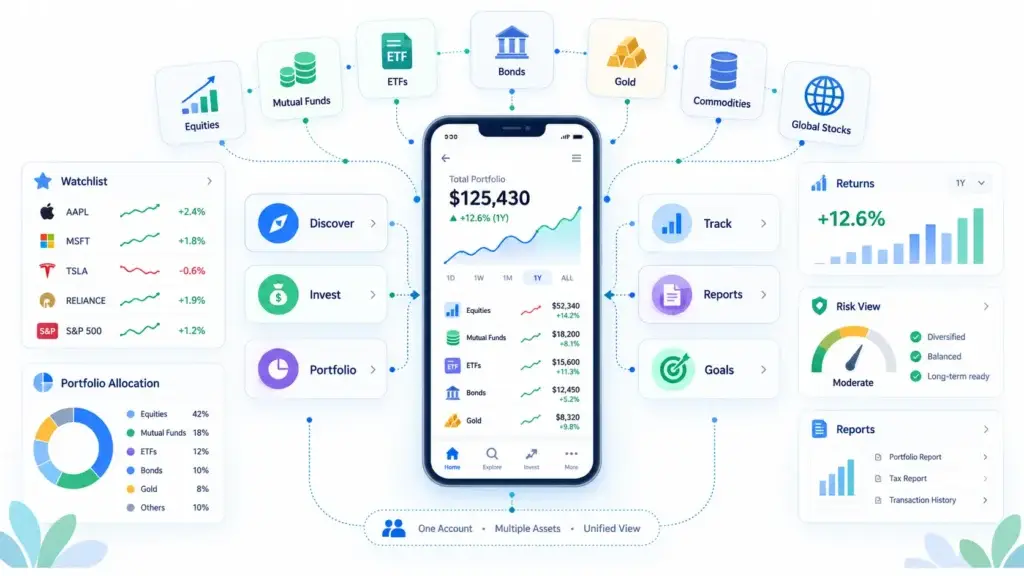
A multi-asset investment platform is a digital product that allows users to access, manage, and track different financial products from one account. Depending on the business model and regulatory setup, this may include equities, mutual funds, ETFs, bonds, derivatives, commodities, digital gold, fixed-income products, international stocks, or other investment categories.
The value is not only in showing many asset types. The stronger product logic is consolidation. Users do not want to jump between disconnected apps to understand their holdings, returns, risk exposure, and financial goals. They want one clean experience where discovery, execution, portfolio tracking, and reporting work together.
For founders, this means the app should be planned as a financial product ecosystem, not just a trading screen. A simple trading interface may help with early acquisition, but a wider investment platform can improve retention by giving users more reasons to stay, invest, monitor, and expand their financial activity over time.
Founders who want to explore broader investment platform solutions can use this category to understand how investor apps, portfolio tracking, order workflows, broker-side operations, and KYC-ready onboarding can fit into a scalable product foundation.
Why Founders Should Evaluate Features Before Development Starts
Feature planning directly affects cost, timeline, compliance complexity, and future scalability. Many fintech founders start with an attractive app interface but underestimate the operational systems behind it.
A multi-asset investment platform needs more than login, charts, and a buy button. It needs user verification, account status rules, portfolio calculations, payment flows, asset-specific metadata, support workflows, role-based admin access, transaction records, risk disclosures, and reporting systems.
If these are not planned early, development becomes reactive. New modules get added as patches. Data models become difficult to extend. Admin teams depend on developers for everyday operational changes. This increases cost after launch.
The smarter approach is to identify which features are essential for launch, which features can be enabled later, and which features must be part of the core architecture from day one.
Core User Features Every Investment Platform Should Consider
The user side of an investment platform decides whether people understand, trust, and continue using the product. Founders should focus on clarity, confidence, and repeat engagement.
To plan the right launch scope, founders can review the complete investment platform feature set and decide which onboarding, portfolio, asset discovery, transaction, and admin workflows should be active from day one.
1. Simple Onboarding and Account Creation
Onboarding should help users create an account, verify basic details, complete KYC steps, and understand what they can do next. The process should be clear enough for beginners but structured enough for regulated financial workflows.
Important onboarding elements include:
- Mobile number or email registration
- Identity verification flow
- KYC document upload
- Bank account linking
- Risk profile inputs where required
- Account approval status
- User consent records
- Security setup such as PIN, password, or biometric access
A smooth onboarding flow reduces drop-off. A weak onboarding flow creates confusion before the user even explores investment products.
2. Asset Discovery and Search
Users need to find investment options quickly. Search and discovery should support multiple asset categories, filters, sorting, watchlists, category pages, and educational context.
For example, a beginner may search by fund category or risk level, while an active trader may search by symbol, sector, price movement, or technical indicators. Both journeys require different UI logic but should connect to the same account and portfolio layer.
3. Watchlists and Personalized Tracking
Watchlists are important because they create repeat usage before a transaction happens. A user may not invest immediately, but they may return to track instruments, compare performance, or wait for a better entry point.
Founder insight: watchlists are not just a convenience feature. They are a retention feature. They help the platform learn user intent and create more relevant notifications, alerts, and product recommendations.
4. Portfolio Dashboard
The portfolio dashboard is one of the most important screens in an investment app. It should show holdings, allocation, returns, transaction history, asset-wise performance, and goal progress in a simple format.
A strong dashboard can include:
- Total invested value
- Current portfolio value
- Profit and loss
- Asset allocation
- Sector or category exposure
- Realized and unrealized gains
- Dividends or income history
- Goal-linked investments
- Risk indicators where relevant
The portfolio page should help users answer one question quickly: “Where do I stand financially?”
5. Order and Transaction Flow
If the platform supports buy, sell, switch, redeem, or transfer actions, the transaction flow must be clear and reliable. Users should understand charges, order status, payment confirmation, settlement expectations, and transaction history.
This is where product trust is built. Even small confusion around payments, order status, or failed transactions can damage user confidence.
6. Systematic Investment Features
Systematic investment features are important for wealth-focused platforms. These may include recurring investment plans, step-up contributions, withdrawal schedules, goal-based investing, and reminders.
For founders, systematic plans are valuable because they create repeat platform activity without needing to reacquire the same user every time. They also shift the product from transaction-led usage to long-term financial habit formation.
7. Alerts, Notifications, and Reminders
Notifications should not feel random. They should be tied to user intent, portfolio activity, payment events, account status, market movement, and educational journeys.
Useful alerts may include:
- KYC approval or rejection updates
- Payment success or failure
- Order execution status
- SIP or recurring plan reminders
- Price movement alerts
- Portfolio milestone updates
- Account security notifications
Poor notification design can increase uninstall rates. Good notification design improves trust and timely action.
Admin and Operator Features That Founders Should Not Ignore
Many founders focus heavily on the customer app and underestimate the admin side. In fintech, the operator console is not optional. It is where the business controls approvals, risk, support, content, transactions, user issues, and platform configuration.
Key Admin Modules for a Multi-Asset Investment Platform
| Admin Feature | Business Value | Founder Impact |
|---|---|---|
| User Management | Helps teams view, update, suspend, or support user accounts | Reduces dependency on developers for routine account issues |
| KYC Review Desk | Allows operators to review verification documents and approval status | Supports a more controlled onboarding process |
| Transaction Monitoring | Tracks payments, order activity, failed flows, and settlement issues | Helps detect operational gaps early |
| Asset Catalogue Control | Manages listed instruments, categories, visibility, and metadata | Makes product expansion easier |
| Support Ticket Desk | Connects user complaints with account and transaction context | Improves customer support quality |
| Audit Logs | Records admin actions and system changes | Supports accountability and operational review |
| Feature Flags | Enables or disables modules based on region, plan, or launch phase | Helps founders launch in stages |
| Analytics Dashboard | Shows platform activity, user behavior, and business performance | Helps leadership make product decisions |
The admin layer affects cost because it requires dashboards, permissions, workflows, secure authentication, reporting logic, and operational controls. But skipping it is risky. Without admin control, the founder may have an app that looks complete but is difficult to operate.
Compliance and Security Features Matter From Day One
Investment platforms operate in a trust-heavy category. Even when a founder is not directly handling every regulated activity themselves, the platform must be designed with compliance-ready workflows, secure data handling, clear audit trails, and responsible operational controls.
Important security and compliance-related layers include:
- KYC workflow support
- Encrypted data transfer
- Encrypted data storage
- Role-based access control
- Secure payment gateway integration
- Audit logs
- Admin access controls
- Activity logs
- Transaction monitoring
- User verification
- Risk disclosure flows
- Complaint and dispute workflows
- Secure API integration
- Privacy-conscious data handling
Founders should avoid treating compliance as something to “add later.” The final compliance requirement depends on jurisdiction, licensing, legal review, operating model, and integrations. But the software foundation should still be built in a way that supports compliance workflows instead of fighting them later.
Miracuves’ finance and investment app solutions help connect important fintech layers such as KYC workflows, transaction controls, portfolio logic, payment integrations, and source-code ownership into a more structured launch foundation.
Miracuves’ white-label investment app foundation is designed for founders who want source-code ownership, admin control, and a faster path to launch while still keeping room for compliance-led customization.
Miracuves Multi-Asset Investment Platform Solution Cost and Tech Stack
Miracuves Pricing for a Multi-Asset Investment Platform developed in JavaScript For $7,299 USD (One-Time Price) in just 6 days
Get a fully developed, deployment-ready multi-asset investment platform built for fintech startups, brokerage businesses, wealthtech companies, digital investment products, and founders planning to offer multiple asset classes through a single platform. Built on a modern JavaScript foundation, this complete package includes everything you need to launch and scale:
Core Workflows: User onboarding, KYC verification, investment account setup, asset discovery, watchlists, portfolio management, buy/sell order workflows, deposits, withdrawals, transaction history, and investment performance tracking.
Built-in Revenue Logic: Brokerage fees, transaction charges, spread-based revenue, premium subscriptions, advisory fees, portfolio management charges, API access fees, referral income, and financial product cross-selling.
Management Hub: Centralized admin dashboard, investor management, KYC review, asset management, order monitoring, transaction records, deposit and withdrawal controls, portfolio analytics, compliance logs, risk monitoring, and financial reporting.
Launch-Ready: Fully prepared for your custom branding, configuration, payment setup, KYC workflows, market data integrations, brokerage/API connections, asset category configuration, and immediate market entry.
Why Is Multi-Asset Investment Platform Development More Affordable?
Most multi-asset investment platforms become expensive when businesses choose fully custom development from scratch. Building separate workflows for investors, stocks, ETFs, commodities, digital assets, portfolio tracking, market data, transactions, compliance, payments, reporting, and admin controls can significantly increase cost, timeline, and technical complexity.
We took a smarter, more practical approach:
You Aren’t Paying for Ground-Up Development: Our investment platform engine is already developed, tested, and ready to deploy. You skip the inflated cost and long development cycles normally associated with building a complete multi-asset investment ecosystem from scratch.
The Power of JavaScript: We built this solution on a modern JavaScript architecture that supports interactive investment dashboards, scalable portfolio workflows, real-time data experiences, API-driven integrations, and smooth administrative operations.
You get a launch-ready multi-asset investment platform with practical investing, portfolio, compliance, monetization, and management features, source code access, and faster deployment without the high custom development price tag.
Note: This cost is for the solution, re-branding, deployment, and source code only.
Feature Scope vs Cost Impact
| Feature Area | Cost Impact | Why It Matters |
|---|---|---|
| Basic onboarding and login | Low to Medium | Needed for every user journey |
| KYC workflow and document review | Medium to High | Adds verification, admin review, and audit logic |
| Multi-asset catalogue | High | Different asset types need different data structures |
| Portfolio analytics | Medium to High | Requires accurate calculations and clean reporting |
| Payment gateway integration | Medium | Needs verification, testing, and failure handling |
| Market data integration | High | Depends on vendor APIs, licensing, and real-time needs |
| Systematic investment plans | Medium to High | Requires recurring logic, schedules, and notifications |
| Admin console | Medium to High | Determines how easily the business can operate |
| Security and audit logs | Medium to High | Critical for trust and operational review |
| Custom UI/UX design | Medium | Affects conversion, retention, and brand perception |
The best cost decision is not always the smallest build. It is the build that includes the right foundation for launch without overloading the first version with unnecessary complexity.
Ready-Made vs Custom Development: Which Route Makes More Sense?
Founders usually compare two paths: building everything from scratch or starting with a ready-made foundation that can be customized.
A custom build gives maximum flexibility, but it usually requires more discovery, design, engineering, QA, and iteration before the platform is ready. This can make sense for established financial institutions with unique workflows, proprietary integrations, or complex regulatory environments.
A ready-made route can be more practical when the founder wants to launch faster, validate demand, control branding, and avoid rebuilding standard modules from zero. In this model, the core flows are already available, while the business can still customize branding, modules, integrations, and launch scope.
| Build Route | Best For | Cost Logic | Launch Logic |
|---|---|---|---|
| Fully Custom Development | Complex institutions, unique workflows, deeply specialized systems | Higher due to full discovery, architecture, design, and engineering | Timeline depends on final scope |
| Ready-Made White-Label Foundation | Founders, fintech startups, agencies, and operators seeking faster validation | More cost-efficient because core modules already exist | Faster launch when requirements match the available foundation |
| Hybrid Customization | Teams that need a ready-made base plus specific integrations | Balanced cost based on customization depth | Faster than a full custom build, more flexible than a basic script |
When comparing build options, founders should also evaluate whether their fintech app development partner can support secure deployment, source-code handover, admin control, documentation, and future customization without creating vendor lock-in.
For founders evaluating speed and control, Miracuves offers a retail investing platform solution that can be delivered in 6 days where the ready-made scope fits the business requirement. Custom additions, integrations, compliance work, and special modules should always be scoped separately.
Founder Decision Signals
Speed
If your goal is to test demand quickly, a ready-made foundation can reduce the time spent building standard onboarding, portfolio, admin, and investment workflows from zero.
Cost
Cost rises when the platform needs more asset classes, real-time data, broker connectivity, deeper compliance workflows, and advanced analytics.
Scalability
A scalable platform should separate user flows, admin controls, transaction records, reporting, and integrations clearly enough to support future expansion.
Market Fit
Founders should launch with the asset categories and user journeys most relevant to their target audience instead of trying to activate every possible feature on day one.
Monetization Models for Multi-Asset Investment Platforms
A strong investment platform should be planned with monetization from the beginning. The right model depends on market, licensing, integrations, user segment, and product depth.
A practical investment platform revenue model should evaluate multiple income paths such as subscriptions, eligible transaction fees, premium tools, platform partnerships, and B2B licensing instead of depending on only one revenue stream.
Common monetization options include:
Brokerage or Transaction Fees
The platform may generate revenue from eligible transactions, depending on the market model and integrations. This works best when users trade or invest frequently.
Subscription Plans
Subscription plans can offer premium research, advanced alerts, analytics, reports, advisory access, or higher usage limits. This creates recurring revenue beyond transaction activity.
Distribution or Platform Fees
Some investment products may support platform or distribution economics depending on the regulatory environment and product category. This must be evaluated carefully with legal and compliance advisors.
Premium Tools
Advanced screeners, tax reports, portfolio insights, goal planning, or market intelligence tools can be offered as paid features.
B2B Licensing
A platform operator may also offer branded investment technology to advisors, agencies, financial educators, or distribution partners, depending on the business model.
Founder insight: monetization should not be added after development. The pricing model affects feature flags, plan limits, admin controls, reporting, user segmentation, and payment logic.
Mistakes Founders Should Avoid Before Launch
Building Only the Frontend Experience
An investment app may look simple from the outside, but the real product depends on backend workflows, data accuracy, transaction states, admin control, and compliance-ready records.
Adding Too Many Asset Classes Without a Clear Launch Sequence
More asset categories increase complexity. Founders should decide what launches first, what stays behind feature flags, and what requires future integration or licensing.
Ignoring the Operator Console
Without a strong admin dashboard, teams struggle to manage users, KYC, orders, support tickets, feature settings, and audit records after launch.
Underestimating Integration Costs
Market data, payments, verification, notifications, analytics, and broker connections can all affect final development cost and launch readiness.
What Should Founders Prioritize for the First Launch?
A practical first launch should focus on the strongest user journey, not the longest feature list. For many investment platforms, the first version should include:
- Account registration and secure login
- KYC workflow
- Basic user profile and bank details
- Asset discovery
- Watchlist
- Portfolio dashboard
- Transaction or investment flow
- Payment gateway setup
- Notifications
- Admin user management
- KYC review
- Support tickets
- Audit logs
- Basic analytics
- Security controls
Advanced features such as complex screeners, deep tax automation, advanced advisory workflows, multi-region asset access, or institutional reporting can be phased based on user demand and licensing readiness.
This staged approach helps founders control cost while still launching with a credible product.
How Miracuves Helps Founders Launch Faster
Miracuves helps founders build ready-made and white-label app solutions with source-code ownership, branded design, admin dashboards, and launch-focused execution.
For a multi-asset investing product, this matters because founders need both speed and control. Speed helps the business enter the market faster. Control helps the team customize features, integrations, branding, and workflows as the product grows.
Where the ready-made scope fits, Miracuves can support a 6-day delivery timeline for faster deployment. This works because the rapid app development process is based on ready-made foundations, structured QA, deployment preparation, branding, configuration, and source-code handover—not building every module from zero. For custom compliance requirements, advanced integrations, or high-scale enterprise workflows, the final timeline and cost should be confirmed based on the selected modules and launch scope.
Explore the source-code-owned investment platform if you are planning a branded investing app and want a faster route than building every module from zero.
Final Thoughts
A multi-asset investment platform is not just a trading app with more categories. It is a financial product ecosystem where onboarding, KYC, portfolio tracking, payments, asset discovery, reporting, security, and admin control must work together.
For founders, the strongest launch decision is not always the largest build. It is the product foundation that supports the right first market version, controls cost, reduces avoidable technical risk, and leaves enough flexibility for future asset classes and integrations.
If your goal is to launch faster with a branded, source-code-owned foundation, Miracuves can help you evaluate the right feature scope and deployment path.
FAQs
What features should a multi-asset investment platform include?
A multi-asset investment platform should include user onboarding, KYC workflows, asset discovery, watchlists, portfolio tracking, transaction flows, payment integration, alerts, admin dashboards, audit logs, analytics, and security controls. The exact feature set depends on the target market, asset categories, and regulatory requirements.
What affects the cost of building an investment app?
Investment app development cost depends on asset class coverage, market data integrations, payment gateways, KYC workflows, portfolio analytics, mobile and web platforms, admin dashboard depth, security requirements, third-party APIs, and customization scope.
Should founders build a custom investment app or use a ready-made platform?
A custom app may suit businesses with unique workflows or complex enterprise requirements. A ready-made platform can be better for founders who want faster market validation, branded launch, admin control, and lower development effort compared with building every module from scratch.
Why is the admin dashboard important in an investment platform?
The admin dashboard helps operators manage users, KYC approvals, transactions, support tickets, asset catalogues, feature settings, analytics, and audit logs. Without a strong admin layer, the business may struggle to operate the platform after launch.
Is KYC required for an investment app?
KYC requirements depend on the jurisdiction, financial products, operating model, and regulated partners involved. Founders should plan KYC workflow support early and confirm final compliance requirements with legal and regulatory advisors.
Can a multi-asset investment platform launch with limited features first?
Yes. Many founders launch with a focused set of asset categories and core user journeys first, then expand into additional instruments, advanced analytics, subscriptions, and integrations based on demand and licensing readiness.
How can founders reduce investment app development cost?
Founders can reduce cost by starting with a clear launch scope, using a ready-made foundation, prioritizing essential modules, avoiding unnecessary first-version complexity, and scoping integrations carefully before development begins.
How fast can Miracuves help launch a ready-made investment platform?
Where the ready-made scope fits the business requirement, Miracuves can support a 6-day delivery timeline. Custom integrations, compliance-specific workflows, advanced modules, and enterprise requirements should be scoped separately.
Miracuves is an independent software development company. We are not affiliated with, connected to, sponsored by, or endorsed by any company or product named in this article.
Terms such as “X Clone” are used descriptively. It is how the software industry refers to building a platform with functionality comparable to a known service, and how clients search for it.
The entire design and codebase of our products is built by our own team. Our products contain no code, design, graphics, or content originating from any third-party website or applications.
All third-party names and marks referenced in this article are the property of their respective owners, referenced solely to identify the services discussed.