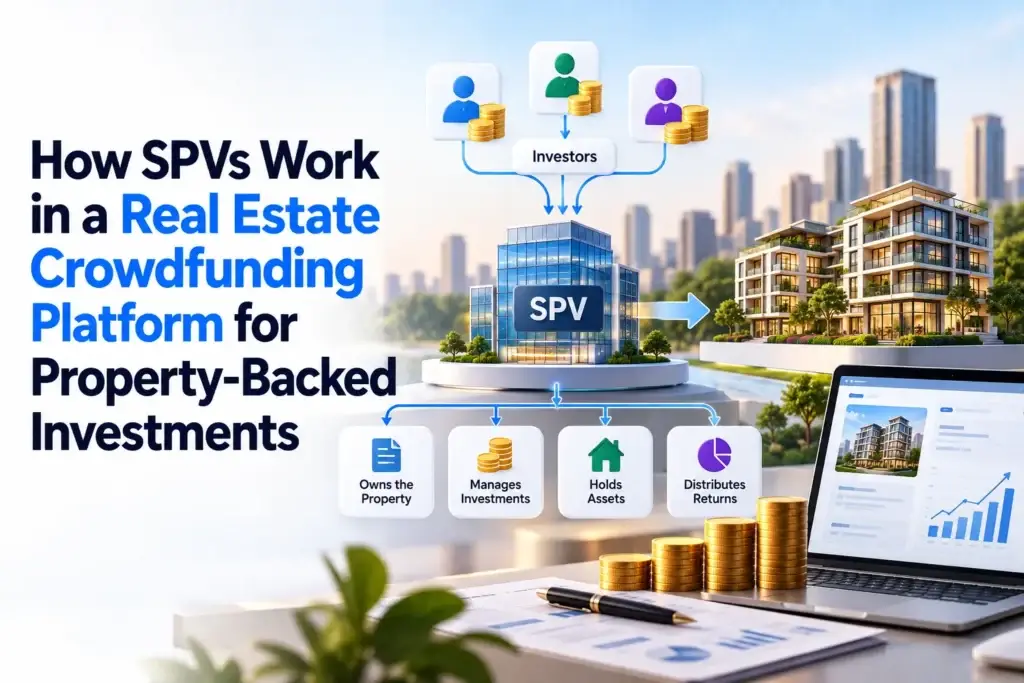


A multi-asset investment platform is not just a trading screen with a few financial products added on top. It is a connected fintech ecosystem where investors discover assets, complete onboarding, fund accounts, place orders, track portfolios, receive updates, and interact with support through one digital experience.
For founders, the real business question is not only “how does an investment platform make money?” The better question is:
How do investors, asset classes, orders, revenue streams, compliance workflows, and platform operations connect without creating a fragmented product?
That connection is what separates a basic trading app from a scalable wealth platform. When the user can move from stocks to funds, ETFs, IPOs, bonds, fixed deposits, digital gold, or other permitted assets inside one account experience, the platform increases retention, unlocks more monetization opportunities, and gives the operator better control over the customer journey.
This guide breaks down the multi-asset investment platform business model from a founder’s point of view. It explains how the ecosystem works, where revenue comes from, what operational layers matter, and why a ready-made fintech foundation can help businesses launch faster without building every module from zero.
Key Takeaways
- A multi-asset investment platform business model connects investors, asset classes, order workflows, portfolio tracking, compliance, and platform operations into one financial ecosystem.
- The strongest platforms do not rely on one revenue stream. They combine brokerage, subscriptions, distribution, advisory tools, premium insights, and permitted financial service integrations.
- Asset-class breadth improves retention only when the platform has unified KYC, wallet logic, order management, portfolio reporting, and admin control.
- Founders should plan compliance-ready workflows early, including KYC, risk checks, audit logs, transaction monitoring, and role-based access control.
- Miracuves helps founders move faster with ready-made, white-label fintech app foundations that include source code, branded design, admin control, and faster deployment.
What Is a Multi-Asset Investment Platform Business Model?
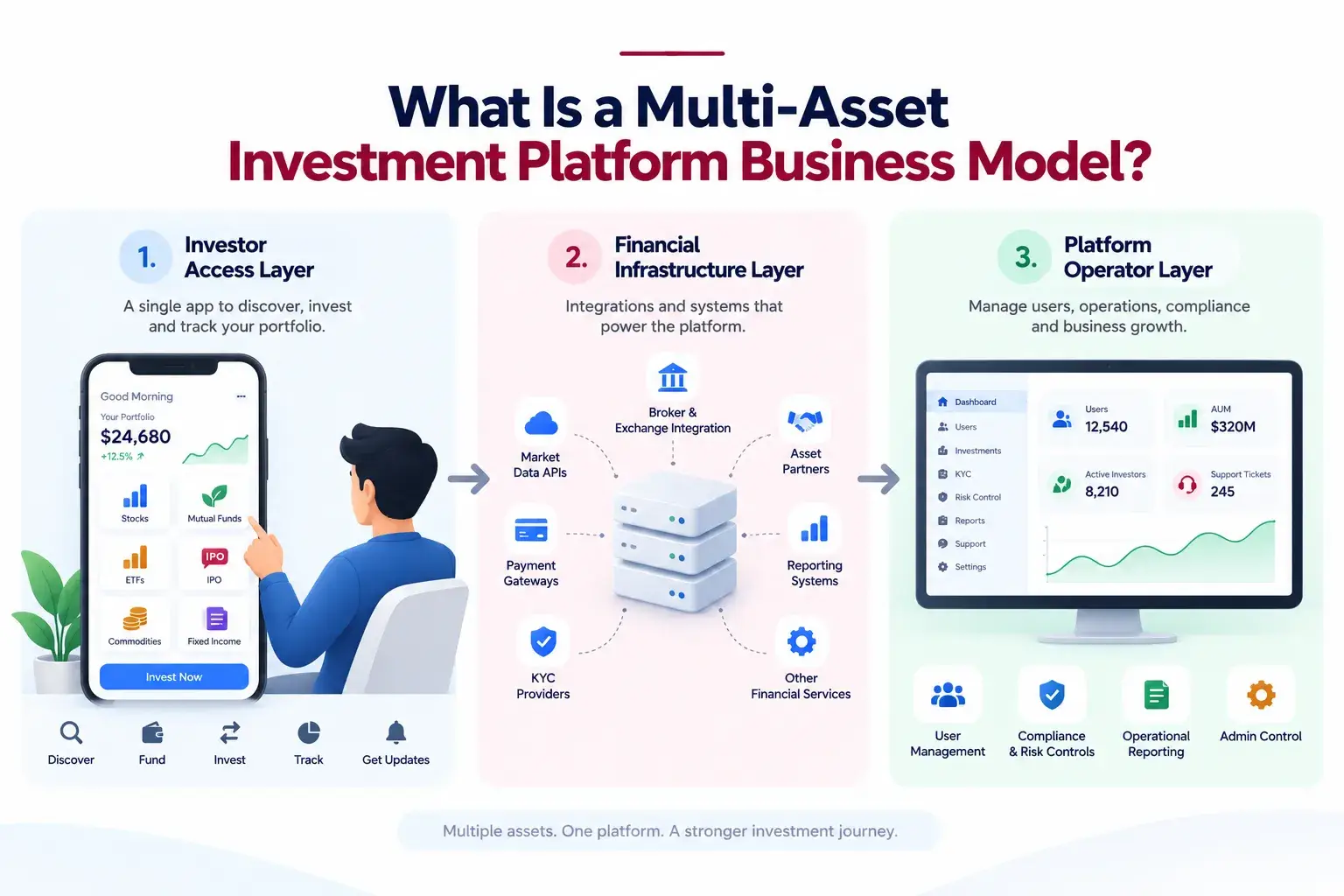
A multi-asset investment platform business model allows users to access different investment products through one digital account. Instead of forcing investors to use separate apps for stocks, mutual funds, ETFs, IPOs, fixed income, commodities, or other permitted assets, the platform brings discovery, transactions, records, reporting, and support into one operating layer.
The model usually combines three business roles:
- Investor access layer
This is the mobile app or web dashboard where users complete onboarding, search assets, fund their account, place orders, track portfolios, and receive updates. - Financial infrastructure layer
This includes broker integrations, exchange connectivity, market data APIs, payment gateways, KYC providers, asset partners, and reporting systems. - Platform operator layer
This is where the business manages users, fees, limits, asset availability, KYC review, risk controls, support tickets, reports, admin roles, and operational exceptions.
The business model becomes powerful when these three layers work together. If the investor experience is smooth but operations are weak, the business struggles to scale. If the backend is strong but onboarding is complex, users drop off. If revenue streams exist but compliance and risk workflows are unclear, the platform becomes difficult to operate responsibly.
Why Multi-Asset Platforms Are More Than Trading Apps
A basic trading app focuses mainly on order execution. A multi-asset investment platform focuses on a broader financial relationship.
That difference matters because investors do not always behave the same way. Some users want long-term SIPs or recurring investments. Some want short-term trades. Some want IPO access. Some want portfolio visibility. Some want educational support before making their first investment. Others want advanced dashboards, alerts, tax reports, or premium research.
A multi-asset platform gives the business more ways to serve those different user segments without pushing every user into the same transaction path.
Trading app vs multi-asset investment platform
| Layer | Basic Trading App | Multi-Asset Investment Platform |
|---|---|---|
| Core focus | Buy and sell orders | Full investor lifecycle |
| User journey | Account opening, trading, reports | Onboarding, asset discovery, orders, goals, portfolio, insights, support |
| Asset scope | Usually limited | Multiple asset classes based on licensing and integrations |
| Revenue logic | Mainly brokerage or transaction fees | Brokerage, subscriptions, distribution, advisory tools, premium insights, and permitted partner revenue |
| Retention driver | Trading activity | Portfolio consolidation and long-term financial engagement |
| Admin requirement | Order and user management | KYC, risk, payments, asset control, reporting, support, compliance workflows |
For founders, this distinction is important. A trading-first product may be easier to explain, but a multi-asset model can create stronger long-term engagement if the platform is built with the right operational foundation.
The Core Participants in a Multi-Asset Investment Platform
A multi-asset investment platform works because several participants interact through one controlled system. Each participant has a different role, and each role affects the business model.
1. Investors
Investors are the demand side of the platform. They create accounts, complete verification, deposit funds, explore investment products, place orders, and monitor returns.
A strong platform must support different investor types:
- First-time investors who need simple onboarding and clear guidance
- Long-term investors who care about goals, SIPs, portfolio tracking, and reports
- Active traders who need speed, charts, alerts, and order accuracy
- Higher-intent investors who may want premium insights or advanced tools
- Returning users who want one dashboard for multiple holdings
The more clearly the platform understands these segments, the easier it becomes to design onboarding, pricing, nudges, education, and monetization.
2. Asset Classes
Asset classes are the supply side of the investment experience. They may include stocks, mutual funds, ETFs, IPOs, bonds, fixed deposits, commodities, digital gold, REITs, or other products depending on the market, licence, and integration partners.
Every asset class creates new product opportunities, but it also adds operational complexity. Each asset type may need different data fields, order rules, disclosures, settlement logic, reporting, tax treatment, and partner integrations.
That is why founders should avoid treating asset expansion as a simple “add more products” decision. The right question is:
Can the platform support each asset class without breaking onboarding, order management, portfolio reporting, admin control, and compliance workflows?
3. Financial Partners and Infrastructure Providers
Most investment platforms depend on external infrastructure. This may include broker partners, exchange connections, market data providers, payment gateways, KYC vendors, banking partners, asset managers, and reporting systems.
These partners help the platform complete important workflows such as:
- Identity verification
- Market data access
- Order routing
- Payment collection
- Transaction settlement
- Portfolio updates
- Statements and reports
- Risk and compliance checks
For founders, partner readiness can affect launch timelines as much as software development. Even if the app is ready, final go-live depends on licensing, legal review, integration approvals, data vendor access, and operational readiness.
4. Platform Operators
The platform operator runs the business behind the app. This includes monitoring users, reviewing KYC cases, managing fees, resolving failed transactions, tracking order statuses, handling support tickets, controlling feature access, and reviewing operational reports.
The operator layer is often underestimated because users never see it directly. But for a fintech platform, the admin dashboard is not a back-office extra. It is the control room of the business.
How the Investor Journey Creates Business Value
The investor journey usually moves through five stages. Each stage creates a different business opportunity and operational responsibility.
Stage 1: Discovery
The user discovers the platform through search, paid campaigns, referrals, social content, education, or brand trust. At this stage, the platform must communicate simplicity, security, product breadth, and clear value.
Business value comes from lowering acquisition friction. Users are more likely to start when they understand what they can invest in, what documents are needed, how fees work, and how much control they will have.
Stage 2: Onboarding and Verification
The user creates an account, enters personal details, completes KYC, links payment methods, and accepts required disclosures.
This stage is critical because every additional step can reduce completion. But cutting corners is risky. The platform needs secure identity workflows, data validation, risk checks, audit logs, and admin review paths.
A founder should treat onboarding as both a conversion funnel and a compliance workflow.
Stage 3: First Transaction
The first successful transaction is the moment a visitor becomes an active investor. The platform must make asset discovery, pricing, order placement, payment confirmation, and post-order updates easy to understand.
A strong first transaction experience builds trust. A failed or unclear transaction creates support pressure and damages confidence.
Stage 4: Portfolio Engagement
Once users hold assets, the platform must help them understand performance, allocation, returns, risk, goals, statements, and upcoming actions.
This is where a multi-asset platform becomes more valuable than a single-purpose trading tool. When users can see multiple holdings in one place, the app becomes part of their financial routine.
Stage 5: Expansion
After trust is built, users may explore additional asset classes, premium tools, recurring investments, goal planning, alerts, research, or advisor-assisted workflows.
Expansion is where revenue diversification becomes possible. Instead of relying only on one-time transactions, the platform can increase customer lifetime value through deeper engagement.
How Asset Classes Shape the Revenue Model
Each asset class changes the business model because each one has different economics, user behavior, and operational needs.
Stocks and ETFs
Stocks and ETFs usually support brokerage, transaction-linked fees, market data tools, advanced charts, watchlists, and portfolio tracking. They attract both active traders and long-term investors.
The challenge is execution reliability. Users expect accurate prices, fast order status updates, transparent charges, and reliable portfolio reflection after trades.
Mutual Funds and Recurring Investments
Mutual funds and recurring investment plans support long-term retention. They may not always create high transaction frequency, but they can improve account stickiness because users return to monitor goals, SIPs, statements, allocation, and performance.
The product layer must support fund discovery, risk categories, scheme details, recurring instructions, pause or modification workflows, and portfolio reporting.
IPOs and New Offerings
IPO and new issue access can create high engagement because users frequently check upcoming opportunities, application status, allotment updates, and listing outcomes.
For founders, IPO workflows need careful status management, payment linkage, application confirmation, and communication triggers.
Fixed Income and Alternative Assets
Bonds, fixed deposits, digital gold, REITs, or similar assets can help the platform serve conservative investors, income-focused users, and portfolio diversification needs.
These products often require different disclosures, partner relationships, yield displays, maturity logic, redemption workflows, and suitability checks.
Margin, Credit, or Lending-Linked Products
Some platforms expand into margin-related or credit-linked products. These can create additional revenue potential, but they also require stronger risk controls, eligibility checks, repayment workflows, disclosure handling, and regulatory review.
Founders should not treat credit as a simple monetization add-on. It must be designed with risk, compliance, customer protection, and operational controls from the beginning.
Order Flow: How Transactions Move Through the Platform
The order flow is the operating spine of an investment platform. If order management is weak, the user experience, reporting layer, support team, and revenue model all suffer.
A simplified order journey looks like this:
- User selects an asset
- Platform checks eligibility and permissions
- User reviews price, quantity, fees, and disclosures
- User confirms the order
- Payment or wallet balance is verified
- Order is routed to the relevant partner or execution system
- Status updates return to the platform
- Holdings, ledger, and portfolio views are updated
- Reports, notifications, and audit logs are generated
- Admin team monitors exceptions, failures, and disputes
This flow looks simple from the user side, but each step needs strong backend coordination. A missed status update can confuse users. A delayed portfolio update can increase support tickets. A weak fee calculation layer can damage trust. A poor audit trail can create operational risk.
That is why order management should be designed as a core business system, not just a checkout screen.
Revenue Streams in a Multi-Asset Investment Platform
A scalable investment platform usually combines multiple monetization layers. The exact revenue model depends on licensing, jurisdiction, asset classes, pricing strategy, and partner agreements.
1. Brokerage or Transaction Fees
Brokerage is one of the most common revenue streams for trading-related products. The platform may charge a flat fee, percentage-based fee, capped fee, or segment-specific charge depending on the asset class and market rules.
This model works well when users trade frequently, but it can be cyclical. Trading activity may rise or fall based on market conditions, regulation, and user sentiment.
2. Distribution or Partner Revenue
Some investment products may create revenue through distribution arrangements, platform services, or partner commercial agreements. The structure depends on the product type, regulations, and whether the platform operates as a distributor, broker, advisor, or technology provider.
Founders should confirm what is permitted in their target market before building revenue assumptions.
3. Premium Subscription Plans
Subscription revenue can come from advanced tools, premium research, portfolio analytics, alerts, tax reports, goal planning, API access, or professional dashboards.
Subscriptions work best when users clearly understand the value. If the free product is weak, subscriptions feel forced. If the free product builds trust, premium tiers can become a natural upgrade.
4. Advisory or Assisted Investing Services
Some platforms offer advisor-assisted portfolios, managed baskets, goal-based planning, or model portfolio tools. These can create recurring revenue, but they may require additional licensing, suitability checks, disclosures, and human or automated advisory governance.
This model should be planned carefully because advice-related workflows carry higher trust and regulatory expectations.
5. Margin or Financing-Linked Revenue
Margin trading, secured lending, or credit-linked products may generate interest or fee income where permitted. These products require strict eligibility checks, risk rules, collateral logic, limit monitoring, repayment tracking, and user communication.
A platform should not introduce financing tools without the right compliance review and risk infrastructure.
6. B2B or White-Label Licensing
Some operators monetize the platform itself by offering branded versions to financial institutions, wealth firms, advisors, or regional partners. This turns the software foundation into a business-to-business revenue stream.
For this model to work, the platform needs strong configuration control, brand flexibility, permission-based dashboards, reporting, and operational separation between business accounts.
7. Education, Research, and Value-Added Tools
Investor education, calculators, market explainers, research modules, portfolio health checks, and tax-planning tools may support monetization directly or indirectly.
Even when these tools are not paid products, they can reduce user confusion, improve trust, increase engagement, and support conversion into more advanced features.
Business Model Canvas for a Multi-Asset Investment Platform
Multi-Asset Investment Platform Business Model Canvas
| Business Model Layer | What It Includes | Founder Impact |
|---|---|---|
| Customer Segments | First-time investors, long-term investors, active traders, wealth-focused users, financial partners | Defines onboarding, pricing, education, support, and feature depth |
| Value Proposition | One account for asset discovery, investing, tracking, reports, and financial tools | Improves retention by reducing fragmentation across multiple apps |
| Channels | Mobile app, web dashboard, referrals, search, education, partnerships, communities | Controls user acquisition cost and trust-building strategy |
| Revenue Streams | Brokerage, subscriptions, distribution, advisory tools, premium insights, permitted financing products, licensing | Reduces dependency on one transaction-based income line |
| Key Activities | KYC, order management, asset listing, portfolio tracking, payments, compliance workflows, customer support | Determines whether the business can operate reliably at scale |
| Key Resources | Technology stack, market data, broker integrations, payment rails, compliance workflows, admin dashboard | Creates the operational foundation for growth and trust |
| Key Partners | Brokerage partners, KYC providers, payment gateways, asset partners, data vendors, legal advisors | Affects go-live readiness, asset coverage, and compliance planning |
| Cost Structure | Technology, infrastructure, compliance, support, integrations, security, data feeds, user acquisition | Helps founders plan realistic unit economics before scaling |
Platform Operations: The Business Layer Founders Should Not Ignore
The visible app gets most of the attention, but the operator dashboard decides whether the business can scale.
A serious investment platform needs admin workflows for:
- User and investor profile management
- KYC review and verification status
- Asset-class permission controls
- Payment and wallet activity
- Order status inspection
- Failed transaction handling
- Fee and pricing configuration
- Reports and statements
- Support ticket management
- Risk alerts and suspicious activity flags
- Admin roles and access permissions
- Audit logs and activity history
- Notification and communication management
- Feature flags and product configuration
Without these workflows, the business becomes dependent on manual spreadsheets, developer intervention, and disconnected support processes.
For founders, this creates hidden cost. A platform may look launch-ready from the user side but become expensive to operate if the admin layer is weak.
Compliance-Ready Workflows in Investment Platforms
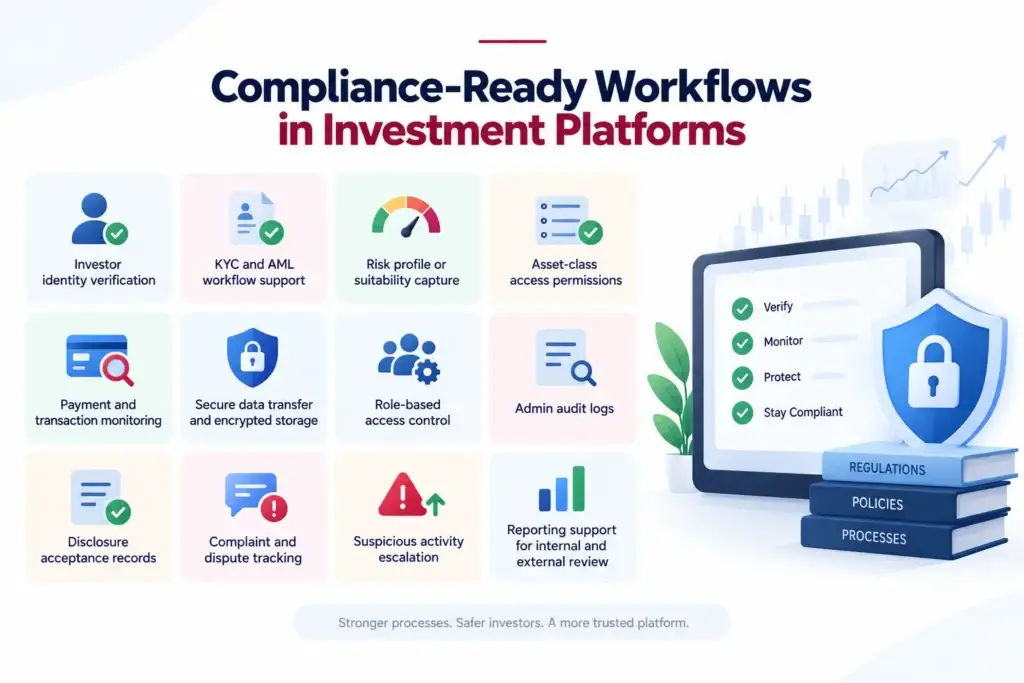
Investment platforms operate in regulated environments. The exact requirements depend on the country, licence, asset classes, partner model, and legal structure. Still, there are common workflow areas founders should plan early.
These include:
- Investor identity verification
- KYC and AML workflow support
- Risk profile or suitability capture where required
- Asset-class access permissions
- Payment and transaction monitoring
- Secure data transfer and encrypted data storage
- Role-based access control
- Admin audit logs
- Disclosure acceptance records
- Complaint and dispute tracking
- Suspicious activity escalation
- Reporting support for internal and external review
A software platform can provide a compliance-ready foundation, but final compliance depends on jurisdiction, legal review, operating model, licences, integrations, and partner approvals.
This is why founders should involve legal and compliance advisors before final go-live. The product can launch faster when the software foundation is ready, but the regulated operating path must still be planned responsibly.
Technology Architecture Behind the Business Model
A multi-asset investment platform needs connected architecture. Adding features one by one without a strong backend can create fragmented data, inconsistent reports, and slow operations.
The core architecture usually includes:
User and Identity Layer
This manages registration, login, KYC status, user profile, linked accounts, permissions, and security settings.
Asset and Instrument Layer
This stores details about stocks, funds, ETFs, IPOs, bonds, fixed deposits, commodities, or other supported products. Each asset class needs structured data fields, eligibility rules, and display logic.
Order Management Layer
This handles order creation, validation, routing, status updates, cancellations, confirmations, failures, and settlement-related events.
Wallet or Payment Layer
This manages deposits, withdrawals, payment verification, blocked balances, refunds, and transaction history where the operating model permits it.
Portfolio and Ledger Layer
This records holdings, performance, allocation, transaction history, realized and unrealized gains, dividends, recurring plans, and reports.
API and Integration Layer
This connects the platform with market data providers, broker systems, KYC providers, payment gateways, notification tools, analytics systems, and compliance workflows.
Admin and Reporting Layer
This gives the platform operator visibility into users, orders, payments, support, activity logs, revenue, risk, and system health.
When these layers are built properly, the business can expand asset coverage without rebuilding the entire platform each time.
Founder Decision Signals
Speed
If the goal is to test a fintech opportunity quickly, a ready-made foundation can reduce time spent building common modules such as onboarding, order flows, admin dashboards, and portfolio views.
Cost
Costs rise when each asset class is built as a separate system. A unified platform foundation helps founders control development effort, integration complexity, and long-term maintenance.
Scalability
The platform should support user growth, new asset classes, higher transaction volume, reporting needs, and operational exceptions without forcing a rebuild after launch.
Market Fit
Founders should validate which investor segment they want to serve first: beginners, active traders, long-term investors, wealth managers, regional users, or niche financial communities.
Ready-Made vs Custom Development for Investment Platforms
Founders usually compare two paths: building from scratch or starting with a ready-made fintech foundation.
Custom development gives full flexibility, but it can take longer because the team must build user onboarding, asset logic, order flows, integrations, admin controls, reporting, security, and compliance workflows from the beginning.
A ready-made foundation is useful when the business wants to validate faster, reduce avoidable build risk, and customize an existing product structure for its market.
| Build Path | Best For | Strength | Risk to Watch |
|---|---|---|---|
| Custom development from zero | Complex licensed institutions with highly specific workflows | Maximum flexibility | Longer timeline, higher discovery cost, more rebuild risk |
| Ready-made fintech foundation | Founders who want faster validation with core workflows already available | Faster launch, lower initial complexity, source-code ownership where provided | Must still validate integrations, licensing, and compliance needs |
| Hybrid approach | Businesses that need speed plus customization | Balanced launch path | Requires clear scope control and strong technical planning |
For founders exploring the ready-made route, Miracuves offers a launch-ready multi-asset investing app foundation that can be customized for brand, asset scope, admin control, and market requirements. The goal is not to copy another brand. The goal is to start with a proven product structure and adapt it responsibly for your own business model.
Common Mistakes Founders Should Avoid
Building Asset Classes as Separate Products
When stocks, funds, ETFs, and other assets are built as disconnected systems, users get fragmented portfolios and operators struggle with reporting, support, and maintenance.
Ignoring the Admin Dashboard
The admin layer controls KYC, orders, user status, payments, reports, support, and risk workflows. Without it, the business becomes hard to operate even if the user app looks polished.
Treating Compliance as a Footer Disclaimer
Compliance-ready workflows should be part of the product architecture. Identity checks, audit logs, disclosures, transaction records, and access controls cannot be added casually after launch.
Depending on One Revenue Stream
If the model depends only on trading fees, revenue may fluctuate with market activity. A stronger model evaluates subscriptions, value-added tools, distribution, advisory workflows, and permitted partner revenue.
How Miracuves Helps Founders Build Faster
Miracuves helps founders build ready-made and white-label fintech platforms with source-code ownership, branded design, admin control, and integration-ready architecture.
For investment platform founders, this matters because the hardest work is not only creating screens. The product must connect investor onboarding, asset discovery, KYC workflows, order management, portfolio tracking, payment flows, support operations, reporting, and compliance-ready controls.
A ready-made solution from Miracuves can help businesses move faster when the product scope fits the existing foundation. The 6-day delivery approach is especially useful for founders who want to validate a market, demonstrate product readiness, or reduce time spent building standard fintech modules from zero.
Founders can also review the asset-class and portfolio feature depth to understand how multi-asset breadth affects product planning, or explore investment platform cost and scope planning before finalizing a build path.
Final Thoughts
A multi-asset investment platform succeeds when the business model, product architecture, and operating system work together.
Investors want simple onboarding, clear asset discovery, reliable transactions, transparent reporting, and one place to understand their portfolio. Platform operators need KYC workflows, payment visibility, order control, risk checks, support tools, and audit records. The business needs revenue streams that can grow beyond one transaction type.
For founders, the right decision is not just whether to build an investment app. It is whether the platform foundation can support the investor journey, asset expansion, order accuracy, compliance workflows, and long-term monetization.
Miracuves helps founders move from idea to launch faster with ready-made, white-label fintech app solutions built for branding, admin control, source-code ownership, and scalable product execution.
FAQs
What is a multi-asset investment platform business model?
A multi-asset investment platform business model allows users to access different financial products through one digital account. It connects onboarding, KYC, asset discovery, order placement, payments, portfolio tracking, reporting, and admin operations into one system.
How do multi-asset investment platforms make money?
They can make money through brokerage, transaction fees, subscription plans, distribution arrangements, advisory tools, premium research, financing-related products where permitted, and B2B licensing. The exact model depends on the jurisdiction, licence, product scope, and partner agreements.
Why are multiple asset classes important for investment platforms?
Multiple asset classes help platforms serve different investor needs. Some users want long-term investments, some want active trading, some want IPO access, and others want fixed income or portfolio diversification. A broader asset catalog can improve retention if the platform has unified reporting and strong operations.
What operational features does an investment platform need?
A serious investment platform needs user management, KYC review, order monitoring, payment tracking, portfolio records, risk alerts, fee controls, support tickets, audit logs, reports, and role-based admin access.
Is a ready-made investment platform better than custom development?
A ready-made platform can be better when the founder wants faster validation and core workflows are already available. Custom development may be better for highly specific institutional requirements. Many founders choose a hybrid approach: start with a ready-made foundation and customize the product for their market.
How important is compliance in an investment platform?
Compliance is critical. Investment platforms should plan KYC, AML workflow support, risk controls, audit logs, user disclosures, transaction records, and admin access controls early. Final compliance depends on jurisdiction, legal review, licensing, integrations, and operating model.
What should founders check before launching a multi-asset investing app?
Founders should check target users, asset classes, licence requirements, broker or partner integrations, payment workflows, KYC process, revenue model, admin controls, reporting needs, security requirements, and support operations before launch.
How can Miracuves help with investment platform development?
Miracuves helps founders build ready-made and white-label fintech app foundations with source code, branded design, admin dashboards, faster deployment, and customization support. This helps businesses reduce development effort while planning product, compliance, and market launch more clearly.
Miracuves is an independent software development company. We are not affiliated with, connected to, sponsored by, or endorsed by any company or product named in this article.
Terms such as “X Clone” are used descriptively. It is how the software industry refers to building a platform with functionality comparable to a known service, and how clients search for it.
The entire design and codebase of our products is built by our own team. Our products contain no code, design, graphics, or content originating from any third-party website or applications.
All third-party names and marks referenced in this article are the property of their respective owners, referenced solely to identify the services discussed.