

Key Takeaways
- An Automated SIP Investment Platform should connect recurring schedules, payment mandates, portfolio updates, goals, notifications, failure handling, and admin control in one workflow.
- A strong SIP engine should support amount, frequency, investment product, mandate status, order creation, transaction history, and schedule changes.
- Step-up SIPs increase future recurring contributions, while top-ups add extra investments without changing the original schedule.
- Goal-based investing can improve retention by showing users progress toward targets instead of displaying only an active recurring investment.
- Founders should build reliable mandate, retry, ledger, audit, notification, and support workflows before adding advanced SIP automation features.
Automation Signals
- Recurring schedules should clearly manage investment amount, debit date, frequency, linked product, payment method, mandate, and current status.
- Step-up workflows need increment rules, future amount calculations, effective dates, user consent, reminders, and edit or pause controls.
- Top-up workflows should remain separate from the base SIP and clearly map additional contributions to the correct product, goal, portfolio, and transaction history.
- Failed mandates and payments should trigger status updates, retry rules, user notifications, support visibility, and traceable failure records.
- Admin teams should be able to monitor active, paused, failed, upcoming, step-up, and top-up investment activity from one control layer.
Real Insights
- SIP automation is more than recurring debit scheduling because every cycle also affects eligibility, payments, orders, settlements, portfolio records, and user communication.
- Users should always understand what amount will be debited, when it will happen, whether the schedule will change, and how they can pause or cancel it.
- The ledger should clearly distinguish initiated, pending, successful, failed, reversed, refunded, and settled transactions so recurring activity remains easy to reconcile.
- Advanced automation should be layered only after the core SIP engine is stable, because additional frequencies, step-ups, top-ups, goals, and personalization increase operational complexity.
- The strongest rollout is: build core SIP scheduling → connect mandates and payments → add failure and retry handling → update portfolio and ledger records → add notifications and admin visibility → introduce goals → add step-up and top-up flows → expand personalization and premium planning features.
SIP automation is one of the most important retention layers in an Multi-Asset Investment Platform. It helps users invest regularly without manually placing the same order every month, week, or selected schedule.
For founders, SIP automation is not just a “set and forget” feature. It affects user onboarding, payment mandates, portfolio tracking, goal progress, retry workflows, failed payments, notifications, compliance workflows, and admin control. A simple recurring payment screen may look enough at first, but serious wealth products need deeper scheduling logic behind it.
Users expect flexibility. Some want a fixed monthly SIP. Some want a step-up plan that increases every year. Some want to top up investments when they receive a bonus. Others want goal-based investing tied to education, retirement, travel, emergency savings, or long-term wealth creation.
This guide explains how SIP automation should work in a modern investment app, how step-up and top-up flows should be structured, why goal-linked investing improves retention, and what founders should evaluate before building scheduled investment workflows.
Why SIP Automation Matters in Investment App Retention
Many users start investing with good intent but inconsistent behavior. They may invest once, track the portfolio for a few days, and then stop engaging. SIP automation helps solve this by turning investing from a one-time action into a recurring habit.
Readers who need broader product context can also review this guide to how modern investing apps work before comparing SIP automation, wallet flows, and portfolio workflows.
For the user, automation reduces friction. They select an amount, frequency, instrument, mandate method, and start date. The app then handles reminders, payment attempts, transaction status, portfolio updates, and progress visibility.
For the platform operator, SIP automation improves repeat usage. A user with an active schedule is more likely to return, monitor performance, increase contributions, explore goals, and use related investment tools.
The strongest investment apps do not treat SIPs as isolated order forms. They connect recurring investing to the user’s wallet, bank mandate, portfolio dashboard, goal tracker, notifications, transaction history, and support workflows.
For founders evaluating a ready-made fintech launch path, Miracuves’ automated investing app foundation can help connect recurring investment flows with onboarding, wallet logic, portfolio visibility, and operator control.
What SIP Automation Should Include
A basic SIP flow allows a user to select an investment amount and repeat date. A stronger SIP automation system gives users flexibility while giving operators control over payment reliability, investment rules, and reporting.
| SIP Automation Layer | User Experience | Platform Requirement | Founder Impact |
|---|---|---|---|
| Recurring schedule | User selects amount, date, frequency, and investment product. | Schedule engine, mandate mapping, status tracking, and order creation logic. | Creates repeat investment behavior without manual user action every cycle. |
| Step-up plan | User increases SIP amount periodically based on income or goal needs. | Increment rules, future amount calculation, user consent, and notification workflows. | Supports higher long-term investment value and better goal alignment. |
| Top-up contribution | User adds extra money once or occasionally without changing the base SIP. | One-time contribution flow, transaction mapping, and portfolio tagging. | Captures bonus, surplus, or event-driven investing intent. |
| Goal linking | User connects recurring investments to a target amount and timeline. | Goal calculator, projection logic, progress tracking, and contribution suggestions. | Improves retention by giving users a reason to continue investing. |
| Retry handling | User receives alerts when payment fails and can retry or update payment details. | Failed mandate detection, retry rules, notification triggers, and status logs. | Reduces silent SIP failures and protects user trust. |
| Admin monitoring | User gets cleaner support when SIP status or payment issues occur. | Admin dashboard, schedule filters, failure reasons, audit logs, and support notes. | Helps operations teams manage recurring flows at scale. |
Step-Up SIP: Helping Users Increase Contributions Over Time
A step-up SIP allows users to increase their recurring investment amount at planned intervals. The increase may happen yearly, half-yearly, quarterly, or on another selected schedule depending on product design and allowed rules.
This feature is useful because many users start small. As income grows, they may want their investment amount to grow as well. Without step-up automation, the user must remember to manually edit the SIP amount. Many will not.
A step-up flow should allow users to choose:
- Current SIP amount
- Increment amount or percentage
- Step-up frequency
- Start date for increase
- Maximum contribution cap
- Goal connection
- Confirmation before future increase where required
- Notification reminders before change
- Edit or pause options
For example, a user investing ₹5,000 per month may choose to increase the amount by 10% every year. The platform should calculate future amounts, show a clear schedule, and communicate the change before it applies.
The most important product principle is consent. A user should understand when the SIP amount will increase and how much will be debited. Step-up automation should not feel hidden or confusing.
Top-Up Investing: Capturing Extra Contributions Without Breaking the SIP
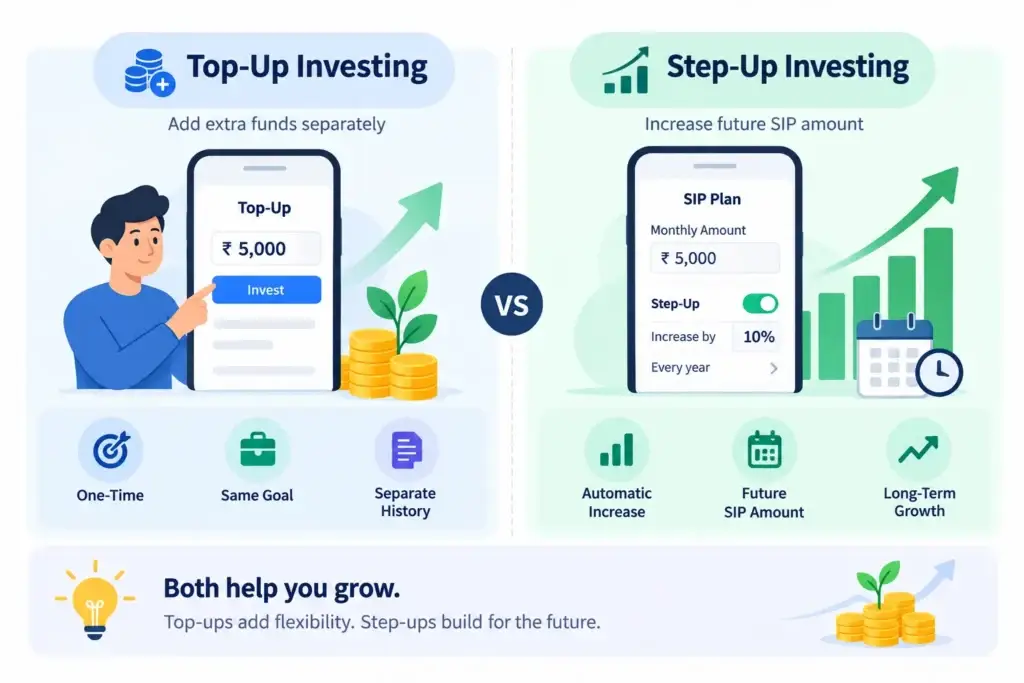
A top-up is different from a step-up.
A step-up changes future recurring contribution amounts. A top-up adds extra money separately, usually once or occasionally. This is useful when users receive bonuses, salary increases, extra savings, or want to accelerate progress toward a goal.
A well-designed top-up flow should answer three user questions:
- Will this change my existing SIP amount?
- Will this extra investment be mapped to the same goal or portfolio?
- Will this contribution be visible separately in transaction history?
Top-ups are useful because they give the user flexibility without disturbing the original schedule. The app can offer top-up prompts when the user is behind a goal, when a market-linked product dips, when the user receives a reminder, or when the user manually chooses to invest more.
A clean top-up workflow should include:
- One-time amount selection
- Linked investment product
- Linked goal where applicable
- Payment method or wallet selection
- Risk and product confirmation
- Transaction status
- Portfolio update
- Separate transaction history
- Optional recurring schedule adjustment
Founders should avoid mixing top-ups and step-ups in one unclear flow. Users need to know whether they are adding a one-time contribution or changing the future schedule.
Goal-Based Investing: Turning SIPs Into Progress
Goal-based investing gives users a reason to stay consistent.
Instead of showing only “monthly SIP active,” the app can show progress toward a target. This makes recurring investing more meaningful. A user saving for a house down payment, education, emergency fund, retirement, or long-term wealth can see whether the current monthly contribution is enough.
A goal-based investment flow should include:
- Goal name
- Target amount
- Target date
- Current invested amount
- Suggested SIP amount
- Expected contribution path
- Risk preference
- Recommended asset category where permitted
- Progress indicator
- Shortfall alerts
- Top-up suggestions
- Step-up suggestions
- Completion status
The product should not promise outcomes or guaranteed returns. Instead, it should show estimates, assumptions, and contribution paths clearly.
For founders, goals can improve user retention because they turn the app from a transaction tool into a planning companion. Users are more likely to continue investing when they understand what they are working toward.
Scheduled Investing Beyond Monthly SIPs
Monthly SIP is only one type of scheduled investing. A modern wealth app may support different frequencies based on user preferences, payment rails, product eligibility, and operational rules.
Possible scheduled investing options include:
- Daily recurring investment
- Weekly investment
- Fortnightly investment
- Monthly investment
- Quarterly investment
- Custom date investment
- Salary-date investing
- Goal milestone investing
- Festival or bonus top-up reminders
- Portfolio rebalancing reminders
- Manual recurring reminders without auto-debit
Founders comparing different wealth product directions can explore Miracuves’ investment app solution options to understand how different investing models can be structured.
The right schedule depends on user behavior. Some users prefer monthly investing because salaries arrive monthly. Others may prefer weekly micro-investments. Some may want reminders without automatic debits. Some may prefer salary-date scheduling, where the investment happens soon after income arrives.
A flexible schedule system should allow the operator to enable or disable frequencies by product type, user segment, country, payment method, or compliance rules.
Mandate Management and Payment Reliability
SIP automation depends heavily on payment reliability.
If mandates fail silently, users assume the platform is working while the investment never happens. This creates trust issues and support load.
A mandate management system should support:
- Mandate creation
- Mandate status tracking
- Linked bank account or payment method
- Maximum debit amount
- Mandate validity period
- User consent records
- Payment attempt history
- Failed payment reasons
- Retry rules
- Mandate cancellation
- Mandate update flow
- User notifications
- Admin visibility
The app should show users whether the mandate is active, pending, failed, expired, cancelled, or requires action. It should also notify users before scheduled debits, after successful investments, and when a payment fails.
For the platform operator, failed mandate analytics can reveal important patterns. If many users fail because of insufficient balance, reminders may help. If failures happen due to expired mandates, the app needs renewal prompts. If failures happen because of payment provider issues, operations teams need deeper reconciliation.
Wallet, Bank, and Ledger Logic for Scheduled Investing
SIP automation must be connected to money movement carefully.
Some platforms may debit directly from a bank mandate. Some may use wallet balances. Some may support both. Each model needs clear backend logic.
A scheduled investment flow should check:
- User KYC status
- Mandate validity
- Bank account status
- Wallet balance where applicable
- Product eligibility
- Investment amount limits
- Payment status
- Order creation status
- Settlement status
- Refund status if failure occurs
- Audit records
If your roadmap includes recurring investments across domestic and overseas assets, this guide to Indian and global investment access workflows can help you plan wallet permissions, portfolio visibility, and eligibility rules.
The ledger should clearly separate initiated, pending, successful, failed, reversed, refunded, and settled transactions. This matters because recurring investment flows generate many repeated financial events. Without clean records, support and reconciliation become difficult.
The user-facing experience should be simple, but the backend must preserve accuracy.
Notifications That Keep Users in Control
Automation should not make users feel disconnected from their money.
A strong SIP automation system should use notifications to keep users informed before and after important events.
Useful notification triggers include:
- SIP setup confirmation
- Upcoming debit reminder
- Successful debit
- Successful investment
- Failed payment
- Mandate pending approval
- Mandate expiry reminder
- Step-up amount change reminder
- Goal progress update
- Top-up suggestion
- SIP paused confirmation
- SIP cancelled confirmation
- Portfolio milestone alert
Notifications should be useful, not excessive. Users should be able to manage preferences where appropriate. The tone should be clear, especially for financial actions.
For example, a notification should say what is happening, when it will happen, the amount involved, and what the user can do if action is needed.
Admin Controls Needed for SIP Automation
SIP automation is not complete without operator controls.
The admin team should be able to monitor schedules, payment statuses, mandate issues, user complaints, order creation, product eligibility, and failure reasons.
Important admin controls include:
- Active SIP list
- Paused SIP list
- Failed SIP list
- Upcoming debit schedule
- User-wise recurring investment history
- Product-wise SIP volume
- Mandate status dashboard
- Failed payment reason filters
- Retry management
- Step-up schedule view
- Top-up transaction records
- Goal progress visibility
- User support notes
- Audit trails
- Role-based admin access
- Exportable reports
This allows the business to support users before small failures become trust problems.
For a deeper look at app modules behind recurring investments, portfolio views, wallet logic, and operator workflows, founders can review Miracuves’ investment app feature modules.
SIP Automation Workflow: From Setup to Portfolio Update
A strong SIP automation flow should be predictable for both the user and the platform.
| Workflow Stage | User Action | System Requirement | Business Value |
|---|---|---|---|
| Goal or product selection | User selects an investment product or goal. | Product catalog, eligibility checks, risk labels, and investment limits. | Ensures the user starts with a suitable and allowed flow. |
| SIP setup | User chooses amount, date, frequency, and payment method. | Schedule engine, mandate capture, consent record, and confirmation screen. | Creates repeat investment behavior. |
| Pre-debit reminder | User receives an alert before the debit date. | Notification scheduler and user preference logic. | Reduces failed payments and improves transparency. |
| Payment attempt | User does not need to take manual action if auto-debit is active. | Mandate validation, debit trigger, payment response, and retry handling. | Turns investing into a reliable habit. |
| Order creation | User sees investment status after payment processing. | Order lifecycle, product rules, settlement status, and transaction mapping. | Connects payment success to investment execution. |
| Portfolio update | User sees updated holdings, goal progress, and transaction history. | Portfolio engine, NAV or price update logic, ledger records, and reporting. | Reinforces trust and long-term engagement. |
Security, Consent, and Audit Trails in SIP Automation
Scheduled investing involves repeated financial activity, so security and consent must be designed early.
Users should understand what they are authorizing, how much may be debited, when debit may happen, and how to pause or cancel a schedule. The system should preserve records for consent, mandate status, schedule changes, payment attempts, failed transactions, successful orders, admin changes, and cancellation requests.
For deeper planning around wallet verification, KYC controls, consent records, and audit logs, this guide to investment app security workflows can help founders map trust and compliance-ready controls more clearly.
A secure SIP automation foundation should include:
- Encrypted data transfer
- Secure payment gateway integration
- Mandate consent records
- KYC status checks
- Bank verification status
- Transaction monitoring
- Role-based admin access
- Audit logs
- User activity history
- Admin activity history
- Failed payment logs
- Schedule change history
- Pause and cancellation records
For example, if a user changes a SIP amount, the system should record the previous amount, new amount, timestamp, user identity, and effective date. If an admin assists with a support request, that action should also be logged.
This does not mean software automatically guarantees compliance. Final compliance depends on jurisdiction, legal review, licences, payment integrations, and the operating model. The app should provide a compliance-ready foundation that supports proper workflows.
Founder Decision Signals
Speed
Start with core recurring investment setup, mandate status, payment retry, and portfolio updates. Step-up and top-up flows can be added once the base SIP engine is stable.
Cost
SIP automation cost depends on payment rails, mandate logic, schedule complexity, investment products, reporting depth, and admin workflows. Avoid building advanced automation before validating the core user journey.
Scalability
Recurring investing creates repeated transactions. The backend should handle schedules, retries, failures, ledger updates, and audit records without manual reconciliation for every case.
Retention
Goals, progress reminders, step-up prompts, and top-up suggestions can help users stay engaged because the app gives them a reason to continue investing consistently.
Monetization Opportunities Around Scheduled Investing
SIP automation can support monetization indirectly by improving retention, recurring engagement, and premium feature adoption.
Possible monetization paths include:
| Monetization Layer | How It Connects to SIP Automation | Founder Consideration |
|---|---|---|
| Premium portfolio tools | Users may pay for deeper goal tracking, reports, or advanced analytics. | Works only when users see clear ongoing value. |
| Advisory or assisted planning | Users may need help selecting contribution paths or goals. | Requires careful compliance and advisory workflow planning. |
| Subscription plans | Premium alerts, goal calculators, tax reports, or rebalancing tools can sit behind plans. | Should not block basic user trust features. |
| Distribution or transaction-linked revenue | Recurring investments can support steady investment activity where permitted. | Must be disclosed and aligned with regulations. |
| Business dashboards | Advisors, organizations, or partner brands may need recurring investment reporting tools. | Requires strict access controls and user permissions. |
Founders planning commercial workflows can study this wealth app business model breakdown to understand how subscriptions, investment access, portfolio tools, and user engagement may connect to revenue strategy.
Common SIP Automation Mistakes Founders Should Avoid
Building SIP Setup Without Failure Handling
A recurring investment flow must handle failed mandates, insufficient balance, expired payment methods, retry attempts, and user alerts. Otherwise, schedules may appear active while investments are not happening.
Confusing Step-Up and Top-Up Flows
Step-up changes future recurring amounts. Top-up adds extra investment separately. Mixing both flows can confuse users and create support issues.
Hiding Schedule Changes From Users
Users should always know the amount, date, frequency, and effective changes linked to their recurring investments. Clear consent and notifications protect trust.
Ignoring Admin Visibility
Without admin dashboards for active, failed, paused, and upcoming SIPs, the operations team cannot manage payment failures, user complaints, or recurring investment health at scale.
What Founders Should Evaluate Before Building SIP Automation
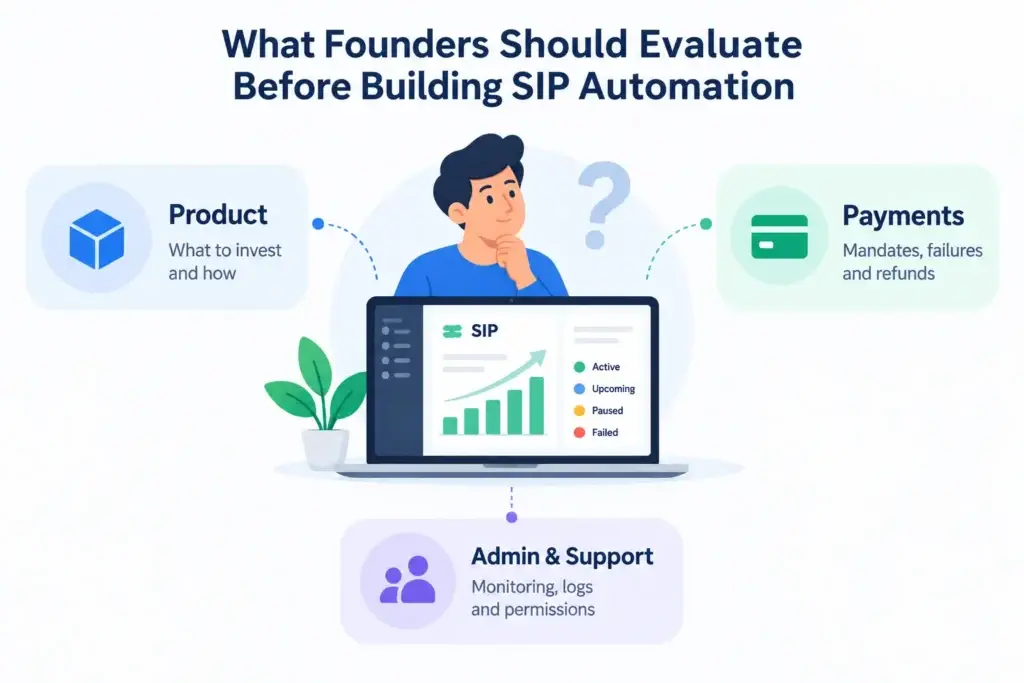
Before adding scheduled investing features, founders should answer practical product and operational questions.
Before finalizing the build scope, teams should review the investment app and compare the features and pricing considerations for investment apps.
Product Questions
- Which investment products will support SIPs?
- Will users invest by amount, units, goal, or recommended plan?
- Which frequencies will be allowed?
- Can users pause, resume, edit, or cancel schedules?
- Will step-up SIPs be available at launch or later?
- Will top-ups be linked to goals or treated separately?
- Will users receive reminders before every debit?
Payment and Mandate Questions
- Which payment methods support recurring debit?
- How will mandate status be checked?
- What happens when a mandate fails?
- How many retries are allowed?
- How are failed payments shown to users?
- How are refunds and reversals tracked?
Admin and Support Questions
- Can admins view active, paused, failed, and upcoming schedules?
- Can support teams see payment attempt history?
- Are user schedule changes logged?
- Are admin changes logged?
- Can reports be exported for reconciliation?
- Are role-based permissions available?
For teams estimating scope, the investment app development cost guide can help explain how SIP scheduling, wallet workflows, payment mandates, portfolio updates, and admin controls affect development planning.
If the product requires highly custom SIP rules, advanced payment mandates, unique portfolio workflows, or deeper integrations, Miracuves also offers custom mobile app development services.
How Miracuves Helps Founders Launch Scheduled Investing Features Faster
Miracuves helps founders build ready-made and white-label fintech app solutions with source-code ownership, branded design, admin dashboards, wallet workflows, portfolio views, KYC review, and recurring investment logic.
For suitable ready-made solution scopes, Miracuves can support 6-day delivery. This helps founders move faster than building every onboarding, wallet, SIP, dashboard, notification, and admin module from zero. Final scope, integrations, compliance requirements, and customization should still be confirmed before deployment.
If your team is comparing execution options, this guide on choosing an investment app development partner can help you evaluate fintech workflow depth, source-code ownership, implementation speed, and support expectations.
Final Thoughts
SIP automation is more than recurring payment scheduling. It is a retention system, goal-planning system, wallet workflow, notification engine, admin-control layer, and trust mechanism working together.
Step-up SIPs help users grow contributions over time. Top-ups help them add extra money without disrupting the recurring schedule. Goal-based investing gives those contributions meaning. Scheduled investing turns long-term wealth creation into a repeatable habit.
For founders, the smartest approach is to build the core SIP engine first: schedule setup, mandate status, payment attempts, failure handling, portfolio updates, notifications, audit logs, and admin visibility. Advanced step-up, top-up, personalization, and premium planning tools can then be layered with less operational risk.
Miracuves helps founders move faster with ready-made, white-label fintech app foundations that support source-code ownership, admin control, secure workflows, and 6-day delivery for suitable ready-made scopes.
FAQs
What is SIP automation in an investment app?
SIP automation allows users to schedule recurring investments at a selected amount, date, and frequency. The app manages mandate status, payment attempts, investment orders, portfolio updates, reminders, and transaction history.
How does a step-up SIP feature work?
A step-up SIP feature lets users increase their recurring investment amount over time. The increase may happen annually, quarterly, or on another selected schedule. The app should clearly show the future amount, effective date, and user consent.
What is the difference between SIP top-up and step-up?
A step-up changes future recurring investment amounts. A top-up is an extra contribution made separately without necessarily changing the ongoing SIP schedule. Both should be shown clearly in transaction history and portfolio records.
Why is goal-based investing useful in SIP apps?
Goal-based investing connects recurring contributions to a specific target such as education, retirement, emergency savings, or a major purchase. It helps users understand progress and stay consistent over tim
What happens when a SIP payment fails?
When a SIP payment fails, the app should show the reason where available, notify the user, trigger retry rules if allowed, update schedule status, record the failed attempt, and provide a way to update payment details or retry.
What admin controls are needed for SIP automation?
Admin controls should include active SIP lists, failed schedules, mandate status, upcoming debit view, payment attempt history, user support notes, step-up schedules, top-up records, audit logs, and exportable reports.
Can SIP automation support multiple asset categories?
Yes, scheduled investing can support different asset categories if the product rules, payment flow, eligibility checks, portfolio mapping, and settlement logic are configured properly. Each asset type may need different handling.
How can Miracuves help build SIP automation features?
Miracuves helps founders build ready-made and white-label fintech app foundations with wallet workflows, KYC review, portfolio views, recurring investment logic, admin dashboards, source-code ownership, and 6-day delivery for suitable ready-made scopes.
Miracuves is an independent software development company. We are not affiliated with, connected to, sponsored by, or endorsed by any company or product named in this article.
Terms such as “X Clone” are used descriptively. It is how the software industry refers to building a platform with functionality comparable to a known service, and how clients search for it.
The entire design and codebase of our products is built by our own team. Our products contain no code, design, graphics, or content originating from any third-party website or applications.
All third-party names and marks referenced in this article are the property of their respective owners, referenced solely to identify the services discussed.