
Key Takeaways
- A multi-asset investment platform go-to-market strategy should connect investor acquisition, KYC completion, account funding, first investment, portfolio engagement, and repeat investing within one measurable funnel.
- Investor growth can come from SEO, educational content, referrals, partnerships, paid campaigns, app store visibility, and product-led experiences built around stocks, mutual funds, ETFs, and other supported assets.
- Strong growth depends on moving users beyond registration toward funded accounts, first transactions, recurring investments, diversified portfolios, and long-term platform engagement.
Acquisition & Activation Signals
- Educational investing content, asset-specific landing pages, referral programs, financial communities, partnerships, and targeted campaigns can attract investors with different risk profiles and goals.
- Simple KYC, guided onboarding, watchlists, portfolio suggestions, clear asset discovery, transparent fees, and easy fund transfers can reduce friction between signup and first investment.
- Track acquisition cost, signup completion, KYC conversion, funded accounts, first-investment rate, time to first transaction, and activation by asset class to measure funnel quality.
Repeat Investing Insights
- SIPs, recurring investments, portfolio alerts, personalized recommendations, goal tracking, market updates, and watchlist notifications can encourage investors to return and invest again.
- Operators should monitor repeat investment rate, investment frequency, assets per investor, portfolio value, SIP activation, retention, and revenue per active investor to understand long-term growth.
- Miracuves develops customizable multi-asset investment platforms with KYC, asset discovery, portfolio management, recurring investments, payments, referrals, analytics, notifications, and admin controls, with delivery available in as little as 6 days.
Launching a multi-asset investment platform is not only a technology decision. It is a trust, education, acquisition, and retention challenge.
A founder may have equities, mutual funds, ETFs, systematic plans, wallet flows, watchlists, portfolio analytics, and admin controls ready inside the product. But if investors do not understand why they should sign up, complete verification, fund their account, place the first order, and return for repeat investing, the product will struggle to grow.
That is why go-to-market strategy matters.
A multi-asset investing app needs more than downloads. It needs investor confidence. It needs clear onboarding. It needs product journeys that reduce hesitation. It needs educational content that turns uncertain users into informed users. It needs retention loops that help investors come back without feeling pushed.
For founders planning to launch a modern retail investing platform, Miracuves helps create a ready-made, source-code-owned app foundation that can be delivered in 6 days, making it easier to focus on market entry, user acquisition, investor activation, and long-term platform growth.
This guide explains how to build a practical go-to-market strategy for a multi-asset investment platform without wasting acquisition spend or relying only on paid installs.
Why Multi-Asset Investment Platforms Need a Different Go-to-Market Strategy
A single-feature finance app can usually lead with one clear promise. A savings app may focus on better budgeting. A wallet app may focus on faster payments. A trading tool may focus on speed and charts.
A multi-asset investment platform is different because the product serves multiple investor mindsets at once.
One user may want to start with mutual funds. Another may want stock discovery. Another may care about long-term goals. Another may be interested in ETFs, systematic investments, or diversified portfolios. Some users are confident. Others are cautious. Some are ready to invest today. Others need education before they trust the platform.
This means the go-to-market strategy must avoid one generic message. Founders who are still studying the product logic behind retail investing apps can first understand how modern investment platforms work, including user journeys, investing flows, and platform engagement patterns.
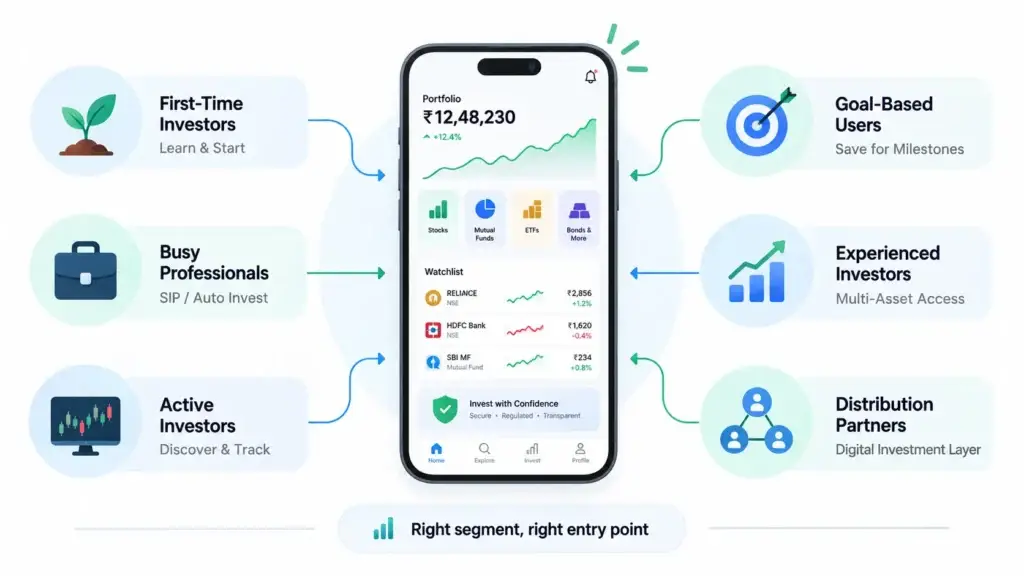
The platform should be positioned around investor journeys, such as:
- First-time investors who need guidance and confidence
- Busy professionals who want systematic investing
- Active investors who need market discovery and portfolio tracking
- Goal-based users saving for milestones
- Experienced users who want access to multiple asset categories
- Distribution-led businesses that already have a user base but need a digital investment layer
The stronger strategy is not “get everyone to download the app.” The stronger strategy is “match the right investor segment with the right entry point.”
Start With the Investor Segment, Not the Feature List
Many investment app launches fail because founders start marketing the platform by listing features.
Features matter, but investors rarely activate because of feature volume alone. They activate when the product solves a specific hesitation.
Before planning campaigns, define your first investor segment clearly.
| Investor Segment | Main Motivation | Main Hesitation | Best GTM Angle |
|---|---|---|---|
| First-time investors | Start safely and understand basics | Fear of losing money or choosing wrong products | Education-led onboarding |
| SIP-focused investors | Build wealth gradually | Unsure when or how much to invest | Goal-based recurring investing |
| Equity investors | Discover stocks and track performance | Need confidence in tools and execution | Research, watchlists, alerts |
| Wealth managers or advisors | Serve clients digitally | Need operational control and reporting | Admin control and portfolio visibility |
| Existing finance communities | Monetize audience trust | Need a branded investment experience | White-label investment platform launch |
| Regional fintech founders | Build local market presence | Need faster launch with custom branding | Ready-made app foundation |
Before finalizing acquisition campaigns, founders should also map their features and cost planning for investment platforms so the GTM strategy matches the actual product scope, investor journeys, and launch priorities.
This segmentation helps founders decide where to spend marketing money first.
For example, a founder targeting first-time investors should not begin with advanced trading language. The campaign should focus on simple onboarding, investor education, small-ticket entry points, portfolio visibility, and trust.
A founder targeting experienced investors can talk more about multi-asset access, watchlists, order flows, analytics, and advanced portfolio tools.
Build the GTM Funnel Around Investor Behavior
A normal app funnel often looks like this:
Awareness → Install → Signup → Purchase
An investment platform funnel needs more stages because the user is making a financial decision. The product must earn trust before asking for action.
A better go-to-market funnel looks like this:
Awareness → Education → Signup → Verification → Wallet Funding → First Investment → Portfolio Tracking → Repeat Investing → Referral
Each stage needs a separate strategy.
Awareness
At this stage, users are not ready to invest through the platform yet. They may be searching for beginner investing, mutual fund basics, stock market education, portfolio diversification, SIP planning, or wealth-building ideas.
The goal is not immediate conversion. The goal is familiarity.
Useful channels include:
- SEO blogs
- Short educational videos
- Social posts
- Founder-led content
- Finance explainers
- Webinars
- Community discussions
- Newsletter content
Signup
Signup should feel low-risk. Do not overwhelm the user with every feature at once. Explain what the platform helps them do and what comes next.
A good signup journey answers:
- What can I invest in?
- Is my data safe?
- What documents are needed?
- Can I explore before investing?
- What happens after verification?
Verification
Verification is often the first serious drop-off point. Users may hesitate if the process feels long, unclear, or risky.
Founders should make this stage transparent by showing:
- Why verification is needed
- What documents are required
- How long each step may take
- What happens if the submission is rejected
- Where users can get support
First Investment
The first investment is the real activation point. A user who signs up but never invests is not fully activated.
The first investment journey should be simple, guided, and confidence-building. It can include beginner-friendly filters, watchlists, small-ticket investment options, portfolio previews, risk explanations, and goal-based suggestions.
Repeat Investing
Repeat investing is where long-term platform value starts. Users return when they see progress, receive useful alerts, understand their portfolio, and feel that the platform helps them make better decisions.
Investor Acquisition Channels That Work for a Multi-Asset Investing App
Investor acquisition should not depend only on paid app install campaigns. Paid installs may create visibility, but they do not automatically create trust.
A multi-asset investment platform needs a blended acquisition strategy.
1. SEO-Led Education
Search is one of the strongest channels for finance products because users often research before acting.
Content can target informational queries such as:
- How to start investing with small amounts
- How systematic investing works
- Mutual funds vs stocks for beginners
- How to build a diversified portfolio
- What is portfolio allocation?
- How to track investment goals
- How to invest regularly without timing the market
This kind of content attracts users before they are ready to choose a platform. Over time, it builds authority and trust.
Readers who are still researching the fintech market can also explore Miracuves’ fintech app development insights to compare related product models, technology considerations, and growth topics before finalizing a launch strategy.
2. Founder-Led Content
Investing is trust-driven. People often want to know who is behind the platform and what the brand stands for.
Founder-led content can explain:
- Why the platform exists
- Which investor problems it solves
- How the product simplifies investing
- What the team believes about financial education
- How users should think about long-term investing
This makes the brand feel more human and less transactional.
3. Community-Led Growth
Communities work well for investment platforms because financial decisions are influenced by conversations, education, and peer confidence.
A founder can build communities around:
- Beginner investing
- Long-term wealth creation
- Goal-based planning
- Financial literacy
- Market education
- Young professionals
- Regional investor groups
The community should educate first and promote second.
4. Referral Programs
Referral programs can work well when the product already delivers trust and value.
The referral should not feel like a gimmick. It should reward users for inviting people who genuinely want to invest or learn.
A strong referral program can include:
- Reward after verified signup
- Reward after first investment
- Milestone-based rewards
- Educational referral links
- Family investing journeys
- Community-based referral campaigns
5. Partnerships
Partnerships can help reduce cold-start acquisition challenges.
Useful partnership categories include:
- Finance educators
- Local business communities
- Employers
- Creator-led finance communities
- Wealth advisors
- Regional financial literacy groups
- Student and young professional networks
The key is audience trust. A smaller trusted audience can outperform a larger uninterested audience.
Activation Strategy: Turning Signups Into Real Investors
Investor activation is not the same as account creation.
A user becomes meaningfully activated when they complete actions that show investment intent. These may include:
- Completing verification
- Adding funds
- Creating a watchlist
- Exploring an asset category
- Setting an investment goal
- Starting a recurring investment
- Placing the first order
- Tracking portfolio movement
The activation strategy should reduce friction at every step.
Make the First Session Useful
The first session should not feel empty.
After signup, users should immediately see:
- A clean dashboard
- Recommended starting points
- Asset categories explained simply
- Watchlist creation options
- Goal setup prompts
- Educational cards
- Portfolio preview sections
- Verification progress
The goal is to make the user feel, “I understand what to do next.”
Use Progressive Onboarding
Do not ask for too much too early.
Progressive onboarding introduces steps in the right order. For example:
- Create account
- Choose investor goal
- Explore recommended categories
- Start verification
- Add funds
- Make first investment
- Set recurring plan or watchlist
This approach prevents the user from feeling overloaded.
Design Around Investor Confidence
Investment decisions create hesitation. The product should help users feel informed, not pressured.
Confidence-building elements include:
- Plain-language explanations
- Risk labels
- Goal calculators
- Portfolio allocation views
- Order confirmation screens
- Transparent charges
- Educational tooltips
- Clear support access
- Portfolio performance explanations
For founders, this matters because confidence improves activation more sustainably than aggressive push notifications.
The First Investment Journey Should Be Treated Like a Product Campaign
The first investment should not be left to chance.
A strong first-investment journey can include:
- Beginner-friendly investment categories
- “Start with a goal” flow
- Low-friction wallet funding
- Watchlist-to-order journey
- Educational prompts before confirmation
- Transparent order summary
- Confirmation screen with next steps
- Portfolio tracking after order completion
The first order is also a trust moment. If the user understands what happened, where the investment appears, and what they should do next, they are more likely to return.
A weak first-investment journey creates confusion. A strong journey creates confidence.
Repeat Investing: The Real Growth Engine
Repeat investing is where a multi-asset platform becomes a habit.
A user who invests once may still leave. A user who tracks progress, creates goals, receives useful alerts, and invests repeatedly becomes far more valuable to the platform.
Repeat investing depends on lifecycle design.
Portfolio Visibility
Users return when they can clearly see what changed.
The dashboard should show:
- Current value
- Invested amount
- Gain or loss
- Asset allocation
- Goal progress
- Watchlist movement
- Upcoming recurring investments
- Recent transactions
The dashboard should not only show numbers. It should explain what the numbers mean.
Goal-Based Investing
Goal-based investing helps users connect the platform to real life.
Instead of saying “invest now,” the platform can help users think about:
- Emergency fund planning
- Education goals
- Travel goals
- Retirement planning
- Home purchase planning
- Long-term wealth creation
Goals make investing feel intentional rather than random.
Recurring Investment Nudges
Recurring plans can improve retention because they reduce the need for users to make a fresh decision every time.
However, nudges should be responsible and user-controlled. A platform should avoid pressure-based communication and instead use helpful reminders.
Examples include:
- “Your monthly investment date is coming up.”
- “You are close to your goal milestone.”
- “Your watchlist item moved today.”
- “Review your portfolio allocation this month.”
- “You paused a plan last month. Would you like to review it?”
The tone should support informed investing, not impulsive action.
Monetization Should Align With Investor Trust
A multi-asset investing platform can have multiple monetization routes, but trust should remain central.
Possible monetization models include:
| Revenue Stream | How It Works | Founder Consideration |
|---|---|---|
| Brokerage or transaction fees | Earned from eligible transactions | Must be transparent and aligned with regulations |
| Subscription plans | Premium tools, analytics, research, or advisory access | Works when users see ongoing value |
| Distribution revenue | Revenue from eligible financial products | Requires clear disclosure and compliant workflows |
| Premium analytics | Advanced charts, portfolio reports, or alerts | Useful for experienced investors |
| Partner integrations | Value-added financial services | Should not damage user trust |
| Education programs | Paid courses, webinars, or premium learning | Strong fit for beginner investor segments |
The monetization strategy should not make users feel exploited. In wealthtech, trust is the product layer that protects retention. Founders who want a deeper breakdown of revenue streams, platform roles, commissions, subscriptions, and monetization logic can explore this guide on the investment platform business model.
Trust, Security, and Compliance Messaging in GTM
Investment platforms must communicate trust carefully.
Founders should avoid vague promises. Instead, explain the operational layers that support responsible investing experiences.
Useful trust-building elements include:
- User verification workflows
- Secure login
- Role-based admin access
- Audit logs
- Transaction history
- Payment verification
- Data protection practices
- Support ticket workflows
- Transparent risk communication
- Clear terms and disclosures
The go-to-market message should make users feel that the platform is structured, controlled, and responsibly operated.
At the same time, founders should avoid claiming universal compliance. Final compliance depends on the operating market, licensing, legal review, financial integrations, and product scope.
Product Readiness Checklist Before Acquisition Spend
Before spending heavily on acquisition, founders should check whether the platform is ready to convert traffic into activated investors.
Use this checklist:
| GTM Readiness Area | What to Check | Why It Matters |
|---|---|---|
| Onboarding | Signup, verification, profile setup, and first-session guidance | Reduces early drop-off |
| Asset Discovery | Clear categories, filters, watchlists, and details | Helps users find relevant investment options |
| Wallet and Funding | Simple funding flow with confirmation | Supports first investment activation |
| First Order Flow | Transparent order ticket and confirmation | Builds user confidence |
| Portfolio Dashboard | Clear holdings, performance, and allocation | Encourages repeat visits |
| Admin Control | User management, verification review, orders, support, and audit logs | Helps operators manage growth |
| Education Layer | Tooltips, explainers, guides, and lifecycle content | Improves trust and activation |
| Notifications | Useful alerts, reminders, and lifecycle nudges | Supports repeat investing |
| Support | Help center, ticketing, and escalation workflows | Reduces abandonment during sensitive steps |
If these layers are not ready, acquisition spend may create installs but not long-term investors. Founders who are still defining product scope can review the essential multi-asset investment app features needed to support onboarding, portfolio tracking, wallet flows, admin control, and repeat investing journeys.
This is where a launch-ready investment app foundation can help founders move faster. Instead of building every user, wallet, portfolio, and admin flow from zero, Miracuves helps founders start with a ready-made structure that can be branded, customized, and delivered in 6 days for faster market validation.
Where a Ready-Made Investment Platform Foundation Fits Into GTM
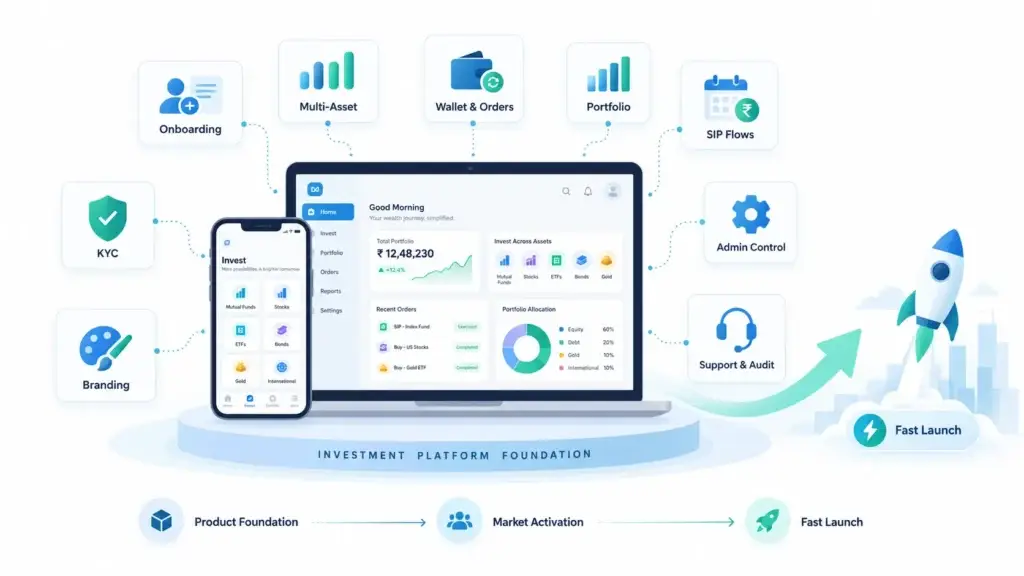
A go-to-market strategy is only useful when the product can support it.
If the app lacks verification flows, portfolio views, wallet logic, watchlists, investment journeys, admin controls, or audit visibility, the marketing team will struggle to convert users. Traffic may arrive, but activation will leak.
A ready-made investment platform foundation gives founders a faster starting point for:
- Investor onboarding
- Multi-asset discovery
- Wallet and order journeys
- Portfolio tracking
- Systematic investment flows
- Admin dashboard control
- User verification workflows
- Support and audit processes
- Branding and customization
- Faster launch planning
For founders comparing build options, Miracuves’ ready-made investment platform foundation can support a faster route from concept to launch while keeping the blog’s focus on GTM strategy rather than direct product-page keywords.
Founder Decision Signals: When GTM Should Start Before Development Ends
Many founders wait until the app is finished before thinking about go-to-market. That creates avoidable delay.
The GTM strategy should begin while the product is being configured.
Audience Clarity
If the platform serves beginners, active investors, and long-term planners, each group needs a different entry message. One generic campaign will not convert every investor type equally.
Activation Readiness
If users can sign up but cannot easily verify, fund, invest, and track progress, acquisition spend should be delayed until the activation path is stronger.
Trust Layer
If the platform handles financial data, users need clear explanations around verification, security, transactions, support, and responsible investing workflows.
Retention Loop
If the product does not encourage portfolio review, goals, alerts, and repeat investing, the business may depend too heavily on new user acquisition.
90-Day GTM Roadmap for a Multi-Asset Investment Platform
A practical launch roadmap should move in phases.
Days 1–30: Positioning, Education, and Pre-Launch Trust
The first month should focus on clarity.
Key actions:
- Define the first target investor segment
- Build landing page messaging
- Create educational SEO content
- Prepare onboarding emails
- Build pre-launch waitlist
- Create founder-led trust content
- Set up analytics for signup and activation
- Finalize verification and first-investment journeys
This is also the right stage to estimate the investment platform development cost, because GTM planning, feature scope, integrations, and launch priorities should be aligned before acquisition campaigns begin.
The goal is to create a warm audience before launch. Founders working with tight validation windows can also explore the ready-made app launch approach to understand how prebuilt foundations support faster deployment while still allowing branding, customization, and market-specific changes.
Days 31–60: Launch, Activation, and First Investment
The second phase should focus on moving users from signup to first meaningful action.
Key actions:
- Launch invite-based or targeted beta access
- Track signup-to-verification conversion
- Track verification-to-wallet funding
- Track wallet funding-to-first investment
- Improve drop-off screens
- Add lifecycle emails and in-app nudges
- Run small paid campaigns for validated segments
- Launch referral testing
The goal is not only user growth. The goal is activation quality.
Days 61–90: Retention, Repeat Investing, and Referral Loops
The third phase should focus on habit formation.
Key actions:
- Launch portfolio review nudges
- Promote recurring investment journeys
- Add goal-based investing campaigns
- Segment users by behavior
- Build education around asset categories
- Test premium features or subscription interest
- Improve customer support workflows
- Introduce referral rewards tied to meaningful activity
The goal is to turn first-time users into repeat investors.
Common GTM Mistakes Founders Should Avoid
Spending on installs before fixing activation
Paid installs can create vanity numbers, but they do not create a healthy investment platform if users fail to verify, fund, invest, or return.
Marketing every asset class at once
A multi-asset platform should not confuse beginners with too many choices. Start with clear investor journeys and widen messaging as users mature.
Ignoring trust signals
Users need clarity around verification, transactions, data protection, support, and platform control before they feel comfortable investing.
Treating repeat investing as an afterthought
The strongest platforms do not stop at first investment. They build dashboards, reminders, goals, alerts, and education that bring users back.
KPIs That Matter Beyond App Downloads
Downloads are easy to measure, but they do not tell the full story.
A multi-asset investment platform should track KPIs across the full investor journey.
| Funnel Stage | KPI to Track | What It Reveals |
|---|---|---|
| Awareness | Organic traffic, landing page visits, waitlist signups | Whether the market understands the positioning |
| Signup | Signup conversion rate | Whether the value proposition is strong enough |
| Verification | Verification completion rate | Whether trust and process clarity are working |
| Funding | Wallet funding rate | Whether users are moving toward real intent |
| First Investment | First order or first plan completion | Whether activation is successful |
| Repeat Investing | Second investment rate, recurring plan setup | Whether users are building habits |
| Retention | 30-day and 90-day active investors | Whether the platform remains useful |
| Referral | Invite rate and referred activation | Whether users trust the product enough to recommend it |
The founder’s goal is not only to acquire investors. It is to understand where investors lose confidence and improve those moments.
Final Thoughts: GTM Is the Bridge Between Product Readiness and Investor Trust
A multi-asset investment platform succeeds when product, trust, education, and activation work together.
The technology foundation matters, but the market strategy decides whether users understand the platform, complete onboarding, make their first investment, and return for future investing decisions.
The strongest go-to-market strategy starts with a clear investor segment, builds education before conversion, reduces onboarding friction, creates a confident first-investment journey, and designs retention loops around portfolio progress and goals.
For founders who want to launch faster, Miracuves can help with a white-label, source-code-owned investment app foundation that supports branding, admin control, investor workflows, and 6-day delivery for ready-made deployment. The smarter move is not only to build the platform. It is to launch with a GTM strategy that turns attention into trust and trust into repeat investing.
FAQs
What is a go-to-market strategy for a multi-asset investment platform?
A go-to-market strategy for a multi-asset investment platform is the plan for attracting investors, educating them, getting them to sign up, helping them complete verification, guiding them toward the first investment, and encouraging repeat investing through portfolio tracking, goals, alerts, and lifecycle communication.
What should founders focus on before launching an investment app?
Founders should focus on target investor segments, onboarding clarity, verification flow, wallet funding, first investment experience, portfolio dashboard quality, admin control, support workflows, and trust messaging. These layers directly affect whether acquisition traffic converts into active investors.
How do investment platforms acquire first-time investors?
First-time investors are usually acquired through education-led content, beginner-friendly onboarding, clear risk explanations, simple goal-based journeys, referral programs, and trust-building communication. The messaging should reduce fear and confusion rather than push users into fast action.
What is investor activation in a wealthtech app?
Investor activation happens when a user completes meaningful steps such as verification, wallet funding, watchlist creation, goal setup, first investment, or recurring plan creation. Signup alone is not enough to measure real activation.
How can a multi-asset investing app increase repeat investing?
Repeat investing can improve through portfolio visibility, goal-based investing, useful alerts, recurring investment flows, educational content, lifecycle emails, watchlist updates, and transparent performance tracking. The app should help users understand progress and return naturally.
Why is trust important in investment app marketing?
Trust is critical because users are sharing personal data and making financial decisions. Clear verification workflows, secure access, transparent order journeys, support systems, audit logs, and responsible communication help users feel more confident using the platform.
Should founders build a custom platform or start with a ready-made foundation?
The answer depends on scope, budget, timeline, regulatory needs, and customization requirements. A ready-made foundation can help founders launch faster and validate demand earlier, while custom development may be better for highly unique workflows or complex institutional requirements.
How can Miracuves help with investment platform launch planning?
Miracuves helps founders create ready-made and white-label investment app foundations with source-code ownership, branding flexibility, admin control, and 6-day delivery for ready-made deployment. This allows founders to focus more on market strategy, activation, and growth rather than starting every product module from zero.
Miracuves is an independent software development company. We are not affiliated with, connected to, sponsored by, or endorsed by any company or product named in this article.
Terms such as “X Clone” are used descriptively. It is how the software industry refers to building a platform with functionality comparable to a known service, and how clients search for it.
The entire design and codebase of our products is built by our own team. Our products contain no code, design, graphics, or content originating from any third-party website or applications.
All third-party names and marks referenced in this article are the property of their respective owners, referenced solely to identify the services discussed.