
Key Takeaways
- B2B buyers evaluate application software by architecture strength, security controls, scalability, and operational reliability.
- Enterprise-ready software needs clear workflows for users, admins, data, integrations, payments, reports, and support teams.
- Decoupled databases, secure APIs, role-based access, audit logs, and modular systems are core buyer expectations.
- Procurement risk depends on data handling, compliance readiness, uptime, integration quality, and vendor ownership terms.
- A production-grade software foundation helps founders pass buyer reviews and reduce friction during enterprise sales.
Buyer Signals
- Corporate buyers need proof of secure authentication, permission controls, database structure, API safety, and audit visibility.
- Admins need control over users, roles, approvals, reports, logs, integrations, configurations, and operational settings.
- Developers need modular code, documented APIs, scalable databases, deployment notes, testing workflows, and version control.
- Enterprise systems should support clean separation between frontend, backend, database, business logic, and security layers.
- Procurement teams look for software that is maintainable, customizable, compliant, secure, and ready for long-term operations.
Real Insights
- B2B buyers do not judge application software only by features; they inspect the system behind the interface.
- Weak architecture can create procurement delays when buyers ask about access control, audits, backups, and integration security.
- Modular application software helps businesses customize workflows without rebuilding the entire product from scratch.
- Founders should prepare architecture, ownership, compliance, and support evidence before selling to institutional buyers.
- Miracuves builds enterprise-ready application software with modular architecture, secure APIs, role-based access, audit logs, scalable workflows, and admin control.
Most articles about the types of application software stop at a simple list: word processors, spreadsheets, browsers, media tools, database software, enterprise systems, and communication apps. That works for students or casual readers, but it does not help a procurement team decide whether a platform is safe to buy, integrate, scale, and govern.
For B2B buyers, application software is not just a tool employees open on a screen. It becomes part of the company’s operating structure. It may control payments, approvals, customer records, vendor workflows, internal reporting, partner access, transaction histories, or confidential business data.
That is why corporate procurement teams, mid-market enterprise buyers, and scaling B2B founders need a different way to evaluate application software. The real question is not only “What category does this software belong to?” The stronger question is: Can this software support secure roles, scalable databases, resilient APIs, audit logs, integrations, and operational control?
Miracuves helps founders and businesses build ready-made, white-label, and custom application software foundations that can be adapted for real business workflows, admin control, branded deployment, and source-code ownership.Miracuves helps founders and businesses build ready-made, white-label, and custom application software foundations through its enterprise software development company capabilities, adapting products for real business workflows, admin control, branded deployment, and source-code ownership.
Inside the B2B Stack: What Corporate Procurement Teams Look For
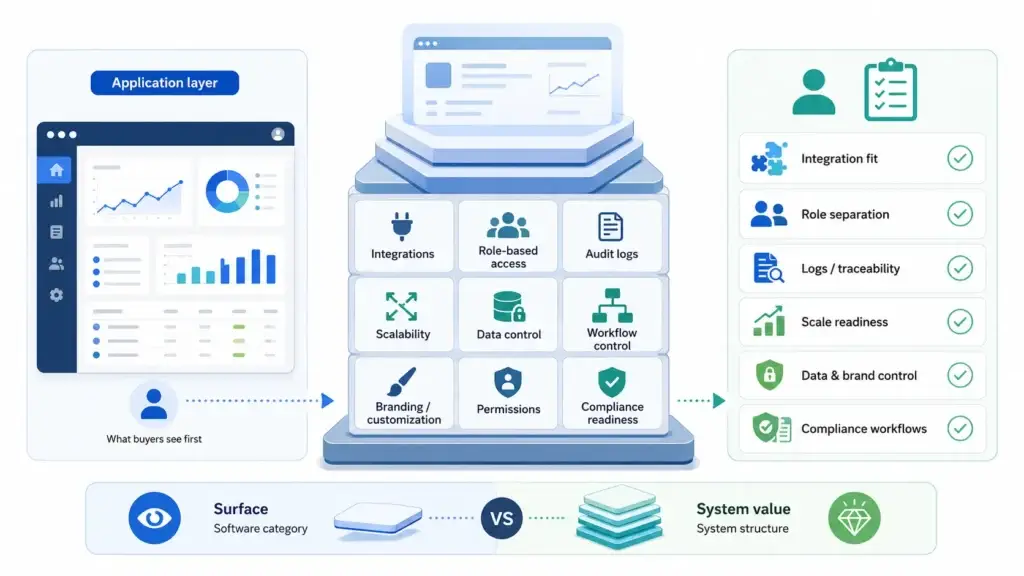
A corporate buyer rarely evaluates application software as a standalone product. They evaluate it as part of a larger business stack.
Procurement teams usually ask practical questions before approving a software purchase:
Can this system integrate with existing tools?
Can access be separated by role, department, vendor, or partner?
Can the platform produce logs when something goes wrong?
Can it scale if usage grows?
Can the company control data, branding, workflows, and permissions?
Can the software support compliance workflows without forcing a complete rebuild later?
This is where commodity software lists become weak. A spreadsheet tool and an enterprise procurement platform may both be application software, but they do not carry the same operational risk. One helps users complete office tasks. The other may control approvals, spending, vendor records, invoices, payment stages, user permissions, and executive reporting.
For B2B buyers, the application category is only the surface. The deeper value comes from the system structure underneath.
Read More: Beyond the Code: The DevOps Guide to Launching Production Architecture
The 7 Types of Application Software B2B Buyers Demand
Below are the seven types of application software that matter most in enterprise and mid-market buying decisions. These are not just generic app categories. They represent the software layers companies depend on to operate, sell, manage, analyze, communicate, and scale.
1. Workflow and Operations Application Software
For companies comparing software ownership, subscription delivery, and scalability, Miracuves’ guide on SaaS applications for growing businesses can support the broader build-versus-buy decision.Workflow and operations software helps companies manage internal processes, approvals, scheduling, task routing, service delivery, and operational visibility.
Examples include:
- Internal approval systems
- Field service platforms
- Operations dashboards
- Task routing software
- Inventory and fulfilment tools
- Vendor or provider management systems
For a procurement lead, the main concern is not whether the interface looks modern. The real concern is whether the system can enforce process discipline. A workflow app should know who can approve, who can edit, who can view, who can escalate, and who can override a process.
Strong workflow software usually includes role-based access, status tracking, activity logs, notifications, admin controls, and reporting. Without these layers, the business may end up with a digital tool that still depends on manual follow-ups, spreadsheet exports, and unsupported workarounds.
2. Customer and Sales Application Software
Customer-facing software helps businesses acquire, manage, retain, and support customers. This includes CRM platforms, lead management systems, sales dashboards, customer portals, booking systems, and service request platforms.
For B2B buyers, customer software must do more than store names and emails. It should connect customer actions to business decisions.
A strong customer platform should support:
- Lead capture and qualification
- Customer profiles
- Sales pipeline visibility
- Follow-up automation
- Communication history
- Role-based sales access
- Reporting for managers
- Integration with email, payments, analytics, or support tools
The risk of weak customer software is fragmented data. When sales, support, marketing, and operations all keep separate records, leadership loses a reliable view of the customer lifecycle.
For businesses building customer-facing platforms, custom app development becomes valuable when standard tools cannot support unique workflows, industry-specific logic, or proprietary customer journeys.
3. Marketplace and Transaction Application Software
Marketplace software connects multiple sides of a business ecosystem. This may include buyers and sellers, customers and service providers, restaurants and delivery partners, hosts and guests, drivers and riders, or creators and subscribers.
Marketplace platforms are more complex than single-user software because they must coordinate different user roles and transaction flows.
A production-grade marketplace application usually needs:
- User onboarding
- Provider, vendor, or partner dashboards
- Listings or service catalogues
- Booking or order flows
- Payment gateway integration
- Commissions and fees
- Reviews and ratings
- Dispute management
- Admin approval controls
- Fraud and abuse reporting
For procurement teams, marketplace software carries higher operational risk because every transaction involves trust. The platform must protect users, records, payments, and platform rules. If role permissions, payment flows, or dispute workflows are weak, the business may face operational leakage as it scales.
A ready-made app solution from Miracuves can help founders start from a proven application foundation instead of building every user panel, payment flow, and admin function from zero.
4. Finance, Billing, and Transaction Security Software
Finance-related application software includes billing systems, wallet platforms, subscription systems, remittance tools, invoicing systems, payment orchestration layers, accounting workflows, and financial dashboards.
This category demands stricter review because money movement creates risk. Even if the application is not a bank, it may still process sensitive customer data, payment events, refunds, wallet balances, ledger entries, or reconciliation workflows.
B2B buyers usually look for:
- Secure payment gateway integration
- Transaction history
- Admin approval flows
- Refund and dispute workflows
- Activity logs
- User verification support
- Role-based financial controls
- Reporting and reconciliation
- Fraud monitoring signals
Financial application software should be described carefully. A platform can support compliance workflows, KYC workflows, audit trails, and secure transaction handling, but final compliance depends on jurisdiction, legal review, selected integrations, payment partners, and the operating model.
The strongest finance software is not only attractive on the front end. It protects transaction logic on the back end.
5. Analytics, Reporting, and Business Intelligence Software
Analytics software turns operational data into decisions. This includes dashboards, business intelligence tools, reporting engines, KPI trackers, forecasting tools, and performance monitoring systems.
For enterprise buyers, analytics software is valuable when it answers real business questions:
Which workflow is slowing down revenue?
Which customer segment is converting?
Which vendors are underperforming?
Which locations are creating delivery delays?
Which product lines need attention?
Which users are creating risk?
A weak analytics system only displays charts. A strong analytics platform connects metrics to action. It should collect clean data, define permissions, show role-specific dashboards, and allow leadership to monitor performance without depending on manual reporting.
For dashboard-heavy products, portals, and reporting systems, a web app development company can help structure admin panels, customer portals, and analytics layers around real business workflows.
6. Communication and Collaboration Application Software
Communication software includes messaging platforms, video call systems, team collaboration tools, customer support chat, notification systems, and internal communication portals.
This category looks simple from the outside, but corporate buyers evaluate it through security and continuity.
Business communication software may need:
- User authentication
- Role-based conversations
- File-sharing controls
- Notification preferences
- Message history
- Moderation or admin review
- Secure media handling
- Integration with CRM or support systems
- Audit visibility for sensitive workflows
For B2B applications, communication is often part of a larger product rather than a separate tool. A delivery platform needs customer-driver messaging. A healthcare app needs secure patient-provider communication. A marketplace needs buyer-seller conversations. A fintech app may need support chat connected to transaction records.
This is why communication software should be designed as a controlled business workflow, not just a chat box.
7. Custom and White-Label Application Software
Custom and white-label application software is built or configured around a specific business model. This category matters when standard software cannot support the company’s workflow, branding, roles, monetization model, or integration requirements.
Custom software is useful when the company needs unique logic. White-label software is useful when the company wants a launch-ready foundation that can be branded, configured, and extended faster.
The procurement question is not “custom or white-label?” The better question is:
Does the business need a completely unique system, or does it need a proven foundation customized around its market?
A white-label software foundation can reduce avoidable development effort when the core flows already exist. A custom build is stronger when the workflow, data model, or product experience is proprietary.
Miracuves supports both paths through full stack app development, software development services, and ready-made app solutions with source-code ownership.
The Seven Core Architecture Pillars Behind Procurement-Ready Software
The seven types of application software above are only useful if the underlying structure is resilient. Enterprise buyers increasingly evaluate the architecture baseline before approving software for serious use.
Enterprise Structural Baseline: 7 Architecture Pillars
| Architecture Pillar | What It Means | Why B2B Buyers Care |
|---|---|---|
| Decoupled Database Scaling | Data layers are structured so growth, reporting, and transactions do not overload the application. | Helps the platform handle more users, records, and transactions without constant rebuilding. |
| Secure RESTful API Layer | Application functions communicate through structured, authenticated, permission-aware APIs. | Supports integrations, mobile apps, dashboards, partner systems, and controlled access. |
| Role-Based Access Control | Users see and perform actions based on defined roles such as admin, manager, vendor, provider, agent, or customer. | Reduces permission risk and supports internal governance. |
| Transaction Security | Payments, wallet events, refunds, bookings, or orders are protected through secure flows and traceable records. | Protects revenue, trust, and operational accountability. |
| Automated Audit Logs | The system records important actions, changes, access events, and operational events. | Helps teams investigate issues, support audits, and monitor unusual activity. |
| Admin Control Layer | Platform operators can manage users, content, workflows, fees, settings, reports, and disputes. | Allows business teams to operate without depending on developers for every small change. |
| Modular Extension Readiness | The software can add integrations, modules, user panels, or features without disrupting the full system. | Protects long-term scalability and reduces future rebuild risk. |
Why Decoupled Databases Matter in B2B Application Software
A small application can often survive with a simple database structure. Enterprise-grade application software cannot.
When workflows, users, transactions, analytics, and integrations grow together, the database becomes one of the biggest performance risks. If every feature depends on the same tightly coupled data structure, the system becomes harder to scale, harder to debug, and harder to modify.
Decoupled database thinking helps separate operational data, reporting needs, transaction records, and high-volume activity where appropriate. This does not always mean using many databases from day one. It means designing the data layer so the system has room to grow.
For procurement teams, this matters because database architecture affects:
- Reporting speed
- Data integrity
- Backup strategy
- Transaction reliability
- Future integrations
- Performance during growth
- Cost of future changes
A buyer does not need to inspect every schema table. But they should ask whether the vendor has designed the application for scale, reporting, and operational change.
Read More: Cursor vs. Hiring a Dev Agency: The Honest Capital Comparison for Startups
Why Secure RESTful Layers Matter for Integrations
Modern application software rarely works alone. It connects with payment gateways, CRM tools, analytics platforms, mobile apps, admin dashboards, logistics systems, authentication providers, and third-party services.
That connection layer is usually handled through APIs.
A secure RESTful API layer helps business functions communicate in a structured way. But APIs also create risk if authentication, authorization, rate controls, data exposure, and endpoint inventory are not handled properly.
This is why API security should be part of the procurement conversation. A platform may look stable in a demo, but if its API layer is weak, the business may face serious issues when integrations expand.
Procurement teams should ask:
Are APIs authenticated?
Are permissions enforced at object and function levels?
Are sensitive flows protected from abuse?
Is API documentation maintained?
Are third-party integrations reviewed?
Are logs available for important API events?
For complex builds, API development and microservices app development may be relevant when the application needs secure integrations, distributed modules, independent scaling, or service-level separation.
Why Role-Based Access Control Is a Procurement Requirement
Role-based access control is one of the clearest differences between casual software and enterprise-ready software.
In a B2B system, not every user should see the same data or perform the same actions. A finance manager, support agent, platform admin, vendor, operations lead, delivery partner, and customer all need different access levels.
Weak access control creates avoidable risk. A user may see sensitive data, edit a restricted field, approve a transaction, export records, or modify settings they should not control.
A procurement-ready application should support role logic such as:
- Super admin access
- Department-level access
- Manager approvals
- Vendor or provider dashboards
- Customer-only views
- Support team permissions
- Finance-only controls
- Restricted reporting access
This is not only a security feature. It is an operational governance feature.
Read More: The Maintenance Trap: Benchmarking the Long-Term Cost of Custom Code
Automated Audit Logs: The Control Layer Buyers Often Miss
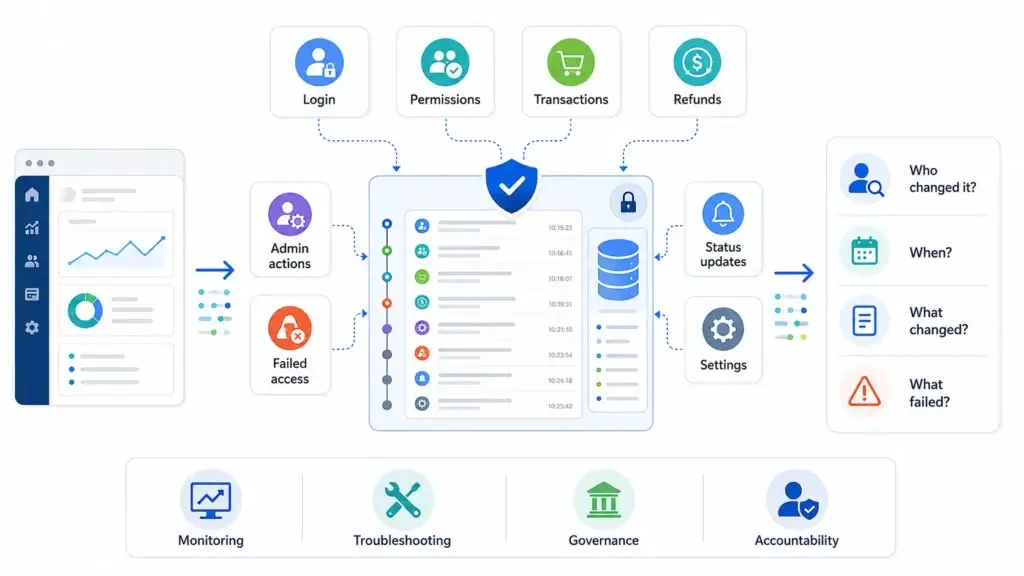
Audit logs are not exciting during a sales demo, but they become essential when something goes wrong.
A production-grade application should record important activity, such as logins, permission changes, transaction updates, failed access attempts, admin actions, refund decisions, listing changes, status updates, and configuration edits.
Without audit logs, the business may struggle to answer basic questions:
Who changed this setting?
When was this transaction updated?
Which admin approved this refund?
Which user attempted restricted access?
What happened before the workflow failed?
Automated audit logs support monitoring, troubleshooting, governance, and accountability. They do not guarantee compliance on their own, but they provide an important foundation for compliance-supporting operations.
Founder Decision Signals
Speed
If the business model is already proven, a white-label foundation can reduce time spent rebuilding standard flows.
Control
If the platform requires user roles, admin dashboards, reporting, and transaction management, control layers should be evaluated early.
Scalability
If the app may expand across locations, teams, vendors, or partners, database and API architecture should be reviewed before launch.
Audit Readiness
If corporate buyers, investors, or partners will review the system, logs, permissions, and secure workflows become procurement assets.
Why Modular White-Label Engines Meet Institutional Reviews Faster
A modular white-label engine gives businesses a ready-made application foundation that can be branded, configured, and extended around a specific market. This approach is especially useful when the core product pattern is already known.
For example, many marketplaces need user onboarding, listings, payments, reviews, notifications, admin control, and reporting. Many delivery platforms need customer, merchant, delivery partner, and admin workflows. Many fintech platform need verification flows, wallet logic, transaction records, and risk controls.
For a deeper look at how prepared foundations reduce launch risk, read Miracuves’ guide to the rapid app development process.
However, buyers should avoid the assumption that every white-label product is enterprise-ready. A serious white-label platform should still be reviewed for:
- Source-code ownership
- Database structure
- API security
- Role-based access
- Admin controls
- Audit logs
- Payment integration security
- Customization flexibility
- Documentation
- Post-launch support
Miracuves’ white-label app approach is designed for founders and businesses that want a faster path to launch without losing control over branding, workflows, admin operations, and future customization..
Read More: Can AI Build a Multi-Vendor Marketplace? The Real-Time Logistics Blueprint
Mistakes B2B Buyers Should Avoid When Evaluating Application Software
Choosing by interface instead of architecture
A clean interface does not prove that the application has secure APIs, scalable databases, audit logs, or role-based access control.
Ignoring admin control
If every operational change requires developer support, the business may struggle to manage users, pricing, approvals, content, disputes, or reporting after launch.
Treating compliance as a checkbox
Software can support compliance workflows, but final compliance depends on legal review, jurisdiction, integrations, policies, and operating model.
Buying software without source-code clarity
For serious B2B platforms, source-code ownership and IP clarity affect future customization, vendor independence, and long-term product control.
Application Software Procurement Checklist for B2B Buyers
Before approving a software purchase or development project, procurement teams should review the system through a practical checklist.
| Procurement Area | Buyer Question | Strong Signal |
|---|---|---|
| Architecture | Can the platform scale without a complete rebuild? | Modular backend, structured database, clean APIs |
| Security | Are access and sensitive workflows protected? | RBAC, authentication, transaction controls |
| Operations | Can business teams manage daily workflows? | Admin dashboard, settings, approvals, reporting |
| Auditability | Can important actions be traced? | Automated logs and activity history |
| Integrations | Can the platform connect with other tools? | Secure API layer and integration documentation |
| Ownership | Can the business customize later? | Source-code ownership and IP clarity |
| Support | Can issues be handled after launch? | Maintenance, documentation, and post-launch support |
This checklist helps buyers move beyond surface-level feature comparisons. It also helps founders prepare for investor, partner, or corporate buyer scrutiny.
Final Thoughts: The Best Application Software Is Built for Control, Not Just Usage
The seven types of application software are not just categories on a list. For B2B buyers, they represent different levels of operational risk, business dependency, and architecture responsibility.
A simple productivity tool may only need ease of use. A marketplace, fintech platform, workflow engine, or customer portal needs much more. It needs secure roles, reliable transactions, scalable databases, clear APIs, admin control, and audit visibility.
The strongest application software decision is not always the most custom build or the fastest template. It is the structure that gives the business enough speed to launch, enough control to operate, and enough flexibility to scale.
For founders and procurement teams evaluating their next software investment, Miracuves can help map whether a ready-made white-label foundation, custom application, or full-stack build is the right path. To discuss your application software requirements, contact Miracuves experts and review the fastest route from idea to launch-ready product.
FAQs
What are the 7 types of application software?
The seven types of application software for B2B buyers are workflow and operations software, customer and sales software, marketplace software, finance and billing software, analytics and reporting software, communication software, and custom or white-label application software.
How are enterprise application software types different from normal software types?
Normal software categories usually describe what users do, such as writing, browsing, editing, or communicating. Enterprise application software is evaluated by how well it supports business workflows, security, integrations, user roles, reporting, and scale.
Why do B2B buyers care about application software architecture?
B2B buyers care about architecture because it affects performance, security, integrations, future customization, audit visibility, and operational continuity. Poor architecture can create hidden costs after launch.
What is the role of RBAC in application software?
Role-based access control helps define what each user type can see and do inside the application. This is important for platforms with admins, managers, vendors, customers, support teams, finance users, or external partners.
Are audit logs required in all application software?
Not every simple tool needs detailed audit logs, but serious B2B platforms benefit from them. Audit logs help track important actions, investigate issues, monitor access, and support governance workflows.
Is white-label application software suitable for enterprise buyers?
White-label software can be suitable when the foundation is modular, secure, customizable, source-code-owned, and aligned with the buyer’s workflow. Buyers should still review architecture, access control, integrations, audit logs, and support terms.
Does application software guarantee compliance?
No. Application software can support compliance workflows through secure access, audit logs, verification flows, data controls, and reporting. Final compliance depends on legal review, jurisdiction, operating model, policies, and third-party integrations.
When should a company choose custom application software?
A company should consider custom software when its workflows, data model, integrations, or user experience are too specific for standard tools. Custom development is useful when software becomes a competitive advantage rather than a basic operational utility.
Miracuves is an independent software development company. We are not affiliated with, connected to, sponsored by, or endorsed by any company or product named in this article.
Terms such as “X Clone” are used descriptively. It is how the software industry refers to building a platform with functionality comparable to a known service, and how clients search for it.
The entire design and codebase of our products is built by our own team. Our products contain no code, design, graphics, or content originating from any third-party website or applications.
All third-party names and marks referenced in this article are the property of their respective owners, referenced solely to identify the services discussed.