
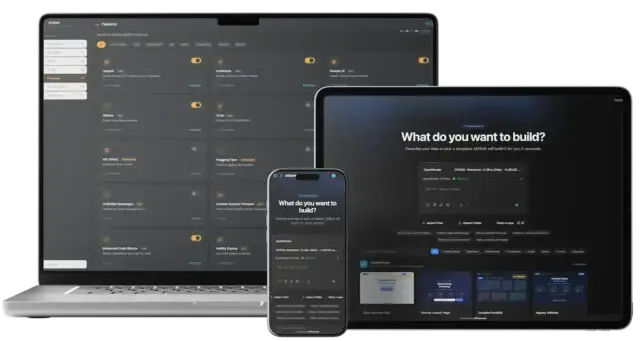
White Label Real Estate Crowdfunding Platform Features: Ledger First
Anyone can publish a page of buildings with a funding bar. What an operator is judged on comes later: whether the cap table is right, whether a payout run matches the bank, and whether a repeated payment callback can create a second holding. This platform starts from those questions, with an SPV for every property, a register that only ever appends and double-entry books kept in whole minor units, then puts the investor, operator and partner screens on top. You buy it once and keep the source.
Request a Live Demo →Full OverviewFeature Set by Role
Investors, your own staff and your property partners all read and write one data model. Each card below matches a ready login on the seeded demo, so you can check it rather than take our word.
The Investor
Lines up as many as four properties side by side, models returns in the calculator and reads valuation history and due-diligence files. After KYC, a risk questionnaire and a signed subscription agreement, they buy shares in a named building, keep the certificate in their portfolio, receive payouts into a wallet that holds several currencies and can list holdings for resale. Available on the web and in an Expo app for iOS and Android.
The Operator
Moves between about thirty workspaces grouped under Overview, Investors, Properties, Finance, Compliance and Platform. That covers the deal pipeline, underwriting in bear, base and bull cases, committee decisions stored as their own evidence, tenancies and the rent roll, logged expenses, maintenance tickets passing through nine states, marketplace moderation and the scheduling of exit windows.
The Finance Desk
If you open one console, make it this one. Every payout batch breaks into gross, tax, fee and net per line, withdrawals wait in a queue until a second person clears them, and fee schedules accrue against what investors hold. Revenue invoices, imported processor costs and the balanced postings beneath all of them are visible from the same place.
The Compliance Officer
Works KYC as cases that carry provider evidence, approves or rejects them, and opens reverification as a new case. Accreditation runs on its own track with expiry dates and history, investor classes span retail, accredited, professional and institutional, and audit search filters by resource, action, actor and time window beside a 360 view of each investor.
The Developer Partner
Your source of deals. A developer applies, is given a developer record, drafts properties into your pipeline and follows each one through pre-listing, almost funded and active. Every deal card shows target and committed capital, the number of investors in, the yield and where due diligence stands.
The Owner
Holds the switches the business runs on while it is live: maintenance mode, registration gates, MFA policy, session length, rate limits, investment limits, marketplace rules and feature flags. Fee schedules, country profiles, investor tiers and the approval thresholds that maker-checker applies are set here as well, with no developer in the loop.
The permissions package describes thirty catalog roles by resource, action and scope, and navigation is filtered by permission. Enforcing those roles on every route, mapped to your real org chart, is finished during delivery, so the base build makes no least-privilege claim of its own.
Rented Platform vs One-Time Script vs Miracuves Platform
Most white label crowdfunding software is rented by the month or sold as a script. The routes part ways at the cap table and the payout run, far more than on a listing page.
| What decides it | Miracuves platform | Rented or hosted platform | One-time script |
|---|---|---|---|
| Who holds the source | You, handed over in full | Nobody on your side, access is rented | Usually code under a restricted license |
| How you pay | $6,099 once, no monthly platform fee | A setup fee, then a subscription for as long as you trade | A license fee, usually without deployment |
| Where investor records sit | Your server, your PostgreSQL database | On the vendor's servers | Wherever you manage to install it |
| What an investor holds | Shares in a named property inside its own SPV, with a share class | Often a campaign-style pledge | Usually a pledge amount on a campaign |
| How ownership is recorded | Appended to a register, never overwritten | Decided by the vendor | Often a row edited in place |
| How money is kept | Whole minor units, balanced postings, derived balances | Decided by the vendor | Often one balance field on the wallet |
| A payment callback that fires twice | Idempotency keys block a second allocation | Depends on the vendor | Often a duplicate allocation to unwind by hand |
| Rental payouts | Batches in gross, tax, fee and net lines, cleared by two approvers | Limited to what the plan includes | Frequently a spreadsheet plus a bulk transfer |
| A holder who wants out | Secondary market, exit windows, whole-property sale votes | Varies by plan | Usually stuck until the asset is sold |
| Back office | Roughly thirty operator workspaces | Often an investor portal first | Rarely more than an investor portal |
| When payments to the vendor stop | Nothing changes, the platform is yours | Access usually ends | The code keeps running within its license terms |
A subscription often bundles hosting and support that you arrange yourself here, so compare a one-time software cost against a recurring fee rather than a total. A custom agency build also ends in ownership, typically after 6-9+ months spent writing a ledger, a register, a compliance desk and a secondary market. The cost comparison sits on the Development Cost page.
Deal Submission to Investor Exit, Step by Step
Six stages, and at each one the software enforces the order of events instead of trusting a status field that someone edits by hand.
Sourcing deals
When a property partner applies, a developer relationship is created and the partner can draft a property into your pipeline. Ownership and draft-state checks on the partner routes keep every partner inside their own deals and away from anyone else's.
Underwriting and committee
A property cannot go live on someone's say-so. Assumptions are saved against it and turned into bear, base and bull outputs, and the investment committee's decision is logged as separate evidence before the status moves from draft to approved.
Onboarding investors
A single transaction creates the user, the investor profile, the wallet and the ledger account. The KYC case goes to your provider, accreditation and the risk questionnaire settle suitability, and the investor class, from retail up to institutional, controls which offerings that person may buy.
Subscribing and funding
Placing an order records intent and creates no ownership. Shares are picked within minimums and availability, the signed subscription agreement is kept as evidence, and the order carries an idempotency key while it waits as payment-pending. Only a verified settlement callback confirms it, allocates the shares and appends the holding.
Holding and paying out
Certificates come from durable records. Tenancies, rent receipts and expenses are logged, a batch rolls them into gross, tax, fee and net lines, and it clears compliance review and then finance approval before executing as balanced ledger postings, with statements and investor alerts attached.
Getting out
Holders have three governed exits: list on the secondary market, where negotiated offers end in an atomic transfer; request redemption in an exit window you schedule, subject to holding-period and eligibility checks; or vote, weighted by shares, on a proposal to sell the whole property. None of the three promises redemption.
Every stage writes into the same 77-model domain. An investor 360 view, a payout statement and an audit search therefore read one set of facts instead of three separate systems that somebody has to reconcile afterwards.
Eight Features That Keep the Numbers Right
Put each row to any vendor on your shortlist. Every one of them is costly to bolt on after investors are already on the register.
| Feature | Why it matters once real investors hold shares |
|---|---|
| Per-property SPVs and share classes | Backing a named building is a different product from a blind pool. The vehicle has to exist in the data model first, or it can never appear on a certificate or stand up to a regulator's question. |
| Append-only ownership register | Because holdings are added and never overwritten, a beneficial-owner request is answered from one record rather than rebuilt from spreadsheets, email and memory. |
| Double-entry ledger in minor units | Integer amounts cannot drift the way floating-point values do, every posting balances and balances are derived, so a wallet always agrees with its own history and reconciling it is a query. |
| Idempotency keys on external-input writes | Processors retry callbacks and investors press submit twice. Without a key on each of those writes, one repeat will sooner or later issue the same ownership two times. |
| Maker-checker on money movements | A withdrawal needs a different approver, and a payout batch clears compliance and then finance before anyone executes it. The control shields the operator from staff error and staff misuse alike. |
| Investment memo before a secondary trade | Buyers see the premium or discount to the latest NAV, the yield, occupancy, capital structure and valuation history before paying, which turns a noticeboard into an informed market. |
| Exit windows and sale voting | A young secondary market has few active buyers. Scheduled windows with eligibility checks, and share-weighted votes on a full sale, give holders a governed route out that does not hinge on a buyer appearing. |
| Audit log of actor, action, resource and time | Diligence requests and disputes are settled from one place, so asking who edited a fee schedule becomes a search instead of an internal inquiry. |
All eight are part of the base build and visible in the demo. Open the finance console, walk a payout batch line by line, then follow its postings into the ledger.
The Technology Behind the Features
TypeScript from end to end, with specialist engineering only in the places investment operations call for it.
The schema moves to any PostgreSQL instance and every layer is a mainstream skill to hire for. That matters more here than in most categories, because you will run this system for as long as investors hold shares on it.
What Is Not Included in the Base Package
The platform handles other people's money, so its gaps are written down here instead of surfacing in your security review. Permission to operate heads the list.
Your license and legal structure
Owning and deploying the software is lawful; operating it is regulated in most markets, and securities, crowdfunding and collective investment rules differ by country. You obtain the license, registration or exemption, set up the legal structure of each property and arrange custody or trustee cover. The platform does not hold investor funds and is not certified by any regulator. We supply software, not permission to operate.
Hardening happens during delivery
The build as audited is not production-ready, and we say so plainly. Gating of admin routes, webhook signature checks native to each provider, route-level enforcement of the thirty catalog roles and managed secrets are finished against your environment as scoped work, before any real investor money moves.
Live payment rails are scoped work
Out of the box, deposits run in sandbox mode. Wiring Stripe, Razorpay or NOWPayments on your own merchant accounts, with settlement, reconciliation, refunds and disputes, belongs to the deployment engagement. It is not a switch that is already turned on.
Sanctions and PEP screening is not running
A screening data model is present, but nothing screens anyone at runtime. Connecting a screening vendor and writing your escalation policy has to happen before regulated operation, and that work is quoted as an add-on.
Mobile KYC capture is simulated
The app covers the investor path, yet document capture inside it is simulated. Native capture is a hardening add-on, delivered together with a consistent refresh path, runtime payload validation and a review of secure storage.
One operator brand per deployment
No tenant isolation or branding editor exists today, so an installation serves a single brand, which is yours. Running several brands from one deployment is architecture work scoped separately, not a setting to flip.
What is built can be checked in the demo: SPVs and share classes, the append-only register, the double-entry ledger, idempotent orders, payout batches through two approvers, the secondary market with its investment memo, exit windows, sale voting, and ten technical documents including a security handbook and a VAPT review aligned with the OWASP top ten. Fully custom scope beyond this list lives under real estate app development.
Deciding who should supply the platform?
The questions worth putting to any provider in this category, how delivery runs, the warning signs, and a modelled multi-jurisdiction operator, all gathered on the Provider page.
Frequently Asked Questions
What features does a white label real estate crowdfunding platform need?
What do I own, and what stays my responsibility?
What does the double-entry ledger give an operator?
How does resale on the secondary market work?
What if an investor wants to sell and nobody is buying?
Which markets, currencies and languages does it cover?
Follow one property from subscription to ledger
Sign in as an investor and open a funded holding, then switch to the operator and finance consoles to trace the same money through a payout batch and the balanced postings underneath it. The demo data is seeded and read-only.
Explore the White Label Real Estate Crowdfunding Platform
Own the register, the ledger and the console.
The platform underneath the real estate crowdfunding clones: an SPV for every property, a register that only appends, balanced postings in minor units, two approvers on every money path and a secondary market, on your brand with the source in your hands.
Talk to Us →Miracuves is an independent software development company. We are not affiliated with, connected to, sponsored by, or endorsed by Fundrise, GetStake or any other real estate investment platform.
“White label real estate crowdfunding platform” describes a category of product, not any one company. Brand names appear elsewhere on this site only to describe the kind of platform being built and the terms buyers search for.
We supply software, not permission to operate. Obtaining any license, registration or exemption needed to offer investments in every market you accept investors from is your responsibility, as are investor eligibility checks, offering documents, custody of investor funds and the legal structure of each property. We do not advise on any of it.
The entire design and codebase is built by our own team. The product contains no code, design, graphics, or content originating from any third-party real estate investment website or application. All third-party names and marks belong to their respective owners.
